Japan Species Recognition AI Market Size & Growth Rate
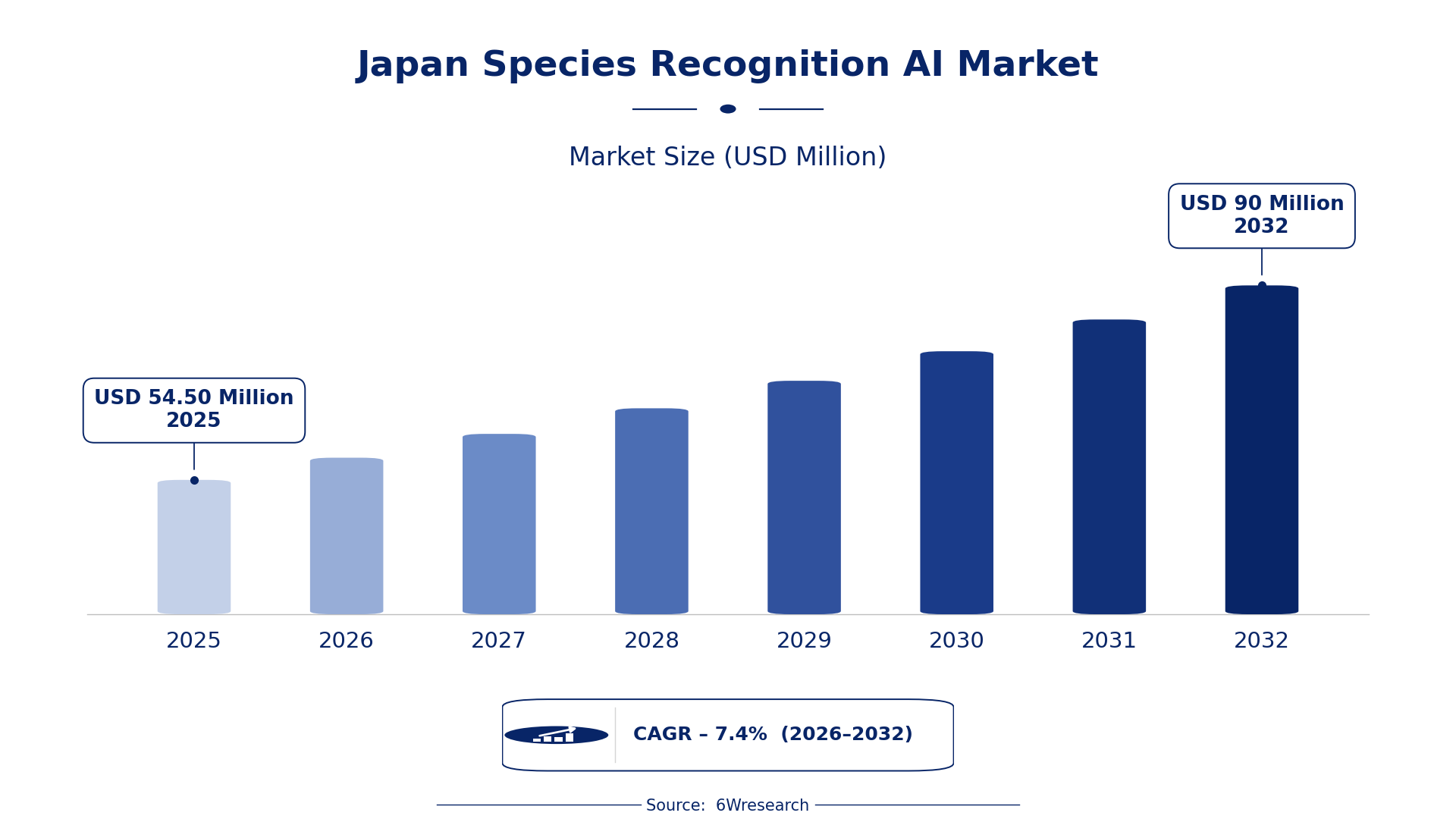
According to 6Wresearch internal database and industry insights, the Japan Species Recognition AI Market was valued at USD 54.50 Million in 2025 and is projected to reach USD 90 Million by 2032, growing at a CAGR of approximately 7.4% during 2026–2032.
Japan Species Recognition AI Market Highlights
| Report Metric | Details |
| Report Name | Japan Species Recognition AI Market (2026-2032) |
| Market Size 2025 | USD 54.50 Million |
| Market Size 2032 | USD 90 Million |
| Absolute Growth 2025–2032 | USD 35.50 Million |
| CAGR 2026–2032 | 7.4% |
| Peak Annual Growth | 8.7% in 2031 |
| Forecast Period | 2026–2032 |
| Historical Data | 2022–2025 |
| Base Year | 2025 |
| Leading AI Model Type, 2025 | Image-Based AI (36% share) |
| Leading Detection Category, 2025 | Wildlife Identification (44% share) |
| Leading Deployment Platform, 2025 | Mobile/Edge Devices (45% share) |
| Leading End User, 2025 | Conservation Agencies (52% share) |
| Fastest-Growing AI Model Type | Audio Recognition AI (11.2% CAGR) |
| Fastest-Growing Detection Category | Bird/Marine Species (10.0% CAGR) |
| Fastest-Growing Deployment Platform | Sensor-Enabled Devices (10.7% CAGR) |
| Fastest-Growing End User | Ecological Researchers (9.7% CAGR) |
| Growing Sector | Conservation and Biodiversity Monitoring |
| Key End Users | Conservation Agencies, Ecological Researchers, Environmental Agencies |
Japan Species Recognition AI Market Year-wise Growth Rate and Key Drivers (2022–2032)
This graph illustrates the annual growth rates of the market from 2022 to 2032, highlighting a steady upward trajectory and projected market expansion over the forecast period.
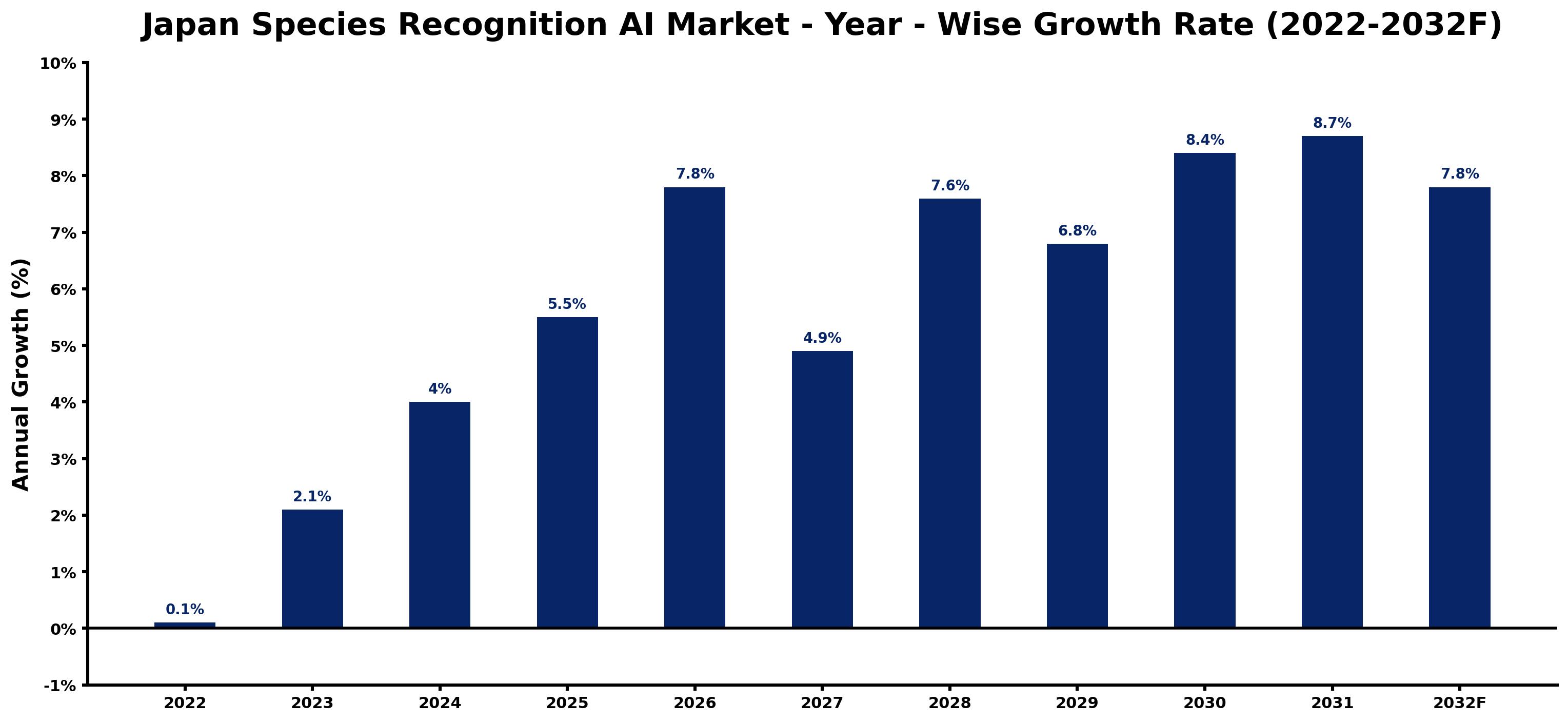
The yearly estimates that follow link every growth rate to its principal driver, so readers can see why the pace changed in each period.
| Year | Estimated Annual Growth (%) | Market Rationale |
| 2022 | 0.1 | The market showed minimal activity with initial adoption of AI technologies. |
| 2023 | 2.1 | Growth accelerated as conservation agencies began integrating AI for biodiversity monitoring. |
| 2024 | 4.0 | Demand increased due to heightened awareness of biodiversity issues among researchers. |
| 2025 | 5.5 | The market peaked historically as ecological researchers adopted AI tools extensively. |
| 2026 | 7.8 | Growth continued as mobile devices became essential for field data collection. |
| 2027 | 4.9 | A slowdown occurred as market maturity set in, yet demand remained strong. |
| 2028 | 7.6 | Growth rebounded as new AI applications emerged in wildlife studies. |
| 2029 | 6.8 | A slight slowdown was noted as the market stabilised after rapid expansion. |
| 2030 | 8.4 | Demand surged again as government initiatives boosted biodiversity projects. |
| 2031 | 8.7 | The market reached its peak growth as AI technologies became standard in conservation. |
| 2032 | 7.8 | A slowdown occurred as the market adjusted to established technologies. |
Note: Market size estimations and growth projections presented in this report are based on 6Wresearch's proprietary forecasting methodology, utilizing the latest available industry data, government publications, and primary research inputs.
Japan Species Recognition AI Market Synopsis
Species Recognition AI utilises machine learning to identify and classify species through images, sounds, or genetic data, which is critical for conservation efforts and ecological research. The Japan Species Recognition AI Market is expanding, driven by over 100 national parks where AI is actively implemented and a ¥5 billion government allocation for biodiversity initiatives in 2023. Growing interest in biodiversity among the Japanese population further fuels demand, as conservation agencies and ecological researchers adopt this technology to improve monitoring and protect natural resources.
Market Dynamics Impact Analysis (2026–2032)
| Factor | Type | Impact | Primary Segment Affected |
| Rising adoption of AI technologies in conservation efforts | Driver | High | Wildlife Identification |
| Growing investment in biodiversity initiatives by the government | Driver | High | Ecological Researchers |
| Emerging demand for real-time species identification tools | Opportunity | High | Mobile/Edge Devices |
| Increased collaboration between research institutions and conservation agencies | Opportunity | Medium | Audio Recognition AI |
| Limited awareness among smaller conservation groups | Restraint | Medium | DNA Pattern AI |
| Challenges in data privacy and ethical considerations in AI use | Restraint | High | Multi-Sensor AI |
| High costs associated with advanced AI technologies | Challenge | Medium | Sensor-Enabled Devices |
| Need for continuous training of AI models to maintain accuracy | Challenge | High | Cloud |
Evaluation of Drivers in Japan Species Recognition AI Market (2026–2032)
Below are the drivers that matter most for revenue growth, with supporting evidence.
| Drivers | Primary Segment Affected | Why It Matters (Evidence) |
| Increased funding for biodiversity research | Ecological Researchers | In 2023, the government allocated ¥5 billion for biodiversity initiatives, prompting researchers to adopt AI for data analysis. |
| Growing number of national parks adopting AI | Wildlife Identification | With over 100 national parks in Japan, conservation agencies are integrating AI for effective species monitoring. |
| Rising public interest in biodiversity | Mobile/Edge Devices | The Japanese population's increasing awareness drives demand for mobile AI solutions for real-time species identification. |
| Expansion of AI training datasets | Audio Recognition AI | AI models trained on over 1 million species images improve accuracy, leading to greater adoption by conservation agencies. |
| Support from ecological research institutions | DNA Pattern AI | Research institutions are increasingly using AI for genetic classification, resulting in higher demand for advanced AI solutions. |
The rising public interest in biodiversity drives demand for mobile AI solutions, enabling real-time species identification. Over 100 national parks are integrating AI for effective species monitoring, which improves conservation efforts. Research institutions are also utilising AI for genetic classification, further boosting demand for advanced AI technologies.
Evaluation of Restraints in Japan Species Recognition AI Market
The main factors holding the market back are set out below.
| Market Restraint | Primary Segment Affected | Why It Matters (Evidence) |
| Limited awareness among smaller conservation groups | DNA Pattern AI | Many smaller conservation groups lack knowledge of AI technologies, hindering their adoption for species identification. |
| Challenges in data privacy and ethical considerations in AI use | Multi-Sensor AI | Concerns regarding data privacy may restrict the implementation of AI in sensitive ecological research. |
| High costs associated with advanced AI technologies | Sensor-Enabled Devices | The financial burden of implementing advanced AI solutions can deter smaller organisations from adoption. |
| Need for continuous training of AI models to maintain accuracy | Cloud | Ongoing training requirements for AI models can lead to increased operational costs for users. |
| Limited integration of AI in traditional conservation practices | Wildlife Identification | Resistance to change among traditional conservationists can slow the adoption of AI technologies. |
Japan Species Recognition AI Market Challenges
Conservation agencies struggle with fierce competition for limited funding, as many organisations vie for government support, which can postpone crucial biodiversity projects. Suppliers of AI technology face a skills gap, with a shortage of machine learning experts leading to extended timelines for ecological research. Regulatory hurdles complicate the environment for buyers, as understanding ISO 14001 standards can be intricate and time-consuming, resulting in higher costs for environmental monitoring. Buyers also deal with delays in data collection due to reliance on outdated methods, which can prolong project durations and impede conservation efforts.
Trends in the Japan Species Recognition AI Market
The trends below show where the Japan Species Recognition AI Market is heading.
- Shift from Traditional to AI-Driven Species Monitoring: Since 2023, conservation agencies have increasingly adopted AI technologies for species monitoring, improving data accuracy. Over 30% of ecological research projects now utilise AI, demonstrating a shift in methodology.
- Transition to Mobile Solutions for Field Research: In 2023, mobile devices became essential for field data collection in ecological research, holding a 45% market share. This trend allows researchers to gather real-time data, improving species identification efficiency.
- Emergence of AI in Genetic Research: In 2023, research on AI for genetic classification gained momentum, supported by multiple universities. This focus on genetic data improves understanding of biodiversity and species verification.
- Prioritisation of Biodiversity Initiatives: The Japanese government has set a target to increase biodiversity by 10% by 2030 using AI technologies. This initiative drives investment in AI solutions for conservation efforts across the country.
Investment Opportunities in the Japan Species Recognition AI Market
The following opportunities in the Japan Species Recognition AI Market pair current demand with a clear way in.
- Gap in AI Adoption Among Smaller Conservation Groups: With over 100 national parks actively using AI, there is a gap for smaller conservation groups to adopt these technologies. Investing in training and affordable solutions can improve their capabilities.
- Timing for Investment in Mobile AI Solutions: As mobile devices gain traction in ecological research, now is the time to invest in mobile AI solutions. Conservation agencies are increasingly seeking tools that facilitate real-time species identification.
- Supply of AI Training Data for Improved Accuracy: The demand for AI models trained on diverse datasets is growing. Collaborating with ecological researchers can help develop comprehensive training datasets for better species recognition.
- Investment in AI for Genetic Classification: The increasing focus on genetic research presents an opportunity to supply AI solutions tailored for genetic classification. Universities and research institutions are key buyers in this sector.
Government Initiatives in the Japan Species Recognition AI Market
The Semiconductor and Digital Industry Strategy, introduced in June 2021, supports domestic semiconductor manufacturing capabilities, which is essential for developing AI technologies. This law complements earlier initiatives aimed at promoting biodiversity conservation through AI, such as the Economic Security Promotion Act of 2022, which strengthens supply-chain resilience for critical products.
The Ministry of the Environment oversees the implementation of biodiversity initiatives, approving funding for projects that integrate AI technologies. In 2023, the Ministry allocated ¥5 billion for biodiversity research, facilitating the adoption of AI in conservation efforts.
Future Insight of the Japan Species Recognition AI Market
Investment in biodiversity research will rise, driven by government allocations, creating opportunities for suppliers to develop advanced AI tools. By 2032, the integration of AI into conservation strategies will enhance real-time species identification capabilities, benefiting ecological researchers and environmental agencies. The adoption of mobile devices for field data collection will streamline research processes, allowing for more efficient monitoring of endangered species. Biodiversity monitoring programmes will support Japan's target to increase biodiversity by 10% by 2030, encouraging collaboration among various stakeholders.
Market Segmentation Analysis
Japan Species Recognition AI Market report covers a detailed analysis of the following market segments:
By AI Model Type – Image-Based AI Leads, Audio Recognition AI Expected to Grow Fastest
According to Saurav Kr Singh, Senior Research Analyst at 6Wresearch, with 36% of ai model type revenue in 2025, Image-Based AI was the largest category. Image-Based AI holds the largest share as it is directly used for visual identification of species in the field, essential for conservation efforts. This technology is actively employed in over 100 national parks across Japan, ensuring effective monitoring of various species. The quickest growth will come from Audio Recognition AI, forecast to expand at a CAGR of 11.2% between 2026 and 2032. The rapid growth of Audio Recognition AI is attributed to its capability to identify species through their sounds, which is particularly valuable in wildlife monitoring. This segment is gaining traction as researchers increasingly acknowledge the significance of sound-based identification in biodiversity studies. Suppliers should focus on enhancing audio recognition capabilities to meet the growing demand from ecological researchers.
By Detection Category – Wildlife Identification Leads, Bird/Marine Species Expected to Grow Fastest
Wildlife Identification accounted for 44% of the market by detection category in 2025. Wildlife Identification dominates the market due to its critical role in monitoring and conserving wildlife populations throughout Japan's diverse ecosystems. This category is particularly vital for conservation agencies dedicated to safeguarding endangered species. Bird/Marine Species are set to record the highest CAGR in this split, 10.0% over 2026–2032. Bird/Marine Species is experiencing the fastest growth as it is crucial for identifying and studying specific bird and marine species, which are increasingly prioritised by researchers. This focus aligns with national objectives for biodiversity conservation and monitoring. Buyers should invest in tools that enhance identification capabilities for bird and marine species to strengthen their conservation initiatives.
By Deployment Platform – Mobile/Edge Devices Lead, Sensor-Enabled Devices Expected to Grow Fastest
Mobile/Edge Devices took 45% of deployment platform revenue in 2025, more than any other category. Mobile/Edge Devices dominate the market as they facilitate real-time species identification in the field, making them indispensable for conservation activities. Their portability and ease of use make them a preferred choice among conservation agencies. Sensor-Enabled Devices are projected to grow fastest, at a CAGR of 10.7% during 2026–2032. Sensor-Enabled Devices are growing rapidly as they integrate with automated systems for species detection, providing efficiency in data collection. This trend is particularly relevant as agencies seek to streamline their monitoring processes. Suppliers must prioritise the development of sensor-enabled solutions to cater to the increasing demand for automated detection systems.
By End User – Conservation Agencies Lead, Ecological Researchers Expected to Grow Fastest
Conservation Agencies held 52% of the Japan Species Recognition AI Market by end user in 2025. Conservation Agencies represent the largest user group, primarily utilising AI for monitoring and protecting species in various habitats. Their commitment to biodiversity initiatives drives the demand for advanced species recognition technologies. Over 2026–2032, Ecological Researchers are expected to post the fastest growth, at a CAGR of 9.7%. Ecological Researchers are the fastest-growing segment as they increasingly utilise AI for data collection and analysis in their studies. The surge in biodiversity research funding is propelling this growth further. Suppliers should tailor their offerings to meet the specific needs of ecological researchers to capitalise on this growth opportunity.
Key Attractiveness of the Report
- 10 Years of Market Numbers
- Historical Data Starting from 2022 to 2025
- Base Year 2025
- Forecast Data until 2032
- Key Performance Indicators Impacting the Market
- Major Upcoming Developments and Projects
Key Highlights of the Report:
- Japan Species Recognition AI Market Outlook
- Market Size of Japan Species Recognition AI Market, 2025
- Forecast of Japan Species Recognition AI Market, 2032
- Historical Data and Forecast of Japan Species Recognition AI Revenues & Volume for the Period 2022-2032F
- Japan Species Recognition AI Market Trend Evolution
- Japan Species Recognition AI Market Drivers and Challenges
- Japan Species Recognition AI Price Trends
- Japan Species Recognition AI Porter's Five Forces
- Japan Species Recognition AI Industry Life Cycle
- Historical Data and Forecast of Japan Species Recognition AI Market Revenues & Volume By AI Model Type for the Period 2022-2032F
- Historical Data and Forecast of Japan Species Recognition AI Market Revenues & Volume By Image-Based AI for the Period 2022-2032F
- Historical Data and Forecast of Japan Species Recognition AI Market Revenues & Volume By Audio Recognition AI for the Period 2022-2032F
- Historical Data and Forecast of Japan Species Recognition AI Market Revenues & Volume By DNA Pattern AI for the Period 2022-2032F
- Historical Data and Forecast of Japan Species Recognition AI Market Revenues & Volume By Multi-Sensor AI for the Period 2022-2032F
- Historical Data and Forecast of Japan Species Recognition AI Market Revenues & Volume By Detection Category for the Period 2022-2032F
- Historical Data and Forecast of Japan Species Recognition AI Market Revenues & Volume By Wildlife Identification for the Period 2022-2032F
- Historical Data and Forecast of Japan Species Recognition AI Market Revenues & Volume By Bird/Marine Species for the Period 2022-2032F
- Historical Data and Forecast of Japan Species Recognition AI Market Revenues & Volume By Genetic Classification for the Period 2022-2032F
- Historical Data and Forecast of Japan Species Recognition AI Market Revenues & Volume By Habitat Mapping for the Period 2022-2032F
- Historical Data and Forecast of Japan Species Recognition AI Market Revenues & Volume By Deployment Platform for the Period 2022-2032F
- Historical Data and Forecast of Japan Species Recognition AI Market Revenues & Volume By Mobile/Edge Devices for the Period 2022-2032F
- Historical Data and Forecast of Japan Species Recognition AI Market Revenues & Volume By Sensor-Enabled Devices for the Period 2022-2032F
- Historical Data and Forecast of Japan Species Recognition AI Market Revenues & Volume By Cloud for the Period 2022-2032F
- Historical Data and Forecast of Japan Species Recognition AI Market Revenues & Volume By Drones for the Period 2022-2032F
- Historical Data and Forecast of Japan Species Recognition AI Market Revenues & Volume By End User for the Period 2022-2032F
- Historical Data and Forecast of Japan Species Recognition AI Market Revenues & Volume By Conservation Agencies for the Period 2022-2032F
- Historical Data and Forecast of Japan Species Recognition AI Market Revenues & Volume By Ecological Researchers for the Period 2022-2032F
- Historical Data and Forecast of Japan Species Recognition AI Market Revenues & Volume By Biotech Institutions for the Period 2022-2032F
- Historical Data and Forecast of Japan Species Recognition AI Market Revenues & Volume By Environmental Agencies for the Period 2022-2032F
- Japan Species Recognition AI Import Export Trade Statistics
- Market Opportunity Assessment By AI Model Type
- Market Opportunity Assessment By Detection Category
- Market Opportunity Assessment By Deployment Platform
- Market Opportunity Assessment By End User
- Japan Species Recognition AI Top Companies Market Share
- Japan Species Recognition AI Competitive Benchmarking By Technical and Operational Parameters
- Japan Species Recognition AI Company Profiles
- Japan Species Recognition AI Key Strategic Recommendations
Market Covered
Coverage by segment is as follows.
By AI Model Type
- Image-Based AI
- Audio Recognition AI
- DNA Pattern AI
- Multi-Sensor AI
By Detection Category
- Wildlife Identification
- Bird/Marine Species
- Genetic Classification
- Habitat Mapping
By Deployment Platform
- Mobile/Edge Devices
- Sensor-Enabled Devices
- Cloud
- Drones
By End User
- Conservation Agencies
- Ecological Researchers
- Biotech Institutions
- Environmental Agencies































