Japan Speech Analytics Market Size & Growth Rate (2026-2032)
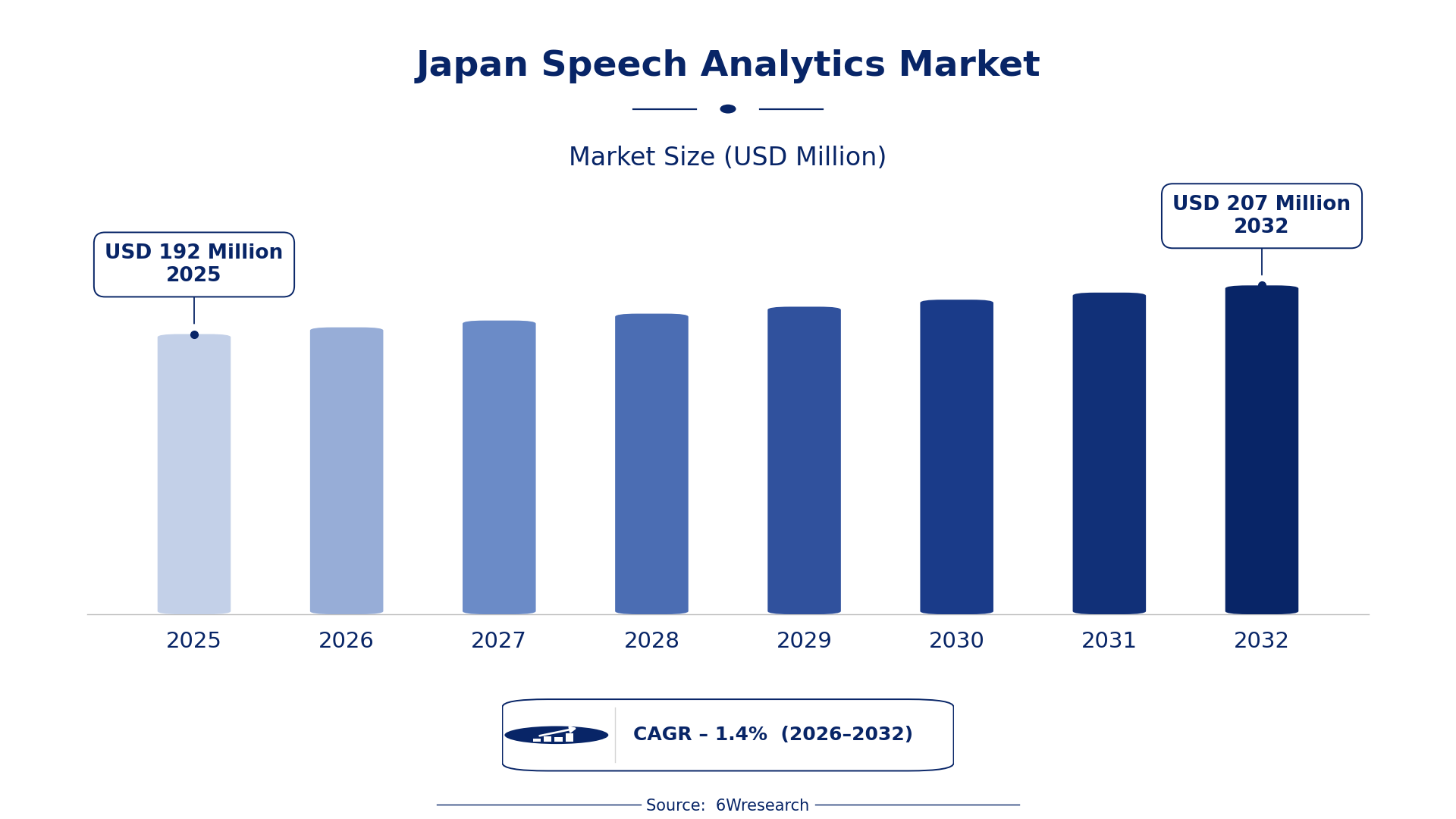
The Japan Speech Analytics Market was estimated at USD 192 Million in 2025 and is projected to reach USD 207 Million by 2032, growing at a CAGR of 1.4% from 2026 to 2032.
Japan Speech Analytics Market Synopsis
In Japan, the speech analytics market is experiencing solid momentum, driven primarily by advancements in customer service technology. Businesses across various sectors are now leveraging sophisticated speech analytics solutions to analyze customer interactions and improve service delivery. This is not just a trend; it's a growing necessity in a highly competitive environment.
Organizations are adopting these technologies to gain actionable insights that directly influence agent performance and customer satisfaction. With the Japanese focus on delivering superior customer experiences, the demand for speech analytics tools tailored to this market is climbing steadily.
Japan Speech Analytics Market Year-wise Growth Rate and Key Drivers
This graph illustrates the annual growth rates of the Japan Speech Analytics Market from 2021 to 2032, highlighting a steady upward trajectory and projected expansion over the forecast period.
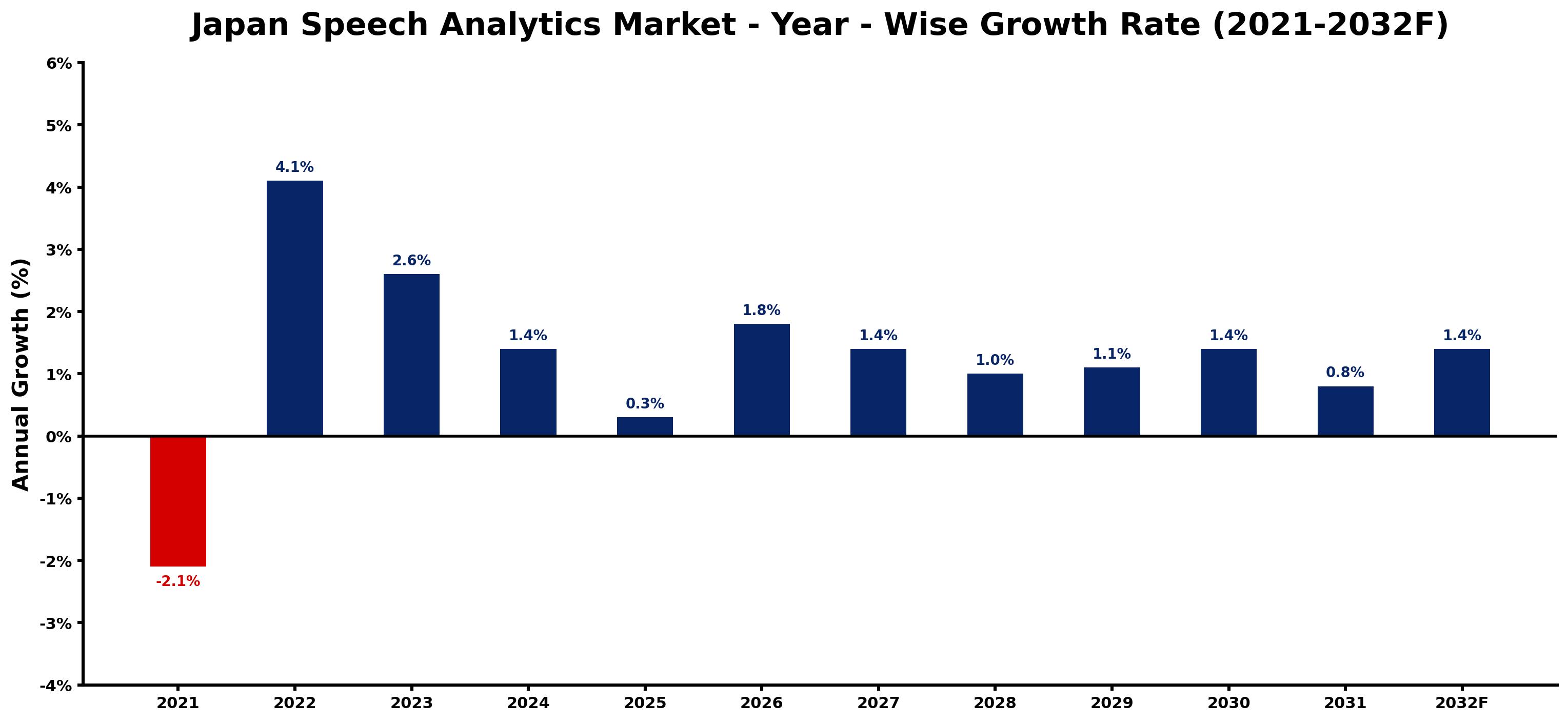
The table below presents the year‑wise growth rates along with the key drivers influencing the market
| Year | Growth Rate | Major Drivers |
| 2021 | -2.1% | Decline in enterprise software investment post-2020 Olympics |
| 2022 | 4.1% | Increased demand for customer insights post-COVID-19. |
| 2023 | 2.6% | Government initiatives promoting AI-driven customer service tools. |
| 2024 | 1.4% | Growing interest in multilingual support for global business. |
| 2025 | 0.3% | Introduction of privacy regulations driving compliance analytics needs. |
| 2026 | 1.8% | Rise of remote work enhancing digital communication analysis. |
| 2027 | 1.4% | Shift towards personalized customer engagement strategies. |
| 2028 | 1.0% | Increased investment in voice technology by telecom companies. |
| 2029 | 1.1% | Greater focus on voice recognition for accessibility improvements. |
| 2030 | 1.4% | Adoption of adaptive learning technologies in education sector. |
| 2031 | 0.8% | Emergence of startup innovations in natural language processing. |
| 2032 | 1.4% | Continued integration of speech analytics in healthcare operations. |
Note: Market size estimations and growth projections presented in this report are based on 6Wresearch's proprietary forecasting methodology, utilizing the latest available industry data, government publications, and primary research inputs.
Japan Speech Analytics Market Key Takeaways
Below are some of the specific key takeaways from the market, including:
- The market is driven by the need for improved customer satisfaction and regulatory compliance.
- AI and machine learning technologies are becoming increasingly integrated into speech analytics solutions.
- Real-time analytics are gaining traction, providing businesses with immediate insights.
- Cloud-based solutions are on the rise, offering flexibility and scalability to organizations.
- There is a growing focus on the integration of speech analytics with other data systems for enhanced insights.
Evaluation of Restraints in Japan Speech Analytics Market
Despite the promising prospects, the Japan Speech Analytics Market faces several challenges. One of the foremost issues is the complexity of the Japanese language, which includes various dialects and levels of formality that complicate speech recognition. This intricacy can hinder effective analysis compared to simpler languages like English.
Additionally, stringent data privacy laws in Japan pose a significant barrier, as organizations must navigate complex regulations when implementing speech analytics solutions. Cultural preferences for in-person communication can also limit the volume of recorded interactions available for analysis, further constraining market potential.
Japan Speech Analytics Market Trends
Several key trends are influencing the Japan Speech Analytics Market today. The integration of AI and machine learning is enhancing the analytical capabilities of these solutions, allowing for deeper insights into customer interactions. on top of that, businesses are increasingly turning to real-time analytics, which enables immediate feedback loops and operational adjustments.
The shift towards cloud-based analytics is also noteworthy, as organizations seek more cost-effective, scalable options. There's a noticeable trend in the amalgamation of speech analytics with CRM systems and voice biometrics, providing a more comprehensive view of customer interactions and needs.
Japan Speech Analytics Market Opportunities
Investment opportunities in the Japan Speech Analytics Market are abundant as companies seek to enhance their customer service capabilities. Industries like telecommunications, retail, and healthcare are particularly promising due to their critical need for improved customer engagement insights. With increasing governmental support for digital transformation, the market is expected to attract significant investment, especially in tailored solutions addressing the nuances of the Japanese market.
Government Initiatives in the Japan Speech Analytics Market
The Japanese government is actively fostering the growth of the speech analytics sector through a series of strategic initiatives aimed at integrating advanced technologies across industries. Policies that promote digital innovation, such as the "Society 5.0" initiative, are crucial for encouraging the adoption of these technologies, ensuring that businesses can leverage speech analytics effectively.
- A recently completed initiative focused on enhancing digital infrastructure across urban centers, facilitating better data utilization for analytics.
- A currently ongoing funding program that supports startups in AI and data analytics, including speech technologies.
- A planned public-private partnership aimed at expanding access to cloud-based speech analytics solutions for SMEs, expected to launch in 2026.
- Regulatory updates in 2025 intended to streamline compliance processes around data privacy, benefiting companies utilizing speech analytics.
- The introduction of training programs to upskill professionals in speech analytics technologies as part of the "Connected Industries" strategy.
Future Insights of the Japan Speech Analytics Market
Looking ahead to the period from 2026 to 2032, the Japan Speech Analytics Market is expected to grow steadily, fueled by technology adoption across customer service, sales, and marketing sectors. As businesses increasingly prioritize operational efficiency and real-time customer insights, the demand for integrated and sophisticated speech analytics solutions will only rise.
With advancements in AI, the potential for enhanced decision-making capabilities will become a critical aspect of business strategy. Market players will need to remain agile, adapting their offerings to meet the evolving requirements of clients seeking to extract actionable intelligence from their customer interactions.
Japan Speech Analytics Market Latest Developments
In the past year, the Japan Speech Analytics Market has seen a flurry of activity, with numerous advancements aimed at improving analytics capabilities and integrating them into existing business processes. As organizations look to capitalize on the benefits of speech analytics, the urgency for innovation has never been higher.
- A major technology vendor announced the rollout of an advanced speech analytics tool in Q1 2025, which incorporates AI-driven features for enhanced accuracy.
- A leading regional operator began implementing real-time analytics capabilities in customer support centers, expected to be fully operational by mid-2025.
- In early 2025, a cloud-based speech analytics solution targeting the retail sector was launched, focusing on customer sentiment analysis.
- A partnership between software developers and a telecommunications provider is underway, focusing on integrating voice biometrics with speech analytics, anticipated to enhance security and insights by late 2025.
- A forthcoming regulatory framework aimed at improving the ethical usage of speech analytics is scheduled for discussion in mid-2026, likely influencing market practices.
Japan Speech Analytics Market - Key Attractiveness of the Report
- 10 Years of Market Numbers
- Historical Data Starting from 2022 to 2025
- Base Year: 2025
- Forecast Data until 2032
- Key Performance Indicators Impacting the Market
- Major Upcoming Developments and Projects
The Japanese government is promoting digital technologies through initiatives like "Society 5.0," while also supporting R&D in speech analytics, establishing a favorable environment for market growth.
Key Highlights of the Report:
- Japan Speech Analytics Market Outlook
- Market Size of Japan Speech Analytics Market, 2025
- Forecast of Japan Speech Analytics Market, 2032
- Historical Data and Forecast of Japan Speech Analytics Revenues & Volume for the Period 2022-2032F
- Japan Speech Analytics Market Trend Evolution
- Japan Speech Analytics Market Drivers and Challenges
- Japan Speech Analytics Price Trends
- Japan Speech Analytics Porter's Five Forces
- Japan Speech Analytics Industry Life Cycle
- Historical Data and Forecast of Japan Speech Analytics Market Revenues & Volume By Component for the Period 2022-2032F
- Historical Data and Forecast of Japan Speech Analytics Market Revenues & Volume By Solutions for the Period 2022-2032F
- Historical Data and Forecast of Japan Speech Analytics Market Revenues & Volume By Services for the Period 2022-2032F
- Historical Data and Forecast of Japan Speech Analytics Market Revenues & Volume By Vertical for the Period 2022-2032F
- Historical Data and Forecast of Japan Speech Analytics Market Revenues & Volume By BFSI for the Period 2022-2032F
- Historical Data and Forecast of Japan Speech Analytics Market Revenues & Volume By Telecom for the Period 2022-2032F
- Historical Data and Forecast of Japan Speech Analytics Market Revenues & Volume By Retail and eCommerce for the Period 2022-2032F
- Historical Data and Forecast of Japan Speech Analytics Market Revenues & Volume By Automotive and Transportation for the Period 2022-2032F
- Historical Data and Forecast of Japan Speech Analytics Market Revenues & Volume By IT and ITES for the Period 2022-2032F
- Historical Data and Forecast of Japan Speech Analytics Market Revenues & Volume By Healthcare and Life Sciences for the Period 2022-2032F
- Historical Data and Forecast of Japan Speech Analytics Market Revenues & Volume By Media and Entertainment for the Period 2022-2032F
- Historical Data and Forecast of Japan Speech Analytics Market Revenues & Volume By Travel and Hospitality for the Period 2022-2032F
- Historical Data and Forecast of Japan Speech Analytics Market Revenues & Volume By Application for the Period 2022-2032F
- Historical Data and Forecast of Japan Speech Analytics Market Revenues & Volume By Customer Experience Management for the Period 2022-2032F
- Historical Data and Forecast of Japan Speech Analytics Market Revenues & Volume By Quality Management for the Period 2022-2032F
- Historical Data and Forecast of Japan Speech Analytics Market Revenues & Volume By Call Monitoring and Summarization for the Period 2022-2032F
- Historical Data and Forecast of Japan Speech Analytics Market Revenues & Volume By Agent Performance Management for the Period 2022-2032F
- Historical Data and Forecast of Japan Speech Analytics Market Revenues & Volume By Risk and Compliance Management for the Period 2022-2032F
- Historical Data and Forecast of Japan Speech Analytics Market Revenues & Volume By Sentiment Analysis for the Period 2022-2032F
- Historical Data and Forecast of Japan Speech Analytics Market Revenues & Volume By Other Verticals (operational efficiency, revenue/ lead generation, BPM, and competitive intelligence) for the Period 2022-2032F
- Historical Data and Forecast of Japan Speech Analytics Market Revenues & Volume By Business Function for the Period 2022-2032F
- Historical Data and Forecast of Japan Speech Analytics Market Revenues & Volume By Finance and Accounting for the Period 2022-2032F
- Historical Data and Forecast of Japan Speech Analytics Market Revenues & Volume By Sales and Marketing for the Period 2022-2032F
- Historical Data and Forecast of Japan Speech Analytics Market Revenues & Volume By Contact Center/ Call Center for the Period 2022-2032F
- Historical Data and Forecast of Japan Speech Analytics Market Revenues & Volume By Operations and Supply Chain for the Period 2022-2032F
- Historical Data and Forecast of Japan Speech Analytics Market Revenues & Volume By HR for the Period 2022-2032F
- Historical Data and Forecast of Japan Speech Analytics Market Revenues & Volume By Organization Size for the Period 2022-2032F
- Historical Data and Forecast of Japan Speech Analytics Market Revenues & Volume By Large Enterprises for the Period 2022-2032F
- Historical Data and Forecast of Japan Speech Analytics Market Revenues & Volume By SMEs for the Period 2022-2032F
- Historical Data and Forecast of Japan Speech Analytics Market Revenues & Volume By Deployment Mode for the Period 2022-2032F
- Historical Data and Forecast of Japan Speech Analytics Market Revenues & Volume By On-premises for the Period 2022-2032F
- Historical Data and Forecast of Japan Speech Analytics Market Revenues & Volume By Cloud for the Period 2022-2032F
- Japan Speech Analytics Import Export Trade Statistics
- Market Opportunity Assessment By Component
- Market Opportunity Assessment By Vertical
- Market Opportunity Assessment By Application
- Market Opportunity Assessment By Business Function
- Market Opportunity Assessment By Organization Size
- Market Opportunity Assessment By Deployment Mode
- Japan Speech Analytics Top Companies Market Share
- Japan Speech Analytics Competitive Benchmarking By Technical and Operational Parameters
- Japan Speech Analytics Company Profiles
- Japan Speech Analytics Key Strategic Recommendations






































