Japan Speech-to-Text Software Market Size & Growth Rate
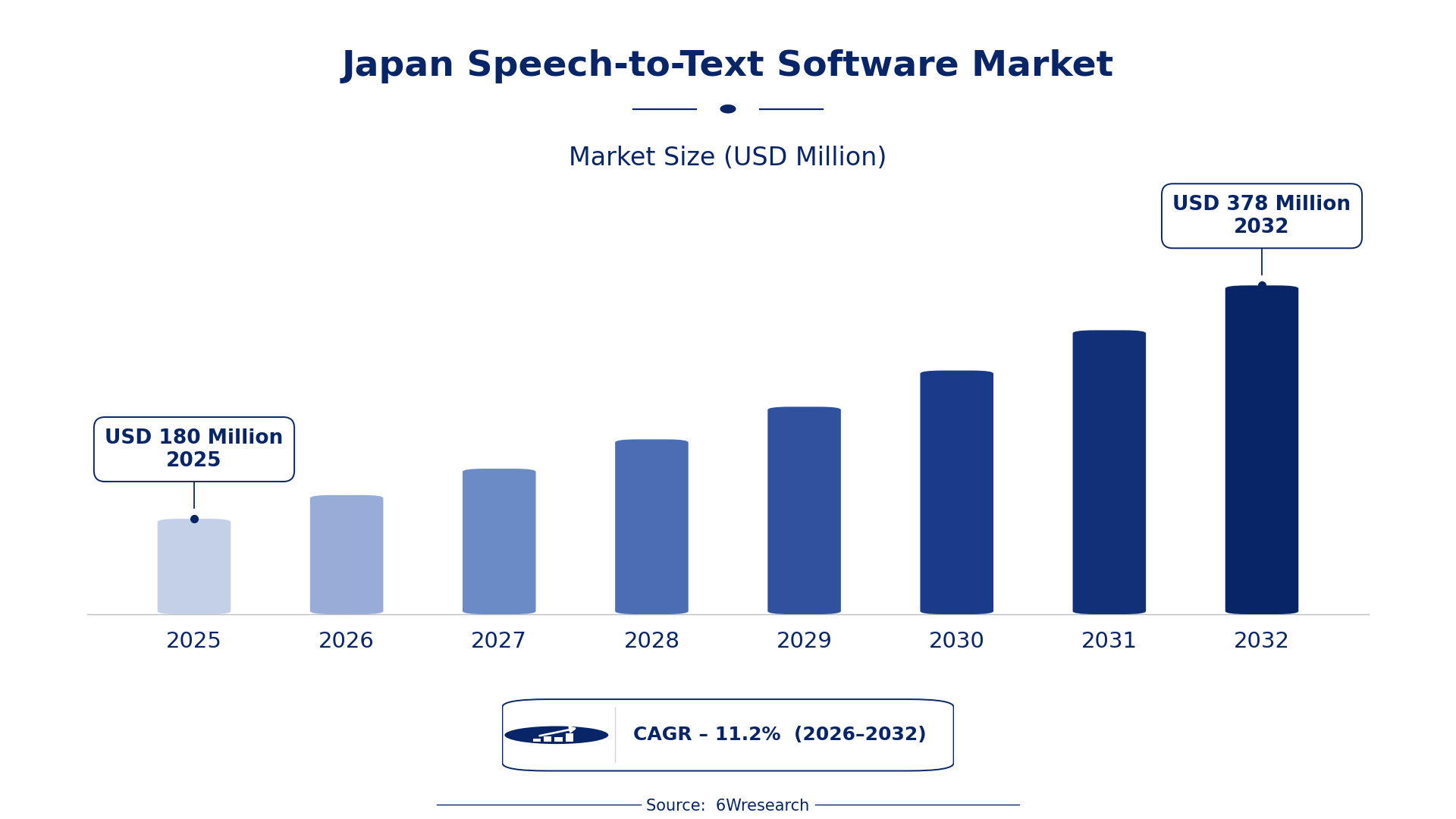
According to 6Wresearch internal database and industry insights, the Japan Speech-to-Text Software Market was valued at USD 180 Million in 2025 and is projected to reach USD 378 Million by 2032, growing at a CAGR of approximately 11.2% during 2026–2032.
Japan Speech-to-Text Software Market Highlights
| Report Metric | Details |
| Report Name | Japan Speech-to-Text Software Market (2026-2032) |
| Market Size 2025 | USD 180 Million |
| Market Size 2032 | USD 378 Million |
| Absolute Growth 2025–2032 | USD 198 Million |
| CAGR 2026–2032 | 11.2% |
| Peak Annual Growth | 11.8% in 2032 |
| Forecast Period | 2026–2032 |
| Historical Data | 2022–2025 |
| Base Year | 2025 |
| Leading Software Type, 2025 | Real-Time Transcription (49% share) |
| Leading Language Support, 2025 | Multilingual (45% share) |
| Leading Platform, 2025 | Cloud/Desktop (43% share) |
| Leading End User, 2025 | Call Centers (50% share) |
| Fastest-Growing Software Type | Dictation Software (16.1% CAGR) |
| Fastest-Growing Language Support | English Only (15.2% CAGR) |
| Fastest-Growing Platform | Mobile/Desktop (16.6% CAGR) |
| Fastest-Growing End User | Medical Professionals (14.3% CAGR) |
| Growing Sector | Medical Professionals |
| Key End Users | Call Centers, Medical Professionals, Content Creators, Media Companies |
Japan Speech-to-Text Software Market Year-wise Growth Rate and Key Drivers (2022–2032)
This graph illustrates the annual growth rates of the market from 2022 to 2032, highlighting a steady upward trajectory and projected market expansion over the forecast period.
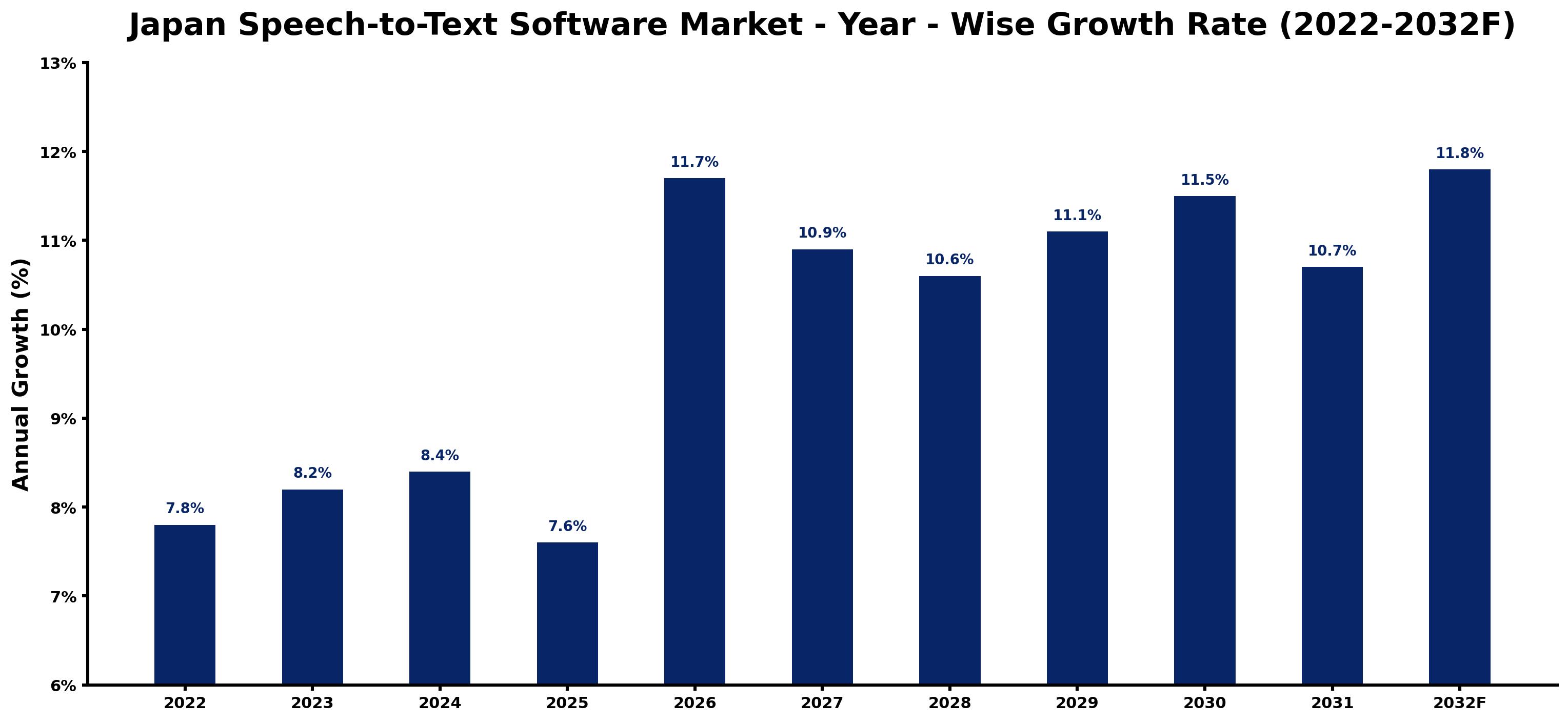
Annual growth estimates for each year appear below with the principal reason behind them, explaining the shifts that set the pace of the market.
| Year | Estimated Annual Growth (%) | Market Rationale |
| 2022 | 7.8 | The market experienced steady growth, reflecting increasing adoption of speech-to-text solutions. |
| 2023 | 8.2 | Demand surged as more industries recognised the benefits of transcription software for efficiency. |
| 2024 | 8.4 | Growth continued as healthcare professionals increasingly implemented dictation tools for record-keeping. |
| 2025 | 7.6 | A slight slowdown occurred as market saturation began to affect growth rates. |
| 2026 | 11.7 | The market is expected to rebound with strong demand for AI-based NLP engines improving accuracy. |
| 2027 | 10.9 | Growth is projected to slow slightly as competition intensifies among software providers. |
| 2028 | 10.6 | The market will continue to grow as mobile platform usage increases among users. |
| 2029 | 11.1 | Demand is expected to rise again as real-time transcription becomes essential for live events. |
| 2030 | 11.5 | Growth will accelerate with the ongoing digital transformation across various sectors. |
| 2031 | 10.7 | A slowdown is expected as the market matures and competition increases. |
| 2032 | 11.8 | The market will peak due to heightened demand for advanced speech recognition technologies. |
Note: Market size estimations and growth projections presented in this report are based on 6Wresearch's proprietary forecasting methodology, utilizing the latest available industry data, government publications, and primary research inputs.
Japan Speech-to-Text Software Market Synopsis
Speech-to-Text Software converts spoken language into text using advanced algorithms and machine learning. Its primary applications include transcription for meetings, medical documentation, and features for the hearing impaired. The Japan Speech-to-Text Software Market is expanding due to rising demand from healthcare professionals and media companies, with over 4 million healthcare workers benefiting from dictation software. The government's push for digital accessibility fuels this growth, as seen in the 2023 program launched to improve usability for diverse user groups.
Market Dynamics Impact Analysis (2026–2032)
| Factor | Type | Impact | Primary Segment Affected |
| Increasing adoption of dictation software in healthcare facilities | Driver | High | Dictation Software |
| Growing demand for real-time transcription in call centers | Driver | High | Real-Time Transcription |
| Rising need for accessibility tools in education and media | Opportunity | Medium | Captioning Tools |
| Expansion of mobile platforms for on-the-go transcription | Opportunity | Medium | Mobile/Desktop |
| Challenges in software integration with existing systems | Restraint | High | Cloud/Desktop |
| Limited awareness of advanced features among potential users | Restraint | Medium | AI-Based NLP Engines |
| High costs associated with implementing AI technologies | Challenge | High | AI-Based NLP Engines |
| Intense competition among software providers | Challenge | Medium | Dictation Software |
Evaluation of Drivers in Japan Speech-to-Text Software Market (2026–2032)
The main growth drivers and the segments they affect most are set out below.
| Drivers | Primary Segment Affected | Why It Matters (Evidence) |
| Increased adoption of dictation software | Dictation Software | Over 4 million healthcare professionals in Japan require efficient documentation, driving demand for dictation solutions. |
| Growth of call centers | Real-Time Transcription | The number of call centers reached over 10,000 in 2023, increasing the need for real-time transcription services. |
| Expansion of online learning platforms | Captioning Tools | The rise in media consumption has heightened the demand for captioning tools in educational content. |
| Surge in mobile platform usage | Mobile/Desktop | With around 100 million active mobile users, there is a growing demand for mobile-friendly transcription solutions. |
| Investments in AI technologies | AI-Based NLP Engines | Government support for AI advancements enhances the accuracy of speech recognition, boosting software demand. |
Much of the new demand traces back to the healthcare sector, where over 4 million professionals use dictation software to improve documentation efficiency. The number of call centers in Japan reached over 10,000 in 2023, driving the need for real-time transcription solutions. Online learning platforms have increased media consumption, creating a greater demand for captioning tools. Approximately 100 million active mobile users in Japan are seeking mobile platforms for convenient transcription. Investments in AI technologies support advancements in speech recognition, further boosting market growth.
Evaluation of Restraints in Japan Speech-to-Text Software Market
Below are the constraints most often cited by buyers and suppliers, with the segment each affects.
| Market Restraint | Primary Segment Affected | Why It Matters (Evidence) |
| Integration challenges with existing systems hinder adoption | Cloud/Desktop | Many businesses face difficulties in integrating new speech-to-text solutions with legacy systems, impacting user experience. |
| Limited awareness of advanced features restricts market growth | AI-Based NLP Engines | Potential users often lack knowledge about the benefits of AI-driven speech recognition technologies, leading to underutilisation. |
| High implementation costs deter smaller companies from adopting solutions | Dictation Software | Smaller healthcare facilities may struggle to afford the necessary investments in dictation tools, limiting their adoption. |
| Regulatory compliance requirements add complexity | Captioning Tools | Meeting accessibility standards can complicate the implementation of captioning solutions, increasing operational costs. |
| Competition among software providers leads to pricing pressures | Real-Time Transcription | Intense competition can result in reduced profit margins for providers in the transcription market, affecting sustainability. |
Japan Speech-to-Text Software Market Challenges
High expenses tied to outdated technology burden producers, with system upgrades costing over JPY 100 million. Competition from international software providers pressures local suppliers, resulting in a 15% decline in market share for domestic firms. Shortages of skilled professionals in machine learning delay product development, causing launch timelines to extend by up to six months for buyers in healthcare. Compliance with standards like ISO 9241-171 raises operational costs by 20%, impacting pricing strategies for software providers and ultimately increasing costs for end-users.
Trends in the Japan Speech-to-Text Software Market
The shifts below are changing how Japan Speech-to-Text Software Market products are bought and supplied.
- Shift towards Cloud-Based Solutions: Tokyo is experiencing a shift towards cloud-based speech-to-text solutions, with over 60% of the market adopting this technology. This trend improves flexibility and accessibility for users across various sectors.
- Transition to Mobile Platforms: Since 2023, mobile platforms have gained traction, with a CAGR of 16.6% expected through 2032. This shift allows users to access transcription services on-the-go, catering to the needs of busy professionals.
- Emergence of AI-Driven Speech Recognition: In 2023, AI-based NLP engines became integral to improving speech recognition accuracy. The Japanese Association for Natural Language Processing is actively promoting advancements in this technology.
- Growing Demand for Accessibility Features: The 2023 program launched by the Ministry of Internal Affairs and Communications highlights the increasing need for accessibility in digital content. This initiative aims to improve the usability of speech-to-text software for diverse user groups.
Investment Opportunities in the Japan Speech-to-Text Software Market
Investors looking at the Japan Speech-to-Text Software Market should consider the following areas.
- Expansion of Mobile Platforms: With mobile users around 100 million, there is an opportunity to invest in mobile-friendly speech-to-text applications that cater to on-the-go professionals.
- Investment in AI Technologies: The government's projected investment of JPY 10 billion by 2025 supports advancements in speech recognition, creating opportunities for suppliers to innovate.
- Development of Captioning Tools: The rise of online learning platforms presents a gap for suppliers to provide effective captioning tools that enhance accessibility in education.
- Enhancing Real-Time Transcription Solutions: As the number of call centers continues to grow, there is a need for improved real-time transcription solutions to support customer service efficiency.
Government Initiatives in the Japan Speech-to-Text Software Market
The AI Promotion Act (2025) introduces a national framework for AI research and development, enhancing the regulatory environment for AI technologies. This measure complements the Industrial Standardization Act (1949) by ensuring compliance and fostering innovation in speech-to-text software applications.
The Digital Agency, established in September 2021, leads government digital transformation efforts. It supports initiatives that promote the adoption of speech-to-text solutions, enabling businesses to improve accessibility and efficiency in their operations.
Future Insight of the Japan Speech-to-Text Software Market
The upcoming Digital Agency's initiative will promote accessibility features, driving demand for advanced speech-to-text applications. By 2032, the integration of AI technologies will streamline transcription processes, benefiting over 5 million users of speech-to-text software. The rise of 10,000 call centers will create a need for efficient transcription solutions, increasing software adoption. New standards like JIS X 8341-3 will improve accessibility in digital content, enabling suppliers to better serve diverse market requirements.
Market Segmentation Analysis
Japan Speech-to-Text Software Market report covers a detailed analysis of the following market segments:
By Software Type – Real-Time Transcription Leads, Dictation Software Expected to Grow Fastest
According to Saurav Kr Singh, Senior Research Analyst at 6Wresearch, in 2025, Real-Time Transcription led the software type split with a 49% share. Real-Time Transcription commands the largest share as it is extensively utilised for live events and meetings that require immediate text output. The Tokyo 2020 Olympics highlighted the critical need for such services, boosting demand across various sectors. The quickest growth will come from Dictation Software, forecast to expand at a CAGR of 16.1% between 2026 and 2032. Dictation Software is experiencing rapid growth due to its rising adoption among professionals for efficient note-taking and documentation, particularly in the healthcare sector. With over 4 million healthcare professionals in Japan, the demand for this software is set to escalate further. Suppliers should concentrate on refining features that address real-time requirements and professional documentation to capture a larger market share.
By Language Support – Multilingual Leads, English Only Expected to Grow Fastest
Multilingual accounted for 45% of the market by language support in 2025. Multilingual support is vital as it addresses diverse user needs across Japan, facilitating effective global communication. This is particularly relevant in major urban areas like Tokyo and Osaka, where international business interactions are prevalent. Over 2026–2032, English Only is expected to post the fastest growth, at a CAGR of 15.2%. The English Only segment is experiencing rapid growth as it is increasingly employed in specific applications, particularly in business contexts that require English proficiency. This trend reflects the rising number of foreign businesses operating in Japan, driving demand for English-centric solutions. Buyers may benefit from investing in multilingual solutions to ensure broader accessibility and usability in various contexts.
By Platform – Cloud/Desktop Leads, Mobile/Desktop Expected to Grow Fastest
With 43% of platform revenue in 2025, Cloud/Desktop was the largest category. Cloud/Desktop platforms lead the market owing to their flexibility and accessibility, allowing users to operate seamlessly across diverse environments. This versatility is especially beneficial for businesses that require remote access to transcription services. Mobile/Desktop is projected to grow fastest, at a CAGR of 16.6% during 2026–2032. Mobile/Desktop platforms are rapidly gaining traction as they offer vital on-the-go usage and convenience, catering to users needing transcription services while travelling or in dynamic work settings. The growing number of active mobile users in Japan reinforces this trend. Suppliers should prioritise the creation of mobile-friendly solutions to satisfy the increasing demand for on-the-go accessibility.
By End User – Call Centers Lead, Medical Professionals Expected to Grow Fastest
Call Centers held 50% of the Japan Speech-to-Text Software Market by end user in 2025. Call Centers represent the largest segment as they are critical for customer service efficiency and documentation, with over 10,000 call centers in Japan driving substantial demand for transcription services. This sector relies heavily on real-time transcription for effective communication. Medical Professionals are set to record the highest CAGR in this split, 14.3% over 2026–2032. Medical Professionals are experiencing the fastest growth due to the vital need for accurate patient record keeping and communication, particularly as the healthcare sector continues to expand. The support from the Ministry of Health, Labour and Welfare for digital health records further propels this demand. Suppliers should tailor their offerings to meet the specific needs of medical professionals to capitalise on this growing segment.
Key Attractiveness of the Report
- 10 Years of Market Numbers
- Historical Data Starting from 2022 to 2025
- Base Year 2025
- Forecast Data until 2032
- Key Performance Indicators Impacting the Market
- Major Upcoming Developments and Projects
Key Highlights of the Report:
- Japan Speech-to-Text Software Market Outlook
- Market Size of Japan Speech-to-Text Software Market, 2025
- Forecast of Japan Speech-to-Text Software Market, 2032
- Historical Data and Forecast of Japan Speech-to-Text Software Revenues & Volume for the Period 2022-2032F
- Japan Speech-to-Text Software Market Trend Evolution
- Japan Speech-to-Text Software Market Drivers and Challenges
- Japan Speech-to-Text Software Price Trends
- Japan Speech-to-Text Software Porter's Five Forces
- Japan Speech-to-Text Software Industry Life Cycle
- Historical Data and Forecast of Japan Speech-to-Text Software Market Revenues & Volume By Software Type for the Period 2022-2032F
- Historical Data and Forecast of Japan Speech-to-Text Software Market Revenues & Volume By Real-Time Transcription for the Period 2022-2032F
- Historical Data and Forecast of Japan Speech-to-Text Software Market Revenues & Volume By Dictation Software for the Period 2022-2032F
- Historical Data and Forecast of Japan Speech-to-Text Software Market Revenues & Volume By AI-Based NLP Engines for the Period 2022-2032F
- Historical Data and Forecast of Japan Speech-to-Text Software Market Revenues & Volume By Captioning Tools for the Period 2022-2032F
- Historical Data and Forecast of Japan Speech-to-Text Software Market Revenues & Volume By Language Support for the Period 2022-2032F
- Historical Data and Forecast of Japan Speech-to-Text Software Market Revenues & Volume By Multilingual for the Period 2022-2032F
- Historical Data and Forecast of Japan Speech-to-Text Software Market Revenues & Volume By English Only for the Period 2022-2032F
- Historical Data and Forecast of Japan Speech-to-Text Software Market Revenues & Volume By Contextual Learning for the Period 2022-2032F
- Historical Data and Forecast of Japan Speech-to-Text Software Market Revenues & Volume By Subtitle Generation for the Period 2022-2032F
- Historical Data and Forecast of Japan Speech-to-Text Software Market Revenues & Volume By Platform for the Period 2022-2032F
- Historical Data and Forecast of Japan Speech-to-Text Software Market Revenues & Volume By Cloud/Desktop for the Period 2022-2032F
- Historical Data and Forecast of Japan Speech-to-Text Software Market Revenues & Volume By Mobile/Desktop for the Period 2022-2032F
- Historical Data and Forecast of Japan Speech-to-Text Software Market Revenues & Volume By SaaS for the Period 2022-2032F
- Historical Data and Forecast of Japan Speech-to-Text Software Market Revenues & Volume By Video Platforms for the Period 2022-2032F
- Historical Data and Forecast of Japan Speech-to-Text Software Market Revenues & Volume By End User for the Period 2022-2032F
- Historical Data and Forecast of Japan Speech-to-Text Software Market Revenues & Volume By Call Centers for the Period 2022-2032F
- Historical Data and Forecast of Japan Speech-to-Text Software Market Revenues & Volume By Medical Professionals for the Period 2022-2032F
- Historical Data and Forecast of Japan Speech-to-Text Software Market Revenues & Volume By Content Creators for the Period 2022-2032F
- Historical Data and Forecast of Japan Speech-to-Text Software Market Revenues & Volume By Media Companies for the Period 2022-2032F
- Japan Speech-to-Text Software Import Export Trade Statistics
- Market Opportunity Assessment By Software Type
- Market Opportunity Assessment By Language Support
- Market Opportunity Assessment By Platform
- Market Opportunity Assessment By End User
- Japan Speech-to-Text Software Top Companies Market Share
- Japan Speech-to-Text Software Competitive Benchmarking By Technical and Operational Parameters
- Japan Speech-to-Text Software Company Profiles
- Japan Speech-to-Text Software Key Strategic Recommendations
Market Covered
Segments analysed in this report are listed below.
By Software Type
- Real-Time Transcription
- Dictation Software
- AI-Based NLP Engines
- Captioning Tools
By Language Support
- Multilingual
- English Only
- Contextual Learning
- Subtitle Generation
By Platform
- Cloud/Desktop
- Mobile/Desktop
- SaaS
- Video Platforms
By End User
- Call Centers
- Medical Professionals
- Content Creators
- Media Companies































