Japan Spill Containment Market Size & Growth Rate
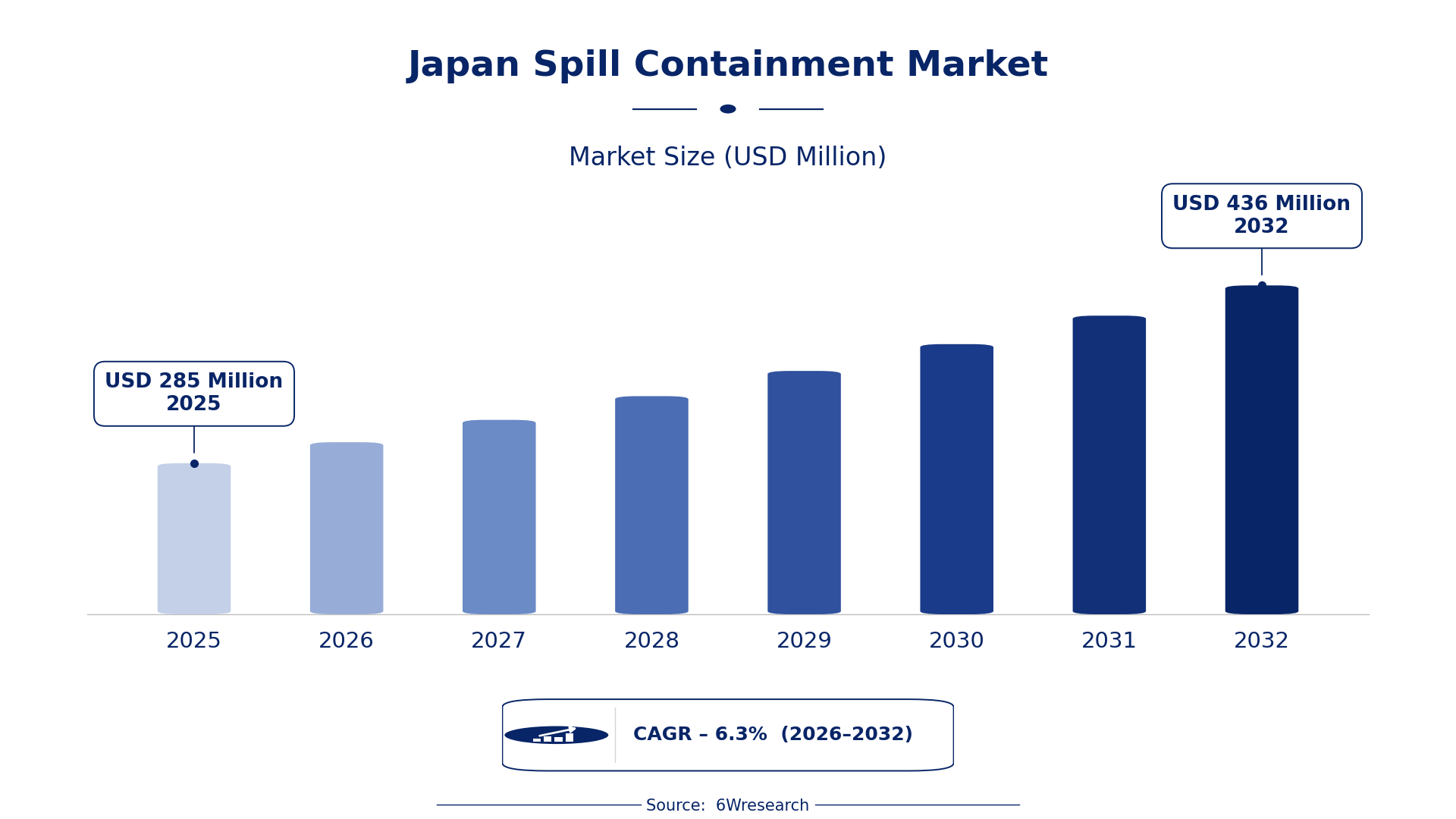
According to 6Wresearch internal database and industry insights, the Japan Spill Containment Market was valued at USD 285 Million in 2025 and is projected to reach USD 436 Million by 2032, growing at a CAGR of approximately 6.3% during 2026–2032.
Japan Spill Containment Market Highlights
| Report Metric | Details |
| Report Name | Japan Spill Containment Market (2026-2032) |
| Market Size 2025 | USD 285 Million |
| Market Size 2032 | USD 436 Million |
| Absolute Growth 2025–2032 | USD 151 Million |
| CAGR 2026–2032 | 6.3% |
| Peak Annual Growth | 7.0% in 2031 |
| Forecast Period | 2026–2032 |
| Historical Data | 2022–2025 |
| Base Year | 2025 |
| Leading Containment Type, 2025 | Portable Berms (38% share) |
| Leading Spill Category, 2025 | Chemical/Oil Spills (43% share) |
| Leading Deployment Format, 2025 | Temporary/Reusable (47% share) |
| Leading End User, 2025 | Industrial Facilities (48% share) |
| Fastest-Growing Containment Type | Spill Kits (9.1% CAGR) |
| Fastest-Growing Spill Category | Biohazard/Lubricant (8.7% CAGR) |
| Fastest-Growing Deployment Format | Mobile Units (9.3% CAGR) |
| Fastest-Growing End User | Safety Response Teams (8.2% CAGR) |
| Growing Sector | Manufacturing |
| Key End Users | Industrial Facilities, Safety Response Teams, Environmental Agencies |
Japan Spill Containment Market Year-wise Growth Rate and Key Drivers (2022–2032)
This graph illustrates the annual growth rates of the market from 2022 to 2032, highlighting a steady upward trajectory and projected market expansion over the forecast period.
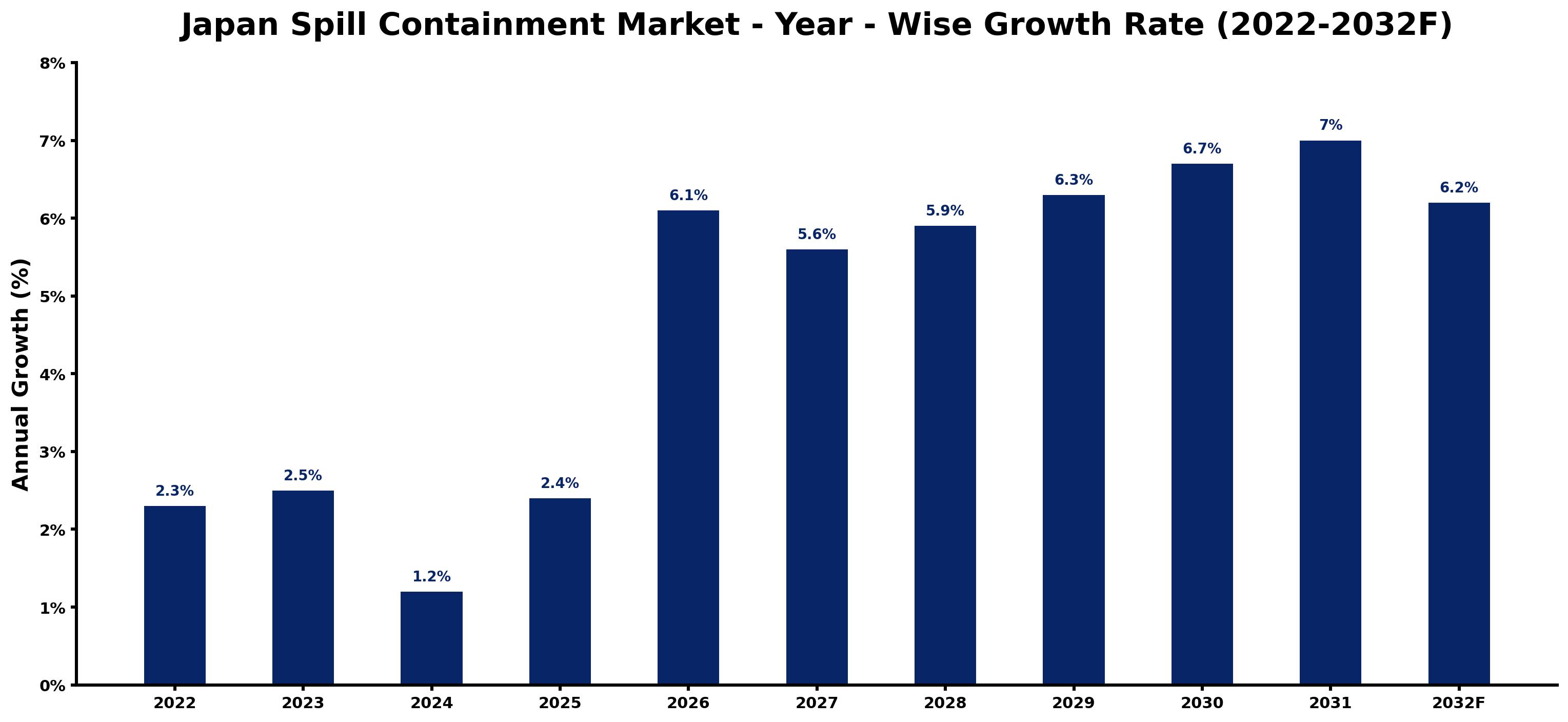
The table below sets out the estimated growth rate for each year and the main factor behind it.
| Year | Estimated Annual Growth (%) | Market Rationale |
| 2022 | 2.3 | The market experienced steady growth due to increasing regulatory compliance. |
| 2023 | 2.5 | Demand rose as more manufacturing plants adopted spill containment solutions. |
| 2024 | 1.2 | Growth slowed as some industries faced temporary operational challenges. |
| 2025 | 2.4 | Increased investment in spill response infrastructure contributed to faster growth. |
| 2026 | 6.1 | The market is expected to surge as new technologies improve spill containment effectiveness. |
| 2027 | 5.6 | Growth is projected to slow slightly as the market begins to stabilise after rapid expansion. |
| 2028 | 5.9 | Demand is expected to increase again as environmental concerns drive further investments. |
| 2029 | 6.3 | The market is projected to see a boost from heightened regulatory scrutiny on spill management. |
| 2030 | 6.7 | Continued technological advancements will support a rise in demand for solutions. |
| 2031 | 7.0 | The peak growth year will be driven by substantial investments in urban spill response. |
| 2032 | 6.2 | Growth is expected to slow as the market begins to normalise after reaching its peak. |
Note: Market size estimations and growth projections presented in this report are based on 6Wresearch's proprietary forecasting methodology, utilizing the latest available industry data, government publications, and primary research inputs.
Japan Spill Containment Market Synopsis
Spill containment technologies aim to prevent and control hazardous substance spills, using durable materials that can withstand chemical exposure. In Japan, solutions like portable berms play a crucial role in protecting the environment and ensuring workplace safety, especially within the manufacturing and chemical processing sectors. The Japan Spill Containment Market is expanding due to stricter regulatory compliance, increased investments in spill response infrastructure, and a growing awareness of environmental protection, with strong demand from industrial facilities and environmental agencies. In 2022, around 50% of spill kits sold were utilised in manufacturing plants, indicating robust market activity.
Market Dynamics Impact Analysis (2026–2032)
| Factor | Type | Impact | Primary Segment Affected |
| Increasing regulatory compliance requirements drive demand for spill containment solutions. | Driver | High | Spill Kits |
| Growing environmental awareness leads to investments in spill containment technologies. | Driver | High | Containment Pallets |
| Investment in urban spill response infrastructure creates opportunities for suppliers. | Opportunity | High | Portable Berms |
| Rising demand for flexible containment solutions opens new market avenues. | Opportunity | Medium | Mobile Units |
| High costs associated with spill containment technologies may deter some buyers. | Restraint | High | Temporary/Reusable |
| Limited awareness of spill containment solutions among smaller facilities restricts growth. | Restraint | Medium | Sewer Spill Protection |
| Inadequate training for safety response teams can delay effective spill management. | Challenge | High | Safety Response Teams |
| Challenges in sourcing high-quality materials may affect production timelines. | Challenge | Medium | Drum Storage |
Evaluation of Drivers in Japan Spill Containment Market (2026–2032)
Demand rests on the following drivers, each shown with the segment it touches most.
| Drivers | Primary Segment Affected | Why It Matters (Evidence) |
| Regulatory compliance mandates the use of spill kits in chemical storage areas. | Spill Kits | In Japan, spill kits are legally required in all chemical storage areas, driving demand from industrial facilities. |
| Environmental agencies enforce spill containment measures for hazardous waste management. | Containment Pallets | Strict regulations compel industries to invest in containment pallets for safe storage. |
| Increased investment in spill response infrastructure boosts market opportunities. | Portable Berms | Urban areas are seeing funding for improved spill response, boosting demand for portable berms. |
| Growing awareness of environmental protection fuels demand for flexible containment solutions. | Mobile Units | The rise in environmental concerns has led to increased purchases of adaptable mobile units. |
| Technological advancements improve the effectiveness of spill containment solutions. | Temporary/Reusable | Innovations in materials and design enhance the performance of temporary containment options. |
Several shifts outside the market lift sales. The Tokyo metropolitan area has the highest concentration of industrial facilities requiring spill containment solutions, which boosts local purchases. The average response time for safety teams to deploy spill kits is under 30 minutes in urban areas, highlighting the urgency of spill management and the need for efficient solutions.
Evaluation of Restraints in Japan Spill Containment Market
These restraints slow adoption and weigh on supplier margins.
| Market Restraint | Primary Segment Affected | Why It Matters (Evidence) |
| High costs associated with advanced spill containment technologies deter some buyers. | Temporary/Reusable | The initial investment for advanced solutions can be prohibitive for smaller facilities. |
| Limited awareness of spill containment solutions among smaller facilities restricts growth. | Sewer Spill Protection | Many smaller facilities are unaware of the need for effective spill containment measures. |
| Inadequate training for safety response teams can delay effective spill management. | Safety Response Teams | Without proper training, response teams may struggle to manage spills efficiently. |
| Challenges in sourcing high-quality materials may affect production timelines. | Drum Storage | Supply chain issues can lead to delays in obtaining necessary materials for production. |
| Regulatory changes may impose additional compliance costs on manufacturers. | Containment Pallets | New regulations can increase the financial burden on manufacturers, impacting purchasing decisions. |
Japan Spill Containment Market Challenges
At construction sites, workers often lack adequate training on spill containment measures, which delays response times during hazardous incidents for safety teams. Regulatory requirements for spill containment are stringent, yet compliance can be burdensome, causing project approval delays for contractors in the Tokyo metropolitan area. The costs associated with spill kits and containment solutions can strain budgets, particularly for smaller manufacturers, where expenses can reach up to 15% of operational costs. Slow adoption of new technologies in spill containment leaves some suppliers unable to meet safety standards, hindering their competitiveness in the automotive and chemical sectors.
Trends in the Japan Spill Containment Market
The shifts below are changing how Japan Spill Containment Market products are bought and supplied.
- Shift towards Flexible Materials for Spill Containment: In 2023, flexible materials gained popularity due to their adaptability and ease of use in various containment scenarios. This trend is evident in the Tokyo Bay area, reflecting increased investment in flexible solutions.
- Transition from Stationary to Mobile Units: Since 2022, there has been a notable shift towards mobile units for spill containment in construction sites. This change stems from the need for rapid deployment, with increased usage reported in urban construction projects.
- Emergence of Advanced Spill Kits: The introduction of advanced spill kits in 2022 has transformed spill response capabilities. These kits, which now include more comprehensive tools, have seen increased sales across manufacturing plants, reflecting their growing importance.
- Prioritisation of Environmental Compliance: The 2023 regulatory updates have prioritised environmental compliance, prompting industries to invest more in spill containment solutions. In response, the market has seen an increase in spill kit purchases as companies strive to meet new standards.
Investment Opportunities in the Japan Spill Containment Market
The opportunities below stand out in the Japan Spill Containment Market for new entrants and existing suppliers.
- Increasing Demand for Urban Spill Response Solutions: With the Japanese government allocating funds for improving spill response infrastructure in urban areas, suppliers can tap into this market. The allocated budget of USD 10 million in 2023 creates opportunities for partnerships with local municipalities.
- Growing Need for Training and Certification Programs: As awareness of spill management increases, there is a growing need for training programs for safety response teams. This presents an opportunity for educational institutions and training providers to develop courses tailored to industry needs.
- Expansion of Spill Containment in Manufacturing Facilities: The manufacturing sector is increasingly adopting spill containment solutions, driven by regulatory compliance. With approximately 50% of spill kits sold to this sector, suppliers can focus on targeting manufacturing plants for new product offerings.
- Investment in Spill Containment Technologies: Now is the time to invest in spill containment technologies, as industries seek effective solutions. Collaborating with environmental agencies can facilitate the introduction of new products that meet stringent regulatory standards.
Government Initiatives in the Japan Spill Containment Market
The PRTR Law, enacted in 1999, mandates businesses to report releases of designated chemical substances, directly impacting spill containment practices. This law ensures that companies are accountable for their environmental impact, compelling them to implement effective spill management solutions. Additionally, the Industrial Safety and Health Act of 1972 sets employer duties for hazardous substances, reinforcing the need for effective spill containment measures in workplaces.
In 2023, the Japanese government allocated USD 10 million for improving spill response infrastructure, overseen by the Ministry of the Environment. This funding aims to improve urban spill management capabilities, ensuring that facilities are better equipped to handle hazardous spills and comply with environmental regulations.
Future Insight of the Japan Spill Containment Market
Investment in spill response infrastructure will create demand for advanced containment technologies by 2032, with urban areas receiving increased funding. New JIS standards will encourage suppliers to innovate and improve compliance measures. Enhanced training programmes will equip workers with necessary skills, ensuring quicker response times. As flexible materials gain traction, buyers will benefit from more adaptable and efficient spill containment solutions, ultimately improving safety and environmental protection.
Market Segmentation Analysis
Japan Spill Containment Market report covers a detailed analysis of the following market segments:
By Containment Type – Portable Berms Lead, Spill Kits Expected to Grow Fastest
According to Saurav Kr Singh, Senior Research Analyst at 6Wresearch, with 38% of containment type revenue in 2025, Portable Berms was the largest category. Portable berms are essential for immediate spill containment on-site, making them a preferred choice in various industrial settings. Their widespread use in the Tokyo metropolitan area, which has a high concentration of industrial facilities, solidifies their leading market position. The quickest growth will come from Spill Kits, forecast to expand at a CAGR of 9.1% between 2026 and 2032. The growing regulatory requirements for spill kits in all chemical storage areas are significantly boosting their demand. This compliance trend is expected to further accelerate the growth of this segment in the near future. Suppliers must focus on ensuring the availability and compliance features of spill kits to meet increasing regulatory demands.
By Spill Category – Chemical/Oil Spills Lead, Biohazard/Lubricant Expected to Grow Fastest
The largest spill category category in 2025 was Chemical/Oil Spills, at 43% of revenue. Chemical and oil spills are the most common types requiring containment, with numerous incidents stemming from industrial activities. Their frequent occurrence in Japan's manufacturing and chemical processing sectors supports their dominant market share. Biohazard/Lubricant is set to record the highest CAGR in this split, 8.7% over 2026–2032. Biohazard and lubricant spills, while less common, are gaining importance due to their relevance in specific industries such as healthcare and automotive. Increased awareness of safety protocols in these sectors is likely to drive this segment's growth. Buyers in specialised sectors should consider investing in tailored solutions for biohazard and lubricant spills to ensure compliance and improve safety.
By Deployment Format – Temporary/Reusable Leads, Mobile Units Expected to Grow Fastest
In 2025, Temporary/Reusable led the deployment format split with a 47% share. Temporary and reusable solutions are favoured for their flexibility in addressing various spill scenarios, making them indispensable in industrial operations. Their adaptability to different environments, particularly in urban areas, supports their leading market position. Over 2026–2032, Mobile Units are expected to post the fastest growth, at a CAGR of 9.3%. Mobile units are becoming increasingly popular as they facilitate rapid deployment during emergencies, a critical factor for effective spill response. The growing emphasis on quick response times in urban settings is likely to accelerate the adoption of this format. Suppliers should prioritise the development of mobile units to meet the urgent needs of industries facing spill incidents.
By End User – Industrial Facilities Lead, Safety Response Teams Expected to Grow Fastest
Industrial Facilities accounted for 48% of the market by end user in 2025. Industrial facilities are the primary users of spill containment solutions, motivated by stringent regulatory compliance and the necessity for workplace safety. Their significant presence in Japan's industrial landscape guarantees a steady demand for these products. Safety Response Teams are projected to grow fastest, at a CAGR of 8.2% during 2026–2032. Safety response teams are experiencing rapid growth as their critical role in effective spill management gains recognition. The increasing focus on emergency preparedness is expected to enhance their importance in the spill containment market. Investing in training and resources for safety response teams will be crucial for improving spill management capabilities.
Key Attractiveness of the Report
- 10 Years of Market Numbers
- Historical Data Starting from 2022 to 2025
- Base Year 2025
- Forecast Data until 2032
- Key Performance Indicators Impacting the Market
- Major Upcoming Developments and Projects
Key Highlights of the Report:
- Japan Spill Containment Market Outlook
- Market Size of Japan Spill Containment Market, 2025
- Forecast of Japan Spill Containment Market, 2032
- Historical Data and Forecast of Japan Spill Containment Revenues & Volume for the Period 2022-2032F
- Japan Spill Containment Market Trend Evolution
- Japan Spill Containment Market Drivers and Challenges
- Japan Spill Containment Price Trends
- Japan Spill Containment Porter's Five Forces
- Japan Spill Containment Industry Life Cycle
- Historical Data and Forecast of Japan Spill Containment Market Revenues & Volume By Containment Type for the Period 2022-2032F
- Historical Data and Forecast of Japan Spill Containment Market Revenues & Volume By Portable Berms for the Period 2022-2032F
- Historical Data and Forecast of Japan Spill Containment Market Revenues & Volume By Spill Kits for the Period 2022-2032F
- Historical Data and Forecast of Japan Spill Containment Market Revenues & Volume By Containment Pallets for the Period 2022-2032F
- Historical Data and Forecast of Japan Spill Containment Market Revenues & Volume By Drain Covers & Socks for the Period 2022-2032F
- Historical Data and Forecast of Japan Spill Containment Market Revenues & Volume By Spill Category for the Period 2022-2032F
- Historical Data and Forecast of Japan Spill Containment Market Revenues & Volume By Chemical/Oil Spills for the Period 2022-2032F
- Historical Data and Forecast of Japan Spill Containment Market Revenues & Volume By Biohazard/Lubricant for the Period 2022-2032F
- Historical Data and Forecast of Japan Spill Containment Market Revenues & Volume By Drum Storage for the Period 2022-2032F
- Historical Data and Forecast of Japan Spill Containment Market Revenues & Volume By Sewer Spill Protection for the Period 2022-2032F
- Historical Data and Forecast of Japan Spill Containment Market Revenues & Volume By Deployment Format for the Period 2022-2032F
- Historical Data and Forecast of Japan Spill Containment Market Revenues & Volume By Temporary/Reusable for the Period 2022-2032F
- Historical Data and Forecast of Japan Spill Containment Market Revenues & Volume By Mobile Units for the Period 2022-2032F
- Historical Data and Forecast of Japan Spill Containment Market Revenues & Volume By Stationary for the Period 2022-2032F
- Historical Data and Forecast of Japan Spill Containment Market Revenues & Volume By Flexible Materials for the Period 2022-2032F
- Historical Data and Forecast of Japan Spill Containment Market Revenues & Volume By End User for the Period 2022-2032F
- Historical Data and Forecast of Japan Spill Containment Market Revenues & Volume By Industrial Facilities for the Period 2022-2032F
- Historical Data and Forecast of Japan Spill Containment Market Revenues & Volume By Safety Response Teams for the Period 2022-2032F
- Historical Data and Forecast of Japan Spill Containment Market Revenues & Volume By Manufacturing Plants for the Period 2022-2032F
- Historical Data and Forecast of Japan Spill Containment Market Revenues & Volume By Environmental Agencies for the Period 2022-2032F
- Japan Spill Containment Import Export Trade Statistics
- Market Opportunity Assessment By Containment Type
- Market Opportunity Assessment By Spill Category
- Market Opportunity Assessment By Deployment Format
- Market Opportunity Assessment By End User
- Japan Spill Containment Top Companies Market Share
- Japan Spill Containment Competitive Benchmarking By Technical and Operational Parameters
- Japan Spill Containment Company Profiles
- Japan Spill Containment Key Strategic Recommendations
Market Covered
The study includes the following segmentation.
By Containment Type
- Portable Berms
- Spill Kits
- Containment Pallets
- Drain Covers & Socks
By Spill Category
- Chemical/Oil Spills
- Biohazard/Lubricant
- Drum Storage
- Sewer Spill Protection
By Deployment Format
- Temporary/Reusable
- Mobile Units
- Stationary
- Flexible Materials
By End User
- Industrial Facilities
- Safety Response Teams
- Manufacturing Plants
- Environmental Agencies































