Japan Sports Analytics AI Market Size & Growth Rate
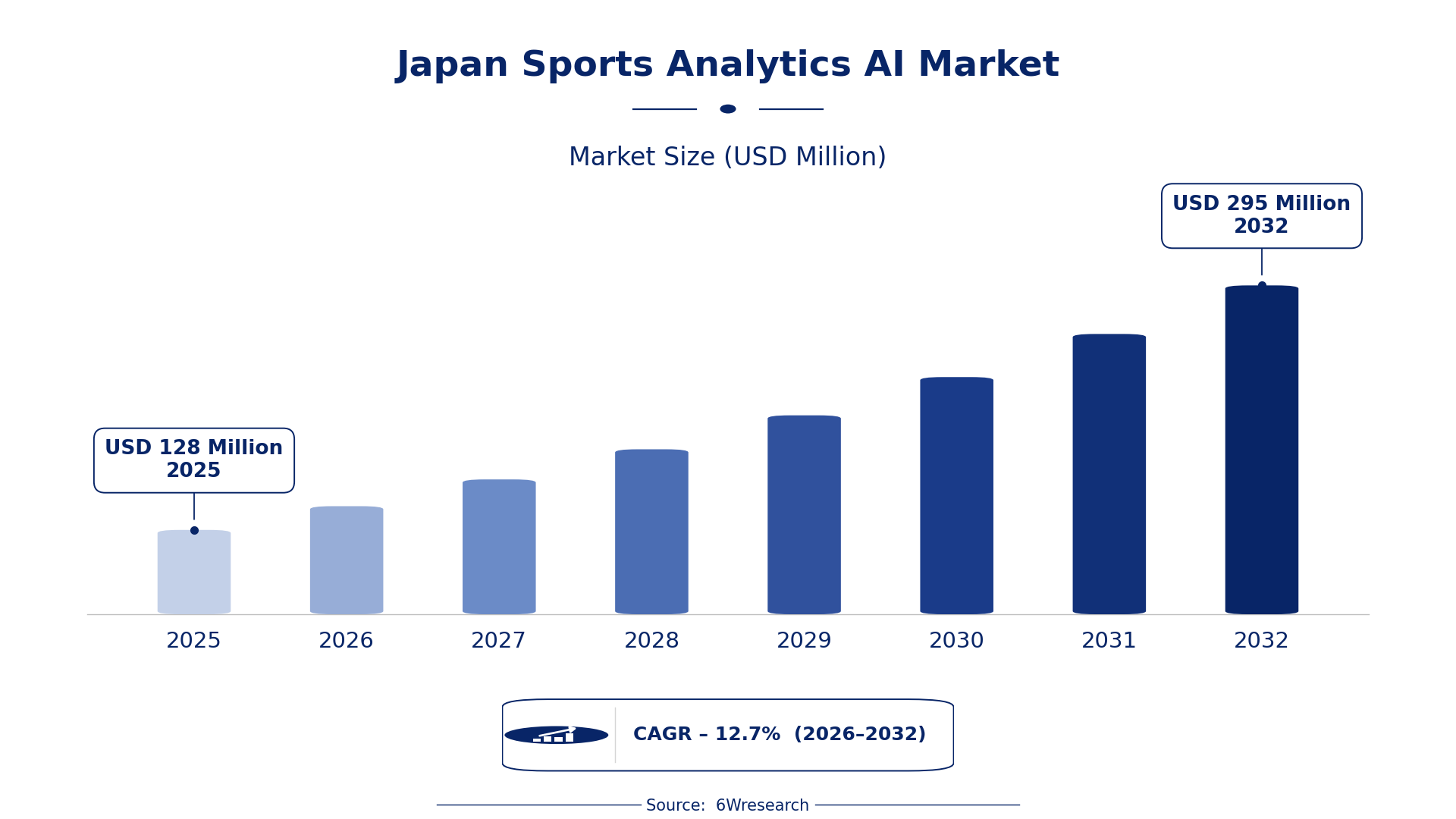
According to 6Wresearch internal database and industry insights, the Japan Sports Analytics AI Market was valued at USD 128 Million in 2025 and is projected to reach USD 295 Million by 2032, growing at a CAGR of approximately 12.7% during 2026–2032.
Japan Sports Analytics AI Market Highlights
| Report Metric | Details |
| Report Name | Japan Sports Analytics AI Market (2026-2032) |
| Market Size 2025 | USD 128 Million |
| Market Size 2032 | USD 295 Million |
| Absolute Growth 2025–2032 | USD 167 Million |
| CAGR 2026–2032 | 12.7% |
| Peak Annual Growth | 14.4% in 2032 |
| Forecast Period | 2026–2032 |
| Historical Data | 2022–2025 |
| Base Year | 2025 |
| Leading AI Application, 2025 | Performance Tracking (43% share) |
| Leading Data Focus, 2025 | Player Movement (50% share) |
| Leading Platform Type, 2025 | Cloud-Based Software (44% share) |
| Leading End User, 2025 | Coaching Teams (35% share) |
| Fastest-Growing AI Application | Fan Engagement AI (18.1% CAGR) |
| Fastest-Growing Data Focus | Sentiment/Behavior Data (17.8% CAGR) |
| Fastest-Growing Platform Type | Wearable Devices (19.4% CAGR) |
| Fastest-Growing End User | Sports Marketing Firms (16.5% CAGR) |
| Growing Sector | sports performance enhancement |
| Key End Users | coaching teams, sports medicine units, team analysts, sports marketing firms |
Japan Sports Analytics AI Market Year-wise Growth Rate and Key Drivers (2022–2032)
This graph illustrates the annual growth rates of the market from 2022 to 2032, highlighting a steady upward trajectory and projected market expansion over the forecast period.
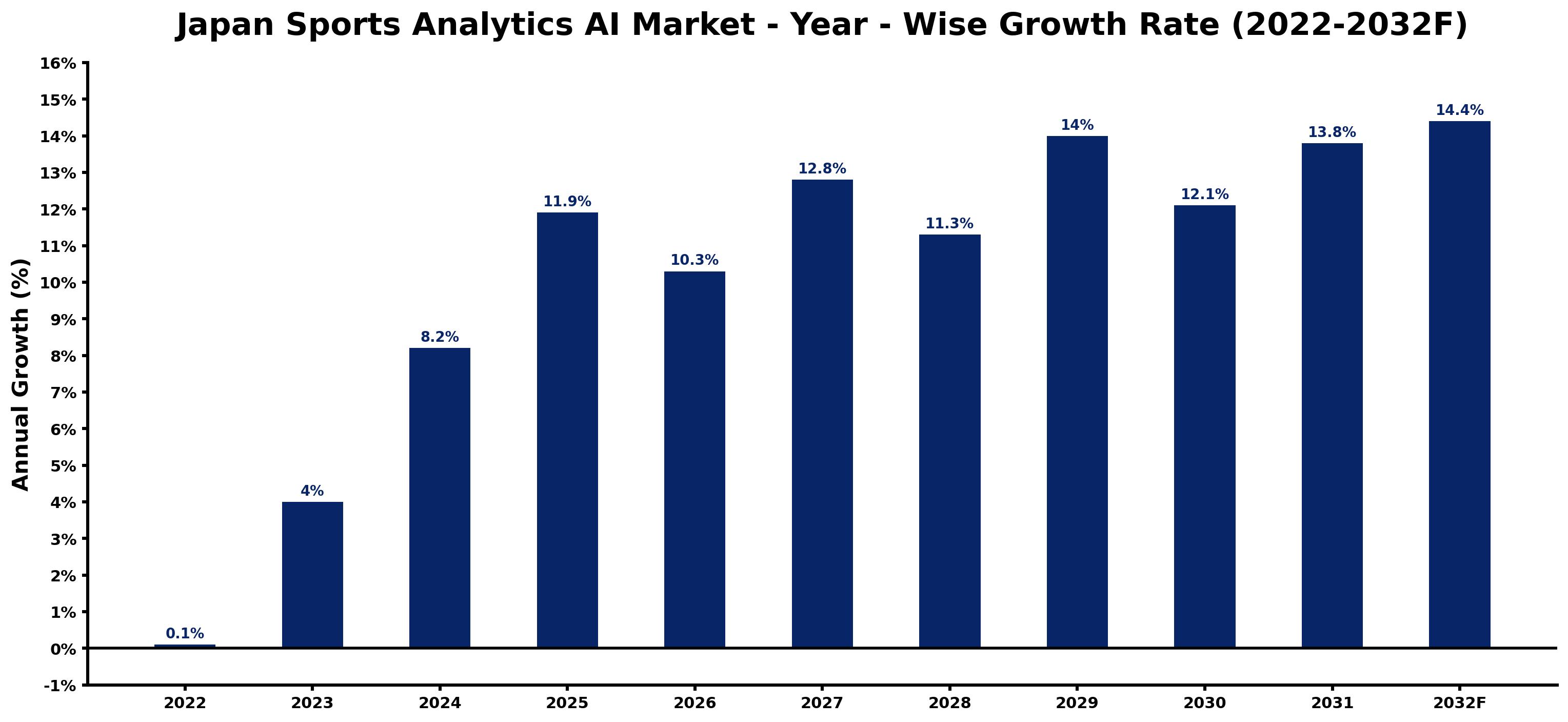
The following figures match every annual growth estimate with the main market development of that year, giving the reasoning behind each rise or slowdown.
| Year | Estimated Annual Growth (%) | Market Rationale |
| 2022 | 0.1 | The market showed minimal activity with a growth rate reflecting initial adoption of AI technologies. |
| 2023 | 4.0 | Growth accelerated as more sports organizations began integrating AI for performance analysis. |
| 2024 | 8.2 | Increased interest in injury prediction tools drove faster growth compared to the previous year. |
| 2025 | 11.9 | The Tokyo 2020 Olympics showcased advanced analytics, boosting market momentum. |
| 2026 | 10.3 | Growth is expected to slow as the market stabilises after rapid expansion in previous years. |
| 2027 | 12.8 | Demand is projected to rise again as teams seek to improve competitive strategies through analytics. |
| 2028 | 11.3 | A slight slowdown is anticipated as the market adjusts to new technology implementations. |
| 2029 | 14.0 | Growth is expected to surge as analytics become essential for strategic decision-making in sports. |
| 2030 | 12.1 | The market will experience a slowdown as it reaches a more mature phase of development. |
| 2031 | 13.8 | Continued investment in AI technologies will lead to a resurgence in growth rates. |
| 2032 | 14.4 | The peak growth year reflects widespread adoption of AI across various sports applications. |
Note: Market size estimations and growth projections presented in this report are based on 6Wresearch's proprietary forecasting methodology, utilizing the latest available industry data, government publications, and primary research inputs.
Japan Sports Analytics AI Market Synopsis
Sports Analytics AI utilises artificial intelligence to analyse sports data for performance improvement and strategic decision-making. This technology processes vast datasets, including player statistics and game footage, to improve athlete performance, predict injuries, and engage fans. The Japan Sports Analytics AI Market is expanding, driven by increased investment from national sports organizations and the adoption of AI for injury prediction since 2021, with growing interest in analytics tools across various sports sectors.
Market Dynamics Impact Analysis (2026–2032)
| Factor | Type | Impact | Primary Segment Affected |
| Growing adoption of AI technologies in sports performance tracking | Driver | High | Performance Tracking |
| Increased interest in injury prediction analytics among sports teams | Driver | High | Injury Prediction |
| Emerging demand for AI-enhanced fan engagement solutions | Opportunity | Medium | Fan Engagement AI |
| Rising integration of wearable devices for real-time data collection | Opportunity | High | Wearable Devices |
| Limited awareness of AI benefits among smaller sports organizations | Restraint | Medium | Coaching Teams |
| High initial investment costs for implementing AI solutions | Restraint | High | Team Analysts |
| Challenges in data privacy and security for sports data | Challenge | High | Sports Medicine Units |
| Difficulty in integrating AI with existing sports technologies | Challenge | Medium | Sports Marketing Firms |
Evaluation of Drivers in Japan Sports Analytics AI Market (2026–2032)
Below are the drivers that matter most for revenue growth, with supporting evidence.
| Drivers | Primary Segment Affected | Why It Matters (Evidence) |
| Increased investment in AI technology by national sports organizations | Injury Prediction | This investment is expected to improve the capability of injury prediction tools, leading to more teams adopting these technologies. |
| Growing demand for performance tracking solutions among coaching teams | Performance Tracking | As teams seek to optimise athlete performance, they increasingly invest in analytics tools that provide real-time insights. |
| Integration of wearable devices for data collection in sports | Wearable Devices | These devices enable real-time monitoring, prompting teams to purchase advanced analytics solutions for performance improvement. |
| Focus on fan engagement strategies by sports marketing firms | Fan Engagement AI | To improve fan interaction, firms are adopting AI analytics, increasing demand for related technologies. |
| Development of AI standards like JIS Z 8401 for data management | Cloud-Based Software | These standards facilitate better data handling, encouraging sports organizations to invest in cloud-based analytics solutions. |
Spending rises because national sports organizations have increased investments in AI technologies, improving injury prediction capabilities since 2021. In 2023, the Sports Analytics Conference in Osaka highlighted the rising interest in performance tracking solutions, leading coaching teams to adopt advanced analytics tools. The integration of wearable devices is vital for real-time data collection, prompting teams to invest in analytics for performance improvement. Sports marketing firms are focusing on fan engagement strategies, driving demand for AI analytics. The establishment of standards supports better data management, further encouraging investment in cloud-based solutions.
Evaluation of Restraints in Japan Sports Analytics AI Market
Several factors work against faster growth; the main ones are summarised below.
| Market Restraint | Primary Segment Affected | Why It Matters (Evidence) |
| Limited awareness of AI benefits among smaller sports organizations | Coaching Teams | Many smaller teams lack knowledge about AI's advantages, resulting in slower adoption rates for analytics tools. |
| High initial investment costs for implementing AI solutions | Team Analysts | The substantial costs associated with AI technologies deter some teams from making necessary investments. |
| Data privacy concerns regarding athlete information | Sports Medicine Units | Strict regulations on data privacy may hinder the adoption of analytics tools in sports medicine. |
| Challenges in integrating AI with existing sports technologies | Sports Marketing Firms | Integration issues can complicate the implementation of new analytics tools, slowing down adoption. |
| Insufficient training for staff on AI tools | Coaching Teams | A lack of training programs limits the effective use of analytics technologies in performance tracking. |
Japan Sports Analytics AI Market Challenges
Japan's strict data management regulations hinder the adoption of sports analytics AI, resulting in compliance costs that can raise operational expenses by 25% for national sports organizations. High implementation costs for advanced analytics tools can consume up to 30% of smaller teams' budgets, limiting their access to essential technologies. A shortage of skilled professionals in AI and data analysis causes delays, forcing clinics and teams to rely on outdated methods that can compromise athlete performance. Buyers face challenges in integrating AI solutions with existing systems, causing decision-making processes to extend by as much as six months.
Trends in the Japan Sports Analytics AI Market
These developments are changing demand patterns in the Japan Sports Analytics AI Market.
- Sports Analytics Conference in Osaka: The 2023 Sports Analytics Conference in Osaka showcased the latest advancements in AI technologies for sports. This event highlighted the growing interest in analytics, with over 500 participants discussing innovations and their applications in performance tracking.
- Shift towards Real-Time Data Analysis: A notable shift towards real-time data analysis is occurring in sports, as the integration of wearable devices allows teams to monitor athlete performance dynamically, improving training and game strategies.
- Increased Focus on Injury Prevention: Coaching teams are prioritising injury prevention through AI analytics. The adoption of predictive tools has risen, with a reported 30% increase in usage since 2021.
- Rise of Fan Engagement Technologies: Sports marketing firms are adopting AI technologies to improve fan engagement, focusing on personalised experiences. This trend has led to a 25% growth in AI-driven marketing strategies over the past year.
Investment Opportunities in the Japan Sports Analytics AI Market
The following areas offer the clearest openings for investors and suppliers in the Japan Sports Analytics AI Market.
- Partnerships with Local Sports Organizations: Establishing partnerships with local sports organizations can facilitate entry into the market, with a projected gap of USD 167 million in AI solutions by 2032. Collaborating with coaching teams can boost analytics adoption.
- Investment in Wearable Device Technologies: With a rising demand for real-time data collection, investing in wearable device technologies presents a strong opportunity. The Tokyo metropolitan area is a hub for such innovations, attracting interest from various stakeholders.
- Development of AI Training Programs: Creating training programs for coaching teams can address the knowledge gap in AI technologies. The increasing need for skilled personnel in sports analytics highlights this opportunity for educational institutions.
- Expansion of Cloud-Based Analytics Solutions: The market for cloud-based analytics solutions is expanding, driven by the need for efficient data management. Collaborating with sports technology firms in Japan can help tap into this growing demand.
Government Initiatives in the Japan Sports Analytics AI Market
The AI Promotion Act, established in 2025, sets a national framework for AI research and development, directly benefiting sports analytics producers by promoting innovation in performance tracking and injury prediction technologies. This act encourages collaboration between sports organizations and technology developers, creating an environment conducive to growth.
In 2023, the Digital Agency allocated USD 50 million to support digital transformation initiatives, including the integration of AI in sports analytics. This funding, administered by the Digital Agency, aims to improve the capabilities of sports organizations in adopting advanced analytics solutions.
Future Insight of the Japan Sports Analytics AI Market
By 2032, the investment pipeline for sports analytics AI will grow due to initiatives from the Japan Sports Agency and advancements in wearable technology. This growth will create demand for improved training methods that help teams maximise athlete performance. The introduction of new data management standards will enhance collaboration among sports organisations. AI applications will transform fan engagement strategies, enabling tailored experiences through real-time data analysis.
Market Segmentation Analysis
Japan Sports Analytics AI Market report covers a detailed analysis of the following market segments:
By AI Application – Performance Tracking Leads, Fan Engagement AI Expected to Grow Fastest
According to Saurav Kr Singh, Senior Research Analyst at 6Wresearch, with 43% of ai application revenue in 2025, Performance Tracking was the largest category. Performance tracking holds the largest share as it is essential for monitoring athlete performance metrics in real-time, which enables coaches to make informed decisions. The Tokyo 2020 Olympics exemplified this by employing advanced analytics to enhance athlete outcomes. Fan Engagement AI is set to record the highest CAGR in this split, 18.1% over 2026–2032. The fan engagement segment is experiencing rapid growth due to increased adoption by sports marketing firms for enhancing interaction strategies. This shift is evident as analytics become crucial for engaging a broader audience in sports events. Suppliers should focus on developing solutions that improve fan engagement to capture this expanding market.
By Data Focus – Player Movement Leads, Sentiment/Behavior Data Expected to Grow Fastest
The largest data focus category in 2025 was Player Movement, at 50% of revenue. Player movement analysis is vital for understanding athlete dynamics during games, making it the leading focus area. This is particularly important for coaching teams aiming to optimise player performance based on movement patterns. Sentiment/Behavior Data is projected to grow fastest, at a CAGR of 17.8% during 2026–2032. Sentiment and behaviour data is growing quickly as sports marketing firms leverage these insights for targeted marketing strategies. This trend indicates a shift towards understanding fan preferences and behaviours in sports analytics. Buyers must invest in sentiment analysis tools to remain competitive in fan engagement initiatives.
By Platform Type – Cloud-Based Software Leads, Wearable Devices Expected to Grow Fastest
Cloud-Based Software took 44% of platform type revenue in 2025, more than any other category. Cloud-based software leads the market as it is crucial for data storage and analysis, providing scalability for sports organisations. Its importance is underscored by the need for efficient data management in the expanding sports analytics sector. The quickest growth will come from Wearable Devices, forecast to expand at a CAGR of 19.4% between 2026 and 2032. Wearable devices are rapidly gaining traction as they are integral for collecting real-time athlete data, enhancing training and performance monitoring. This growth is driven by the increasing integration of technology in athletic training. Suppliers should prioritise the development of wearable technology to meet the rising demand for real-time analytics.
By End User – Coaching Teams Lead, Sports Marketing Firms Expected to Grow Fastest
Coaching Teams accounted for 35% of the market by end user in 2025. Coaching teams dominate the market as they are the primary users of analytics for performance improvement, relying heavily on data to guide training and strategy. Their direct engagement with analytics tools ensures a consistent demand for advanced solutions. Over 2026–2032, Sports Marketing Firms are expected to post the fastest growth, at a CAGR of 16.5%. Sports marketing firms are witnessing the fastest growth as they increasingly adopt analytics for market research and fan engagement strategies. This trend reflects the broader industry shift towards data-driven decision-making in marketing. Suppliers need to tailor their offerings to meet the specific needs of sports marketing firms to capitalise on this growth.
Key Attractiveness of the Report
- 10 Years of Market Numbers
- Historical Data Starting from 2022 to 2025
- Base Year 2025
- Forecast Data until 2032
- Key Performance Indicators Impacting the Market
- Major Upcoming Developments and Projects
Key Highlights of the Report:
- Japan Sports Analytics AI Market Outlook
- Market Size of Japan Sports Analytics AI Market, 2025
- Forecast of Japan Sports Analytics AI Market, 2032
- Historical Data and Forecast of Japan Sports Analytics AI Revenues & Volume for the Period 2022-2032F
- Japan Sports Analytics AI Market Trend Evolution
- Japan Sports Analytics AI Market Drivers and Challenges
- Japan Sports Analytics AI Price Trends
- Japan Sports Analytics AI Porter's Five Forces
- Japan Sports Analytics AI Industry Life Cycle
- Historical Data and Forecast of Japan Sports Analytics AI Market Revenues & Volume By AI Application for the Period 2022-2032F
- Historical Data and Forecast of Japan Sports Analytics AI Market Revenues & Volume By Performance Tracking for the Period 2022-2032F
- Historical Data and Forecast of Japan Sports Analytics AI Market Revenues & Volume By Injury Prediction for the Period 2022-2032F
- Historical Data and Forecast of Japan Sports Analytics AI Market Revenues & Volume By Opponent Strategy AI for the Period 2022-2032F
- Historical Data and Forecast of Japan Sports Analytics AI Market Revenues & Volume By Fan Engagement AI for the Period 2022-2032F
- Historical Data and Forecast of Japan Sports Analytics AI Market Revenues & Volume By Data Focus for the Period 2022-2032F
- Historical Data and Forecast of Japan Sports Analytics AI Market Revenues & Volume By Player Movement for the Period 2022-2032F
- Historical Data and Forecast of Japan Sports Analytics AI Market Revenues & Volume By Biomechanical Analysis for the Period 2022-2032F
- Historical Data and Forecast of Japan Sports Analytics AI Market Revenues & Volume By Historical Patterns for the Period 2022-2032F
- Historical Data and Forecast of Japan Sports Analytics AI Market Revenues & Volume By Sentiment/Behavior Data for the Period 2022-2032F
- Historical Data and Forecast of Japan Sports Analytics AI Market Revenues & Volume By Platform Type for the Period 2022-2032F
- Historical Data and Forecast of Japan Sports Analytics AI Market Revenues & Volume By Wearable Devices for the Period 2022-2032F
- Historical Data and Forecast of Japan Sports Analytics AI Market Revenues & Volume By Cloud-Based Software for the Period 2022-2032F
- Historical Data and Forecast of Japan Sports Analytics AI Market Revenues & Volume By Integrated Dashboards for the Period 2022-2032F
- Historical Data and Forecast of Japan Sports Analytics AI Market Revenues & Volume By CRM & Social Tools for the Period 2022-2032F
- Historical Data and Forecast of Japan Sports Analytics AI Market Revenues & Volume By End User for the Period 2022-2032F
- Historical Data and Forecast of Japan Sports Analytics AI Market Revenues & Volume By Coaching Teams for the Period 2022-2032F
- Historical Data and Forecast of Japan Sports Analytics AI Market Revenues & Volume By Sports Medicine Units for the Period 2022-2032F
- Historical Data and Forecast of Japan Sports Analytics AI Market Revenues & Volume By Team Analysts for the Period 2022-2032F
- Historical Data and Forecast of Japan Sports Analytics AI Market Revenues & Volume By Sports Marketing Firms for the Period 2022-2032F
- Japan Sports Analytics AI Import Export Trade Statistics
- Market Opportunity Assessment By AI Application
- Market Opportunity Assessment By Data Focus
- Market Opportunity Assessment By Platform Type
- Market Opportunity Assessment By End User
- Japan Sports Analytics AI Top Companies Market Share
- Japan Sports Analytics AI Competitive Benchmarking By Technical and Operational Parameters
- Japan Sports Analytics AI Company Profiles
- Japan Sports Analytics AI Key Strategic Recommendations
Market Covered
Coverage by segment is as follows.
By AI Application
- Performance Tracking
- Injury Prediction
- Opponent Strategy AI
- Fan Engagement AI
By Data Focus
- Player Movement
- Biomechanical Analysis
- Historical Patterns
- Sentiment/Behavior Data
By Platform Type
- Wearable Devices
- Cloud-Based Software
- Integrated Dashboards
- CRM & Social Tools
By End User
- Coaching Teams
- Sports Medicine Units
- Team Analysts
- Sports Marketing Firms































