Japan Sports Performance Equipment Market Size & Growth Rate
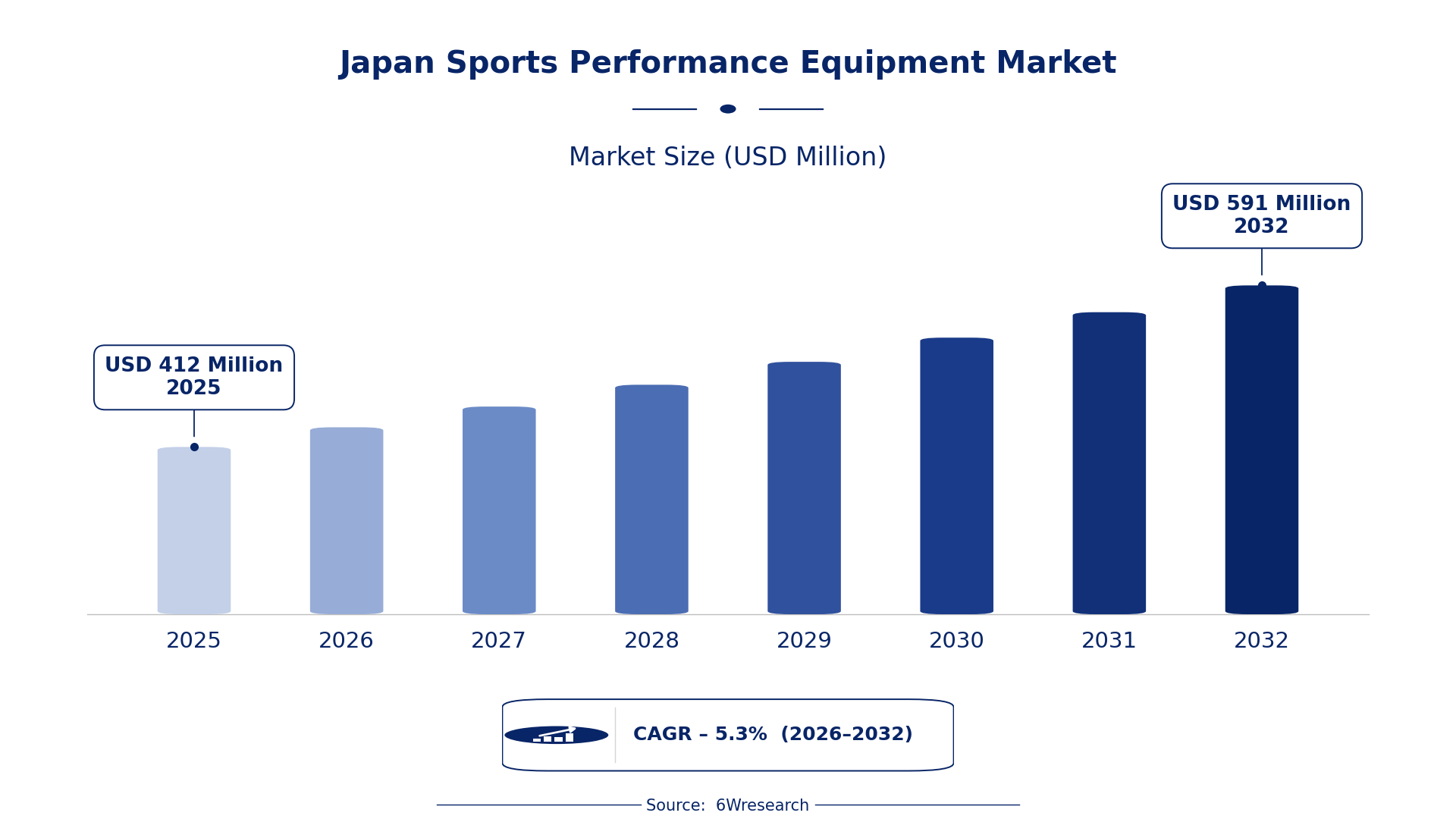
According to 6Wresearch internal database and industry insights, the Japan Sports Performance Equipment Market was valued at USD 412 Million in 2025 and is projected to reach USD 591 Million by 2032, growing at a CAGR of approximately 5.3% during 2026–2032.
Japan Sports Performance Equipment Market Highlights
| Report Metric | Details |
| Report Name | Japan Sports Performance Equipment Market (2026-2032) |
| Market Size 2025 | USD 412 Million |
| Market Size 2032 | USD 591 Million |
| Absolute Growth 2025–2032 | USD 179 Million |
| CAGR 2026–2032 | 5.3% |
| Peak Annual Growth | 6.1% in 2027 |
| Forecast Period | 2026–2032 |
| Historical Data | 2022–2025 |
| Base Year | 2025 |
| Leading Equipment Type, 2025 | Resistance Trainers (43% share) |
| Leading Sport Application, 2025 | Strength Training (42% share) |
| Leading Key Feature, 2025 | Adjustable Tension (46% share) |
| Leading End User, 2025 | Fitness Studios (46% share) |
| Fastest-Growing Equipment Type | Speed Ladders & Hurdles (7.6% CAGR) |
| Fastest-Growing Sport Application | Agility Training (7.1% CAGR) |
| Fastest-Growing Key Feature | Portable (6.9% CAGR) |
| Fastest-Growing End User | Athletic Coaches (6.6% CAGR) |
| Growing Sector | Agility Training |
| Key End Users | Strength Training, Agility Training, Biometric Monitoring, Core Stability |
Japan Sports Performance Equipment Market Year-wise Growth Rate and Key Drivers (2022–2032)
This graph illustrates the annual growth rates of the market from 2022 to 2032, highlighting a steady upward trajectory and projected market expansion over the forecast period.
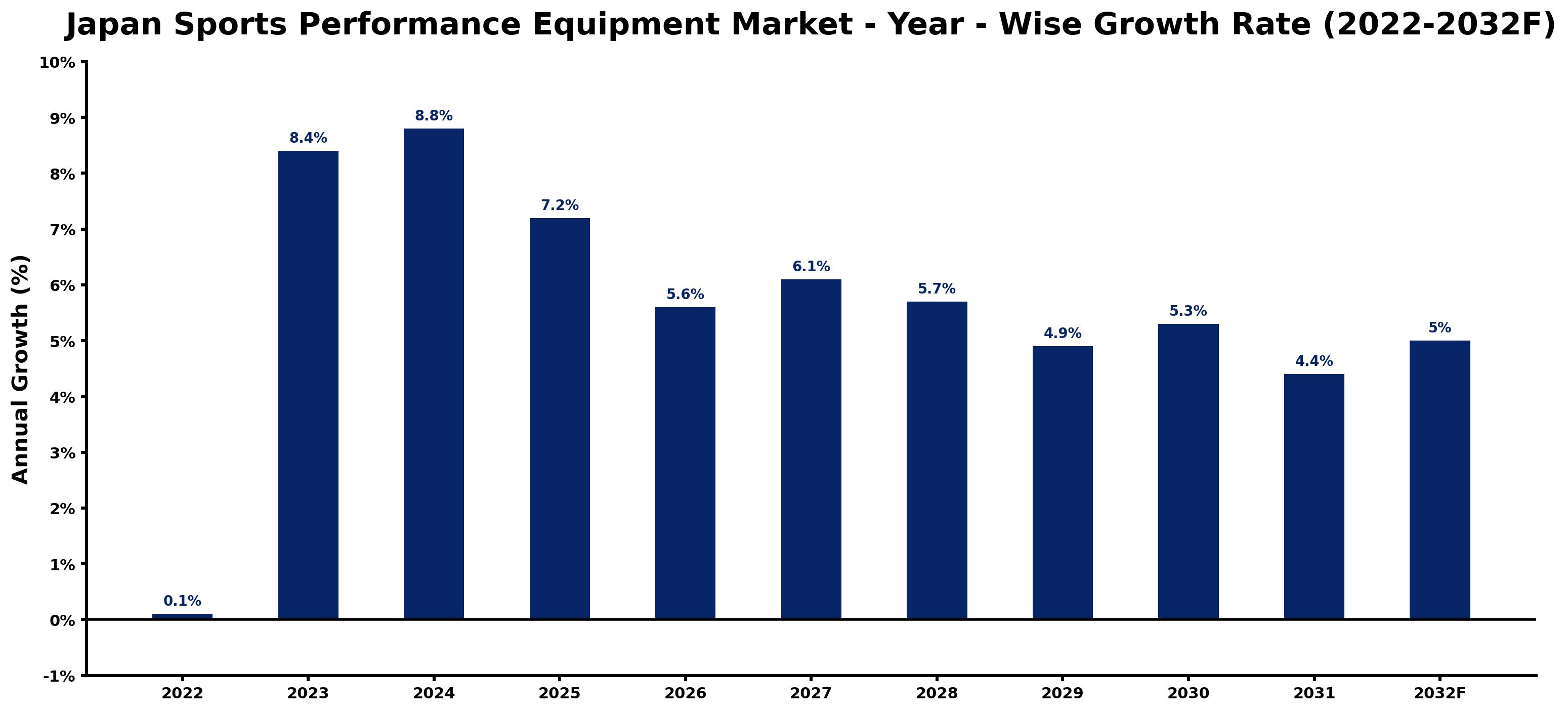
Below, each year's estimated growth is shown next to the factor that most influenced it.
| Year | Estimated Annual Growth (%) | Market Rationale |
| 2022 | 0.1 | The market experienced minimal growth due to limited consumer awareness of performance equipment. |
| 2023 | 8.4 | Increased fitness participation among urban populations boosted demand for sports performance equipment. |
| 2024 | 8.8 | The Tokyo 2020 Olympics heightened interest in athletic training tools and technologies. |
| 2025 | 7.2 | Growth slowed as market saturation began to impact new purchases of performance equipment. |
| 2026 | 5.6 | Demand is expected to continue rising, driven by the expansion of fitness studios and training programs. |
| 2027 | 6.1 | A surge in interest for agility training tools will lead to a rebound in market growth. |
| 2028 | 5.7 | Growth is projected to moderate as consumers become more selective in their equipment purchases. |
| 2029 | 4.9 | The market will experience slower growth as competition intensifies among equipment providers. |
| 2030 | 5.3 | Demand will increase again, driven by the adoption of portable training equipment. |
| 2031 | 4.4 | Growth is expected to slow as market maturity leads to a focus on product differentiation. |
| 2032 | 5.0 | A renewed interest in biometric monitoring tools is projected to drive growth. |
Note: Market size estimations and growth projections presented in this report are based on 6Wresearch's proprietary forecasting methodology, utilizing the latest available industry data, government publications, and primary research inputs.
Japan Sports Performance Equipment Market Synopsis
Sports performance equipment consists of tools designed to enhance athletic capabilities through training and monitoring. The Japan Sports Performance Equipment Market is growing due to over 30 million fitness enthusiasts and a rising interest in wearable trackers, which have achieved a 15% adoption rate among urban athletes. The increase in fitness studios in urban centres like Tokyo and the promotion of sports performance programs by the Ministry of Education are key contributors to this demand.
Market Dynamics Impact Analysis (2026–2032)
| Factor | Type | Impact | Primary Segment Affected |
| Growing fitness culture in urban areas | Driver | High | Wearable Trackers |
| Increased focus on agility training by athletic coaches | Driver | High | Speed Ladders & Hurdles |
| Rising demand for innovative rehabilitation tools | Opportunity | Medium | Balance Boards |
| Growing interest in outdoor fitness activities | Opportunity | Medium | Portable |
| Market saturation impacting new purchases | Restraint | High | Resistance Trainers |
| Limited awareness of advanced training tools | Restraint | Medium | Wearable Trackers |
| High costs associated with advanced equipment | Challenge | High | Strength Training |
| Intense competition among equipment providers | Challenge | Medium | Agility Training |
Evaluation of Drivers in Japan Sports Performance Equipment Market (2026–2032)
The following drivers explain most of the expected growth.
| Drivers | Primary Segment Affected | Why It Matters (Evidence) |
| Increased participation in fitness activities | Wearable Trackers | Japan has over 30 million fitness enthusiasts, leading to higher demand for tracking devices. |
| Focus on agility training | Speed Ladders & Hurdles | Agility training is a key focus for many athletic coaches in Japan, driving equipment purchases. |
| Growth of fitness studios | Resistance Trainers | Resistance trainers are commonly used in over 1,000 fitness studios nationwide, boosting sales. |
| Adoption of biometric monitoring | Balance Boards | Performance labs in Japan are equipped with advanced biometric monitoring tools, increasing demand. |
| Rising interest in outdoor workouts | Portable | Portable training equipment is favored for outdoor and travel workouts, appealing to active consumers. |
A wider customer base explains much of the growth, as over 30 million fitness enthusiasts in Japan increasingly adopt wearable trackers, which have reached a 15% adoption rate among athletes in urban areas. The expansion of fitness studios, particularly in Tokyo, has led to widespread use of resistance trainers, commonly found in numerous facilities. Athletic coaches are increasingly focusing on agility training, driving demand for speed ladders and hurdles. Performance labs are equipped with advanced biometric monitoring tools, increasing the need for effective training equipment. The popularity of portable training tools is also rising, catering to consumers who prefer outdoor workouts.
Evaluation of Restraints in Japan Sports Performance Equipment Market
The following restraints limit how fast demand can grow.
| Market Restraint | Primary Segment Affected | Why It Matters (Evidence) |
| Market saturation limiting new purchases | Resistance Trainers | As more consumers already own performance equipment, new purchases are slowing down. |
| Limited awareness of advanced training tools | Wearable Trackers | Many potential users remain unaware of the benefits of biometric monitoring devices. |
| High costs associated with advanced equipment | Strength Training | The price of advanced strength training equipment can deter budget-conscious buyers. |
| Intense competition among equipment providers | Agility Training | Competition leads to price wars, affecting profitability for suppliers. |
| Consumer preference for established brands | Balance Boards | New entrants struggle to gain market share due to brand loyalty among consumers. |
Japan Sports Performance Equipment Market Challenges
A shortage of skilled trainers limits producers' ability to develop advanced sports performance equipment, resulting in product delays that can extend up to six months. Buyers face increased costs as competition for quality materials drives prices up by 20%, impacting budgets for fitness facilities. Rapid technological advancements leave buyers struggling to keep pace, leading to reliance on outdated equipment that fails to meet current performance demands. Logistical issues disrupt supply chains, causing shipment delays of several weeks for importers, which frustrates consumers eager for timely access to new products.
Trends in the Japan Sports Performance Equipment Market
Below are the shifts with the largest effect on the Japan Sports Performance Equipment Market.
- Shift from Traditional to Biometric Monitoring: In 2023, there has been a noticeable shift towards biometric monitoring tools in fitness. Performance labs in Japan are increasingly equipped with advanced biometric monitoring tools, reflecting a growing preference for data-driven training methods.
- Transition from Indoor to Outdoor Training: In 2024, outdoor training became more popular as consumers sought variety in their workouts. Portable training equipment is favoured for outdoor and travel workouts, appealing to active consumers.
- Emergence of Adjustable Tension Equipment: Starting in 2025, adjustable tension equipment gained traction among fitness enthusiasts. With a 46% share in 2025, adjustable tension devices are preferred for their versatility in training.
- Rise of Agility Training Tools: Beginning in 2026, agility training tools like speed ladders gained popularity. Athletic coaches in Japan increasingly focus on agility training, driving demand for these specialised tools.
Investment Opportunities in the Japan Sports Performance Equipment Market
Investors looking at the Japan Sports Performance Equipment Market should consider the following areas.
- Growing Demand for Portable Equipment: With fitness enthusiasts increasingly seeking outdoor training options, the market for portable equipment is expanding. This trend is particularly strong among active consumers in urban areas, where convenience is key.
- Investment in Biometric Monitoring Tools: As awareness of health metrics rises, there is a significant opportunity to supply biometric monitoring tools. Performance labs and fitness studios are key buyers, looking to enhance their training programs.
- Expansion of Fitness Studios: The growth of fitness studios in urban areas creates a demand for a variety of performance equipment. Suppliers can enter this market by partnering with local fitness chains.
- Focus on Youth Sports Development: With government initiatives promoting youth sports, there is a pressing need for performance equipment in schools. Suppliers can gain access through collaborations with educational institutions.
Government Initiatives in the Japan Sports Performance Equipment Market
The GX Basic Policy adopted in 2023 aims for about JPY 150 trillion of public-private decarbonisation investment over 10 years, promoting sustainable practices in the sports performance equipment sector. This measure builds on the Industrial Standardization Act, which governs product standards and ensures quality in sports equipment.
The Japan Sports Agency supports initiatives for youth sports development, allocating significant funds annually to enhance sports infrastructure. This agency plays an important role in approving projects that improve access to sports performance equipment for schools and communities.
Future Insight of the Japan Sports Performance Equipment Market
By 2032, government initiatives will drive the development of new training tools tailored to improve athletic performance metrics. Increased funding for youth sports will elevate participation rates and demand for sports equipment in schools. The integration of smart technologies will expand, with wearable trackers becoming standard in training environments. Performance labs will upgrade their offerings, using advanced biometric monitoring tools to provide athletes with immediate feedback, contributing to the 200 billion yen in fitness equipment sales recorded in 2023.
Market Segmentation Analysis
Japan Sports Performance Equipment Market report covers a detailed analysis of the following market segments:
By Equipment Type – Resistance Trainers Lead, Speed Ladders & Hurdles Expected to Grow Fastest
According to Saurav Kr Singh, Senior Research Analyst at 6Wresearch, in 2025, Resistance Trainers led the equipment type split with a 43% share. Resistance trainers hold the largest share due to their extensive use in over 1,000 fitness studios across Japan, catering to both strength training and rehabilitation needs. Their versatility makes them a preferred choice among fitness enthusiasts looking for effective workout solutions. Speed Ladders & Hurdles are set to record the highest CAGR in this split, 7.6% over 2026–2032. Speed ladders and hurdles are experiencing rapid growth as agility training gains traction among athletic coaches, particularly in high school programmes. This heightened focus on agility indicates a broader shift towards optimising athletic performance in competitive environments. Suppliers should prioritise agility training equipment to capitalise on the growing interest from coaches and athletes.
By Sport Application – Strength Training Leads, Agility Training Expected to Grow Fastest
Strength Training accounted for 42% of the market by sport application in 2025. Strength training leads the market as it is essential for improving physical performance across various sports, making it a primary focus for many fitness enthusiasts. The government's initiatives promoting sports performance enhancement programmes further underscore the significance of strength training. Agility Training is projected to grow fastest, at a CAGR of 7.1% during 2026–2032. Agility training is witnessing rapid growth as athletes increasingly recognise the necessity for quick directional changes in competitive sports. This trend is reflected in the heightened emphasis coaches place on agility training techniques. Buyers should invest in agility training tools to enhance their competitive edge in sports.
By Key Feature – Adjustable Tension Leads, Portable Expected to Grow Fastest
Adjustable Tension took 46% of key feature revenue in 2025, more than any other category. Adjustable tension is a key feature as it allows users to customise resistance levels for different training intensities, making it vital in various training settings. This adaptability appeals to both casual users and serious athletes aiming to maximise their workout efficiency. The quickest growth will come from Portable, forecast to expand at a CAGR of 6.9% between 2026 and 2032. Portable equipment is gaining traction due to its convenience, enabling users to train in diverse locations such as parks or while travelling. The rising demand for flexible training solutions is evident among fitness enthusiasts who value versatility. Suppliers should focus on developing portable training solutions to meet the needs of on-the-go fitness enthusiasts.
By End User – Fitness Studios Lead, Athletic Coaches Expected to Grow Fastest
Fitness Studios held 46% of the Japan Sports Performance Equipment Market by end user in 2025. Fitness studios are the largest user group of performance equipment, relying on these tools to conduct a wide range of classes for numerous fitness enthusiasts. Their significant presence in urban areas drives the demand for advanced sports performance equipment. Over 2026–2032, Athletic Coaches are expected to post the fastest growth, at a CAGR of 6.6%. Athletic coaches are increasingly adopting performance equipment to enhance their training methodologies, reflecting a growing awareness of the importance of specialised training tools. This trend is likely to accelerate as more coaches aim to improve athlete performance. Suppliers must engage with athletic coaches to tailor products to their specific training needs.
Key Attractiveness of the Report
- 10 Years of Market Numbers
- Historical Data Starting from 2022 to 2025
- Base Year 2025
- Forecast Data until 2032
- Key Performance Indicators Impacting the Market
- Major Upcoming Developments and Projects
Key Highlights of the Report:
- Japan Sports Performance Equipment Market Outlook
- Market Size of Japan Sports Performance Equipment Market, 2025
- Forecast of Japan Sports Performance Equipment Market, 2032
- Historical Data and Forecast of Japan Sports Performance Equipment Revenues & Volume for the Period 2022-2032F
- Japan Sports Performance Equipment Market Trend Evolution
- Japan Sports Performance Equipment Market Drivers and Challenges
- Japan Sports Performance Equipment Price Trends
- Japan Sports Performance Equipment Porter's Five Forces
- Japan Sports Performance Equipment Industry Life Cycle
- Historical Data and Forecast of Japan Sports Performance Equipment Market Revenues & Volume By Equipment Type for the Period 2022-2032F
- Historical Data and Forecast of Japan Sports Performance Equipment Market Revenues & Volume By Resistance Trainers for the Period 2022-2032F
- Historical Data and Forecast of Japan Sports Performance Equipment Market Revenues & Volume By Speed Ladders & Hurdles for the Period 2022-2032F
- Historical Data and Forecast of Japan Sports Performance Equipment Market Revenues & Volume By Wearable Trackers for the Period 2022-2032F
- Historical Data and Forecast of Japan Sports Performance Equipment Market Revenues & Volume By Balance Boards for the Period 2022-2032F
- Historical Data and Forecast of Japan Sports Performance Equipment Market Revenues & Volume By Sport Application for the Period 2022-2032F
- Historical Data and Forecast of Japan Sports Performance Equipment Market Revenues & Volume By Strength Training for the Period 2022-2032F
- Historical Data and Forecast of Japan Sports Performance Equipment Market Revenues & Volume By Agility Training for the Period 2022-2032F
- Historical Data and Forecast of Japan Sports Performance Equipment Market Revenues & Volume By Biometric Monitoring for the Period 2022-2032F
- Historical Data and Forecast of Japan Sports Performance Equipment Market Revenues & Volume By Core Stability for the Period 2022-2032F
- Historical Data and Forecast of Japan Sports Performance Equipment Market Revenues & Volume By Key Feature for the Period 2022-2032F
- Historical Data and Forecast of Japan Sports Performance Equipment Market Revenues & Volume By Adjustable Tension for the Period 2022-2032F
- Historical Data and Forecast of Japan Sports Performance Equipment Market Revenues & Volume By Portable for the Period 2022-2032F
- Historical Data and Forecast of Japan Sports Performance Equipment Market Revenues & Volume By Bluetooth-Enabled for the Period 2022-2032F
- Historical Data and Forecast of Japan Sports Performance Equipment Market Revenues & Volume By Anti-Slip for the Period 2022-2032F
- Historical Data and Forecast of Japan Sports Performance Equipment Market Revenues & Volume By End User for the Period 2022-2032F
- Historical Data and Forecast of Japan Sports Performance Equipment Market Revenues & Volume By Fitness Studios for the Period 2022-2032F
- Historical Data and Forecast of Japan Sports Performance Equipment Market Revenues & Volume By Athletic Coaches for the Period 2022-2032F
- Historical Data and Forecast of Japan Sports Performance Equipment Market Revenues & Volume By Performance Labs for the Period 2022-2032F
- Historical Data and Forecast of Japan Sports Performance Equipment Market Revenues & Volume By Physio Clinics for the Period 2022-2032F
- Japan Sports Performance Equipment Import Export Trade Statistics
- Market Opportunity Assessment By Equipment Type
- Market Opportunity Assessment By Sport Application
- Market Opportunity Assessment By Key Feature
- Market Opportunity Assessment By End User
- Japan Sports Performance Equipment Top Companies Market Share
- Japan Sports Performance Equipment Competitive Benchmarking By Technical and Operational Parameters
- Japan Sports Performance Equipment Company Profiles
- Japan Sports Performance Equipment Key Strategic Recommendations
Market Covered
Coverage by segment is as follows.
By Equipment Type
- Resistance Trainers
- Speed Ladders & Hurdles
- Wearable Trackers
- Balance Boards
By Sport Application
- Strength Training
- Agility Training
- Biometric Monitoring
- Core Stability
By Key Feature
- Adjustable Tension
- Portable
- Bluetooth-Enabled
- Anti-Slip
By End User
- Fitness Studios
- Athletic Coaches
- Performance Labs
- Physio Clinics































