Japan Spray-Less Tank Market Size & Growth Rate
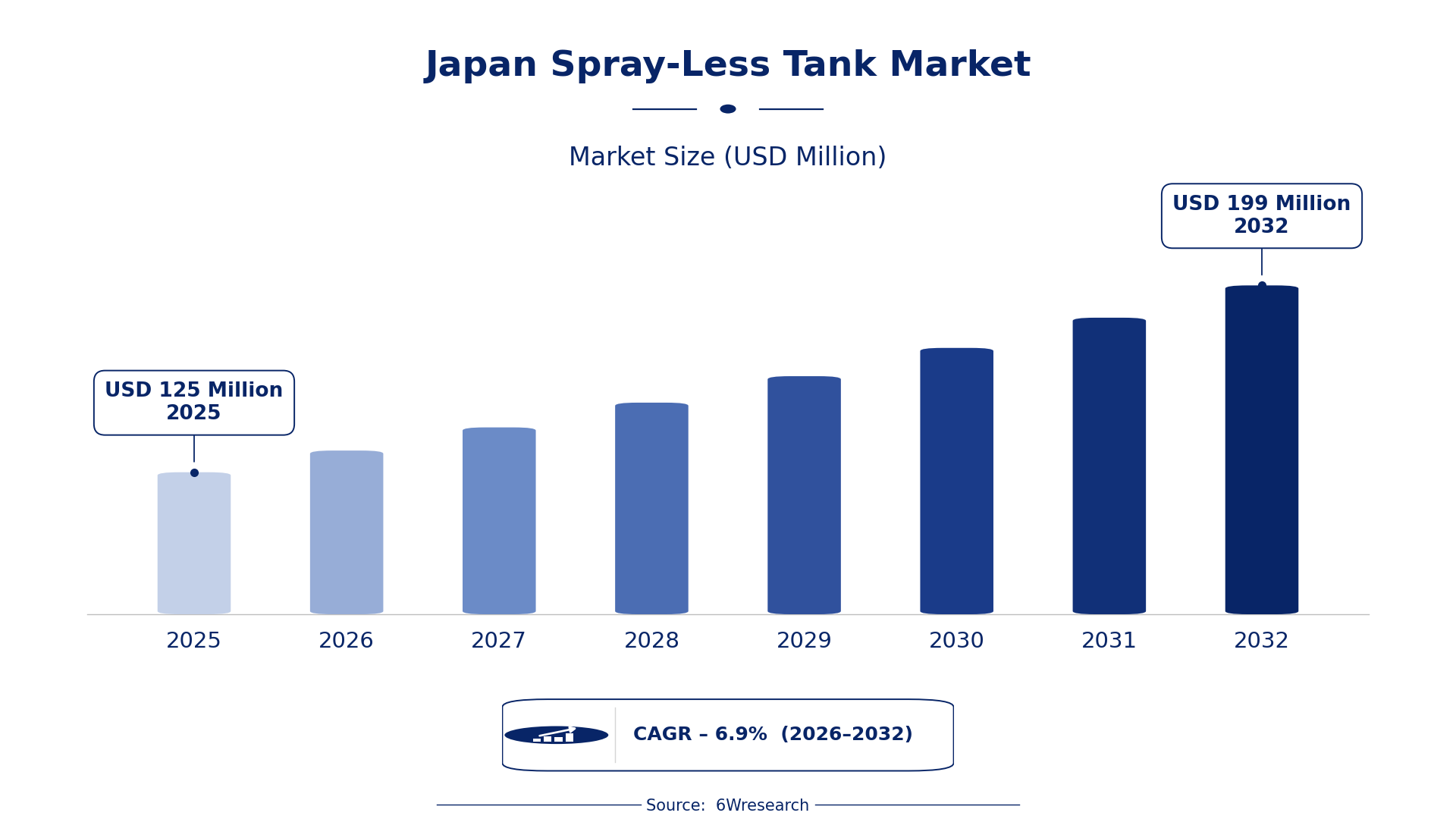
According to 6Wresearch internal database and industry insights, the Japan Spray-Less Tank Market was valued at USD 125 Million in 2025 and is projected to reach USD 199 Million by 2032, growing at a CAGR of approximately 6.9% during 2026–2032.
Japan Spray-Less Tank Market Highlights
| Report Metric | Details |
| Report Name | Japan Spray-Less Tank Market (2026-2032) |
| Market Size 2025 | USD 125 Million |
| Market Size 2032 | USD 199 Million |
| Absolute Growth 2025–2032 | USD 74 Million |
| CAGR 2026–2032 | 6.9% |
| Peak Annual Growth | 7.6% in 2032 |
| Forecast Period | 2026–2032 |
| Historical Data | 2022–2025 |
| Base Year | 2025 |
| Leading Tank Type, 2025 | Industrial Storage (50% share) |
| Leading Application Type, 2025 | Chemical Containment (38% share) |
| Leading Coating Material, 2025 | Corrosion-Resistant Coating (46% share) |
| Leading End User, 2025 | Petrochemical Plants (47% share) |
| Fastest-Growing Tank Type | Agricultural Tanks (9.9% CAGR) |
| Fastest-Growing Application Type | Fertilizer Storage (9.1% CAGR) |
| Fastest-Growing Coating Material | Spray-Less Laminate (9.7% CAGR) |
| Fastest-Growing End User | Agrochemical Firms (8.8% CAGR) |
| Growing Sector | agrochemical sector |
| Key End Users | petrochemical plants, agrochemical firms, disaster relief units, fire departments |
Japan Spray-Less Tank Market Year-wise Growth Rate and Key Drivers (2022–2032)
This graph illustrates the annual growth rates of the market from 2022 to 2032, highlighting a steady upward trajectory and projected market expansion over the forecast period.
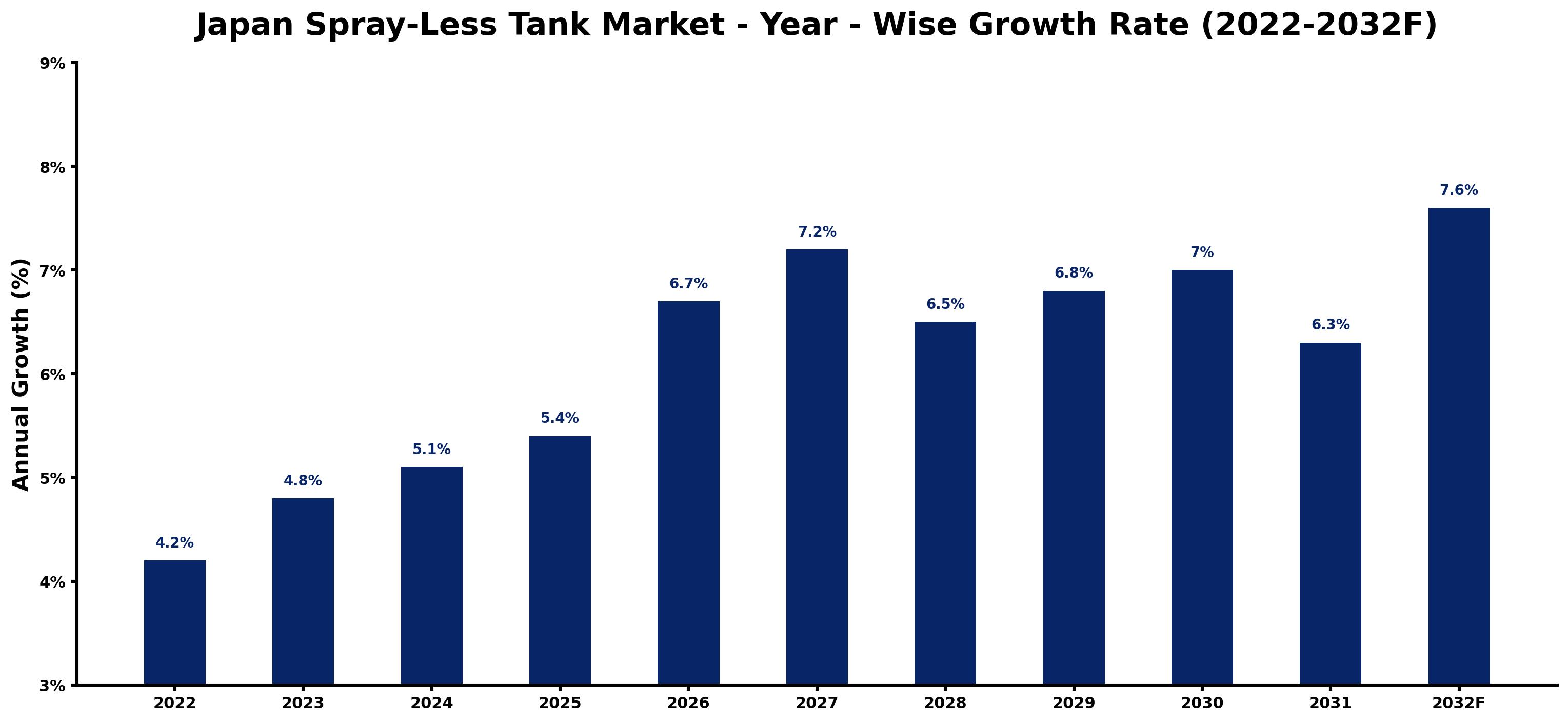
Below, each year's estimated growth is shown next to the factor that most influenced it.
| Year | Estimated Annual Growth (%) | Market Rationale |
| 2022 | 4.2 | The market experienced stable demand from industrial storage applications. |
| 2023 | 4.8 | Increased adoption of specialized agricultural tanks contributed to market growth. |
| 2024 | 5.1 | Growing fertilizer usage in agriculture spurred demand for storage solutions. |
| 2025 | 5.4 | The implementation of new fire suppression standards improved safety and demand. |
| 2026 | 6.7 | Rising logistics needs will drive demand for mobile tanks in various sectors. |
| 2027 | 7.2 | The agrochemical sector's expansion will support higher tank requirements. |
| 2028 | 6.5 | Market growth will slow slightly as demand stabilises after rapid increases. |
| 2029 | 6.8 | Increased agricultural productivity will lead to a rise in fertilizer storage needs. |
| 2030 | 7.0 | Growing awareness of environmental standards will boost demand for innovative tanks. |
| 2031 | 6.3 | Market growth will moderate as supply chains adjust to new demands. |
| 2032 | 7.6 | The introduction of advanced tank technologies will drive significant growth. |
Note: Market size estimations and growth projections presented in this report are based on 6Wresearch's proprietary forecasting methodology, utilizing the latest available industry data, government publications, and primary research inputs.
Japan Spray-Less Tank Market Synopsis
Spray-Less Tanks are advanced storage solutions made from composite materials, designed to eliminate traditional spray coatings. They are primarily used for storing chemicals, fertilizers, and emergency response applications. The Japan Spray-Less Tank Market is expanding, supported by the thriving petrochemical and agrochemical sectors, which utilise over 1 million tons of fertilizers annually, necessitating efficient storage solutions. New standards for fire suppression tanks and a government programme to improve disaster response infrastructure further fuel this growth.
Market Dynamics Impact Analysis (2026–2032)
| Factor | Type | Impact | Primary Segment Affected |
| Growing demand from the petrochemical sector for efficient storage solutions | Driver | High | Industrial Storage |
| Increased agricultural productivity requiring better fertilizer storage | Driver | High | Agricultural Tanks |
| Investment in disaster response infrastructure by the government | Opportunity | High | Emergency Use |
| Rising logistics needs for mobile tanks in transportation | Opportunity | Medium | Mobile Tanks |
| High costs associated with advanced tank manufacturing technologies | Restraint | High | Spray-Less Laminate |
| Strict compliance with JIS standards for chemical containment tanks | Restraint | Medium | Chemical Containment |
| Limited awareness of innovative tank technologies among buyers | Challenge | High | Corrosion-Resistant Coating |
| Competition from traditional tank manufacturers with established products | Challenge | Medium | Fire Suppression Tanks |
Evaluation of Drivers in Japan Spray-Less Tank Market (2026–2032)
Below are the drivers that matter most for revenue growth, with supporting evidence.
| Drivers | Primary Segment Affected | Why It Matters (Evidence) |
| Increased fertilizer usage in agriculture | Fertilizer Storage | The agricultural sector in Japan utilizes over 1 million tons of fertilizers annually, boosting demand for efficient storage solutions. |
| Growing petrochemical industry | Industrial Storage | The thriving petrochemical sector increases the need for specialized storage tanks, particularly in the Kanto region. |
| Rising logistics demands | Mobile Tanks | The annual demand for mobile tanks is projected to exceed 200,000 units by 2025, driven by logistics needs. |
| Implementation of new fire suppression standards | Fire Suppression Tanks | New standards increase safety protocols, raising demand for compliant tanks. |
| Government investment in disaster response infrastructure | Emergency Use | The government has launched a program to improve disaster response infrastructure, including storage solutions for emergency use. |
Volumes grow on the back of increased fertilizer usage, with the agricultural sector consuming over 1 million tons annually, leading to higher demand for storage solutions. The petrochemical industry also fuels demand, where specialised tanks are essential. Logistics needs will drive the projected annual demand for mobile tanks to exceed 200,000 units by 2025. New fire suppression standards improve safety protocols, increasing the need for compliant tanks.
Evaluation of Restraints in Japan Spray-Less Tank Market
The key brakes on demand, and where they bite hardest, are shown below.
| Market Restraint | Primary Segment Affected | Why It Matters (Evidence) |
| High costs associated with advanced tank manufacturing technologies | Spray-Less Laminate | The advanced manufacturing processes for Spray-Less Tanks can increase production costs for manufacturers. |
| Strict compliance with JIS standards for chemical containment tanks | Chemical Containment | Manufacturers must adhere to stringent JIS standards, complicating production and increasing costs. |
| Limited awareness of advanced tank technologies among buyers | Corrosion-Resistant Coating | Many potential buyers are unaware of the benefits of modern tank technologies, which limits market expansion. |
| Competition from traditional tank manufacturers with established products | Fire Suppression Tanks | Established manufacturers dominate the market, making it challenging for new entrants to gain traction. |
| Supply chain disruptions affecting raw material availability | Industrial Storage | Ongoing supply chain issues can delay production and increase costs for tank manufacturers. |
Japan Spray-Less Tank Market Challenges
Regulatory pressures have intensified, particularly due to new fire suppression standards from the Tokyo Fire Department in 2023, causing delays in tank approvals for producers. Compliance with these standards can extend project timelines by up to six months, impacting suppliers' ability to deliver on time. Rising material costs, particularly for advanced composite materials, have surged by 10%, forcing buyers to adjust their budgets. Skills shortages in advanced manufacturing techniques hinder production efficiency, resulting in a 15% increase in lead times for clinics and emergency response units. Supply chain disruptions from natural disasters can delay deliveries, affecting the availability of over 200,000 mobile tanks needed by 2025.
Trends in the Japan Spray-Less Tank Market
Several trends are reshaping the Japan Spray-Less Tank Market; the most important are set out below.
- Agrochemical Firms Adopting New Storage Solutions: Agrochemical firms are increasingly adopting specialised storage solutions to meet rising fertilizer demands, with a reported 15% increase in the use of agricultural tanks in 2023.
- Shift Towards Sustainable Tank Technologies: Japan has seen a rise in the adoption of spray-less laminate technology in tank manufacturing, promoting sustainability and reducing coating waste, with growth expected in this area.
- New Standards Improving Fire Safety: The Tokyo Fire Department's implementation of new standards for fire suppression tanks in 2023 has improved safety protocols, resulting in increased demand for compliant tanks.
- Government Investment in Disaster Preparedness: The Japanese government has launched a programme allocating 500 million yen for upgrading fire suppression systems, improving disaster response capabilities and driving demand for emergency storage solutions.
Investment Opportunities in the Japan Spray-Less Tank Market
Where to invest in the Japan Spray-Less Tank Market: the main openings are set out below.
- Agrochemical Firms Seeking Efficient Storage: Agrochemical firms require efficient storage solutions for fertilizers, with over 1 million tons used annually, presenting a substantial investment opportunity for manufacturers.
- Collaborations for Advanced Tank Solutions: Now is the time for manufacturers to partner with local firms to develop advanced tank solutions, capitalising on the growing demand in the agrochemical sector.
- Investment in Disaster Response Infrastructure: With the government's commitment to improving disaster response infrastructure, manufacturers can invest in emergency storage solutions to meet rising needs.
- Focus on Mobile Tank Production: As logistics needs rise, manufacturers should focus on mobile tank production, with projected annual demand exceeding 200,000 units by 2025.
Government Initiatives in the Japan Spray-Less Tank Market
The GX Promotion Act of 2023 establishes a legal framework for promoting sustainable practices in tank manufacturing, improving compliance with environmental standards. This builds on previous laws such as the Water Supply Act and the Sewerage Act, which set essential standards for water quality and wastewater treatment. The measures support manufacturers in meeting environmental regulations and improving product sustainability.
The Fire and Disaster Management Agency oversees funding for upgrading fire suppression systems, allocating 500 million yen in 2023 to improve safety protocols. This funding assists manufacturers in meeting new standards and improving the safety of fire suppression tanks.
Future Insight of the Japan Spray-Less Tank Market
The rise of spray-less laminate technology will transform tank manufacturing by 2032, reducing production waste and improving durability. The Japanese government's disaster response programme will expand storage solutions, increasing readiness for future crises. Enhanced quality management through ISO 9001 certification will elevate standards across suppliers, ensuring reliability for buyers. The agricultural sector's rising need for efficient storage will drive innovation, with projections indicating a 15% increase in specialised tank usage annually, benefiting both producers and end users.
Market Segmentation Analysis
Japan Spray-Less Tank Market report covers a detailed analysis of the following market segments:
By Tank Type – Industrial Storage Leads, Agricultural Tanks Expected to Grow Fastest
According to Saurav Kr Singh, Senior Research Analyst at 6Wresearch, Industrial Storage accounted for 50% of the market by tank type in 2025. Industrial Storage commands the largest share due to its critical role in safely storing bulk materials, especially in the Kanto region, where industrial activities are concentrated. The extensive installed base of these tanks, particularly for petrochemical applications, reinforces their market dominance. Agricultural Tanks are set to record the highest CAGR in this split, 9.9% over 2026–2032. Agricultural Tanks are experiencing rapid growth, driven by the agricultural sector's annual fertilizer usage exceeding 1 million tons. The Ministry of Agriculture's 15% increase in specialized agricultural tank usage in 2023 underscores this upward trend. Suppliers should enhance their product offerings for agricultural applications to capitalise on this growing demand.
By Application Type – Chemical Containment Leads, Fertilizer Storage Expected to Grow Fastest
In 2025, Chemical Containment led the application type split with a 38% share. Chemical Containment is the leading application type, as it is essential for preventing leaks and spills in various industries, particularly petrochemicals. The stringent regulations in Japan necessitate high-quality containment solutions, solidifying its market position. The quickest growth will come from Fertilizer Storage, forecast to expand at a CAGR of 9.1% between 2026 and 2032. Fertilizer Storage is the fastest-growing application, primarily due to its importance in maintaining agricultural productivity. The demand for efficient storage solutions is increasing as the agricultural sector expands its operations. Buyers in agriculture must prioritise effective storage solutions to meet rising productivity demands.
By Coating Material – Corrosion-Resistant Coating Leads, Spray-Less Laminate Expected to Grow Fastest
Corrosion-Resistant Coating took 46% of coating material revenue in 2025, more than any other category. Corrosion-Resistant Coating leads the market as it is essential for ensuring the longevity of tanks in harsh environments, particularly for chemical containment. Compliance with JIS standards further solidifies its widespread use among manufacturers, ensuring quality and reliability. Over 2026–2032, Spray-Less Laminate is expected to post the fastest growth, at a CAGR of 9.7%. Spray-Less Laminate is the fastest-growing coating material, providing a solution that effectively reduces coating waste while aligning with sustainability goals. The increasing focus on eco-friendly practices among manufacturers is driving its rapid adoption in the market. Suppliers should prioritise the development of sustainable coating technologies to align with market trends and customer preferences.
By End User – Petrochemical Plants Lead, Agrochemical Firms Expected to Grow Fastest
Petrochemical Plants held 47% of the Japan Spray-Less Tank Market by end user in 2025. Petrochemical Plants represent the largest end user group, as they require robust storage solutions for the high volumes of chemicals processed in their operations. Their significant demand for storage tanks solidifies their leading position in the market. Agrochemical Firms are projected to grow fastest, at a CAGR of 8.8% during 2026–2032. Agrochemical Firms are the fastest-growing end user segment, driven by the rising demand for fertilizers and pesticides in agriculture. This sector's expansion is creating an urgent need for effective storage solutions to support their operations. Suppliers should customise their offerings to address the specific requirements of agrochemical firms to seize this growth opportunity.
Key Attractiveness of the Report
- 10 Years of Market Numbers
- Historical Data Starting from 2022 to 2025
- Base Year 2025
- Forecast Data until 2032
- Key Performance Indicators Impacting the Market
- Major Upcoming Developments and Projects
Key Highlights of the Report:
- Japan Spray-Less Tank Market Outlook
- Market Size of Japan Spray-Less Tank Market, 2025
- Forecast of Japan Spray-Less Tank Market, 2032
- Historical Data and Forecast of Japan Spray-Less Tank Revenues & Volume for the Period 2022-2032F
- Japan Spray-Less Tank Market Trend Evolution
- Japan Spray-Less Tank Market Drivers and Challenges
- Japan Spray-Less Tank Price Trends
- Japan Spray-Less Tank Porter's Five Forces
- Japan Spray-Less Tank Industry Life Cycle
- Historical Data and Forecast of Japan Spray-Less Tank Market Revenues & Volume By Tank Type for the Period 2022-2032F
- Historical Data and Forecast of Japan Spray-Less Tank Market Revenues & Volume By Industrial Storage for the Period 2022-2032F
- Historical Data and Forecast of Japan Spray-Less Tank Market Revenues & Volume By Agricultural Tanks for the Period 2022-2032F
- Historical Data and Forecast of Japan Spray-Less Tank Market Revenues & Volume By Mobile Tanks for the Period 2022-2032F
- Historical Data and Forecast of Japan Spray-Less Tank Market Revenues & Volume By Fire Suppression Tanks for the Period 2022-2032F
- Historical Data and Forecast of Japan Spray-Less Tank Market Revenues & Volume By Application Type for the Period 2022-2032F
- Historical Data and Forecast of Japan Spray-Less Tank Market Revenues & Volume By Chemical Containment for the Period 2022-2032F
- Historical Data and Forecast of Japan Spray-Less Tank Market Revenues & Volume By Fertilizer Storage for the Period 2022-2032F
- Historical Data and Forecast of Japan Spray-Less Tank Market Revenues & Volume By Water Transport for the Period 2022-2032F
- Historical Data and Forecast of Japan Spray-Less Tank Market Revenues & Volume By Emergency Use for the Period 2022-2032F
- Historical Data and Forecast of Japan Spray-Less Tank Market Revenues & Volume By Coating Material for the Period 2022-2032F
- Historical Data and Forecast of Japan Spray-Less Tank Market Revenues & Volume By Epoxy/Internal Liners for the Period 2022-2032F
- Historical Data and Forecast of Japan Spray-Less Tank Market Revenues & Volume By Polyurethane Coated for the Period 2022-2032F
- Historical Data and Forecast of Japan Spray-Less Tank Market Revenues & Volume By Spray-Less Laminate for the Period 2022-2032F
- Historical Data and Forecast of Japan Spray-Less Tank Market Revenues & Volume By Corrosion-Resistant Coating for the Period 2022-2032F
- Historical Data and Forecast of Japan Spray-Less Tank Market Revenues & Volume By End User for the Period 2022-2032F
- Historical Data and Forecast of Japan Spray-Less Tank Market Revenues & Volume By Petrochemical Plants for the Period 2022-2032F
- Historical Data and Forecast of Japan Spray-Less Tank Market Revenues & Volume By Agrochemical Firms for the Period 2022-2032F
- Historical Data and Forecast of Japan Spray-Less Tank Market Revenues & Volume By Disaster Relief Units for the Period 2022-2032F
- Historical Data and Forecast of Japan Spray-Less Tank Market Revenues & Volume By Fire Departments for the Period 2022-2032F
- Japan Spray-Less Tank Import Export Trade Statistics
- Market Opportunity Assessment By Tank Type
- Market Opportunity Assessment By Application Type
- Market Opportunity Assessment By Coating Material
- Market Opportunity Assessment By End User
- Japan Spray-Less Tank Top Companies Market Share
- Japan Spray-Less Tank Competitive Benchmarking By Technical and Operational Parameters
- Japan Spray-Less Tank Company Profiles
- Japan Spray-Less Tank Key Strategic Recommendations
Market Covered
This report examines the market across the segments below.
By Tank Type
- Industrial Storage
- Agricultural Tanks
- Mobile Tanks
- Fire Suppression Tanks
By Application Type
- Chemical Containment
- Fertilizer Storage
- Water Transport
- Emergency Use
By Coating Material
- Epoxy/Internal Liners
- Polyurethane Coated
- Spray-Less Laminate
- Corrosion-Resistant Coating
By End User
- Petrochemical Plants
- Agrochemical Firms
- Disaster Relief Units
- Fire Departments































