Japan Sprayer Technology Market Size & Growth Rate
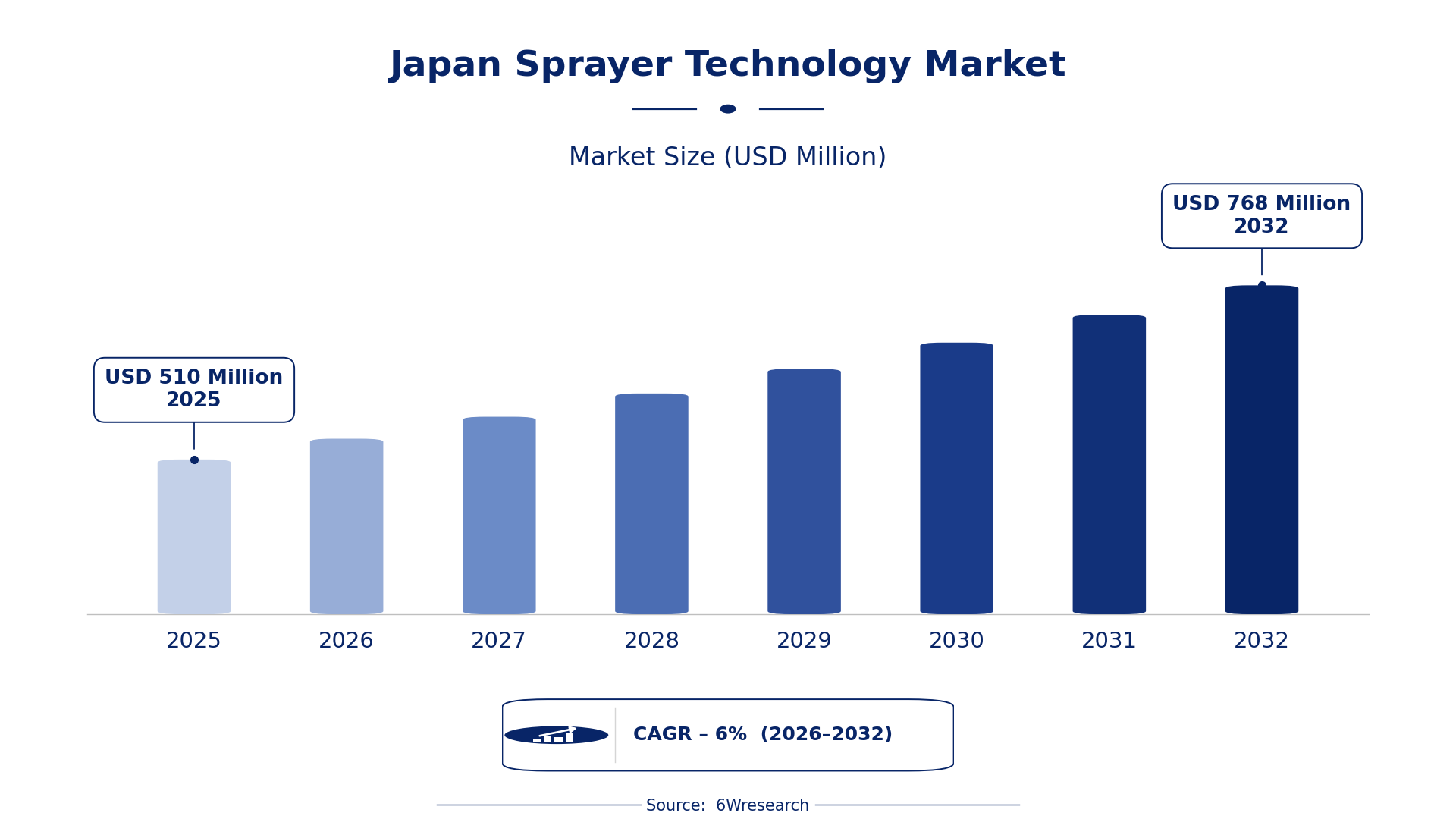
According to 6Wresearch internal database and industry insights, the Japan Sprayer Technology Market was valued at USD 510 Million in 2025 and is projected to reach USD 768 Million by 2032, growing at a CAGR of approximately 6% during 2026–2032.
Japan Sprayer Technology Market Highlights
| Report Metric | Details |
| Report Name | Japan Sprayer Technology Market (2026-2032) |
| Market Size 2025 | USD 510 Million |
| Market Size 2032 | USD 768 Million |
| Absolute Growth 2025–2032 | USD 258 Million |
| CAGR 2026–2032 | 6% |
| Peak Annual Growth | 7.4% in 2027 |
| Forecast Period | 2026–2032 |
| Historical Data | 2022–2025 |
| Base Year | 2025 |
| Leading Sprayer Type, 2025 | Boom Sprayers (42% share) |
| Leading Power Source, 2025 | Tractor-Mounted (45% share) |
| Leading Application Area, 2025 | Farmland (44% share) |
| Leading End User, 2025 | Commercial Farmers (39% share) |
| Fastest-Growing Sprayer Type | Airblast Sprayers (8.3% CAGR) |
| Fastest-Growing Power Source | Engine-Driven (8.8% CAGR) |
| Fastest-Growing Application Area | Orchards/Vineyards (7.6% CAGR) |
| Fastest-Growing End User | Horticulture Firms (7.7% CAGR) |
| Growing Sector | Orchards/Vineyards |
| Key End Users | Farmland, Orchards/Vineyards, High-Precision Zones, Gardens & Small Farms |
Japan Sprayer Technology Market Year-wise Growth Rate and Key Drivers (2022–2032)
This graph illustrates the annual growth rates of the market from 2022 to 2032, highlighting a steady upward trajectory and projected market expansion over the forecast period.
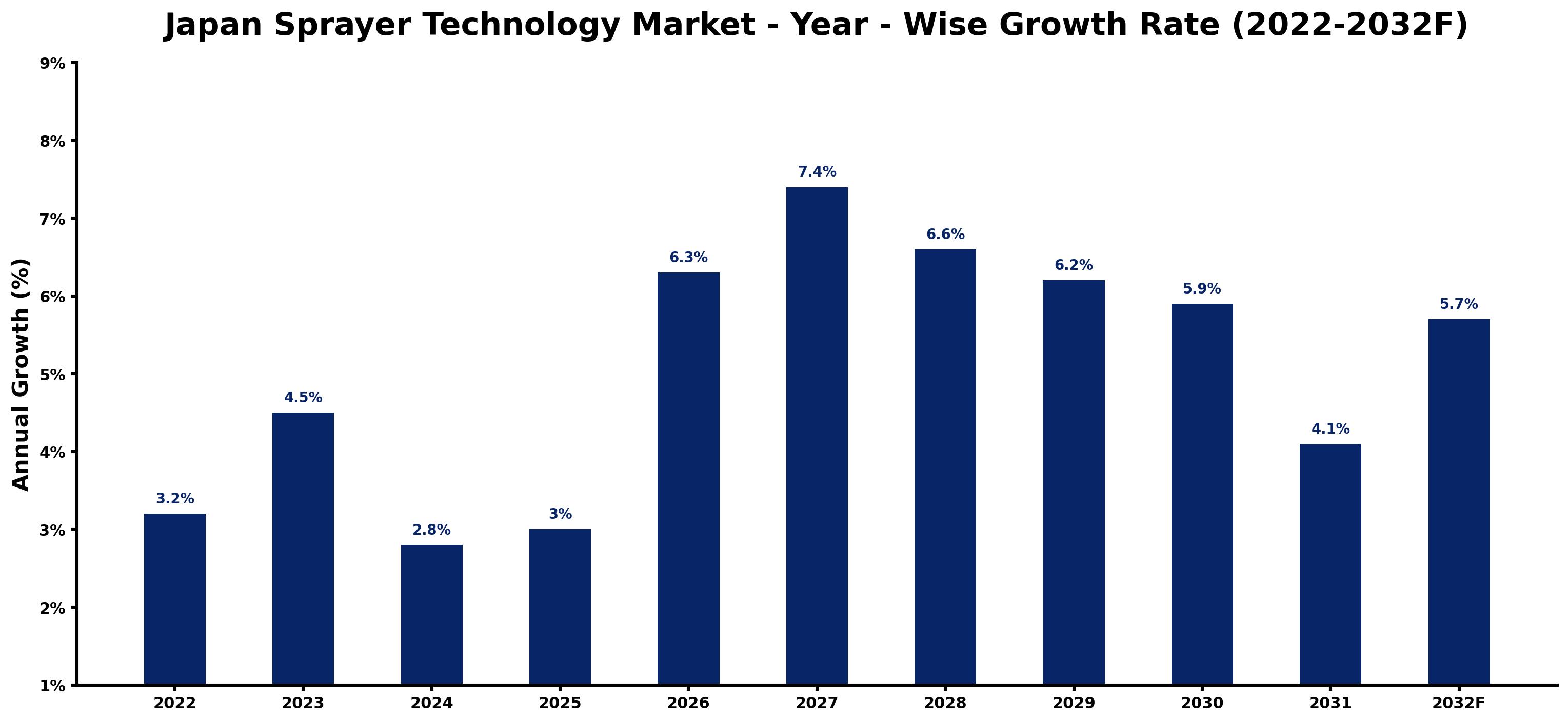
The following figures match every annual growth estimate with the main market development of that year, giving the reasoning behind each rise or slowdown.
| Year | Estimated Annual Growth (%) | Market Rationale |
| 2022 | 3.2 | The market showed steady growth due to ongoing agricultural activities and investments. |
| 2023 | 4.5 | Growth accelerated as precision agriculture gained traction among farmers and horticulture firms. |
| 2024 | 2.8 | The market experienced a slowdown as some farmers delayed purchasing new equipment amid economic uncertainty. |
| 2025 | 3.0 | Demand rebounded as commercial farmers sought efficient sprayer solutions to improve productivity. |
| 2026 | 6.3 | Growth is expected to surge as investments in smart sprayer technologies become more prevalent among agri-tech companies. |
| 2027 | 7.4 | The market is projected to peak due to heightened adoption of drone sprayers in rice cultivation areas. |
| 2028 | 6.6 | Growth is anticipated to slow as the market begins to stabilise following the peak in technology adoption. |
| 2029 | 6.2 | A continued slowdown is expected as the market adjusts to previous rapid growth rates. |
| 2030 | 5.9 | The market will maintain positive growth as sustainable practices influence purchasing decisions. |
| 2031 | 4.1 | Growth is projected to slow as the market reaches a more mature phase with established technology. |
| 2032 | 5.7 | Demand is expected to rise again as new innovations in sprayer technology emerge. |
Note: Market size estimations and growth projections presented in this report are based on 6Wresearch's proprietary forecasting methodology, utilizing the latest available industry data, government publications, and primary research inputs.
Japan Sprayer Technology Market Synopsis
Sprayer technology encompasses devices designed for applying pesticides, herbicides, and fertilizers, primarily used in agriculture and horticulture. The Japan Sprayer Technology Market is driven by over 4 million hectares of farmland requiring efficient solutions. Factors such as the increasing adoption of precision agriculture, government support for sustainable practices, and the rise of agri-tech innovations are boosting demand across various user segments.
Market Dynamics Impact Analysis (2026–2032)
| Factor | Type | Impact | Primary Segment Affected |
| Growing adoption of precision agriculture techniques | Driver | High | Boom Sprayers |
| Increasing investment in smart sprayer technologies | Driver | High | Drone Sprayers |
| Rising demand for environmentally friendly solutions | Opportunity | Medium | Battery Operated |
| Expansion of horticulture firms in urban areas | Opportunity | Medium | Airblast Sprayers |
| High initial investment costs for advanced sprayers | Restraint | High | Engine-Driven |
| Limited awareness of new technologies among small farmers | Restraint | Medium | Backpack Sprayers |
| Aging farmer population affecting adoption rates | Challenge | High | Tractor-Mounted |
| Economic fluctuations impacting purchasing power | Challenge | Medium | Commercial Farmers |
Evaluation of Drivers in Japan Sprayer Technology Market (2026–2032)
The factors lifting demand, and the evidence behind each, are summarised below.
| Drivers | Primary Segment Affected | Why It Matters (Evidence) |
| Increased focus on crop yield and efficiency | Boom Sprayers | This drives demand as farmers seek effective solutions for large-scale applications, with approximately 1.5 million commercial farmers in Japan. |
| Emerging technologies improving precision | Battery Operated | The national target to reduce pesticide use by 30% by 2030 is influencing technology demand. |
| Rising urban gardening trends | Backpack Sprayers | The total population of home gardeners in Japan is estimated at 10 million, increasing demand for user-friendly sprayers. |
| Growing horticulture sector in urban regions | Airblast Sprayers | The Shizuoka Prefecture is known for its extensive use of airblast sprayers in tea cultivation, driving demand for advanced sprayer technology. |
| Expansion of precision agriculture initiatives | Drone Sprayers | Agri-tech companies are investing in smart sprayer technologies for better crop management, enhancing precision agriculture. |
Much of the new demand traces back to the increasing focus on crop yield and efficiency among farmers. In Japan, approximately 1.5 million commercial farmers are seeking effective solutions, particularly in large-scale applications. The adoption of drone sprayers is rising in rice cultivation areas, improving precision in agricultural practices. Urban gardening trends are also on the rise, with an estimated 10 million home gardeners increasing their use of sprayers. The growing horticulture sector in urban regions, particularly in the Tokyo area, further drives demand for advanced sprayer technology.
Evaluation of Restraints in Japan Sprayer Technology Market
The following restraints limit how fast demand can grow.
| Market Restraint | Primary Segment Affected | Why It Matters (Evidence) |
| High initial investment costs for advanced sprayers | Engine-Driven | Many farmers find it challenging to invest in high-tech equipment, limiting adoption rates despite potential benefits. |
| Limited awareness of new technologies among small farmers | Backpack Sprayers | Small-scale farmers often lack information on advanced sprayer technologies, hindering their purchasing decisions. |
| Regulatory compliance requirements for new products | Drone Sprayers | Manufacturers face stringent regulations that can delay product launches and increase costs. |
| Competition from traditional sprayer methods | Boom Sprayers | Some farmers prefer conventional methods due to familiarity, slowing the transition to modern technologies. |
| Supply chain disruptions affecting timely deliveries | Commercial Farmers | Supply chain issues can delay deliveries by up to three months, impacting farmers' ability to acquire new equipment. |
Japan Sprayer Technology Market Challenges
Over 4 million hectares of farmland in Japan require efficient sprayer technology, yet supply chain disruptions can delay deliveries by up to three months for producers. The average age of farmers is around 67 years, complicating the adoption of advanced sprayers that demand technical proficiency, thus limiting suppliers' market reach. Compliance with the JIS B 9950 standard can inflate production costs by approximately 15%, forcing manufacturers to raise prices for buyers. Skills shortages in the agricultural sector restrict the effective use of modern sprayer technology, reducing productivity for farmers nationwide.
Trends in the Japan Sprayer Technology Market
The trends below show where the Japan Sprayer Technology Market is heading.
- Shift from Manual to Automated Spraying: Since 2023, farmers in Japan have increasingly adopted automated sprayers, improving efficiency. The rise in drone technology adoption is a key driver, with over 14,000 hectares of vineyards needing effective solutions.
- Transition to Sustainable Spraying Solutions: In 2023, the government launched a program to promote sustainable agricultural practices, influencing sprayer technology demand. This initiative aligns with the national target to reduce pesticide use by 30% by 2030.
- Emergence of Smart Sprayer Technologies: The trend towards smart sprayer technologies has gained traction, particularly among agri-tech companies. Investments in these innovations are expected to increase, reflecting a growing market for precision agriculture.
- Growing Demand for Urban Gardening Solutions: Home gardeners are increasingly turning to advanced sprayer technologies, with an estimated 10 million gardeners in Japan. This shift drives demand for user-friendly, efficient sprayers.
Investment Opportunities in the Japan Sprayer Technology Market
The openings below show where demand in the Japan Sprayer Technology Market is visible and how suppliers can enter.
- Partnerships with Agri-Tech Companies: With a growing horticulture sector, there is a strong opportunity to partner with agri-tech companies to supply advanced sprayer technologies, particularly in urban areas where demand is rising.
- Investment in Drone Sprayer Technology: As drone sprayers gain traction, investing in this technology presents a lucrative opportunity, especially in rice cultivation areas where precision is critical.
- Focus on Sustainable Solutions: With the government's target to reduce pesticide use by 30% by 2030, there is a strong demand for sustainable sprayer solutions, creating opportunities for manufacturers to innovate.
- Expansion into Urban Gardening Market: The increasing number of home gardeners, estimated at 10 million, presents an opportunity for suppliers to develop user-friendly sprayers tailored for urban gardening needs.
Government Initiatives in the Japan Sprayer Technology Market
The Electrical Appliance and Material Safety Act (1961) regulates the safety of electrical appliances and materials in Japan, ensuring that sprayer technology meets safety standards. This law complements the Food Sanitation Act amendment (2018), which mandates hygiene management in food businesses, indirectly influencing sprayer technology by ensuring safe application methods.
In 2023, the government allocated 1 billion yen to support the adoption of drone technology in agriculture, administered by the Ministry of Agriculture, Forestry and Fisheries. This funding aims to improve efficiency and precision in agricultural practices, benefiting sprayer technology producers and users alike.
Future Insight of the Japan Sprayer Technology Market
Japan's shift towards sustainable agricultural practices will drive suppliers to innovate sprayer technologies by 2032. Government support for precision agriculture will encourage investment in smart sprayers, enhancing crop management capabilities. The adoption of drone technology will transform spraying methods, particularly in rice cultivation areas. As urban gardening grows, battery-operated sprayers will become essential, catering to millions of gardeners and reshaping the market.
Market Segmentation Analysis
Japan Sprayer Technology Market report covers a detailed analysis of the following market segments:
By Sprayer Type – Boom Sprayers Lead, Airblast Sprayers Expected to Grow Fastest
According to Saurav Kr Singh, Senior Research Analyst at 6Wresearch, Boom Sprayers took 42% of sprayer type revenue in 2025, more than any other category. Boom sprayers dominate the market as they are essential for large-scale applications, particularly in Japan’s extensive farmland of over 4 million hectares. Their efficiency in covering vast areas makes them indispensable for commercial farmers during peak seasons. Over 2026–2032, Airblast Sprayers are expected to post the fastest growth, at a CAGR of 8.3%. Airblast sprayers are experiencing rapid growth due to their effectiveness in orchards and vineyards, which are crucial for Japan's fruit production. The average orchard size of around 1.2 hectares necessitates the use of these sprayers for optimal crop management. Suppliers should enhance airblast sprayer capabilities to capture the expanding horticulture market.
By Power Source – Tractor-Mounted Leads, Engine-Driven Expected to Grow Fastest
In 2025, Tractor-Mounted led the power source split with a 45% share. Tractor-mounted sprayers lead the market as they are seamlessly integrated into farming equipment, providing efficiency for Japan's approximately 1.5 million commercial farmers. This integration allows for effective operation across large agricultural areas, making them a preferred choice. Engine-Driven is set to record the highest CAGR in this split, 8.8% over 2026–2032. Engine-driven sprayers are gaining traction due to their mobility across various agricultural settings, meeting the diverse needs of farmers. Their adaptability supports a wide range of applications, contributing to their rapid adoption. Buyers may find value in investing in engine-driven sprayers to improve operational flexibility across different farming environments.
By Application Area – Farmland Leads, Orchards/Vineyards Expected to Grow Fastest
With 44% of application area revenue in 2025, Farmland was the largest category. Farmland is the primary application area for agricultural sprayers, driven by the necessity to manage over 4 million hectares efficiently. This vast area highlights the importance of effective spraying solutions for crop management. Orchards/Vineyards are projected to grow fastest, at a CAGR of 7.6% during 2026–2032. Orchards and vineyards are experiencing the fastest growth in sprayer technology adoption, as these areas require specific techniques for fruit cultivation. The total area of vineyards in Japan, approximately 14,000 hectares, underscores the demand for effective spraying solutions. Suppliers should tailor their products to meet the specific requirements of orchard and vineyard applications to capitalise on this growth.
By End User – Commercial Farmers Lead, Horticulture Firms Expected to Grow Fastest
The largest end user category in 2025 was Commercial Farmers, at 39% of revenue. Commercial farmers represent the largest end user group, extensively utilising sprayer technology in their agricultural practices. With around 1.5 million commercial farmers in Japan, their demand significantly shapes the market dynamics. The quickest growth will come from Horticulture Firms, forecast to expand at a CAGR of 7.7% between 2026 and 2032. Horticulture firms are rapidly adopting sprayer technology, driven by the need for specialised equipment to enhance productivity. The estimated 30,000 horticulture firms in Japan are key players, advocating for advanced solutions. Suppliers should focus on developing specialised sprayer technologies to address the unique needs of horticulture firms.
Key Attractiveness of the Report
- 10 Years of Market Numbers
- Historical Data Starting from 2022 to 2025
- Base Year 2025
- Forecast Data until 2032
- Key Performance Indicators Impacting the Market
- Major Upcoming Developments and Projects
Key Highlights of the Report:
- Japan Sprayer Technology Market Outlook
- Market Size of Japan Sprayer Technology Market, 2025
- Forecast of Japan Sprayer Technology Market, 2032
- Historical Data and Forecast of Japan Sprayer Technology Revenues & Volume for the Period 2022-2032F
- Japan Sprayer Technology Market Trend Evolution
- Japan Sprayer Technology Market Drivers and Challenges
- Japan Sprayer Technology Price Trends
- Japan Sprayer Technology Porter's Five Forces
- Japan Sprayer Technology Industry Life Cycle
- Historical Data and Forecast of Japan Sprayer Technology Market Revenues & Volume By Sprayer Type for the Period 2022-2032F
- Historical Data and Forecast of Japan Sprayer Technology Market Revenues & Volume By Boom Sprayers for the Period 2022-2032F
- Historical Data and Forecast of Japan Sprayer Technology Market Revenues & Volume By Airblast Sprayers for the Period 2022-2032F
- Historical Data and Forecast of Japan Sprayer Technology Market Revenues & Volume By Drone Sprayers for the Period 2022-2032F
- Historical Data and Forecast of Japan Sprayer Technology Market Revenues & Volume By Backpack Sprayers for the Period 2022-2032F
- Historical Data and Forecast of Japan Sprayer Technology Market Revenues & Volume By Power Source for the Period 2022-2032F
- Historical Data and Forecast of Japan Sprayer Technology Market Revenues & Volume By Tractor-Mounted for the Period 2022-2032F
- Historical Data and Forecast of Japan Sprayer Technology Market Revenues & Volume By Engine-Driven for the Period 2022-2032F
- Historical Data and Forecast of Japan Sprayer Technology Market Revenues & Volume By Battery Operated for the Period 2022-2032F
- Historical Data and Forecast of Japan Sprayer Technology Market Revenues & Volume By Manual/Electric for the Period 2022-2032F
- Historical Data and Forecast of Japan Sprayer Technology Market Revenues & Volume By Application Area for the Period 2022-2032F
- Historical Data and Forecast of Japan Sprayer Technology Market Revenues & Volume By Farmland for the Period 2022-2032F
- Historical Data and Forecast of Japan Sprayer Technology Market Revenues & Volume By Orchards/Vineyards for the Period 2022-2032F
- Historical Data and Forecast of Japan Sprayer Technology Market Revenues & Volume By High-Precision Zones for the Period 2022-2032F
- Historical Data and Forecast of Japan Sprayer Technology Market Revenues & Volume By Gardens & Small Farms for the Period 2022-2032F
- Historical Data and Forecast of Japan Sprayer Technology Market Revenues & Volume By End User for the Period 2022-2032F
- Historical Data and Forecast of Japan Sprayer Technology Market Revenues & Volume By Commercial Farmers for the Period 2022-2032F
- Historical Data and Forecast of Japan Sprayer Technology Market Revenues & Volume By Horticulture Firms for the Period 2022-2032F
- Historical Data and Forecast of Japan Sprayer Technology Market Revenues & Volume By Agri-Tech Companies for the Period 2022-2032F
- Historical Data and Forecast of Japan Sprayer Technology Market Revenues & Volume By Home Gardeners for the Period 2022-2032F
- Japan Sprayer Technology Import Export Trade Statistics
- Market Opportunity Assessment By Sprayer Type
- Market Opportunity Assessment By Power Source
- Market Opportunity Assessment By Application Area
- Market Opportunity Assessment By End User
- Japan Sprayer Technology Top Companies Market Share
- Japan Sprayer Technology Competitive Benchmarking By Technical and Operational Parameters
- Japan Sprayer Technology Company Profiles
- Japan Sprayer Technology Key Strategic Recommendations
Market Covered
Segments analysed in this report are listed below.
By Sprayer Type
- Boom Sprayers
- Airblast Sprayers
- Drone Sprayers
- Backpack Sprayers
By Power Source
- Tractor-Mounted
- Engine-Driven
- Battery Operated
- Manual/Electric
By Application Area
- Farmland
- Orchards/Vineyards
- High-Precision Zones
- Gardens & Small Farms
By End User
- Commercial Farmers
- Horticulture Firms
- Agri-Tech Companies
- Home Gardeners































