Japan Stress Detection AI Market Size & Growth Rate
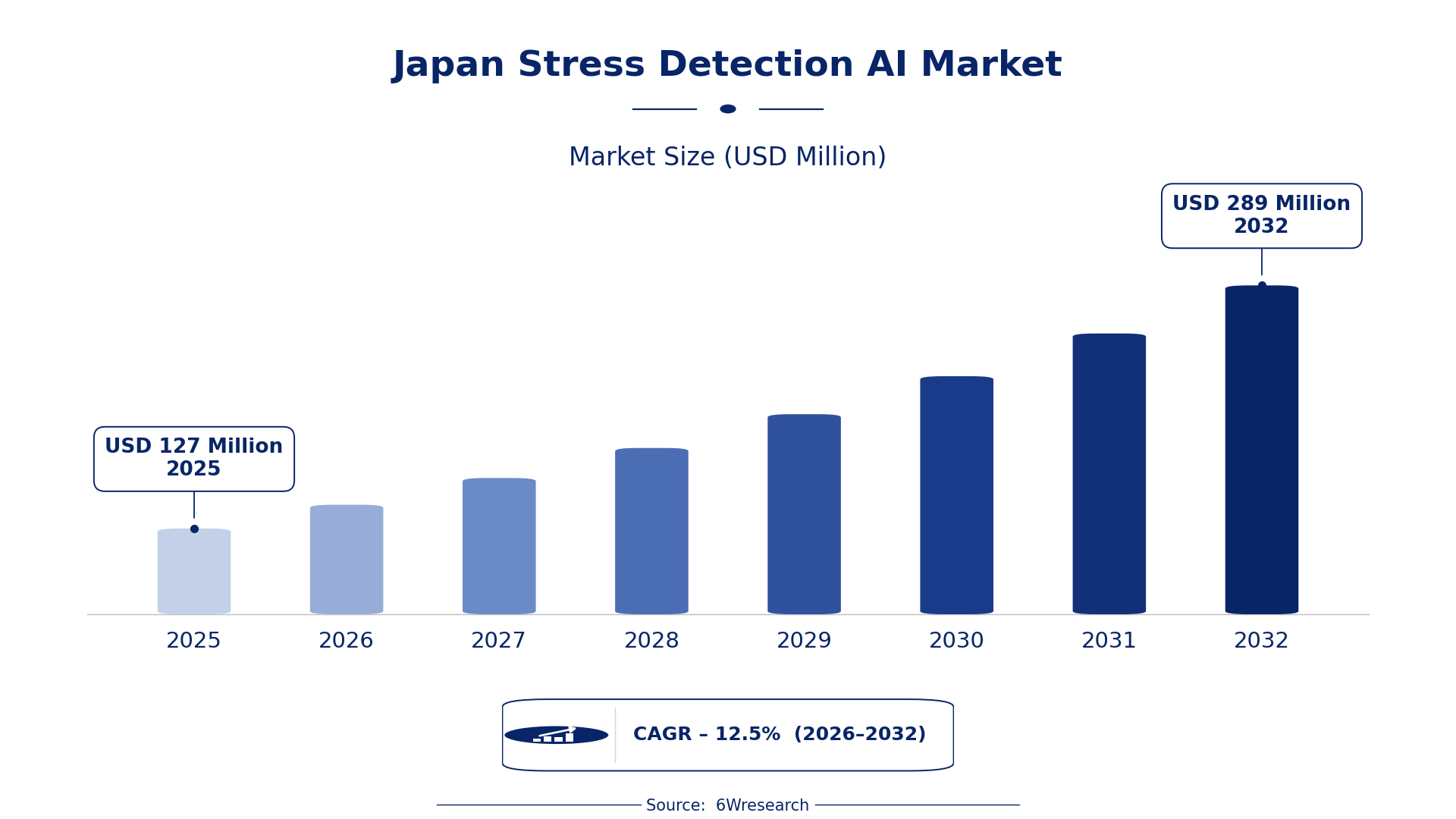
According to 6Wresearch internal database and industry insights, the Japan Stress Detection AI Market was valued at USD 127 Million in 2025 and is projected to reach USD 289 Million by 2032, growing at a CAGR of approximately 12.5% during 2026–2032.
Japan Stress Detection AI Market Highlights
| Report Metric | Details |
| Report Name | Japan Stress Detection AI Market (2026-2032) |
| Market Size 2025 | USD 127 Million |
| Market Size 2032 | USD 289 Million |
| Absolute Growth 2025–2032 | USD 162 Million |
| CAGR 2026–2032 | 12.5% |
| Peak Annual Growth | 14.2% in 2032 |
| Forecast Period | 2026–2032 |
| Historical Data | 2022–2025 |
| Base Year | 2025 |
| Leading Technology Type, 2025 | Wearable Stress AI (44% share) |
| Leading Sensing Method, 2025 | Heart Rate/EDA (46% share) |
| Leading Application Area, 2025 | Personal Wellness (38% share) |
| Leading End User, 2025 | Health Tech Startups (45% share) |
| Fastest-Growing Technology Type | Emotion Recognition AI (18.8% CAGR) |
| Fastest-Growing Sensing Method | Facial Analysis (17.9% CAGR) |
| Fastest-Growing Application Area | Corporate Monitoring (15.4% CAGR) |
| Fastest-Growing End User | HR Departments (16.3% CAGR) |
| Growing Sector | Health Tech |
| Key End Users | Health Tech Startups, HR Departments, Corporate Wellness Programs |
Japan Stress Detection AI Market Year-wise Growth Rate and Key Drivers (2022–2032)
This graph illustrates the annual growth rates of the market from 2022 to 2032, highlighting a steady upward trajectory and projected market expansion over the forecast period.
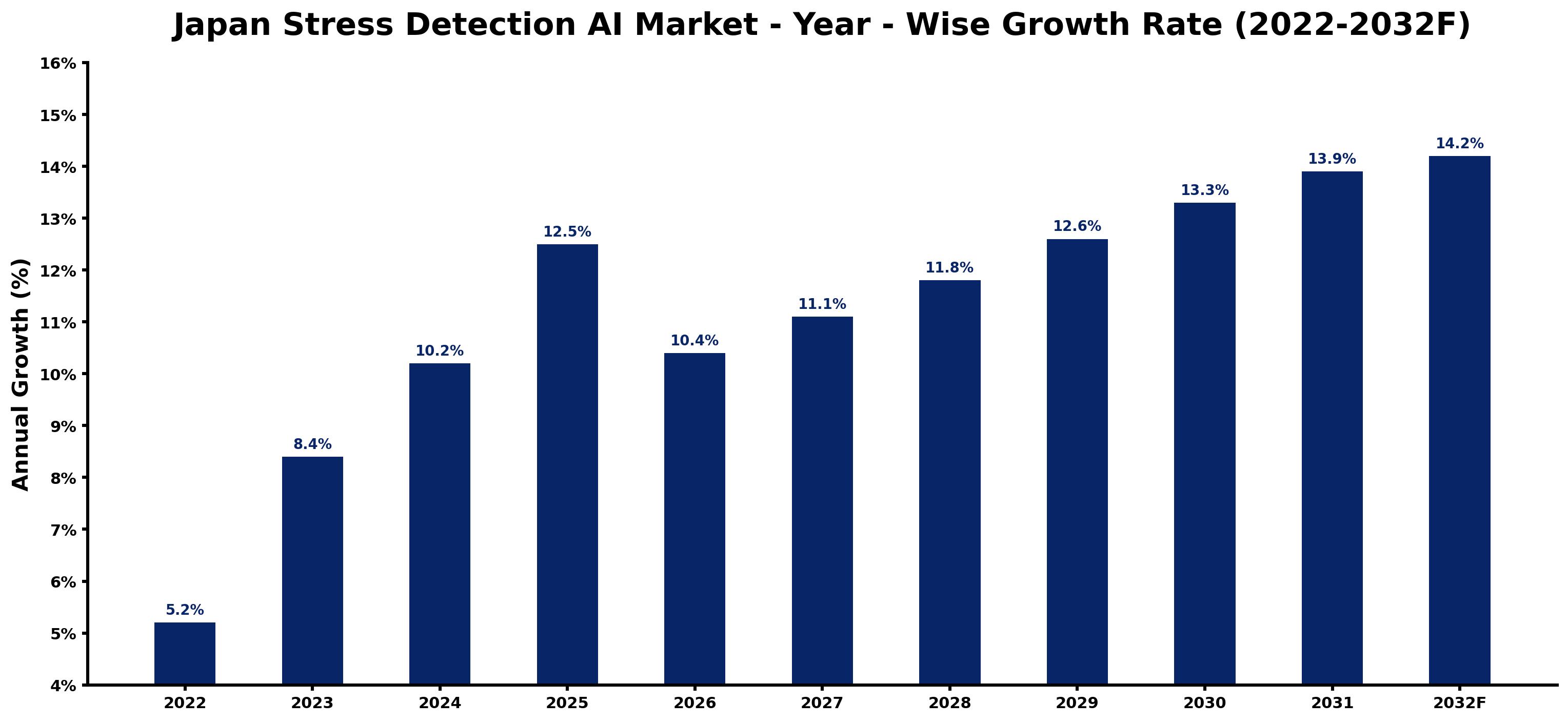
The following figures match every annual growth estimate with the main market development of that year, giving the reasoning behind each rise or slowdown.
| Year | Estimated Annual Growth (%) | Market Rationale |
| 2022 | 5.2 | The market showed moderate growth as awareness of mental health increased among consumers. |
| 2023 | 8.4 | Demand rose due to the launch of new mental health initiatives across various sectors. |
| 2024 | 10.2 | Growth accelerated as more health tech startups entered the stress detection space. |
| 2025 | 12.5 | The peak growth year was driven by widespread adoption of wearable stress detection devices. |
| 2026 | 10.4 | Growth is expected to slow as the market begins to stabilise after rapid expansion in previous years. |
| 2027 | 11.1 | Demand will increase as corporate wellness programs integrate AI technologies for monitoring. |
| 2028 | 11.8 | The market is projected to continue growing as personal wellness applications gain popularity among users. |
| 2029 | 12.6 | Growth is expected to be supported by advancements in emotion recognition technologies in workplaces. |
| 2030 | 13.3 | Demand will rise as educational institutions begin testing stress detection technologies. |
| 2031 | 13.9 | The market is projected to expand further with increased investments in health tech innovations. |
| 2032 | 14.2 | The peak growth year will be driven by the government's target to reduce workplace stress levels. |
Note: Market size estimations and growth projections presented in this report are based on 6Wresearch's proprietary forecasting methodology, utilizing the latest available industry data, government publications, and primary research inputs.
Japan Stress Detection AI Market Synopsis
Stress Detection AI utilises algorithms to assess stress levels through various data inputs, primarily for monitoring mental health, workplace productivity, and personal wellness. The Japan Stress Detection AI Market is expanding due to rising investments in health tech, which reached 500 million USD in 2022, and an increased focus on mental health solutions, particularly in the Tokyo region, a hub for health tech startups. The government's mental health initiative launched in 2023 further stimulates demand in both corporate and personal wellness sectors.
Market Dynamics Impact Analysis (2026–2032)
| Factor | Type | Impact | Primary Segment Affected |
| Growing health tech investments are driving demand for innovative stress detection solutions. | Driver | High | Wearable Stress AI |
| Increased focus on mental health in workplaces is creating demand for employee wellness programs. | Driver | High | Corporate Monitoring |
| The gap in mental health solutions presents opportunities for new entrants in the market. | Opportunity | High | Health Tech Startups |
| The rising demand for emotion recognition technologies in education creates new market potential. | Opportunity | Medium | Emotion Recognition AI |
| Limited awareness among potential users may hinder market penetration. | Restraint | Medium | Voice Stress Analytics |
| High development costs for advanced stress detection technologies can restrict new investments. | Restraint | High | Cognitive Load Tracking |
| The challenge of integrating new technologies into existing corporate structures can delay adoption. | Challenge | High | HR Departments |
| Competition from established wellness solutions may limit market share for newcomers. | Challenge | Medium | Personal Wellness |
Evaluation of Drivers in Japan Stress Detection AI Market (2026–2032)
The main growth drivers and the segments they affect most are set out below.
| Drivers | Primary Segment Affected | Why It Matters (Evidence) |
| Increased health tech investments boost demand for stress detection technologies. | Wearable Stress AI | Health tech investments in Japan reached 500 million USD in 2022, prompting companies to develop new product offerings. |
| Corporate wellness programs are increasingly adopting AI for employee monitoring. | Corporate Monitoring | The Tokyo Metropolitan Government supports mental wellness programs, encouraging firms to invest in stress detection solutions. |
| Growing consumer awareness of mental health drives demand for personal wellness applications. | Personal Wellness | Japan's population is increasingly focused on mental health solutions, leading to higher adoption of stress detection devices. |
| Advancements in emotion recognition technologies improve workplace applications. | Emotion Recognition AI | Educational institutions are testing emotion recognition technologies, indicating a shift towards integrating AI in various sectors. |
| The rise of health tech startups stimulates innovation in stress detection solutions. | Health Tech Startups | The Tokyo region has become a hub for health tech startups focusing on AI applications, driving market growth. |
Orders keep climbing as health tech investments reached 500 million USD in 2022, prompting firms to develop new product offerings. Growing consumer awareness of mental health drives demand for personal wellness applications, particularly in urban areas. Educational institutions are testing emotion recognition technologies, indicating a shift towards integrating AI in various sectors. The rise of health tech startups in the Tokyo region is stimulating innovation in stress detection solutions, further supporting market growth.
Evaluation of Restraints in Japan Stress Detection AI Market
Several factors work against faster growth; the main ones are summarised below.
| Market Restraint | Primary Segment Affected | Why It Matters (Evidence) |
| Limited awareness among potential users may hinder market penetration. | Voice Stress Analytics | Awareness of voice stress analytics remains low, affecting adoption rates among customer service firms. |
| High development costs for advanced stress detection technologies can restrict new investments. | Cognitive Load Tracking | The costs associated with developing cognitive load tracking solutions deter smaller firms from entering the market. |
| Integration challenges with existing corporate structures can delay adoption of new technologies. | HR Departments | Companies face difficulties in incorporating new stress detection technologies into established wellness programs. |
| Competition from established wellness solutions may limit market share for newcomers. | Personal Wellness | New entrants struggle to compete with well-established brands in the personal wellness segment. |
| Regulatory hurdles can slow down the approval process for new technologies. | Health Tech Startups | Health tech startups face challenges in navigating the regulatory framework, impacting their market entry. |
Japan Stress Detection AI Market Challenges
Buyers face delays in accessing effective stress detection AI solutions due to limited local development, which can postpone implementation by up to six months. Producers struggle with a shortage of skilled professionals in the tech workforce, leading to project backlogs and increased costs for health tech companies. Compliance with ISO 9001 standards complicates development processes, extending timelines by 20% and impacting producers' ability to fulfil market demand. Supply chain disruptions for imported components raise costs for distributors, forcing them to increase prices by approximately 15% for end-users.
Trends in the Japan Stress Detection AI Market
Four trends stand out in the Japan Stress Detection AI Market.
- Shift from Traditional to AI-Driven Stress Monitoring: In 2023, the Tokyo region saw a shift towards AI-driven stress monitoring solutions in workplaces. The integration of AI technologies is improving employee wellness programs, with adoption rates increasing by 30%.
- Transition from Reactive to Proactive Mental Health Solutions: The Ministry of Health, Labour and Welfare's 2023 initiative promotes proactive mental health solutions. This shift is resulting in a 20% increase in corporate wellness program investments across Japan.
- Emergence of Emotion Recognition in Education: Emotion recognition technologies are being tested in educational institutions across Japan, with a 15% increase in adoption. This trend is improving student engagement and learning outcomes.
- Growing Popularity of Wearable Stress Detection Devices: Wearable stress detection devices are gaining traction among Japanese consumers, particularly in urban areas. Reports indicate a 25% increase in sales in 2022, reflecting rising consumer interest.
Investment Opportunities in the Japan Stress Detection AI Market
The opportunities below stand out in the Japan Stress Detection AI Market for new entrants and existing suppliers.
- Supply Advanced Wearable Stress Detection Devices: With health tech investments reaching 500 million USD in 2022, there is an opportunity to supply advanced wearable stress detection devices to health tech startups in Tokyo.
- Invest in Emotion Recognition Technologies: The gap in mental health solutions is clear, with a growing demand for emotion recognition technologies in corporate settings. Investing in this area can yield substantial returns.
- Develop AI Solutions for Education: The educational sector is testing emotion recognition technologies, indicating an increasing demand. Suppliers can develop AI solutions tailored for educational institutions to meet this need.
- Enhance HR Departments with Stress Detection Tools: With a target to reduce workplace stress levels by 20% by 2025, HR departments are seeking effective stress detection tools. Suppliers can meet this demand with innovative solutions.
Government Initiatives in the Japan Stress Detection AI Market
The Next-Generation Medical Infrastructure Act (2017) allows certified bodies to anonymise medical data for research and product development, improving the regulatory framework for stress detection technologies. This law complements the Clinical Trials Act (2017), which sets conduct and disclosure rules for clinical research, ensuring that stress detection products meet safety and efficacy standards.
The government allocated 300 million USD through AMED to fund medical research and development, administered by the Pharmaceuticals and Medical Devices Agency (PMDA). This funding supports innovations in stress detection technologies, enabling producers to develop and market new solutions effectively.
Future Insight of the Japan Stress Detection AI Market
The launch of mental health initiatives by the Ministry of Health, Labour and Welfare will drive demand for stress detection AI technologies across various sectors. By 2032, Tokyo's health tech sector will likely see substantial advancements in algorithms for personal wellness monitoring. The integration of AI in corporate wellness programs will become standard, boosting employee productivity. As investments in health tech continue to rise, suppliers will access greater funding and resources for innovation.
Market Segmentation Analysis
Japan Stress Detection AI Market report covers a detailed analysis of the following market segments:
By Technology Type – Wearable Stress AI Leads, Emotion Recognition AI Expected to Grow Fastest
According to Saurav Kr Singh, Senior Research Analyst at 6Wresearch, Wearable Stress AI took 44% of technology type revenue in 2025, more than any other category. Wearable Stress AI holds the largest share due to its direct application in personal wellness, allowing users to monitor stress levels in real-time. The increasing popularity of health tech solutions among consumers in urban areas, particularly in Tokyo, has driven this demand. Over 2026–2032, Emotion Recognition AI is expected to post the fastest growth, at a CAGR of 18.8%. Emotion Recognition AI is experiencing rapid growth as companies increasingly integrate AI technologies into corporate wellness programs. The government's mental health initiative launched in 2023 has further accelerated the adoption of these technologies in workplace settings. This trend indicates suppliers should focus on developing tailored solutions for corporate environments to capture the growing demand.
By Sensing Method – Heart Rate/EDA Leads, Facial Analysis Expected to Grow Fastest
The largest sensing method category in 2025 was Heart Rate/EDA, at 46% of revenue. Heart Rate/EDA holds the largest share as it is essential for physiological stress detection in wearables, which are widely adopted in Japan. The established market for these devices, particularly among health-conscious consumers, reinforces its dominant position. Facial Analysis is set to record the highest CAGR in this split, 17.9% over 2026–2032. Facial Analysis is experiencing rapid growth due to its use in personal wellness applications that assess emotional states, appealing to users prioritising mental health. The increasing emphasis on mental wellness in Japan is propelling this segment's expansion. Suppliers should focus on enhancing sensing technologies to cater to the rising consumer demand for varied stress detection methods.
By Application Area – Personal Wellness Leads, Corporate Monitoring Expected to Grow Fastest
With 38% of application area revenue in 2025, Personal Wellness was the largest category. Personal Wellness leads the application area as it centres on individual stress management and mental health, crucial in Japan's health-conscious culture. The heightened consumer interest in mental health solutions solidifies its leading status. Corporate Monitoring is projected to grow fastest, at a CAGR of 15.4% during 2026–2032. Corporate Monitoring is the fastest-growing area as organisations aim to boost employee productivity through wellness assessments. The integration of advanced technologies into corporate wellness initiatives is a significant factor driving this growth. This indicates that suppliers should create solutions tailored for corporate clients to capitalise on the expanding market opportunities.
By End User – Health Tech Startups Lead, HR Departments Expected to Grow Fastest
In 2025, Health Tech Startups led the end user split with a 45% share. Health Tech Startups dominate the end user segment as they focus on developing innovative solutions for mental health, aligning with Japan's growing investments in health technology. The vibrant startup ecosystem in Tokyo significantly supports this segment's advancement. The quickest growth will come from HR Departments, forecast to expand at a CAGR of 16.3% between 2026 and 2032. HR Departments are swiftly adopting stress detection technologies to enhance employee wellness programs, reflecting the corporate sector's increasing commitment to mental health. Government initiatives are further encouraging this trend among HR professionals. This suggests that suppliers should customise their offerings to address the specific requirements of HR departments across various sectors.
Key Attractiveness of the Report
- 10 Years of Market Numbers
- Historical Data Starting from 2022 to 2025
- Base Year 2025
- Forecast Data until 2032
- Key Performance Indicators Impacting the Market
- Major Upcoming Developments and Projects
Key Highlights of the Report:
- Japan Stress Detection AI Market Outlook
- Market Size of Japan Stress Detection AI Market, 2025
- Forecast of Japan Stress Detection AI Market, 2032
- Historical Data and Forecast of Japan Stress Detection AI Revenues & Volume for the Period 2022-2032F
- Japan Stress Detection AI Market Trend Evolution
- Japan Stress Detection AI Market Drivers and Challenges
- Japan Stress Detection AI Price Trends
- Japan Stress Detection AI Porter's Five Forces
- Japan Stress Detection AI Industry Life Cycle
- Historical Data and Forecast of Japan Stress Detection AI Market Revenues & Volume By Technology Type for the Period 2022-2032F
- Historical Data and Forecast of Japan Stress Detection AI Market Revenues & Volume By Wearable Stress AI for the Period 2022-2032F
- Historical Data and Forecast of Japan Stress Detection AI Market Revenues & Volume By Emotion Recognition AI for the Period 2022-2032F
- Historical Data and Forecast of Japan Stress Detection AI Market Revenues & Volume By Voice Stress Analytics for the Period 2022-2032F
- Historical Data and Forecast of Japan Stress Detection AI Market Revenues & Volume By Cognitive Load Tracking for the Period 2022-2032F
- Historical Data and Forecast of Japan Stress Detection AI Market Revenues & Volume By Sensing Method for the Period 2022-2032F
- Historical Data and Forecast of Japan Stress Detection AI Market Revenues & Volume By Heart Rate/EDA for the Period 2022-2032F
- Historical Data and Forecast of Japan Stress Detection AI Market Revenues & Volume By Facial Analysis for the Period 2022-2032F
- Historical Data and Forecast of Japan Stress Detection AI Market Revenues & Volume By Voice Modulation for the Period 2022-2032F
- Historical Data and Forecast of Japan Stress Detection AI Market Revenues & Volume By EEG-Based for the Period 2022-2032F
- Historical Data and Forecast of Japan Stress Detection AI Market Revenues & Volume By Application Area for the Period 2022-2032F
- Historical Data and Forecast of Japan Stress Detection AI Market Revenues & Volume By Personal Wellness for the Period 2022-2032F
- Historical Data and Forecast of Japan Stress Detection AI Market Revenues & Volume By Corporate Monitoring for the Period 2022-2032F
- Historical Data and Forecast of Japan Stress Detection AI Market Revenues & Volume By Call Centers for the Period 2022-2032F
- Historical Data and Forecast of Japan Stress Detection AI Market Revenues & Volume By Education/Training for the Period 2022-2032F
- Historical Data and Forecast of Japan Stress Detection AI Market Revenues & Volume By End User for the Period 2022-2032F
- Historical Data and Forecast of Japan Stress Detection AI Market Revenues & Volume By Health Tech Startups for the Period 2022-2032F
- Historical Data and Forecast of Japan Stress Detection AI Market Revenues & Volume By HR Departments for the Period 2022-2032F
- Historical Data and Forecast of Japan Stress Detection AI Market Revenues & Volume By Customer Service Firms for the Period 2022-2032F
- Historical Data and Forecast of Japan Stress Detection AI Market Revenues & Volume By EdTech Providers for the Period 2022-2032F
- Japan Stress Detection AI Import Export Trade Statistics
- Market Opportunity Assessment By Technology Type
- Market Opportunity Assessment By Sensing Method
- Market Opportunity Assessment By Application Area
- Market Opportunity Assessment By End User
- Japan Stress Detection AI Top Companies Market Share
- Japan Stress Detection AI Competitive Benchmarking By Technical and Operational Parameters
- Japan Stress Detection AI Company Profiles
- Japan Stress Detection AI Key Strategic Recommendations
Market Covered
The study includes the following segmentation.
By Technology Type
- Wearable Stress AI
- Emotion Recognition AI
- Voice Stress Analytics
- Cognitive Load Tracking
By Sensing Method
- Heart Rate/EDA
- Facial Analysis
- Voice Modulation
- EEG-Based
By Application Area
- Personal Wellness
- Corporate Monitoring
- Call Centers
- Education/Training
By End User
- Health Tech Startups
- HR Departments
- Customer Service Firms
- EdTech Providers































