Japan String Instruments Market Size & Growth Rate
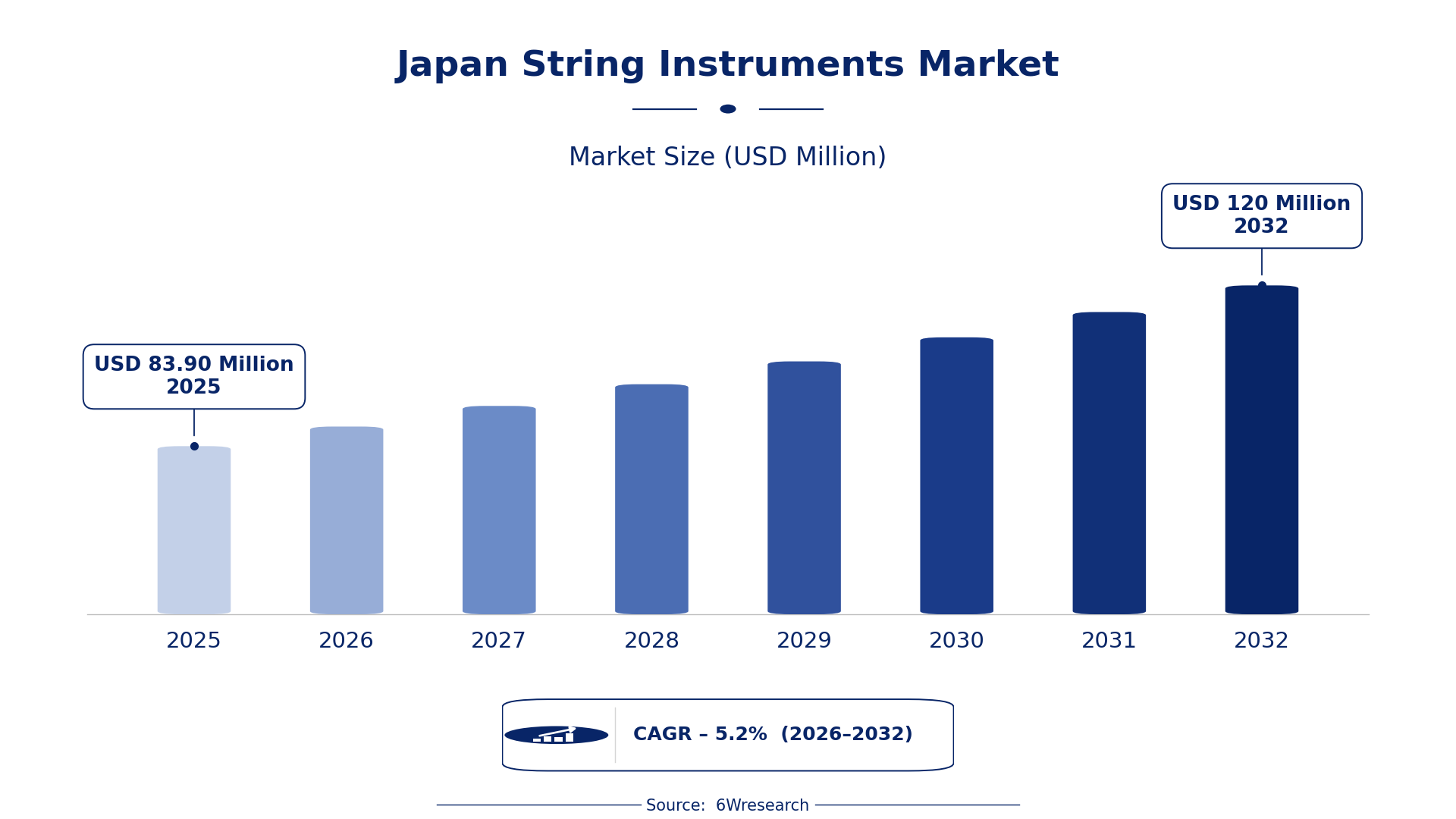
According to 6Wresearch internal database and industry insights, the Japan String Instruments Market was valued at USD 83.90 Million in 2025 and is projected to reach USD 120 Million by 2032, growing at a CAGR of approximately 5.2% during 2026–2032.
Japan String Instruments Market Highlights
| Report Metric | Details |
| Report Name | Japan String Instruments Market (2026-2032) |
| Market Size 2025 | USD 83.90 Million |
| Market Size 2032 | USD 120 Million |
| Absolute Growth 2025–2032 | USD 36.10 Million |
| CAGR 2026–2032 | 5.2% |
| Peak Annual Growth | 6.0% in 2028 |
| Forecast Period | 2026–2032 |
| Historical Data | 2022–2025 |
| Base Year | 2025 |
| Leading Instrument Type, 2025 | Violins (37% share) |
| Leading Material Type, 2025 | Maple/Spruce (39% share) |
| Leading Distribution Channel, 2025 | Music Stores (39% share) |
| Leading End User, 2025 | Music Students (38% share) |
| Fastest-Growing Instrument Type | Guitars (7.2% CAGR) |
| Fastest-Growing Material Type | Mahogany/Rosewood (7.9% CAGR) |
| Fastest-Growing Distribution Channel | Online Retailers (6.9% CAGR) |
| Fastest-Growing End User | Amateur Musicians (6.6% CAGR) |
| Growing Sector | Music Education |
| Key End Users | Music Students, Amateur Musicians, Orchestras, Hobbyists |
Japan String Instruments Market Year-wise Growth Rate and Key Drivers (2022–2032)
This graph illustrates the annual growth rates of the market from 2022 to 2032, highlighting a steady upward trajectory and projected market expansion over the forecast period.
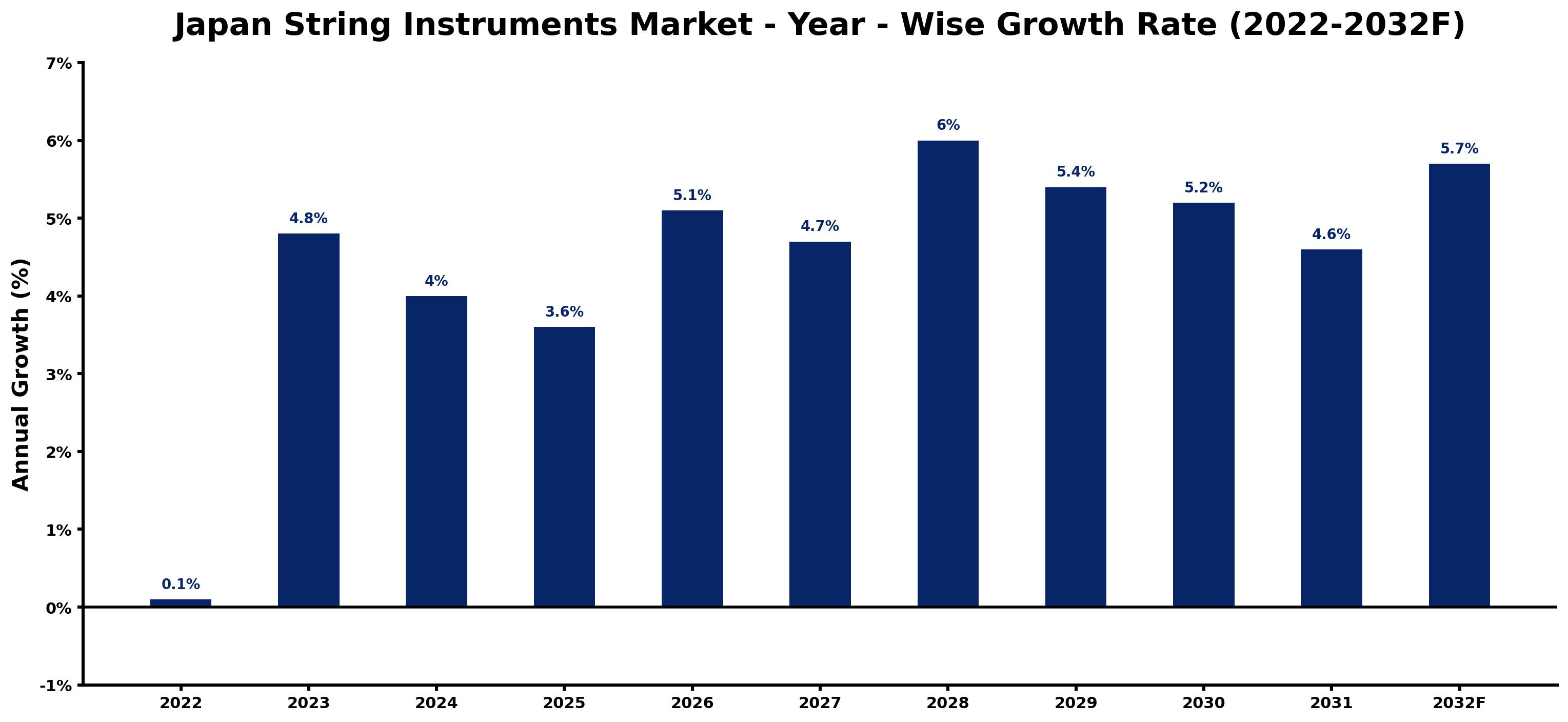
Year by year, the estimates below pair each growth rate with the development that shaped it.
| Year | Estimated Annual Growth (%) | Market Rationale |
| 2022 | 0.1 | The market showed minimal activity with a slight growth rate. |
| 2023 | 4.8 | Demand surged due to increased interest in music education and performances. |
| 2024 | 4.0 | Growth slowed as market conditions stabilised after the previous year's spike. |
| 2025 | 3.6 | The market continued to grow, but at a slower pace as interest normalised. |
| 2026 | 5.1 | Orders keep climbing as new educational initiatives boost instrument sales. |
| 2027 | 4.7 | Growth slowed again, reflecting a temporary market adjustment in demand. |
| 2028 | 6.0 | A peak in growth is expected as music festivals and events gain momentum. |
| 2029 | 5.4 | The market will see a slight slowdown as growth stabilises post-peak. |
| 2030 | 5.2 | Demand remains steady, supported by ongoing interest in music education. |
| 2031 | 4.6 | Growth slows again, indicating a maturing market with established players. |
| 2032 | 5.7 | A renewed interest in music programs drives growth higher once more. |
Note: Market size estimations and growth projections presented in this report are based on 6Wresearch's proprietary forecasting methodology, utilizing the latest available industry data, government publications, and primary research inputs.
Japan String Instruments Market Synopsis
String instruments are musical instruments that produce sound through vibrating strings, commonly used in orchestras, solo performances, and music education. The Japan String Instruments Market saw approximately 200,000 violins sold in 2022, indicating strong demand from music schools and cultural events. Factors driving market growth include government support for music education, a thriving manufacturing hub in the Tokyo region, and increasing online sales, which have risen by 30% since 2020.
Market Dynamics Impact Analysis (2026–2032)
| Factor | Type | Impact | Primary Segment Affected |
| Growing interest in music education and cultural events boosts demand for string instruments. | Driver | High | Violins |
| The rise of online retail channels facilitates easier access to instruments for consumers. | Driver | High | Guitars |
| Increased funding for music programs in rural areas creates new opportunities for instrument sales. | Opportunity | High | Cellos |
| The popularity of music festivals encourages greater participation and instrument purchases. | Opportunity | High | Ukuleles |
| Market saturation limits growth potential for existing manufacturers and retailers. | Restraint | Medium | Guitars |
| High-quality materials like mahogany and rosewood increase production costs for manufacturers. | Restraint | Medium | Violins |
| Competition from alternative music education methods may divert interest away from traditional instruments. | Challenge | High | Cellos |
| Supply chain disruptions can delay production and affect availability of instruments. | Challenge | High | Ukuleles |
Evaluation of Drivers in Japan String Instruments Market (2026–2032)
Key forces behind demand, with the segment each one moves most, are listed below.
| Drivers | Primary Segment Affected | Why It Matters (Evidence) |
| Increased interest in music education drives demand for violins. | Violins | Around 1,000 music schools in Japan offer courses, leading to higher sales. |
| Cultural events and festivals promote string instrument performances. | Cellos | The annual Tokyo Music Festival features numerous string instrument performances. |
| Government initiatives supporting music education encourage instrument purchases. | Violins | Funding for music programs in schools increases demand for quality instruments. |
| Rising online sales channels improve access to string instruments. | Ukuleles | Online sales of string instruments have increased by 30% since 2020. |
| The growing popularity of guitars among amateur musicians boosts sales. | Guitars | Guitars accounted for 40% of the string instrument market in Japan. |
Orders continue to rise as interest in music education grows, with over 1,000 music schools offering string instrument courses. Cultural events, such as the Tokyo Music Festival, have spurred demand for performances, resulting in around 200,000 violins sold in 2022. The increase in online sales by 30% since 2020 has simplified the purchasing process for consumers. The rising popularity of guitars among amateur musicians also contributes to overall sales.
Evaluation of Restraints in Japan String Instruments Market
These restraints slow adoption and weigh on supplier margins.
| Market Restraint | Primary Segment Affected | Why It Matters (Evidence) |
| Market saturation limits growth potential for existing manufacturers. | Guitars | With a large share of the market, growth opportunities are becoming scarce. |
| High-quality materials increase production costs for manufacturers. | Violins | The use of mahogany and rosewood raises the price of premium instruments. |
| Competition from alternative music education methods may divert interest. | Cellos | New teaching methods can lead students to choose different instruments. |
| Supply chain disruptions can delay production and affect availability. | Ukuleles | Logistics issues can lead to longer wait times for retailers and buyers. |
| Limited awareness of niche products restricts market expansion. | Violins | Consumers may overlook high-end instruments due to lack of marketing. |
Japan String Instruments Market Challenges
High prices for quality string instruments limit access for music schools, which often operate under constrained budgets. String instruments must adhere to JIS standards, resulting in production delays that can extend delivery times by three months for suppliers. Sourcing premium materials like ebony remains a challenge, increasing production costs and retail prices by 15% for buyers. Rapid technological advancements require suppliers to invest in digital marketing, diverting funds from essential production processes and affecting supply chain efficiency.
Trends in the Japan String Instruments Market
The trends below show where the Japan String Instruments Market is heading.
- Shift from Traditional to Online Sales: The Japan String Instruments Market is experiencing a shift towards online sales, with a 30% increase since 2020. This trend reshapes how consumers purchase instruments, making it easier for them to access a wider variety of products.
- Emergence of Ukuleles as a Popular Choice: Ukuleles are gaining traction among beginners and hobbyists, reflecting a broader trend in music education. Their affordability and ease of learning have led to increased sales, particularly in music schools.
- Growing Focus on Music Festivals: The annual Tokyo Music Festival, featuring string instrument performances, highlights the rising popularity of cultural events. This trend encourages more individuals to purchase instruments for participation.
- Increased Government Support for Music Education: In 2023, a government initiative funded music education in rural areas with a budget of ¥500 million. This investment aims to improve access to music programs, driving demand for string instruments.
Investment Opportunities in the Japan String Instruments Market
The following areas offer the clearest openings for investors and suppliers in the Japan String Instruments Market.
- Music Schools Seeking Quality Instruments: Music schools throughout Japan require high-quality string instruments for their students. With over 1,000 institutions offering courses, this presents a prime opportunity for manufacturers to partner with schools for direct supply.
- Entry Through Online Retail Partnerships: Online retailers are expanding their product ranges, creating an opportunity for manufacturers to enter the market. Collaborating with established e-commerce platforms can help reach a broader customer base.
- Focus on Cultural Events and Festivals: The Tokyo region, a key area for string instrument sales, is ideal for targeting cultural events. By aligning product offerings with festival schedules, suppliers can capture increased demand during peak periods.
- Investing in Music Education Programs: With government funding supporting music education, there is an opportunity to supply instruments to rural schools. Establishing joint ventures with local educational institutions can strengthen market presence.
Government Initiatives in the Japan String Instruments Market
The Plastic Resource Circulation Act, enacted in 2021, promotes the reduction and recycling of plastics, impacting string instrument manufacturers by encouraging the use of sustainable materials. Compliance with JIS standards ensures quality, which is vital for maintaining consumer trust in products. The act aims to reduce plastic waste by 25% by 2030, benefiting the environment and the industry.
Support for music programs in schools allows institutions to purchase quality instruments, directly benefiting students and creating a steady demand for string instruments. In 2023, the government allocated ¥500 million to improve music education initiatives, ensuring that students have access to the instruments they need.
Future Insight of the Japan String Instruments Market
A policy-driven increase in funding for music education will improve access for buyers in rural areas by 2032. The Tokyo Music Festival will expand its outreach, promoting cultural engagement and interest in string instruments. Advancements in online sales platforms will streamline purchasing, allowing suppliers to connect with a larger customer base. With online sales projected to rise by 30% in the coming years, suppliers must refine their strategies to align with changing buyer preferences.
Market Segmentation Analysis
Japan String Instruments Market report covers a detailed analysis of the following market segments:
By Instrument Type – Violins Lead, Guitars Expected to Grow Fastest
According to Saurav Kr Singh, Senior Research Analyst at 6Wresearch, Violins held 37% of the Japan String Instruments Market by instrument type in 2025. Violins hold the largest share due to their extensive use in orchestras and educational institutions, with approximately 200,000 sold in Japan in 2022. This established demand from schools and performance venues solidifies their position in the market. Over 2026–2032, Guitars are expected to post the fastest growth, at a CAGR of 7.2%. Guitars are experiencing rapid growth as they appeal to amateur musicians and hobbyists, reflecting a shift towards more casual music engagement. The increase in online sales by 30% since 2020 has further accelerated their popularity. Suppliers should focus on expanding guitar offerings to capture the growing interest among amateur musicians.
By Material Type – Maple/Spruce Leads, Mahogany/Rosewood Expected to Grow Fastest
Maple/Spruce took 39% of material type revenue in 2025, more than any other category. Maple and spruce are the preferred materials for high-quality string instruments, commonly used in violins and cellos, ensuring their dominance in the market. Their acoustic properties make them the go-to choice for both manufacturers and musicians. The quickest growth will come from Mahogany/Rosewood, forecast to expand at a CAGR of 7.9% between 2026 and 2032. Mahogany and rosewood are gaining traction due to their use in premium instruments, which are sought after for superior sound quality. The rise in demand for high-end instruments is pushing this segment's growth. Manufacturers should consider increasing the production of mahogany and rosewood instruments to meet the rising demand for quality.
By Distribution Channel – Music Stores Lead, Online Retailers Expected to Grow Fastest
The largest distribution channel category in 2025 was Music Stores, at 39% of revenue. Music stores are the primary sales channel for string instruments, allowing customers to physically interact with the instruments and receive expert advice. Their established presence in the Tokyo region, a key area for music education and performance, reinforces their substantial market share. Online Retailers are projected to grow fastest, at a CAGR of 6.9% during 2026–2032. Online retailers are rapidly expanding as more consumers opt for the convenience of home shopping. The 30% increase in online sales since 2020 indicates a clear trend towards digital purchasing in the string instruments sector. Suppliers must adapt to the increasing preference for online shopping to effectively capture the evolving market demand.
By End User – Music Students Lead, Amateur Musicians Expected to Grow Fastest
With 38% of end user revenue in 2025, Music Students was the largest category. Music students represent the largest user group, supported by over 1,000 music schools in Japan offering string instrument courses. This educational focus ensures a steady demand for instruments tailored to learners. Amateur Musicians are set to record the highest CAGR in this split, 6.6% over 2026–2032. Amateur musicians are the fastest-growing segment, reflecting a rise in leisure music-making activities among the population. This trend is likely to continue as more individuals seek music as a hobby. Suppliers should tailor their marketing strategies to engage amateur musicians, tapping into this expanding market.
Key Attractiveness of the Report
- 10 Years of Market Numbers
- Historical Data Starting from 2022 to 2025
- Base Year 2025
- Forecast Data until 2032
- Key Performance Indicators Impacting the Market
- Major Upcoming Developments and Projects
Key Highlights of the Report:
- Japan String Instruments Market Outlook
- Market Size of Japan String Instruments Market, 2025
- Forecast of Japan String Instruments Market, 2032
- Historical Data and Forecast of Japan String Instruments Revenues & Volume for the Period 2022-2032F
- Japan String Instruments Market Trend Evolution
- Japan String Instruments Market Drivers and Challenges
- Japan String Instruments Price Trends
- Japan String Instruments Porter's Five Forces
- Japan String Instruments Industry Life Cycle
- Historical Data and Forecast of Japan String Instruments Market Revenues & Volume By Instrument Type for the Period 2022-2032F
- Historical Data and Forecast of Japan String Instruments Market Revenues & Volume By Violins for the Period 2022-2032F
- Historical Data and Forecast of Japan String Instruments Market Revenues & Volume By Guitars for the Period 2022-2032F
- Historical Data and Forecast of Japan String Instruments Market Revenues & Volume By Cellos for the Period 2022-2032F
- Historical Data and Forecast of Japan String Instruments Market Revenues & Volume By Ukuleles for the Period 2022-2032F
- Historical Data and Forecast of Japan String Instruments Market Revenues & Volume By Material Type for the Period 2022-2032F
- Historical Data and Forecast of Japan String Instruments Market Revenues & Volume By Maple/Spruce for the Period 2022-2032F
- Historical Data and Forecast of Japan String Instruments Market Revenues & Volume By Mahogany/Rosewood for the Period 2022-2032F
- Historical Data and Forecast of Japan String Instruments Market Revenues & Volume By Ebony/Fiberglass for the Period 2022-2032F
- Historical Data and Forecast of Japan String Instruments Market Revenues & Volume By Bamboo/Plastic for the Period 2022-2032F
- Historical Data and Forecast of Japan String Instruments Market Revenues & Volume By Distribution Channel for the Period 2022-2032F
- Historical Data and Forecast of Japan String Instruments Market Revenues & Volume By Music Stores for the Period 2022-2032F
- Historical Data and Forecast of Japan String Instruments Market Revenues & Volume By Online Retailers for the Period 2022-2032F
- Historical Data and Forecast of Japan String Instruments Market Revenues & Volume By Specialty Shops for the Period 2022-2032F
- Historical Data and Forecast of Japan String Instruments Market Revenues & Volume By E-commerce for the Period 2022-2032F
- Historical Data and Forecast of Japan String Instruments Market Revenues & Volume By End User for the Period 2022-2032F
- Historical Data and Forecast of Japan String Instruments Market Revenues & Volume By Music Students for the Period 2022-2032F
- Historical Data and Forecast of Japan String Instruments Market Revenues & Volume By Amateur Musicians for the Period 2022-2032F
- Historical Data and Forecast of Japan String Instruments Market Revenues & Volume By Orchestras for the Period 2022-2032F
- Historical Data and Forecast of Japan String Instruments Market Revenues & Volume By Hobbyists for the Period 2022-2032F
- Japan String Instruments Import Export Trade Statistics
- Market Opportunity Assessment By Instrument Type
- Market Opportunity Assessment By Material Type
- Market Opportunity Assessment By Distribution Channel
- Market Opportunity Assessment By End User
- Japan String Instruments Top Companies Market Share
- Japan String Instruments Competitive Benchmarking By Technical and Operational Parameters
- Japan String Instruments Company Profiles
- Japan String Instruments Key Strategic Recommendations
Market Covered
Segments analysed in this report are listed below.
By Instrument Type
- Violins
- Guitars
- Cellos
- Ukuleles
By Material Type
- Maple/Spruce
- Mahogany/Rosewood
- Ebony/Fiberglass
- Bamboo/Plastic
By Distribution Channel
- Music Stores
- Online Retailers
- Specialty Shops
- E-commerce
By End User
- Music Students
- Amateur Musicians
- Orchestras
- Hobbyists































