Japan Structural Casting Market Size & Growth Rate
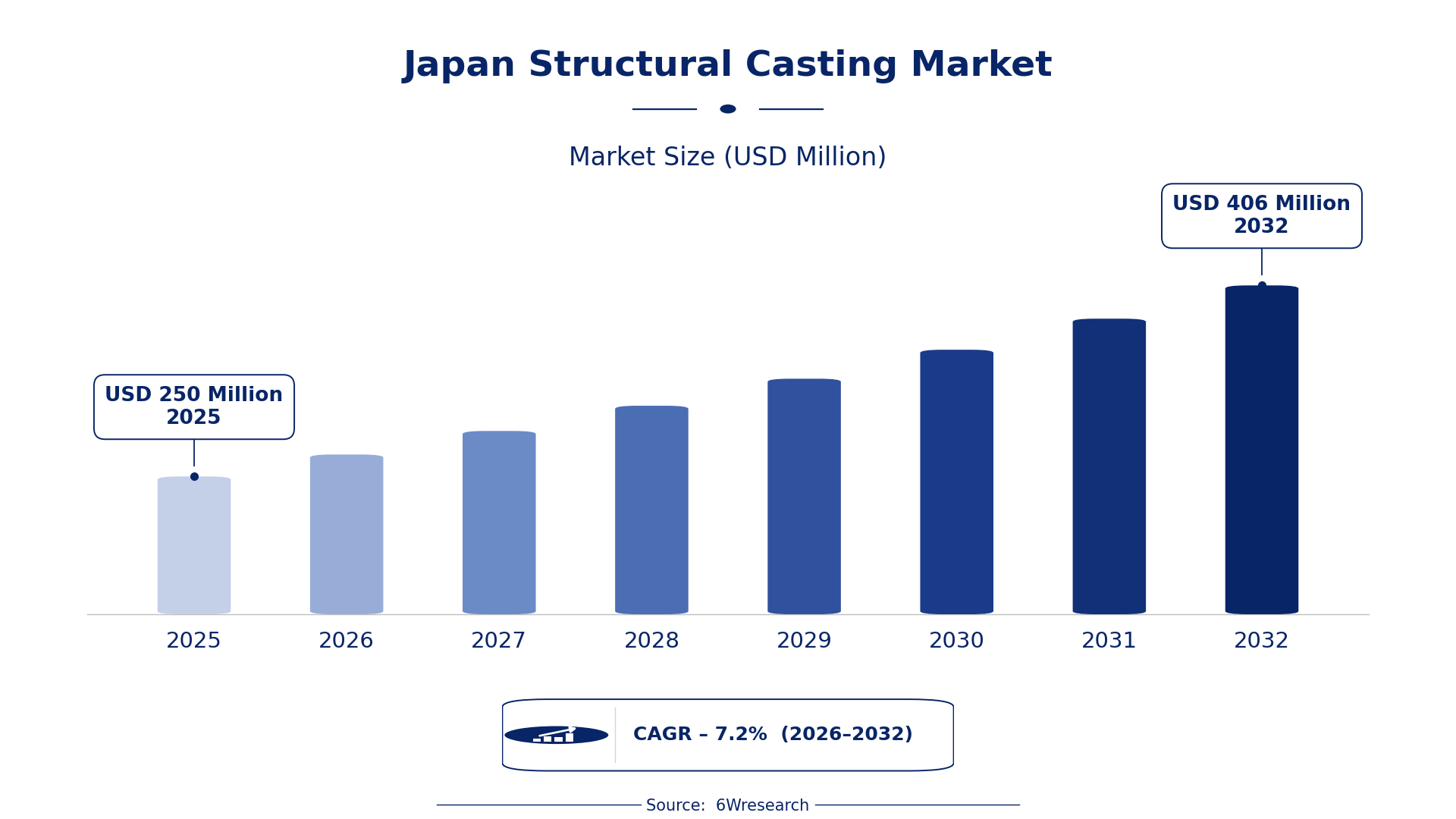
According to 6Wresearch internal database and industry insights, the Japan Structural Casting Market was valued at USD 250 Million in 2025 and is projected to reach USD 406 Million by 2032, growing at a CAGR of approximately 7.2% during 2026–2032.
Japan Structural Casting Market Highlights
| Report Metric | Details |
| Report Name | Japan Structural Casting Market (2026-2032) |
| Market Size 2025 | USD 250 Million |
| Market Size 2032 | USD 406 Million |
| Absolute Growth 2025–2032 | USD 156 Million |
| CAGR 2026–2032 | 7.2% |
| Peak Annual Growth | 8.2% in 2026 |
| Forecast Period | 2026–2032 |
| Historical Data | 2022–2025 |
| Base Year | 2025 |
| Leading Casting Type, 2025 | Sand Castings (34% share) |
| Leading Material Type, 2025 | Ductile Iron (47% share) |
| Leading Molding Method, 2025 | Green Sand Molding (39% share) |
| Leading End User, 2025 | Construction Equipment OEMs (49% share) |
| Fastest-Growing Casting Type | Investment Castings (9.7% CAGR) |
| Fastest-Growing Material Type | Aluminum (10.2% CAGR) |
| Fastest-Growing Molding Method | Lost Wax Process (9.9% CAGR) |
| Fastest-Growing End User | Aerospace Suppliers (8.9% CAGR) |
| Growing Sector | Construction |
| Key End Users | Construction Equipment OEMs, Aerospace Suppliers, Automotive Industry, Shipbuilding Companies |
Japan Structural Casting Market Year-wise Growth Rate and Key Drivers (2022–2032)
This graph illustrates the annual growth rates of the market from 2022 to 2032, highlighting a steady upward trajectory and projected market expansion over the forecast period.
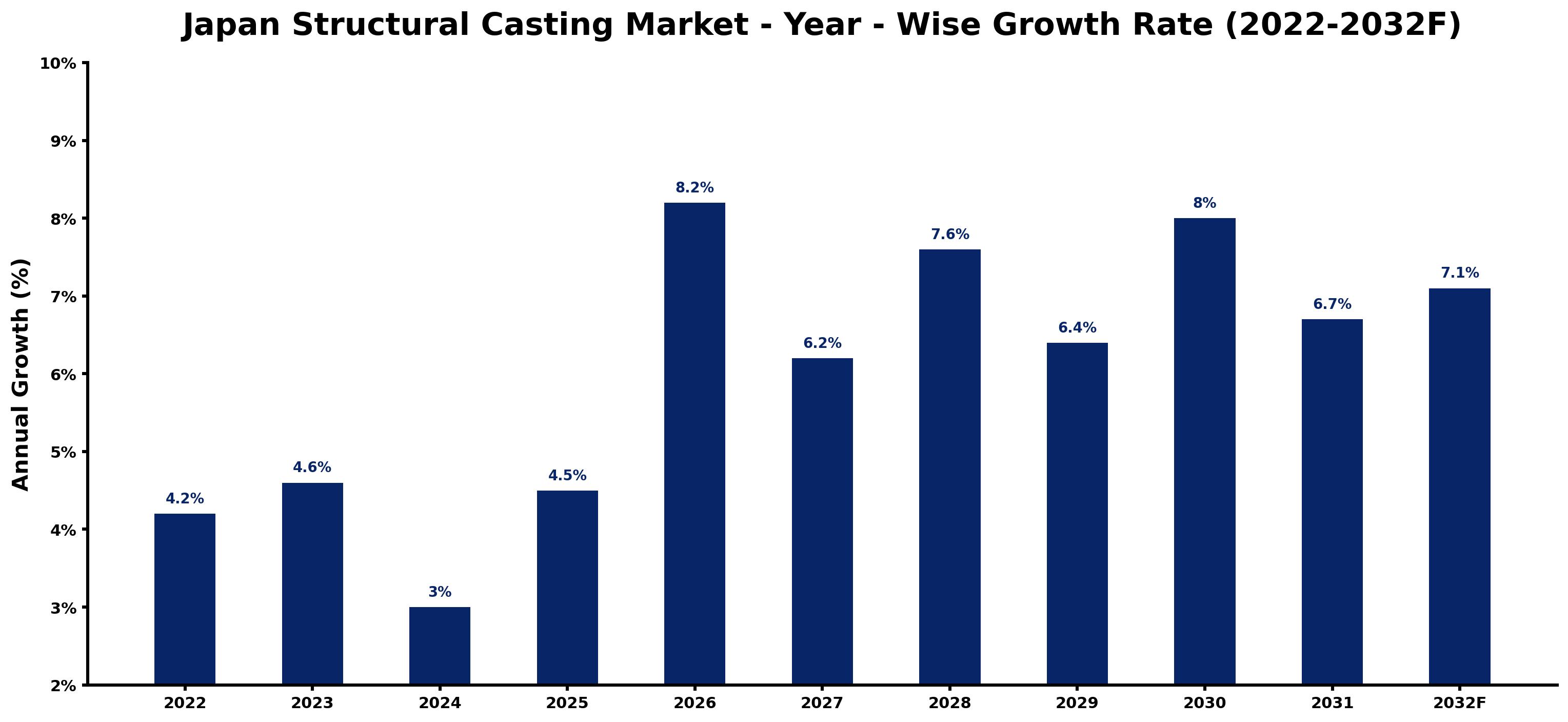
Annual growth estimates for each year appear below with the principal reason behind them, explaining the shifts that set the pace of the market.
| Year | Estimated Annual Growth (%) | Market Rationale |
| 2022 | 4.2 | The market showed steady growth due to ongoing construction projects and manufacturing activities. |
| 2023 | 4.6 | Demand increased as the construction sector expanded, supported by a growing workforce. |
| 2024 | 3.0 | Growth slowed as some construction projects faced delays, yet demand remained strong. |
| 2025 | 4.5 | The market rebounded with faster growth as construction activities resumed and investment increased. |
| 2026 | 8.2 | The peak growth year reflects heightened investments in advanced casting technologies and infrastructure. |
| 2027 | 6.2 | Growth is expected to slow as market conditions stabilise after the peak, maintaining positive demand. |
| 2028 | 7.6 | Demand is projected to rise again due to increased construction projects and technological advancements in casting. |
| 2029 | 6.4 | Growth is anticipated to slow slightly, driven by market saturation in some segments and project completions. |
| 2030 | 8.0 | The market is expected to see renewed growth as new infrastructure projects are initiated across Japan. |
| 2031 | 6.7 | Growth is projected to slow as the market adjusts to previous expansions, yet demand will remain healthy. |
| 2032 | 7.1 | The market is expected to continue growing as the aerospace sector expands and new technologies emerge. |
Note: Market size estimations and growth projections presented in this report are based on 6Wresearch's proprietary forecasting methodology, utilizing the latest available industry data, government publications, and primary research inputs.
Japan Structural Casting Market Synopsis
Structural casting involves creating metal structures through various techniques, primarily serving construction, automotive, aerospace, and shipbuilding industries. The market is expanding, driven by the construction sector employing over 5 million workers and strong demand from the automotive industry for aluminum castings. Investment in advanced casting technologies, supported by government initiatives, is further increasing market potential, particularly in regions like Aichi and Nagoya.
Market Dynamics Impact Analysis (2026–2032)
| Factor | Type | Impact | Primary Segment Affected |
| Increased investment in advanced casting technologies | Driver | High | Investment Castings |
| Growing demand from the automotive industry for lightweight materials | Driver | High | Aluminum |
| Expansion of the aerospace sector requiring high-quality castings | Opportunity | High | Investment Castings |
| Rising demand for durable components in shipbuilding | Opportunity | Medium | Steel |
| Supply chain disruptions impacting material availability | Restraint | High | Ductile Iron |
| High production costs affecting profit margins | Restraint | Medium | Aluminum |
| Limited capacity in existing casting facilities | Challenge | High | Sand Castings |
| Competition from low-cost imports affecting pricing strategies | Challenge | Medium | Die Castings |
Evaluation of Drivers in Japan Structural Casting Market (2026–2032)
Key forces behind demand, with the segment each one moves most, are listed below.
| Drivers | Primary Segment Affected | Why It Matters (Evidence) |
| Investment in advanced casting technologies | Investment Castings | This investment leads to improved production efficiency and quality, increasing demand from aerospace suppliers in Nagoya. |
| Growing demand for lightweight aluminum components | Aluminum | The automotive sector's shift towards electric vehicles drives higher consumption of aluminum castings, particularly in Aichi. |
| Expansion of construction projects across Japan | Ductile Iron | The construction sector's growth, employing over 5 million workers, boosts demand for durable castings. |
| Technological advancements in casting methods | Green Sand Molding | Innovations in molding techniques improve production capabilities, attracting more construction equipment manufacturers. |
| Rising exports of investment castings | Investment Castings | Investment castings account for a significant portion of exports, driven by high demand from international aerospace markets. |
Several shifts outside the market lift sales. Increased investment in advanced casting technologies is improving production efficiency, particularly benefiting aerospace suppliers in Nagoya. The automotive sector's transition towards electric vehicles is driving higher consumption of aluminum castings, especially in Aichi. Growth in construction projects across Japan boosts demand for durable ductile iron components, supported by a workforce exceeding 5 million. Innovations in molding techniques are improving production capabilities, attracting construction equipment manufacturers. Rising exports of investment castings are also contributing to market growth, driven by international aerospace demand.
Evaluation of Restraints in Japan Structural Casting Market
The following restraints limit how fast demand can grow.
| Market Restraint | Primary Segment Affected | Why It Matters (Evidence) |
| Supply chain disruptions impacting material availability | Ductile Iron | Recent global supply chain issues have led to material shortages, delaying projects and increasing costs for manufacturers. |
| High production costs affecting profit margins | Aluminum | Rising raw material prices have squeezed profit margins, making it challenging for producers to maintain competitive pricing. |
| Limited capacity in existing casting facilities | Sand Castings | Many facilities are operating at full capacity, restricting the ability to meet rising demand from the construction sector. |
| Regulatory compliance costs for environmental standards | Die Castings | Compliance with stringent environmental regulations raises operational costs, impacting the pricing strategies of manufacturers. |
| Competition from low-cost imports affecting pricing strategies | Investment Castings | Import competition from lower-cost regions pressures domestic producers to reduce prices, impacting profitability. |
Japan Structural Casting Market Challenges
High material costs arise from reliance on domestic raw materials, inflating production expenses by up to 15% for manufacturers. Limited technology adoption exists, with only 30% of facilities implementing advanced casting techniques, which delays production timelines for suppliers. Compliance with JIS standards necessitates extensive documentation, extending project timelines by an average of six weeks for producers. Workforce skills shortages lead to operational inefficiencies, increasing labour costs by 10% for small-scale manufacturers, ultimately affecting their profitability.
Trends in the Japan Structural Casting Market
These developments are changing demand patterns in the Japan Structural Casting Market.
- Shift towards Lightweight Materials in Automotive: The automotive industry is increasingly adopting lightweight materials, particularly aluminum castings, to improve fuel efficiency. This trend is reflected in a projected rise in aluminum castings, especially in electric vehicle production in Aichi.
- Transition from Traditional to Advanced Casting Techniques: Japan's casting facilities are moving towards advanced techniques like high-pressure die casting, improving efficiency and precision. This trend is evident in Aichi, where automotive production is concentrated.
- Emergence of Sustainable Casting Practices: Sustainable practices are gaining traction in the casting industry, driven by environmental regulations. The 2023 Tokyo International Foundry Expo highlighted innovations in eco-friendly casting technologies, showcasing a commitment to sustainability.
- Increased Demand for Precision Castings in Aerospace: The aerospace sector is experiencing heightened demand for precision castings, particularly investment castings. This trend is supported by the growth of the aerospace industry in Nagoya, which is expected to expand significantly.
Investment Opportunities in the Japan Structural Casting Market
Where to invest in the Japan Structural Casting Market: the main openings are set out below.
- Timing for Investment in Advanced Technologies: With the aerospace sector expanding, now is the ideal time to invest in advanced casting technologies. Investment casting for aerospace components is particularly promising, especially in Nagoya, where demand is increasing.
- Focus on Construction Equipment Manufacturing: The construction equipment manufacturing sector presents a notable opportunity, with over 5 million workers driving demand. Investing in durable ductile iron castings can effectively meet this growing need.
- Gap in High-Quality Aluminum Castings: There is a notable gap in high-quality aluminum castings for electric vehicles, projected to grow significantly. Targeting automotive manufacturers in Aichi can yield substantial returns.
- Expansion in Aerospace Supply Chain: The aerospace supply chain is expanding, creating opportunities for precision castings. Engaging with aerospace suppliers in Nagoya can facilitate entry into this lucrative market.
Government Initiatives in the Japan Structural Casting Market
The Economic Security Promotion Act (2022) supports supply-chain resilience for critical products, including structural castings. This law complements earlier regulations by ensuring that manufacturers adopt effective practices to maintain production continuity and quality standards. The Act also mandates reporting on supply chain vulnerabilities, increasing transparency and accountability in the industry.
The Ministry of Economy, Trade and Industry (METI) oversees initiatives that fund advanced casting technologies, with a budget of JPY 10 billion allocated for 2023. This funding supports manufacturers in upgrading their facilities and improving production capabilities.
Future Insight of the Japan Structural Casting Market
New aerospace facilities in Nagoya will emerge by 2032, driving demand for structural casting components. Investment in advanced manufacturing technologies will improve production efficiency for suppliers. Government initiatives will promote automation in production processes, reducing lead times for buyers. The Tokyo International Foundry Expo will showcase innovations, encouraging widespread adoption and improving quality standards across the industry.
Market Segmentation Analysis
Japan Structural Casting Market report covers a detailed analysis of the following market segments:
By Casting Type – Sand Castings Lead, Investment Castings Expected to Grow Fastest
According to Saurav Kr Singh, Senior Research Analyst at 6Wresearch, with 34% of casting type revenue in 2025, Sand Castings was the largest category. Sand castings maintain the largest share because they are essential for creating large, complex shapes needed in construction and automotive applications. This method is particularly favoured for producing robust components that satisfy industry requirements. The quickest growth will come from Investment Castings, forecast to expand at a CAGR of 9.7% between 2026 and 2032. Investment castings are growing rapidly as the aerospace sector demands high precision parts, especially in areas like Nagoya. This growth is propelled by technological advancements and government support for casting innovations. Suppliers should focus on enhancing investment casting capabilities to meet the increasing aerospace demand.
By Material Type – Ductile Iron Leads, Aluminum Expected to Grow Fastest
Ductile Iron took 47% of material type revenue in 2025, more than any other category. Ductile iron leads the market as it is commonly used for manufacturing construction and automotive components, reflecting the robust infrastructure development in Japan. Its strength and durability make it a preferred choice across various applications. Aluminum is projected to grow fastest, at a CAGR of 10.2% during 2026–2032. Aluminum is experiencing the fastest growth due to its lightweight and corrosion-resistant characteristics, which are increasingly required in electric vehicle production. This trend aligns with Japan's focus on sustainable transportation solutions. Buyers should consider aluminium options to enhance product performance and comply with environmental standards.
By Molding Method – Green Sand Molding Leads, Lost Wax Process Expected to Grow Fastest
Green Sand Molding held 39% of the Japan Structural Casting Market by molding method in 2025. Green sand molding is the predominant method due to its traditional application in producing a diverse range of castings, making it a cornerstone in Japanese foundries. Its versatility across various industries ensures a steady demand. Lost Wax Process is set to record the highest CAGR in this split, 9.9% over 2026–2032. The lost wax process is rapidly gaining traction as it enables intricate designs, especially in jewellery and art, catering to niche markets. This method's precision is becoming more valued as consumer preferences shift towards detailed craftsmanship. Suppliers should invest in lost wax technology to capitalise on the growing demand for high-detail castings.
By End User – Construction Equipment OEMs Lead, Aerospace Suppliers Expected to Grow Fastest
The largest end user category in 2025 was Construction Equipment OEMs, at 49% of revenue. Construction equipment OEMs represent the largest segment as they are major consumers of structural castings, driven by ongoing infrastructure projects across Japan. Their substantial workforce and investment in equipment underscore their critical role in the market. Over 2026–2032, Aerospace Suppliers are expected to post the fastest growth, at a CAGR of 8.9%. Aerospace suppliers are the fastest-growing group, driven by the industry's increasing need for high-quality, precise castings to meet stringent safety and performance standards. This growth is supported by the anticipated expansion of Japan's aerospace sector. Suppliers should prioritise building relationships with aerospace suppliers to capitalise on this growth opportunity.
Key Attractiveness of the Report
- 10 Years of Market Numbers
- Historical Data Starting from 2022 to 2025
- Base Year 2025
- Forecast Data until 2032
- Key Performance Indicators Impacting the Market
- Major Upcoming Developments and Projects
Key Highlights of the Report:
- Japan Structural Casting Market Outlook
- Market Size of Japan Structural Casting Market, 2025
- Forecast of Japan Structural Casting Market, 2032
- Historical Data and Forecast of Japan Structural Casting Revenues & Volume for the Period 2022-2032F
- Japan Structural Casting Market Trend Evolution
- Japan Structural Casting Market Drivers and Challenges
- Japan Structural Casting Price Trends
- Japan Structural Casting Porter's Five Forces
- Japan Structural Casting Industry Life Cycle
- Historical Data and Forecast of Japan Structural Casting Market Revenues & Volume By Casting Type for the Period 2022-2032F
- Historical Data and Forecast of Japan Structural Casting Market Revenues & Volume By Sand Castings for the Period 2022-2032F
- Historical Data and Forecast of Japan Structural Casting Market Revenues & Volume By Investment Castings for the Period 2022-2032F
- Historical Data and Forecast of Japan Structural Casting Market Revenues & Volume By Die Castings for the Period 2022-2032F
- Historical Data and Forecast of Japan Structural Casting Market Revenues & Volume By Permanent Mold Casting for the Period 2022-2032F
- Historical Data and Forecast of Japan Structural Casting Market Revenues & Volume By Material Type for the Period 2022-2032F
- Historical Data and Forecast of Japan Structural Casting Market Revenues & Volume By Ductile Iron for the Period 2022-2032F
- Historical Data and Forecast of Japan Structural Casting Market Revenues & Volume By Aluminum for the Period 2022-2032F
- Historical Data and Forecast of Japan Structural Casting Market Revenues & Volume By Magnesium for the Period 2022-2032F
- Historical Data and Forecast of Japan Structural Casting Market Revenues & Volume By Steel for the Period 2022-2032F
- Historical Data and Forecast of Japan Structural Casting Market Revenues & Volume By Molding Method for the Period 2022-2032F
- Historical Data and Forecast of Japan Structural Casting Market Revenues & Volume By Green Sand Molding for the Period 2022-2032F
- Historical Data and Forecast of Japan Structural Casting Market Revenues & Volume By Lost Wax Process for the Period 2022-2032F
- Historical Data and Forecast of Japan Structural Casting Market Revenues & Volume By High-Pressure Die Casting for the Period 2022-2032F
- Historical Data and Forecast of Japan Structural Casting Market Revenues & Volume By Gravity Molding for the Period 2022-2032F
- Historical Data and Forecast of Japan Structural Casting Market Revenues & Volume By End User for the Period 2022-2032F
- Historical Data and Forecast of Japan Structural Casting Market Revenues & Volume By Construction Equipment OEMs for the Period 2022-2032F
- Historical Data and Forecast of Japan Structural Casting Market Revenues & Volume By Aerospace Suppliers for the Period 2022-2032F
- Historical Data and Forecast of Japan Structural Casting Market Revenues & Volume By Automotive Industry for the Period 2022-2032F
- Historical Data and Forecast of Japan Structural Casting Market Revenues & Volume By Shipbuilding Companies for the Period 2022-2032F
- Japan Structural Casting Import Export Trade Statistics
- Market Opportunity Assessment By Casting Type
- Market Opportunity Assessment By Material Type
- Market Opportunity Assessment By Molding Method
- Market Opportunity Assessment By End User
- Japan Structural Casting Top Companies Market Share
- Japan Structural Casting Competitive Benchmarking By Technical and Operational Parameters
- Japan Structural Casting Company Profiles
- Japan Structural Casting Key Strategic Recommendations
Market Covered
This report examines the market across the segments below.
By Casting Type
- Sand Castings
- Investment Castings
- Die Castings
- Permanent Mold Casting
By Material Type
- Ductile Iron
- Aluminum
- Magnesium
- Steel
By Molding Method
- Green Sand Molding
- Lost Wax Process
- High-Pressure Die Casting
- Gravity Molding
By End User
- Construction Equipment OEMs
- Aerospace Suppliers
- Automotive Industry
- Shipbuilding Companies































