Japan Structural Components Market Size & Growth Rate
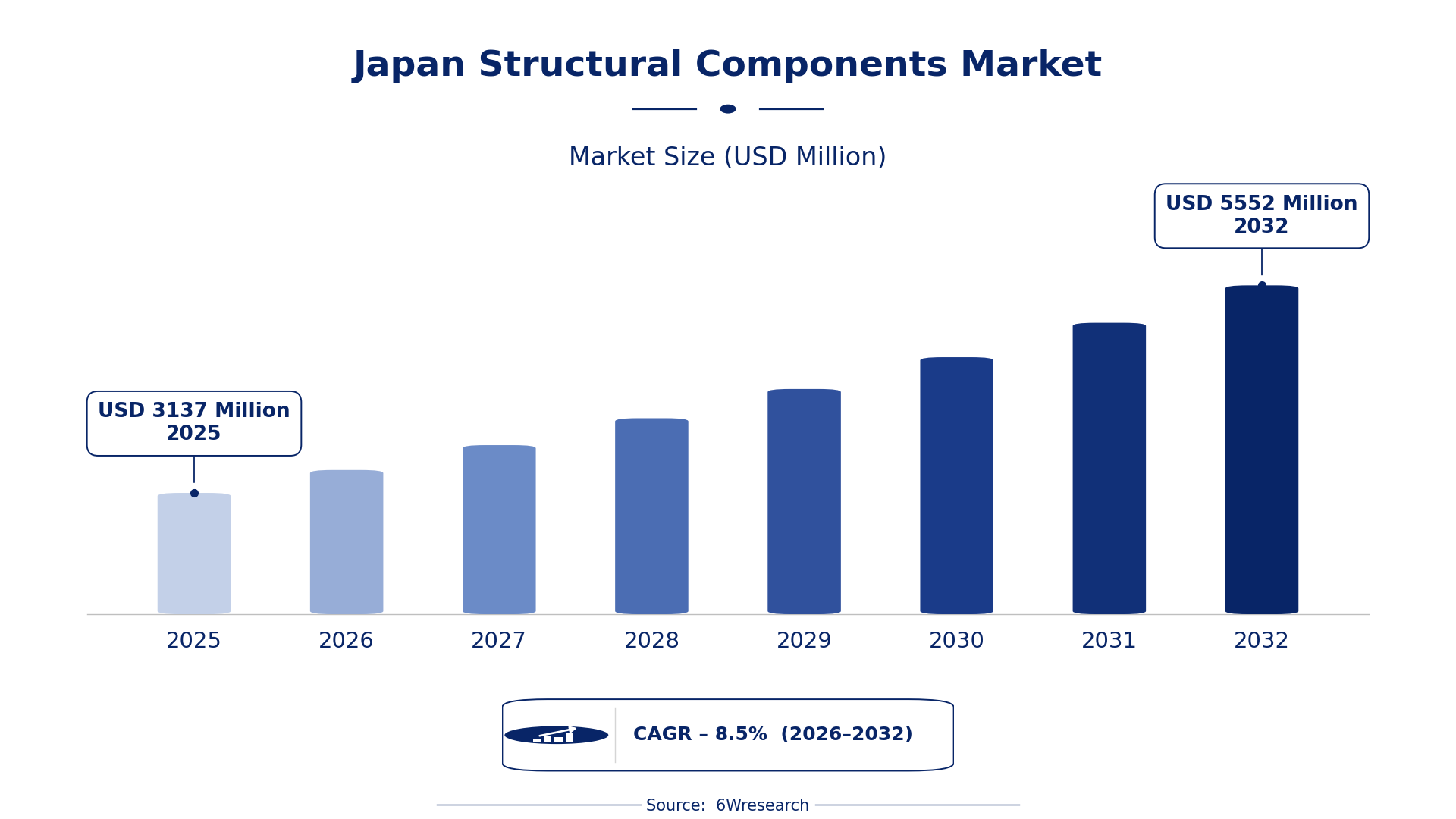
According to 6Wresearch internal database and industry insights, the Japan Structural Components Market was valued at USD 3,137 Million in 2025 and is projected to reach USD 5,552 Million by 2032, growing at a CAGR of approximately 8.5% during 2026–2032.
Japan Structural Components Market Highlights
| Report Metric | Details |
| Report Name | Japan Structural Components Market (2026-2032) |
| Market Size 2025 | USD 3,137 Million |
| Market Size 2032 | USD 5,552 Million |
| Absolute Growth 2025–2032 | USD 2,415 Million |
| CAGR 2026–2032 | 8.5% |
| Peak Annual Growth | 9.6% in 2029 |
| Forecast Period | 2026–2032 |
| Historical Data | 2022–2025 |
| Base Year | 2025 |
| Leading Component Type, 2025 | Steel Beams (52% share) |
| Leading Material Type, 2025 | Carbon Steel (44% share) |
| Leading Use Case, 2025 | Bridge Construction (49% share) |
| Leading End User, 2025 | Construction Companies (39% share) |
| Fastest-Growing Component Type | Prefab Panels (12.2% CAGR) |
| Fastest-Growing Material Type | Reinforced Concrete (12.0% CAGR) |
| Fastest-Growing Use Case | Modular Buildings (11.5% CAGR) |
| Fastest-Growing End User | EPC Contractors (11.1% CAGR) |
| Growing Sector | Construction |
| Key End Users | Construction Companies, Civil Engineering Firms, EPC Contractors, Infrastructure Developers |
Japan Structural Components Market Year-wise Growth Rate and Key Drivers (2022–2032)
This graph illustrates the annual growth rates of the market from 2022 to 2032, highlighting a steady upward trajectory and projected market expansion over the forecast period.
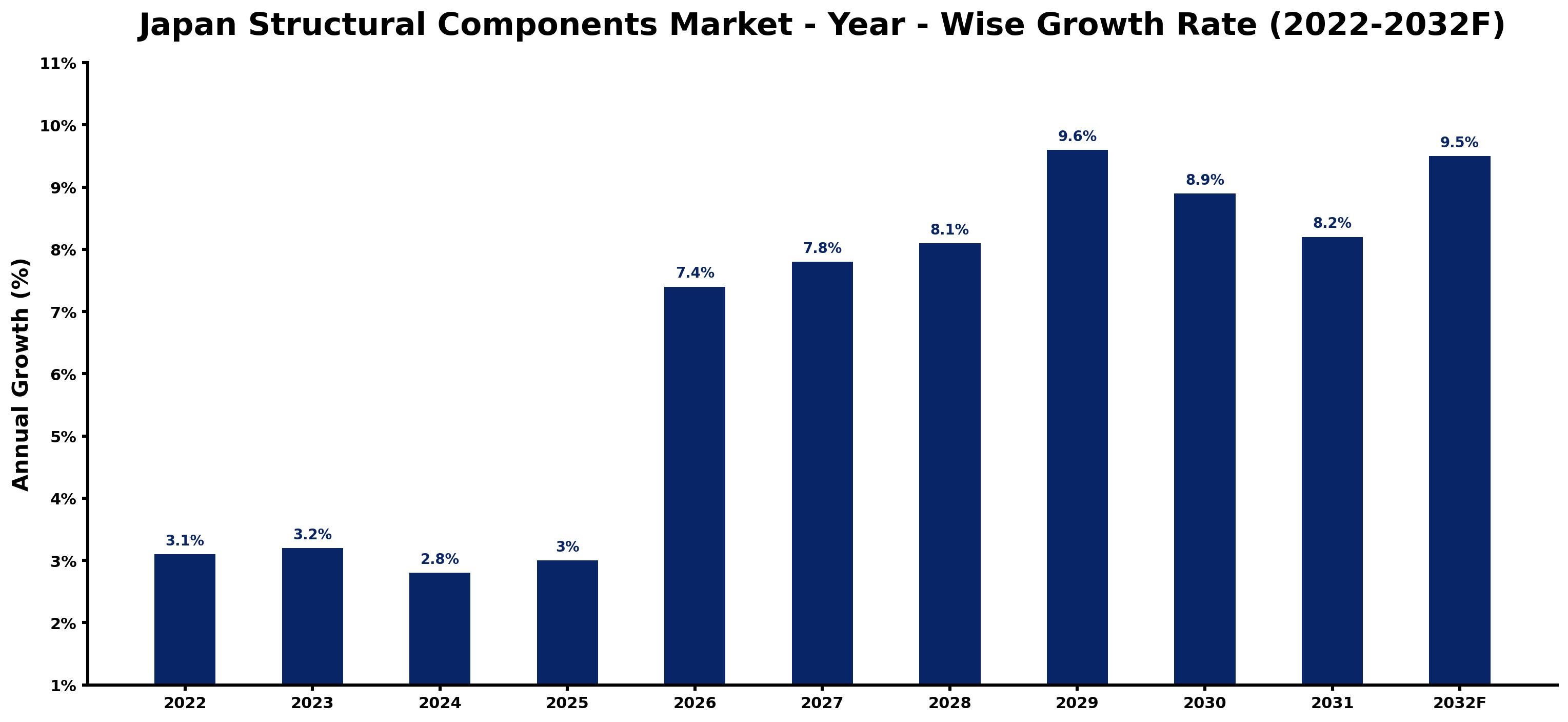
The table below sets out the estimated growth rate for each year and the main factor behind it.
| Year | Estimated Annual Growth (%) | Market Rationale |
| 2022 | 3.1 | The market saw steady growth, driven by ongoing construction projects. |
| 2023 | 3.2 | Demand increased due to the completion of infrastructure from the 2020 Olympics. |
| 2024 | 2.8 | Growth slowed as some projects reached completion, yet demand remained strong. |
| 2025 | 3.0 | Investment in infrastructure projects accelerated, boosting demand for structural components. |
| 2026 | 7.4 | Demand is expected to rise with new urban renewal initiatives. |
| 2027 | 7.8 | Investment in modular buildings is expected to drive market growth. |
| 2028 | 8.1 | The market is projected to benefit from increased public infrastructure spending. |
| 2029 | 9.6 | Peak growth is anticipated as major projects are initiated across the country. |
| 2030 | 8.9 | Growth will slow slightly as some projects complete, yet demand remains high. |
| 2031 | 8.2 | The market will continue to grow, albeit at a slower pace than previous years. |
| 2032 | 9.5 | Demand is expected to rise again with new sustainable building practices. |
Note: Market size estimations and growth projections presented in this report are based on 6Wresearch's proprietary forecasting methodology, utilizing the latest available industry data, government publications, and primary research inputs.
Japan Structural Components Market Synopsis
Structural components are vital elements in construction, primarily made from steel and concrete, used for supporting buildings, bridges, and industrial facilities. The Japan Structural Components Market is expanding due to strong domestic construction activity, driven by infrastructure projects and urban renewal initiatives. The construction sector, valued at approximately 50 trillion yen, continues to grow, with carbon steel accounting for 70% of materials used. The government's focus on sustainable building practices further fuels demand, providing opportunities for suppliers in the market.
Market Dynamics Impact Analysis (2026–2032)
| Factor | Type | Impact | Primary Segment Affected |
| Growing investment in infrastructure development | Driver | High | Steel Beams |
| Increased demand for modular buildings | Driver | High | Prefab Panels |
| Rising urbanisation and housing demand | Opportunity | High | Bridge Construction |
| Expansion of renewable energy projects | Opportunity | Medium | Industrial Plants |
| Compliance with JIS standards for quality | Restraint | High | Columns & Girders |
| High competition among suppliers | Restraint | Medium | Structural Tubing |
| Fluctuating raw material prices | Challenge | High | Carbon Steel |
| Delays in project approvals | Challenge | Medium | Reinforced Concrete |
Evaluation of Drivers in Japan Structural Components Market (2026–2032)
The table below links each growth driver to the segment it affects and the evidence for it.
| Drivers | Primary Segment Affected | Why It Matters (Evidence) |
| Investment in infrastructure projects | Steel Beams | Japan's government plans to invest 10 trillion yen in infrastructure by 2025, increasing demand for load-bearing structures. |
| Growth in modular construction | Prefab Panels | Prefabricated panels reduce construction time by up to 30%, attracting construction companies to adopt this method. |
| Rising urban population | Columns & Girders | With a population of approximately 125 million, housing demand drives the need for structural integrity in buildings. |
| Government initiatives for sustainable practices | Reinforced Concrete | The 2023 program promoting sustainable building practices encourages the use of durable materials in construction. |
| Technological advancements in construction | Structural Tubing | Lightweight structural tubing is increasingly used in modular buildings, improving design flexibility. |
This investment drives construction companies to increase their purchases of steel beams for load-bearing applications. The rising urban population fuels the need for durable structures, leading to higher demand for columns and girders. Innovations in lightweight structural tubing are making it more appealing for modular buildings, contributing to overall market growth.
Evaluation of Restraints in Japan Structural Components Market
The main factors holding the market back are set out below.
| Market Restraint | Primary Segment Affected | Why It Matters (Evidence) |
| Compliance with stringent JIS standards | Columns & Girders | Manufacturers must ensure their products meet JIS standards, which can increase production costs significantly. |
| Intense competition among suppliers | Structural Tubing | High competition may lead to price wars, affecting profit margins for suppliers. |
| Fluctuating prices of raw materials | Carbon Steel | Volatility in raw material costs can impact pricing strategies and profitability for manufacturers. |
| Delays in project approvals | Reinforced Concrete | Lengthy approval processes can postpone project timelines, affecting demand for structural components. |
| Limited availability of skilled labor | Prefab Panels | A shortage of skilled labor in the construction sector can hinder the timely execution of projects. |
Japan Structural Components Market Challenges
In Tokyo, construction companies face a skills shortage, with over 4 million workers lacking advanced construction techniques, leading to project delays of several months. Buyers encounter rising costs due to regulatory changes, as the Ministry of Land, Infrastructure, Transport and Tourism enforces stricter compliance measures that can extend project timelines by up to six months. Regulatory requirements for JIS standards necessitate additional testing and certification, causing delays for contractors by several weeks. Supply chain disruptions arise from reliance on carbon steel, which constitutes 70% of materials, inflating prices for buyers by approximately 15%.
Trends in the Japan Structural Components Market
The shifts below are changing how Japan Structural Components Market products are bought and supplied.
- Shift towards Modular Construction: Construction companies are increasingly adopting modular building techniques, which allow for quicker assembly. Prefabricated panels are now used in over 30% of new projects, reducing construction time by up to 30%.
- Increased Focus on Sustainability: The government launched a program in 2023 to promote sustainable building practices, aiming for a 30% reduction in carbon emissions by 2030. This initiative is reshaping material choices in construction.
- Urban Renewal Initiatives Gaining Momentum: Tokyo's urban renewal projects are driving demand for structural components, with funding of 1 trillion yen allocated for 2025. This trend is reshaping the construction environment in urban areas.
- Technological Advancements in Construction Materials: Innovations in lightweight structural tubing are transforming modular buildings, with adoption rates increasing by 15% annually. This shift is improving design flexibility and reducing construction costs.
Investment Opportunities in the Japan Structural Components Market
The following areas offer the clearest openings for investors and suppliers in the Japan Structural Components Market.
- Supply of Prefabricated Panels: With a growing demand for quick assembly in construction, suppliers can focus on prefabricated panels. The market gap is evident, with a projected increase in this segment.
- Investment in Urban Infrastructure: Tokyo's urban renewal projects present a notable opportunity for construction suppliers. With 1 trillion yen allocated for 2025, partnerships with local firms can facilitate market entry.
- Expansion of Sustainable Materials: There is a pressing need for sustainable construction materials, with the government targeting a 30% reduction in carbon emissions by 2030. Suppliers can invest in eco-friendly products to meet this demand.
- Growth in Modular Building Solutions: The rise of modular buildings represents a promising opportunity, with a projected increase in demand. Suppliers should consider partnerships with EPC contractors to capitalise on this trend.
Government Initiatives in the Japan Structural Components Market
The Building Energy Efficiency Act mandates that all new buildings meet energy standards by April 2025, compelling construction companies to invest in compliant structural components. This act aims to improve energy efficiency in the construction sector, influencing material choices and design processes. The act also establishes a framework for reducing carbon emissions, aligning with broader sustainability goals.
The Ministry of Land, Infrastructure, Transport and Tourism oversees construction regulations and approves projects, ensuring compliance with safety and quality standards. Their initiatives support sustainable building practices, driving demand for advanced structural components. In 2023, the ministry approved funding for several urban renewal projects, enhancing the market for structural components.
Future Insight of the Japan Structural Components Market
Investment in infrastructure development is projected at 10 trillion yen by 2025, creating strong demand for structural components, particularly in urban areas. By 2032, the adoption of prefabricated panels will streamline project delivery, reducing construction time by up to 30%. The government's programme promoting sustainable building practices will drive innovation in materials, benefiting suppliers. Urban renewal initiatives by the Tokyo Metropolitan Government will ensure a steady flow of projects, providing ongoing opportunities for construction firms.
Market Segmentation Analysis
Japan Structural Components Market report covers a detailed analysis of the following market segments:
By Component Type – Steel Beams Lead, Prefab Panels Expected to Grow Fastest
According to Saurav Kr Singh, Senior Research Analyst at 6Wresearch, Steel Beams held 52% of the Japan Structural Components Market by component type in 2025. Steel beams hold the largest share in the market due to their critical role in load-bearing applications across various structures. Their widespread use in significant urban infrastructure projects, particularly in Tokyo, illustrates their importance in the construction industry. Over 2026–2032, Prefab Panels are expected to post the fastest growth, at a CAGR of 12.2%. Prefab panels are experiencing rapid growth as they facilitate quicker assembly in construction, appealing to builders focused on efficiency. The rising adoption of prefabricated methods in urban renewal initiatives significantly fuels this growth. Suppliers must enhance their prefab panel offerings to meet the rising demand for efficient construction solutions.
By Material Type – Carbon Steel Leads, Reinforced Concrete Expected to Grow Fastest
Carbon Steel accounted for 44% of the market by material type in 2025. Carbon steel dominates the market because of its widespread use for its strength in structural applications. Its prevalence in major construction projects, including those governed by JIS standards, highlights its significance in the industry. The quickest growth will come from Reinforced Concrete, forecast to expand at a CAGR of 12.0% between 2026 and 2032. Reinforced concrete is growing rapidly as it is favoured for its durability in new construction projects, particularly in urban areas. The ongoing investment in infrastructure development further fuels this trend, making it a preferred choice among builders. Buyers should consider sourcing reinforced concrete to ensure longevity and reliability in their construction projects.
By Use Case – Bridge Construction Leads, Modular Buildings Expected to Grow Fastest
With 49% of use case revenue in 2025, Bridge Construction was the largest category. Bridge construction leads the market as it is vital for infrastructure projects, particularly in a nation with an extensive network of bridges. The emphasis on improving transportation links reinforces its significance in Japan's construction environment. Modular Buildings are projected to grow fastest, at a CAGR of 11.5% during 2026–2032. Modular buildings are experiencing the fastest growth due to their adaptability and efficiency in construction, aligning with contemporary building preferences. The rising demand for swift and flexible construction solutions is propelling this trend. Suppliers should consider opportunities in modular building solutions to align with the changing preferences of the construction market.
By End User – Construction Companies Lead, EPC Contractors Expected to Grow Fastest
In 2025, Construction Companies led the end user split with a 39% share. Construction companies represent the largest segment as they serve as the primary contractors for a wide array of projects. Their extensive workforce and active participation in diverse construction activities highlight their vital role in the market. EPC Contractors are set to record the highest CAGR in this split, 11.1% over 2026–2032. EPC contractors are witnessing swift growth as they play an integral role in project execution, managing the entire process from design to completion. The increasing complexity of construction projects requires their expertise, driving their rapid expansion. Suppliers should customise their offerings to address the specific needs of EPC contractors, ensuring alignment with project execution requirements.
Key Attractiveness of the Report
- 10 Years of Market Numbers
- Historical Data Starting from 2022 to 2025
- Base Year 2025
- Forecast Data until 2032
- Key Performance Indicators Impacting the Market
- Major Upcoming Developments and Projects
Key Highlights of the Report:
- Japan Structural Components Market Outlook
- Market Size of Japan Structural Components Market, 2025
- Forecast of Japan Structural Components Market, 2032
- Historical Data and Forecast of Japan Structural Components Revenues & Volume for the Period 2022-2032F
- Japan Structural Components Market Trend Evolution
- Japan Structural Components Market Drivers and Challenges
- Japan Structural Components Price Trends
- Japan Structural Components Porter's Five Forces
- Japan Structural Components Industry Life Cycle
- Historical Data and Forecast of Japan Structural Components Market Revenues & Volume By Component Type for the Period 2022-2032F
- Historical Data and Forecast of Japan Structural Components Market Revenues & Volume By Steel Beams for the Period 2022-2032F
- Historical Data and Forecast of Japan Structural Components Market Revenues & Volume By Prefab Panels for the Period 2022-2032F
- Historical Data and Forecast of Japan Structural Components Market Revenues & Volume By Columns & Girders for the Period 2022-2032F
- Historical Data and Forecast of Japan Structural Components Market Revenues & Volume By Structural Tubing for the Period 2022-2032F
- Historical Data and Forecast of Japan Structural Components Market Revenues & Volume By Material Type for the Period 2022-2032F
- Historical Data and Forecast of Japan Structural Components Market Revenues & Volume By Carbon Steel for the Period 2022-2032F
- Historical Data and Forecast of Japan Structural Components Market Revenues & Volume By Reinforced Concrete for the Period 2022-2032F
- Historical Data and Forecast of Japan Structural Components Market Revenues & Volume By Alloy Steel for the Period 2022-2032F
- Historical Data and Forecast of Japan Structural Components Market Revenues & Volume By Stainless Steel for the Period 2022-2032F
- Historical Data and Forecast of Japan Structural Components Market Revenues & Volume By Use Case for the Period 2022-2032F
- Historical Data and Forecast of Japan Structural Components Market Revenues & Volume By Bridge Construction for the Period 2022-2032F
- Historical Data and Forecast of Japan Structural Components Market Revenues & Volume By Modular Buildings for the Period 2022-2032F
- Historical Data and Forecast of Japan Structural Components Market Revenues & Volume By Industrial Plants for the Period 2022-2032F
- Historical Data and Forecast of Japan Structural Components Market Revenues & Volume By Stadium Structures for the Period 2022-2032F
- Historical Data and Forecast of Japan Structural Components Market Revenues & Volume By End User for the Period 2022-2032F
- Historical Data and Forecast of Japan Structural Components Market Revenues & Volume By Civil Engineering Firms for the Period 2022-2032F
- Historical Data and Forecast of Japan Structural Components Market Revenues & Volume By Construction Companies for the Period 2022-2032F
- Historical Data and Forecast of Japan Structural Components Market Revenues & Volume By EPC Contractors for the Period 2022-2032F
- Historical Data and Forecast of Japan Structural Components Market Revenues & Volume By Infrastructure Developers for the Period 2022-2032F
- Japan Structural Components Import Export Trade Statistics
- Market Opportunity Assessment By Component Type
- Market Opportunity Assessment By Material Type
- Market Opportunity Assessment By Use Case
- Market Opportunity Assessment By End User
- Japan Structural Components Top Companies Market Share
- Japan Structural Components Competitive Benchmarking By Technical and Operational Parameters
- Japan Structural Components Company Profiles
- Japan Structural Components Key Strategic Recommendations
Market Covered
This report examines the market across the segments below.
By Component Type
- Steel Beams
- Prefab Panels
- Columns & Girders
- Structural Tubing
By Material Type
- Carbon Steel
- Reinforced Concrete
- Alloy Steel
- Stainless Steel
By Use Case
- Bridge Construction
- Modular Buildings
- Industrial Plants
- Stadium Structures
By End User
- Civil Engineering Firms
- Construction Companies
- EPC Contractors
- Infrastructure Developers































