Japan Structural Health Sensor Market Size & Growth Rate
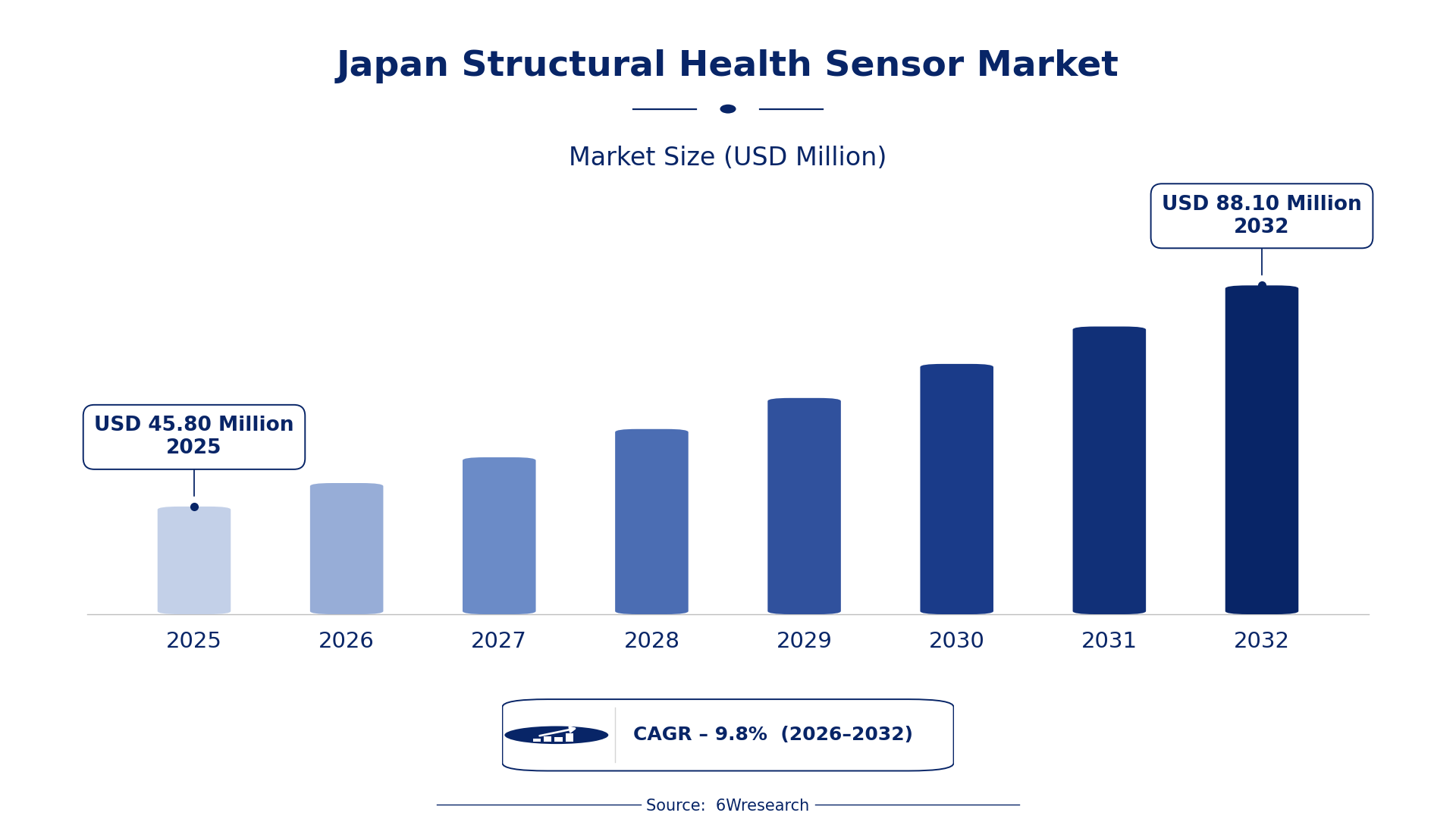
According to 6Wresearch internal database and industry insights, the Japan Structural Health Sensor Market was valued at USD 45.80 Million in 2025 and is projected to reach USD 88.10 Million by 2032, growing at a CAGR of approximately 9.8% during 2026–2032.
Japan Structural Health Sensor Market Highlights
| Report Metric | Details |
| Report Name | Japan Structural Health Sensor Market (2026-2032) |
| Market Size 2025 | USD 45.80 Million |
| Market Size 2032 | USD 88.10 Million |
| Absolute Growth 2025–2032 | USD 42.30 Million |
| CAGR 2026–2032 | 9.8% |
| Peak Annual Growth | 11.4% in 2029 |
| Forecast Period | 2026–2032 |
| Historical Data | 2022–2025 |
| Base Year | 2025 |
| Leading Sensor Type, 2025 | Strain Gauges (42% share) |
| Leading Measurement Focus, 2025 | Structural Stress (40% share) |
| Leading Integration Method, 2025 | Wired (47% share) |
| Leading End User, 2025 | Dam Monitoring Agencies (35% share) |
| Fastest-Growing Sensor Type | Acoustic Emission Sensors (14.6% CAGR) |
| Fastest-Growing Measurement Focus | Crack Detection (12.6% CAGR) |
| Fastest-Growing Integration Method | Embedded (13.9% CAGR) |
| Fastest-Growing End User | Bridge Maintenance Units (12.5% CAGR) |
| Growing Sector | Bridge Maintenance Units |
| Key End Users | Dam Monitoring Agencies, Bridge Maintenance Units, Power Grid Managers, Oil & Gas Infrastructure |
Japan Structural Health Sensor Market Year-wise Growth Rate and Key Drivers (2022–2032)
This graph illustrates the annual growth rates of the market from 2022 to 2032, highlighting a steady upward trajectory and projected market expansion over the forecast period.
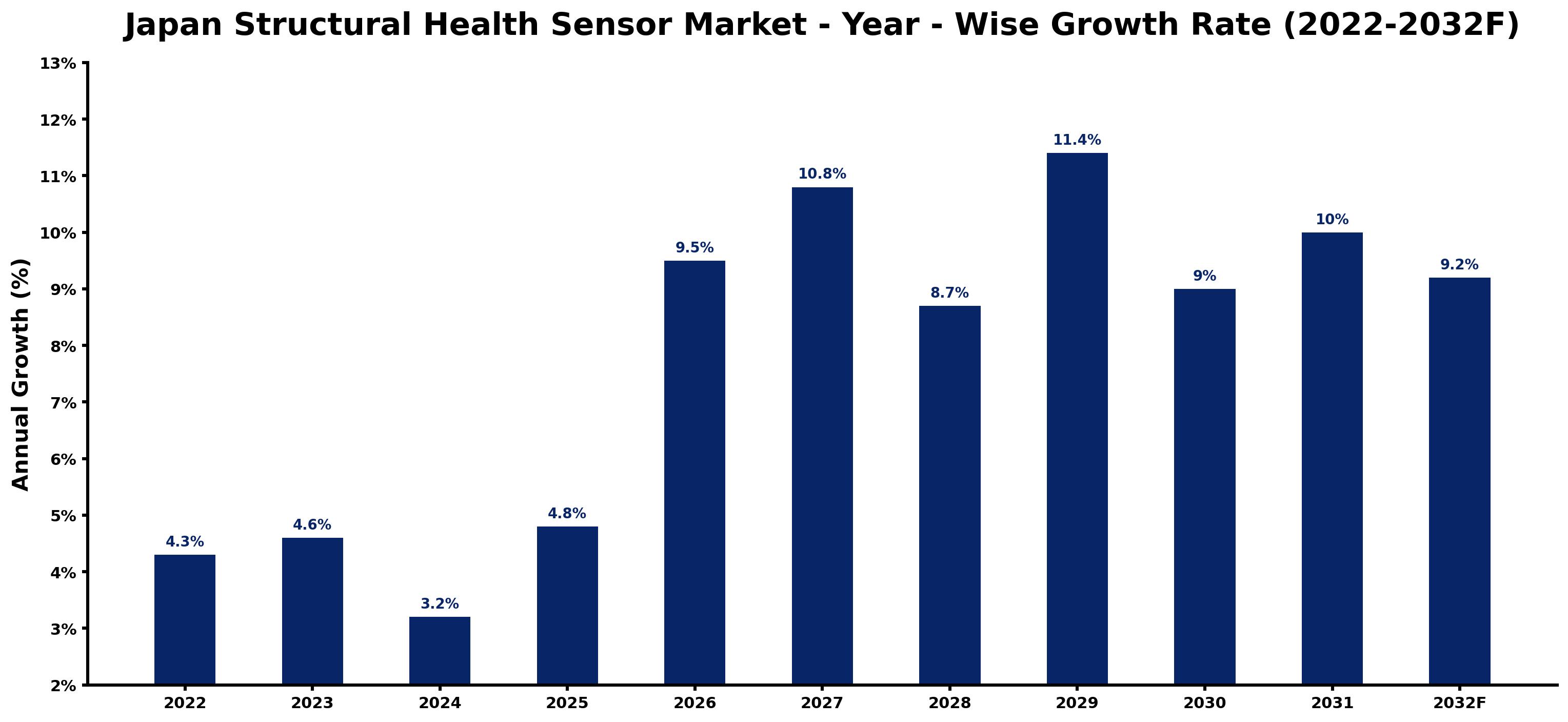
Each row of the following table gives one year's estimated growth and the event or demand shift that explains it.
| Year | Estimated Annual Growth (%) | Market Rationale |
| 2022 | 4.3 | The market exhibited steady growth due to ongoing infrastructure projects and maintenance needs. |
| 2023 | 4.6 | Growth accelerated as infrastructure investments increased, particularly in urban areas. |
| 2024 | 3.2 | Growth slowed as some projects faced delays, impacting sensor demand. |
| 2025 | 4.8 | Demand picked up again with renewed focus on infrastructure resilience and safety. |
| 2026 | 9.5 | The market is expected to grow as technology adoption in monitoring systems rises. |
| 2027 | 10.8 | Investments in seismic safety measures will drive demand further. |
| 2028 | 8.7 | Growth is projected to slow as market saturation begins to take effect. |
| 2029 | 11.4 | Demand will surge as new infrastructure projects are initiated nationwide. |
| 2030 | 9.0 | A slowdown is anticipated as the market stabilises after rapid growth. |
| 2031 | 10.0 | Growth is expected to rise again due to emerging technologies in monitoring. |
| 2032 | 9.2 | The market will continue to grow as infrastructure maintenance remains a priority. |
Note: Market size estimations and growth projections presented in this report are based on 6Wresearch's proprietary forecasting methodology, utilizing the latest available industry data, government publications, and primary research inputs.
Japan Structural Health Sensor Market Synopsis
Structural health sensors are critical devices used to monitor the condition of essential infrastructure, including bridges and dams. They employ technologies such as strain gauges and fibre optics to detect structural stress, crack formation, and vibrations. The Japan Structural Health Sensor Market is growing due to rising investments in infrastructure resilience and safety, particularly in regions prone to seismic activity. With substantial government funding directed towards infrastructure projects, demand from agencies responsible for infrastructure safety is propelling growth in this sector.
Market Dynamics Impact Analysis (2026–2032)
| Factor | Type | Impact | Primary Segment Affected |
| Growing urban infrastructure projects | Driver | High | Strain Gauges |
| Rising focus on disaster resilience | Driver | High | Acoustic Emission Sensors |
| Increased funding for infrastructure monitoring | Opportunity | High | Fiber Optic Sensors |
| Expansion of monitoring in seismic regions | Opportunity | Medium | Accelerometers |
| High costs of advanced sensors | Restraint | High | Structural Stress |
| Limited awareness of sensor benefits | Restraint | Medium | Crack Detection |
| Compliance with strict safety standards | Challenge | High | Vibration/Temp |
| Capacity constraints in sensor manufacturing | Challenge | Medium | Dynamic Load |
Evaluation of Drivers in Japan Structural Health Sensor Market (2026–2032)
Key forces behind demand, with the segment each one moves most, are listed below.
| Drivers | Primary Segment Affected | Why It Matters (Evidence) |
| Increased infrastructure spending | Strain Gauges | Japan allocated ¥500 million for infrastructure resilience projects in 2023, boosting sensor demand. |
| Growing awareness of structural safety | Acoustic Emission Sensors | With over 1,200 dams monitored, agencies are investing in advanced monitoring solutions. |
| Advancements in sensor capabilities | Fiber Optic Sensors | The Shinkansen rail system employs advanced sensors for track safety, improving monitoring effectiveness. |
| Rising demand for continuous monitoring | Accelerometers | The average lifespan of bridges necessitates ongoing monitoring to ensure structural safety. |
| Focus on disaster preparedness | Structural Stress | The Japan Society of Civil Engineers promotes structural health monitoring for improved safety. |
Buyers are adding capacity as Japan's infrastructure spending rises, with ¥500 million allocated for resilience projects in 2023. Increased investments in seismic safety measures will drive demand for structural health sensors, particularly in earthquake-prone regions. The average lifespan of bridges necessitates ongoing monitoring, leading to higher purchases of accelerometers for vibration measurements. New sensor technologies are further driving demand from bridge maintenance units, ensuring safety and reliability in infrastructure.
Evaluation of Restraints in Japan Structural Health Sensor Market
The following restraints limit how fast demand can grow.
| Market Restraint | Primary Segment Affected | Why It Matters (Evidence) |
| High costs of advanced sensor technologies | Structural Stress | The average cost of implementing advanced monitoring systems can deter agencies from upgrading. |
| Limited understanding of benefits among stakeholders | Crack Detection | Many infrastructure managers lack awareness of the advantages of health monitoring systems. |
| Regulatory compliance requirements | Vibration/Temp | Strict safety regulations necessitate costly certifications and testing for new sensors. |
| Market saturation in urban areas | Dynamic Load | As more structures are equipped with sensors, new demand may slow in densely populated regions. |
| Dependence on skilled technicians for installation | Acoustic Emission Sensors | The need for trained personnel can limit the speed of sensor deployment. |
Japan Structural Health Sensor Market Challenges
High costs for buyers stem from the need to monitor ageing infrastructure, as the average lifespan of a bridge in Japan is 50 years. This ongoing requirement for structural health sensors can lead to expenditures surpassing ¥46.7 trillion in national medical care, straining public funding for infrastructure projects. A shortage of skilled workers complicates the installation and maintenance of these sensors, delaying critical assessments and increasing operational costs for producers. Outdated technology impedes effective monitoring, posing safety risks and potentially resulting in financial losses for hospitals and infrastructure operators.
Trends in the Japan Structural Health Sensor Market
Several trends are reshaping the Japan Structural Health Sensor Market; the most important are set out below.
- Shift from Wired to Wireless Monitoring: Since 2023, there has been a noticeable shift towards wireless sensor technologies in urban areas. This transition allows for easier installation and maintenance, particularly in densely populated regions like Tokyo, where over 300 bridge maintenance units operate.
- Emergence of Real-Time Data Analytics: In 2024, the integration of real-time data analytics in monitoring systems began to gain traction. This advancement is apparent in infrastructure projects across the Tokyo Bay area, improving decision-making processes with immediate data access.
- Increased Adoption of Embedded Sensors: Starting in 2026, embedded sensors are becoming more prevalent in new construction projects. This trend is particularly significant in seismic-prone regions, where continuous monitoring is critical for safety.
- Focus on Sustainability in Infrastructure Projects: From 2025, sustainability has become a priority in infrastructure projects, influencing sensor selection. Programs promoting eco-friendly materials in construction are gaining support, aligning with Japan's long-term environmental goals.
Investment Opportunities in the Japan Structural Health Sensor Market
Below are the investment opportunities with the strongest case in the Japan Structural Health Sensor Market.
- Investment in Advanced Monitoring Solutions: With over 1,200 major dams monitored, there is a growing opportunity to supply advanced structural health sensors. The government allocated ¥500 million for infrastructure resilience projects in 2023, creating a favourable environment for investment.
- Partnerships for Sensor Deployment: Now is the time to invest in wireless sensor technologies, which are increasingly adopted in urban areas. Collaborating with bridge maintenance units can facilitate market entry and improve product offerings.
- Focus on Seismic Safety: Investment in seismic safety monitoring solutions is essential, especially in regions like Tokyo. The ongoing government initiatives to improve disaster resilience present opportunities for suppliers.
- Expansion in Retrofit Solutions: With many aging structures, there is a demand for retrofit solutions that integrate modern sensors. Engaging with dam monitoring agencies can help suppliers tap into this growing market.
Government Initiatives in the Japan Structural Health Sensor Market
The Economic Security Promotion Act, enacted in 2022, supports supply-chain resilience for critical products, including structural health sensors. This measure encourages local production and innovation, benefiting manufacturers and buyers alike by ensuring a steady supply of essential monitoring technologies.
The Ministry of Land, Infrastructure, Transport and Tourism oversees infrastructure monitoring and has allocated ¥500 million in 2023 for resilience projects. This funding supports the development and deployment of structural health sensors, improving safety and reliability across critical infrastructure.
Future Insight of the Japan Structural Health Sensor Market
By 2032, the adoption of advanced sensor technologies will transform demand for structural health sensors, particularly in seismic-prone regions where monitoring is essential. The government programme aimed at enhancing disaster resilience will drive investment in new infrastructure projects, creating opportunities for suppliers. Implementation of ISO 9001 standards will raise manufacturing quality, ensuring buyers receive more reliable products. With over 300 bridge maintenance units across Japan, the use of data analytics will streamline decision-making processes in infrastructure management.
Market Segmentation Analysis
Japan Structural Health Sensor Market report covers a detailed analysis of the following market segments:
By Sensor Type – Strain Gauges Lead, Acoustic Emission Sensors Expected to Grow Fastest
According to Saurav Kr Singh, Senior Research Analyst at 6Wresearch, Strain Gauges held 42% of the Japan Structural Health Sensor Market by sensor type in 2025. Strain gauges hold the largest share as they are extensively used for measuring stress in critical structures across Japan. Their application in monitoring the safety of over 1,200 major dams demonstrates their pivotal role in infrastructure management. The quickest growth will come from Acoustic Emission Sensors, forecast to expand at a CAGR of 14.6% between 2026 and 2032. The growth of acoustic emission sensors is propelled by their ability to detect crack formation, which is crucial for maintaining structural integrity in seismic-prone regions. This capability is increasingly sought after as infrastructure resilience becomes a priority in Japan. Suppliers must focus on developing acoustic emission sensors to align with the rising demand for advanced monitoring solutions.
By Measurement Focus – Structural Stress Leads, Crack Detection Expected to Grow Fastest
Structural Stress accounted for 40% of the market by measurement focus in 2025. Structural stress measurement is paramount for assessing safety and performance, making it the leading focus area in the market. This is particularly relevant for Japan's bridges, which require regular evaluations throughout their average lifespan of 50 years. Crack Detection is set to record the highest CAGR in this split, 12.6% over 2026–2032. Crack detection is rapidly gaining traction as it is essential for preventive maintenance, especially within aging infrastructure. The government's ongoing infrastructure resilience initiatives further highlight the critical need for effective crack detection solutions. Buyers should prioritise acquiring crack detection technologies to enhance the safety of aging infrastructure.
By Integration Method – Wired Leads, Embedded Expected to Grow Fastest
The largest integration method category in 2025 was Wired, at 47% of revenue. Wired integration methods dominate the market due to their provision of stable connections essential for reliable data transmission. This reliability is crucial in Japan's infrastructure, where consistent monitoring is vital for ensuring safety. Embedded is projected to grow fastest, at a CAGR of 13.9% during 2026–2032. Embedded systems are increasingly popular as they allow for continuous monitoring directly integrated into structures. This trend aligns with Japan's efforts to improve disaster resilience, making embedded solutions more appealing to stakeholders. Suppliers should concentrate on embedded technology to meet the growing demand for integrated monitoring solutions.
By End User – Dam Monitoring Agencies Lead, Bridge Maintenance Units Expected to Grow Fastest
Dam Monitoring Agencies took 35% of end user revenue in 2025, more than any other category. Dam monitoring agencies represent the largest user group as they are directly responsible for the safety of critical infrastructure. Their involvement in overseeing over 1,200 monitored dams in Japan underscores their importance in the structural health sensor market. Over 2026–2032, Bridge Maintenance Units are expected to post the fastest growth, at a CAGR of 12.5%. Bridge maintenance units are the fastest-growing segment, playing a vital role in ensuring the longevity of bridge structures that are crucial to Japan's transport network. With over 300 units across the country, their significance in infrastructure maintenance is on the rise. Suppliers should target bridge maintenance units to capitalise on the increasing emphasis on infrastructure longevity.
Key Attractiveness of the Report
- 10 Years of Market Numbers
- Historical Data Starting from 2022 to 2025
- Base Year 2025
- Forecast Data until 2032
- Key Performance Indicators Impacting the Market
- Major Upcoming Developments and Projects
Key Highlights of the Report:
- Japan Structural Health Sensor Market Outlook
- Market Size of Japan Structural Health Sensor Market, 2025
- Forecast of Japan Structural Health Sensor Market, 2032
- Historical Data and Forecast of Japan Structural Health Sensor Revenues & Volume for the Period 2022-2032F
- Japan Structural Health Sensor Market Trend Evolution
- Japan Structural Health Sensor Market Drivers and Challenges
- Japan Structural Health Sensor Price Trends
- Japan Structural Health Sensor Porter's Five Forces
- Japan Structural Health Sensor Industry Life Cycle
- Historical Data and Forecast of Japan Structural Health Sensor Market Revenues & Volume By Sensor Type for the Period 2022-2032F
- Historical Data and Forecast of Japan Structural Health Sensor Market Revenues & Volume By Strain Gauges for the Period 2022-2032F
- Historical Data and Forecast of Japan Structural Health Sensor Market Revenues & Volume By Acoustic Emission Sensors for the Period 2022-2032F
- Historical Data and Forecast of Japan Structural Health Sensor Market Revenues & Volume By Fiber Optic Sensors for the Period 2022-2032F
- Historical Data and Forecast of Japan Structural Health Sensor Market Revenues & Volume By Accelerometers for the Period 2022-2032F
- Historical Data and Forecast of Japan Structural Health Sensor Market Revenues & Volume By Measurement Focus for the Period 2022-2032F
- Historical Data and Forecast of Japan Structural Health Sensor Market Revenues & Volume By Structural Stress for the Period 2022-2032F
- Historical Data and Forecast of Japan Structural Health Sensor Market Revenues & Volume By Crack Detection for the Period 2022-2032F
- Historical Data and Forecast of Japan Structural Health Sensor Market Revenues & Volume By Vibration/Temp for the Period 2022-2032F
- Historical Data and Forecast of Japan Structural Health Sensor Market Revenues & Volume By Dynamic Load for the Period 2022-2032F
- Historical Data and Forecast of Japan Structural Health Sensor Market Revenues & Volume By Integration Method for the Period 2022-2032F
- Historical Data and Forecast of Japan Structural Health Sensor Market Revenues & Volume By Wired for the Period 2022-2032F
- Historical Data and Forecast of Japan Structural Health Sensor Market Revenues & Volume By Embedded for the Period 2022-2032F
- Historical Data and Forecast of Japan Structural Health Sensor Market Revenues & Volume By Wireless for the Period 2022-2032F
- Historical Data and Forecast of Japan Structural Health Sensor Market Revenues & Volume By Retrofit Solutions for the Period 2022-2032F
- Historical Data and Forecast of Japan Structural Health Sensor Market Revenues & Volume By End User for the Period 2022-2032F
- Historical Data and Forecast of Japan Structural Health Sensor Market Revenues & Volume By Dam Monitoring Agencies for the Period 2022-2032F
- Historical Data and Forecast of Japan Structural Health Sensor Market Revenues & Volume By Bridge Maintenance Units for the Period 2022-2032F
- Historical Data and Forecast of Japan Structural Health Sensor Market Revenues & Volume By Power Grid Managers for the Period 2022-2032F
- Historical Data and Forecast of Japan Structural Health Sensor Market Revenues & Volume By Oil & Gas Infrastructure for the Period 2022-2032F
- Japan Structural Health Sensor Import Export Trade Statistics
- Market Opportunity Assessment By Sensor Type
- Market Opportunity Assessment By Measurement Focus
- Market Opportunity Assessment By Integration Method
- Market Opportunity Assessment By End User
- Japan Structural Health Sensor Top Companies Market Share
- Japan Structural Health Sensor Competitive Benchmarking By Technical and Operational Parameters
- Japan Structural Health Sensor Company Profiles
- Japan Structural Health Sensor Key Strategic Recommendations
Market Covered
Segments analysed in this report are listed below.
By Sensor Type
- Strain Gauges
- Acoustic Emission Sensors
- Fiber Optic Sensors
- Accelerometers
By Measurement Focus
- Structural Stress
- Crack Detection
- Vibration/Temp
- Dynamic Load
By Integration Method
- Wired
- Embedded
- Wireless
- Retrofit Solutions
By End User
- Dam Monitoring Agencies
- Bridge Maintenance Units
- Power Grid Managers
- Oil & Gas Infrastructure































