Japan Structural Integrity Testing Market Size & Growth Rate
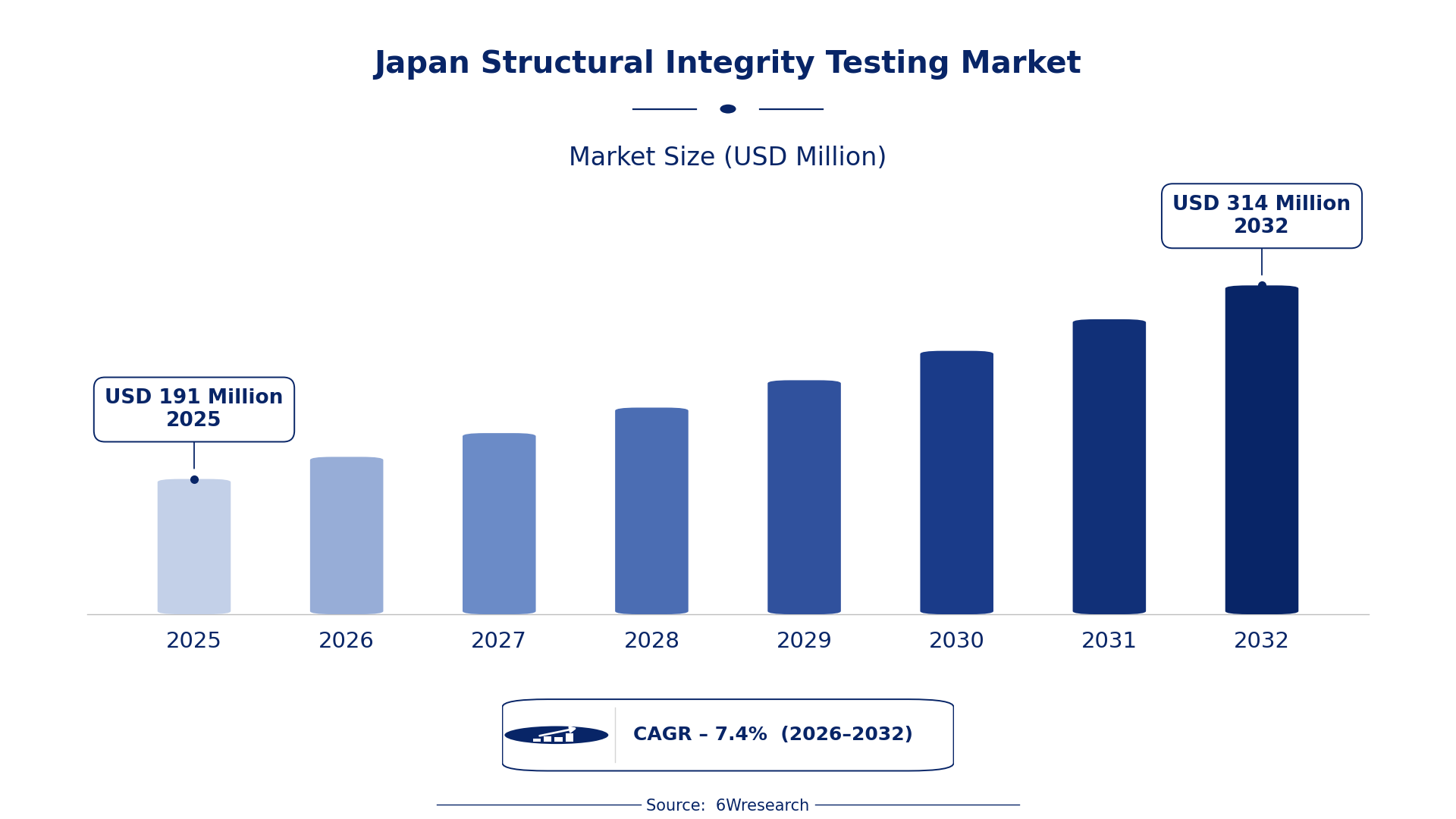
According to 6Wresearch internal database and industry insights, the Japan Structural Integrity Testing Market was valued at USD 191 Million in 2025 and is projected to reach USD 314 Million by 2032, growing at a CAGR of approximately 7.4% during 2026–2032.
Japan Structural Integrity Testing Market Highlights
| Report Metric | Details |
| Report Name | Japan Structural Integrity Testing Market (2026-2032) |
| Market Size 2025 | USD 191 Million |
| Market Size 2032 | USD 314 Million |
| Absolute Growth 2025–2032 | USD 123 Million |
| CAGR 2026–2032 | 7.4% |
| Peak Annual Growth | 8.1% in 2028 |
| Forecast Period | 2026–2032 |
| Historical Data | 2022–2025 |
| Base Year | 2025 |
| Leading Testing Type, 2025 | Ultrasonic Testing (42% share) |
| Leading Method Used, 2025 | Sound Wave Propagation (42% share) |
| Leading Structure Type, 2025 | Pipelines (53% share) |
| Leading End User, 2025 | Oil & Gas Companies (42% share) |
| Fastest-Growing Testing Type | Radiographic Testing (10.3% CAGR) |
| Fastest-Growing Method Used | X-Ray Imaging (10.1% CAGR) |
| Fastest-Growing Structure Type | Aerospace Frames (10.5% CAGR) |
| Fastest-Growing End User | Aerospace QA Teams (9.5% CAGR) |
| Growing Sector | infrastructure maintenance |
| Key End Users | Oil & Gas Companies, Aerospace QA Teams, Construction Firms |
Japan Structural Integrity Testing Market Year-wise Growth Rate and Key Drivers (2022–2032)
This graph illustrates the annual growth rates of the market from 2022 to 2032, highlighting a steady upward trajectory and projected market expansion over the forecast period.
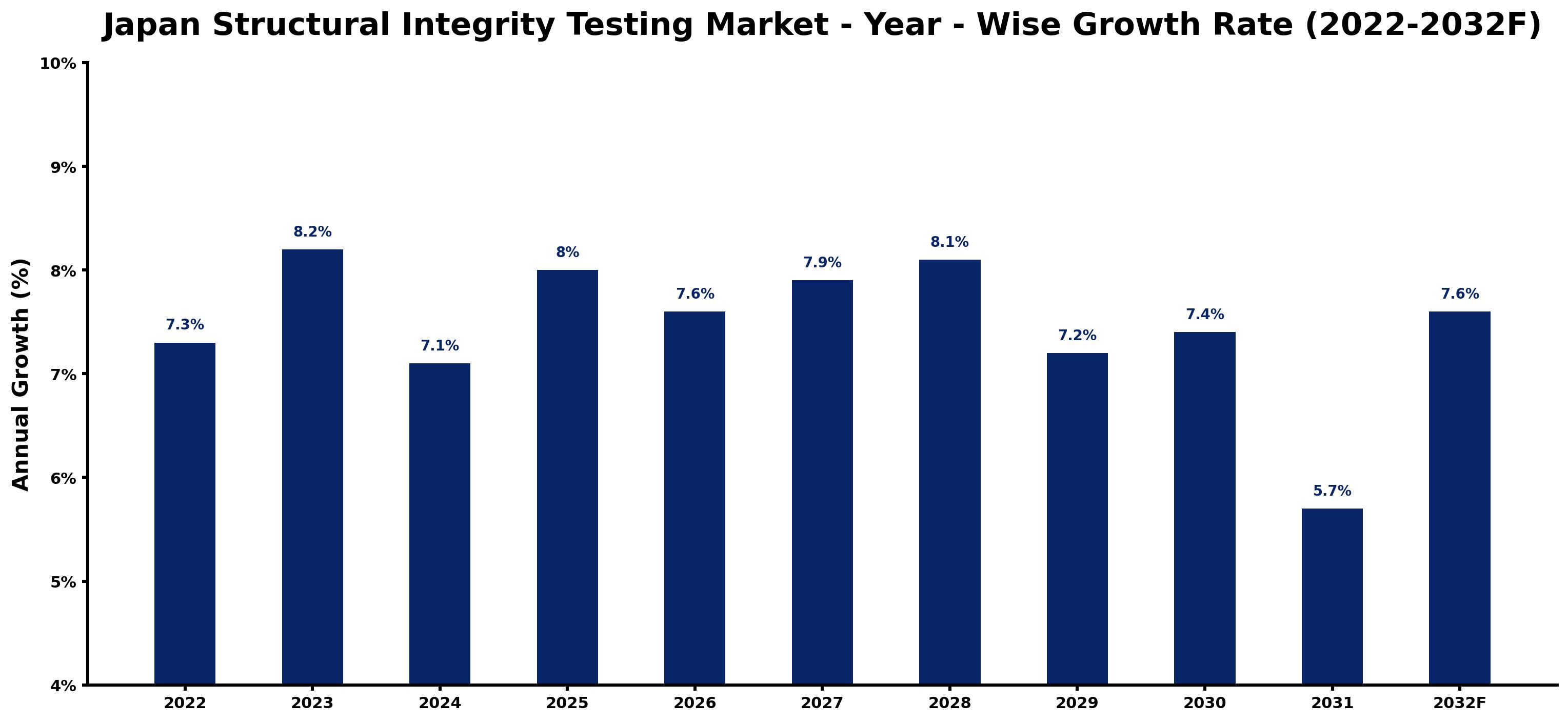
The yearly estimates that follow link every growth rate to its principal driver, so readers can see why the pace changed in each period.
| Year | Estimated Annual Growth (%) | Market Rationale |
| 2022 | 7.3 | The market experienced steady demand due to ongoing infrastructure maintenance needs. |
| 2023 | 8.2 | Growth accelerated as the aerospace sector expanded, increasing testing requirements. |
| 2024 | 7.1 | A slight slowdown occurred as the market adjusted to previous high growth rates. |
| 2025 | 8.0 | Demand surged again, driven by investments in safety measures in construction. |
| 2026 | 7.6 | Growth is expected to slow as the market stabilises following rapid expansion in prior years. |
| 2027 | 7.9 | A rebound in demand will be seen as infrastructure projects ramp up. |
| 2028 | 8.1 | Demand is projected to peak due to heightened regulatory compliance in various sectors. |
| 2029 | 7.2 | A slowdown is projected as the market adjusts to post-peak conditions. |
| 2030 | 7.4 | Growth will resume as new technologies in testing emerge, improving capabilities. |
| 2031 | 5.7 | The market will grow at a slower pace as saturation begins in key sectors. |
| 2032 | 7.6 | A resurgence in demand is expected as infrastructure investments increase. |
Note: Market size estimations and growth projections presented in this report are based on 6Wresearch's proprietary forecasting methodology, utilizing the latest available industry data, government publications, and primary research inputs.
Japan Structural Integrity Testing Market Synopsis
Structural Integrity Testing assesses the physical condition of structures to ensure safety and reliability, employing methods such as ultrasonic and radiographic testing. The Japan Structural Integrity Testing Market is expanding due to investments in infrastructure maintenance, particularly in the oil and gas and aerospace sectors. The market is supported by the JIS Z 2305 standard and a government programme launched in 2023 aimed at improving infrastructure safety, driving further demand for these services.
Market Dynamics Impact Analysis (2026–2032)
| Factor | Type | Impact | Primary Segment Affected |
| Rising infrastructure investments | Driver | High | Pipelines |
| Growing aerospace sector | Driver | High | Aerospace Frames |
| Increasing regulatory compliance | Opportunity | High | Steel Welds |
| Emerging technologies in testing | Opportunity | Medium | Concrete Structures |
| Limited skilled workforce | Restraint | High | Visual Inspection |
| High costs of advanced testing equipment | Restraint | Medium | Magnetic Particle Testing |
| Competition from low-cost alternatives | Challenge | High | Ultrasonic Testing |
| Regulatory changes impacting testing protocols | Challenge | Medium | Radiographic Testing |
Evaluation of Drivers in Japan Structural Integrity Testing Market (2026–2032)
The table below links each growth driver to the segment it affects and the evidence for it.
| Drivers | Primary Segment Affected | Why It Matters (Evidence) |
| Increased infrastructure spending | Pipelines | The oil and gas sector, valued at over 6 trillion yen, drives demand for pipeline integrity testing. |
| Expansion in the aerospace industry | Aerospace Frames | The projected growth in aerospace is increasing the need for compliance testing in aircraft manufacturing. |
| Focus on safety regulations | Steel Welds | Compliance with safety regulations in construction necessitates more frequent testing of steel welds. |
| Adoption of advanced testing technologies | Concrete Structures | Technological advancements are enabling more efficient and accurate assessments of concrete integrity. |
| Rising population driving infrastructure needs | Visual Inspection | Japan's population of approximately 125 million increases the demand for regular infrastructure maintenance. |
Spending rises because infrastructure investments have surged, particularly in the oil and gas sector, which is valued at over 6 trillion yen, leading to heightened demand for pipeline integrity testing. The aerospace industry is expanding, projected to grow, thus increasing the need for compliance testing in aircraft manufacturing. Japan's large population drives the need for regular infrastructure maintenance, further boosting demand for visual inspection services.
Evaluation of Restraints in Japan Structural Integrity Testing Market
The key brakes on demand, and where they bite hardest, are shown below.
| Market Restraint | Primary Segment Affected | Why It Matters (Evidence) |
| Shortage of skilled professionals | Visual Inspection | The limited availability of qualified personnel hampers the ability to meet growing testing demands, affecting service delivery. |
| High costs associated with advanced equipment | Magnetic Particle Testing | The financial burden of acquiring and maintaining advanced testing equipment can deter investment in necessary services. |
| Competition from low-cost alternatives | Ultrasonic Testing | The presence of cheaper testing options undermines pricing strategies and market share for established testing services. |
| Changes in regulatory requirements | Radiographic Testing | Frequent updates to testing protocols complicate compliance efforts, resulting in delays and increased operational costs. |
| Limited awareness of testing benefits | Concrete Structures | A lack of understanding about the importance of structural testing results in reduced demand from potential clients. |
Japan Structural Integrity Testing Market Challenges
A lack of advanced testing technologies hampers the supply of structural integrity testing services. This situation exists due to limited investment in modern equipment, causing delays for construction firms that require prompt evaluations. Compliance with stringent safety regulations raises operational costs, inflating testing fees by up to 30% for buyers in the aerospace sector. Frequent changes in regulatory standards necessitate additional certifications, which can extend project timelines by several weeks for clients in the oil and gas industry.
Trends in the Japan Structural Integrity Testing Market
Below are the shifts with the largest effect on the Japan Structural Integrity Testing Market.
- Shift towards Advanced Testing Technologies: In 2023, the government allocated funds to improve pipeline safety inspections, promoting advanced testing technologies. This investment is anticipated to improve testing accuracy and efficiency, benefiting service providers and clients alike.
- Increase in Compliance Standards: The introduction of stricter compliance standards in 2024 is prompting industries to invest more in structural integrity testing. This trend is particularly evident in the aerospace sector, projected to grow.
- Growing Demand for Non-Destructive Testing: The rising emphasis on safety in construction is driving demand for non-destructive testing methods. In 2023, the JIS Z 2305 standard for non-destructive testing gained traction among construction firms.
- Focus on Infrastructure Maintenance: With Japan's population of approximately 125 million, there is a notable focus on infrastructure maintenance. This trend is driving demand for visual inspection services to ensure safety and reliability.
Investment Opportunities in the Japan Structural Integrity Testing Market
Investors looking at the Japan Structural Integrity Testing Market should consider the following areas.
- Gap in Advanced Testing Services: With the aerospace sector projected to grow, there is a gap in advanced testing services. Companies can enter this market by forming joint ventures with local aerospace QA teams to improve service offerings.
- Investment in Infrastructure Safety: The construction industry is expected to invest heavily in safety measures post-2023. This presents an opportunity for testing service providers to supply comprehensive solutions to construction firms.
- Expansion of Pipeline Testing Services: With the oil and gas sector's value exceeding 6 trillion yen, there is a pressing need for pipeline testing services. Entering this market requires partnerships with local oil and gas companies to ensure compliance.
- Emerging Technologies in Testing: The rise of new technologies in structural integrity testing presents opportunities for service providers. Collaborating with research institutions can facilitate the development of innovative testing solutions.
Government Initiatives in the Japan Structural Integrity Testing Market
The Waste Management and Public Cleansing Act (1970) regulates waste treatment and disposal, impacting testing service providers by necessitating compliance with waste management standards. The Building Energy Efficiency Act (2015, amended 2022) further requires that all new buildings meet energy standards, influencing construction firms to adopt rigorous testing protocols.
In 2023, the Ministry of Land, Infrastructure, Transport and Tourism allocated funds to improve infrastructure safety inspections. This initiative, administered by the ministry, supports the implementation of advanced testing methods, ensuring compliance with safety regulations.
Future Insight of the Japan Structural Integrity Testing Market
By 2032, automated inspection systems will revolutionise the demand for structural integrity testing. The introduction of these technologies will significantly reduce testing durations, benefiting buyers seeking quick results. Enhanced training programmes for technicians will elevate service quality and ensure compliance with safety standards. Increased government funding for infrastructure safety will drive investment in testing services, supporting the construction industry's commitment to safety.
Market Segmentation Analysis
Japan Structural Integrity Testing Market report covers a detailed analysis of the following market segments:
By Testing Type – Ultrasonic Testing Leads, Radiographic Testing Expected to Grow Fastest
According to Saurav Kr Singh, Senior Research Analyst at 6Wresearch, in 2025, Ultrasonic Testing led the testing type split with a 42% share. Ultrasonic Testing holds the largest share as it is extensively used in critical sectors like oil and gas, where safety compliance is paramount. This method is particularly prevalent in facilities that conduct regular pipeline inspections, ensuring the integrity of vital infrastructure. Over 2026–2032, Radiographic Testing is expected to post the fastest growth, at a CAGR of 10.3%. Radiographic Testing is seeing rapid growth due to its necessity for inspecting welds and structural integrity, particularly within the expanding aerospace sector. As this sector continues to grow, the demand for radiographic testing services will likely increase substantially. This indicates that suppliers must prioritise their ultrasonic and radiographic testing offerings to align with the growing market needs.
By Method Used – Sound Wave Propagation Leads, X-Ray Imaging Expected to Grow Fastest
Sound Wave Propagation took 42% of method used revenue in 2025, more than any other category. Sound Wave Propagation is the leading method as it serves as the foundational principle for ultrasonic testing, which is widely used in various industries. Its application in critical testing processes ensures safety and reliability in infrastructure, particularly in pipelines. The quickest growth will come from X-Ray Imaging, forecast to expand at a CAGR of 10.1% between 2026 and 2032. X-Ray Imaging is growing quickly due to its application in radiographic testing, which provides detailed inspections necessary for compliance in sectors like aerospace. The increasing focus on safety regulations is driving this growth. Buyers will benefit from suppliers who can offer advanced sound wave propagation and X-ray imaging techniques for thorough inspections.
By Structure Type – Pipelines Lead, Aerospace Frames Expected to Grow Fastest
The largest structure type category in 2025 was Pipelines, at 53% of revenue. Pipelines dominate the market as they are critical for ensuring the integrity of oil and gas transport, which is a major sector in Japan. The extensive network of pipelines necessitates regular testing to maintain safety and compliance. Aerospace Frames are set to record the highest CAGR in this split, 10.5% over 2026–2032. Aerospace Frames are the fastest-growing structure type due to the rising demand for safety in aircraft manufacturing. As the aerospace sector expands, the need for rigorous testing of frames will increase correspondingly. Suppliers should invest in specialised testing solutions for pipelines and aerospace frames to capitalise on these growth opportunities.
By End User – Oil & Gas Companies Lead, Aerospace QA Teams Expected to Grow Fastest
Oil & Gas Companies held 42% of the Japan Structural Integrity Testing Market by end user in 2025. Oil & Gas Companies represent the largest end user group, primarily utilising testing services for pipeline integrity. The sector's substantial value, exceeding 6 trillion yen, drives consistent demand for structural integrity testing. Aerospace QA Teams are projected to grow fastest, at a CAGR of 9.5% during 2026–2032. Aerospace QA Teams are the fastest-growing end user group, as they are responsible for ensuring compliance with safety standards in the expanding aerospace industry. The projected growth in this sector will lead to increased testing requirements. Suppliers must align their offerings with the specific needs of oil and gas companies and aerospace QA teams to capture market share.
Key Attractiveness of the Report
- 10 Years of Market Numbers
- Historical Data Starting from 2022 to 2025
- Base Year 2025
- Forecast Data until 2032
- Key Performance Indicators Impacting the Market
- Major Upcoming Developments and Projects
Key Highlights of the Report:
- Japan Structural Integrity Testing Market Outlook
- Market Size of Japan Structural Integrity Testing Market, 2025
- Forecast of Japan Structural Integrity Testing Market, 2032
- Historical Data and Forecast of Japan Structural Integrity Testing Revenues & Volume for the Period 2022-2032F
- Japan Structural Integrity Testing Market Trend Evolution
- Japan Structural Integrity Testing Market Drivers and Challenges
- Japan Structural Integrity Testing Price Trends
- Japan Structural Integrity Testing Porter's Five Forces
- Japan Structural Integrity Testing Industry Life Cycle
- Historical Data and Forecast of Japan Structural Integrity Testing Market Revenues & Volume By Testing Type for the Period 2022-2032F
- Historical Data and Forecast of Japan Structural Integrity Testing Market Revenues & Volume By Ultrasonic Testing for the Period 2022-2032F
- Historical Data and Forecast of Japan Structural Integrity Testing Market Revenues & Volume By Radiographic Testing for the Period 2022-2032F
- Historical Data and Forecast of Japan Structural Integrity Testing Market Revenues & Volume By Magnetic Particle Testing for the Period 2022-2032F
- Historical Data and Forecast of Japan Structural Integrity Testing Market Revenues & Volume By Visual Inspection for the Period 2022-2032F
- Historical Data and Forecast of Japan Structural Integrity Testing Market Revenues & Volume By Method Used for the Period 2022-2032F
- Historical Data and Forecast of Japan Structural Integrity Testing Market Revenues & Volume By Sound Wave Propagation for the Period 2022-2032F
- Historical Data and Forecast of Japan Structural Integrity Testing Market Revenues & Volume By X-Ray Imaging for the Period 2022-2032F
- Historical Data and Forecast of Japan Structural Integrity Testing Market Revenues & Volume By Magnetic Field for the Period 2022-2032F
- Historical Data and Forecast of Japan Structural Integrity Testing Market Revenues & Volume By Optical Analysis for the Period 2022-2032F
- Historical Data and Forecast of Japan Structural Integrity Testing Market Revenues & Volume By Structure Type for the Period 2022-2032F
- Historical Data and Forecast of Japan Structural Integrity Testing Market Revenues & Volume By Pipelines for the Period 2022-2032F
- Historical Data and Forecast of Japan Structural Integrity Testing Market Revenues & Volume By Aerospace Frames for the Period 2022-2032F
- Historical Data and Forecast of Japan Structural Integrity Testing Market Revenues & Volume By Steel Welds for the Period 2022-2032F
- Historical Data and Forecast of Japan Structural Integrity Testing Market Revenues & Volume By Concrete Structures for the Period 2022-2032F
- Historical Data and Forecast of Japan Structural Integrity Testing Market Revenues & Volume By End User for the Period 2022-2032F
- Historical Data and Forecast of Japan Structural Integrity Testing Market Revenues & Volume By Oil & Gas Companies for the Period 2022-2032F
- Historical Data and Forecast of Japan Structural Integrity Testing Market Revenues & Volume By Aerospace QA Teams for the Period 2022-2032F
- Historical Data and Forecast of Japan Structural Integrity Testing Market Revenues & Volume By Foundries for the Period 2022-2032F
- Historical Data and Forecast of Japan Structural Integrity Testing Market Revenues & Volume By Construction Firms for the Period 2022-2032F
- Japan Structural Integrity Testing Import Export Trade Statistics
- Market Opportunity Assessment By Testing Type
- Market Opportunity Assessment By Method Used
- Market Opportunity Assessment By Structure Type
- Market Opportunity Assessment By End User
- Japan Structural Integrity Testing Top Companies Market Share
- Japan Structural Integrity Testing Competitive Benchmarking By Technical and Operational Parameters
- Japan Structural Integrity Testing Company Profiles
- Japan Structural Integrity Testing Key Strategic Recommendations
Market Covered
The report covers the following segments.
By Testing Type
- Ultrasonic Testing
- Radiographic Testing
- Magnetic Particle Testing
- Visual Inspection
By Method Used
- Sound Wave Propagation
- X-Ray Imaging
- Magnetic Field
- Optical Analysis
By Structure Type
- Pipelines
- Aerospace Frames
- Steel Welds
- Concrete Structures
By End User
- Oil & Gas Companies
- Aerospace QA Teams
- Foundries
- Construction Firms































