Japan Structural Reinforcement Market Size & Growth Rate
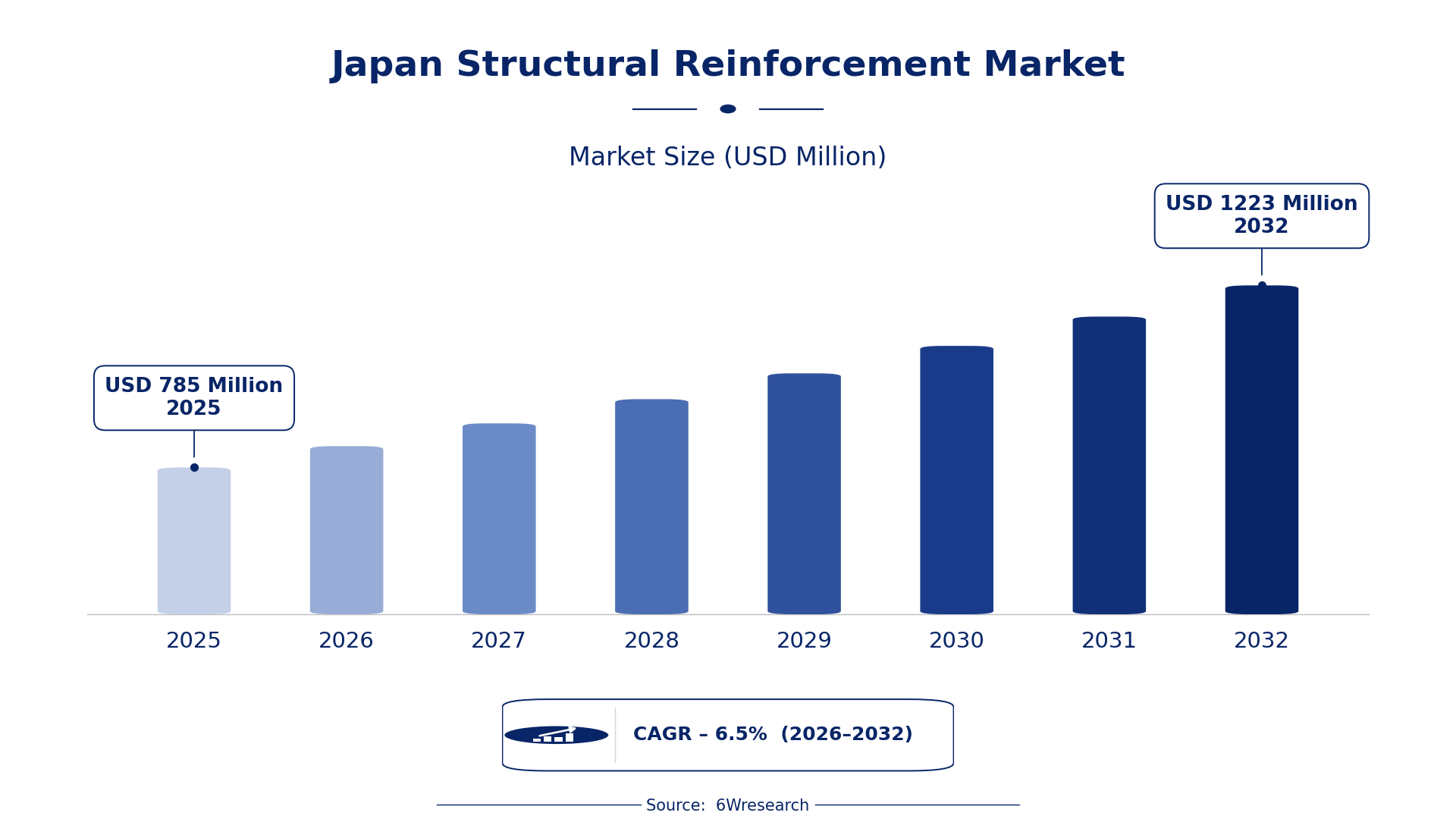
According to 6Wresearch internal database and industry insights, the Japan Structural Reinforcement Market was valued at USD 785 Million in 2025 and is projected to reach USD 1,223 Million by 2032, growing at a CAGR of approximately 6.5% during 2026–2032.
Japan Structural Reinforcement Market Highlights
| Report Metric | Details |
| Report Name | Japan Structural Reinforcement Market (2026-2032) |
| Market Size 2025 | USD 785 Million |
| Market Size 2032 | USD 1,223 Million |
| Absolute Growth 2025–2032 | USD 438 Million |
| CAGR 2026–2032 | 6.5% |
| Peak Annual Growth | 7.7% in 2027 |
| Forecast Period | 2026–2032 |
| Historical Data | 2022–2025 |
| Base Year | 2025 |
| Leading Reinforcement Type, 2025 | Rebar Mesh (46% share) |
| Leading Material Used, 2025 | Steel (40% share) |
| Leading Application Structure, 2025 | Slabs & Foundations (43% share) |
| Leading End User, 2025 | Concrete Contractors (38% share) |
| Fastest-Growing Reinforcement Type | Fiber Reinforcement (9.2% CAGR) |
| Fastest-Growing Material Used | Glass/Carbon Fiber (9.3% CAGR) |
| Fastest-Growing Application Structure | Beams & Columns (9.0% CAGR) |
| Fastest-Growing End User | Infrastructure Firms (8.2% CAGR) |
| Growing Sector | Beams & Columns |
| Key End Users | Slabs & Foundations, Beams & Columns, Tunnels & Bridges, Seismic Retrofit |
Japan Structural Reinforcement Market Year-wise Growth Rate and Key Drivers (2022–2032)
This graph illustrates the annual growth rates of the market from 2022 to 2032, highlighting a steady upward trajectory and projected market expansion over the forecast period.
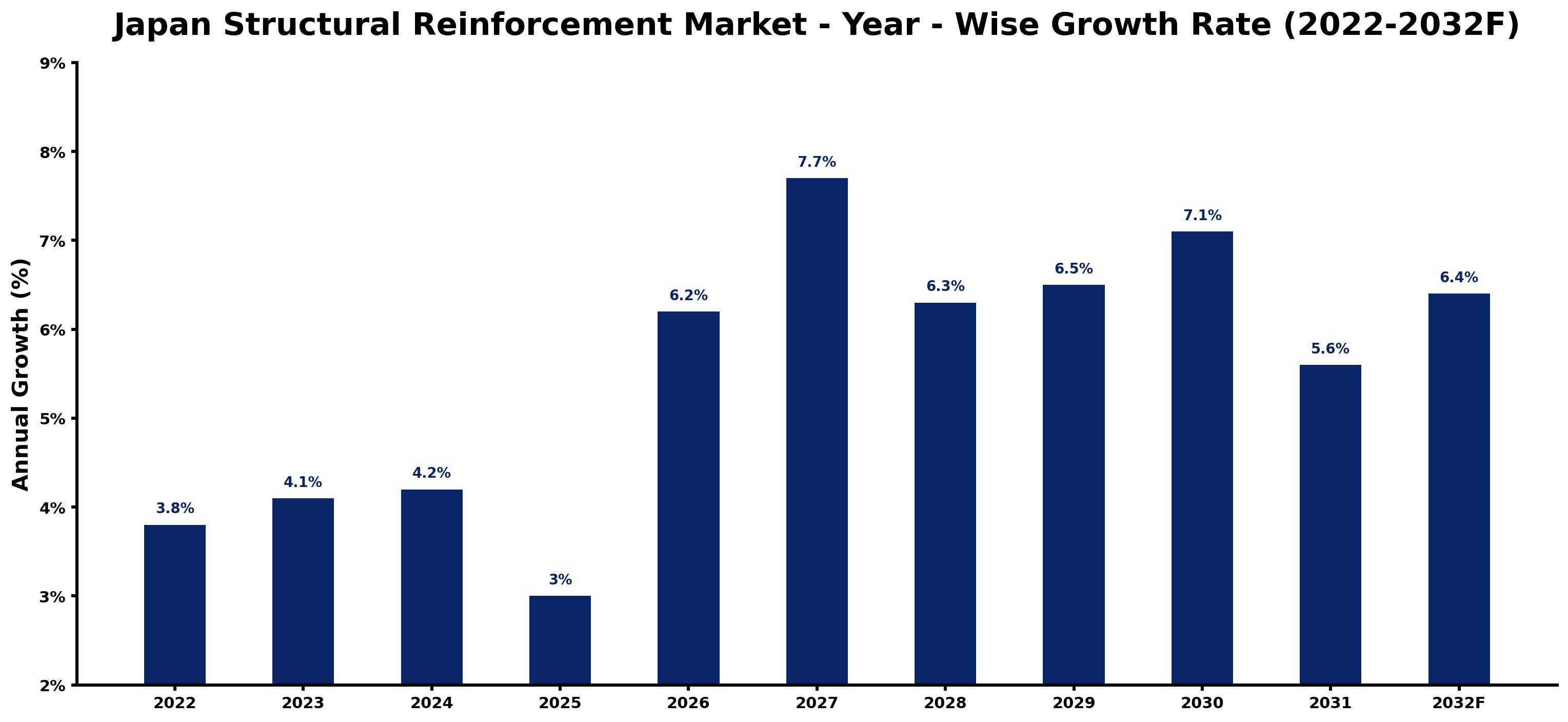
For each year, the table pairs the estimated growth rate with the leading influence on demand, showing how the drivers changed across the period.
| Year | Estimated Annual Growth (%) | Market Rationale |
| 2022 | 3.8 | The market experienced steady growth, driven by ongoing urban development projects. |
| 2023 | 4.1 | Demand increased as construction activities expanded in major urban centres. |
| 2024 | 4.2 | Growth continued with rising investments in infrastructure and safety measures. |
| 2025 | 3.0 | Growth slowed as some projects faced delays due to resource allocation. |
| 2026 | 6.2 | The market will rebound with heightened investments in earthquake resilience initiatives. |
| 2027 | 7.7 | Peak growth will occur as infrastructure projects surge ahead of major events. |
| 2028 | 6.3 | Growth is projected to decelerate slightly as the market stabilises after rapid expansion. |
| 2029 | 6.5 | Demand will rise again due to ongoing urbanisation and infrastructure upgrades. |
| 2030 | 7.1 | A further increase in growth will stem from new building standards and regulations. |
| 2031 | 5.6 | Growth is expected to moderate as the market adjusts to previous peaks in demand. |
| 2032 | 6.4 | Demand will remain strong, supported by sustained investments in infrastructure. |
Note: Market size estimations and growth projections presented in this report are based on 6Wresearch's proprietary forecasting methodology, utilizing the latest available industry data, government publications, and primary research inputs.
Japan Structural Reinforcement Market Synopsis
Structural reinforcement improves the load-bearing capacity of buildings and infrastructure through various techniques and materials. The Japan Structural Reinforcement Market is expanding due to substantial investments in urban development and safety regulations. The construction sector is projected to invest ¥6 trillion in infrastructure by 2025, which will drive demand for reinforcement materials. Ongoing seismic resilience initiatives are further stimulating market activity, as buyers aim to improve the durability and safety of structures against natural disasters.
Market Dynamics Impact Analysis (2026–2032)
| Factor | Type | Impact | Primary Segment Affected |
| Increased urbanisation drives demand for structural reinforcement materials. | Driver | High | Rebar Mesh |
| Growing focus on seismic resilience enhances the need for advanced reinforcement techniques. | Driver | High | Fiber Reinforcement |
| The gap in advanced reinforcement techniques presents opportunities for innovation. | Opportunity | High | FRP Rods |
| Rising infrastructure investments create a demand for reliable reinforcement solutions. | Opportunity | High | Steel Plates |
| Compliance with stringent standards can increase production costs. | Restraint | Medium | Steel |
| Limited awareness of advanced materials may hinder adoption rates. | Restraint | Medium | Glass/Carbon Fiber |
| High costs of advanced materials can deter some buyers from upgrading. | Challenge | High | Fiber Reinforcement |
| Competition from alternative materials can limit market share for traditional products. | Challenge | Medium | Rebar Mesh |
Evaluation of Drivers in Japan Structural Reinforcement Market (2026–2032)
These are the developments adding the most demand over the forecast period.
| Drivers | Primary Segment Affected | Why It Matters (Evidence) |
| Urban development projects | Slabs & Foundations | The Tokyo metropolitan area is seeing extensive construction, with over 50% of new buildings using structural reinforcement, driving demand for foundational support materials. |
| Seismic resilience initiatives | Fiber Reinforcement | The 2023 programme launched to enhance seismic resilience promotes the use of fibre reinforcement, increasing its adoption among concrete contractors for improved durability. |
| Investment in infrastructure | Steel | With the construction sector projected to invest ¥6 trillion by 2025, demand for steel as the primary reinforcement material is expected to rise significantly. |
| Compliance with JIS standards | Rebar Mesh | Adherence to JIS G 3112 standards ensures quality, leading to increased demand for certified rebar mesh among construction firms. |
| Research on advanced techniques | FRP Rods | Growing research initiatives by the Japan Concrete Institute are promoting FRP rods for seismic retrofitting, enhancing their market presence in urban areas. |
The strongest pull on demand comes from urban development projects in the Tokyo metropolitan area, where substantial investments are being made. The construction sector is projected to invest ¥6 trillion in infrastructure by 2025, which will boost demand for structural reinforcement. Compliance with JIS G 3112 standards ensures that materials meet quality requirements, resulting in higher demand for certified steel. Research on advanced reinforcement techniques is increasing the use of FRP rods in urban areas.
Evaluation of Restraints in Japan Structural Reinforcement Market
These are the pressures that could keep growth below its potential.
| Market Restraint | Primary Segment Affected | Why It Matters (Evidence) |
| Rising costs due to compliance with JIS standards. | Rebar Mesh | Compliance with JIS G 3112 standards creates additional expenses for producers, raising production costs by 15%. |
| Delays in obtaining compliant materials extend project timelines. | Steel Plates | In 2023, buyers faced delays in obtaining compliant structural reinforcement materials, extending project timelines by up to three months. |
| Slow technology adoption limits competitiveness. | Fiber Reinforcement | Many contractors are hesitant to integrate advanced materials like fiber reinforcement, limiting their competitiveness in seismic retrofitting. |
| Skills shortages lead to inefficiencies. | FRP Rods | The workforce lacks training in modern reinforcement techniques, resulting in increased labour costs for contractors. |
| Market volatility affects pricing stability. | Steel | Fluctuations in raw material prices impact the overall cost of structural reinforcement, creating uncertainty for buyers. |
Japan Structural Reinforcement Market Challenges
In 2023, buyers encounter rising costs due to delays in sourcing structural reinforcement materials, which can extend project timelines by up to three months. Compliance with JIS G 3112 standards raises production expenses for suppliers, compelling them to allocate resources for quality assurance. Many contractors are reluctant to adopt advanced materials like FRP rods, limiting their effectiveness in seismic retrofitting and delaying project completion. A shortage of skilled workers trained in modern reinforcement techniques is increasing labour costs for contractors, affecting overall project budgets and profitability.
Trends in the Japan Structural Reinforcement Market
These developments are changing demand patterns in the Japan Structural Reinforcement Market.
- Shift towards Advanced Reinforcement Techniques: Since 2023, there has been a noticeable shift towards advanced reinforcement techniques, particularly in urban areas. Initiatives from the Ministry of Land, Infrastructure, Transport and Tourism have increased the adoption of materials like fibre reinforcement, with over 50% of new buildings now utilising these methods.
- Transition from Traditional to Modern Materials: In 2023, the use of modern materials like FRP rods gained traction, especially in seismic retrofitting projects. The Japan Concrete Institute reported a 30% increase in the adoption of these materials, reflecting a broader trend towards modernisation in construction.
- Emergence of Sustainability Standards: Starting in 2023, sustainability standards have begun to shape the structural reinforcement market. The GX Basic Policy aims for JPY 150 trillion of public-private decarbonisation investment, prompting buyers to seek environmentally friendly reinforcement solutions.
- Prioritisation of Seismic Resilience: Since 2023, seismic resilience has become a priority in construction, particularly in urban areas. The Tokyo metropolitan area has seen a surge in projects aimed at enhancing structural safety, with significant investments directed towards compliance with new safety standards.
Investment Opportunities in the Japan Structural Reinforcement Market
The opportunities below stand out in the Japan Structural Reinforcement Market for new entrants and existing suppliers.
- Gap in Advanced Reinforcement Solutions: With over 50% of new buildings utilising structural reinforcement, there is a strong opportunity to supply advanced materials like fibre reinforcement. Concrete contractors in urban areas are increasingly seeking these solutions to improve durability.
- Investment in Seismic Resilience: The projected ¥6 trillion investment in infrastructure by 2025 presents an opportunity to supply advanced reinforcement solutions. Infrastructure firms are actively looking for partners to implement modern materials in their projects.
- Demand for Compliance with Standards: As compliance with JIS standards becomes mandatory, there is a growing need for certified materials. Suppliers can capitalise on this demand by ensuring their products meet these stringent requirements.
- Market for Sustainable Solutions: With Japan targeting a 46% reduction in greenhouse-gas emissions by 2030, there is an opportunity to invest in sustainable reinforcement materials. Civil engineers are increasingly prioritising eco-friendly options in their designs.
Government Initiatives in the Japan Structural Reinforcement Market
The Building Energy Efficiency Act, amended in 2022, mandates that all new buildings meet energy standards by April 2025. This requirement compels producers to invest in energy-efficient materials, which directly impacts the structural reinforcement market by raising the quality of available products.
The Industrial Standardization Act governs JIS product and test standards, ensuring that reinforcement materials meet specific quality criteria. This regulation affects buyers by requiring them to verify compliance before procurement, influencing their purchasing decisions.
Future Insight of the Japan Structural Reinforcement Market
The investment pipeline in infrastructure will reach ¥6 trillion by 2025, driving substantial demand for structural reinforcement solutions. The Ministry of Land, Infrastructure, Transport and Tourism's seismic resilience programme will prompt buyers to seek advanced materials for improved safety. New guidelines from the Japan Society of Civil Engineers will encourage the use of fibre reinforcement, increasing durability in urban structures. Enhanced funding for research on advanced techniques will enable suppliers to develop superior products, meeting the specific needs of the construction sector.
Market Segmentation Analysis
Japan Structural Reinforcement Market report covers a detailed analysis of the following market segments:
By Reinforcement Type – Rebar Mesh Leads, Fiber Reinforcement Expected to Grow Fastest
According to Saurav Kr Singh, Senior Research Analyst at 6Wresearch, Rebar Mesh accounted for 46% of the market by reinforcement type in 2025. Rebar mesh dominates Japan's structural reinforcement market due to its critical role in concrete reinforcement, especially for slabs and foundations. Its extensive use is evident in the numerous infrastructure projects currently underway in the Tokyo metropolitan area. Over 2026–2032, Fiber Reinforcement is expected to post the fastest growth, at a CAGR of 9.2%. The rapid adoption of fiber reinforcement is fuelled by its ability to significantly enhance the tensile strength of concrete, making it increasingly preferred by construction professionals. This trend is further supported by government initiatives that advocate for advanced reinforcement techniques. Suppliers should consider diversifying their offerings to include fiber reinforcement in response to growing market demand.
By Material Used – Steel Leads, Glass/Carbon Fiber Expected to Grow Fastest
Steel held 40% of the Japan Structural Reinforcement Market by material used in 2025. Steel is the leading material for structural reinforcement in Japan, selected for its strength and durability across various applications. This preference is reinforced by the construction sector's projected investment of ¥6 trillion in infrastructure by 2025, highlighting steel's pivotal role. The quickest growth will come from Glass/Carbon Fiber, forecast to expand at a CAGR of 9.3% between 2026 and 2032. The swift growth of glass and carbon fiber can be attributed to their lightweight characteristics, making them ideal for niche applications where weight reduction is crucial. This trend is particularly pronounced in urban areas, where innovative construction solutions are increasingly sought after. Buyers should investigate lightweight reinforcement options to enhance project efficiency and overall performance.
By Application Structure – Slabs & Foundations Lead, Beams & Columns Expected to Grow Fastest
With 43% of application structure revenue in 2025, Slabs & Foundations was the largest category. Slabs and foundations are vital in construction, establishing them as the leading application for structural reinforcement in Japan. Their importance is underscored by the fact that over 50% of new buildings in urban areas utilise some form of structural reinforcement. Beams & Columns are set to record the highest CAGR in this split, 9.0% over 2026–2032. The application of beams and columns is experiencing rapid growth, as they are essential for maintaining structural integrity, particularly in urban settings. This increase is driven by ongoing urban development projects that require robust structural solutions. Suppliers should concentrate on developing products tailored for beams and columns to capitalise on this expanding market segment.
By End User – Concrete Contractors Lead, Infrastructure Firms Expected to Grow Fastest
In 2025, Concrete Contractors led the end user split with a 38% share. Concrete contractors represent the primary consumers of reinforcement materials, as they are directly engaged in the construction process and heavily rely on these materials. Their leading position is reflected in the substantial demand generated by various ongoing infrastructure projects. Infrastructure Firms are projected to grow fastest, at a CAGR of 8.2% during 2026–2032. Infrastructure firms are significantly increasing their consumption of reinforcement materials due to the scale of the large projects they undertake. This growth is further bolstered by government initiatives aimed at enhancing infrastructure resilience. Suppliers should strengthen partnerships with infrastructure firms to secure long-term contracts and ensure a steady demand.
Key Attractiveness of the Report
- 10 Years of Market Numbers
- Historical Data Starting from 2022 to 2025
- Base Year 2025
- Forecast Data until 2032
- Key Performance Indicators Impacting the Market
- Major Upcoming Developments and Projects
Key Highlights of the Report:
- Japan Structural Reinforcement Market Outlook
- Market Size of Japan Structural Reinforcement Market, 2025
- Forecast of Japan Structural Reinforcement Market, 2032
- Historical Data and Forecast of Japan Structural Reinforcement Revenues & Volume for the Period 2022-2032F
- Japan Structural Reinforcement Market Trend Evolution
- Japan Structural Reinforcement Market Drivers and Challenges
- Japan Structural Reinforcement Price Trends
- Japan Structural Reinforcement Porter's Five Forces
- Japan Structural Reinforcement Industry Life Cycle
- Historical Data and Forecast of Japan Structural Reinforcement Market Revenues & Volume By Reinforcement Type for the Period 2022-2032F
- Historical Data and Forecast of Japan Structural Reinforcement Market Revenues & Volume By Rebar Mesh for the Period 2022-2032F
- Historical Data and Forecast of Japan Structural Reinforcement Market Revenues & Volume By Fiber Reinforcement for the Period 2022-2032F
- Historical Data and Forecast of Japan Structural Reinforcement Market Revenues & Volume By FRP Rods for the Period 2022-2032F
- Historical Data and Forecast of Japan Structural Reinforcement Market Revenues & Volume By Steel Plates for the Period 2022-2032F
- Historical Data and Forecast of Japan Structural Reinforcement Market Revenues & Volume By Material Used for the Period 2022-2032F
- Historical Data and Forecast of Japan Structural Reinforcement Market Revenues & Volume By Steel for the Period 2022-2032F
- Historical Data and Forecast of Japan Structural Reinforcement Market Revenues & Volume By Glass/Carbon Fiber for the Period 2022-2032F
- Historical Data and Forecast of Japan Structural Reinforcement Market Revenues & Volume By Polymer Composites for the Period 2022-2032F
- Historical Data and Forecast of Japan Structural Reinforcement Market Revenues & Volume By Carbon Steel for the Period 2022-2032F
- Historical Data and Forecast of Japan Structural Reinforcement Market Revenues & Volume By Application Structure for the Period 2022-2032F
- Historical Data and Forecast of Japan Structural Reinforcement Market Revenues & Volume By Slabs & Foundations for the Period 2022-2032F
- Historical Data and Forecast of Japan Structural Reinforcement Market Revenues & Volume By Beams & Columns for the Period 2022-2032F
- Historical Data and Forecast of Japan Structural Reinforcement Market Revenues & Volume By Tunnels & Bridges for the Period 2022-2032F
- Historical Data and Forecast of Japan Structural Reinforcement Market Revenues & Volume By Seismic Retrofit for the Period 2022-2032F
- Historical Data and Forecast of Japan Structural Reinforcement Market Revenues & Volume By End User for the Period 2022-2032F
- Historical Data and Forecast of Japan Structural Reinforcement Market Revenues & Volume By Concrete Contractors for the Period 2022-2032F
- Historical Data and Forecast of Japan Structural Reinforcement Market Revenues & Volume By Infrastructure Firms for the Period 2022-2032F
- Historical Data and Forecast of Japan Structural Reinforcement Market Revenues & Volume By Civil Engineers for the Period 2022-2032F
- Historical Data and Forecast of Japan Structural Reinforcement Market Revenues & Volume By Structural Consultants for the Period 2022-2032F
- Japan Structural Reinforcement Import Export Trade Statistics
- Market Opportunity Assessment By Reinforcement Type
- Market Opportunity Assessment By Material Used
- Market Opportunity Assessment By Application Structure
- Market Opportunity Assessment By End User
- Japan Structural Reinforcement Top Companies Market Share
- Japan Structural Reinforcement Competitive Benchmarking By Technical and Operational Parameters
- Japan Structural Reinforcement Company Profiles
- Japan Structural Reinforcement Key Strategic Recommendations
Market Covered
The report covers the following segments.
By Reinforcement Type
- Rebar Mesh
- Fiber Reinforcement
- FRP Rods
- Steel Plates
By Material Used
- Steel
- Glass/Carbon Fiber
- Polymer Composites
- Carbon Steel
By Application Structure
- Slabs & Foundations
- Beams & Columns
- Tunnels & Bridges
- Seismic Retrofit
By End User
- Concrete Contractors
- Infrastructure Firms
- Civil Engineers
- Structural Consultants































