Japan Styrene Market Size & Growth Rate
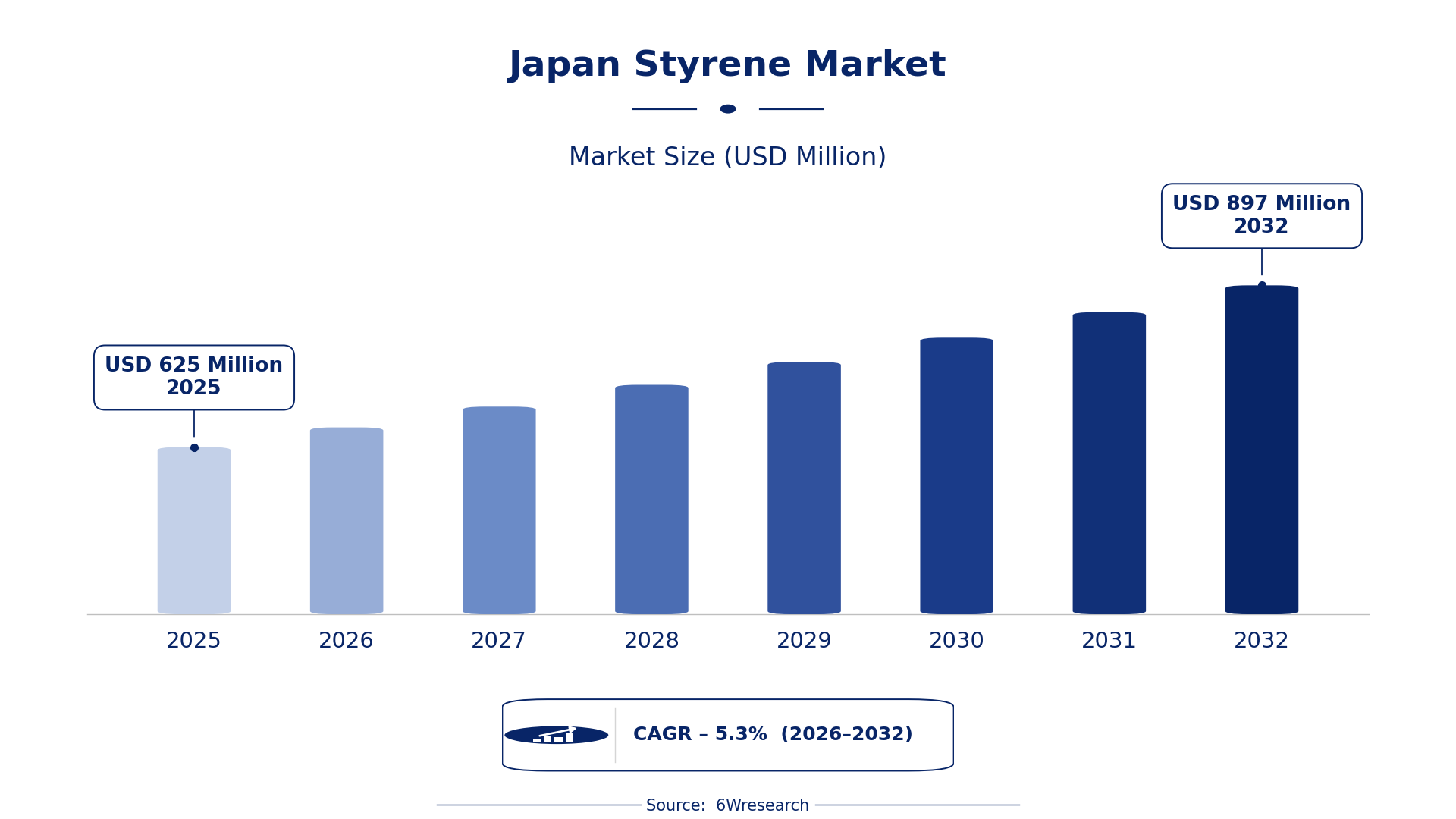
According to 6Wresearch internal database and industry insights, the Japan Styrene Market was valued at USD 625 Million in 2025 and is projected to reach USD 897 Million by 2032, growing at a CAGR of approximately 5.3% during 2026–2032.
Japan Styrene Market Highlights
| Report Metric | Details |
| Report Name | Japan Styrene Market (2026-2032) |
| Market Size 2025 | USD 625 Million |
| Market Size 2032 | USD 897 Million |
| Absolute Growth 2025–2032 | USD 272 Million |
| CAGR 2026–2032 | 5.3% |
| Peak Annual Growth | 6.2% in 2028 |
| Forecast Period | 2026–2032 |
| Historical Data | 2022–2025 |
| Base Year | 2025 |
| Leading Type, 2025 | Expanded Polystyrene (EPS) (43% share) |
| Leading Application, 2025 | Automotive (38% share) |
| Leading Distribution Channel, 2025 | Offline (59% share) |
| Fastest-Growing Type | Acrylonitrile Butadiene Styrene (ABS) (7.0% CAGR) |
| Fastest-Growing Application | Construction (6.8% CAGR) |
| Fastest-Growing Distribution Channel | Online (6.6% CAGR) |
| Growing Sector | Construction |
| Key End Users | Automotive, Construction, Packaging Consumer Goods |
Japan Styrene Market Year-wise Growth Rate and Key Drivers (2022–2032)
This graph illustrates the annual growth rates of the market from 2022 to 2032, highlighting a steady upward trajectory and projected market expansion over the forecast period.
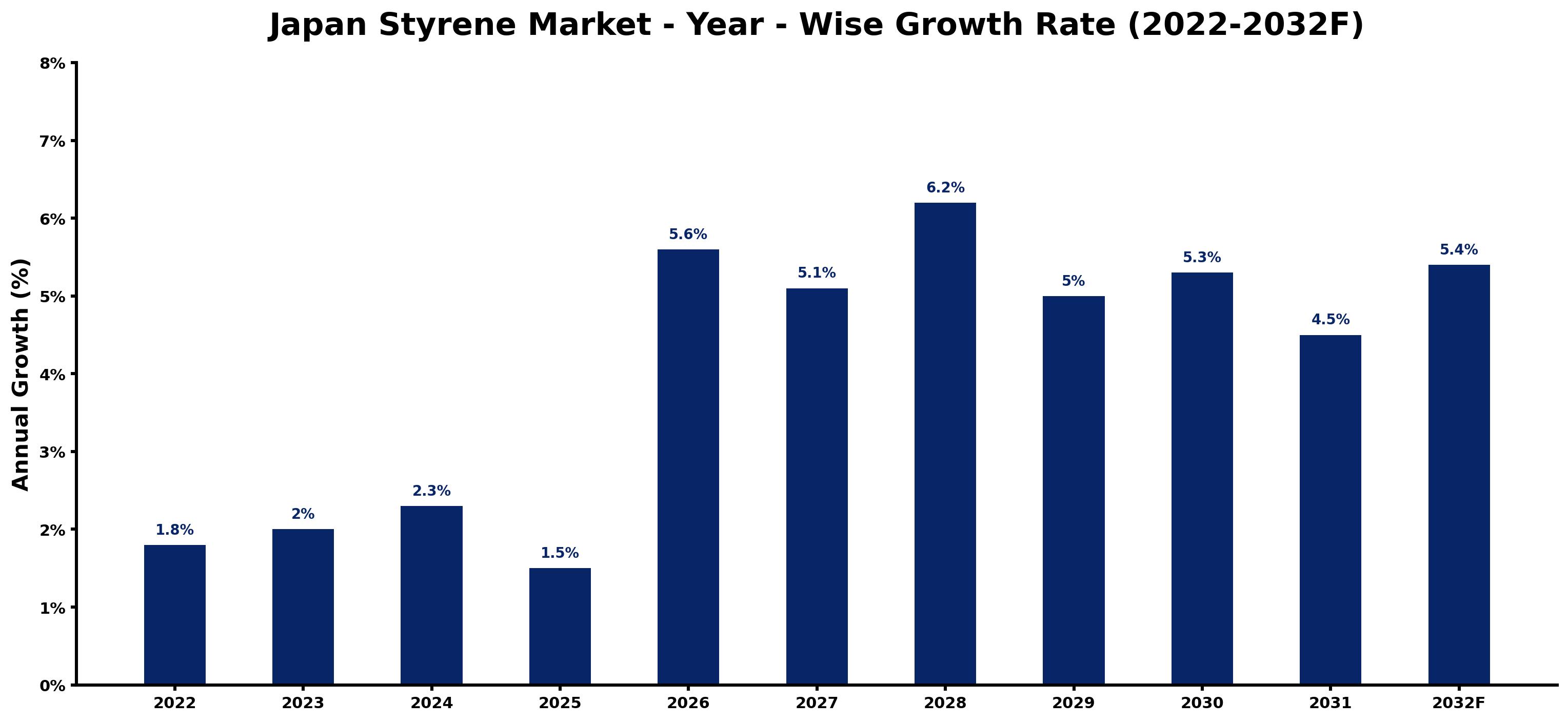
Annual growth estimates for each year appear below with the principal reason behind them, explaining the shifts that set the pace of the market.
| Year | Estimated Annual Growth (%) | Market Rationale |
| 2022 | 1.8 | The market experienced steady growth, driven by stable demand from the automotive sector. |
| 2023 | 2.0 | Demand from the packaging industry increased, contributing to higher growth rates. |
| 2024 | 2.3 | The automotive sector continued to expand, leading to further growth in styrene consumption. |
| 2025 | 1.5 | Growth slowed as the market adjusted to previous peaks in demand. |
| 2026 | 5.6 | A surge in construction activities is expected to boost styrene demand. |
| 2027 | 5.1 | The market is projected to grow, but at a slower pace due to stabilising demand. |
| 2028 | 6.2 | Peak growth is anticipated as the automotive sector ramps up production. |
| 2029 | 5.0 | Growth is expected to slow as the market normalises after peak levels. |
| 2030 | 5.3 | Demand from the construction sector is expected to drive growth again. |
| 2031 | 4.5 | The market will continue to grow, albeit at a slower rate than previous years. |
| 2032 | 5.4 | Styrene consumption will rise as the packaging industry expands further. |
Note: Market size estimations and growth projections presented in this report are based on 6Wresearch's proprietary forecasting methodology, utilizing the latest available industry data, government publications, and primary research inputs.
Japan Styrene Market Synopsis
Styrene is an organic compound primarily used in producing polystyrene and various copolymers, derived from petroleum through ethylbenzene dehydrogenation. The Japan Styrene Market is set to expand, driven by the automotive sector, which represents around 30% of demand, alongside the packaging industry, valued at over 10 trillion yen. Recent government initiatives, including the 2023 programme promoting sustainable production, stimulate market growth by encouraging eco-friendly practices among manufacturers.
Market Dynamics Impact Analysis (2026–2032)
| Factor | Type | Impact | Primary Segment Affected |
| Increased automotive production drives demand for styrene-based components. | Driver | High | Automotive |
| Rising demand for packaging solutions boosts consumption of styrene. | Driver | High | Packaging Consumer Goods |
| Growing construction activities create opportunities for styrene-based materials. | Opportunity | High | Construction |
| Expansion of online distribution channels opens new markets for styrene products. | Opportunity | Medium | Online |
| Environmental regulations may limit styrene production processes. | Restraint | High | Expanded Polystyrene (EPS) |
| Volatility in petroleum prices affects styrene production costs. | Restraint | Medium | Expanded Polystyrene (EPS) |
| Competition from alternative materials can reduce styrene demand. | Challenge | High | Expanded Polystyrene (EPS) |
| Technological advancements in recycling may impact styrene consumption. | Challenge | Medium | Expanded Polystyrene (EPS) |
Evaluation of Drivers in Japan Styrene Market (2026–2032)
The main growth drivers and the segments they affect most are set out below.
| Drivers | Primary Segment Affected | Why It Matters (Evidence) |
| Automotive production growth | Automotive | The automotive sector's expansion drives increased purchases for durable vehicle parts. |
| Packaging industry expansion | Packaging Consumer Goods | The packaging sector, valued at over 10 trillion yen, creates a strong demand for versatile styrene-based materials. |
| Construction growth | Construction | Japan's growing construction industry increases demand for styrene in building materials and insulation applications. |
| Technological advancements | Acrylonitrile Butadiene Styrene (ABS) | Innovations in ABS production improve its appeal, driving demand for styrene as a key ingredient. |
| Rising consumer goods demand | Packaging Consumer Goods | The population of Japan, around 125 million, drives the need for efficient packaging solutions, increasing styrene consumption. |
A wider customer base explains much of the growth, as the automotive sector expands, accounting for approximately 30% of styrene demand. In 2022, Japan produced 1.5 million tons of styrene, highlighting the strong production capacity. The packaging industry, valued at over 10 trillion yen, also contributes significantly to demand, as consumers require efficient packaging solutions. Furthermore, the construction sector is projected to grow, increasing the need for styrene in building materials and insulation applications. With the population of Japan around 125 million, the demand for versatile styrene-based products is expected to rise considerably.
Evaluation of Restraints in Japan Styrene Market
The following restraints limit how fast demand can grow.
| Market Restraint | Primary Segment Affected | Why It Matters (Evidence) |
| Environmental regulations may limit production processes. | Expanded Polystyrene (EPS) | Compliance with stringent regulations may increase production costs for manufacturers. |
| Volatility in petroleum prices affects production costs. | Expanded Polystyrene (EPS) | Fluctuating oil prices can lead to unpredictable expenses for styrene producers. |
| Competition from alternative materials can reduce demand. | Expanded Polystyrene (EPS) | The rise of eco-friendly substitutes may divert buyers from traditional styrene products. |
| Supply chain disruptions can hinder availability. | Automotive | Logistics issues may delay shipments and increase lead times for producers. |
| Skills shortages in the workforce limit efficiency. | Construction | Limited skilled labour can cause plants to operate below capacity, delaying output. |
Japan Styrene Market Challenges
Logistics issues lead to delays in styrene shipments, extending lead times by up to 20% for producers and impacting timely delivery for buyers. A shortage of skilled workers hampers production efficiency, causing plants to operate at only 70% of their capacity, which slows output for manufacturers. Rising raw material costs, influenced by fluctuations in global oil prices, inflate prices by approximately 15% for producers, squeezing profit margins for suppliers. Regulatory changes from the Ministry of Economy, Trade and Industry introduce compliance costs that can increase production expenses by 10%, compelling manufacturers to invest in new processes.
Trends in the Japan Styrene Market
These developments are changing demand patterns in the Japan Styrene Market.
- Shift towards Sustainable Production: Japan is focusing on sustainable styrene production methods, as seen in the government's 2023 initiative to promote eco-friendly practices. This shift is expected to improve the reputation of styrene products and attract environmentally conscious buyers.
- Growth of Online Distribution Channels: Online sales channels are gaining traction in Japan, with a projected CAGR of 6.6% for the online distribution of styrene products. This trend allows buyers to access a wider range of products conveniently.
- Increased Use of Styrene in Construction: The construction sector is experiencing a rise in the use of styrene-based materials, with a projected CAGR of 6.8%. This growth is driven by the demand for insulation and structural applications.
- Expansion of ABS Applications: The application of Acrylonitrile Butadiene Styrene (ABS) is expanding in various industries, particularly in electronics. This trend is supported by the growing demand for durable and impact-resistant materials.
Investment Opportunities in the Japan Styrene Market
Several openings in the Japan Styrene Market merit attention from investors.
- Tokyo as a Production Hub: Tokyo is emerging as a key production hub for styrene, with substantial investments in facilities. This offers opportunities for local partnerships to strengthen production capabilities.
- Joint Ventures for Sustainable Practices: There is a growing opportunity for joint ventures centred on sustainable styrene production, particularly in regions like Tokyo. Collaborating with local firms can facilitate market entry.
- Gap in Eco-Friendly Products: With the rising demand for sustainable products, a gap exists in the market for eco-friendly styrene solutions. Targeting environmentally conscious consumers can yield considerable returns.
- Investment in Construction Materials: As Japan's construction industry grows, there is an opportunity to supply styrene-based materials. Engaging with construction firms can open new avenues for development.
Government Initiatives in the Japan Styrene Market
The Plastic Resource Circulation Act (2021) promotes the reduction, reuse, and recycling of plastics, impacting styrene producers by requiring compliance with new sustainability standards. This act encourages manufacturers to invest in eco-friendly production methods to meet regulatory expectations. The Building Energy Efficiency Act (2015, amended 2022) mandates that all new buildings meet energy standards from April 2025, pushing construction firms to consider styrene-based materials that comply with these regulations.
The Ministry of Economy, Trade and Industry oversees the implementation of the Plastic Resource Circulation Act, ensuring that styrene producers adhere to recycling and sustainability guidelines. This oversight supports buyers by promoting a market for recycled materials and eco-friendly products. The Ministry also provides guidance on compliance with the Building Energy Efficiency Act, assisting construction firms in navigating the new standards.
Future Insight of the Japan Styrene Market
Buyers in the automotive and construction sectors will benefit from anticipated changes by 2032. The government’s programme promoting sustainable production will encourage suppliers to adopt eco-friendly practices, aligning with international standards. The implementation of JIS K 6726 will standardise quality across the market, improving product reliability. With the Tokyo region remaining a processing hub, advancements in facilities will boost operational efficiency, enabling quicker responses to market demands.
Market Segmentation Analysis
Japan Styrene Market report covers a detailed analysis of the following market segments:
By Type – Expanded Polystyrene (EPS) Leads, Acrylonitrile Butadiene Styrene (ABS) Expected to Grow Fastest
According to Ravi Bhandari, Research Head at 6Wresearch, with 43% of type revenue in 2025, Expanded Polystyrene (EPS) was the largest category. The lightweight properties of EPS make it particularly valuable in the Tokyo region, a key area for production and processing. Over 2026–2032, Acrylonitrile Butadiene Styrene (ABS) is expected to post the fastest growth, at a CAGR of 7.0%. Acrylonitrile Butadiene Styrene is experiencing rapid growth as it becomes increasingly essential in automotive components where impact resistance is vital. The automotive sector, accounting for around 30% of styrene demand, will further propel the expansion of ABS. Suppliers should focus on strengthening their offerings in EPS while also exploring opportunities in the growing ABS segment.
By Application – Automotive Leads, Construction Expected to Grow Fastest
The largest application category in 2025 was Automotive, at 38% of revenue. The automotive sector leads the application group, relying heavily on styrene for manufacturing vehicle parts that require durability and weight reduction. This sector's significant share highlights the ongoing demand for lightweight materials in contemporary vehicle production. The quickest growth will come from Construction, forecast to expand at a CAGR of 6.8% between 2026 and 2032. Construction is the fastest-growing application as the industry is set to expand, increasing the need for styrene-based materials in building applications. The rising emphasis on energy-efficient structures is a driving force behind this growth. Buyers in the construction sector should actively pursue more styrene products to meet the increasing demand and comply with regulatory standards.
By Distribution Channel – Offline Leads, Online Expected to Grow Fastest
In 2025, Offline led the distribution channel split with a 59% share. The offline distribution channel dominates due to established networks that facilitate the traditional supply of styrene products. This channel benefits from long-standing relationships with manufacturers and end-users in various sectors. Online is set to record the highest CAGR in this split, 6.6% over 2026–2032. Online distribution is the fastest-growing channel as it offers consumers greater access to styrene products, particularly in a digital marketplace. The shift towards e-commerce reflects changing purchasing behaviours among consumers and businesses alike. Suppliers must strengthen their online presence to capture the growing segment of consumers preferring digital purchasing options.
Key Attractiveness of the Report
- 10 Years of Market Numbers
- Historical Data Starting from 2022 to 2025
- Base Year 2025
- Forecast Data until 2032
- Key Performance Indicators Impacting the Market
- Major Upcoming Developments and Projects
Key Highlights of the Report:
- Japan Styrene Market Outlook
- Market Size of Japan Styrene Market, 2025
- Forecast of Japan Styrene Market, 2032
- Historical Data and Forecast of Japan Styrene Revenues & Volume for the Period 2022-2032
- Japan Styrene Market Trend Evolution
- Japan Styrene Market Drivers and Challenges
- Japan Styrene Price Trends
- Japan Styrene Porter's Five Forces
- Japan Styrene Industry Life Cycle
- Historical Data and Forecast of Japan Styrene Market Revenues & Volume By Type for the Period 2022-2032
- Historical Data and Forecast of Japan Styrene Market Revenues & Volume By Acrylonitrile Butadiene Styrene (ABS) for the Period 2022-2032
- Historical Data and Forecast of Japan Styrene Market Revenues & Volume By Expanded Polystyrene (EPS) for the Period 2022-2032
- Historical Data and Forecast of Japan Styrene Market Revenues & Volume By Others for the Period 2022-2032
- Historical Data and Forecast of Japan Styrene Market Revenues & Volume By Application for the Period 2022-2032
- Historical Data and Forecast of Japan Styrene Market Revenues & Volume By Automotive for the Period 2022-2032
- Historical Data and Forecast of Japan Styrene Market Revenues & Volume By Construction for the Period 2022-2032
- Historical Data and Forecast of Japan Styrene Market Revenues & Volume By Packaging Consumer Goods for the Period 2022-2032
- Historical Data and Forecast of Japan Styrene Market Revenues & Volume By Others for the Period 2022-2032
- Historical Data and Forecast of Japan Styrene Market Revenues & Volume By Distribution Channel for the Period 2022-2032
- Historical Data and Forecast of Japan Styrene Market Revenues & Volume By Offline for the Period 2022-2032
- Historical Data and Forecast of Japan Styrene Market Revenues & Volume By Online for the Period 2022-2032
- Japan Styrene Import Export Trade Statistics
- Market Opportunity Assessment By Type
- Market Opportunity Assessment By Application
- Market Opportunity Assessment By Distribution Channel
- Japan Styrene Top Companies Market Share
- Japan Styrene Competitive Benchmarking By Technical and Operational Parameters
- Japan Styrene Company Profiles
- Japan Styrene Key Strategic Recommendations
Market Covered
The report covers the following segments.
By Type
- Acrylonitrile Butadiene Styrene (ABS)
- Expanded Polystyrene (EPS)
- Others
By Application
- Automotive
- Construction
- Packaging Consumer Goods
- Others
By Distribution Channel
- Offline
- Online































