Japan Subsea Equipment Market Size & Growth Rate
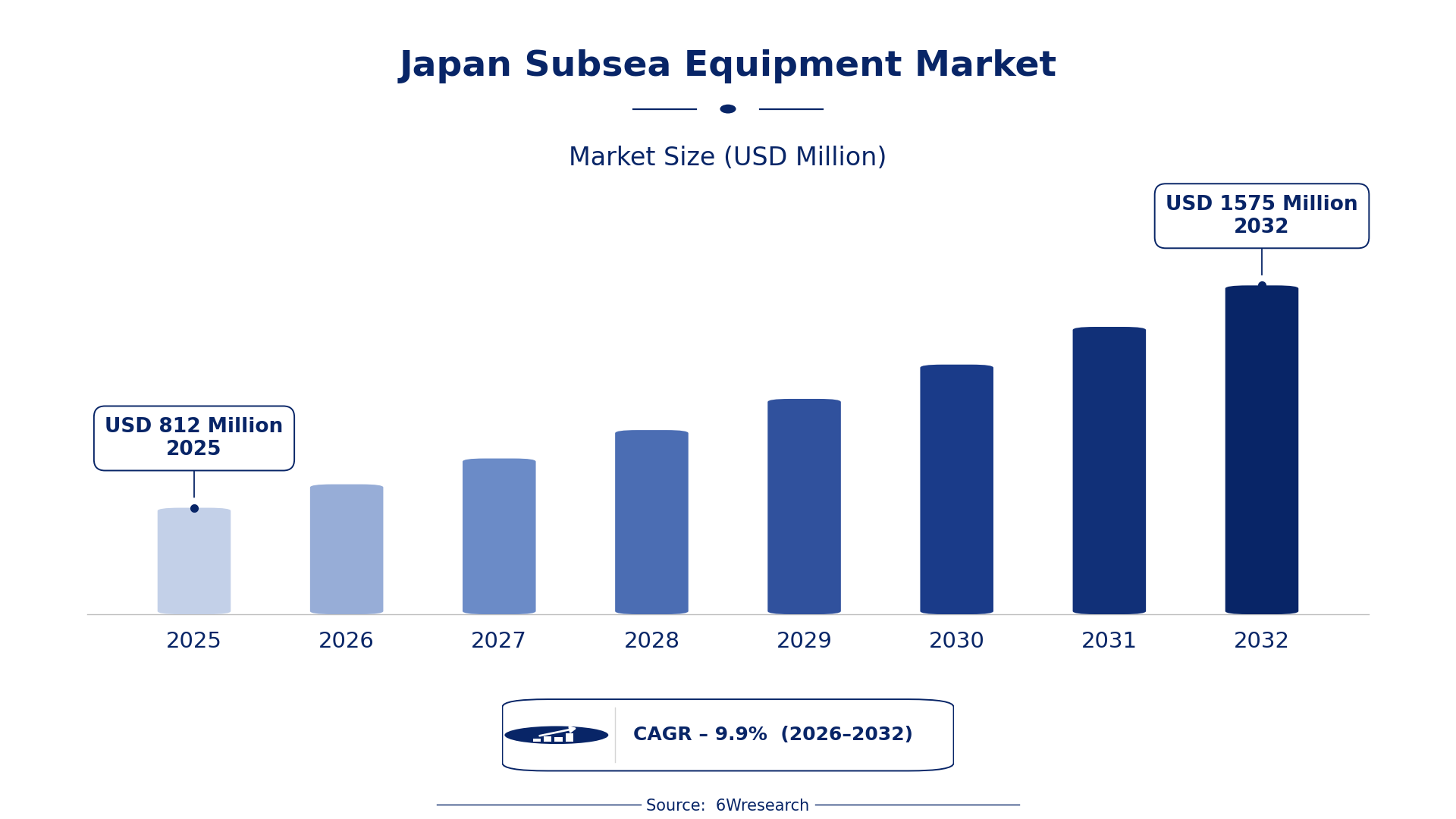
According to 6Wresearch internal database and industry insights, the Japan Subsea Equipment Market was valued at USD 812 Million in 2025 and is projected to reach USD 1,575 Million by 2032, growing at a CAGR of approximately 9.9% during 2026–2032.
Japan Subsea Equipment Market Highlights
| Report Metric | Details |
| Report Name | Japan Subsea Equipment Market (2026-2032) |
| Market Size 2025 | USD 812 Million |
| Market Size 2032 | USD 1,575 Million |
| Absolute Growth 2025–2032 | USD 763 Million |
| CAGR 2026–2032 | 9.9% |
| Peak Annual Growth | 11.1% in 2032 |
| Forecast Period | 2026–2032 |
| Historical Data | 2022–2025 |
| Base Year | 2025 |
| Leading Equipment Type, 2025 | Subsea Trees (41% share) |
| Leading Depth Rating, 2025 | Deepwater (55% share) |
| Leading Application Area, 2025 | Oil Extraction (44% share) |
| Leading End User, 2025 | Offshore Drillers (39% share) |
| Fastest-Growing Equipment Type | Manifolds (14.0% CAGR) |
| Fastest-Growing Depth Rating | Midwater (13.5% CAGR) |
| Fastest-Growing Application Area | Flow Management (12.2% CAGR) |
| Fastest-Growing End User | EPC Contractors (12.9% CAGR) |
| Growing Sector | Flow Management |
| Key End Users | Oil Extraction, Flow Management, Communication & Power, Modular Deployment |
Japan Subsea Equipment Market Year-wise Growth Rate and Key Drivers (2022–2032)
This graph illustrates the annual growth rates of the market from 2022 to 2032, highlighting a steady upward trajectory and projected market expansion over the forecast period.
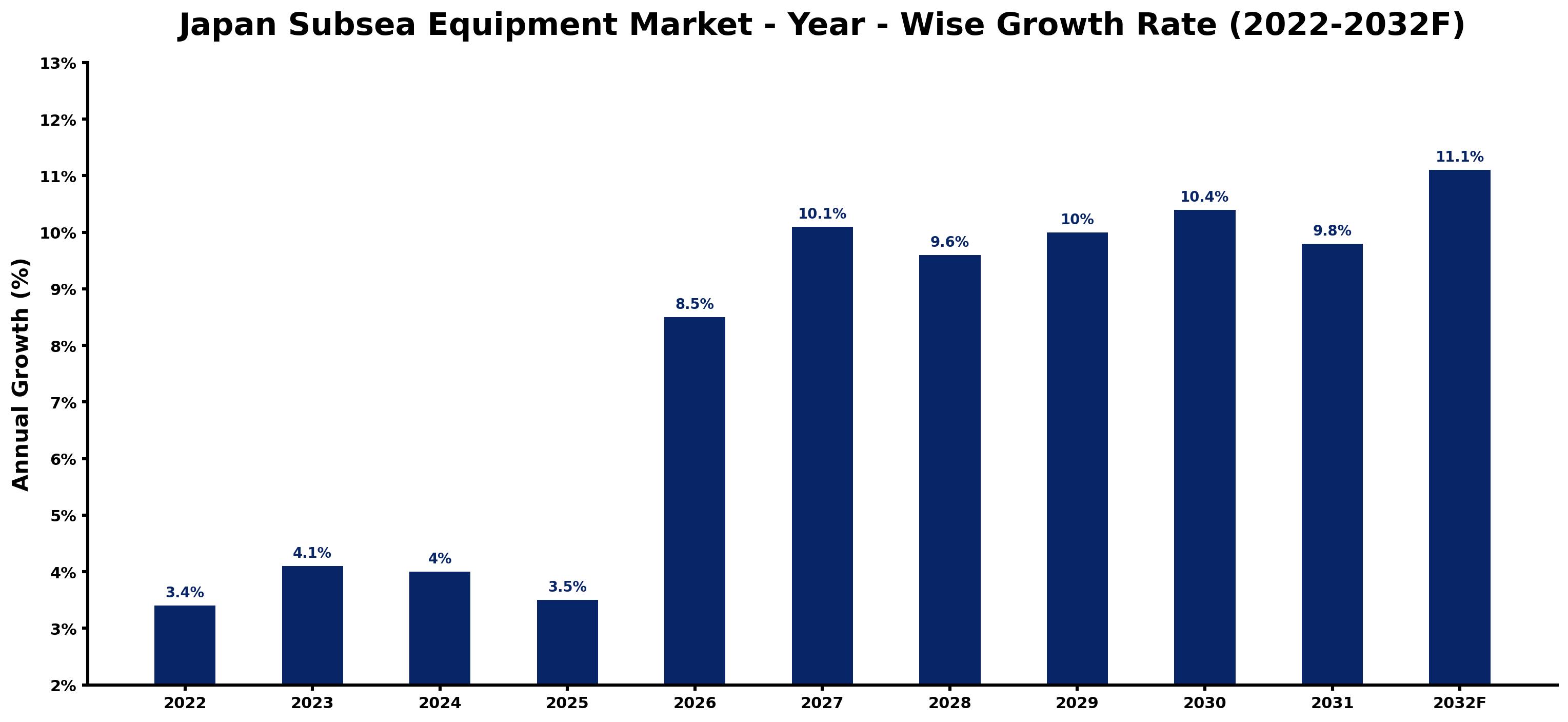
Below, each year's estimated growth is shown next to the factor that most influenced it.
| Year | Estimated Annual Growth (%) | Market Rationale |
| 2022 | 3.4 | The market experienced steady demand from domestic offshore drilling operations. |
| 2023 | 4.1 | Growth was driven by increased subsea technology investments and exploration activities. |
| 2024 | 4.0 | A slight slowdown occurred as projects faced delays in implementation. |
| 2025 | 3.5 | Demand remained strong, supported by ongoing offshore drilling operations. |
| 2026 | 8.5 | Growth accelerated as deepwater exploration activities expanded. |
| 2027 | 10.1 | Rising investments in subsea technology and infrastructure boosted demand further. |
| 2028 | 9.6 | The market continued to grow, although at a slower pace due to project completion. |
| 2029 | 10.0 | Increased exploration activities led to a resurgence in demand for subsea equipment. |
| 2030 | 10.4 | Continued investment in advanced subsea technologies supported strong growth. |
| 2031 | 9.8 | The market experienced a slight slowdown as competition intensified among suppliers. |
| 2032 | 11.1 | A peak in growth is expected as deepwater exploration reaches new heights. |
Note: Market size estimations and growth projections presented in this report are based on 6Wresearch's proprietary forecasting methodology, utilizing the latest available industry data, government publications, and primary research inputs.
Japan Subsea Equipment Market Synopsis
Subsea equipment is specialized technology essential for underwater operations, particularly in oil and gas extraction. It is manufactured using advanced materials to withstand harsh underwater conditions. The Japan Subsea Equipment Market is expanding due to increased domestic offshore drilling and investments in subsea technology.
Market Dynamics Impact Analysis (2026–2032)
| Factor | Type | Impact | Primary Segment Affected |
| Growing investments in subsea technology development | Driver | High | Subsea Trees |
| Increased deepwater exploration activities | Driver | High | Deepwater |
| Rising demand for advanced subsea solutions | Opportunity | High | Manifolds |
| Expansion of offshore drilling operations | Opportunity | High | Oil Extraction |
| High costs associated with subsea technology acquisition | Restraint | Medium | Umbilicals |
| Limited availability of skilled workforce in the subsea sector | Restraint | Medium | Connectors |
| Intense competition among suppliers | Challenge | High | EPC Contractors |
| Technological advancements leading to rapid changes | Challenge | High | Subsea Integrators |
Evaluation of Drivers in Japan Subsea Equipment Market (2026–2032)
The table below links each growth driver to the segment it affects and the evidence for it.
| Drivers | Primary Segment Affected | Why It Matters (Evidence) |
| Increased offshore drilling activities | Subsea Trees | Over 100 subsea trees installed in Japan, driving demand for subsea trees essential for oil extraction. |
| Rising investments in deepwater exploration | Deepwater | Deepwater exploration activities have increased by 15% in the past five years, boosting demand for subsea equipment. |
| Growing need for efficient flow management | Manifolds | Investment in subsea technology reached approximately 200 million JPY in 2023, increasing manifold demand. |
| Expansion of communication and power systems | Umbilicals | Communication and power systems are vital for operational efficiency, increasing umbilical requirements. |
| Development of new subsea standards | Connectors | ISO 13628-1 standard promotes better integration of subsea systems, increasing connector demand. |
Behind the steady rise in orders sits a marked increase in offshore drilling activities, with over 30 active rigs in Japan as of 2023. Investments in deepwater exploration have surged, resulting in a 15% rise in activities over the past five years. The need for efficient flow management is paramount, leading to investments in subsea technology, which reached approximately 200 million JPY in 2023. Demand for communication and power systems is rising, as they are essential for operational efficiency in subsea installations. The introduction of ISO 13628-1 has improved the integration of subsea systems, further driving demand for connectors.
Evaluation of Restraints in Japan Subsea Equipment Market
These are the pressures that could keep growth below its potential.
| Market Restraint | Primary Segment Affected | Why It Matters (Evidence) |
| High costs associated with subsea technology acquisition | Umbilicals | Investment in advanced subsea technology can be prohibitive, limiting buyer participation. |
| Limited availability of skilled workforce in the subsea sector | Connectors | A shortage of trained professionals can delay project timelines and increase costs. |
| Regulatory compliance requirements | Subsea Trees | Strict compliance with standards can slow down project initiation and increase operational costs. |
| Market competition leading to price pressures | Manifolds | Intense competition among suppliers can reduce margins and profitability. |
| Technological obsolescence risks | Deepwater | Rapid advancements in technology can render existing systems outdated, affecting buyer decisions. |
Japan Subsea Equipment Market Challenges
Subsea umbilicals are critical for connecting surface facilities to underwater systems, yet buyers experience delays due to insufficient domestic production, which can extend project timelines by up to six months. Regulatory challenges arise from compliance with ISO 13628-1, forcing suppliers to absorb additional costs that may account for 15% of project budgets. High investment barriers, with approximately 200 million JPY spent in 2023, discourage new entrants, limiting buyers' access to competitive pricing. Technology gaps exist as advanced subsea equipment relies heavily on imports, increasing operational costs for producers who must adapt to foreign standards.
Trends in the Japan Subsea Equipment Market
Below are the shifts with the largest effect on the Japan Subsea Equipment Market.
- Shift from Conventional to Advanced Subsea Technologies: Since 2022, there has been a notable shift towards advanced subsea technologies, as the Ministry of Economy, Trade and Industry promotes this transition, with investment reaching 200 million JPY in 2023.
- Transition from Shallow to Deepwater Operations: In 2023, deepwater operations gained prominence as exploration activities increased. The average depth of subsea oil extraction in Japan is now around 1,500 meters, reflecting this shift in focus.
- Emergence of Modular Deployment Solutions: In 2023, modular deployment solutions began to gain traction due to their flexibility in project setups. This trend is particularly beneficial for offshore drilling operations requiring adaptability.
- Prioritisation of Communication and Power Systems: In 2023, the importance of communication and power systems surged, with subsea umbilicals becoming essential for operational integrity. This shift is driven by the need for reliable connections in underwater environments.
Investment Opportunities in the Japan Subsea Equipment Market
The following opportunities in the Japan Subsea Equipment Market pair current demand with a clear way in.
- Subsea Umbilicals: Now is an opportune time to invest in subsea umbilicals, as demand is rising due to increased offshore drilling activities. The Japan Subsea Association is a key player in facilitating partnerships for local production.
- Advanced Subsea Trees: With the market projected to grow, there is an opportunity to supply advanced subsea trees. Offshore drillers are actively seeking innovative solutions to improve extraction efficiency.
- Manifolds for Flow Management: The need for efficient flow management creates a timely opportunity to supply manifolds. EPC contractors are looking for reliable solutions to improve operational efficiency.
- Connectors for Integration: Investing in connectors is timely as the introduction of new standards increases demand. Subsea integrators are seeking high-quality products to ensure effective system integration.
Government Initiatives in the Japan Subsea Equipment Market
The Industrial Safety and Health Act (1972) mandates that employers ensure safe working conditions for hazardous operations, impacting subsea equipment producers by requiring compliance with safety standards. This law is complemented by the Act on the Rational Use of Energy (1979), which obliges energy users to improve efficiency, further influencing subsea technology development.
The Ministry of Economy, Trade and Industry oversees the implementation of various funding schemes for subsea technology projects. It supports initiatives that improve operational efficiency and promote innovation, with approximately 200 million JPY allocated for development in 2023.
Future Insight of the Japan Subsea Equipment Market
By 2032, buyers will benefit from subsea technology development initiatives backed by the Ministry of Economy, Trade and Industry, which will improve operational efficiency. Investment in local production facilities will decrease dependence on imports, enabling buyers to access more competitive pricing. Innovations in extraction techniques will allow operations at greater depths, with the average extraction depth projected to rise to 1,800 meters. Collaboration through the Japan Subsea Association will streamline project execution, reducing time to market and improving overall efficiency.
Market Segmentation Analysis
Japan Subsea Equipment Market report covers a detailed analysis of the following market segments:
By Equipment Type – Subsea Trees Lead, Manifolds Expected to Grow Fastest
According to Saurav Kr Singh, Senior Research Analyst at 6Wresearch, in 2025, Subsea Trees led the equipment type split with a 41% share. Subsea trees hold the largest market share as they are essential for oil extraction operations, with over 100 units installed in Japan. Their critical role in facilitating offshore drilling activities underscores their importance in the subsea sector. The quickest growth will come from Manifolds, forecast to expand at a CAGR of 14.0% between 2026 and 2032. Manifolds are witnessing rapid growth due to their critical function in flow management within subsea systems, particularly as deepwater exploration activities have increased by 15% in the past five years. This trend suggests that the demand for efficient subsea operations will continue to drive manifold adoption. Suppliers should prioritise the development of advanced manifold technologies to align with the growing demand in the subsea market.
By Depth Rating – Deepwater Leads, Midwater Expected to Grow Fastest
Deepwater took 55% of depth rating revenue in 2025, more than any other category. Deepwater equipment leads the market as it is crucial for offshore oil extraction, aligning with Japan's active offshore drilling fleet of 30 rigs. The average extraction depth of approximately 1,500 meters necessitates robust solutions tailored for deepwater operations. Midwater is set to record the highest CAGR in this split, 13.5% over 2026–2032. Midwater technology is experiencing rapid growth due to its importance in various subsea applications, reflecting the industry's need for versatile operational capabilities. This trend indicates that midwater solutions will play an increasingly vital role in future subsea developments. Buyers should consider investing in midwater technologies to enhance flexibility in their subsea operations.
By Application Area – Oil Extraction Leads, Flow Management Expected to Grow Fastest
Oil Extraction accounted for 44% of the market by application area in 2025. Oil extraction remains the primary application of subsea equipment, driving the largest market share due to ongoing demand from offshore drilling activities. This focus aligns with Japan's strategic initiatives to bolster its subsea capabilities and support energy requirements. Flow Management is projected to grow fastest, at a CAGR of 12.2% during 2026–2032. Flow management is the fastest-growing application area, crucial for the efficient operation of subsea systems, particularly as exploration activities expand. This shift towards optimising flow management indicates a significant trend in subsea operations. Suppliers must focus on flow management solutions to leverage opportunities in this expanding segment.
By End User – Offshore Drillers Lead, EPC Contractors Expected to Grow Fastest
Offshore Drillers held 39% of the Japan Subsea Equipment Market by end user in 2025. Offshore drillers are the largest end users of subsea equipment, reflecting their direct involvement in oil extraction operations. Their substantial investment in subsea technology underscores the critical nature of these systems for their operational success. Over 2026–2032, EPC Contractors are expected to post the fastest growth, at a CAGR of 12.9%. EPC contractors are the fastest-growing end user group, as they are increasingly engaged in the installation and maintenance of subsea systems. This trend highlights the expanding role of contractors in supporting offshore drilling activities. Suppliers should strengthen partnerships with EPC contractors to tap into this growing market.
Key Attractiveness of the Report
- 10 Years of Market Numbers
- Historical Data Starting from 2022 to 2025
- Base Year 2025
- Forecast Data until 2032
- Key Performance Indicators Impacting the Market
- Major Upcoming Developments and Projects
Key Highlights of the Report:
- Japan Subsea Equipment Market Outlook
- Market Size of Japan Subsea Equipment Market, 2025
- Forecast of Japan Subsea Equipment Market, 2032
- Historical Data and Forecast of Japan Subsea Equipment Revenues & Volume for the Period 2022-2032F
- Japan Subsea Equipment Market Trend Evolution
- Japan Subsea Equipment Market Drivers and Challenges
- Japan Subsea Equipment Price Trends
- Japan Subsea Equipment Porter's Five Forces
- Japan Subsea Equipment Industry Life Cycle
- Historical Data and Forecast of Japan Subsea Equipment Market Revenues & Volume By Equipment Type for the Period 2022-2032F
- Historical Data and Forecast of Japan Subsea Equipment Market Revenues & Volume By Subsea Trees for the Period 2022-2032F
- Historical Data and Forecast of Japan Subsea Equipment Market Revenues & Volume By Manifolds for the Period 2022-2032F
- Historical Data and Forecast of Japan Subsea Equipment Market Revenues & Volume By Umbilicals for the Period 2022-2032F
- Historical Data and Forecast of Japan Subsea Equipment Market Revenues & Volume By Connectors for the Period 2022-2032F
- Historical Data and Forecast of Japan Subsea Equipment Market Revenues & Volume By Depth Rating for the Period 2022-2032F
- Historical Data and Forecast of Japan Subsea Equipment Market Revenues & Volume By Deepwater for the Period 2022-2032F
- Historical Data and Forecast of Japan Subsea Equipment Market Revenues & Volume By Midwater for the Period 2022-2032F
- Historical Data and Forecast of Japan Subsea Equipment Market Revenues & Volume By Ultra-Deepwater for the Period 2022-2032F
- Historical Data and Forecast of Japan Subsea Equipment Market Revenues & Volume By Shallow Water for the Period 2022-2032F
- Historical Data and Forecast of Japan Subsea Equipment Market Revenues & Volume By Application Area for the Period 2022-2032F
- Historical Data and Forecast of Japan Subsea Equipment Market Revenues & Volume By Oil Extraction for the Period 2022-2032F
- Historical Data and Forecast of Japan Subsea Equipment Market Revenues & Volume By Flow Management for the Period 2022-2032F
- Historical Data and Forecast of Japan Subsea Equipment Market Revenues & Volume By Communication & Power for the Period 2022-2032F
- Historical Data and Forecast of Japan Subsea Equipment Market Revenues & Volume By Modular Deployment for the Period 2022-2032F
- Historical Data and Forecast of Japan Subsea Equipment Market Revenues & Volume By End User for the Period 2022-2032F
- Historical Data and Forecast of Japan Subsea Equipment Market Revenues & Volume By Offshore Drillers for the Period 2022-2032F
- Historical Data and Forecast of Japan Subsea Equipment Market Revenues & Volume By EPC Contractors for the Period 2022-2032F
- Historical Data and Forecast of Japan Subsea Equipment Market Revenues & Volume By Subsea Integrators for the Period 2022-2032F
- Historical Data and Forecast of Japan Subsea Equipment Market Revenues & Volume By Marine Operators for the Period 2022-2032F
- Japan Subsea Equipment Import Export Trade Statistics
- Market Opportunity Assessment By Equipment Type
- Market Opportunity Assessment By Depth Rating
- Market Opportunity Assessment By Application Area
- Market Opportunity Assessment By End User
- Japan Subsea Equipment Top Companies Market Share
- Japan Subsea Equipment Competitive Benchmarking By Technical and Operational Parameters
- Japan Subsea Equipment Company Profiles
- Japan Subsea Equipment Key Strategic Recommendations
Market Covered
This report examines the market across the segments below.
By Equipment Type
- Subsea Trees
- Manifolds
- Umbilicals
- Connectors
By Depth Rating
- Deepwater
- Midwater
- Ultra-Deepwater
- Shallow Water
By Application Area
- Oil Extraction
- Flow Management
- Communication & Power
- Modular Deployment
By End User
- Offshore Drillers
- EPC Contractors
- Subsea Integrators
- Marine Operators































