Japan Subsea Exploration Market Size & Growth Rate
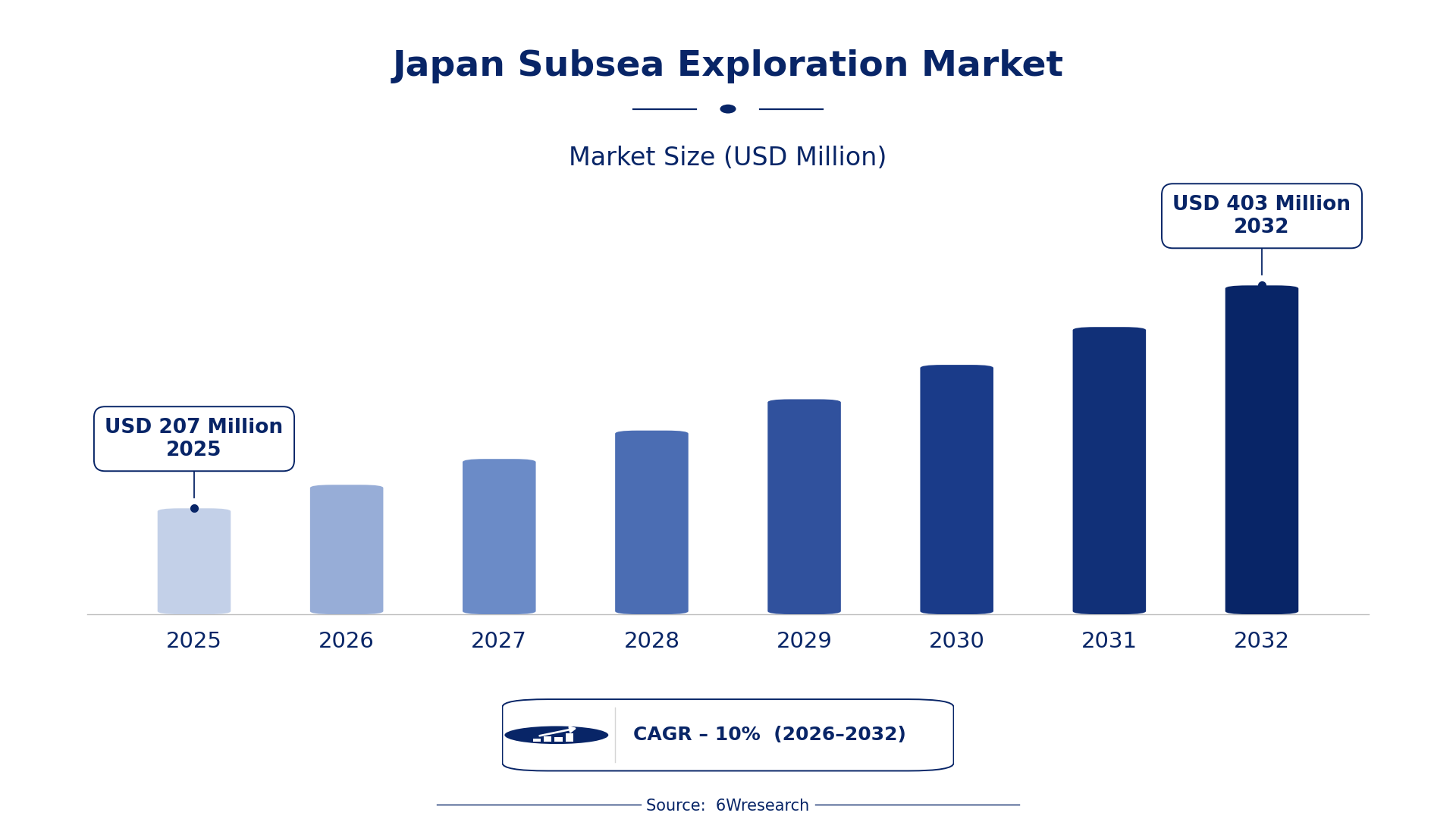
According to 6Wresearch internal database and industry insights, the Japan Subsea Exploration Market was valued at USD 207 Million in 2025 and is projected to reach USD 403 Million by 2032, growing at a CAGR of approximately 10% during 2026–2032.
Japan Subsea Exploration Market Highlights
| Report Metric | Details |
| Report Name | Japan Subsea Exploration Market (2026-2032) |
| Market Size 2025 | USD 207 Million |
| Market Size 2032 | USD 403 Million |
| Absolute Growth 2025–2032 | USD 196 Million |
| CAGR 2026–2032 | 10% |
| Peak Annual Growth | 11.0% in 2032 |
| Forecast Period | 2026–2032 |
| Historical Data | 2022–2025 |
| Base Year | 2025 |
| Leading Exploration Type, 2025 | Seismic Surveys (34% share) |
| Leading Technology Used, 2025 | Airgun/Streamer (44% share) |
| Leading Depth Level, 2025 | Deep Sea (43% share) |
| Leading End User, 2025 | Oil Exploration Companies (39% share) |
| Fastest-Growing Exploration Type | Magnetic Surveys (13.8% CAGR) |
| Fastest-Growing Technology Used | AUV-Based (14.0% CAGR) |
| Fastest-Growing Depth Level | Continental Shelf (12.8% CAGR) |
| Fastest-Growing End User | Geological Institutes (12.7% CAGR) |
| Growing Sector | Oil and Gas Exploration |
| Key End Users | Oil Exploration Companies, Energy Surveyors, Geological Institutes |
Japan Subsea Exploration Market Year-wise Growth Rate and Key Drivers (2022–2032)
This graph illustrates the annual growth rates of the market from 2022 to 2032, highlighting a steady upward trajectory and projected market expansion over the forecast period.
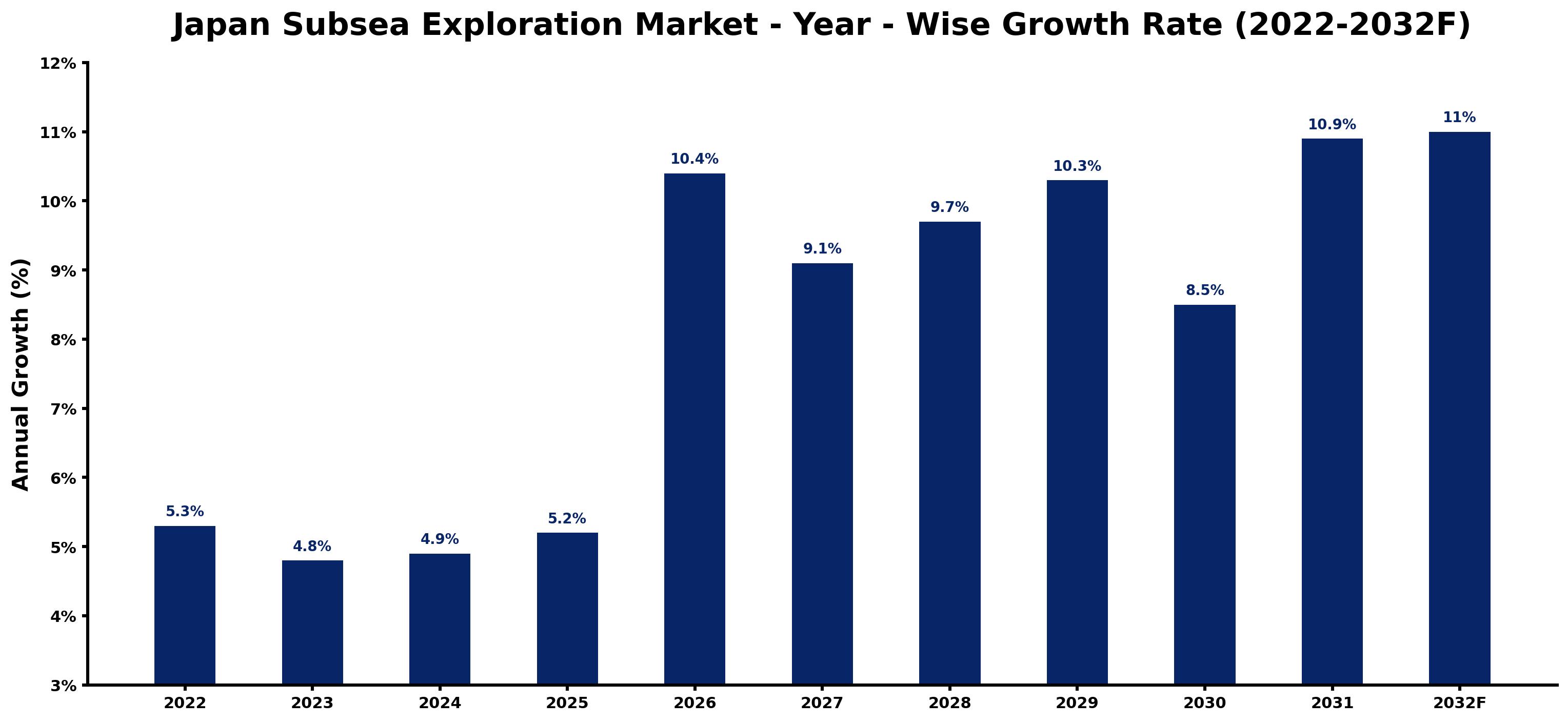
The table below sets out the estimated growth rate for each year and the main factor behind it.
| Year | Estimated Annual Growth (%) | Market Rationale |
| 2022 | 5.3 | The market experienced solid growth due to ongoing exploration activities in the Nankai Trough region. |
| 2023 | 4.8 | Growth slowed slightly as companies adjusted to market conditions and project timelines. |
| 2024 | 4.9 | Demand increased as oil prices stabilised, prompting renewed investment in subsea technologies. |
| 2025 | 5.2 | A rise in project bids indicated a recovering market, leading to faster growth than the previous year. |
| 2026 | 10.4 | Investment surged as companies anticipated higher returns from subsea exploration projects. |
| 2027 | 9.1 | Growth is expected to slow as some projects face delays, but overall demand will remain strong. |
| 2028 | 9.7 | Increased bids for subsea projects will reflect a more optimistic outlook among energy surveyors. |
| 2029 | 10.3 | Demand is projected to continue rising as exploration efforts expand into deeper waters. |
| 2030 | 8.5 | A slight slowdown is anticipated as companies reassess project viability amid changing market conditions. |
| 2031 | 10.9 | Growth is expected to accelerate as new technologies improve exploration efficiency and reduce costs. |
| 2032 | 11.0 | The market is projected to peak due to substantial investments in advanced subsea exploration technologies. |
Note: Market size estimations and growth projections presented in this report are based on 6Wresearch's proprietary forecasting methodology, utilizing the latest available industry data, government publications, and primary research inputs.
Japan Subsea Exploration Market Synopsis
Subsea exploration employs advanced technologies such as seismic surveys and sonar mapping to investigate underwater resources, primarily for oil and gas extraction. The Japan Subsea Exploration Market is propelled by domestic energy requirements and ongoing investments, with ¥10 billion allocated to subsea technology development in 2023. The oil exploration sector remains a primary buyer group, buoyed by a rising number of subsea project bids, which increased by 15% in 2023. This trend reflects strong demand for subsea exploration services, especially in the Nankai Trough region, where exploration activities are on the rise.
Market Dynamics Impact Analysis (2026–2032)
| Factor | Type | Impact | Primary Segment Affected |
| Growing domestic energy needs drive demand for subsea exploration services. | Driver | High | Seismic Surveys |
| Increased investment in subsea technology development enhances exploration capabilities. | Driver | High | Airgun/Streamer |
| Rising interest in environmental monitoring creates opportunities for AUV-based surveys. | Opportunity | Medium | AUV-Based |
| The significant continental shelf area presents untapped potential for resource extraction. | Opportunity | High | Continental Shelf |
| High initial costs of subsea exploration technologies can deter investment. | Restraint | High | Sonar Mapping |
| Limited access to advanced technologies may restrict operational efficiency. | Restraint | Medium | Magnetic Surveys |
| Competition for resources among energy surveyors can lead to project delays. | Challenge | High | Energy Surveyors |
| Technological advancements require constant adaptation, posing risks for suppliers. | Challenge | Medium | Oil Exploration Companies |
Evaluation of Drivers in Japan Subsea Exploration Market (2026–2032)
The table below links each growth driver to the segment it affects and the evidence for it.
| Drivers | Primary Segment Affected | Why It Matters (Evidence) |
| Increased oil prices drive demand for seismic surveys. | Seismic Surveys | As oil prices rise, oil exploration companies invest more in seismic surveys to identify new reserves. |
| Investment in subsea technology improves exploration capabilities. | Airgun/Streamer | With ¥10 billion allocated in 2023, companies are adopting airgun systems for more effective exploration. |
| Environmental concerns boost demand for AUV-based surveys. | AUV-Based | The use of AUVs for environmental monitoring is increasing, particularly in sensitive marine areas. |
| The extensive continental shelf offers rich resources for exploration. | Continental Shelf | Japan's over 1,000 km of continental shelf is attracting attention from oil exploration companies. |
| Technological advancements in sonar mapping improve data accuracy. | Sonar Mapping | Improvements in sonar mapping technologies enable better underwater topography assessments, driving demand. |
Volumes grow on the back of rising oil prices, prompting oil exploration companies to invest heavily in seismic surveys, which are essential for identifying underwater resources. In 2023, Japan allocated ¥10 billion to subsea technology development, improving the capabilities of airgun systems used for seismic exploration. Environmental monitoring is increasingly important, leading to a surge in AUV-based surveys, particularly in sensitive areas like Tokyo Bay. The extensive continental shelf, with over 1,000 km suitable for exploration, attracts considerable interest from energy surveyors. Technological advancements in sonar mapping further improve data accuracy, encouraging more investments in subsea exploration.
Evaluation of Restraints in Japan Subsea Exploration Market
The table below lists the restraints and the evidence behind each.
| Market Restraint | Primary Segment Affected | Why It Matters (Evidence) |
| High initial costs deter smaller companies from entering the market. | Sonar Mapping | The investment required for advanced sonar mapping technologies can be prohibitive for smaller firms. |
| Limited access to advanced technologies restricts operational efficiency. | Magnetic Surveys | Companies lacking access to modern equipment may struggle to compete effectively. |
| Competition for resources can lead to project delays and increased costs. | Energy Surveyors | As more companies bid for the same projects, timelines can extend, impacting overall efficiency. |
| Regulatory hurdles can slow down project approvals. | Seismic Surveys | Stringent regulations around environmental impact assessments can delay seismic survey projects. |
| Market volatility can affect investment decisions. | AUV-Based | Fluctuating oil prices may cause companies to hesitate in committing to new AUV projects. |
Japan Subsea Exploration Market Challenges
In 2023, Japan's energy surveyors reported a 15% rise in subsea project bids, indicating supply constraints for producers competing for limited exploration areas. Compliance with ISO 19901 leads to delays for importers, potentially inflating project costs by up to 20% and hindering timely contract fulfilment. Many producers still depend on outdated seismic survey technologies, causing inefficiencies that increase operational costs by approximately 15%. Buyers face rising prices as these issues accumulate, driving project expenses higher and limiting access to cost-effective subsea exploration options.
Trends in the Japan Subsea Exploration Market
These developments are changing demand patterns in the Japan Subsea Exploration Market.
- Oil Exploration Companies Increasingly Use AUVs: A growing number of oil exploration companies are adopting AUVs for environmental monitoring, reflecting a shift towards more sustainable practices. In 2023, AUV usage rose, with a reported 15% increase in project bids.
- Tokyo Bay Becomes a Key Site for Geological Studies: The Tokyo Bay area is emerging as a prime site for subsea geological studies, due to its rich resources. In 2023, investments in geological research increased, highlighting the area's potential.
- Shift Towards Advanced Sonar Mapping Technologies: There is a notable trend towards advanced sonar mapping technologies, which improve underwater topography assessments. This shift is evident in the increased adoption of these technologies among energy surveyors.
- Rising Interest in Continental Shelf Exploration: The exploration of Japan's continental shelf is gaining momentum, with over 1,000 km of suitable area attracting attention. This interest is reflected in the growing number of subsea project bids.
Investment Opportunities in the Japan Subsea Exploration Market
Several openings in the Japan Subsea Exploration Market merit attention from investors.
- Oil Exploration Companies Seek Advanced Seismic Solutions: Oil exploration companies are actively seeking advanced seismic solutions to improve resource identification. In 2023, the demand for innovative seismic technologies increased, indicating a gap in the market.
- AUVs for Environmental Monitoring in Sensitive Areas: There is a rising demand for AUVs in environmental monitoring, particularly in sensitive marine regions. The Tokyo Bay area presents a prime opportunity for suppliers of AUV technologies.
- Investment in Continental Shelf Exploration Technologies: Investment in technologies for exploring Japan's continental shelf is essential, given its rich resources. The growing interest from energy surveyors highlights the need for innovative solutions.
- Seismic Survey Technologies for Enhanced Resource Extraction: The demand for seismic survey technologies is increasing as companies seek to improve resource extraction capabilities. Suppliers can enter this market by partnering with local energy surveyors.
Government Initiatives in the Japan Subsea Exploration Market
The Hydrogen Society Promotion Act, enacted in 2024, introduces price-gap support for low-carbon hydrogen supply chains. This measure encourages subsea exploration companies to invest in technologies that support sustainable energy production, aligning with Japan's energy goals. Additionally, the Economic Security Promotion Act, implemented in 2022, supports supply-chain resilience for critical products and materials, further strengthening the operational environment for subsea exploration.
The Japan Agency for Marine-Earth Science and Technology oversees marine research and supports subsea exploration initiatives. In practice, energy surveyors utilise funding from this agency to conduct extensive geological studies, ensuring compliance with environmental standards. In 2023, the agency approved multiple projects aimed at improving marine resource management, benefiting both producers and buyers.
Future Insight of the Japan Subsea Exploration Market
New geological studies will commence by 2032, focusing on the Tokyo Bay area to improve extraction capabilities. Advanced AUV technologies will support better environmental monitoring, streamlining management efforts. Collaborative initiatives led by the Japan Subsea Association will enhance industry standards and practices. As the Ministry of the Environment prioritises sustainable marine resource use, buyers will benefit from more efficient extraction methods that align with updated environmental regulations.
Market Segmentation Analysis
Japan Subsea Exploration Market report covers a detailed analysis of the following market segments:
By Exploration Type – Seismic Surveys Lead, Magnetic Surveys Expected to Grow Fastest
According to Saurav Kr Singh, Senior Research Analyst at 6Wresearch, Seismic Surveys took 34% of exploration type revenue in 2025, more than any other category. Seismic surveys are essential for mapping underwater resources, particularly in Japan's extensive continental shelf. Their application in the Tokyo Bay area highlights their critical role in resource extraction, ensuring they maintain a strong market presence. The quickest growth will come from Magnetic Surveys, forecast to expand at a CAGR of 13.8% between 2026 and 2032. Magnetic surveys are gaining traction as they are increasingly utilised for geological assessments, which are vital for understanding subsurface conditions. The 15% increase in subsea project bids in 2023 indicates a growing interest in these assessment methods. Suppliers should focus on developing magnetic survey technologies to capitalise on this growing demand.
By Technology Used – Airgun/Streamer Leads, AUV-Based Expected to Grow Fastest
Airgun/Streamer accounted for 44% of the market by technology used in 2025. Airgun/streamer technology is the primary method for seismic exploration, crucial for oil and gas extraction in Japan's offshore regions. Its established presence among exploration firms solidifies its leading market position, ensuring a robust installed base. AUV-Based is projected to grow fastest, at a CAGR of 14.0% during 2026–2032. AUV-based technologies are rapidly gaining popularity for data collection, particularly due to their efficiency in environmental monitoring applications. The ¥10 billion investment in subsea technology development in 2023 positions this segment for accelerated growth. Suppliers should invest in AUV technology to align with the increasing focus on efficient data collection methods.
By Depth Level – Deep Sea Leads, Continental Shelf Expected to Grow Fastest
Deep Sea held 43% of the Japan Subsea Exploration Market by depth level in 2025. Deep sea exploration commands the largest share due to its focus on resource-rich deposits, especially in the Nankai Trough region. This depth level is critical for oil production, making it a priority for industry stakeholders. Over 2026–2032, Continental Shelf is expected to post the fastest growth, at a CAGR of 12.8%. The continental shelf segment is experiencing the fastest growth, driven by its rich resources and high levels of exploration activity. With over 1,000 km of continental shelf available, interest in this area is expected to continue increasing. This suggests that suppliers should prioritise technologies suited for continental shelf exploration to capture emerging opportunities.
By End User – Oil Exploration Companies Lead, Geological Institutes Expected to Grow Fastest
The largest end user category in 2025 was Oil Exploration Companies, at 39% of revenue. Oil exploration companies represent the largest user group of subsea technologies, as they are the primary drivers of demand for these services in Japan. Their ongoing operations in offshore regions necessitate advanced exploration methods to ensure efficient resource extraction. Geological Institutes are set to record the highest CAGR in this split, 12.7% over 2026–2032. Geological institutes are the fastest-growing segment, utilising exploration data for research purposes, which is becoming increasingly important in understanding marine environments. This growth is likely to be supported by the Ministry of the Environment's initiatives promoting sustainable resource use. This trend highlights the need for suppliers to tailor their offerings to meet the specific requirements of geological research institutions.
Key Attractiveness of the Report
- 10 Years of Market Numbers
- Historical Data Starting from 2022 to 2025
- Base Year 2025
- Forecast Data until 2032
- Key Performance Indicators Impacting the Market
- Major Upcoming Developments and Projects
Key Highlights of the Report:
- Japan Subsea Exploration Market Outlook
- Market Size of Japan Subsea Exploration Market, 2025
- Forecast of Japan Subsea Exploration Market, 2032
- Historical Data and Forecast of Japan Subsea Exploration Revenues & Volume for the Period 2022-2032F
- Japan Subsea Exploration Market Trend Evolution
- Japan Subsea Exploration Market Drivers and Challenges
- Japan Subsea Exploration Price Trends
- Japan Subsea Exploration Porter's Five Forces
- Japan Subsea Exploration Industry Life Cycle
- Historical Data and Forecast of Japan Subsea Exploration Market Revenues & Volume By Exploration Type for the Period 2022-2032F
- Historical Data and Forecast of Japan Subsea Exploration Market Revenues & Volume By Seismic Surveys for the Period 2022-2032F
- Historical Data and Forecast of Japan Subsea Exploration Market Revenues & Volume By Magnetic Surveys for the Period 2022-2032F
- Historical Data and Forecast of Japan Subsea Exploration Market Revenues & Volume By Sonar Mapping for the Period 2022-2032F
- Historical Data and Forecast of Japan Subsea Exploration Market Revenues & Volume By Gravity Surveys for the Period 2022-2032F
- Historical Data and Forecast of Japan Subsea Exploration Market Revenues & Volume By Technology Used for the Period 2022-2032F
- Historical Data and Forecast of Japan Subsea Exploration Market Revenues & Volume By Airgun/Streamer for the Period 2022-2032F
- Historical Data and Forecast of Japan Subsea Exploration Market Revenues & Volume By AUV-Based for the Period 2022-2032F
- Historical Data and Forecast of Japan Subsea Exploration Market Revenues & Volume By Multibeam Echosounder for the Period 2022-2032F
- Historical Data and Forecast of Japan Subsea Exploration Market Revenues & Volume By Submersible Platforms for the Period 2022-2032F
- Historical Data and Forecast of Japan Subsea Exploration Market Revenues & Volume By Depth Level for the Period 2022-2032F
- Historical Data and Forecast of Japan Subsea Exploration Market Revenues & Volume By Deep Sea for the Period 2022-2032F
- Historical Data and Forecast of Japan Subsea Exploration Market Revenues & Volume By Continental Shelf for the Period 2022-2032F
- Historical Data and Forecast of Japan Subsea Exploration Market Revenues & Volume By Mid-Depth for the Period 2022-2032F
- Historical Data and Forecast of Japan Subsea Exploration Market Revenues & Volume By Shallow Waters for the Period 2022-2032F
- Historical Data and Forecast of Japan Subsea Exploration Market Revenues & Volume By End User for the Period 2022-2032F
- Historical Data and Forecast of Japan Subsea Exploration Market Revenues & Volume By Oil Exploration Companies for the Period 2022-2032F
- Historical Data and Forecast of Japan Subsea Exploration Market Revenues & Volume By Geological Institutes for the Period 2022-2032F
- Historical Data and Forecast of Japan Subsea Exploration Market Revenues & Volume By Naval Contractors for the Period 2022-2032F
- Historical Data and Forecast of Japan Subsea Exploration Market Revenues & Volume By Energy Surveyors for the Period 2022-2032F
- Japan Subsea Exploration Import Export Trade Statistics
- Market Opportunity Assessment By Exploration Type
- Market Opportunity Assessment By Technology Used
- Market Opportunity Assessment By Depth Level
- Market Opportunity Assessment By End User
- Japan Subsea Exploration Top Companies Market Share
- Japan Subsea Exploration Competitive Benchmarking By Technical and Operational Parameters
- Japan Subsea Exploration Company Profiles
- Japan Subsea Exploration Key Strategic Recommendations
Market Covered
The following segment groups are covered in the report.
By Exploration Type
- Seismic Surveys
- Magnetic Surveys
- Sonar Mapping
- Gravity Surveys
By Technology Used
- Airgun/Streamer
- AUV-Based
- Multibeam Echosounder
- Submersible Platforms
By Depth Level
- Deep Sea
- Continental Shelf
- Mid-Depth
- Shallow Waters
By End User
- Oil Exploration Companies
- Geological Institutes
- Naval Contractors
- Energy Surveyors































