Japan Subsea Survey Equipment Market Size & Growth Rate
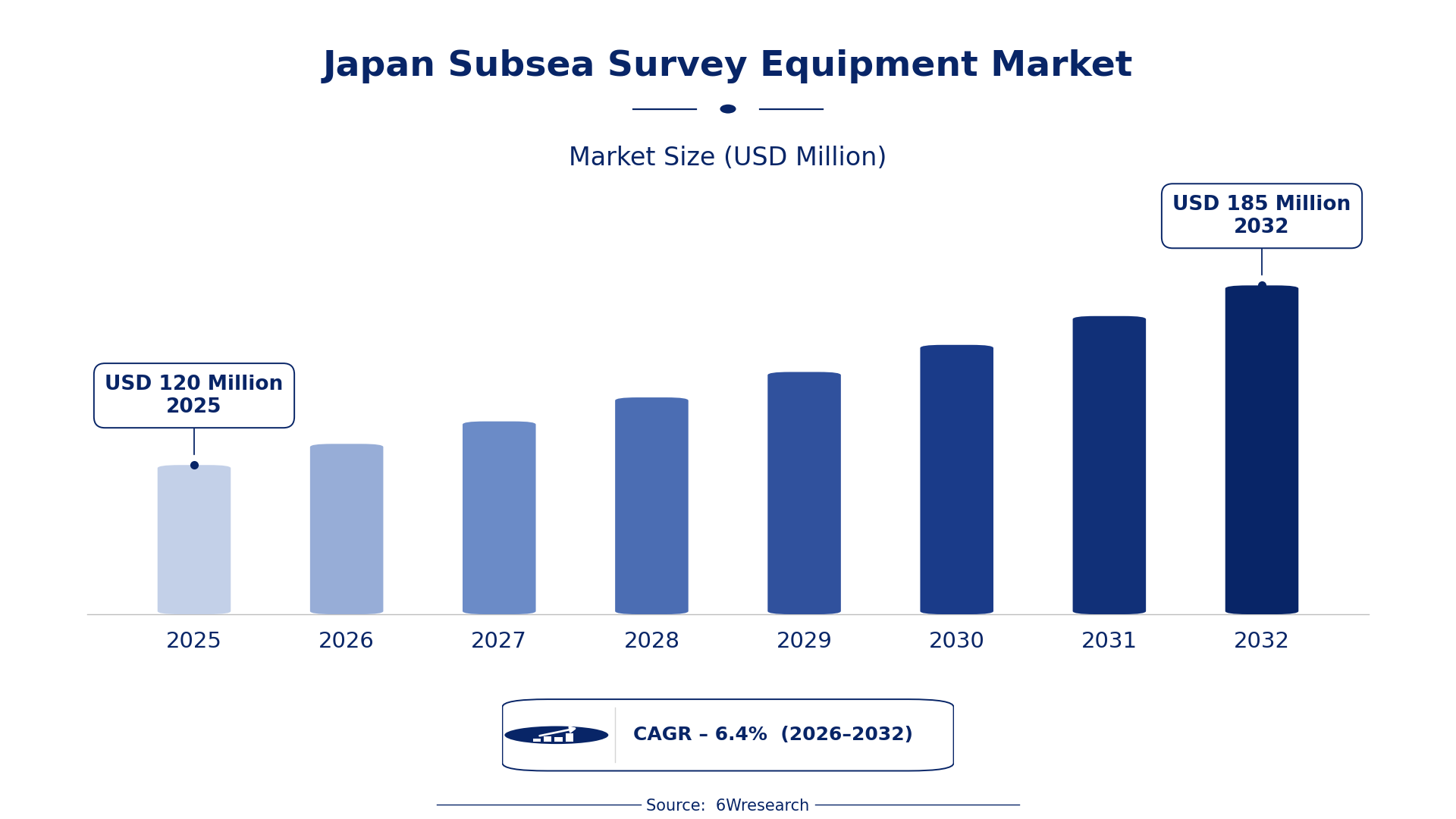
According to 6Wresearch internal database and industry insights, the Japan Subsea Survey Equipment Market was valued at USD 120 Million in 2025 and is projected to reach USD 185 Million by 2032, growing at a CAGR of approximately 6.4% during 2026–2032.
Japan Subsea Survey Equipment Market Highlights
| Report Metric | Details |
| Report Name | Japan Subsea Survey Equipment Market (2026-2032) |
| Market Size 2025 | USD 120 Million |
| Market Size 2032 | USD 185 Million |
| Absolute Growth 2025–2032 | USD 65 Million |
| CAGR 2026–2032 | 6.4% |
| Peak Annual Growth | 8.0% in 2030 |
| Forecast Period | 2026–2032 |
| Historical Data | 2022–2025 |
| Base Year | 2025 |
| Leading Equipment Type, 2025 | Side Scan Sonars (43% share) |
| Leading Survey Purpose, 2025 | Imaging (52% share) |
| Leading Deployment Mode, 2025 | Vessel-Mounted (43% share) |
| Leading End User, 2025 | Marine Surveyors (35% share) |
| Fastest-Growing Equipment Type | CTD Sensors (9.3% CAGR) |
| Fastest-Growing Survey Purpose | Water Quality (8.6% CAGR) |
| Fastest-Growing Deployment Mode | AUV-Based (9.0% CAGR) |
| Fastest-Growing End User | Environmental Agencies (8.3% CAGR) |
| Growing Sector | marine surveying |
| Key End Users | marine surveyors, oilfield explorers, environmental agencies, subsea engineers |
Japan Subsea Survey Equipment Market Year-wise Growth Rate and Key Drivers (2022–2032)
This graph illustrates the annual growth rates of the market from 2022 to 2032, highlighting a steady upward trajectory and projected market expansion over the forecast period.
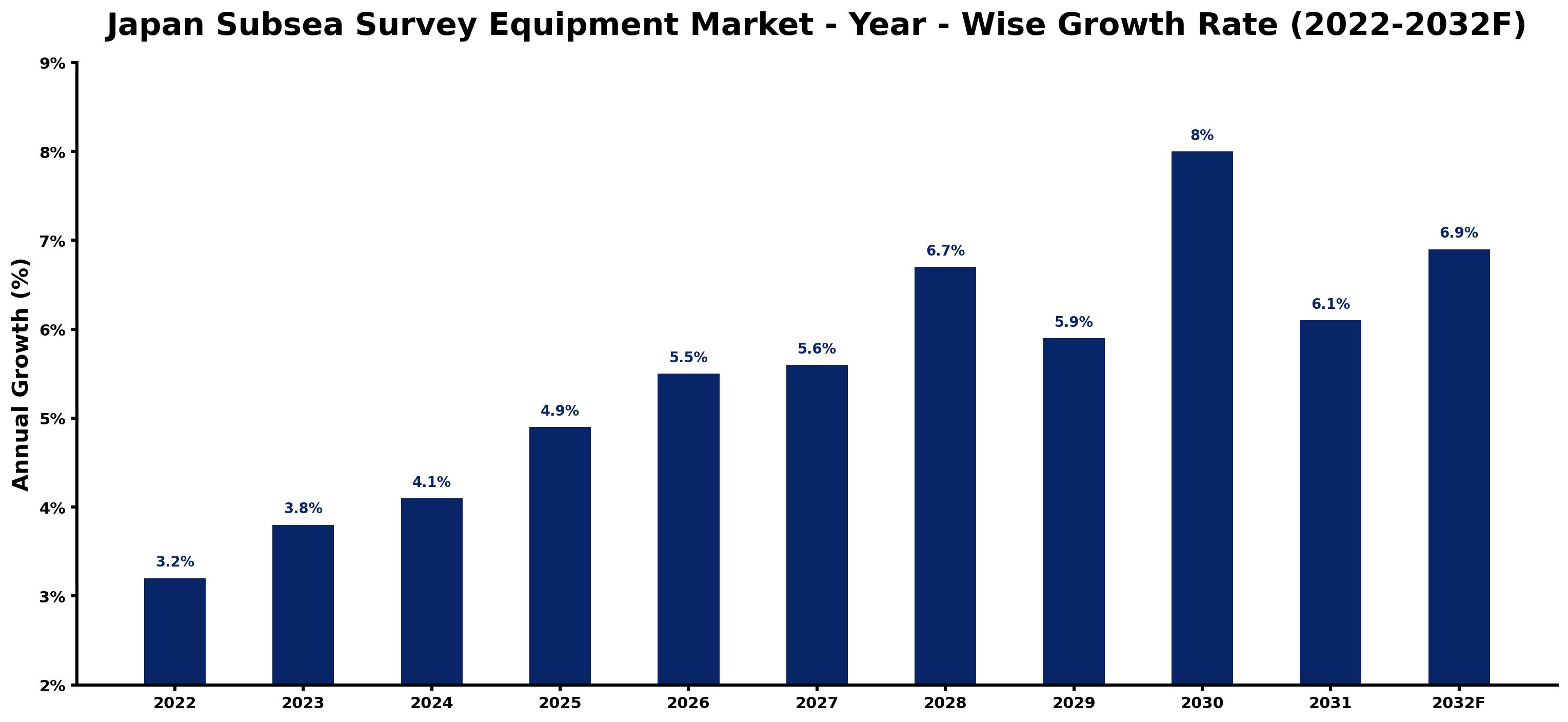
For each year, the table pairs the estimated growth rate with the leading influence on demand, showing how the drivers changed across the period.
| Year | Estimated Annual Growth (%) | Market Rationale |
| 2022 | 3.2 | The market exhibited steady demand from marine surveyors and oilfield explorers. |
| 2023 | 3.8 | Growth accelerated due to increased investments in underwater technology and environmental monitoring. |
| 2024 | 4.1 | Demand rose as marine survey activities expanded in coastal regions and industrial areas. |
| 2025 | 4.9 | The market reached a historical peak due to heightened resource exploration activities. |
| 2026 | 5.5 | Growth is expected to continue as technological advancements improve survey efficiency and accuracy. |
| 2027 | 5.6 | Demand will increase with a focus on environmental compliance and monitoring initiatives. |
| 2028 | 6.7 | The market is projected to experience further growth driven by rising investments in autonomous underwater vehicles. |
| 2029 | 5.9 | Growth is expected to slow slightly as competition intensifies among equipment providers in the sector. |
| 2030 | 8.0 | The market will peak due to a surge in demand for advanced imaging technologies. |
| 2031 | 6.1 | Growth is projected to decelerate as market saturation begins to affect new equipment sales. |
| 2032 | 6.9 | Demand is expected to rise again as environmental agencies increase monitoring efforts. |
Note: Market size estimations and growth projections presented in this report are based on 6Wresearch's proprietary forecasting methodology, utilizing the latest available industry data, government publications, and primary research inputs.
Japan Subsea Survey Equipment Market Synopsis
Subsea survey equipment includes technologies for underwater exploration, such as side scan sonars and AUVs, essential for geological surveying and environmental monitoring. The Japan Subsea Survey Equipment Market is thriving, driven by extensive marine surveying needs along its 29,751 km coastline. Factors such as increased investment in underwater technology, environmental monitoring programs, and a growing focus on resource exploration contribute to the market's expansion, with a projected size of USD 185 million by 2032.
Market Dynamics Impact Analysis (2026–2032)
| Factor | Type | Impact | Primary Segment Affected |
| Growing investments in underwater technology | Driver | High | Side Scan Sonars |
| Increased environmental monitoring initiatives | Driver | High | Water Quality |
| Rising demand for autonomous underwater vehicles | Opportunity | High | AUV-Based |
| Expansion of marine survey activities in Tokyo Bay | Opportunity | Medium | Vessel-Mounted |
| High costs associated with advanced equipment | Restraint | High | CTD Sensors |
| Limited availability of skilled professionals | Restraint | Medium | Marine Surveyors |
| Compliance with stringent environmental regulations | Challenge | High | Environmental Agencies |
| Challenges in integrating new technologies | Challenge | Medium | Subsea Engineers |
Evaluation of Drivers in Japan Subsea Survey Equipment Market (2026–2032)
Key forces behind demand, with the segment each one moves most, are listed below.
| Drivers | Primary Segment Affected | Why It Matters (Evidence) |
| Increased investments in underwater technology | Side Scan Sonars | Japan's marine survey industry employed over 10,000 professionals in 2022, driving demand for advanced imaging solutions. |
| Rising environmental monitoring initiatives | Water Quality | Environmental agencies are increasingly using subsea equipment for monitoring pollution levels and aquatic ecosystems. |
| Growing demand for geological surveys | Sub-bottom Profilers | Japan's coastline necessitates extensive geological assessments, propelling demand for profiling technologies. |
| Expansion of marine survey activities | Vessel-Mounted | The Tokyo Bay area is a key region for marine surveys, spurring demand for traditional deployment methods. |
| Adoption of autonomous underwater vehicles | AUV-Based | AUVs are increasingly utilized for efficient underwater mapping, improving survey capabilities in Japan. |
Buyers are adding capacity as the marine survey industry employs over 10,000 professionals, which drives demand for advanced imaging solutions. The necessity for geological surveys along Japan's extensive coastline propels demand for sub-bottom profilers. Increased marine survey activities in key regions lead to higher purchases of vessel-mounted equipment. The growing adoption of autonomous underwater vehicles is prompting buyers to invest in AUV-based technologies.
Evaluation of Restraints in Japan Subsea Survey Equipment Market
Below are the constraints most often cited by buyers and suppliers, with the segment each affects.
| Market Restraint | Primary Segment Affected | Why It Matters (Evidence) |
| High costs associated with advanced equipment | CTD Sensors | The price of sophisticated subsea equipment limits accessibility for smaller marine survey firms. |
| Limited availability of skilled professionals | Marine Surveyors | The shortage of trained personnel in marine surveying affects operational efficiency and project timelines. |
| Compliance with stringent environmental regulations | Environmental Agencies | Meeting regulatory standards requires investment in certified equipment and processes. |
| Challenges in integrating new technologies | Subsea Engineers | The complexity of new technologies can delay project implementation and increase expenses. |
| Dependence on imported technologies | AUV-Based | Reliance on foreign equipment can lead to supply chain vulnerabilities and higher costs. |
Japan Subsea Survey Equipment Market Challenges
Japan's minimum wage increase to JPY 1,055 per hour raises operational costs for buyers of subsea survey equipment, compelling them to reduce project scopes. Producers face intense competition as they strive to differentiate themselves, which can lead to price reductions that erode profit margins. Manufacturers must navigate complex regulations from the Ministry of Land, Infrastructure, Transport and Tourism, often causing delays that extend delivery timelines for buyers. Supply chain disruptions linked to environmental monitoring initiatives can result in shortages of critical components, delaying production schedules for suppliers.
Trends in the Japan Subsea Survey Equipment Market
Below are the shifts with the largest effect on the Japan Subsea Survey Equipment Market.
- Shift towards Autonomous Underwater Vehicles: AUVs have become increasingly popular in Japan for underwater mapping since 2022, improving survey efficiency. This trend is reflected in the projected growth rate of AUV-based deployments at 9.0% annually.
- Transition from Traditional to Advanced Imaging Techniques: The use of advanced imaging technologies has surged since 2023, with imaging solutions accounting for 52% of the market. This shift enables more accurate assessments of underwater environments.
- Emergence of Environmental Monitoring Programs: Environmental monitoring initiatives have gained traction since 2023, with increased funding for marine protection. In 2023, the government allocated resources to these programs, driving demand for monitoring equipment.
- Growing Focus on Geological Surveys: Geological surveying has become a priority for resource assessment since 2022, particularly in coastal regions. This focus is reflected in the rising demand for sub-bottom profilers.
Investment Opportunities in the Japan Subsea Survey Equipment Market
The following opportunities in the Japan Subsea Survey Equipment Market pair current demand with a clear way in.
- Investment in Autonomous Underwater Vehicles: The demand for AUVs is on the rise, with a projected growth rate of 9.0%. Environmental agencies are key buyers, and partnerships with local firms can facilitate market entry.
- Supply of Advanced Imaging Equipment: The imaging segment is expected to grow, accounting for 52% of the market. Marine surveyors are actively seeking advanced imaging solutions to improve their operations.
- Expansion of Marine Survey Services in Tokyo Bay: With a coastline of approximately 29,751 km, there is a gap in marine survey services. Collaborating with local marine research institutions can provide entry points.
- Provision of Environmental Monitoring Solutions: Environmental agencies are increasingly investing in monitoring technologies, creating opportunities for suppliers. Establishing joint ventures with local firms can strengthen market presence.
Government Initiatives in the Japan Subsea Survey Equipment Market
The Industrial Safety and Health Act mandates that employers ensure safe working conditions for machinery used in subsea surveys. Compliance with this act is essential for subsea equipment manufacturers to maintain operational standards and avoid penalties.
In 2023, the Japanese government allocated funds for marine environmental protection initiatives, overseen by the Japan Agency for Marine-Earth Science and Technology. This funding supports the development of advanced monitoring technologies and promotes compliance with environmental regulations.
Future Insight of the Japan Subsea Survey Equipment Market
By 2032, a notable shift towards marine environmental protection will drive changes in the subsea survey equipment market, prompting suppliers to adopt advanced technologies. Increased government funding for marine research will elevate demand for sophisticated equipment among buyers, enhancing underwater exploration efficiency. New quality standards will improve manufacturing processes, compelling suppliers to uphold high production standards. The integration of autonomous underwater vehicles will streamline data collection, transforming marine survey methodologies.
Market Segmentation Analysis
Japan Subsea Survey Equipment Market report covers a detailed analysis of the following market segments:
By Equipment Type – Side Scan Sonars Lead, CTD Sensors Expected to Grow Fastest
According to Saurav Kr Singh, Senior Research Analyst at 6Wresearch, Side Scan Sonars held 43% of the Japan Subsea Survey Equipment Market by equipment type in 2025. Side Scan Sonars command the largest share in the market due to their essential function in underwater imaging and mapping, which is crucial for marine surveys along Japan's extensive coastline. Their effectiveness is particularly highlighted in regions like Tokyo Bay, where detailed assessments are vital for industrial activities. CTD Sensors are projected to grow fastest, at a CAGR of 9.3% during 2026–2032. CTD Sensors are experiencing rapid growth as they are vital for measuring conductivity, temperature, and depth, particularly in environmental monitoring initiatives addressing climate change. The increasing focus on aquatic ecosystem health drives the demand for these sensors across various marine research projects. Suppliers should enhance the availability of CTD Sensors to meet the increasing demand from environmental monitoring initiatives.
By Survey Purpose – Imaging Leads, Water Quality Expected to Grow Fastest
In 2025, Imaging led the survey purpose split with a 52% share. Imaging leads the market as it is critical for visual assessments of underwater environments, especially within Japan's marine survey industry. This purpose is particularly significant for understanding the impacts of industrial activities in vital areas such as Tokyo Bay. The quickest growth will come from Water Quality, forecast to expand at a CAGR of 8.6% between 2026 and 2032. Water Quality monitoring is the fastest-growing purpose, spurred by the urgent need to evaluate pollution levels and the health of aquatic ecosystems. The implementation of environmental monitoring programs has notably increased the demand for equipment focused on this area. Buyers should prioritise imaging capabilities to ensure thorough assessments of underwater environments.
By Deployment Mode – Vessel-Mounted Leads, AUV-Based Expected to Grow Fastest
Vessel-Mounted accounted for 43% of the market by deployment mode in 2025. Vessel-Mounted deployment remains the predominant method for subsea survey equipment, primarily due to its traditional reliability in marine surveys across Japan's extensive coastline. This method is favoured by marine surveyors for its established effectiveness in various survey applications. Over 2026–2032, AUV-Based is expected to post the fastest growth, at a CAGR of 9.0%. AUV-Based deployment is rapidly gaining traction as it facilitates autonomous underwater surveys, improving efficiency and data collection capabilities. The growing adoption of AUVs for underwater mapping is transforming survey methodologies in Japan's marine sector. Suppliers must invest in AUV technology to align with the shifting preferences towards autonomous survey solutions.
By End User – Marine Surveyors Lead, Environmental Agencies Expected to Grow Fastest
Marine Surveyors took 35% of end user revenue in 2025, more than any other category. Marine Surveyors represent the primary users of subsea survey equipment, employing it for a range of applications, including environmental assessments. Their significant role in the marine survey industry highlights the necessity of reliable equipment for effective data collection. Environmental Agencies are set to record the highest CAGR in this split, 8.3% over 2026–2032. Environmental Agencies are the fastest-growing end users, as they increasingly depend on subsea survey equipment for monitoring compliance with environmental regulations. The heightened emphasis on climate change impacts has resulted in a surge in demand for effective monitoring tools. Suppliers should address the specific needs of environmental agencies to capitalise on the expanding market segment.
Key Attractiveness of the Report
- 10 Years of Market Numbers
- Historical Data Starting from 2022 to 2025
- Base Year 2025
- Forecast Data until 2032
- Key Performance Indicators Impacting the Market
- Major Upcoming Developments and Projects
Key Highlights of the Report:
- Japan Subsea Survey Equipment Market Outlook
- Market Size of Japan Subsea Survey Equipment Market, 2025
- Forecast of Japan Subsea Survey Equipment Market, 2032
- Historical Data and Forecast of Japan Subsea Survey Equipment Revenues & Volume for the Period 2022-2032F
- Japan Subsea Survey Equipment Market Trend Evolution
- Japan Subsea Survey Equipment Market Drivers and Challenges
- Japan Subsea Survey Equipment Price Trends
- Japan Subsea Survey Equipment Porter's Five Forces
- Japan Subsea Survey Equipment Industry Life Cycle
- Historical Data and Forecast of Japan Subsea Survey Equipment Market Revenues & Volume By Equipment Type for the Period 2022-2032F
- Historical Data and Forecast of Japan Subsea Survey Equipment Market Revenues & Volume By Side Scan Sonars for the Period 2022-2032F
- Historical Data and Forecast of Japan Subsea Survey Equipment Market Revenues & Volume By Magnetometers for the Period 2022-2032F
- Historical Data and Forecast of Japan Subsea Survey Equipment Market Revenues & Volume By CTD Sensors for the Period 2022-2032F
- Historical Data and Forecast of Japan Subsea Survey Equipment Market Revenues & Volume By Sub-bottom Profilers for the Period 2022-2032F
- Historical Data and Forecast of Japan Subsea Survey Equipment Market Revenues & Volume By Survey Purpose for the Period 2022-2032F
- Historical Data and Forecast of Japan Subsea Survey Equipment Market Revenues & Volume By Imaging for the Period 2022-2032F
- Historical Data and Forecast of Japan Subsea Survey Equipment Market Revenues & Volume By Geological for the Period 2022-2032F
- Historical Data and Forecast of Japan Subsea Survey Equipment Market Revenues & Volume By Water Quality for the Period 2022-2032F
- Historical Data and Forecast of Japan Subsea Survey Equipment Market Revenues & Volume By Sediment Mapping for the Period 2022-2032F
- Historical Data and Forecast of Japan Subsea Survey Equipment Market Revenues & Volume By Deployment Mode for the Period 2022-2032F
- Historical Data and Forecast of Japan Subsea Survey Equipment Market Revenues & Volume By AUV-Based for the Period 2022-2032F
- Historical Data and Forecast of Japan Subsea Survey Equipment Market Revenues & Volume By Towfish for the Period 2022-2032F
- Historical Data and Forecast of Japan Subsea Survey Equipment Market Revenues & Volume By Fixed Buoy for the Period 2022-2032F
- Historical Data and Forecast of Japan Subsea Survey Equipment Market Revenues & Volume By Vessel-Mounted for the Period 2022-2032F
- Historical Data and Forecast of Japan Subsea Survey Equipment Market Revenues & Volume By End User for the Period 2022-2032F
- Historical Data and Forecast of Japan Subsea Survey Equipment Market Revenues & Volume By Marine Surveyors for the Period 2022-2032F
- Historical Data and Forecast of Japan Subsea Survey Equipment Market Revenues & Volume By Oilfield Explorers for the Period 2022-2032F
- Historical Data and Forecast of Japan Subsea Survey Equipment Market Revenues & Volume By Environmental Agencies for the Period 2022-2032F
- Historical Data and Forecast of Japan Subsea Survey Equipment Market Revenues & Volume By Subsea Engineers for the Period 2022-2032F
- Japan Subsea Survey Equipment Import Export Trade Statistics
- Market Opportunity Assessment By Equipment Type
- Market Opportunity Assessment By Survey Purpose
- Market Opportunity Assessment By Deployment Mode
- Market Opportunity Assessment By End User
- Japan Subsea Survey Equipment Top Companies Market Share
- Japan Subsea Survey Equipment Competitive Benchmarking By Technical and Operational Parameters
- Japan Subsea Survey Equipment Company Profiles
- Japan Subsea Survey Equipment Key Strategic Recommendations
Market Covered
The study includes the following segmentation.
By Equipment Type
- Side Scan Sonars
- Magnetometers
- CTD Sensors
- Sub-bottom Profilers
By Survey Purpose
- Imaging
- Geological
- Water Quality
- Sediment Mapping
By Deployment Mode
- AUV-Based
- Towfish
- Fixed Buoy
- Vessel-Mounted
By End User
- Marine Surveyors
- Oilfield Explorers
- Environmental Agencies
- Subsea Engineers































