Japan Subsea Well Access and BOP System Market Size & Growth Rate
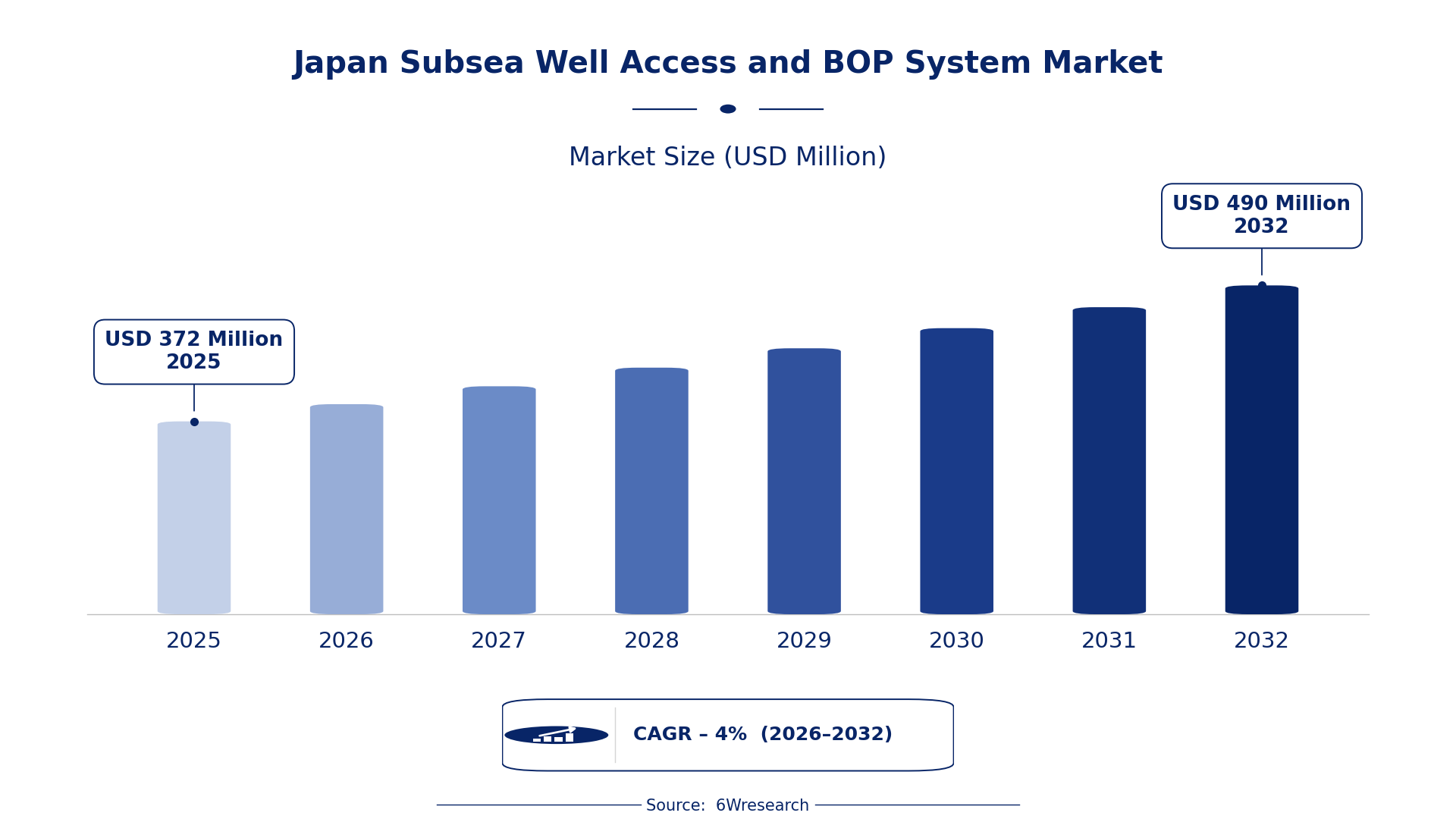
According to 6Wresearch internal database and industry insights, the Japan Subsea Well Access and BOP System Market was valued at USD 372 Million in 2025 and is projected to reach USD 490 Million by 2032, growing at a CAGR of approximately 4% during 2026–2032.
Japan Subsea Well Access and BOP System Market Highlights
| Report Metric | Details |
| Report Name | Japan Subsea Well Access and BOP System Market (2026-2032) |
| Market Size 2025 | USD 372 Million |
| Market Size 2032 | USD 490 Million |
| Absolute Growth 2025–2032 | USD 118 Million |
| CAGR 2026–2032 | 4% |
| Peak Annual Growth | 5.2% in 2028 |
| Forecast Period | 2026–2032 |
| Historical Data | 2022–2025 |
| Base Year | 2025 |
| Leading Water Depth, 2025 | Shallow Water (49% share) |
| Leading Application, 2025 | Exploration (57% share) |
| Leading Component, 2025 | Subsea Well Access System (62% share) |
| Fastest-Growing Water Depth | Deepwater (5.4% CAGR) |
| Fastest-Growing Application | Development (5.3% CAGR) |
| Fastest-Growing Component | Blowout Preventer (BOP) System (5.5% CAGR) |
| Growing Sector | offshore oil extraction |
| Key End Users | oil producers, drilling contractors, energy companies |
Japan Subsea Well Access and BOP System Market Year-wise Growth Rate and Key Drivers (2022–2032)
This graph illustrates the annual growth rates of the market from 2022 to 2032, highlighting a steady upward trajectory and projected market expansion over the forecast period.
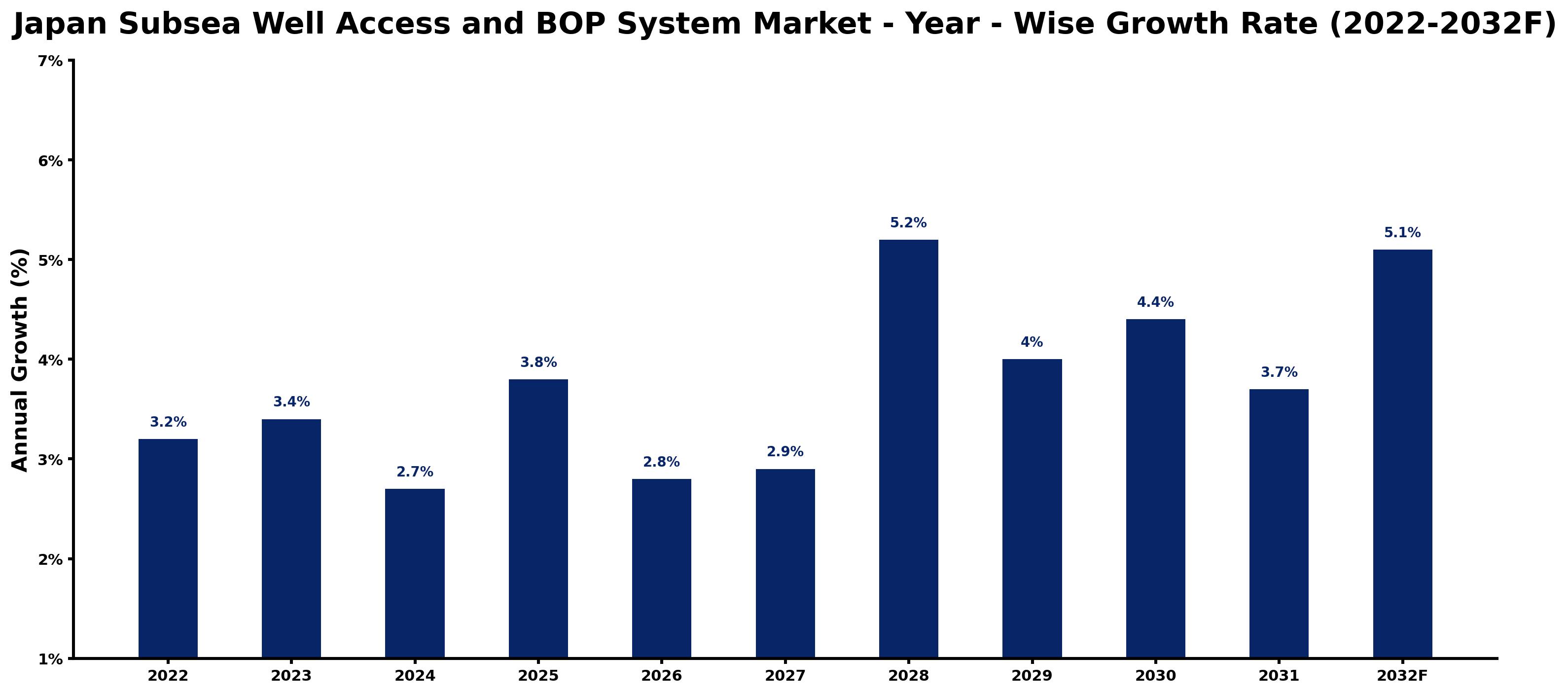
For each year, the table pairs the estimated growth rate with the leading influence on demand, showing how the drivers changed across the period.
| Year | Estimated Annual Growth (%) | Market Rationale |
| 2022 | 3.2 | The market showed steady growth due to ongoing offshore operations and exploration activities. |
| 2023 | 3.4 | Growth accelerated as demand increased from domestic users and international partnerships. |
| 2024 | 2.7 | The market experienced a slowdown as competition intensified among service providers. |
| 2025 | 3.8 | Growth rebounded with enhanced investments in subsea technologies and exploration projects. |
| 2026 | 2.8 | A slowdown occurred as the market adjusted to fluctuating oil prices and demand. |
| 2027 | 2.9 | Demand increased as exploration activities expanded in shallow and deepwater regions. |
| 2028 | 5.2 | The peak growth year is driven by major projects coming online and rising oil prices. |
| 2029 | 4.0 | Growth slowed as market conditions stabilised following peak investment periods. |
| 2030 | 4.4 | Demand rose again as new technologies improved operational efficiencies in subsea operations. |
| 2031 | 3.7 | The market experienced a slowdown as companies focused on cost management and efficiency. |
| 2032 | 5.1 | Growth accelerated again with increased investments in offshore energy technology. |
Note: Market size estimations and growth projections presented in this report are based on 6Wresearch's proprietary forecasting methodology, utilizing the latest available industry data, government publications, and primary research inputs.
Japan Subsea Well Access and BOP System Market Synopsis
Subsea Well Access and BOP Systems are crucial technologies for offshore oil and gas extraction, built to endure challenging underwater conditions. Their main functions include supporting drilling operations and ensuring safety during extraction. The Japan Subsea Well Access and BOP System Market is growing due to increased domestic exploration activities, international collaborations, and substantial investments in subsea technology development. With Japan's offshore oil production at approximately 60,000 barrels per day, the demand for sophisticated subsea systems is anticipated to rise, influenced by both domestic and international market trends.
Market Dynamics Impact Analysis (2026–2032)
| Factor | Type | Impact | Primary Segment Affected |
| Rising domestic exploration activities drive demand for subsea technologies. | Driver | High | Exploration |
| Increased investments in offshore technology enhance operational capabilities. | Driver | High | Development |
| Growing demand for safety in drilling operations creates opportunities for BOP systems. | Opportunity | High | Blowout Preventer (BOP) System |
| Expansion of offshore oil fields necessitates advanced subsea well access systems. | Opportunity | High | Subsea Well Access System |
| Fluctuating oil prices can impact investment decisions in subsea projects. | Restraint | Medium | Deepwater |
| High initial costs of subsea technology may deter smaller operators. | Restraint | Medium | Shallow Water |
| Compliance with international standards can increase operational costs. | Challenge | High | Ultra-Deepwater |
| Limited skilled workforce in subsea operations affects project timelines. | Challenge | Medium | Production |
Evaluation of Drivers in Japan Subsea Well Access and BOP System Market (2026–2032)
The table below links each growth driver to the segment it affects and the evidence for it.
| Drivers | Primary Segment Affected | Why It Matters (Evidence) |
| Increased offshore oil production capacity drives demand for subsea systems. | Exploration | Japan's offshore oil production reached approximately 60,000 barrels per day, prompting more investments in subsea technologies. |
| Technological advancements improve efficiency and safety in subsea operations. | Development | The Ministry of Economy, Trade and Industry promotes subsea technology innovation, leading to higher adoption rates. |
| Rising international oil prices incentivise exploration and production activities. | Production | With oil prices increasing, operators are more likely to invest in advanced subsea technologies. |
| Growing collaboration among industry stakeholders enhances project viability. | Blowout Preventer (BOP) System | The Japan Petroleum Exploration Association supports industry collaboration, boosting demand for BOP systems. |
| Regulatory compliance drives investments in safety technologies. | Subsea Well Access System | ISO 13628 sets standards for subsea well access systems, necessitating upgrades and new purchases. |
Volumes grow on the back of increasing offshore oil production, which reached approximately 60,000 barrels per day in 2022. This rise in production drives demand for subsea well access and BOP systems, as operators seek to enhance drilling efficiency and safety. The average water depth for Japan's offshore drilling is about 300 meters, necessitating advanced subsea technologies. The Japan Petroleum Exploration Association facilitates collaboration among industry players, further boosting demand. Additionally, the Offshore Technology Conference showcases innovations that attract investment in subsea systems, increasing procurement by domestic operators.
Evaluation of Restraints in Japan Subsea Well Access and BOP System Market
The main factors holding the market back are set out below.
| Market Restraint | Primary Segment Affected | Why It Matters (Evidence) |
| Fluctuating oil prices can lead to uncertainty in investment decisions. | Deepwater | Japan's subsea market is influenced by international oil prices, which can deter investment in new projects. |
| High initial costs of subsea technology may limit market access for smaller operators. | Shallow Water | The investment required for advanced systems can deter smaller companies from entering the market. |
| Compliance with international standards increases operational costs for producers. | Ultra-Deepwater | Adhering to standards can require substantial investment in technology upgrades. |
| Limited skilled workforce in subsea operations can delay project timelines. | Production | A shortage of qualified personnel affects the ability to execute complex subsea projects efficiently. |
| Intense competition among service providers can pressure pricing strategies. | Exploration | As more players enter the market, pricing strategies may be affected, impacting profitability. |
Japan Subsea Well Access and BOP System Market Challenges
Buyers face delays due to outdated subsea technologies, particularly in critical fields like Akita and Niigata, which can extend drilling timelines by up to 30%. Suppliers encounter high costs for advanced materials, forcing them to raise prices that impact buyers' operational budgets. Supply chain disruptions stem from volatile international oil prices, creating procurement uncertainties that can increase project costs for buyers by 15%. Regulatory complexities associated with ISO 13628 standards impose additional compliance costs on suppliers, which can inflate prices for buyers seeking reliable subsea solutions.
Trends in the Japan Subsea Well Access and BOP System Market
Several trends are reshaping the Japan Subsea Well Access and BOP System Market; the most important are set out below.
- Adoption of ISO 13628 Standard: Increasing adoption of ISO 13628 among subsea operators in Japan improves safety and efficiency in operations. This standard ensures that subsea well access systems meet international safety requirements, influencing over 200 units of BOP systems in the market.
- Shift Towards Advanced Subsea Technologies: In 2023, Japan allocated ¥5 billion for offshore energy technology research, reflecting a shift towards advanced subsea technologies. This investment is set to drive innovation and improve operational capabilities across the industry.
- Expansion of Offshore Oil Fields: Chiba Prefecture is seeing increased subsea oil exploration activities, with the average water depth for drilling around 300 meters. This expansion is prompting demand for advanced subsea well access systems to support deeper operations.
- Collaboration Among Industry Stakeholders: The Japan Petroleum Exploration Association is promoting collaboration among industry stakeholders, improving project viability. This trend is expected to facilitate more efficient resource sharing and technology adoption across the subsea sector.
Investment Opportunities in the Japan Subsea Well Access and BOP System Market
The opportunities below stand out in the Japan Subsea Well Access and BOP System Market for new entrants and existing suppliers.
- Domestic Oil Producers: Domestic oil producers in Japan are pursuing advanced subsea technologies to boost extraction efficiency. With offshore oil production at approximately 60,000 barrels per day, there is an increasing demand for effective solutions.
- Subsea Well Access Systems: The demand for subsea well access systems is on the rise, driven by ongoing exploration activities. Japan's investment in offshore energy technology research, totalling ¥5 billion, presents an opportunity for suppliers to enter the market.
- Current Investment Climate: The current investment climate is advantageous for subsea technology suppliers, with rising oil prices stimulating exploration. The Offshore Technology Conference acts as a platform for suppliers to connect with potential buyers and showcase their innovations.
- Partnership Opportunities: Partnerships with local firms can ease entry into Japan's subsea market. Collaborating with established players can assist in navigating regulatory requirements and improving market access.
Government Initiatives in the Japan Subsea Well Access and BOP System Market
The GX Basic Policy, adopted in 2023, aims for about JPY 150 trillion of public-private decarbonisation investment over ten years, providing support for subsea technology innovation. This policy builds on the Industrial Standardization Act, which governs product and test standards, ensuring that subsea systems meet safety and quality requirements.
The Ministry of Economy, Trade and Industry is responsible for approving and funding offshore energy technology projects. This agency allocates resources, including ¥5 billion in 2023, to support research and development in subsea technologies, promoting innovation and improving operational capabilities.
Future Insight of the Japan Subsea Well Access and BOP System Market
New offshore energy technology research projects will emerge by 2032, driven by the ¥5 billion investment in innovation. As Japan's offshore oil production stabilises, demand for advanced subsea systems will increase, encouraging collaboration among industry players. The installed base of BOP systems, currently exceeding 200 units, will expand, improving safety in drilling operations. Strengthened international partnerships will facilitate technology transfers, enabling suppliers to provide customised solutions that meet evolving market needs.
Market Segmentation Analysis
Japan Subsea Well Access and BOP System Market report covers a detailed analysis of the following market segments:
By Water Depth – Shallow Water Leads, Deepwater Expected to Grow Fastest
According to Summon Dutta, Assistant Manager at 6Wresearch, with 49% of water depth revenue in 2025, Shallow Water was the largest category. Shallow Water holds the largest share as it is commonly used in nearshore drilling operations, particularly in Japan's offshore oil fields like Akita and Niigata. This segment benefits from a robust infrastructure and a steady demand for efficient extraction methods. Deepwater is projected to grow fastest, at a CAGR of 5.4% during 2026–2032. Deepwater is experiencing rapid growth due to increasing interest in exploring deeper offshore regions, which are essential for accessing untapped reserves. The average water depth of 300 meters in Japan presents opportunities for advancements in deepwater drilling technologies. Suppliers should prioritise the development of deepwater solutions to leverage the expanding market potential.
By Application – Exploration Leads, Development Expected to Grow Fastest
In 2025, Exploration led the application split with a 57% share. Exploration leads the market as it is extensively used during exploratory drilling phases, which are critical for identifying new oil and gas reserves in Japan. The support from the Japan Petroleum Exploration Association further solidifies its importance in the sector. Development is set to record the highest CAGR in this split, 5.3% over 2026–2032. Development is the fastest-growing segment, driven by the necessity to develop discovered oil and gas fields efficiently. The allocation of ¥5 billion for offshore energy technology research underscores the government's commitment to advancing development capabilities. Buyers should prioritise investments in development technologies to ensure timely and effective field exploitation.
By Component – Subsea Well Access System Leads, Blowout Preventer (BOP) System Expected to Grow Fastest
The largest component category in 2025 was Subsea Well Access System, at 62% of revenue. The Subsea Well Access System leads the market as it is a vital component for accessing subsea wells, crucial for both exploration and production activities. Its significance in ensuring operational success makes it a primary focus for offshore projects in Japan. The quickest growth will come from Blowout Preventer (BOP) System, forecast to expand at a CAGR of 5.5% between 2026 and 2032. The Blowout Preventer (BOP) System is growing rapidly because of its essential role in maintaining safety during drilling operations, particularly amid heightened regulatory requirements. The substantial installed base of over 200 units provides a solid foundation for continued growth. Suppliers need to enhance their BOP technologies to align with increasing safety regulations and operational needs.
Key Attractiveness of the Report
- 10 Years of Market Numbers
- Historical Data Starting from 2022 to 2025
- Base Year 2025
- Forecast Data until 2032
- Key Performance Indicators Impacting the Market
- Major Upcoming Developments and Projects
Key Highlights of the Report:
- Japan Subsea Well Access and BOP System Market Outlook
- Market Size of Japan Subsea Well Access and BOP System Market, 2025
- Forecast of Japan Subsea Well Access and BOP System Market, 2032
- Historical Data and Forecast of Japan Subsea Well Access and BOP System Revenues & Volume for the Period 2022-2032
- Japan Subsea Well Access and BOP System Market Trend Evolution
- Japan Subsea Well Access and BOP System Market Drivers and Challenges
- Japan Subsea Well Access and BOP System Price Trends
- Japan Subsea Well Access and BOP System Porter's Five Forces
- Japan Subsea Well Access and BOP System Industry Life Cycle
- Historical Data and Forecast of Japan Subsea Well Access and BOP System Market Revenues & Volume By Water Depth for the Period 2022-2032
- Historical Data and Forecast of Japan Subsea Well Access and BOP System Market Revenues & Volume By Shallow Water for the Period 2022-2032
- Historical Data and Forecast of Japan Subsea Well Access and BOP System Market Revenues & Volume By Deepwater for the Period 2022-2032
- Historical Data and Forecast of Japan Subsea Well Access and BOP System Market Revenues & Volume By Ultra-Deepwater for the Period 2022-2032
- Historical Data and Forecast of Japan Subsea Well Access and BOP System Market Revenues & Volume By Application for the Period 2022-2032
- Historical Data and Forecast of Japan Subsea Well Access and BOP System Market Revenues & Volume By Exploration for the Period 2022-2032
- Historical Data and Forecast of Japan Subsea Well Access and BOP System Market Revenues & Volume By Development for the Period 2022-2032
- Historical Data and Forecast of Japan Subsea Well Access and BOP System Market Revenues & Volume By Production for the Period 2022-2032
- Historical Data and Forecast of Japan Subsea Well Access and BOP System Market Revenues & Volume By Component for the Period 2022-2032
- Historical Data and Forecast of Japan Subsea Well Access and BOP System Market Revenues & Volume By Subsea Well Access System for the Period 2022-2032
- Historical Data and Forecast of Japan Subsea Well Access and BOP System Market Revenues & Volume By Blowout Preventer (BOP) System for the Period 2022-2032
- Japan Subsea Well Access and BOP System Import Export Trade Statistics
- Market Opportunity Assessment By Water Depth
- Market Opportunity Assessment By Application
- Market Opportunity Assessment By Component
- Japan Subsea Well Access and BOP System Top Companies Market Share
- Japan Subsea Well Access and BOP System Competitive Benchmarking By Technical and Operational Parameters
- Japan Subsea Well Access and BOP System Company Profiles
- Japan Subsea Well Access and BOP System Key Strategic Recommendations
Market Covered
The following segment groups are covered in the report.
By Water Depth
- Shallow Water
- Deepwater
- Ultra-Deepwater
By Application
- Exploration
- Development
- Production
By Component
- Subsea Well Access System
- Blowout Preventer (BOP) System






































