Japan Sugar Byproducts Market Size & Growth Rate
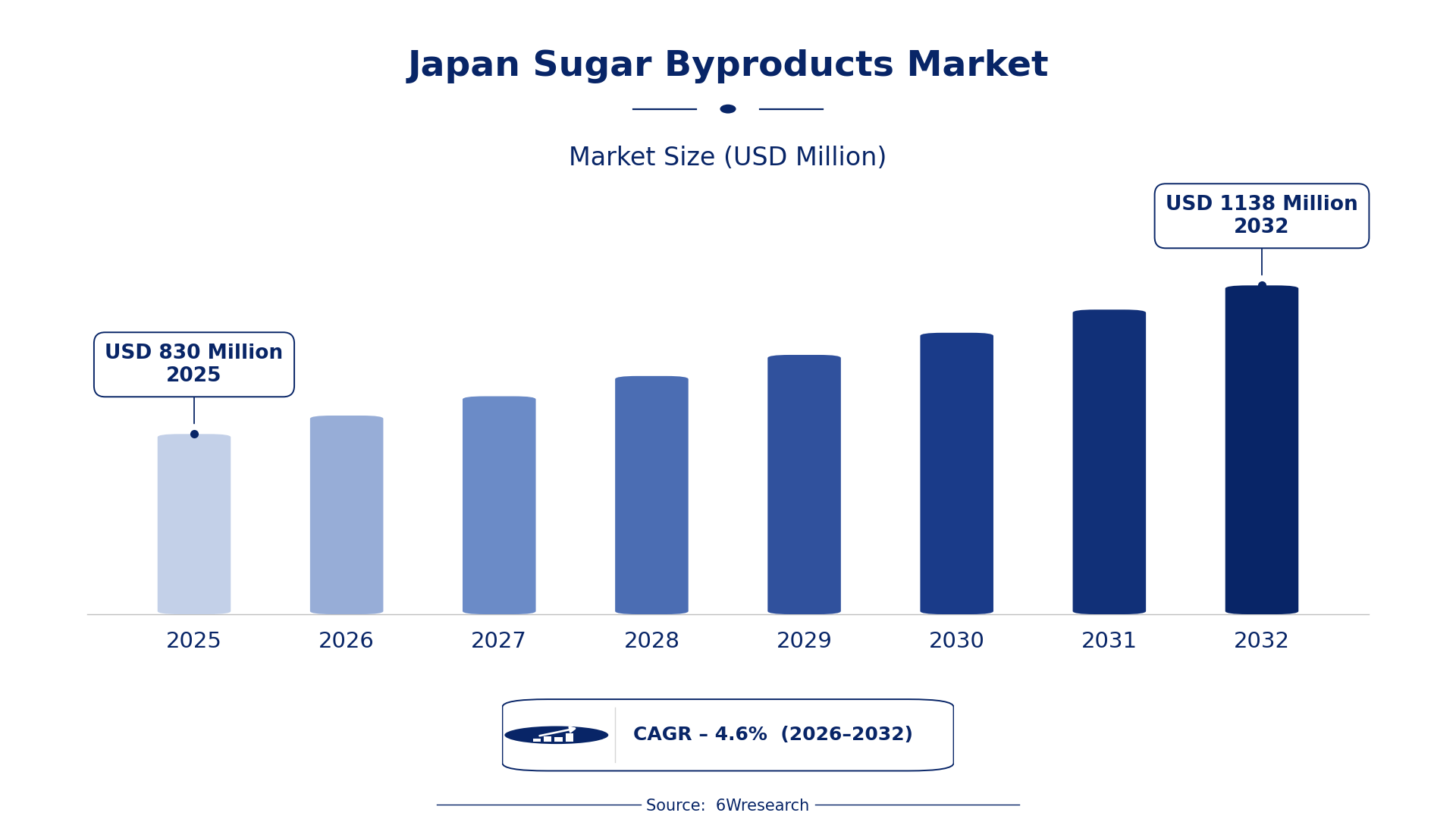
According to 6Wresearch internal database and industry insights, the Japan Sugar Byproducts Market was valued at USD 830 Million in 2025 and is projected to reach USD 1,138 Million by 2032, growing at a CAGR of approximately 4.6% during 2026–2032.
Japan Sugar Byproducts Market Highlights
| Report Metric | Details |
| Report Name | Japan Sugar Byproducts Market (2026-2032) |
| Market Size 2025 | USD 830 Million |
| Market Size 2032 | USD 1,138 Million |
| Absolute Growth 2025–2032 | USD 308 Million |
| CAGR 2026–2032 | 4.6% |
| Peak Annual Growth | 5.7% in 2031 |
| Forecast Period | 2026–2032 |
| Historical Data | 2022–2025 |
| Base Year | 2025 |
| Leading Byproduct Type, 2025 | Molasses (40% share) |
| Leading Processing Method, 2025 | Centrifugal Separation (41% share) |
| Leading Application Area, 2025 | Ethanol Production (40% share) |
| Leading End User, 2025 | Biofuel Companies (43% share) |
| Fastest-Growing Byproduct Type | Bagasse (6.5% CAGR) |
| Fastest-Growing Processing Method | Filtration (6.9% CAGR) |
| Fastest-Growing End User | Biomass Plants (6.2% CAGR) |
| Growing Sector | Ethanol Production |
| Key End Users | Ethanol Production, Power Generation, Fertilizer Manufacturing, Animal Feed |
Japan Sugar Byproducts Market Year-wise Growth Rate and Key Drivers (2022–2032)
This graph illustrates the annual growth rates of the market from 2022 to 2032, highlighting a steady upward trajectory and projected market expansion over the forecast period.
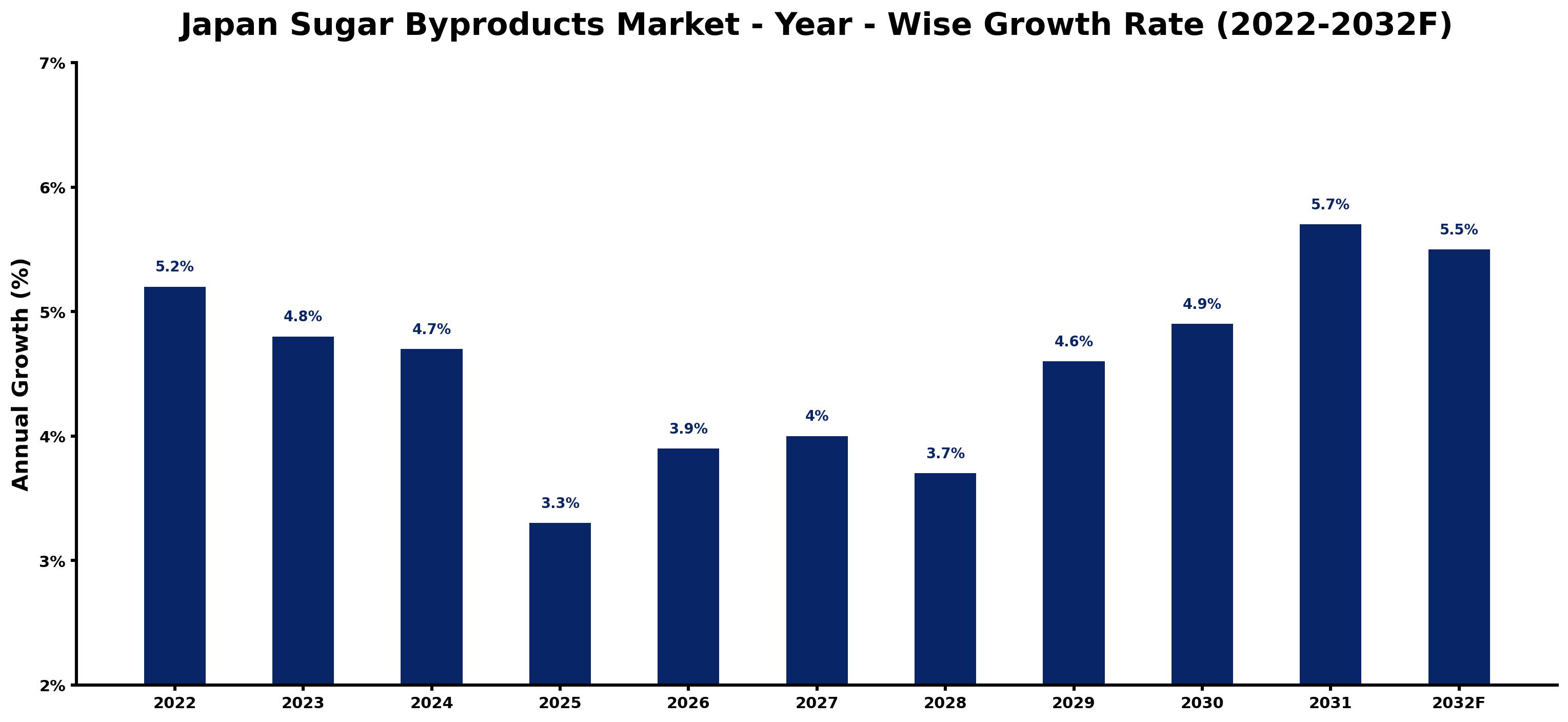
The following figures match every annual growth estimate with the main market development of that year, giving the reasoning behind each rise or slowdown.
| Year | Estimated Annual Growth (%) | Market Rationale |
| 2022 | 5.2 | The market experienced solid growth due to increased domestic demand for sugar byproducts. |
| 2023 | 4.8 | Demand growth slowed as the market adjusted to previous high levels of production and consumption. |
| 2024 | 4.7 | A continued slowdown occurred as buyers became more selective in their sourcing strategies. |
| 2025 | 3.3 | Growth decelerated further as market saturation began to impact purchasing decisions. |
| 2026 | 3.9 | An uptick in demand is anticipated as biofuel production ramps up in response to government initiatives. |
| 2027 | 4.0 | Growth is likely to continue as investments in renewable energy sources gain momentum. |
| 2028 | 3.7 | A slight slowdown is expected as competition intensifies among suppliers. |
| 2029 | 4.6 | Demand is expected to rise as biofuel companies expand their operations and production capacity. |
| 2030 | 4.9 | Further growth is anticipated as the market stabilises and new applications for byproducts emerge. |
| 2031 | 5.7 | The market is projected to peak as investments in biofuel infrastructure reach their height. |
| 2032 | 5.5 | Growth will moderate as the market adjusts to peak levels of production and consumption. |
Note: Market size estimations and growth projections presented in this report are based on 6Wresearch's proprietary forecasting methodology, utilizing the latest available industry data, government publications, and primary research inputs.
Japan Sugar Byproducts Market Synopsis
Sugar byproducts, including molasses, bagasse, press mud, and filter cake, are derived from the sugar refining process. These byproducts primarily serve ethanol production, power generation, and animal feed applications. The Japan Sugar Byproducts Market is growing due to rising demand from biofuel companies and agricultural sectors, with ethanol production capacity reaching 400 million litres in 2023. Government support for biofuel development further stimulates market expansion, creating new opportunities for suppliers and buyers alike.
Market Dynamics Impact Analysis (2026–2032)
| Factor | Type | Impact | Primary Segment Affected |
| Growing demand for ethanol production | Driver | High | Ethanol Production |
| Expansion of biomass power generation facilities | Driver | High | Power Generation |
| Increasing investment in biofuel development programs | Opportunity | High | Ethanol Production |
| Rising interest in organic agriculture practices | Opportunity | Medium | Fertilizer Manufacturing |
| Regulatory constraints on fertilizer use | Restraint | High | Press Mud |
| Limited mainstream applications for filter cake | Restraint | Medium | Filter Cake |
| High competition among suppliers | Challenge | High | Molasses |
| Fluctuations in raw material availability | Challenge | Medium | Molasses |
Evaluation of Drivers in Japan Sugar Byproducts Market (2026–2032)
These are the developments adding the most demand over the forecast period.
| Drivers | Primary Segment Affected | Why It Matters (Evidence) |
| Increased ethanol production capacity | Ethanol Production | Ethanol production capacity in Japan reached 400 million liters in 2023, driving higher demand for sugar byproducts. |
| Expansion of biomass power plants | Power Generation | Bagasse is utilized in over 50 biomass power plants across Japan, boosting its demand for energy generation. |
| Growing cattle feed production | Animal Feed | Cattle feed production in Japan is estimated at 1.5 million tons annually, increasing the need for sugar byproducts. |
| Government support for biofuel initiatives | Ethanol Production | The government allocated 1 billion yen for biofuel development programs, increasing demand for sugar byproducts. |
| Rising organic agriculture practices | Fertilizer Manufacturing | Organic agriculture producers account for 2% of total farmland, increasing the use of byproducts in fertilizers. |
What keeps demand rising is the increased ethanol production capacity, which reached 400 million litres in 2023, driving higher purchases of sugar byproducts. The expansion of biomass power plants utilising bagasse boosts demand for this byproduct. Cattle feed production is increasing, raising the need for sugar byproducts. Organic agriculture practices are also on the rise, leading to greater use of sugar byproducts in fertilizers.
Evaluation of Restraints in Japan Sugar Byproducts Market
The table below lists the restraints and the evidence behind each.
| Market Restraint | Primary Segment Affected | Why It Matters (Evidence) |
| Regulatory constraints on fertilizer use | Press Mud | Regulatory constraints limit the application of press mud in fertilizers, reducing its market potential. |
| Limited mainstream applications for filter cake | Filter Cake | Filter cake is rarely utilized in mainstream applications, restricting its market potential. |
| High competition among suppliers | Molasses | Intense competition among suppliers creates price pressures, impacting profitability for producers. |
| Fluctuations in raw material availability | Molasses | Variability in raw material supply affects production schedules and pricing for sugar byproducts. |
| Market saturation in certain byproduct segments | Molasses | Saturation in the market leads to reduced growth opportunities for certain sugar byproducts. |
Japan Sugar Byproducts Market Challenges
High production costs pressure buyers in Japan's sugar byproducts market. The sugar refining process incurs substantial expenses, which raises prices for end products and discourages domestic users from increasing their purchases. Unpredictable sugarcane yields lead to inconsistent supply levels, causing delays for buyers who rely on steady availability. Regulatory complexities surrounding the use of byproducts in fertiliser manufacturing create compliance challenges for suppliers, resulting in potential revenue losses estimated at 200 million yen annually. Quality assurance standards necessitate additional investments from suppliers, further squeezing their profit margins and limiting their competitiveness.
Trends in the Japan Sugar Byproducts Market
The shifts below are changing how Japan Sugar Byproducts Market products are bought and supplied.
- Biofuel Companies Prioritising Ethanol Production: Biofuel companies are increasingly focusing on ethanol production, which accounted for 40% of the market share in 2025. This shift began in 2023 as demand for renewable energy sources grew, prompting suppliers to adapt their offerings.
- Shift Towards Organic Agriculture: Producers are moving towards organic agriculture practices, with organic agriculture producers accounting for 2% of total farmland as of 2023. This change reflects a growing consumer preference for organic products and is expected to drive up demand for sugar byproducts.
- Transition to Sustainable Power Generation: The focus on sustainable power generation has led to an increase in biomass power plants, utilising bagasse as a feedstock. This trend gained traction in 2023, with many plants adopting bagasse, strengthening its market position.
- Rise of Quality Assurance Standards: The implementation of JIS standards for quality assurance in sugar byproducts has become more prominent since 2023. This trend ensures that producers meet quality requirements, enhancing buyer confidence and increasing market demand.
Investment Opportunities in the Japan Sugar Byproducts Market
The opportunities below stand out in the Japan Sugar Byproducts Market for new entrants and existing suppliers.
- Local Partnerships for Biofuel Production: Establishing local partnerships can facilitate entry into the biofuel market, projected to grow as biofuel companies in Japan actively seek suppliers of sugar byproducts to meet their needs.
- Investment in Biomass Power Generation: Investing in biomass power generation facilities can tap into the growing energy market. Biomass plants across Japan are expanding, creating a need for reliable sources of bagasse.
- Supply of Organic Fertilizers: There is an increasing demand for organic fertilizers, presenting an opportunity for suppliers. Organic agriculture producers are seeking sustainable inputs to meet consumer preferences.
- Expansion into Animal Feed Production: With cattle feed production estimated at 1.5 million tons annually, suppliers can focus on providing high-quality byproducts. Cattle feed producers are looking for reliable sources of molasses.
Government Initiatives in the Japan Sugar Byproducts Market
The Hydrogen Society Promotion Act, established in 2024, supports low-carbon hydrogen and ammonia supply chains. This initiative encourages the use of sugar byproducts in the production of biofuels, benefiting both producers and buyers by ensuring a steady supply of affordable inputs.
The Ministry of Agriculture, Forestry and Fisheries promotes organic agriculture through subsidies and funding. This support enables producers to incorporate sugar byproducts into their operations, improving their competitiveness in the organic market.
Future Insight of the Japan Sugar Byproducts Market
By 2032, a shift in government policy will transform the sugar byproducts market, with biofuel production initiatives set to boost ethanol capacity to 400 million litres, benefiting both buyers and suppliers. Increased support for organic agriculture will encourage more producers to utilise sugar byproducts, expanding their applications. The establishment of new processing facilities will improve supply chain efficiency and reduce operational costs. As a result, buyers will gain better access to affordable byproducts, while suppliers will broaden their market reach.
Market Segmentation Analysis
Japan Sugar Byproducts Market report covers a detailed analysis of the following market segments:
By Byproduct Type – Molasses Lead, Bagasse Expected to Grow Fastest
According to Saurav Kr Singh, Senior Research Analyst at 6Wresearch, with 40% of byproduct type revenue in 2025, Molasses was the largest category. Molasses commands the largest share because of its widespread use in ethanol production and animal feed, with biofuel companies being significant buyers. In 2023, Japan's ethanol production capacity reached 400 million litres, highlighting molasses' essential role in this industry. Bagasse is projected to grow fastest, at a CAGR of 6.5% during 2026–2032. Bagasse is experiencing rapid growth as it is increasingly utilised for power generation in over 50 biomass power plants across Japan. Government initiatives promoting biofuel development are further driving demand for bagasse, indicating a strong upward trend. Suppliers should focus on enhancing their offerings in bagasse to capitalise on this growing demand.
By Processing Method – Centrifugal Separation Leads, Filtration Expected to Grow Fastest
Centrifugal Separation held 41% of the Japan Sugar Byproducts Market by processing method in 2025. Centrifugal separation holds the largest share as it effectively extracts high-quality sugar byproducts, ensuring optimal yield for producers. This method is prevalent in Japan's sugar processing facilities, particularly in the Tokyo region, which is a key processing hub. Over 2026–2032, Filtration is expected to post the fastest growth, at a CAGR of 6.9%. Filtration is witnessing the fastest growth due to its efficiency in refining sugar byproducts, making it increasingly attractive for producers looking to improve processing times. As facilities modernise, the shift towards filtration methods is expected to accelerate. Buyers may benefit from investing in advanced filtration technologies to improve their processing capabilities.
By Application Area – Ethanol Production Leads and Records the Fastest Growth
In 2025, Ethanol Production led the application area split with a 40% share. Ethanol production dominates the market as it is a primary application for sugar byproducts, driven by the increasing demand for biofuels in Japan. The government's allocation of 1 billion yen for biofuel development in 2023 underscores the importance of this application. Ethanol Production is also forecast to expand faster than any other category, at a CAGR of 5.8% over 2026–2032. Ethanol production is also the fastest-growing area, as the ongoing push for renewable energy sources fuels the need for sugar byproducts in biofuel applications. This simultaneous leadership and growth indicate a robust future for this segment. Suppliers must align their strategies with the growing ethanol production to maximise opportunities in the biofuel sector.
By End User – Biofuel Companies Lead, Biomass Plants Expected to Grow Fastest
Biofuel Companies took 43% of end user revenue in 2025, more than any other category. Biofuel companies represent the largest share of end users, as they rely heavily on sugar byproducts for biofuel production. The increasing focus on renewable energy sources in Japan has solidified the position of biofuel companies as key consumers. Biomass Plants are set to record the highest CAGR in this split, 6.2% over 2026–2032. Biomass plants are the fastest-growing end user segment, driven by the rising demand for renewable energy solutions and government support for bioenergy initiatives. This growth reflects a broader shift towards sustainable energy practices in Japan. Suppliers should target biomass plants to capture emerging opportunities in the renewable energy market.
Key Attractiveness of the Report
- 10 Years of Market Numbers
- Historical Data Starting from 2022 to 2025
- Base Year 2025
- Forecast Data until 2032
- Key Performance Indicators Impacting the Market
- Major Upcoming Developments and Projects
Key Highlights of the Report:
- Japan Sugar Byproducts Market Outlook
- Market Size of Japan Sugar Byproducts Market, 2025
- Forecast of Japan Sugar Byproducts Market, 2032
- Historical Data and Forecast of Japan Sugar Byproducts Revenues & Volume for the Period 2022-2032F
- Japan Sugar Byproducts Market Trend Evolution
- Japan Sugar Byproducts Market Drivers and Challenges
- Japan Sugar Byproducts Price Trends
- Japan Sugar Byproducts Porter's Five Forces
- Japan Sugar Byproducts Industry Life Cycle
- Historical Data and Forecast of Japan Sugar Byproducts Market Revenues & Volume By Byproduct Type for the Period 2022-2032F
- Historical Data and Forecast of Japan Sugar Byproducts Market Revenues & Volume By Molasses for the Period 2022-2032F
- Historical Data and Forecast of Japan Sugar Byproducts Market Revenues & Volume By Bagasse for the Period 2022-2032F
- Historical Data and Forecast of Japan Sugar Byproducts Market Revenues & Volume By Press Mud for the Period 2022-2032F
- Historical Data and Forecast of Japan Sugar Byproducts Market Revenues & Volume By Filter Cake for the Period 2022-2032F
- Historical Data and Forecast of Japan Sugar Byproducts Market Revenues & Volume By Processing Method for the Period 2022-2032F
- Historical Data and Forecast of Japan Sugar Byproducts Market Revenues & Volume By Centrifugal Separation for the Period 2022-2032F
- Historical Data and Forecast of Japan Sugar Byproducts Market Revenues & Volume By Pulping for the Period 2022-2032F
- Historical Data and Forecast of Japan Sugar Byproducts Market Revenues & Volume By Filtration for the Period 2022-2032F
- Historical Data and Forecast of Japan Sugar Byproducts Market Revenues & Volume By Lime Clarification for the Period 2022-2032F
- Historical Data and Forecast of Japan Sugar Byproducts Market Revenues & Volume By Application Area for the Period 2022-2032F
- Historical Data and Forecast of Japan Sugar Byproducts Market Revenues & Volume By Ethanol Production for the Period 2022-2032F
- Historical Data and Forecast of Japan Sugar Byproducts Market Revenues & Volume By Power Generation for the Period 2022-2032F
- Historical Data and Forecast of Japan Sugar Byproducts Market Revenues & Volume By Fertilizer Manufacturing for the Period 2022-2032F
- Historical Data and Forecast of Japan Sugar Byproducts Market Revenues & Volume By Animal Feed for the Period 2022-2032F
- Historical Data and Forecast of Japan Sugar Byproducts Market Revenues & Volume By End User for the Period 2022-2032F
- Historical Data and Forecast of Japan Sugar Byproducts Market Revenues & Volume By Biofuel Companies for the Period 2022-2032F
- Historical Data and Forecast of Japan Sugar Byproducts Market Revenues & Volume By Biomass Plants for the Period 2022-2032F
- Historical Data and Forecast of Japan Sugar Byproducts Market Revenues & Volume By Organic Agri Producers for the Period 2022-2032F
- Historical Data and Forecast of Japan Sugar Byproducts Market Revenues & Volume By Cattle Feed Producers for the Period 2022-2032F
- Japan Sugar Byproducts Import Export Trade Statistics
- Market Opportunity Assessment By Byproduct Type
- Market Opportunity Assessment By Processing Method
- Market Opportunity Assessment By Application Area
- Market Opportunity Assessment By End User
- Japan Sugar Byproducts Top Companies Market Share
- Japan Sugar Byproducts Competitive Benchmarking By Technical and Operational Parameters
- Japan Sugar Byproducts Company Profiles
- Japan Sugar Byproducts Key Strategic Recommendations
Market Covered
This report examines the market across the segments below.
By Byproduct Type
- Molasses
- Bagasse
- Press Mud
- Filter Cake
By Processing Method
- Centrifugal Separation
- Pulping
- Filtration
- Lime Clarification
By Application Area
- Ethanol Production
- Power Generation
- Fertilizer Manufacturing
- Animal Feed
By End User
- Biofuel Companies
- Biomass Plants
- Organic Agri Producers
- Cattle Feed Producers































