Japan Sugarcane-Based Biofuel Market Size & Growth Rate
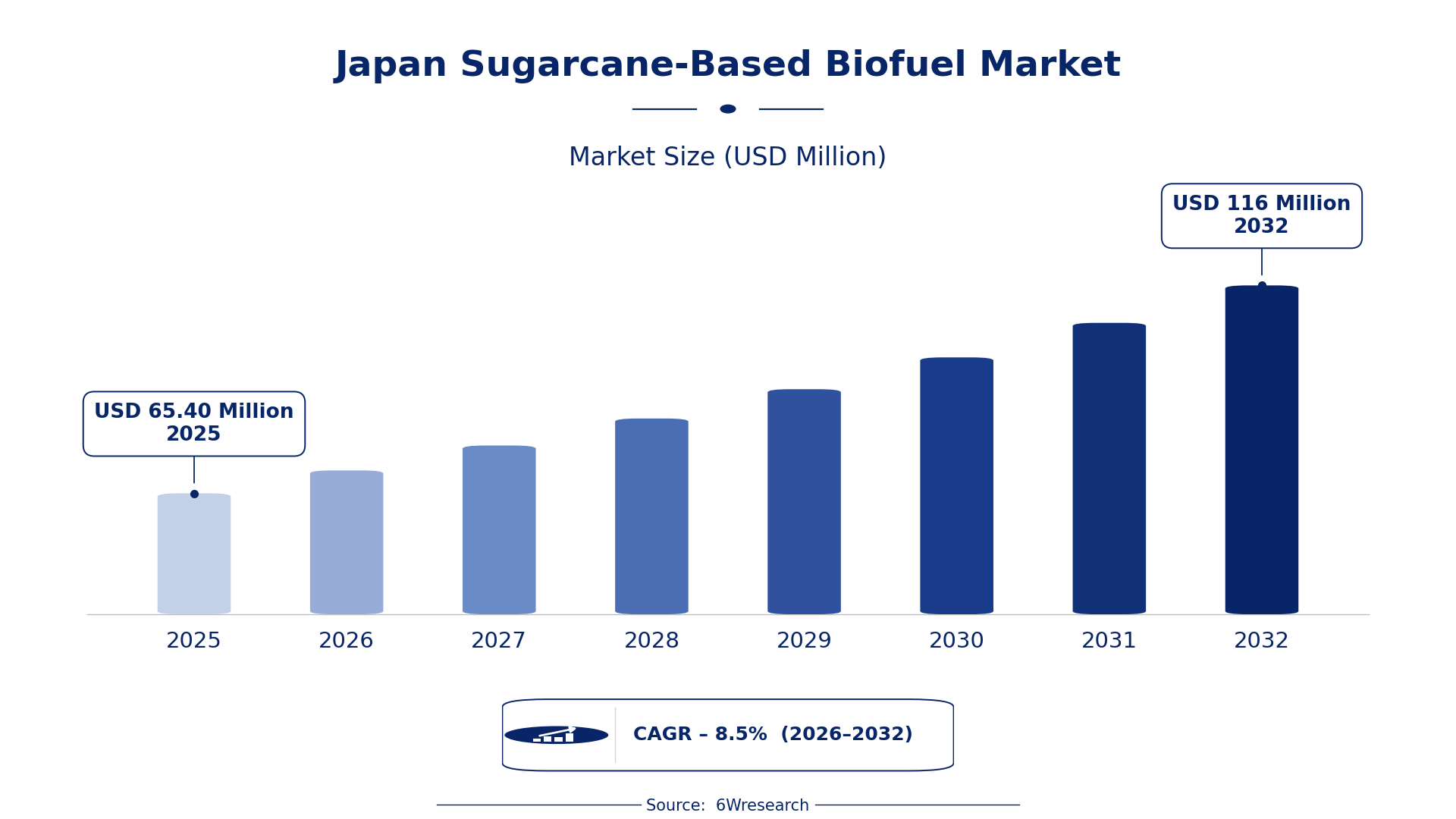
According to 6Wresearch internal database and industry insights, the Japan Sugarcane-Based Biofuel Market was valued at USD 65.40 Million in 2025 and is projected to reach USD 116 Million by 2032, growing at a CAGR of approximately 8.5% during 2026–2032.
Japan Sugarcane-Based Biofuel Market Highlights
| Report Metric | Details |
| Report Name | Japan Sugarcane-Based Biofuel Market (2026-2032) |
| Market Size 2025 | USD 65.40 Million |
| Market Size 2032 | USD 116 Million |
| Absolute Growth 2025–2032 | USD 50.60 Million |
| CAGR 2026–2032 | 8.5% |
| Peak Annual Growth | 9.9% in 2028 |
| Forecast Period | 2026–2032 |
| Historical Data | 2022–2025 |
| Base Year | 2025 |
| Leading Fuel Type, 2025 | Ethanol (48% share) |
| Leading Processing Method, 2025 | Fermentation (41% share) |
| Leading Use Case, 2025 | Transportation Fuel (40% share) |
| Leading End User, 2025 | Fuel Blending Facilities (37% share) |
| Fastest-Growing Fuel Type | Bioethanol (12.2% CAGR) |
| Fastest-Growing Processing Method | Advanced Fermentation (12.1% CAGR) |
| Fastest-Growing Use Case | Power Generation (11.5% CAGR) |
| Fastest-Growing End User | Biofuel Distributors (11.3% CAGR) |
| Growing Sector | Transportation Fuel |
| Key End Users | Fuel Blending Facilities, Biofuel Distributors, Rural Energy Providers |
Japan Sugarcane-Based Biofuel Market Year-wise Growth Rate and Key Drivers (2022–2032)
This graph illustrates the annual growth rates of the market from 2022 to 2032, highlighting a steady upward trajectory and projected market expansion over the forecast period.
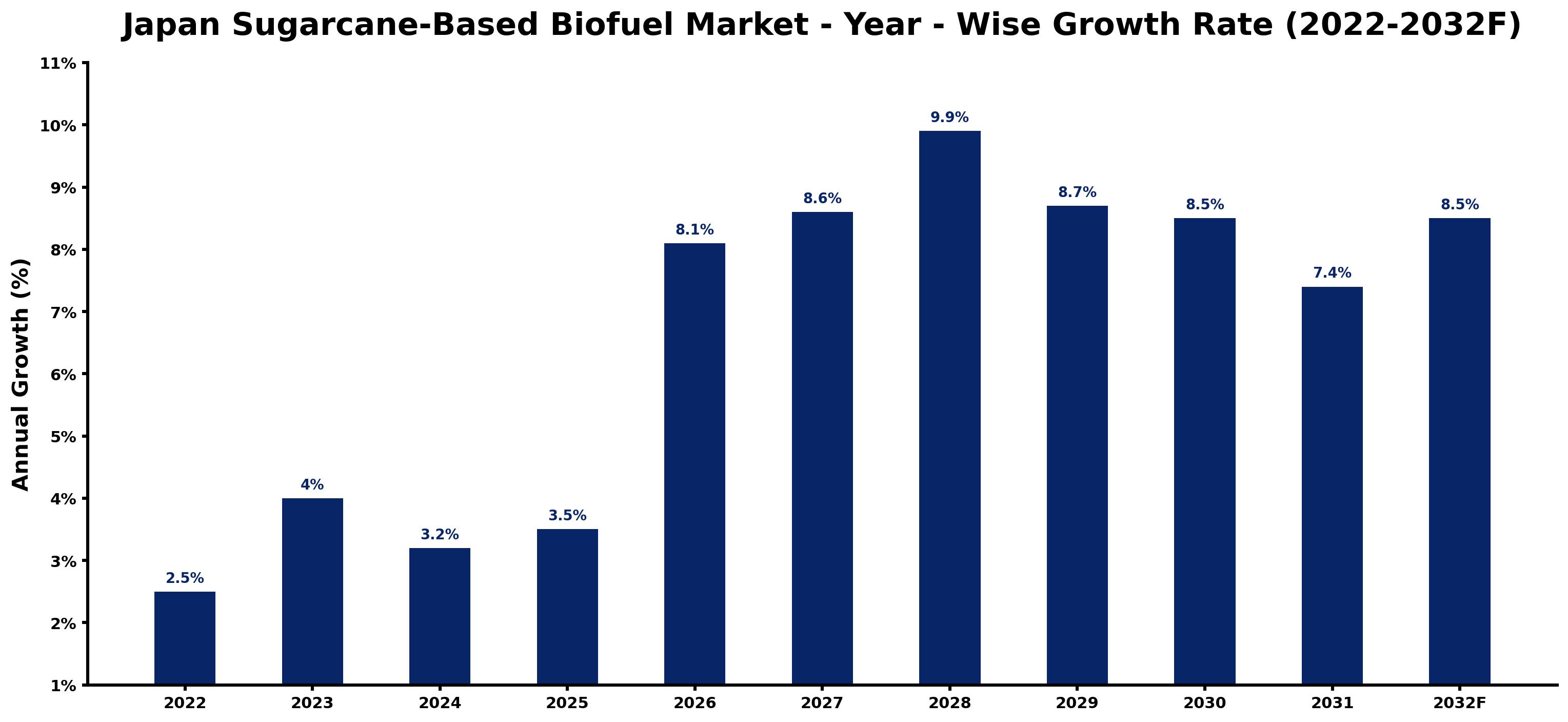
The yearly estimates that follow link every growth rate to its principal driver, so readers can see why the pace changed in each period.
| Year | Estimated Annual Growth (%) | Market Rationale |
| 2022 | 2.5 | The market showed steady demand from local users and imports. |
| 2023 | 4.0 | Demand for biofuels increased as blending rates rose in various regions. |
| 2024 | 3.2 | Growth slowed due to market adjustments and supply chain challenges. |
| 2025 | 3.5 | Increased production capacity and consumer awareness spurred market expansion. |
| 2026 | 8.1 | Demand is expected to surge as biofuel blending targets are raised. |
| 2027 | 8.6 | Rising environmental concerns will drive biofuel adoption in transportation. |
| 2028 | 9.9 | The market is projected to peak as new blending standards are introduced. |
| 2029 | 8.7 | Growth will slow as the market stabilises after rapid expansion. |
| 2030 | 8.5 | Demand is expected to continue rising, supported by initiatives for renewable energy. |
| 2031 | 7.4 | Growth will moderate as the market adjusts to new supply levels. |
| 2032 | 8.5 | Increased biofuel usage is expected as infrastructure improves. |
Note: Market size estimations and growth projections presented in this report are based on 6Wresearch's proprietary forecasting methodology, utilizing the latest available industry data, government publications, and primary research inputs.
Japan Sugarcane-Based Biofuel Market Synopsis
Sugarcane-based biofuel serves as a renewable energy source derived from fermentation processes, primarily used in transportation fuel and power generation. The Japan Sugarcane-Based Biofuel Market is expanding, driven by rising blending rates, particularly in the Tokyo region, where demand reached approximately 1.5 million litres in 2022. Government initiatives aim to increase biofuel usage by 20% by 2025, stimulating market growth through infrastructure investments and consumer awareness.
Market Dynamics Impact Analysis (2026–2032)
| Factor | Type | Impact | Primary Segment Affected |
| Increased blending rates for ethanol in gasoline | Driver | High | Ethanol |
| Growing environmental awareness among consumers | Driver | High | Bioethanol |
| Rising demand for renewable energy sources | Opportunity | High | Transportation Fuel |
| Expansion of biofuel blending facilities | Opportunity | Medium | Fuel Blending Facilities |
| Limited production capacity for bioethanol | Restraint | High | Bioethanol |
| Competition from alternative fuels | Restraint | Medium | Transportation Fuel |
| Supply chain disruptions affecting production | Challenge | High | Ethanol |
| High initial investment for production facilities | Challenge | Medium | Bioethanol |
Evaluation of Drivers in Japan Sugarcane-Based Biofuel Market (2026–2032)
These are the developments adding the most demand over the forecast period.
| Drivers | Primary Segment Affected | Why It Matters (Evidence) |
| Rising blending rates for ethanol in gasoline | Ethanol | Ethanol is blended at a rate of 10% in many regions, increasing demand from fuel blending facilities. |
| Growing environmental awareness among consumers | Bioethanol | With Japan targeting a 46% cut in greenhouse-gas emissions by 2030, consumers are opting for greener fuel alternatives. |
| Increased production capacity for biofuels | Transportation Fuel | Japan's biofuel production reached approximately 1.5 million liters in 2022, meeting increasing needs. |
| Government initiatives promoting renewable energy | Fuel Blending Facilities | The Hydrogen Society Promotion Act encourages the use of biofuels, leading to more investments in blending facilities. |
| Technological advancements in fermentation processes | Bioethanol | Emerging fermentation methods are improving production efficiency and lowering costs. |
Purchasing is picking up as Japan produced approximately 1.5 million litres of bioethanol in 2022, reflecting a growing preference for renewable energy sources. The aim for a 20% increase in biofuel usage by 2025 prompts fuel blending facilities to invest in infrastructure. Environmental awareness supports the shift towards bioethanol, with Japan targeting a 46% reduction in greenhouse gas emissions by 2030. Recent advancements in fermentation processes are also improving production capacity, further boosting market growth.
Evaluation of Restraints in Japan Sugarcane-Based Biofuel Market
The following restraints limit how fast demand can grow.
| Market Restraint | Primary Segment Affected | Why It Matters (Evidence) |
| Limited production capacity for bioethanol | Bioethanol | Japan's production capacity remains constrained, affecting supply to meet increasing needs. |
| Competition from alternative fuels | Transportation Fuel | The availability of cheaper fossil fuels poses a challenge to biofuel adoption. |
| Supply chain disruptions affecting production | Ethanol | Recent global supply chain issues have delayed biofuel production timelines. |
| High initial investment for production facilities | Bioethanol | The cost of establishing biofuel production facilities can be prohibitive for new entrants. |
| Regulatory compliance costs for biofuel producers | Ethanol | Producers must adhere to strict environmental standards, increasing operational costs. |
Japan Sugarcane-Based Biofuel Market Challenges
Japan's average annual consumption of biofuels is around 300 million litres, but competition from alternative renewable sources drives up prices for buyers. This competition arises because government incentives support various energy solutions, forcing producers to adjust pricing strategies. Many suppliers struggle with outdated technology, which hampers production efficiency and leads to delays in meeting demand. Rising raw material costs create budget pressures for hospitals, compelling them to reconsider their energy expenditures. A shortage of skilled workers in the biofuel sector limits innovation, causing producers to lag in market development.
Trends in the Japan Sugarcane-Based Biofuel Market
Buyers and suppliers in the Japan Sugarcane-Based Biofuel Market are adjusting to the following trends.
- Tokyo Region Embracing Bioethanol: The Tokyo region is experiencing a shift towards bioethanol as a primary transportation fuel, with demand increasing. In 2022, ethanol blending rates reached 10%, reflecting this trend.
- Transition from Conventional Fuels to Biofuels: Japan is transitioning from conventional fuels to biofuels, supported by environmental policies. The Hydrogen Society Promotion Act aims for a 20% increase in biofuel usage by 2025.
- Fuel Blending Facilities Expanding: Fuel blending facilities are expanding across Japan, responding to increased biofuel demand. The government allocated ¥2 billion for renewable energy projects in 2023.
- Rural Energy Providers Adopting Biofuels: Rural energy providers are increasingly adopting biofuels for local energy solutions, with biofuel consumption averaging around 300 million litres annually.
Investment Opportunities in the Japan Sugarcane-Based Biofuel Market
The following areas offer the clearest openings for investors and suppliers in the Japan Sugarcane-Based Biofuel Market.
- Increased Demand for Bioethanol: With Japan targeting a 20% increase in biofuel usage by 2025, there is a gap in supply. Fuel blending facilities can invest in production capacity to meet this demand.
- Investment in Advanced Fermentation Technologies: The rise of advanced fermentation technologies presents an opportunity for growth. Biofuel distributors can partner with technology providers to improve production efficiency.
- Government Commitment to Biofuel Infrastructure: The government’s commitment to renewable energy creates a timely opportunity for investment in biofuel infrastructure, particularly in blending facilities across the Tokyo region.
- Collaboration with Rural Energy Providers: Rural energy providers are increasingly adopting biofuels, creating opportunities for partnerships to supply biofuel products in local markets.
Government Initiatives in the Japan Sugarcane-Based Biofuel Market
The Hydrogen Society Promotion Act, enacted in 2024, supports low-carbon hydrogen and ammonia supply chains, indirectly benefiting biofuel producers by creating a more sustainable energy environment. The Renewable Energy Act, established in 2011, encourages biofuel production and usage, aiming for a 20% increase in biofuel consumption by 2025.
Fuel blending facilities benefit from government funding through initiatives like the ¥2 billion allocated for renewable energy projects in 2023. These funds support the development of biofuel infrastructure, enabling blending facilities to meet rising consumer demand for greener fuel alternatives.
Future Insight of the Japan Sugarcane-Based Biofuel Market
New biofuel blending facilities will emerge by 2032, driven by government initiatives to enhance renewable energy production. Aiming for a 46% reduction in greenhouse gas emissions by fiscal 2030 will encourage suppliers to adopt advanced technologies. As rural energy providers increasingly utilise biofuels, buyers will experience improved access to sustainable energy solutions. Japan's commitment to net zero emissions by 2050 will further stimulate advancements in biofuel production and usage.
Market Segmentation Analysis
Japan Sugarcane-Based Biofuel Market report covers a detailed analysis of the following market segments:
By Fuel Type – Ethanol Leads, Bioethanol Expected to Grow Fastest
According to Saurav Kr Singh, Senior Research Analyst at 6Wresearch, in 2025, Ethanol led the fuel type split with a 48% share. Ethanol holds the largest share as it is commonly used in transportation fuel blends across Japan. The established blending rate of 10% with gasoline in many regions illustrates its critical role in meeting energy needs. Bioethanol is projected to grow fastest, at a CAGR of 12.2% during 2026–2032. Bioethanol is poised for rapid growth as production reached approximately 1.5 million litres in 2022, with increasing focus on sugarcane as a source. The government's target to boost biofuel usage by 20% by 2025 will further accelerate this segment's expansion. Suppliers must enhance bioethanol production capabilities to align with the anticipated surge in demand.
By Processing Method – Fermentation Leads, Advanced Fermentation Expected to Grow Fastest
Fermentation accounted for 41% of the market by processing method in 2025. Fermentation is the leading method for ethanol production, establishing itself as the dominant processing technique in Japan's biofuel sector. Its efficiency and established practices contribute to its substantial market presence. Over 2026–2032, Advanced Fermentation is expected to post the fastest growth, at a CAGR of 12.1%. Advanced Fermentation, although currently a minor technology, is projected to grow as innovations in biofuel production are pursued. This aligns with Japan's environmental objectives, ensuring its future relevance and potential market share. Investing in advanced fermentation technologies could provide suppliers with a competitive advantage.
By Use Case – Transportation Fuel Leads, Power Generation Expected to Grow Fastest
The largest use case category in 2025 was Transportation Fuel, at 40% of revenue. Transportation Fuel is the leading application of biofuels, driven by the high demand for renewable energy sources in the automotive sector. The average annual consumption of around 300 million litres highlights its significance in Japan's energy landscape. Power Generation is set to record the highest CAGR in this split, 11.5% over 2026–2032. Power Generation is experiencing rapid growth as rural energy providers adopt biofuels for local energy solutions. This trend aligns with Japan's commitment to reducing greenhouse gas emissions, indicating strong potential for expansion in this area. Buyers in the power generation sector should consider integrating biofuels to enhance sustainability efforts.
By End User – Fuel Blending Facilities Lead, Biofuel Distributors Expected to Grow Fastest
With 37% of end user revenue in 2025, Fuel Blending Facilities was the largest category. Fuel Blending Facilities are key end-users for biofuels, facilitating the integration of these fuels into the existing supply chain. Their established infrastructure is essential for the widespread adoption of ethanol in transportation applications. The quickest growth will come from Biofuel Distributors, forecast to expand at a CAGR of 11.3% between 2026 and 2032. Biofuel Distributors are projected to grow rapidly due to their crucial role in market distribution and the increasing demand for biofuels. Their expansion will be vital in achieving the government's biofuel usage targets by 2025. Suppliers should strengthen partnerships with biofuel distributors to enhance market access and distribution efficiency.
Key Attractiveness of the Report
- 10 Years of Market Numbers
- Historical Data Starting from 2022 to 2025
- Base Year 2025
- Forecast Data until 2032
- Key Performance Indicators Impacting the Market
- Major Upcoming Developments and Projects
Key Highlights of the Report:
- Japan Sugarcane-Based Biofuel Market Outlook
- Market Size of Japan Sugarcane-Based Biofuel Market, 2025
- Forecast of Japan Sugarcane-Based Biofuel Market, 2032
- Historical Data and Forecast of Japan Sugarcane-Based Biofuel Revenues & Volume for the Period 2022-2032F
- Japan Sugarcane-Based Biofuel Market Trend Evolution
- Japan Sugarcane-Based Biofuel Market Drivers and Challenges
- Japan Sugarcane-Based Biofuel Price Trends
- Japan Sugarcane-Based Biofuel Porter's Five Forces
- Japan Sugarcane-Based Biofuel Industry Life Cycle
- Historical Data and Forecast of Japan Sugarcane-Based Biofuel Market Revenues & Volume By Fuel Type for the Period 2022-2032F
- Historical Data and Forecast of Japan Sugarcane-Based Biofuel Market Revenues & Volume By Ethanol for the Period 2022-2032F
- Historical Data and Forecast of Japan Sugarcane-Based Biofuel Market Revenues & Volume By Biogas for the Period 2022-2032F
- Historical Data and Forecast of Japan Sugarcane-Based Biofuel Market Revenues & Volume By Butanol for the Period 2022-2032F
- Historical Data and Forecast of Japan Sugarcane-Based Biofuel Market Revenues & Volume By Bioethanol for the Period 2022-2032F
- Historical Data and Forecast of Japan Sugarcane-Based Biofuel Market Revenues & Volume By Processing Method for the Period 2022-2032F
- Historical Data and Forecast of Japan Sugarcane-Based Biofuel Market Revenues & Volume By Fermentation for the Period 2022-2032F
- Historical Data and Forecast of Japan Sugarcane-Based Biofuel Market Revenues & Volume By Anaerobic Digestion for the Period 2022-2032F
- Historical Data and Forecast of Japan Sugarcane-Based Biofuel Market Revenues & Volume By Advanced Fermentation for the Period 2022-2032F
- Historical Data and Forecast of Japan Sugarcane-Based Biofuel Market Revenues & Volume By Molasses Conversion for the Period 2022-2032F
- Historical Data and Forecast of Japan Sugarcane-Based Biofuel Market Revenues & Volume By Use Case for the Period 2022-2032F
- Historical Data and Forecast of Japan Sugarcane-Based Biofuel Market Revenues & Volume By Transportation Fuel for the Period 2022-2032F
- Historical Data and Forecast of Japan Sugarcane-Based Biofuel Market Revenues & Volume By Power Generation for the Period 2022-2032F
- Historical Data and Forecast of Japan Sugarcane-Based Biofuel Market Revenues & Volume By Industrial Solvents for the Period 2022-2032F
- Historical Data and Forecast of Japan Sugarcane-Based Biofuel Market Revenues & Volume By Vehicle Fuel for the Period 2022-2032F
- Historical Data and Forecast of Japan Sugarcane-Based Biofuel Market Revenues & Volume By End User for the Period 2022-2032F
- Historical Data and Forecast of Japan Sugarcane-Based Biofuel Market Revenues & Volume By Fuel Blending Facilities for the Period 2022-2032F
- Historical Data and Forecast of Japan Sugarcane-Based Biofuel Market Revenues & Volume By Rural Energy Providers for the Period 2022-2032F
- Historical Data and Forecast of Japan Sugarcane-Based Biofuel Market Revenues & Volume By Chemical Manufacturers for the Period 2022-2032F
- Historical Data and Forecast of Japan Sugarcane-Based Biofuel Market Revenues & Volume By Biofuel Distributors for the Period 2022-2032F
- Japan Sugarcane-Based Biofuel Import Export Trade Statistics
- Market Opportunity Assessment By Fuel Type
- Market Opportunity Assessment By Processing Method
- Market Opportunity Assessment By Use Case
- Market Opportunity Assessment By End User
- Japan Sugarcane-Based Biofuel Top Companies Market Share
- Japan Sugarcane-Based Biofuel Competitive Benchmarking By Technical and Operational Parameters
- Japan Sugarcane-Based Biofuel Company Profiles
- Japan Sugarcane-Based Biofuel Key Strategic Recommendations
Market Covered
Coverage by segment is as follows.
By Fuel Type
- Ethanol
- Biogas
- Butanol
- Bioethanol
By Processing Method
- Fermentation
- Anaerobic Digestion
- Advanced Fermentation
- Molasses Conversion
By Use Case
- Transportation Fuel
- Power Generation
- Industrial Solvents
- Vehicle Fuel
By End User
- Fuel Blending Facilities
- Rural Energy Providers
- Chemical Manufacturers
- Biofuel Distributors































