Japan Sugarcane-Based Fuel Market Size & Growth Rate
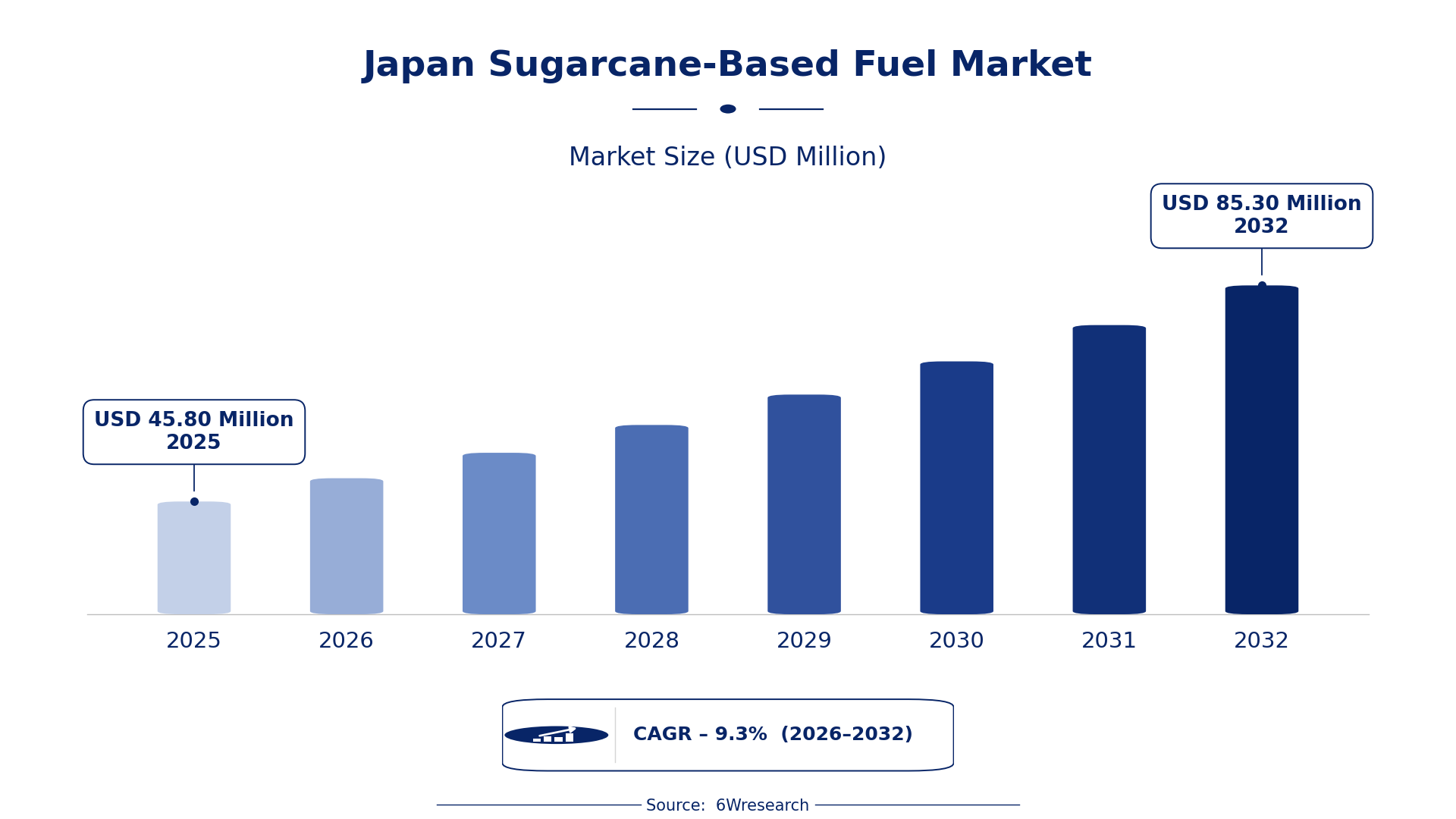
According to 6Wresearch internal database and industry insights, the Japan Sugarcane-Based Fuel Market was valued at USD 45.80 Million in 2025 and is projected to reach USD 85.30 Million by 2032, growing at a CAGR of approximately 9.3% during 2026–2032.
Japan Sugarcane-Based Fuel Market Highlights
| Report Metric | Details |
| Report Name | Japan Sugarcane-Based Fuel Market (2026-2032) |
| Market Size 2025 | USD 45.80 Million |
| Market Size 2032 | USD 85.30 Million |
| Absolute Growth 2025–2032 | USD 39.50 Million |
| CAGR 2026–2032 | 9.3% |
| Peak Annual Growth | 10.2% in 2027 |
| Forecast Period | 2026–2032 |
| Historical Data | 2022–2025 |
| Base Year | 2025 |
| Leading Fuel Type, 2025 | Anhydrous Ethanol (52% share) |
| Leading Feedstock Used, 2025 | Sugarcane Juice (44% share) |
| Leading Blending Ratio, 2025 | E10/E20 (44% share) |
| Leading End User, 2025 | Oil Marketing Companies (51% share) |
| Fastest-Growing Fuel Type | Hydrous Ethanol (13.2% CAGR) |
| Fastest-Growing Feedstock Used | Molasses (13.5% CAGR) |
| Fastest-Growing Blending Ratio | Direct Use (11.9% CAGR) |
| Fastest-Growing End User | Flex Fuel Vehicle Owners (11.7% CAGR) |
| Growing Sector | Transportation and Energy Generation |
| Key End Users | Oil Marketing Companies, Flex Fuel Vehicle Owners, Commercial Fleet Operators |
Japan Sugarcane-Based Fuel Market Year-wise Growth Rate and Key Drivers (2022–2032)
This graph illustrates the annual growth rates of the market from 2022 to 2032, highlighting a steady upward trajectory and projected market expansion over the forecast period.
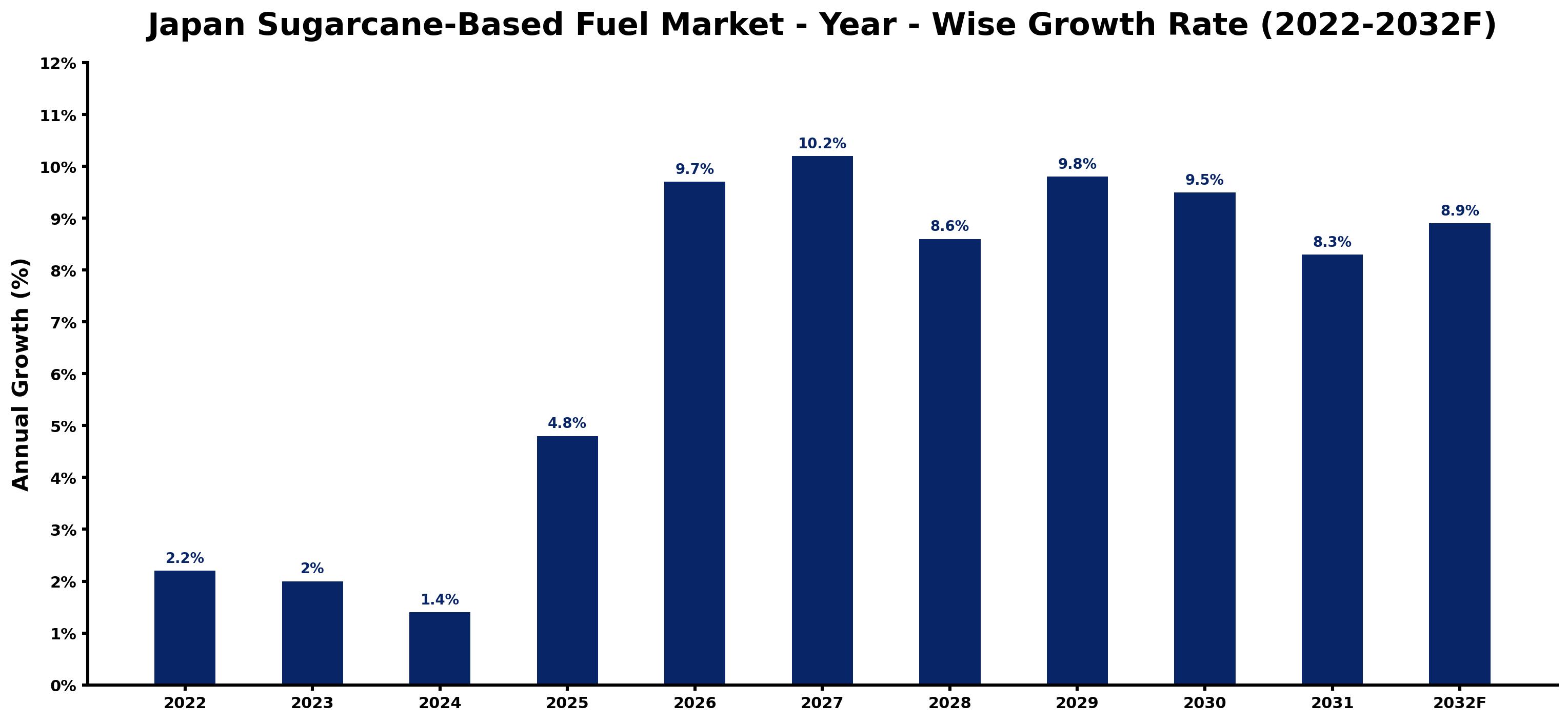
For each year, the table pairs the estimated growth rate with the leading influence on demand, showing how the drivers changed across the period.
| Year | Estimated Annual Growth (%) | Market Rationale |
| 2022 | 2.2 | The market experienced moderate growth, reflecting steady demand for biofuels. |
| 2023 | 2.0 | Growth slowed slightly due to market adjustments and supply chain factors. |
| 2024 | 1.4 | The market continued to grow, albeit at a slower pace, as blending requirements persisted. |
| 2025 | 4.8 | Growth accelerated as biofuel blending targets approached, stimulating production. |
| 2026 | 9.7 | Demand is expected to surge as investment in biofuel infrastructure increases. |
| 2027 | 10.2 | The market is projected to peak with heightened adoption of biofuels across transportation sectors. |
| 2028 | 8.6 | Growth will slow as market saturation begins to affect new investments. |
| 2029 | 9.8 | Demand is expected to pick up again due to rising biofuel consumption in commercial fleets. |
| 2030 | 9.5 | The growth rate will decrease slightly as the market stabilises after rapid expansion. |
| 2031 | 8.3 | A further slowdown is projected as production capacities reach their limits. |
| 2032 | 8.9 | Growth is expected to resume as new technologies and blending standards emerge. |
Note: Market size estimations and growth projections presented in this report are based on 6Wresearch's proprietary forecasting methodology, utilizing the latest available industry data, government publications, and primary research inputs.
Japan Sugarcane-Based Fuel Market Synopsis
Sugarcane-based fuel is a biofuel derived from sugarcane, produced through fermentation and distillation processes. It primarily serves transportation and energy generation needs, supporting renewable energy goals. The Japan Sugarcane-Based Fuel Market is expanding due to increasing domestic demand, government initiatives targeting a 10% biofuel blending by 2025, and investments in production infrastructure, particularly from oil marketing companies and commercial fleet operators. In 2023, the market was valued at approximately 200 billion yen, reflecting strong growth potential.
Market Dynamics Impact Analysis (2026–2032)
| Factor | Type | Impact | Primary Segment Affected |
| Government initiatives promoting biofuel blending requirements | Driver | High | E10/E20 |
| Rising consumer awareness of renewable energy sources | Driver | High | Flex Fuel Vehicle Owners |
| Investment in biofuel production infrastructure | Opportunity | High | Oil Marketing Companies |
| Growing demand for sustainable fuel alternatives | Opportunity | High | Commercial Fleet Operators |
| Limited infrastructure for Bio-CNG distribution | Restraint | Medium | Bio-CNG |
| High production costs of biofuels compared to fossil fuels | Restraint | Medium | Bio-Diesel |
| Competition from cheaper fossil fuels | Challenge | High | Hydrous Ethanol |
| Slow adoption of flex fuel vehicles in urban areas | Challenge | Medium | Flex Fuel Vehicle Owners |
Evaluation of Drivers in Japan Sugarcane-Based Fuel Market (2026–2032)
Demand rests on the following drivers, each shown with the segment it touches most.
| Drivers | Primary Segment Affected | Why It Matters (Evidence) |
| Government biofuel blending targets | E10/E20 | Japan's target of 10% biofuel blending by 2025 encourages higher production and sales, driving demand for E10 and E20 blends. |
| Increased investment in biofuel production facilities | Oil Marketing Companies | Investment in production infrastructure supports greater availability of biofuels for consumers, improving market access. |
| Growing consumer preference for renewable energy sources | Flex Fuel Vehicle Owners | Rising awareness of environmental issues drives demand for alternative fuels, resulting in increased biofuel consumption. |
| Expansion of public transport biofuel initiatives | Commercial Fleet Operators | Programs in urban areas promote biofuel use in public transport, boosting demand among fleet operators. |
| Technological advancements in biofuel production | Hydrous Ethanol | Improvements in fermentation processes increase production efficiency, leading to a more competitive supply. |
What keeps demand rising is the increasing biofuel consumption in Japan, projected to reach 1.2 million tons by 2025. This surge is driven by the growing adoption of biofuels in commercial fleets, which has risen by 20% since 2020, as fleet operators seek sustainable alternatives. The Tokyo region, with the highest demand for biofuels, reflects a shift towards greener transportation solutions. Furthermore, the average cost of biofuel production is around 150 yen per liter, influencing pricing strategies for buyers. With the establishment of the Japanese Biofuels Association, the market is witnessing enhanced promotion of sustainable practices, leading to increased buyer confidence.
Evaluation of Restraints in Japan Sugarcane-Based Fuel Market
The table below lists the restraints and the evidence behind each.
| Market Restraint | Primary Segment Affected | Why It Matters (Evidence) |
| Limited infrastructure for Bio-CNG distribution | Bio-CNG | The restricted availability of Bio-CNG facilities in urban areas hampers widespread adoption, with only a few locations offering such services. |
| High production costs of biofuels compared to fossil fuels | Bio-Diesel | The average cost of biofuel production at around 150 yen per liter makes it less competitive against cheaper fossil fuel alternatives. |
| Regulatory hurdles in biofuel certification processes | Hydrous Ethanol | Complex certification requirements can delay market entry for new biofuel products, impacting availability for consumers. |
| Competition from cheaper fossil fuels | Anhydrous Ethanol | Lower prices of fossil fuels can deter consumers from switching to biofuels, affecting overall market growth. |
| Slow adoption of flex fuel vehicles in urban areas | Flex Fuel Vehicle Owners | Limited consumer awareness and infrastructure restrict the growth of flex fuel vehicle usage, hindering market expansion. |
Japan Sugarcane-Based Fuel Market Challenges
Japan's sugarcane-based fuel market faces stringent regulations, with the JIS K 2201 standard imposing high compliance costs that burden buyers and delay product availability. Supply chain disruptions stem from the country importing 30% of its feedstock, leading to potential shortages for producers and extended lead times. The average production cost of 150 yen per liter pressures suppliers, limiting price competitiveness for buyers and affecting their purchasing decisions. Competition from electric vehicles intensifies, threatening to divert investment from biofuels and impacting long-term growth for producers as demand shifts.
Trends in the Japan Sugarcane-Based Fuel Market
Below are the shifts with the largest effect on the Japan Sugarcane-Based Fuel Market.
- Shift from Traditional Fuels to Biofuels: Since 2023, Japan has seen a transition towards biofuels as public transport initiatives gain traction. The Tokyo Metropolitan Government promotes biofuel use, increasing demand in urban areas, with consumption rising by 20%.
- Emergence of Updated Biofuel Standards: In 2023, the JIS K 2201 standard was revised to improve biofuel quality. This change ensures better performance and safety, encouraging more consumers to adopt biofuels, with a projected increase in market share.
- Increase in Biofuel Research Funding: In 2023, the government allocated 5 billion yen for biofuel research and development. This funding aims to improve production technologies and expand the biofuel market, driving innovation and efficiency.
- Growing Public Awareness of Renewable Energy: The rise in public awareness about climate change has led to increased interest in renewable energy. This trend is reflected in the 20% increase in biofuel consumption in commercial fleets since 2020.
Investment Opportunities in the Japan Sugarcane-Based Fuel Market
The following opportunities in the Japan Sugarcane-Based Fuel Market pair current demand with a clear way in.
- Oil Marketing Companies Seeking Sustainable Solutions: Oil marketing companies are increasingly looking for sustainable fuel alternatives, with Japan's biofuel market valued at approximately 200 billion yen in 2023. Collaborating with local producers can improve their offerings.
- Flex Fuel Vehicle Owners Needing More Fuel Options: With around 500,000 flex fuel vehicles in Japan, there is a significant gap in fuel options. Investing in biofuel production can effectively meet this demand, creating new market opportunities.
- Urban Areas Promoting Biofuel Use: Cities like Osaka are initiating programs to increase biofuel usage in public transport. Suppliers can enter through partnerships with local authorities to expand their reach and influence.
- Government Support for Biofuel Production: The Japanese government has set ambitious biofuel blending targets, creating opportunities for investment in production facilities. Local partnerships can facilitate market entry and compliance with regulations.
Government Initiatives in the Japan Sugarcane-Based Fuel Market
The Hydrogen Society Promotion Act, adopted in 2024, supports low-carbon hydrogen and ammonia supply chains by providing price-gap support. This act complements existing laws by making it easier for biofuel producers to compete with traditional fuels and improves market viability for sugarcane-based fuel. The GX Basic Policy, adopted in 2023, aims for approximately 150 trillion yen of public-private decarbonisation investment over the next decade, further enhancing the biofuel sector.
The Ministry of the Environment administers subsidy programs for biofuel production, benefiting oil marketing companies. In 2023, these subsidies aimed to boost local production and encourage the adoption of biofuels in transportation, supporting the growth of the sugarcane-based fuel market. The Ministry of Agriculture, Forestry and Fisheries also supports sugarcane cultivation, ensuring a steady supply for biofuel production.
Future Insight of the Japan Sugarcane-Based Fuel Market
Advancements in fermentation technology will transform sugarcane-based fuel production, enhancing efficiency and lowering costs for suppliers. By 2032, the biofuel blending target will drive demand, with consumption projected to reach 1.2 million tons. The government's 5 billion yen investment in research and development will spur innovation in fuel applications. Urban initiatives, especially in Osaka, will expand biofuel use in public transport, improving accessibility and consumption for buyers.
Market Segmentation Analysis
Japan Sugarcane-Based Fuel Market report covers a detailed analysis of the following market segments:
By Fuel Type – Anhydrous Ethanol Leads, Hydrous Ethanol Expected to Grow Fastest
According to Saurav Kr Singh, Senior Research Analyst at 6Wresearch, in 2025, Anhydrous Ethanol led the fuel type split with a 52% share. Anhydrous Ethanol holds the largest market share due to its widespread use as a fuel additive that significantly reduces emissions in transportation. The government's target of achieving a 10% biofuel blending ratio by 2025 reinforces its critical role in meeting sustainability goals. The quickest growth will come from Hydrous Ethanol, forecast to expand at a CAGR of 13.2% between 2026 and 2032. Hydrous Ethanol is experiencing rapid growth as a renewable fuel alternative, driven by increasing consumer demand for sustainable energy options. The launch of government subsidies for biofuel production is expected to further boost its adoption in the market. Suppliers must focus on scaling up production of hydrous ethanol to meet the surging demand in the market.
By Feedstock Used – Sugarcane Juice Leads, Molasses Expected to Grow Fastest
Sugarcane Juice took 44% of feedstock used revenue in 2025, more than any other category. Sugarcane Juice is the leading feedstock as it serves as a primary raw material for ethanol production, aligning with Japan's renewable energy goals. The support from the Ministry of Agriculture, Forestry and Fisheries for sugarcane cultivation further strengthens its market position. Over 2026–2032, Molasses are expected to post the fastest growth, at a CAGR of 13.5%. Molasses is the fastest-growing feedstock, primarily due to its effective use in fermentation processes for ethanol production. This growth is supported by the increasing production of ethanol from various sources to meet blending targets. Buyers should consider diversifying their feedstock sources to ensure a stable supply of ethanol.
By Blending Ratio – E10/E20 Leads, Direct Use Expected to Grow Fastest
With 44% of blending ratio revenue in 2025, E10/E20 was the largest category. E10/E20 stands out as the leading blending ratio for gasoline, reflecting its prevalent use in the market. The average blending ratio of E10 indicates a strong integration of biofuels within Japan's fuel infrastructure, ensuring consistent demand. Direct Use is projected to grow fastest, at a CAGR of 11.9% during 2026–2032. Direct Use is rapidly gaining popularity as a preferred choice for flex fuel vehicles, which are increasingly embraced by consumers. This trend is likely to intensify as the number of flex fuel vehicles rises, positively impacting market growth. Suppliers must adjust their strategies to cater to the increasing demand for direct use options in flex fuel vehicles.
By End User – Oil Marketing Companies Lead, Flex Fuel Vehicle Owners Expected to Grow Fastest
Oil Marketing Companies accounted for 51% of the market by end user in 2025. Oil Marketing Companies dominate the market as key distributors of biofuels, ensuring their availability across various regions in Japan. Their established infrastructure and distribution networks facilitate the efficient delivery of biofuels to a wide range of consumers. Flex Fuel Vehicle Owners are set to record the highest CAGR in this split, 11.7% over 2026–2032. Flex Fuel Vehicle Owners represent the fastest-growing user segment, motivated by a growing recognition of the benefits of alternative fuels. The increase in the number of flex fuel vehicles, which reached approximately 500,000 in 2023, is a strong indicator of this trend. Suppliers should engage flex fuel vehicle owners to tailor their products and enhance market reach.
Key Attractiveness of the Report
- 10 Years of Market Numbers
- Historical Data Starting from 2022 to 2025
- Base Year 2025
- Forecast Data until 2032
- Key Performance Indicators Impacting the Market
- Major Upcoming Developments and Projects
Key Highlights of the Report:
- Japan Sugarcane-Based Fuel Market Outlook
- Market Size of Japan Sugarcane-Based Fuel Market, 2025
- Forecast of Japan Sugarcane-Based Fuel Market, 2032
- Historical Data and Forecast of Japan Sugarcane-Based Fuel Revenues & Volume for the Period 2022-2032F
- Japan Sugarcane-Based Fuel Market Trend Evolution
- Japan Sugarcane-Based Fuel Market Drivers and Challenges
- Japan Sugarcane-Based Fuel Price Trends
- Japan Sugarcane-Based Fuel Porter's Five Forces
- Japan Sugarcane-Based Fuel Industry Life Cycle
- Historical Data and Forecast of Japan Sugarcane-Based Fuel Market Revenues & Volume By Fuel Type for the Period 2022-2032F
- Historical Data and Forecast of Japan Sugarcane-Based Fuel Market Revenues & Volume By Anhydrous Ethanol for the Period 2022-2032F
- Historical Data and Forecast of Japan Sugarcane-Based Fuel Market Revenues & Volume By Hydrous Ethanol for the Period 2022-2032F
- Historical Data and Forecast of Japan Sugarcane-Based Fuel Market Revenues & Volume By Bio-CNG for the Period 2022-2032F
- Historical Data and Forecast of Japan Sugarcane-Based Fuel Market Revenues & Volume By Bio-Diesel for the Period 2022-2032F
- Historical Data and Forecast of Japan Sugarcane-Based Fuel Market Revenues & Volume By Feedstock Used for the Period 2022-2032F
- Historical Data and Forecast of Japan Sugarcane-Based Fuel Market Revenues & Volume By Sugarcane Juice for the Period 2022-2032F
- Historical Data and Forecast of Japan Sugarcane-Based Fuel Market Revenues & Volume By Molasses for the Period 2022-2032F
- Historical Data and Forecast of Japan Sugarcane-Based Fuel Market Revenues & Volume By Bagasse + Organic Waste for the Period 2022-2032F
- Historical Data and Forecast of Japan Sugarcane-Based Fuel Market Revenues & Volume By Residue Oils for the Period 2022-2032F
- Historical Data and Forecast of Japan Sugarcane-Based Fuel Market Revenues & Volume By Blending Ratio for the Period 2022-2032F
- Historical Data and Forecast of Japan Sugarcane-Based Fuel Market Revenues & Volume By E10/E20 for the Period 2022-2032F
- Historical Data and Forecast of Japan Sugarcane-Based Fuel Market Revenues & Volume By Direct Use for the Period 2022-2032F
- Historical Data and Forecast of Japan Sugarcane-Based Fuel Market Revenues & Volume By Natural Gas Alternative for the Period 2022-2032F
- Historical Data and Forecast of Japan Sugarcane-Based Fuel Market Revenues & Volume By Diesel Replacement for the Period 2022-2032F
- Historical Data and Forecast of Japan Sugarcane-Based Fuel Market Revenues & Volume By End User for the Period 2022-2032F
- Historical Data and Forecast of Japan Sugarcane-Based Fuel Market Revenues & Volume By Oil Marketing Companies for the Period 2022-2032F
- Historical Data and Forecast of Japan Sugarcane-Based Fuel Market Revenues & Volume By Flex Fuel Vehicle Owners for the Period 2022-2032F
- Historical Data and Forecast of Japan Sugarcane-Based Fuel Market Revenues & Volume By City Gas Providers for the Period 2022-2032F
- Historical Data and Forecast of Japan Sugarcane-Based Fuel Market Revenues & Volume By Commercial Fleet Operators for the Period 2022-2032F
- Japan Sugarcane-Based Fuel Import Export Trade Statistics
- Market Opportunity Assessment By Fuel Type
- Market Opportunity Assessment By Feedstock Used
- Market Opportunity Assessment By Blending Ratio
- Market Opportunity Assessment By End User
- Japan Sugarcane-Based Fuel Top Companies Market Share
- Japan Sugarcane-Based Fuel Competitive Benchmarking By Technical and Operational Parameters
- Japan Sugarcane-Based Fuel Company Profiles
- Japan Sugarcane-Based Fuel Key Strategic Recommendations
Market Covered
Coverage by segment is as follows.
By Fuel Type
- Anhydrous Ethanol
- Hydrous Ethanol
- Bio-CNG
- Bio-Diesel
By Feedstock Used
- Sugarcane Juice
- Molasses
- Bagasse + Organic Waste
- Residue Oils
By Blending Ratio
- E10/E20
- Direct Use
- Natural Gas Alternative
- Diesel Replacement
By End User
- Oil Marketing Companies
- Flex Fuel Vehicle Owners
- City Gas Providers
- Commercial Fleet Operators































