Japan Sugarcane Byproducts Market Size & Growth Rate
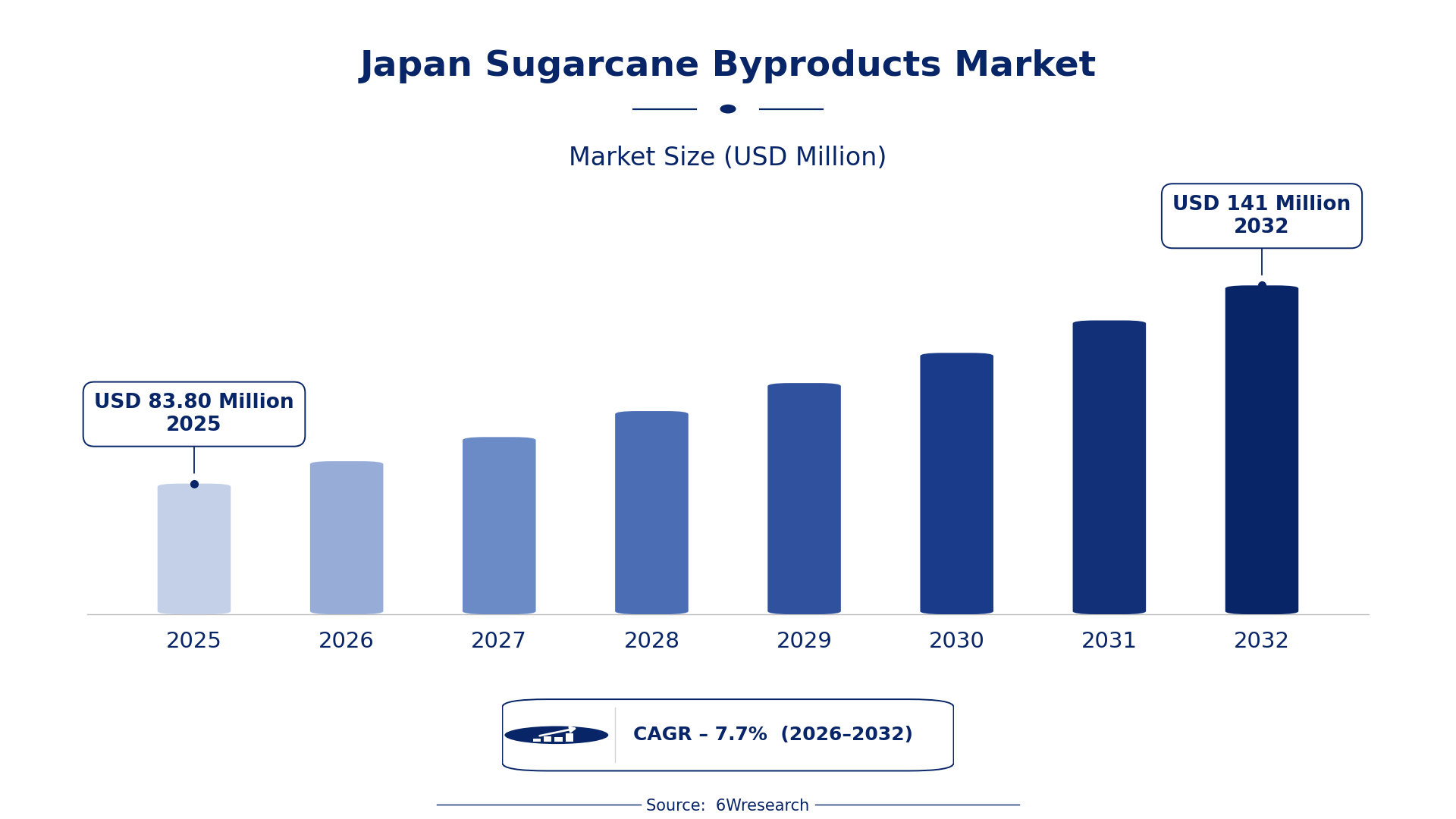
According to 6Wresearch internal database and industry insights, the Japan Sugarcane Byproducts Market was valued at USD 83.80 Million in 2025 and is projected to reach USD 141 Million by 2032, growing at a CAGR of approximately 7.7% during 2026–2032.
Japan Sugarcane Byproducts Market Highlights
| Report Metric | Details |
| Report Name | Japan Sugarcane Byproducts Market (2026-2032) |
| Market Size 2025 | USD 83.80 Million |
| Market Size 2032 | USD 141 Million |
| Absolute Growth 2025–2032 | USD 57.20 Million |
| CAGR 2026–2032 | 7.7% |
| Peak Annual Growth | 10.0% in 2032 |
| Forecast Period | 2026–2032 |
| Historical Data | 2022–2025 |
| Base Year | 2025 |
| Leading Byproduct Type, 2025 | Bagasse (44% share) |
| Leading Derivative Product, 2025 | Paper Pulp (45% share) |
| Leading Industry Application, 2025 | Packaging Industry (50% share) |
| Leading End User, 2025 | Eco Packaging Firms (40% share) |
| Fastest-Growing Byproduct Type | Molasses (10.9% CAGR) |
| Fastest-Growing Derivative Product | Industrial Alcohol (11.3% CAGR) |
| Fastest-Growing Industry Application | Chemical Industry (10.0% CAGR) |
| Fastest-Growing End User | Solvent Manufacturers (10.4% CAGR) |
| Growing Sector | Agriculture |
| Key End Users | Eco Packaging Firms, Organic Fertilizer Brands, Sugar Mills |
Japan Sugarcane Byproducts Market Year-wise Growth Rate and Key Drivers (2022–2032)
This graph illustrates the annual growth rates of the market from 2022 to 2032, highlighting a steady upward trajectory and projected market expansion over the forecast period.
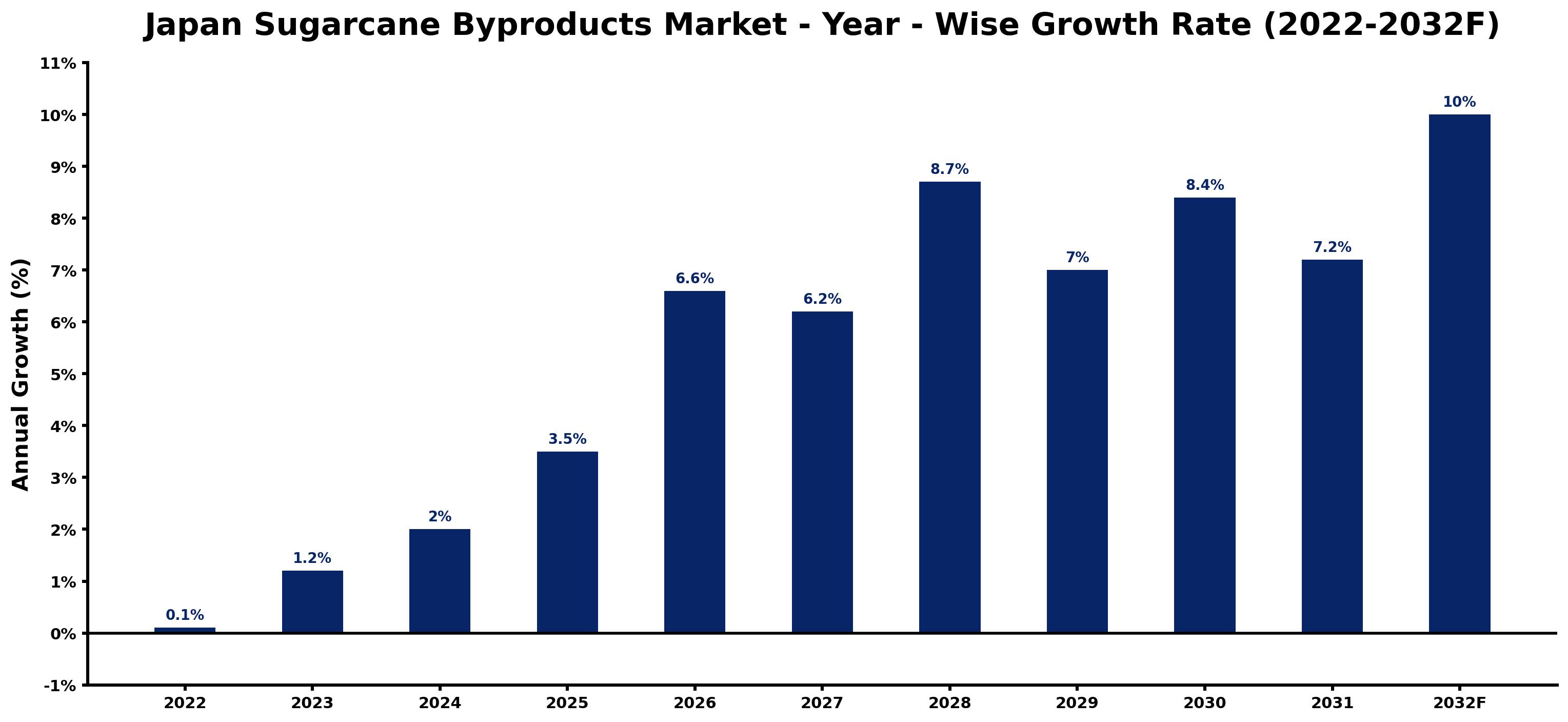
Annual growth estimates for each year appear below with the principal reason behind them, explaining the shifts that set the pace of the market.
| Year | Estimated Annual Growth (%) | Market Rationale |
| 2022 | 0.1 | The market experienced minimal growth due to stable demand from existing users. |
| 2023 | 1.2 | Demand increased as eco-friendly practices gained traction among packaging firms. |
| 2024 | 2.0 | The agricultural sector's need for organic fertilizers spurred further growth. |
| 2025 | 3.5 | Growth accelerated as sugarcane byproducts gained popularity in various industries. |
| 2026 | 6.6 | The introduction of new processing technologies is expected to enhance production efficiency. |
| 2027 | 6.2 | Growth is projected to slow slightly as market saturation begins to affect expansion rates. |
| 2028 | 8.7 | Increased focus on sustainable practices is expected to revitalise demand for byproducts. |
| 2029 | 7.0 | Growth is anticipated to slow as competition among suppliers intensifies in key sectors. |
| 2030 | 8.4 | Rising investments in bio-compost production will boost market activity. |
| 2031 | 7.2 | Demand is expected to stabilise as the market adjusts to new supply conditions. |
| 2032 | 10.0 | The peak growth rate reflects heightened interest in sustainable packaging solutions. |
Note: Market size estimations and growth projections presented in this report are based on 6Wresearch's proprietary forecasting methodology, utilizing the latest available industry data, government publications, and primary research inputs.
Japan Sugarcane Byproducts Market Synopsis
Sugarcane byproducts, which include materials such as bagasse, molasses, and vinasse, serve important functions in agriculture, chemical production, and eco-friendly packaging. The Japan Sugarcane Byproducts Market is expanding due to rising agricultural demand for organic fertilizers and the increasing use of sustainable materials by eco-packaging firms. Government initiatives promoting sustainable practices further stimulate market growth, with the Tokyo region emerging as a key hub for eco-packaging firms, supported by a budget of ¥500 million for agricultural innovation in 2023.
Market Dynamics Impact Analysis (2026–2032)
| Factor | Type | Impact | Primary Segment Affected |
| Increased demand for organic fertilizers from the agricultural sector | Driver | High | Fertilizer Additive |
| Growing interest in sustainable packaging solutions | Driver | High | Packaging Industry |
| Expansion of bio-compost production capabilities | Opportunity | High | Bio-compost |
| Rising investments in eco-friendly packaging technologies | Opportunity | High | Eco Packaging Firms |
| Limited awareness of byproduct applications in various industries | Restraint | Medium | Vinasse |
| Competition from alternative materials in packaging | Restraint | Medium | Packaging Industry |
| Supply chain disruptions affecting raw material availability | Challenge | High | Bagasse |
| Fluctuations in sugarcane production impacting byproduct supply | Challenge | High | Molasses |
Evaluation of Drivers in Japan Sugarcane Byproducts Market (2026–2032)
The factors lifting demand, and the evidence behind each, are summarised below.
| Drivers | Primary Segment Affected | Why It Matters (Evidence) |
| Rising agricultural demand for organic fertilizers | Fertilizer Additive | The agricultural sector requires approximately 300,000 tons of organic fertilizers annually, driving up demand for sugarcane byproducts. |
| Increased production of industrial alcohol from molasses | Industrial Alcohol | Japan's chemical industry consumes around 150,000 tons of molasses, boosting demand for byproducts used in alcohol production. |
| Growing eco-packaging sector in urban areas | Packaging Industry | The Tokyo region is a major hub for eco-packaging firms, increasing the need for sustainable materials derived from sugarcane. |
| Advancements in processing technologies for byproduct utilisation | Bio-compost | The Ministry of Agriculture, Forestry and Fisheries promotes bio-compost production, encouraging investment in processing facilities. |
| Demand for paper pulp from bagasse | Paper Pulp | Bagasse is used to produce approximately 200,000 tons of paper pulp annually, driving demand from the paper industry. |
Purchasing is picking up as agricultural demand for organic fertilizers rises, with the sector requiring about 300,000 tons annually. The chemical industry consumes around 150,000 tons of molasses for industrial alcohol production, further boosting demand. Urban eco-packaging firms are increasingly sourcing sustainable materials from sugarcane byproducts. The paper industry’s demand for bagasse supports the production of 200,000 tons of paper pulp annually, driving growth prospects.
Evaluation of Restraints in Japan Sugarcane Byproducts Market
The key brakes on demand, and where they bite hardest, are shown below.
| Market Restraint | Primary Segment Affected | Why It Matters (Evidence) |
| Limited awareness of sugarcane byproducts' applications | Vinasse | Many potential users are unaware of vinasse's benefits, leading to underutilisation in agriculture. |
| Competition from alternative materials in packaging | Packaging Industry | Eco-packaging firms face pressure from alternatives like plastics, which may limit byproduct demand. |
| Supply chain disruptions affecting raw material availability | Bagasse | Disruptions in sugarcane supply chains can lead to shortages of bagasse for processing. |
| Fluctuations in sugarcane production impacting byproduct supply | Molasses | Variability in sugarcane yields directly affects the availability of molasses for industrial use. |
| Regulatory challenges in byproduct processing | Bio-compost | Complex regulations can hinder the establishment of new bio-compost facilities. |
Japan Sugarcane Byproducts Market Challenges
Japan's sugarcane byproducts market faces a supply challenge due to limited domestic sugarcane production, which constrains availability for local users. This shortfall forces agricultural buyers to rely on imports, delaying access to approximately 300,000 tons of organic fertilizers needed annually. Rising processing and transportation costs burden suppliers, compelling them to increase prices for end users. Strict adherence to ISO 14001 standards complicates operations for producers, resulting in longer processing times and potential delays for eco-packaging firms that depend on timely access to sustainable materials.
Trends in the Japan Sugarcane Byproducts Market
The shifts below are changing how Japan Sugarcane Byproducts Market products are bought and supplied.
- Shift towards Sustainable Packaging Solutions: The Tokyo region is experiencing a shift towards sustainable packaging, with eco-packaging firms increasingly utilising sugarcane byproducts. In 2023, the government allocated ¥500 million to support agricultural innovation, promoting sustainability in the sector.
- Growing Use of Bio-Compost in Agriculture: The agricultural sector is increasingly adopting bio-compost from sugarcane byproducts, with the Ministry of Agriculture promoting its use. The average consumption of bio-compost is expected to increase significantly in the coming years.
- Increased Demand for Industrial Alcohol: Since 2022, the chemical industry has ramped up its use of molasses for industrial alcohol production, with consumption reaching approximately 150,000 tons annually. This trend indicates a growing reliance on sugarcane byproducts.
- Expansion of Paper Production from Bagasse: The paper industry is increasingly turning to bagasse, with production reaching around 200,000 tons of paper pulp annually. This trend highlights the shift towards using sustainable materials in paper manufacturing.
Investment Opportunities in the Japan Sugarcane Byproducts Market
The following areas offer the clearest openings for investors and suppliers in the Japan Sugarcane Byproducts Market.
- Eco Packaging Firms Seeking Sustainable Materials: Eco packaging firms in Japan are actively seeking sustainable materials, with the market for eco-friendly packaging projected to grow. Investing in sugarcane byproducts can meet this demand, particularly in urban areas like Tokyo.
- Gap in Organic Fertilizer Supply: With the agricultural sector requiring 300,000 tons of organic fertilizers annually, there is a notable supply gap. Investing in bio-compost production facilities can address this need effectively.
- Expansion of Bio-Compost Production Facilities: The rising demand for bio-compost presents an opportunity to establish new production facilities. The Ministry of Agriculture's initiatives support investments in this area, ensuring a steady market.
- Sugar Mills Upgrading Processing Technologies: Sugar mills in the Shikoku region are upgrading their processing technologies to enhance byproduct utilisation. This shift creates opportunities for suppliers of advanced processing equipment.
Government Initiatives in the Japan Sugarcane Byproducts Market
The GX Promotion Act, introduced in 2023, establishes a legal framework for sustainable agricultural practices using sugarcane byproducts. This law encourages producers to adopt environmentally friendly methods, ensuring compliance with updated standards and promoting sustainable practices across the sector. The act aims to improve agricultural efficiency and environmental outcomes, supporting the broader goals of sustainability in Japan.
In 2023, the government allocated ¥500 million for agricultural innovation projects, administered by the Ministry of Agriculture, Forestry and Fisheries. This funding supports initiatives aimed at improving the utilisation of sugarcane byproducts in sustainable practices, facilitating the development of new technologies and processes that benefit both producers and consumers.
Future Insight of the Japan Sugarcane Byproducts Market
The 2023 agricultural innovation programme will establish new processing facilities for sugarcane byproducts across Japan. By 2032, advancements in bio-composting techniques will likely increase the annual consumption of vinasse in agriculture to about 100,000 tons, benefiting agricultural users. The Tokyo region will see a rise in eco-packaging firms utilising these byproducts, driven by sustainability demands. Research initiatives supported by the Japan Sugarcane Association will further optimise byproduct utilisation, creating new opportunities for suppliers and buyers.
Market Segmentation Analysis
Japan Sugarcane Byproducts Market report covers a detailed analysis of the following market segments:
By Byproduct Type – Bagasse Leads, Molasses Expected to Grow Fastest
According to Saurav Kr Singh, Senior Research Analyst at 6Wresearch, the largest byproduct type category in 2025 was Bagasse, at 44% of revenue. Bagasse holds the largest share due to its extensive use in producing around 200,000 tons of paper pulp annually in Japan. Its applications in biomass fuel and as a raw material for eco-friendly products further reinforce its dominant position. Molasses are set to record the highest CAGR in this split, 10.9% over 2026–2032. Molasses is experiencing rapid growth because it plays a crucial role in producing approximately 150,000 tons of industrial alcohol annually. This increasing demand from the chemical industry is expected to drive further expansion in the molasses segment. Suppliers should prioritise the processing and availability of molasses to align with the chemical sector's growing demand.
By Derivative Product – Paper Pulp Leads, Industrial Alcohol Expected to Grow Fastest
In 2025, Paper Pulp led the derivative product split with a 45% share. Paper pulp leads the market as it is derived from bagasse, which is increasingly utilised for eco-friendly paper production. The rising emphasis on sustainable materials across various sectors significantly boosts its demand. Over 2026–2032, Industrial Alcohol is expected to post the fastest growth, at a CAGR of 11.3%. Industrial alcohol is the fastest-growing derivative product, fuelled by the chemical industry's heightened reliance on molasses for a variety of applications. This trend reflects a shift towards more sustainable practices within the sector. Buyers in the chemical industry should consider establishing long-term agreements for molasses to secure a reliable supply for industrial alcohol.
By Industry Application – Packaging Industry Leads, Chemical Industry Expected to Grow Fastest
With 50% of industry application revenue in 2025, Packaging Industry was the largest category. The packaging industry dominates the market, employing sugarcane byproducts for sustainable packaging solutions. The concentration of eco-packaging firms in the Tokyo region illustrates the increasing demand for these materials, which contributes to the industry's growth. Chemical Industry is projected to grow fastest, at a CAGR of 10.0% during 2026–2032. The chemical industry is the fastest-growing application, as it increasingly integrates byproducts for chemical synthesis. Regulatory pressures and sustainability initiatives are driving this shift in the sector, indicating a robust future for this application. Suppliers must adapt their offerings to meet the sustainability requirements of the chemical industry to seize new market opportunities.
By End User – Eco Packaging Firms Lead, Solvent Manufacturers Expected to Grow Fastest
Eco Packaging Firms held 40% of the Japan Sugarcane Byproducts Market by end user in 2025. Eco packaging firms represent the largest end user group, heavily relying on sustainable materials sourced from sugarcane byproducts. Their dedication to environmentally friendly practices significantly drives demand in this segment, reinforcing their market position. The quickest growth will come from Solvent Manufacturers, forecast to expand at a CAGR of 10.4% between 2026 and 2032. Solvent manufacturers are the fastest-growing end user segment, using byproducts in solvent production as they pursue greener alternatives. This trend highlights a broader movement towards sustainability in manufacturing processes, indicating a shift in consumer preferences. Suppliers should focus on eco-friendly solutions to attract solvent manufacturers aiming to enhance their sustainability credentials.
Key Attractiveness of the Report
- 10 Years of Market Numbers
- Historical Data Starting from 2022 to 2025
- Base Year 2025
- Forecast Data until 2032
- Key Performance Indicators Impacting the Market
- Major Upcoming Developments and Projects
Key Highlights of the Report:
- Japan Sugarcane Byproducts Market Outlook
- Market Size of Japan Sugarcane Byproducts Market, 2025
- Forecast of Japan Sugarcane Byproducts Market, 2032
- Historical Data and Forecast of Japan Sugarcane Byproducts Revenues & Volume for the Period 2022-2032F
- Japan Sugarcane Byproducts Market Trend Evolution
- Japan Sugarcane Byproducts Market Drivers and Challenges
- Japan Sugarcane Byproducts Price Trends
- Japan Sugarcane Byproducts Porter's Five Forces
- Japan Sugarcane Byproducts Industry Life Cycle
- Historical Data and Forecast of Japan Sugarcane Byproducts Market Revenues & Volume By Byproduct Type for the Period 2022-2032F
- Historical Data and Forecast of Japan Sugarcane Byproducts Market Revenues & Volume By Bagasse for the Period 2022-2032F
- Historical Data and Forecast of Japan Sugarcane Byproducts Market Revenues & Volume By Molasses for the Period 2022-2032F
- Historical Data and Forecast of Japan Sugarcane Byproducts Market Revenues & Volume By Filter Mud for the Period 2022-2032F
- Historical Data and Forecast of Japan Sugarcane Byproducts Market Revenues & Volume By Vinasse for the Period 2022-2032F
- Historical Data and Forecast of Japan Sugarcane Byproducts Market Revenues & Volume By Derivative Product for the Period 2022-2032F
- Historical Data and Forecast of Japan Sugarcane Byproducts Market Revenues & Volume By Paper Pulp for the Period 2022-2032F
- Historical Data and Forecast of Japan Sugarcane Byproducts Market Revenues & Volume By Industrial Alcohol for the Period 2022-2032F
- Historical Data and Forecast of Japan Sugarcane Byproducts Market Revenues & Volume By Bio-compost for the Period 2022-2032F
- Historical Data and Forecast of Japan Sugarcane Byproducts Market Revenues & Volume By Fertilizer Additive for the Period 2022-2032F
- Historical Data and Forecast of Japan Sugarcane Byproducts Market Revenues & Volume By Industry Application for the Period 2022-2032F
- Historical Data and Forecast of Japan Sugarcane Byproducts Market Revenues & Volume By Packaging Industry for the Period 2022-2032F
- Historical Data and Forecast of Japan Sugarcane Byproducts Market Revenues & Volume By Chemical Industry for the Period 2022-2032F
- Historical Data and Forecast of Japan Sugarcane Byproducts Market Revenues & Volume By Agriculture for the Period 2022-2032F
- Historical Data and Forecast of Japan Sugarcane Byproducts Market Revenues & Volume By Soil Amendment for the Period 2022-2032F
- Historical Data and Forecast of Japan Sugarcane Byproducts Market Revenues & Volume By End User for the Period 2022-2032F
- Historical Data and Forecast of Japan Sugarcane Byproducts Market Revenues & Volume By Eco Packaging Firms for the Period 2022-2032F
- Historical Data and Forecast of Japan Sugarcane Byproducts Market Revenues & Volume By Solvent Manufacturers for the Period 2022-2032F
- Historical Data and Forecast of Japan Sugarcane Byproducts Market Revenues & Volume By Organic Fertilizer Brands for the Period 2022-2032F
- Historical Data and Forecast of Japan Sugarcane Byproducts Market Revenues & Volume By Sugar Mills for the Period 2022-2032F
- Japan Sugarcane Byproducts Import Export Trade Statistics
- Market Opportunity Assessment By Byproduct Type
- Market Opportunity Assessment By Derivative Product
- Market Opportunity Assessment By Industry Application
- Market Opportunity Assessment By End User
- Japan Sugarcane Byproducts Top Companies Market Share
- Japan Sugarcane Byproducts Competitive Benchmarking By Technical and Operational Parameters
- Japan Sugarcane Byproducts Company Profiles
- Japan Sugarcane Byproducts Key Strategic Recommendations
Market Covered
The study includes the following segmentation.
By Byproduct Type
- Bagasse
- Molasses
- Filter Mud
- Vinasse
By Derivative Product
- Paper Pulp
- Industrial Alcohol
- Bio-compost
- Fertilizer Additive
By Industry Application
- Packaging Industry
- Chemical Industry
- Agriculture
- Soil Amendment
By End User
- Eco Packaging Firms
- Solvent Manufacturers
- Organic Fertilizer Brands
- Sugar Mills































