Japan Sugarcane Trash Shredders Market Size & Growth Rate
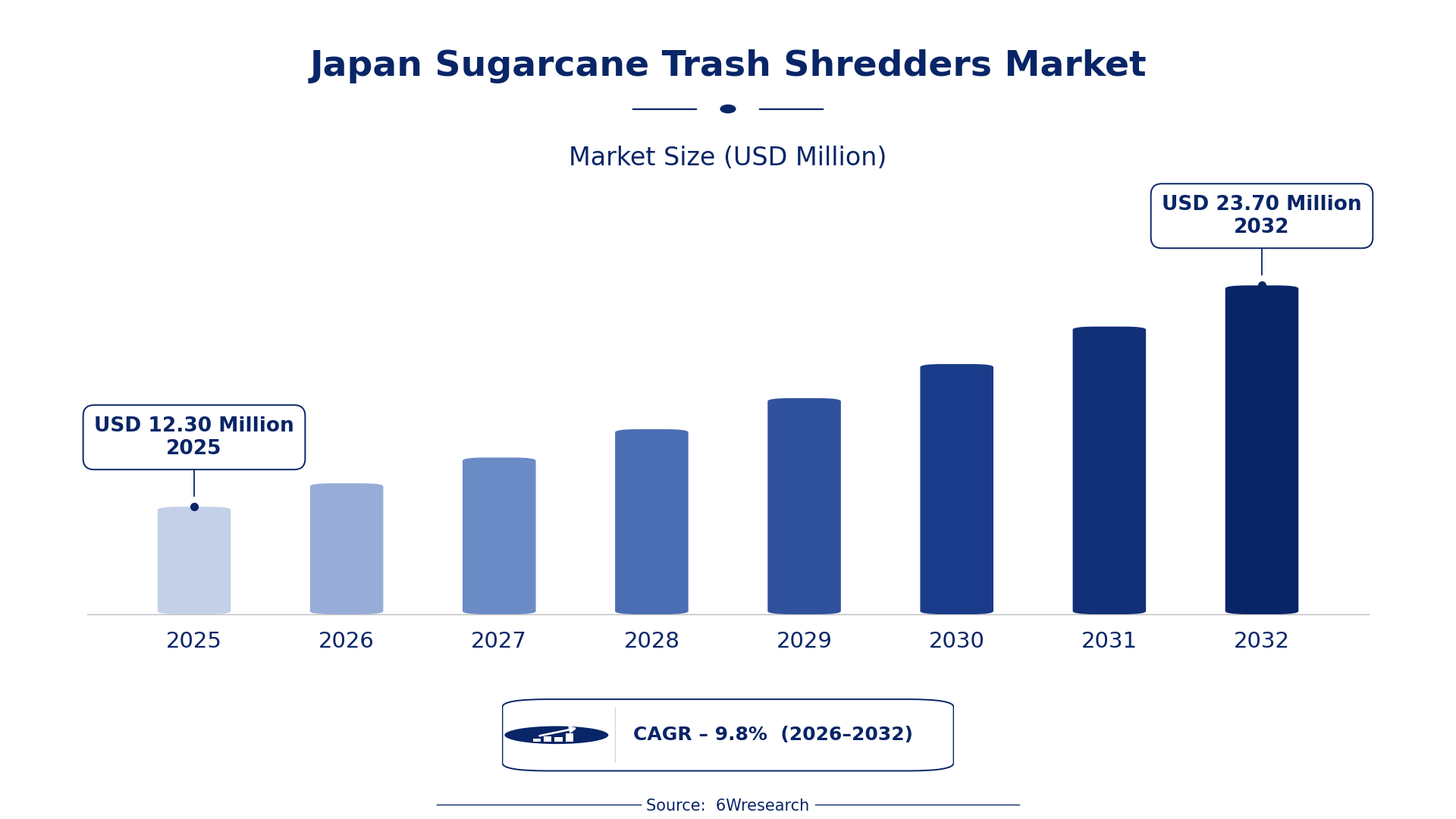
According to 6Wresearch internal database and industry insights, the Japan Sugarcane Trash Shredders Market was valued at USD 12.30 Million in 2025 and is projected to reach USD 23.70 Million by 2032, growing at a CAGR of approximately 9.8% during 2026–2032.
Japan Sugarcane Trash Shredders Market Highlights
| Report Metric | Details |
| Report Name | Japan Sugarcane Trash Shredders Market (2026-2032) |
| Market Size 2025 | USD 12.30 Million |
| Market Size 2032 | USD 23.70 Million |
| Absolute Growth 2025–2032 | USD 11.40 Million |
| CAGR 2026–2032 | 9.8% |
| Peak Annual Growth | 10.5% in 2032 |
| Forecast Period | 2026–2032 |
| Historical Data | 2022–2025 |
| Base Year | 2025 |
| Leading Shredder Type, 2025 | Tractor-Mounted (36% share) |
| Leading Drive Mechanism, 2025 | PTO Driven (47% share) |
| Leading Mounting Type, 2025 | Rear Mount (46% share) |
| Leading End User, 2025 | Medium & Large Farmers (47% share) |
| Fastest-Growing Shredder Type | Self-Propelled (13.7% CAGR) |
| Fastest-Growing Drive Mechanism | Diesel Engine (13.2% CAGR) |
| Fastest-Growing Mounting Type | Built-In (14.4% CAGR) |
| Fastest-Growing End User | Sugarcane Cooperatives (13.3% CAGR) |
| Growing Sector | agricultural machinery |
| Key End Users | medium and large farmers, sugarcane cooperatives, biomass energy firms |
Japan Sugarcane Trash Shredders Market Year-wise Growth Rate and Key Drivers (2022–2032)
This graph illustrates the annual growth rates of the market from 2022 to 2032, highlighting a steady upward trajectory and projected market expansion over the forecast period.
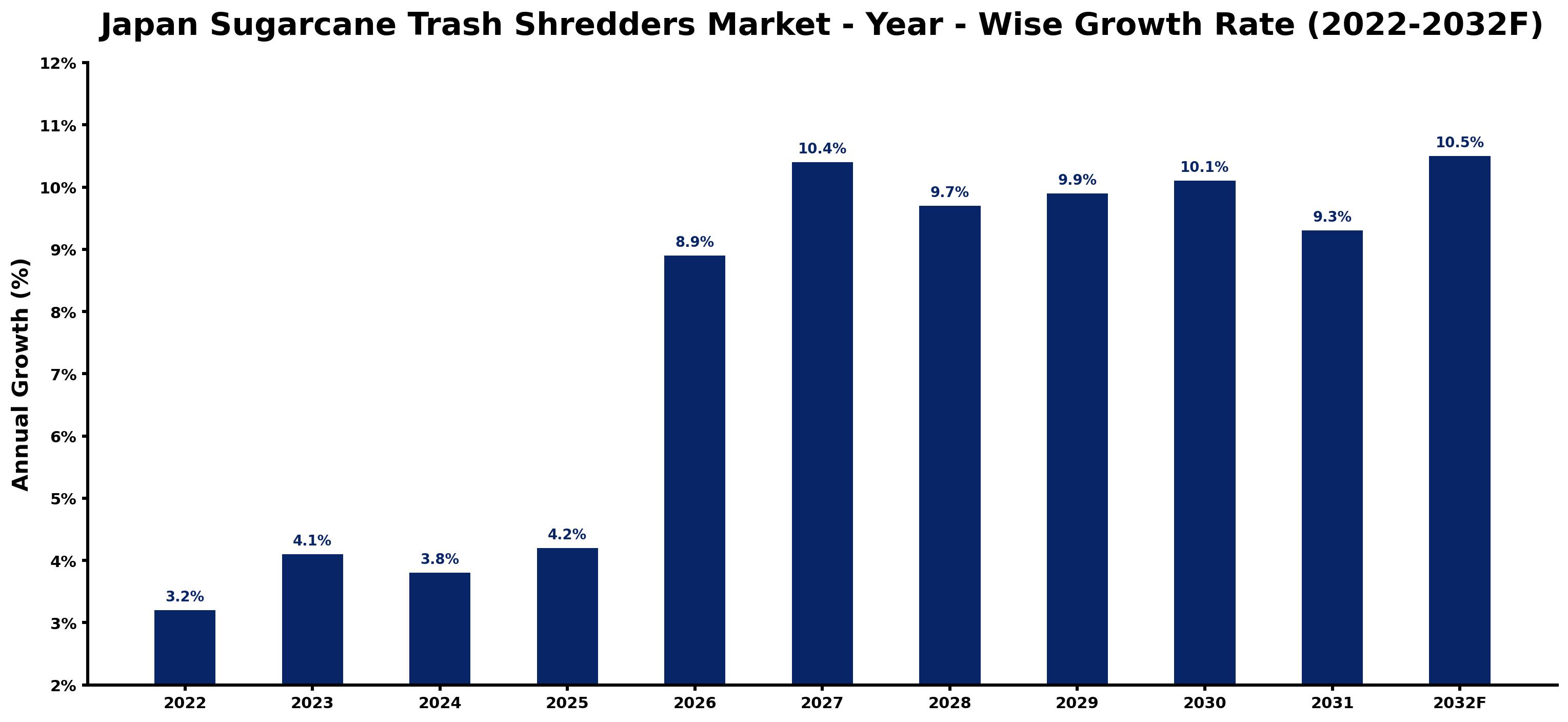
Year by year, the estimates below pair each growth rate with the development that shaped it.
| Year | Estimated Annual Growth (%) | Market Rationale |
| 2022 | 3.2 | The market experienced steady growth due to established sugarcane farming practices. |
| 2023 | 4.1 | Demand increased as farmers sought more efficient field management solutions. |
| 2024 | 3.8 | Growth slowed slightly as market conditions stabilised after previous gains. |
| 2025 | 4.2 | A rise in sugarcane yield contributed to increased machinery purchases. |
| 2026 | 8.9 | The introduction of advanced shredding technology is expected to drive higher demand. |
| 2027 | 10.4 | Growing interest in biomass energy production will drive further equipment sales. |
| 2028 | 9.7 | Market growth is projected to moderate as competition among suppliers intensifies. |
| 2029 | 9.9 | Increased investments in agricultural technology are expected to boost buyer confidence. |
| 2030 | 10.1 | A focus on sustainable farming practices will increase demand for shredders. |
| 2031 | 9.3 | The aging farmer demographic will highlight the need for efficient machinery. |
| 2032 | 10.5 | Demand is projected to surge as biomass energy targets prompt new investments. |
Note: Market size estimations and growth projections presented in this report are based on 6Wresearch's proprietary forecasting methodology, utilizing the latest available industry data, government publications, and primary research inputs.
Japan Sugarcane Trash Shredders Market Synopsis
Sugarcane trash shredders are agricultural machines that process sugarcane residue, improving field management and biomass utilisation. Built from durable materials, these machines are particularly important in regions like Okinawa, where sugarcane farming thrives. The Japan Sugarcane Trash Shredders Market is growing due to increasing demand from medium and large farmers, spurred by government initiatives that promote efficient equipment for residue management. In 2023, Japan's agricultural sector received a substantial investment of 150 billion yen aimed at enhancing productivity, further supporting market growth.
Market Dynamics Impact Analysis (2026–2032)
| Factor | Type | Impact | Primary Segment Affected |
| Increasing focus on biomass energy production drives demand for shredders. | Driver | High | PTO Driven |
| Technological advancements in shredding machinery enhance efficiency. | Driver | High | Self-Propelled |
| Growing sugarcane cultivation areas present new market opportunities. | Opportunity | High | Medium & Large Farmers |
| Government investments in agricultural technology create a favourable environment. | Opportunity | Medium | Sugarcane Cooperatives |
| Aging farmer population may limit adoption of new machinery. | Restraint | High | Medium & Large Farmers |
| Competition among suppliers may affect pricing strategies. | Restraint | Medium | PTO Driven |
| High initial costs of advanced shredders deter some buyers. | Challenge | High | Self-Propelled |
| Limited access to financing options for small farmers hampers growth. | Challenge | Medium | Sugarcane Cooperatives |
Evaluation of Drivers in Japan Sugarcane Trash Shredders Market (2026–2032)
Below are the drivers that matter most for revenue growth, with supporting evidence.
| Drivers | Primary Segment Affected | Why It Matters (Evidence) |
| Rising biomass energy production targets increase shredder demand. | PTO Driven | The Japanese government aims to boost biomass energy production to 25 million tons by 2030, prompting farmers to invest in shredders. |
| Technological advancements improve efficiency and performance. | Self-Propelled | New models provide greater mobility and ease of operation, attracting medium and large farmers seeking productivity. |
| Increased sugarcane cultivation area encourages machinery purchases. | Medium & Large Farmers | With approximately 16,000 hectares dedicated to sugarcane, farmers require efficient shredders for effective residue management. |
| Government support for agricultural machinery promotes adoption. | Sugarcane Cooperatives | The Biomass Energy Strategy encourages the use of efficient equipment, driving cooperative investments in shredders. |
| Growing awareness of sustainable farming practices boosts demand. | Biomass Energy Firms | As farmers adopt eco-friendly practices, the need for shredders to process waste into biomass increases. |
A wider customer base explains much of the growth, as rising biomass energy production targets increase shredder demand. Technological advancements improve efficiency and performance, with new models providing greater mobility and ease of operation. The expansion of sugarcane cultivation area encourages machinery purchases, with approximately 16,000 hectares dedicated to sugarcane. Support for agricultural machinery promotes adoption, as the Biomass Energy Strategy encourages the use of efficient equipment, driving cooperative investments in shredders.
Evaluation of Restraints in Japan Sugarcane Trash Shredders Market
These are the pressures that could keep growth below its potential.
| Market Restraint | Primary Segment Affected | Why It Matters (Evidence) |
| High initial costs of advanced shredders deter some buyers. | Self-Propelled | The price of advanced shredders can be prohibitive for smaller farmers, limiting their ability to invest. |
| Aging farmer population may limit adoption of new machinery. | Medium & Large Farmers | With the average age of farmers around 67 years, there is a reluctance to adopt new technologies. |
| Competition among suppliers may affect pricing strategies. | PTO Driven | Intense competition can lead to price wars, impacting profitability for manufacturers. |
| Limited access to financing options for small farmers hampers growth. | Sugarcane Cooperatives | Many small farmers struggle to secure loans for purchasing new equipment, restricting market expansion. |
| Seasonal demand fluctuations can affect sales consistency. | Trailer-Mounted | Sales may decline during off-peak seasons, leading to revenue instability for suppliers. |
Japan Sugarcane Trash Shredders Market Challenges
Japan's sugarcane sector faces a supply challenge, with an average yield of 80 tons per hectare limiting the availability of raw materials for shredders. This low yield stems from outdated farming practices, causing delays for producers in meeting processing demands. A skills gap exists as the average age of farmers is around 67 years, resulting in a shortage of younger workers who can operate modern machinery, which hampers productivity. Technology adoption is slow, with many relying on older equipment, increasing operational costs for buyers. Competition from imported alternatives pressures local producers to reduce prices, shrinking profit margins for suppliers.
Trends in the Japan Sugarcane Trash Shredders Market
The shifts below are changing how Japan Sugarcane Trash Shredders Market products are bought and supplied.
- Shift towards Self-Propelled Shredders: In 2025, Self-Propelled shredders are gaining traction due to their mobility and efficiency, with a projected CAGR of 13.7%. This trend is evident in Okinawa, where farmers increasingly favour these machines for effective field management.
- Increased Adoption of Biomass Energy Practices: The Biomass Energy Strategy promotes the use of agricultural residues, including sugarcane trash, for energy production. This initiative aims to raise biomass energy output, targeting 25 million tons by 2030.
- Growing Demand for PTO Driven Shredders: PTO Driven shredders dominate the market with a 47% share in 2025, as they are commonly used in tractor applications. Their efficiency in field operations makes them a preferred choice among farmers.
- Rising Interest in Sustainable Farming Techniques: Farmers are increasingly embracing sustainable practices, driven by initiatives from the Ministry of Agriculture, Forestry and Fisheries. This shift is expected to boost the demand for shredders that facilitate effective residue management.
Investment Opportunities in the Japan Sugarcane Trash Shredders Market
The openings below show where demand in the Japan Sugarcane Trash Shredders Market is visible and how suppliers can enter.
- Growing Biomass Energy Sector: With the government targeting 25 million tons of biomass energy production by 2030, there is a notable opportunity for suppliers of shredders. Medium and large farmers in Okinawa are likely to invest in efficient machinery.
- Investment in Agricultural Technology: The recent 150 billion yen investment in Japan's agricultural sector creates opportunities for suppliers. Collaborating with local cooperatives can facilitate entry into the market.
- Increasing Sugarcane Cultivation Area: The expansion of sugarcane cultivation presents a gap for suppliers to fill. Focusing on medium and large farmers can yield substantial returns as they seek efficient shredding solutions.
- Partnerships with Sugarcane Cooperatives: Forming joint ventures with sugarcane cooperatives can strengthen market presence. These cooperatives support over 5,000 local farmers, creating a strong demand for shredders.
Government Initiatives in the Japan Sugarcane Trash Shredders Market
The Biomass Energy Strategy, updated in 2021, supports the adoption of efficient farming equipment, ensuring that producers meet modern agricultural standards. This law complements efforts to promote the use of agricultural residues for energy production, which increases the role of sugarcane trash shredders in Japan. The government investment of 150 billion yen in 2023 aims to improve productivity in the agricultural sector, directly benefiting producers by enabling them to invest in advanced machinery.
The Ministry of Agriculture, Forestry and Fisheries oversees the implementation of the Biomass Energy Strategy, providing funding for projects aimed at increasing agricultural efficiency. This initiative directly benefits sugarcane cooperatives, enabling them to invest in shredders and improve their operational efficiency.
Future Insight of the Japan Sugarcane Trash Shredders Market
Innovations in precision agriculture will transform the sugarcane shredding process by 2032, improving residue management efficiency. A government initiative aims to raise biomass energy production to 25 million tons by 2030, driving demand for shredders that convert waste into energy. The emphasis on sustainable farming practices will further elevate the need for advanced shredders. As new standards emerge from the Japan Agricultural Machinery Manufacturers Association, suppliers will need to adapt their offerings to meet these evolving requirements.
Market Segmentation Analysis
Japan Sugarcane Trash Shredders Market report covers a detailed analysis of the following market segments:
By Shredder Type – Tractor-Mounted Leads, Self-Propelled Expected to Grow Fastest
According to Saurav Kr Singh, Senior Research Analyst at 6Wresearch, Tractor-Mounted held 36% of the Japan Sugarcane Trash Shredders Market by shredder type in 2025. Tractor-mounted shredders are prevalent among farmers for their efficiency in managing the extensive sugarcane cultivation area of around 16,000 hectares. Their design allows for effective field management, making them indispensable in regions like Okinawa. Self-Propelled is projected to grow fastest, at a CAGR of 13.7% during 2026–2032. Self-propelled shredders are gaining traction due to their mobility and ease of operation, which are essential for farmers needing flexibility in various field conditions. This trend aligns with the push for improved agricultural practices and productivity. Suppliers should prioritise the development of self-propelled models to align with the increasing demand for adaptable agricultural equipment.
By Drive Mechanism – PTO Driven Leads, Diesel Engine Expected to Grow Fastest
The largest drive mechanism category in 2025 was PTO Driven, at 47% of revenue. PTO driven shredders hold the largest share due to their widespread use in tractor applications, ensuring reliable power for effective operation. Their compatibility with existing tractor systems makes them a preferred choice among farmers in Japan's sugarcane sector. The quickest growth will come from Diesel Engine, forecast to expand at a CAGR of 13.2% between 2026 and 2032. Diesel engine shredders are experiencing rapid growth as they provide robust power, meeting the demands of farmers who require high performance for extensive processing tasks. The focus on enhancing agricultural productivity further accelerates this segment's growth. Suppliers should prioritise the development of diesel engine models to meet the increasing demand for high-performance machinery.
By Mounting Type – Rear Mount Leads, Built-In Expected to Grow Fastest
With 46% of mounting type revenue in 2025, Rear Mount was the largest category. Rear mount shredders are the leading choice for farmers as they offer efficient operation during field tasks, allowing for effective management of sugarcane residue. Their design is well-suited for the typical layout of sugarcane fields in Japan. Over 2026–2032, Built-In is expected to post the fastest growth, at a CAGR of 14.4%. Built-in shredders are seeing the fastest growth as they integrate seamlessly into larger equipment, providing convenience for farmers looking to optimise their machinery. This trend aligns with the industry's shift towards multifunctional agricultural tools. Suppliers should consider developing built-in options to cater to the evolving preferences of farmers seeking integrated solutions.
By End User – Medium & Large Farmers Lead, Sugarcane Cooperatives Expected to Grow Fastest
Medium & Large Farmers took 47% of end user revenue in 2025, more than any other category. Medium and large farmers represent the largest user group for sugarcane trash shredders, as they require efficient machinery to manage their extensive operations effectively. Their significant involvement in the sugarcane industry underscores the essential role of these shredders in field management. Sugarcane Cooperatives are set to record the highest CAGR in this split, 13.3% over 2026–2032. Sugarcane cooperatives are rapidly adopting shredders, as they enable collective resource management for over 5,000 local farmers. This cooperative model enhances the demand for shredders capable of efficiently processing larger volumes of residue. Suppliers should target sugarcane cooperatives to capitalise on their collective purchasing power and expand their market reach.
Key Attractiveness of the Report
- 10 Years of Market Numbers
- Historical Data Starting from 2022 to 2025
- Base Year 2025
- Forecast Data until 2032
- Key Performance Indicators Impacting the Market
- Major Upcoming Developments and Projects
Key Highlights of the Report:
- Japan Sugarcane Trash Shredders Market Outlook
- Market Size of Japan Sugarcane Trash Shredders Market, 2025
- Forecast of Japan Sugarcane Trash Shredders Market, 2032
- Historical Data and Forecast of Japan Sugarcane Trash Shredders Revenues & Volume for the Period 2022-2032F
- Japan Sugarcane Trash Shredders Market Trend Evolution
- Japan Sugarcane Trash Shredders Market Drivers and Challenges
- Japan Sugarcane Trash Shredders Price Trends
- Japan Sugarcane Trash Shredders Porter's Five Forces
- Japan Sugarcane Trash Shredders Industry Life Cycle
- Historical Data and Forecast of Japan Sugarcane Trash Shredders Market Revenues & Volume By Shredder Type for the Period 2022-2032F
- Historical Data and Forecast of Japan Sugarcane Trash Shredders Market Revenues & Volume By Tractor-Mounted for the Period 2022-2032F
- Historical Data and Forecast of Japan Sugarcane Trash Shredders Market Revenues & Volume By Self-Propelled for the Period 2022-2032F
- Historical Data and Forecast of Japan Sugarcane Trash Shredders Market Revenues & Volume By Stationary Shredders for the Period 2022-2032F
- Historical Data and Forecast of Japan Sugarcane Trash Shredders Market Revenues & Volume By Trailer-Mounted for the Period 2022-2032F
- Historical Data and Forecast of Japan Sugarcane Trash Shredders Market Revenues & Volume By Drive Mechanism for the Period 2022-2032F
- Historical Data and Forecast of Japan Sugarcane Trash Shredders Market Revenues & Volume By PTO Driven for the Period 2022-2032F
- Historical Data and Forecast of Japan Sugarcane Trash Shredders Market Revenues & Volume By Diesel Engine for the Period 2022-2032F
- Historical Data and Forecast of Japan Sugarcane Trash Shredders Market Revenues & Volume By Electric Motor for the Period 2022-2032F
- Historical Data and Forecast of Japan Sugarcane Trash Shredders Market Revenues & Volume By Tow-Behind for the Period 2022-2032F
- Historical Data and Forecast of Japan Sugarcane Trash Shredders Market Revenues & Volume By Mounting Type for the Period 2022-2032F
- Historical Data and Forecast of Japan Sugarcane Trash Shredders Market Revenues & Volume By Rear Mount for the Period 2022-2032F
- Historical Data and Forecast of Japan Sugarcane Trash Shredders Market Revenues & Volume By Built-In for the Period 2022-2032F
- Historical Data and Forecast of Japan Sugarcane Trash Shredders Market Revenues & Volume By Ground Installed for the Period 2022-2032F
- Historical Data and Forecast of Japan Sugarcane Trash Shredders Market Revenues & Volume By Portable for the Period 2022-2032F
- Historical Data and Forecast of Japan Sugarcane Trash Shredders Market Revenues & Volume By End User for the Period 2022-2032F
- Historical Data and Forecast of Japan Sugarcane Trash Shredders Market Revenues & Volume By Medium & Large Farmers for the Period 2022-2032F
- Historical Data and Forecast of Japan Sugarcane Trash Shredders Market Revenues & Volume By Sugarcane Cooperatives for the Period 2022-2032F
- Historical Data and Forecast of Japan Sugarcane Trash Shredders Market Revenues & Volume By Biomass Energy Firms for the Period 2022-2032F
- Historical Data and Forecast of Japan Sugarcane Trash Shredders Market Revenues & Volume By Agricultural Equipment Buyers for the Period 2022-2032F
- Japan Sugarcane Trash Shredders Import Export Trade Statistics
- Market Opportunity Assessment By Shredder Type
- Market Opportunity Assessment By Drive Mechanism
- Market Opportunity Assessment By Mounting Type
- Market Opportunity Assessment By End User
- Japan Sugarcane Trash Shredders Top Companies Market Share
- Japan Sugarcane Trash Shredders Competitive Benchmarking By Technical and Operational Parameters
- Japan Sugarcane Trash Shredders Company Profiles
- Japan Sugarcane Trash Shredders Key Strategic Recommendations
Market Covered
The following segment groups are covered in the report.
By Shredder Type
- Tractor-Mounted
- Self-Propelled
- Stationary Shredders
- Trailer-Mounted
By Drive Mechanism
- PTO Driven
- Diesel Engine
- Electric Motor
- Tow-Behind
By Mounting Type
- Rear Mount
- Built-In
- Ground Installed
- Portable
By End User
- Medium & Large Farmers
- Sugarcane Cooperatives
- Biomass Energy Firms
- Agricultural Equipment Buyers































