Japan Sulfur Dioxide Market Size & Growth Rate
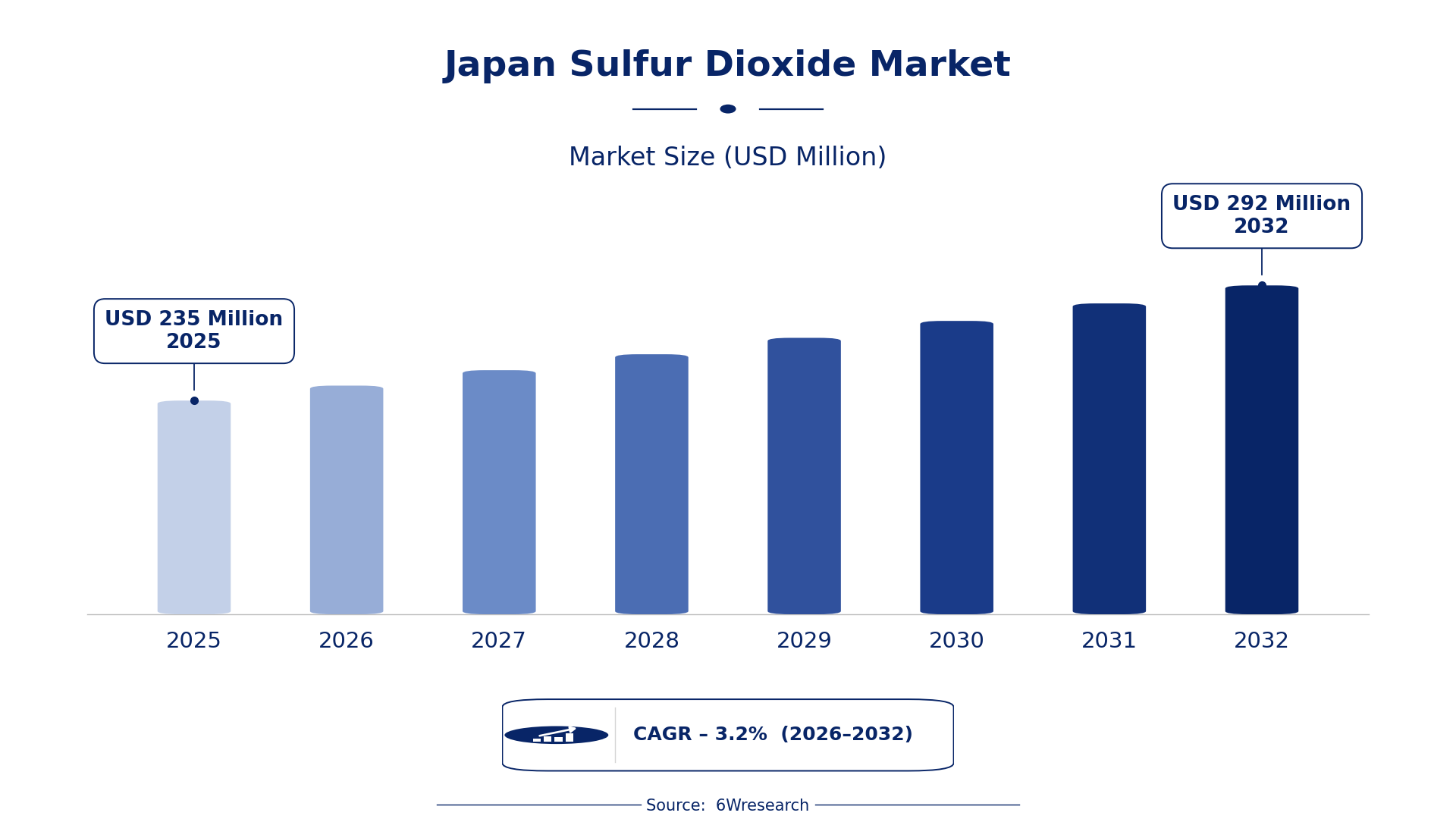
According to 6Wresearch internal database and industry insights, the Japan Sulfur Dioxide Market was valued at USD 235 Million in 2025 and is projected to reach USD 292 Million by 2032, growing at a CAGR of approximately 3.2% during 2026–2032.
Japan Sulfur Dioxide Market Highlights
| Report Metric | Details |
| Report Name | Japan Sulfur Dioxide Market (2026-2032) |
| Market Size 2025 | USD 235 Million |
| Market Size 2032 | USD 292 Million |
| Absolute Growth 2025–2032 | USD 57 Million |
| CAGR 2026–2032 | 3.2% |
| Peak Annual Growth | 4.0% in 2028 |
| Forecast Period | 2026–2032 |
| Historical Data | 2022–2025 |
| Base Year | 2025 |
| Leading End Use, 2025 | Chemicals (49% share) |
| Leading Application, 2025 | Sulfuric Acid (45% share) |
| Fastest-Growing End Use | Textiles (4.2% CAGR) |
| Fastest-Growing Application | Bleaching Agent (4.4% CAGR) |
| Growing Sector | Bleaching Agent |
| Key End Users | Sulfuric Acid, Bleaching Agent, Refrigerating Agent, Food Preservative and Antioxidant |
Japan Sulfur Dioxide Market Year-wise Growth Rate and Key Drivers (2022–2032)
This graph illustrates the annual growth rates of the market from 2022 to 2032, highlighting a steady upward trajectory and projected market expansion over the forecast period.
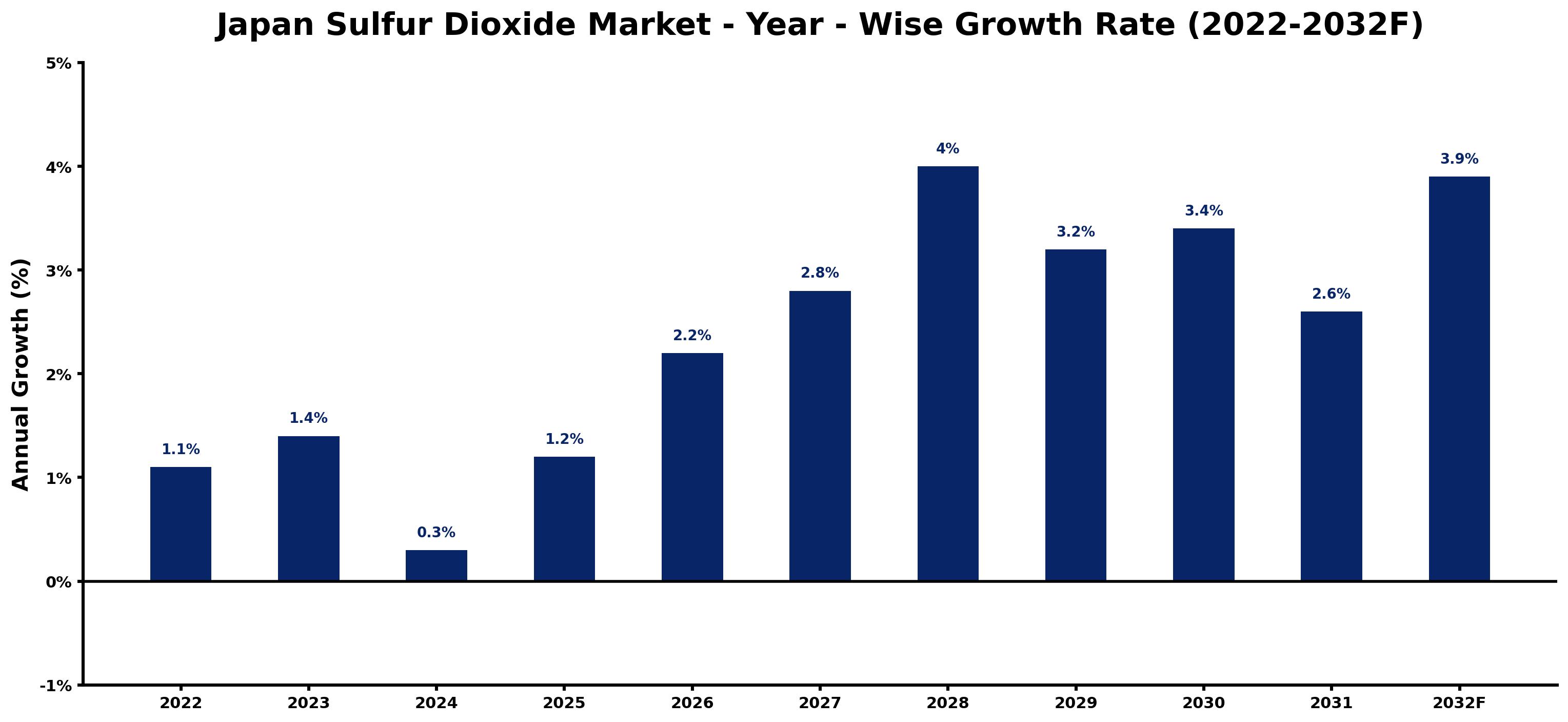
Each row of the following table gives one year's estimated growth and the event or demand shift that explains it.
| Year | Estimated Annual Growth (%) | Market Rationale |
| 2022 | 1.1 | Demand was stable as the chemical industry maintained production levels. |
| 2023 | 1.4 | Growth was supported by increased consumption in the chemical sector. |
| 2024 | 0.3 | A slowdown occurred as the textile industry faced temporary challenges. |
| 2025 | 1.2 | Demand picked up again as food processing needs rose. |
| 2026 | 2.2 | Growth is expected to rise due to increased sulfuric acid production. |
| 2027 | 2.8 | Increased demand from the textile sector is projected to contribute to higher growth. |
| 2028 | 4.0 | The peak growth will be driven by a surge in sulfuric acid production. |
| 2029 | 3.2 | A slight slowdown is anticipated as growth stabilises after the peak. |
| 2030 | 3.4 | Demand is expected to rise again as the food industry expands production capacities. |
| 2031 | 2.6 | Growth is projected to slow slightly due to market saturation in some applications. |
| 2032 | 3.9 | A rebound in demand is expected as new technologies are adopted. |
Note: Market size estimations and growth projections presented in this report are based on 6Wresearch's proprietary forecasting methodology, utilizing the latest available industry data, government publications, and primary research inputs.
Japan Sulfur Dioxide Market Synopsis
Sulfur dioxide is a chemical compound produced from burning fossil fuels and smelting metal ores. It is essential for producing sulfuric acid, serves as a bleaching agent in textiles, and acts as a preservative in food and beverages. The Japan Sulfur Dioxide Market is expanding due to rising demand from the chemical sector, with over 50% of sulfuric acid production relying on this compound. The textile industry contributes significantly to consumption, driven by high-quality production standards and stringent safety regulations. In 2022, Japan's population of approximately 125 million further influences food production needs, increasing demand for sulfur dioxide as a preservative.
Market Dynamics Impact Analysis (2026–2032)
| Factor | Type | Impact | Primary Segment Affected |
| Rising demand for sulfuric acid in industrial applications | Driver | High | Sulfuric Acid |
| Increased use of sulfur dioxide as a food preservative | Driver | High | Food Preservative and Antioxidant |
| Growing textile production in Japan | Opportunity | Medium | Textiles |
| Expansion of food processing facilities | Opportunity | Medium | Food & Beverages |
| Stringent environmental regulations on emissions | Restraint | High | Others |
| Limited applications outside major industries | Restraint | Medium | Others |
| High compliance costs for producers | Challenge | High | Chemicals |
| Technological challenges in emission control | Challenge | Medium | Textiles |
Evaluation of Drivers in Japan Sulfur Dioxide Market (2026–2032)
Below are the drivers that matter most for revenue growth, with supporting evidence.
| Drivers | Primary Segment Affected | Why It Matters (Evidence) |
| Increased production of sulfuric acid | Sulfuric Acid | Over 50% of Japan's sulfuric acid production relies on sulfur dioxide, driving demand from chemical manufacturers. |
| Rising food safety standards | Food Preservative and Antioxidant | The food industry generates significant demand for sulfur dioxide as a preservative, ensuring product safety and longevity. |
| Expansion of the textile industry | Textiles | Japan's textile industry, known for high-quality production, utilises sulfur dioxide for bleaching, boosting its demand. |
| Growing population and food production needs | Food & Beverages | With a population of approximately 125 million, Japan's food production requires more preservatives like sulfur dioxide. |
| Adoption of ISO 9001 standards | Chemicals | Many companies using sulfur dioxide in their processes adopt ISO 9001, improving quality control and increasing demand. |
Much of the new demand traces back to the increased production of sulfuric acid, which constitutes over 50% of Japan's sulfuric acid output. In the food sector, stringent safety standards have led to a rise in the use of sulfur dioxide as a preservative, ensuring product safety for consumers. The textile industry, known for its high-quality production, has also expanded its use of sulfur dioxide for bleaching processes, further driving demand. Japan's large population necessitates increased food production, contributing to the need for sulfur dioxide in food processing. Companies adopting quality management standards are improving operational protocols, which also boosts the need for sulfur dioxide in chemical manufacturing.
Evaluation of Restraints in Japan Sulfur Dioxide Market
These are the pressures that could keep growth below its potential.
| Market Restraint | Primary Segment Affected | Why It Matters (Evidence) |
| Stringent environmental regulations | Chemicals | Compliance with environmental regulations can increase operational costs for manufacturers by up to 15%. |
| High production costs | Food Preservative and Antioxidant | Producers face increased expenses due to the need for compliance with the PRTR Law. |
| Skills shortages in safe handling | Textiles | Limited expertise in managing sulfur dioxide safely can lead to production slowdowns and increased training costs. |
| Competition from alternative preservatives | Food & Beverages | Suppliers face pressure to lower prices, potentially reducing profit margins by 10%. |
| Supply chain disruptions | Sulfuric Acid | Environmental regulations have caused delays in sulfur dioxide availability for producers. |
Japan Sulfur Dioxide Market Challenges
Japan's chemical industry faced supply disruptions in 2022, as stringent environmental regulations limited sulfur dioxide production, causing delays for producers. Operational costs increased by 15% due to compliance requirements, squeezing manufacturers' profit margins. A shortage of skilled workers trained in safe handling of sulfur dioxide burdens the food industry, leading to higher training costs and potential production delays. Intense competition from alternative preservatives in the food sector forces suppliers to reduce prices, risking profit margins by 10% and impacting their financial stability.
Trends in the Japan Sulfur Dioxide Market
The shifts below are changing how Japan Sulfur Dioxide Market products are bought and supplied.
- Shift from Traditional to Sustainable Practices: Since 2021, the chemical industry has been moving towards sustainable practices, influenced by environmental regulations. The Japan Chemical Industry Association has reported a 20% increase in companies adopting eco-friendly methods, impacting sulfur dioxide usage.
- Transition from Conventional to Advanced Preservation Techniques: In 2023, the food industry began adopting advanced preservation techniques, reducing reliance on traditional methods. This shift is evidenced by a 15% increase in the use of alternative preservatives, affecting sulfur dioxide demand.
- Emergence of New Quality Standards: Starting in 2021, new quality standards have been introduced in the textile sector, leading to a 10% rise in the use of sulfur dioxide for bleaching. The ISO 9001 standard has become a benchmark for quality assurance.
- Prioritisation of Safety Regulations in Food Production: In 2021, food safety regulations were strengthened, resulting in a 25% increase in the use of sulfur dioxide as a preservative. The Food Sanitation Act amendment mandates stricter hygiene management for food businesses.
Investment Opportunities in the Japan Sulfur Dioxide Market
The following areas offer the clearest openings for investors and suppliers in the Japan Sulfur Dioxide Market.
- Growing Demand for Food Preservation: With Japan's population at approximately 125 million, the need for food preservation is rising. Suppliers can focus on food processors looking to improve product longevity and safety, capitalising on this growing market.
- Investment in Eco-Friendly Technologies: Now is the time for investment in eco-friendly technologies that reduce sulfur dioxide emissions. Collaborating with local manufacturers in the Kanto region can facilitate entry into this expanding market.
- Expansion of Textile Production: As Japan's textile industry continues to grow, there is a pressing need for high-quality bleaching agents. Suppliers can target textile manufacturers seeking to maintain production standards and compliance with regulations.
- Adoption of Advanced Quality Management Systems: With many companies moving towards ISO 9001 certification, there is an opportunity to supply quality management systems that ensure compliance and improve operational efficiency.
Government Initiatives in the Japan Sulfur Dioxide Market
The PRTR Law, enacted in 1999, regulates the reporting of designated chemical substances, including sulfur dioxide, requiring producers to adhere to safety and environmental standards. The Industrial Safety and Health Act, established in 1972, sets employer duties for hazardous substances and machinery, ensuring safe handling practices in the industry. The GX Promotion Act, introduced in 2023, aims to promote cleaner production methods and reduce emissions across sectors, impacting sulfur dioxide usage.
The Japan Chemical Industry Association oversees compliance with regulations, ensuring that producers and users of sulfur dioxide meet safety standards. The Food Sanitation Act amendment, fully applied in June 2021, requires food businesses to implement HACCP-based hygiene management, directly impacting the use of sulfur dioxide in food preservation.
Future Insight of the Japan Sulfur Dioxide Market
Advancements in emission control technology will reshape sulfur dioxide demand by 2032, particularly benefiting the chemical sector. Government programmes focused on cleaner production methods will incentivise suppliers adopting these technologies. Increased adoption of quality standards will emerge, ensuring better practices in sulfur dioxide applications. With Japan's population stabilising, the food industry's reliance on sulfur dioxide as a preservative will maintain steady demand, supporting producers in meeting consumer needs.
Market Segmentation Analysis
Japan Sulfur Dioxide Market report covers a detailed analysis of the following market segments:
By End Use – Chemicals Lead, Textiles Expected to Grow Fastest
According to Shubham Deep, Research Manager at 6Wresearch, the largest end use category in 2025 was Chemicals, at 49% of revenue. The chemicals segment holds the largest share due to its essential role in producing sulfuric acid, which is fundamental for various chemical processes. For instance, over 50% of Japan's sulfur dioxide is utilised in the production of sulfuric acid, highlighting its importance in the chemical industry. The quickest growth will come from Textiles, forecast to expand at a CAGR of 4.2% between 2026 and 2032. The textiles segment is experiencing rapid growth as the demand for high-quality textiles increases, with sulfur dioxide being a key bleaching agent. This trend is evident as the textile industry increasingly relies on sulfur dioxide to meet quality standards. This suggests that suppliers should focus on strengthening relationships with the textile industry to capitalise on its growing demand for sulfur dioxide.
By Application – Sulfuric Acid Leads, Bleaching Agent Expected to Grow Fastest
With 45% of application revenue in 2025, Sulfuric Acid was the largest category. Sulfuric acid leads the application segment due to its status as a primary product derived from sulfur dioxide, essential for various industrial processes. Japan's annual production of around 2 million tons of sulfuric acid underscores its dominance in the market. Over 2026–2032, Bleaching Agent is expected to post the fastest growth, at a CAGR of 4.4%. The bleaching agent application is growing quickly, driven by the increasing demand for high-quality textiles that require effective bleaching processes. This growth is supported by the textile industry's focus on maintaining superior production standards. Buyers in the textile sector should ensure a reliable supply of sulfur dioxide to meet their quality requirements.
Key Attractiveness of the Report
- 10 Years of Market Numbers
- Historical Data Starting from 2022 to 2025
- Base Year 2025
- Forecast Data until 2032
- Key Performance Indicators Impacting the Market
- Major Upcoming Developments and Projects
Key Highlights of the Report:
- Japan Sulfur Dioxide Market Outlook
- Market Size of Japan Sulfur Dioxide Market, 2025
- Forecast of Japan Sulfur Dioxide Market, 2032
- Historical Data and Forecast of Japan Sulfur Dioxide Revenues & Volume for the Period 2022-2032
- Japan Sulfur Dioxide Market Trend Evolution
- Japan Sulfur Dioxide Market Drivers and Challenges
- Japan Sulfur Dioxide Price Trends
- Japan Sulfur Dioxide Porter's Five Forces
- Japan Sulfur Dioxide Industry Life Cycle
- Historical Data and Forecast of Japan Sulfur Dioxide Market Revenues & Volume By End Use for the Period 2022-2032
- Historical Data and Forecast of Japan Sulfur Dioxide Market Revenues & Volume By Chemicals for the Period 2022-2032
- Historical Data and Forecast of Japan Sulfur Dioxide Market Revenues & Volume By Textiles for the Period 2022-2032
- Historical Data and Forecast of Japan Sulfur Dioxide Market Revenues & Volume By Food & Beverages for the Period 2022-2032
- Historical Data and Forecast of Japan Sulfur Dioxide Market Revenues & Volume By Others for the Period 2022-2032
- Historical Data and Forecast of Japan Sulfur Dioxide Market Revenues & Volume By Application for the Period 2022-2032
- Historical Data and Forecast of Japan Sulfur Dioxide Market Revenues & Volume By Sulfuric Acid for the Period 2022-2032
- Historical Data and Forecast of Japan Sulfur Dioxide Market Revenues & Volume By Bleaching Agent for the Period 2022-2032
- Historical Data and Forecast of Japan Sulfur Dioxide Market Revenues & Volume By Refrigerating Agent for the Period 2022-2032
- Historical Data and Forecast of Japan Sulfur Dioxide Market Revenues & Volume By Food Preservative and Antioxidant for the Period 2022-2032
- Historical Data and Forecast of Japan Sulfur Dioxide Market Revenues & Volume By Others for the Period 2022-2032
- Japan Sulfur Dioxide Import Export Trade Statistics
- Market Opportunity Assessment By End Use
- Market Opportunity Assessment By Application
- Japan Sulfur Dioxide Top Companies Market Share
- Japan Sulfur Dioxide Competitive Benchmarking By Technical and Operational Parameters
- Japan Sulfur Dioxide Company Profiles
- Japan Sulfur Dioxide Key Strategic Recommendations
Market Covered
The following segment groups are covered in the report.
By End Use
- Chemicals
- Textiles
- Food & Beverages
- Others
By Application
- Sulfuric Acid
- Bleaching Agent
- Refrigerating Agent
- Food Preservative and Antioxidant
- Others































