Japan Supercritical Boiler Market Size & Growth Rate
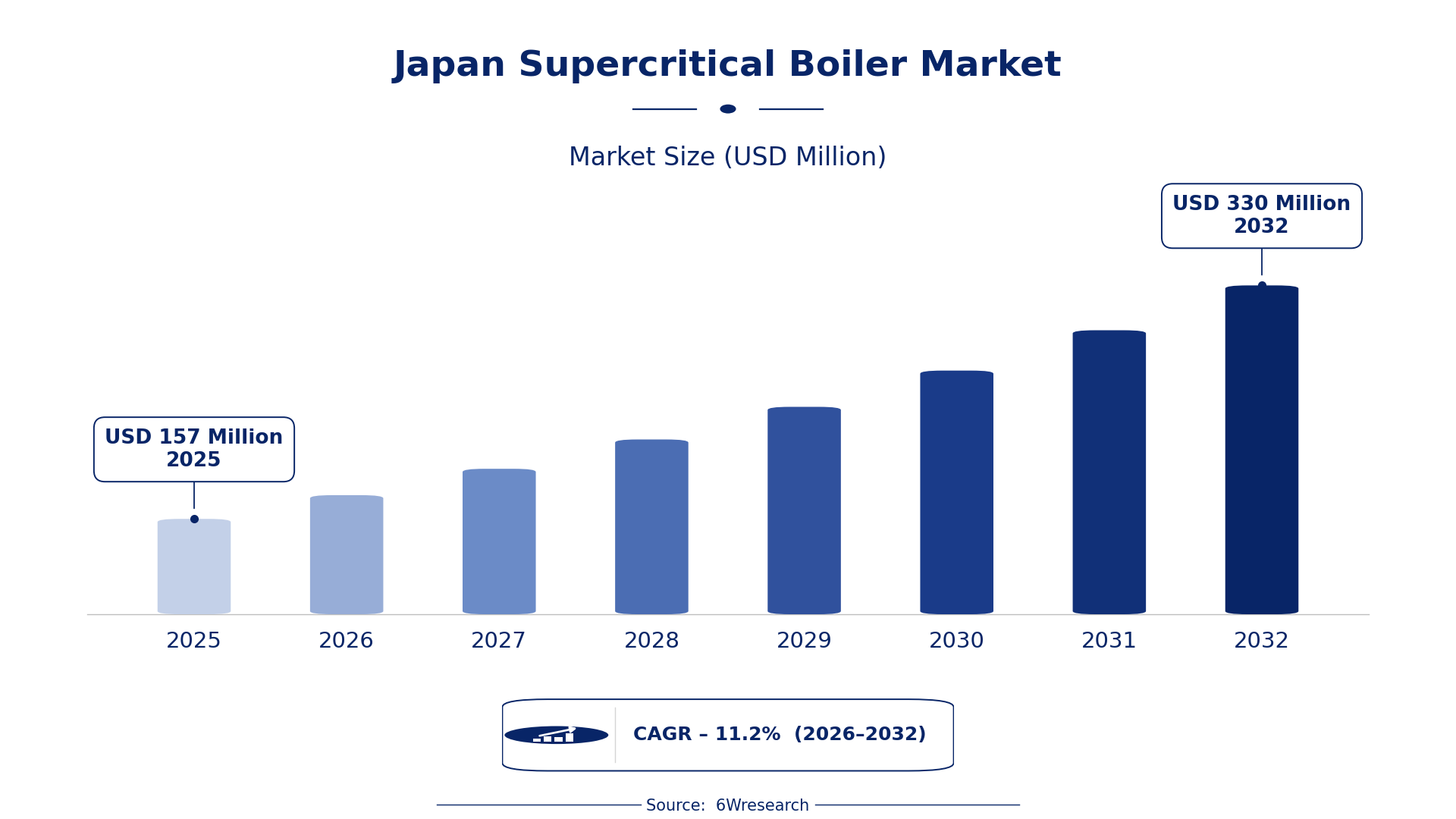
According to 6Wresearch internal database and industry insights, the Japan Supercritical Boiler Market was valued at USD 157 Million in 2025 and is projected to reach USD 330 Million by 2032, growing at a CAGR of approximately 11.2% during 2026–2032.
Japan Supercritical Boiler Market Highlights
| Report Metric | Details |
| Report Name | Japan Supercritical Boiler Market (2026-2032) |
| Market Size 2025 | USD 157 Million |
| Market Size 2032 | USD 330 Million |
| Absolute Growth 2025–2032 | USD 173 Million |
| CAGR 2026–2032 | 11.2% |
| Peak Annual Growth | 12.1% in 2028 |
| Forecast Period | 2026–2032 |
| Historical Data | 2022–2025 |
| Base Year | 2025 |
| Leading Boiler Type, 2025 | Once-Through Boilers (45% share) |
| Leading Pressure Level, 2025 | >22 MPa (51% share) |
| Leading Fuel Type, 2025 | Coal-Based (40% share) |
| Leading End User, 2025 | Thermal Power Plants (45% share) |
| Fastest-Growing Boiler Type | Drum-Type Boilers (15.8% CAGR) |
| Fastest-Growing Pressure Level | Supercritical (14.1% CAGR) |
| Fastest-Growing Fuel Type | Gas-Based (15.9% CAGR) |
| Fastest-Growing End User | Independent Power Producers (14.6% CAGR) |
| Growing Sector | Thermal Power Generation |
| Key End Users | Thermal Power Plants, Independent Power Producers, Utility Companies |
Japan Supercritical Boiler Market Year-wise Growth Rate and Key Drivers (2022–2032)
This graph illustrates the annual growth rates of the market from 2022 to 2032, highlighting a steady upward trajectory and projected market expansion over the forecast period.
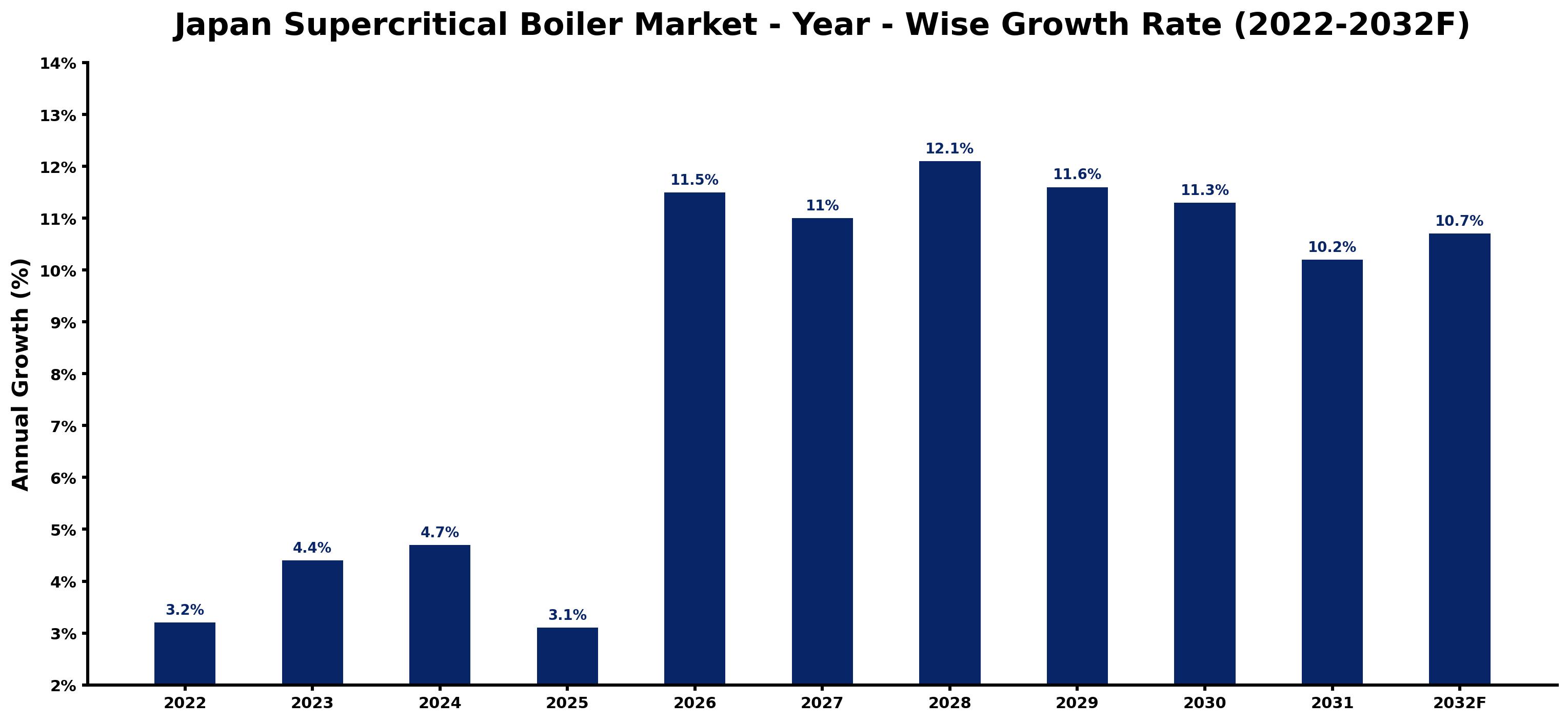
Each row of the following table gives one year's estimated growth and the event or demand shift that explains it.
| Year | Estimated Annual Growth (%) | Market Rationale |
| 2022 | 3.2 | The market showed steady growth due to existing operational supercritical boilers. |
| 2023 | 4.4 | Increased investments in supercritical technology contributed to faster growth than the previous year. |
| 2024 | 4.7 | The market continued to grow as demand for efficient power generation rose. |
| 2025 | 3.1 | Growth slowed as market saturation began to affect new investments in supercritical systems. |
| 2026 | 11.5 | The market is expected to grow as demand for cleaner energy sources increases. |
| 2027 | 11.0 | Growth is projected to slow slightly as competition in the sector intensifies. |
| 2028 | 12.1 | The market is set to peak due to rising investments in ultra-supercritical technology. |
| 2029 | 11.6 | Growth is projected to slow as the market begins to stabilise after peak demand. |
| 2030 | 11.3 | The market will continue to grow as Japan pushes for decarbonisation efforts. |
| 2031 | 10.2 | Growth is expected to slow as the market matures and competition increases. |
| 2032 | 10.7 | The market is anticipated to grow faster due to ongoing investments in energy efficiency. |
Note: Market size estimations and growth projections presented in this report are based on 6Wresearch's proprietary forecasting methodology, utilizing the latest available industry data, government publications, and primary research inputs.
Japan Supercritical Boiler Market Synopsis
In Japan, more than 100 supercritical boilers are currently in operation, primarily within thermal power plants. The Japan Supercritical Boiler Market is growing due to heightened investments in cleaner energy technologies, with a goal of a 46% reduction in greenhouse gas emissions by 2030 driving demand for supercritical systems and advancements in energy efficiency. This expansion is further supported by government initiatives that promote advanced boiler technologies and the integration of renewable energy sources.
Market Dynamics Impact Analysis (2026–2032)
| Factor | Type | Impact | Primary Segment Affected |
| Rising demand for cleaner energy sources | Driver | High | Supercritical |
| Increased investments in renewable energy technologies | Driver | High | Ultra-Supercritical |
| Growing need for efficient power generation solutions | Opportunity | High | Independent Power Producers |
| Expansion of ultra-supercritical technology adoption | Opportunity | Medium | Ultra-Supercritical |
| High initial investment costs for supercritical systems | Restraint | High | Supercritical |
| Regulatory compliance costs associated with emissions standards | Restraint | Medium | Coal-Based |
| Technological challenges in upgrading existing systems | Challenge | High | Sub-Critical Retrofit |
| Competition from alternative energy sources | Challenge | Medium | Gas-Based |
Evaluation of Drivers in Japan Supercritical Boiler Market (2026–2032)
The table below links each growth driver to the segment it affects and the evidence for it.
| Drivers | Primary Segment Affected | Why It Matters (Evidence) |
| Increased efficiency of supercritical boilers | Supercritical | The average efficiency of supercritical boilers in Japan is around 45%, driving demand from thermal power plants. |
| Rising electricity demand | Independent Power Producers | The total population served by thermal power plants in Japan is around 125 million, increasing energy needs. |
| Focus on reducing greenhouse gas emissions | Coal-Based | Japan targets a 46% cut in greenhouse-gas emissions by 2030, boosting supercritical technology adoption. |
| Technological advancements in boiler design | Gas-Based | Investment in gas-based systems is rising due to their lower emissions compared to traditional options. |
| Government support for cleaner technologies | Ultra-Supercritical | The Agency for Natural Resources and Energy supports research on ultra-supercritical technology, encouraging investment. |
Most of the additional volume arises from the increasing efficiency of supercritical boilers, which average around 45% efficiency. This efficiency encourages thermal power plants to invest more in these technologies. Japan's commitment to reducing greenhouse gas emissions by 2030 fuels investment in supercritical technologies, with the total population served by thermal power plants reaching approximately 125 million. Investment in gas-based systems is rising due to their lower emissions compared to traditional options, attracting considerable interest from independent power producers.
Evaluation of Restraints in Japan Supercritical Boiler Market
These are the pressures that could keep growth below its potential.
| Market Restraint | Primary Segment Affected | Why It Matters (Evidence) |
| High initial investment costs for supercritical systems | Supercritical | The average cost of installing supercritical boilers can deter investments, affecting market growth. |
| Regulatory compliance costs associated with emissions standards | Coal-Based | Compliance with strict emissions regulations increases operational costs for coal-based supercritical boilers. |
| Limited availability of skilled workforce | Ultra-Supercritical | A shortage of skilled technicians for advanced boiler technologies can slow down project implementations. |
| Market saturation in certain regions | Independent Power Producers | In some areas, the market for new supercritical plants is saturated, limiting growth opportunities. |
| Technological challenges in upgrading existing systems | Sub-Critical Retrofit | Upgrading older systems to supercritical technology requires substantial investment and expertise. |
Japan Supercritical Boiler Market Challenges
Producers encounter rising costs as high-strength materials for supercritical boilers become more expensive, inflating manufacturing expenses by 20%. Supply chain disruptions in Japan impede timely access to these materials, delaying project timelines for power plants and increasing operational risks for buyers. Technological limitations persist, as many existing systems lack advanced designs, resulting in energy losses of up to 10% for producers. Regulatory requirements, particularly the JIS B 8220 standard, impose strict design criteria that can prolong project timelines for manufacturers, reducing their competitive edge in the market.
Trends in the Japan Supercritical Boiler Market
Several trends are reshaping the Japan Supercritical Boiler Market; the most important are set out below.
- Shift in Fuel Preference among Independent Power Producers: Independent power producers are increasingly adopting gas-based systems over coal-based options, reflecting a shift towards cleaner energy sources. In 2023, gas-based systems accounted for a growing share of new installations, driven by lower emissions.
- Transition to Ultra-Supercritical Technology: The adoption of ultra-supercritical technology is gaining momentum, particularly in large thermal power plants. Since 2023, several facilities have begun integrating these systems, aiming for higher efficiency and lower emissions.
- Emergence of Biomass as a Supplementary Fuel: The use of biomass in supercritical systems is being piloted in several prefectures, reflecting a growing interest in renewable energy integration. In 2023, biomass systems were tested in multiple locations, indicating a shift towards sustainable energy solutions.
- Increased Focus on Energy Efficiency Standards: The introduction of stricter energy efficiency standards is prompting upgrades to existing boiler systems. As part of the GX Basic Policy adopted in 2023, facilities are encouraged to improve their operational efficiency.
Investment Opportunities in the Japan Supercritical Boiler Market
The opportunities below stand out in the Japan Supercritical Boiler Market for new entrants and existing suppliers.
- Growing market for gas-based systems: With gas-based systems expected to expand, there is an opportunity for suppliers. Independent power producers are increasingly pursuing these systems to meet emissions targets.
- Investment in ultra-supercritical technology: The current push for ultra-supercritical technology presents an opportunity for investment, particularly in thermal power plants. The Kanto region is experiencing increased funding for these advanced systems.
- Demand for retrofitting older systems: As many existing boilers require upgrades, the market for retrofitting is on the rise. Thermal power plants are seeking to improve efficiency through retrofitting, creating a demand for specialised solutions.
- Expansion of renewable energy integration: With Japan's commitment to renewable energy, there is a growing opportunity for biomass systems in supercritical applications. Several prefectures are exploring pilot projects to incorporate biomass into their energy mix.
Government Initiatives in the Japan Supercritical Boiler Market
The GX Basic Policy adopted in 2023 aims for approximately JPY 150 trillion of public-private decarbonisation investment over 10 years, impacting supercritical boiler producers. This policy encourages investments in advanced technologies and cleaner energy sources, providing a framework for growth in the supercritical boiler market.
The Waste Management and Public Cleansing Act regulates the treatment of industrial waste, ensuring that supercritical boiler operators adhere to environmental standards. This law affects operational practices and costs for producers.
Future Insight of the Japan Supercritical Boiler Market
By 2032, Japan's commitment to reducing greenhouse gas emissions will drive a shift towards cleaner technologies, compelling suppliers to innovate in boiler designs. The installed capacity for supercritical boilers is projected to increase to 35 GW, with a notable rise in gas-based systems due to their lower emissions. Research initiatives supported by the Agency for Natural Resources and Energy are likely to lead to advancements in boiler efficiency. Piloting of biomass systems across several prefectures will create new opportunities for both suppliers and buyers.
Market Segmentation Analysis
Japan Supercritical Boiler Market report covers a detailed analysis of the following market segments:
By Boiler Type – Once-Through Boilers Lead, Drum-Type Boilers Expected to Grow Fastest
According to Saurav Kr Singh, Senior Research Analyst at 6Wresearch, the largest boiler type category in 2025 was Once-Through Boilers, at 45% of revenue. Once-Through Boilers dominate the market because they are designed for efficient steam generation, particularly in large thermal power plants. Their operational efficiency makes them the preferred choice for major electricity producers, ensuring a robust installed base across Japan. Over 2026–2032, Drum-Type Boilers are expected to post the fastest growth, at a CAGR of 15.8%. Drum-Type Boilers are witnessing growth as they provide operational flexibility, appealing to smaller facilities and those looking to modernise. This segment's expansion is driven by the increasing demand for adaptable and efficient systems in the energy sector. Suppliers should prioritise the development of flexible boiler solutions to cater to the diverse needs of the market.
By Pressure Level – >22 MPa Leads, Supercritical Expected to Grow Fastest
>22 MPa took 51% of pressure level revenue in 2025, more than any other category. >22 MPa boilers are essential for supercritical operations, which significantly enhance thermal efficiency in power generation. This pressure level is widely adopted across Japan's operational units, ensuring their continued dominance in the market. Supercritical is projected to grow fastest, at a CAGR of 14.1% during 2026–2032. The Supercritical segment is rapidly growing as it represents the core technology for achieving high-efficiency power generation, with strong government support for advanced boiler technologies. This trend is likely to continue as investments in research and development increase. Buyers should focus on supercritical technology to align with Japan's energy efficiency objectives and regulatory frameworks.
By Fuel Type – Coal-Based Leads, Gas-Based Expected to Grow Fastest
Coal-Based accounted for 40% of the market by fuel type in 2025. Coal-Based systems maintain the largest market share as they have been the traditional fuel source for power generation in Japan. Approximately 60% of the market is attributed to coal-based supercritical boilers, reflecting their established infrastructure and usage. The quickest growth will come from Gas-Based, forecast to expand at a CAGR of 15.9% between 2026 and 2032. Gas-Based systems are gaining traction due to their lower emissions, which appeal to operators aiming to meet stricter environmental standards. This shift indicates a growing preference for cleaner alternatives among energy producers. Suppliers must incorporate cleaner fuel options into their offerings to stay competitive in a transitioning energy market.
By End User – Thermal Power Plants Lead, Independent Power Producers Expected to Grow Fastest
With 45% of end user revenue in 2025, Thermal Power Plants was the largest category. Thermal Power Plants are the primary users of supercritical technology, significantly contributing to Japan's installed capacity. Their dependence on high-efficiency boilers is vital for meeting the energy needs of a population of around 125 million. Independent Power Producers are set to record the highest CAGR in this split, 14.6% over 2026–2032. Independent Power Producers are increasingly adopting supercritical technology to improve operational efficiency and meet market demands. This adoption is likely to accelerate as these producers strive to enhance their competitiveness. Suppliers should develop targeted solutions for independent power producers to address their unique operational challenges.
Key Attractiveness of the Report
- 10 Years of Market Numbers
- Historical Data Starting from 2022 to 2025
- Base Year 2025
- Forecast Data until 2032
- Key Performance Indicators Impacting the Market
- Major Upcoming Developments and Projects
Key Highlights of the Report:
- Japan Supercritical Boiler Market Outlook
- Market Size of Japan Supercritical Boiler Market, 2025
- Forecast of Japan Supercritical Boiler Market, 2032
- Historical Data and Forecast of Japan Supercritical Boiler Revenues & Volume for the Period 2022-2032F
- Japan Supercritical Boiler Market Trend Evolution
- Japan Supercritical Boiler Market Drivers and Challenges
- Japan Supercritical Boiler Price Trends
- Japan Supercritical Boiler Porter's Five Forces
- Japan Supercritical Boiler Industry Life Cycle
- Historical Data and Forecast of Japan Supercritical Boiler Market Revenues & Volume By Boiler Type for the Period 2022-2032F
- Historical Data and Forecast of Japan Supercritical Boiler Market Revenues & Volume By Once-Through Boilers for the Period 2022-2032F
- Historical Data and Forecast of Japan Supercritical Boiler Market Revenues & Volume By Drum-Type Boilers for the Period 2022-2032F
- Historical Data and Forecast of Japan Supercritical Boiler Market Revenues & Volume By Ultra-Supercritical for the Period 2022-2032F
- Historical Data and Forecast of Japan Supercritical Boiler Market Revenues & Volume By Sub-Critical Retrofit for the Period 2022-2032F
- Historical Data and Forecast of Japan Supercritical Boiler Market Revenues & Volume By Pressure Level for the Period 2022-2032F
- Historical Data and Forecast of Japan Supercritical Boiler Market Revenues & Volume By >22 MPa for the Period 2022-2032F
- Historical Data and Forecast of Japan Supercritical Boiler Market Revenues & Volume By Supercritical for the Period 2022-2032F
- Historical Data and Forecast of Japan Supercritical Boiler Market Revenues & Volume By >25 MPa for the Period 2022-2032F
- Historical Data and Forecast of Japan Supercritical Boiler Market Revenues & Volume By Upgraded Systems for the Period 2022-2032F
- Historical Data and Forecast of Japan Supercritical Boiler Market Revenues & Volume By Fuel Type for the Period 2022-2032F
- Historical Data and Forecast of Japan Supercritical Boiler Market Revenues & Volume By Coal-Based for the Period 2022-2032F
- Historical Data and Forecast of Japan Supercritical Boiler Market Revenues & Volume By Gas-Based for the Period 2022-2032F
- Historical Data and Forecast of Japan Supercritical Boiler Market Revenues & Volume By Biomass for the Period 2022-2032F
- Historical Data and Forecast of Japan Supercritical Boiler Market Revenues & Volume By Oil for the Period 2022-2032F
- Historical Data and Forecast of Japan Supercritical Boiler Market Revenues & Volume By End User for the Period 2022-2032F
- Historical Data and Forecast of Japan Supercritical Boiler Market Revenues & Volume By Thermal Power Plants for the Period 2022-2032F
- Historical Data and Forecast of Japan Supercritical Boiler Market Revenues & Volume By Independent Power Producers for the Period 2022-2032F
- Historical Data and Forecast of Japan Supercritical Boiler Market Revenues & Volume By Renewable Energy Providers for the Period 2022-2032F
- Historical Data and Forecast of Japan Supercritical Boiler Market Revenues & Volume By Utility Companies for the Period 2022-2032F
- Japan Supercritical Boiler Import Export Trade Statistics
- Market Opportunity Assessment By Boiler Type
- Market Opportunity Assessment By Pressure Level
- Market Opportunity Assessment By Fuel Type
- Market Opportunity Assessment By End User
- Japan Supercritical Boiler Top Companies Market Share
- Japan Supercritical Boiler Competitive Benchmarking By Technical and Operational Parameters
- Japan Supercritical Boiler Company Profiles
- Japan Supercritical Boiler Key Strategic Recommendations
Market Covered
Segments analysed in this report are listed below.
By Boiler Type
- Once-Through Boilers
- Drum-Type Boilers
- Ultra-Supercritical
- Sub-Critical Retrofit
By Pressure Level
- >22 MPa
- Supercritical
- >25 MPa
- Upgraded Systems
By Fuel Type
- Coal-Based
- Gas-Based
- Biomass
- Oil
By End User
- Thermal Power Plants
- Independent Power Producers
- Renewable Energy Providers
- Utility Companies































