Japan Superfood Oil Market Size & Growth Rate
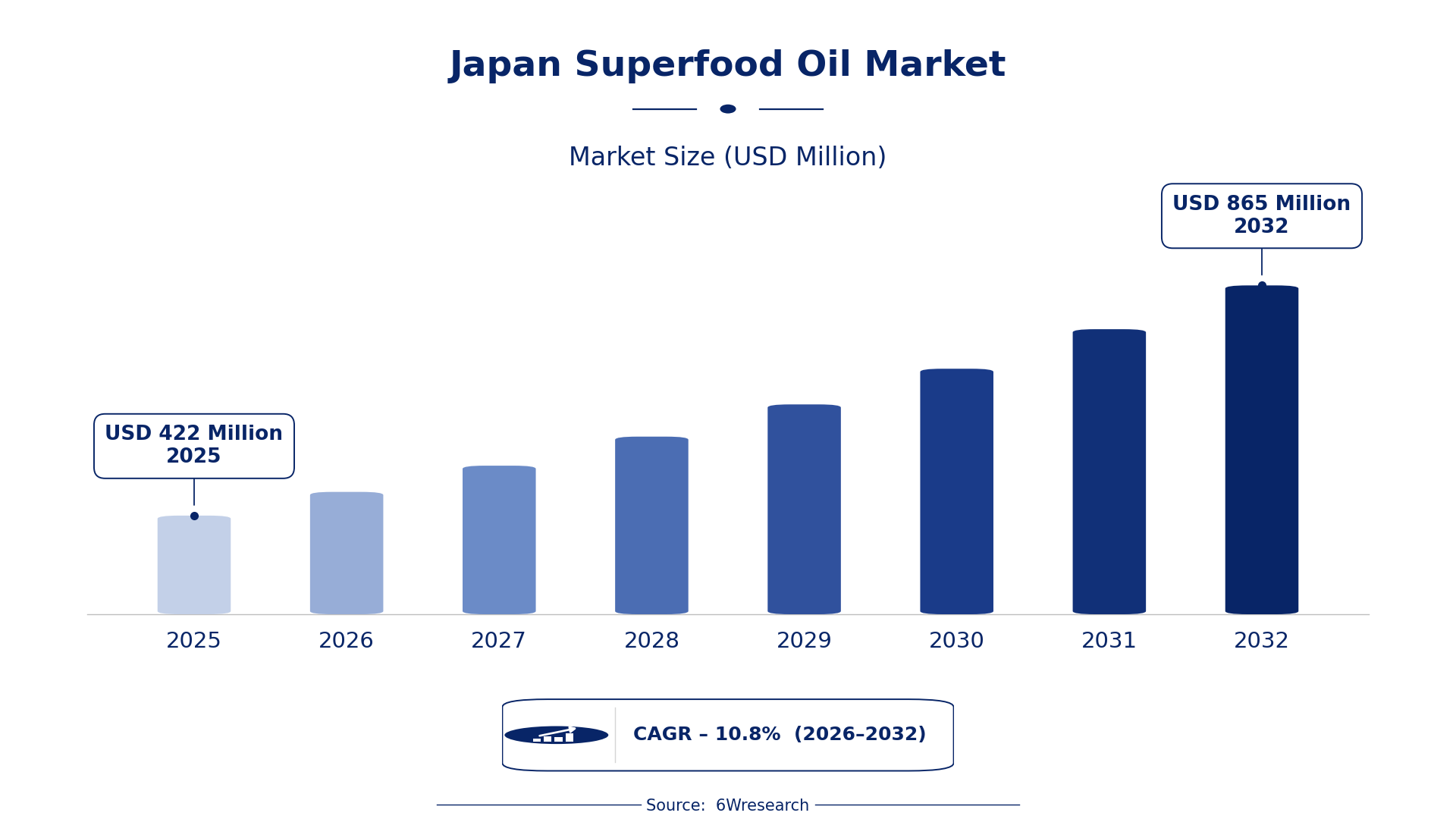
According to 6Wresearch internal database and industry insights, the Japan Superfood Oil Market was valued at USD 422 Million in 2025 and is projected to reach USD 865 Million by 2032, growing at a CAGR of approximately 10.8% during 2026–2032.
Japan Superfood Oil Market Highlights
| Report Metric | Details |
| Report Name | Japan Superfood Oil Market (2026-2032) |
| Market Size 2025 | USD 422 Million |
| Market Size 2032 | USD 865 Million |
| Absolute Growth 2025–2032 | USD 443 Million |
| CAGR 2026–2032 | 10.8% |
| Peak Annual Growth | 12.0% in 2027 |
| Forecast Period | 2026–2032 |
| Historical Data | 2022–2025 |
| Base Year | 2025 |
| Leading Oil Type, 2025 | Avocado Oil (49% share) |
| Leading Source Ingredient, 2025 | Cold Pressed Avocado (42% share) |
| Leading Packaging Type, 2025 | Glass Bottles (43% share) |
| Leading End User, 2025 | Health-Conscious Consumers (43% share) |
| Fastest-Growing Oil Type | Coconut Oil (14.8% CAGR) |
| Fastest-Growing Source Ingredient | Virgin Coconut (15.4% CAGR) |
| Fastest-Growing Packaging Type | Jar (14.9% CAGR) |
| Fastest-Growing End User | Organic Food Brands (14.0% CAGR) |
| Growing Sector | health and wellness |
| Key End Users | Health-Conscious Consumers, Organic Food Brands, Nutritional Supplement Firms, Wellness Retailers |
Japan Superfood Oil Market Year-wise Growth Rate and Key Drivers (2022–2032)
This graph illustrates the annual growth rates of the market from 2022 to 2032, highlighting a steady upward trajectory and projected market expansion over the forecast period.
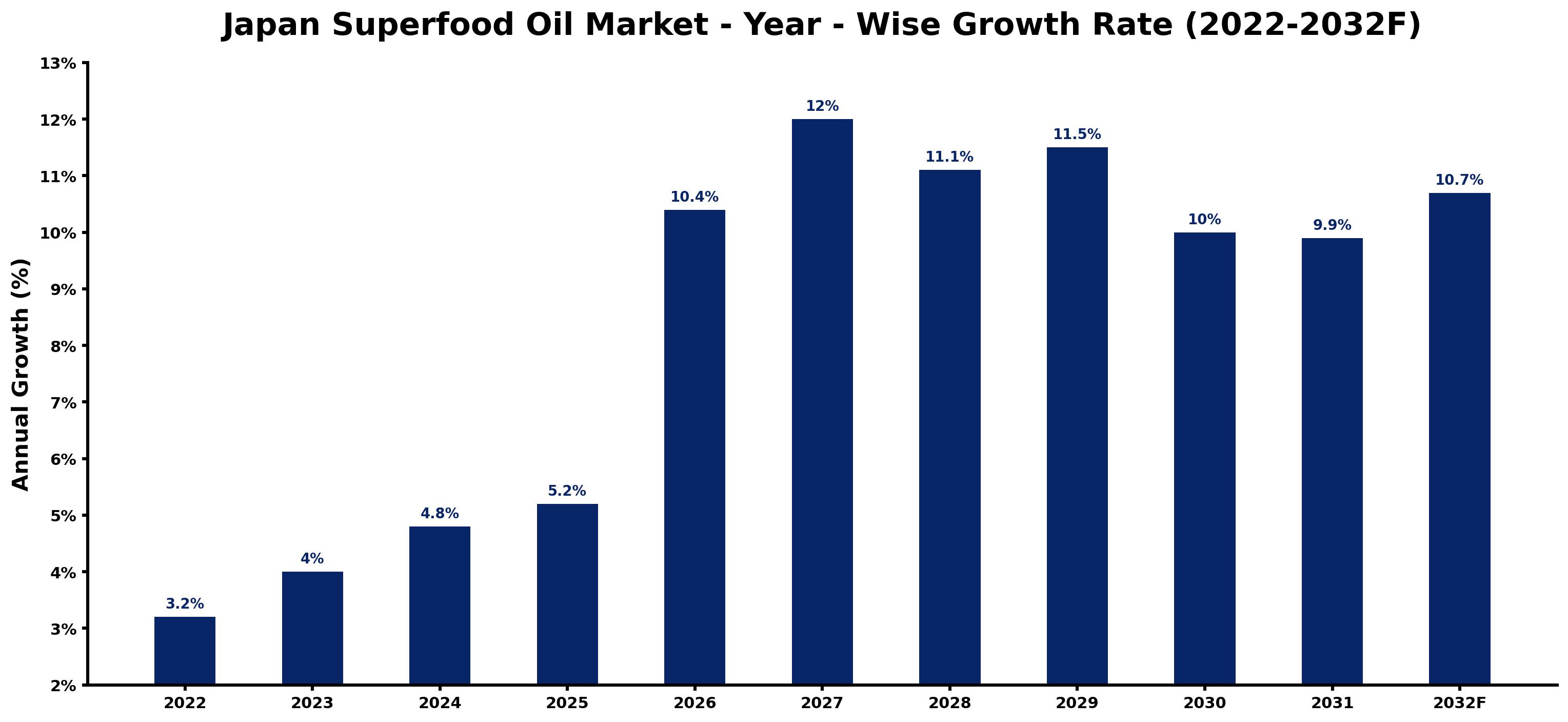
The following figures match every annual growth estimate with the main market development of that year, giving the reasoning behind each rise or slowdown.
| Year | Estimated Annual Growth (%) | Market Rationale |
| 2022 | 3.2 | The market showed steady growth as health trends gained traction among consumers. |
| 2023 | 4.0 | Increased awareness of health benefits drove faster growth in superfood oil consumption. |
| 2024 | 4.8 | Health-conscious consumer behaviour continued to support rising demand for superfood oils. |
| 2025 | 5.2 | The organic food market's expansion contributed to the peak growth rate observed this year. |
| 2026 | 10.4 | Growing investment in organic farming initiatives is expected to boost superfood oil production. |
| 2027 | 12.0 | The introduction of new health products is projected to drive the highest growth rate. |
| 2028 | 11.1 | Demand is anticipated to stabilise after peak levels, resulting in slower growth. |
| 2029 | 11.5 | Consumer interest in health products is expected to further increase demand this year. |
| 2030 | 10.0 | A slight slowdown is projected as the market adjusts to previous growth levels. |
| 2031 | 9.9 | The market is expected to continue growing, albeit at a slower rate. |
| 2032 | 10.7 | Continued health trends will support a resurgence in superfood oil demand. |
Note: Market size estimations and growth projections presented in this report are based on 6Wresearch's proprietary forecasting methodology, utilizing the latest available industry data, government publications, and primary research inputs.
Japan Superfood Oil Market Synopsis
Superfood oil, derived from nutrient-rich plants through methods like cold pressing, is gaining popularity in Japan for cooking, health supplements, and cosmetics. Avocado oil stands out among health-conscious consumers in urban centres. The Japan Superfood Oil Market is growing due to increased health awareness and a burgeoning organic food market valued at over 1 trillion yen. Investment in organic farming initiatives and rising demand for premium oils are further driving market expansion, with the Tokyo metropolitan area exhibiting the highest consumption levels.
Market Dynamics Impact Analysis (2026–2032)
| Factor | Type | Impact | Primary Segment Affected |
| Growing health consciousness among consumers | Driver | High | Health-Conscious Consumers |
| Rising popularity of organic products | Driver | High | Organic Food Brands |
| Increased demand for premium packaging | Opportunity | Medium | Glass Bottles |
| Expansion of wellness retail channels | Opportunity | Medium | Wellness Retailers |
| High production costs for organic oils | Restraint | High | Cold Pressed Avocado |
| Limited domestic production of certain oils | Restraint | High | Virgin Coconut |
| Competition from cheaper alternatives | Challenge | Medium | Flaxseed Oil |
| Supply chain disruptions affecting imports | Challenge | Medium | Chia Seed Oil |
Evaluation of Drivers in Japan Superfood Oil Market (2026–2032)
These are the developments adding the most demand over the forecast period.
| Drivers | Primary Segment Affected | Why It Matters (Evidence) |
| Increased consumer spending on health products | Health-Conscious Consumers | The average Japanese consumer spends about 3,000 yen monthly on health products, driving demand for superfood oils. |
| Growth of the organic food market | Organic Food Brands | The organic food market in Japan is valued at over 1 trillion yen, encouraging brands to incorporate superfood oils. |
| Rising awareness of health benefits | Nutritional Supplement Firms | Health trends are influencing nutritional supplement firms to include superfood oils in their products, promoting sales. |
| Expansion of retail channels | Wellness Retailers | Wellness retailers are expanding their product lines to include superfood oils, increasing market accessibility for consumers. |
| Growing popularity of cold pressed oils | Cold Pressed Avocado | Cold pressed oils are certified under JAS standards, attracting health-conscious consumers and boosting sales. |
The strongest pull on demand comes from increased consumer spending on health products, with the average Japanese consumer spending about 3,000 yen monthly. The organic food market, valued at over 1 trillion yen, encourages brands to incorporate superfood oils into their offerings. Health trends are prompting nutritional supplement firms to include these oils in their products, while wellness retailers are expanding their lines to feature superfood oils. The popularity of cold pressed oils, certified under JAS standards, is attracting health-conscious consumers, further boosting demand. The Tokyo metropolitan area leads in consumption, reflecting urban preferences for premium health products.
Evaluation of Restraints in Japan Superfood Oil Market
The key brakes on demand, and where they bite hardest, are shown below.
| Market Restraint | Primary Segment Affected | Why It Matters (Evidence) |
| High production costs for organic oils | Cold Pressed Avocado | Production costs for organic oils are high, limiting profit margins for producers and increasing prices for consumers. |
| Limited domestic production of certain oils | Virgin Coconut | Japan's limited domestic production of certain oils necessitates imports, impacting supply chains and availability. |
| Competition from cheaper alternatives | Flaxseed Oil | Competition from lower-priced alternatives is affecting market share for premium superfood oils among consumers. |
| Supply chain disruptions affecting imports | Chia Seed Oil | Supply chain disruptions are delaying imports, impacting availability for consumers and increasing wait times. |
| Regulatory compliance costs | Cold Pressed Flax | Compliance with stringent regulations increases operational costs for producers, affecting pricing strategies. |
Japan Superfood Oil Market Challenges
Buyers are contending with rising prices for superfood oils, especially in urban areas like Tokyo, where health-conscious consumer demand has driven prices up by approximately 10% annually. Producers face hurdles with organic certification processes, which can delay product availability by up to three months, affecting supply chains. Importers encounter challenges in complying with JAS standards for cold-pressed oils, which can increase costs and restrict market access for new entrants. Buyers also manage fluctuating availability of certain oils, resulting in inconsistent supply and higher costs, necessitating adjustments to their purchasing strategies.
Trends in the Japan Superfood Oil Market
These developments are changing demand patterns in the Japan Superfood Oil Market.
- Shift towards Sustainable Packaging: A noticeable shift towards sustainable packaging solutions is occurring in the superfood oil market. Glass Bottles held a 43% share in 2025, reflecting consumer preference for eco-friendly packaging.
- Rising Popularity of Cold Pressed Oils: Cold pressed oils are gaining traction due to their health benefits. The Tokyo metropolitan area has the highest demand for these oils, driving market growth.
- Increased Focus on Health Supplements: Health supplements are increasingly incorporating superfood oils, with the market for nutritional supplements projected to reach 1.5 trillion yen by 2025, indicating a strong opportunity for growth.
- Expansion of Wellness Retail Channels: Wellness retailers are expanding their product lines to include superfood oils. This trend is clear as these retailers increasingly cater to health-conscious consumers.
Investment Opportunities in the Japan Superfood Oil Market
Below are the investment opportunities with the strongest case in the Japan Superfood Oil Market.
- Health-Conscious Consumers: Health-conscious consumers are actively seeking premium superfood oils. With over 1 trillion yen in the organic food market, suppliers can effectively target this demographic to increase sales.
- Cold Pressed Oils: Cold pressed oils are rising in popularity due to their health benefits. Investing in production facilities for these oils can satisfy growing consumer demand and strengthen market presence.
- Growing Organic Food Market: The expansion of the organic food market presents an opportunity for suppliers to offer superfood oils. Targeting organic food brands can enhance market penetration and sales volume.
- Wellness Retailers: Wellness retailers are broadening their offerings, creating a demand for diverse superfood oils. Collaborating with these retailers can ease market entry and boost distribution.
Government Initiatives in the Japan Superfood Oil Market
The Food Sanitation Act amendment of 2018 established a positive list system for synthetic resins used in food packaging, which improves safety standards for superfood oils. This measure complements existing regulations, ensuring higher quality and safety for consumers. The amendment mandates producers to follow strict guidelines, which helps maintain consumer trust in the products and supports market integrity.
Wellness retailers benefit from government backing for organic farming initiatives, which promotes the use of superfood oils. The Ministry of Agriculture's programs encourage these retailers to source organic products, providing funding for organic certification that can assist retailers in expanding their product lines and enhancing market competitiveness.
Future Insight of the Japan Superfood Oil Market
By 2032, buyers will increasingly demand superfood oils, contributing to a projected growth in the nutritional supplements market to 1.5 trillion yen. Government initiatives will support sustainable agriculture, encouraging producers to implement eco-friendly practices. Technological advancements in extraction methods will improve oil quality and efficiency, benefiting suppliers. The trend towards premium packaging will continue, with glass bottles becoming the standard for high-quality oils, aligning with consumer preferences for sustainability and product integrity.
Market Segmentation Analysis
Japan Superfood Oil Market report covers a detailed analysis of the following market segments:
By Oil Type – Avocado Oil Leads, Coconut Oil Expected to Grow Fastest
According to Saurav Kr Singh, Senior Research Analyst at 6Wresearch, Avocado Oil held 49% of the Japan Superfood Oil Market by oil type in 2025. Avocado oil holds the largest share due to its extensive use in cooking and health products, appealing particularly to health-conscious consumers in urban areas. This oil's popularity is reflected in its widespread acceptance among various culinary and wellness applications. Coconut Oil is projected to grow fastest, at a CAGR of 14.8% during 2026–2032. Coconut oil is experiencing rapid growth, primarily driven by its increasing use in cooking and skincare. The rising consumer awareness regarding its health benefits is significantly contributing to its expanding market presence. Suppliers should prioritise coconut oil in their product offerings to capitalise on its growing popularity.
By Source Ingredient – Cold Pressed Avocado Leads, Virgin Coconut Expected to Grow Fastest
With 42% of source ingredient revenue in 2025, Cold Pressed Avocado was the largest category. Cold pressed avocado is the leading source ingredient, highly valued for its health benefits and consumer trust, bolstered by its certification under JAS standards. This recognition enhances its appeal among health-conscious consumers seeking quality oils. Over 2026–2032, Virgin Coconut is expected to post the fastest growth, at a CAGR of 15.4%. Virgin coconut is the fastest-growing source ingredient, appreciated for its versatility across various culinary and health applications. The increasing trend towards health-conscious eating habits is significantly driving its demand in multiple sectors. Buyers should consider integrating virgin coconut into their offerings to meet the rising consumer demand for versatile superfood oils.
By Packaging Type – Glass Bottles Lead, Jar Expected to Grow Fastest
Glass Bottles took 43% of packaging type revenue in 2025, more than any other category. Glass bottles dominate the packaging type segment as they are preferred for maintaining the quality and integrity of superfood oils. This preference is particularly evident among premium oil producers who prioritise product preservation and presentation. The quickest growth will come from Jar, forecast to expand at a CAGR of 14.9% between 2026 and 2032. Jars are emerging as the fastest-growing packaging type, commonly used for bulk oils due to their practicality and convenience. This trend aligns with consumer preferences for larger quantities of oils, driving their increased adoption in the market. Suppliers should explore jar packaging solutions to cater to the growing demand for bulk superfood oils.
By End User – Health-Conscious Consumers Lead, Organic Food Brands Expected to Grow Fastest
The largest end user category in 2025 was Health-Conscious Consumers, at 43% of revenue. Health-conscious consumers represent the largest end user group, actively seeking superfood oils for their nutritional benefits and health advantages. Their commitment to healthy living creates substantial demand, particularly in urban markets where wellness trends are prominent. Organic Food Brands are set to record the highest CAGR in this split, 14.0% over 2026–2032. Organic food brands are the fastest-growing end user segment, increasingly incorporating superfood oils into their product lines. The rising consumer preference for organic options is propelling this growth, reflecting a shift towards healthier eating habits. Suppliers should focus on organic food brands to align with the increasing trend towards health-oriented consumer choices.
Key Attractiveness of the Report
- 10 Years of Market Numbers
- Historical Data Starting from 2022 to 2025
- Base Year 2025
- Forecast Data until 2032
- Key Performance Indicators Impacting the Market
- Major Upcoming Developments and Projects
Key Highlights of the Report:
- Japan Superfood Oil Market Outlook
- Market Size of Japan Superfood Oil Market, 2025
- Forecast of Japan Superfood Oil Market, 2032
- Historical Data and Forecast of Japan Superfood Oil Revenues & Volume for the Period 2022-2032F
- Japan Superfood Oil Market Trend Evolution
- Japan Superfood Oil Market Drivers and Challenges
- Japan Superfood Oil Price Trends
- Japan Superfood Oil Porter's Five Forces
- Japan Superfood Oil Industry Life Cycle
- Historical Data and Forecast of Japan Superfood Oil Market Revenues & Volume By Oil Type for the Period 2022-2032F
- Historical Data and Forecast of Japan Superfood Oil Market Revenues & Volume By Avocado Oil for the Period 2022-2032F
- Historical Data and Forecast of Japan Superfood Oil Market Revenues & Volume By Coconut Oil for the Period 2022-2032F
- Historical Data and Forecast of Japan Superfood Oil Market Revenues & Volume By Chia Seed Oil for the Period 2022-2032F
- Historical Data and Forecast of Japan Superfood Oil Market Revenues & Volume By Flaxseed Oil for the Period 2022-2032F
- Historical Data and Forecast of Japan Superfood Oil Market Revenues & Volume By Source Ingredient for the Period 2022-2032F
- Historical Data and Forecast of Japan Superfood Oil Market Revenues & Volume By Cold Pressed Avocado for the Period 2022-2032F
- Historical Data and Forecast of Japan Superfood Oil Market Revenues & Volume By Virgin Coconut for the Period 2022-2032F
- Historical Data and Forecast of Japan Superfood Oil Market Revenues & Volume By Organic Seeds for the Period 2022-2032F
- Historical Data and Forecast of Japan Superfood Oil Market Revenues & Volume By Cold Pressed Flax for the Period 2022-2032F
- Historical Data and Forecast of Japan Superfood Oil Market Revenues & Volume By Packaging Type for the Period 2022-2032F
- Historical Data and Forecast of Japan Superfood Oil Market Revenues & Volume By Glass Bottles for the Period 2022-2032F
- Historical Data and Forecast of Japan Superfood Oil Market Revenues & Volume By Jar for the Period 2022-2032F
- Historical Data and Forecast of Japan Superfood Oil Market Revenues & Volume By Capsules for the Period 2022-2032F
- Historical Data and Forecast of Japan Superfood Oil Market Revenues & Volume By Sachets for the Period 2022-2032F
- Historical Data and Forecast of Japan Superfood Oil Market Revenues & Volume By End User for the Period 2022-2032F
- Historical Data and Forecast of Japan Superfood Oil Market Revenues & Volume By Health-Conscious Consumers for the Period 2022-2032F
- Historical Data and Forecast of Japan Superfood Oil Market Revenues & Volume By Organic Food Brands for the Period 2022-2032F
- Historical Data and Forecast of Japan Superfood Oil Market Revenues & Volume By Nutritional Supplement Firms for the Period 2022-2032F
- Historical Data and Forecast of Japan Superfood Oil Market Revenues & Volume By Wellness Retailers for the Period 2022-2032F
- Japan Superfood Oil Import Export Trade Statistics
- Market Opportunity Assessment By Oil Type
- Market Opportunity Assessment By Source Ingredient
- Market Opportunity Assessment By Packaging Type
- Market Opportunity Assessment By End User
- Japan Superfood Oil Top Companies Market Share
- Japan Superfood Oil Competitive Benchmarking By Technical and Operational Parameters
- Japan Superfood Oil Company Profiles
- Japan Superfood Oil Key Strategic Recommendations
Market Covered
This report examines the market across the segments below.
By Oil Type
- Avocado Oil
- Coconut Oil
- Chia Seed Oil
- Flaxseed Oil
By Source Ingredient
- Cold Pressed Avocado
- Virgin Coconut
- Organic Seeds
- Cold Pressed Flax
By Packaging Type
- Glass Bottles
- Jar
- Capsules
- Sachets
By End User
- Health-Conscious Consumers
- Organic Food Brands
- Nutritional Supplement Firms
- Wellness Retailers































