Japan Supergrain Market Size & Growth Rate
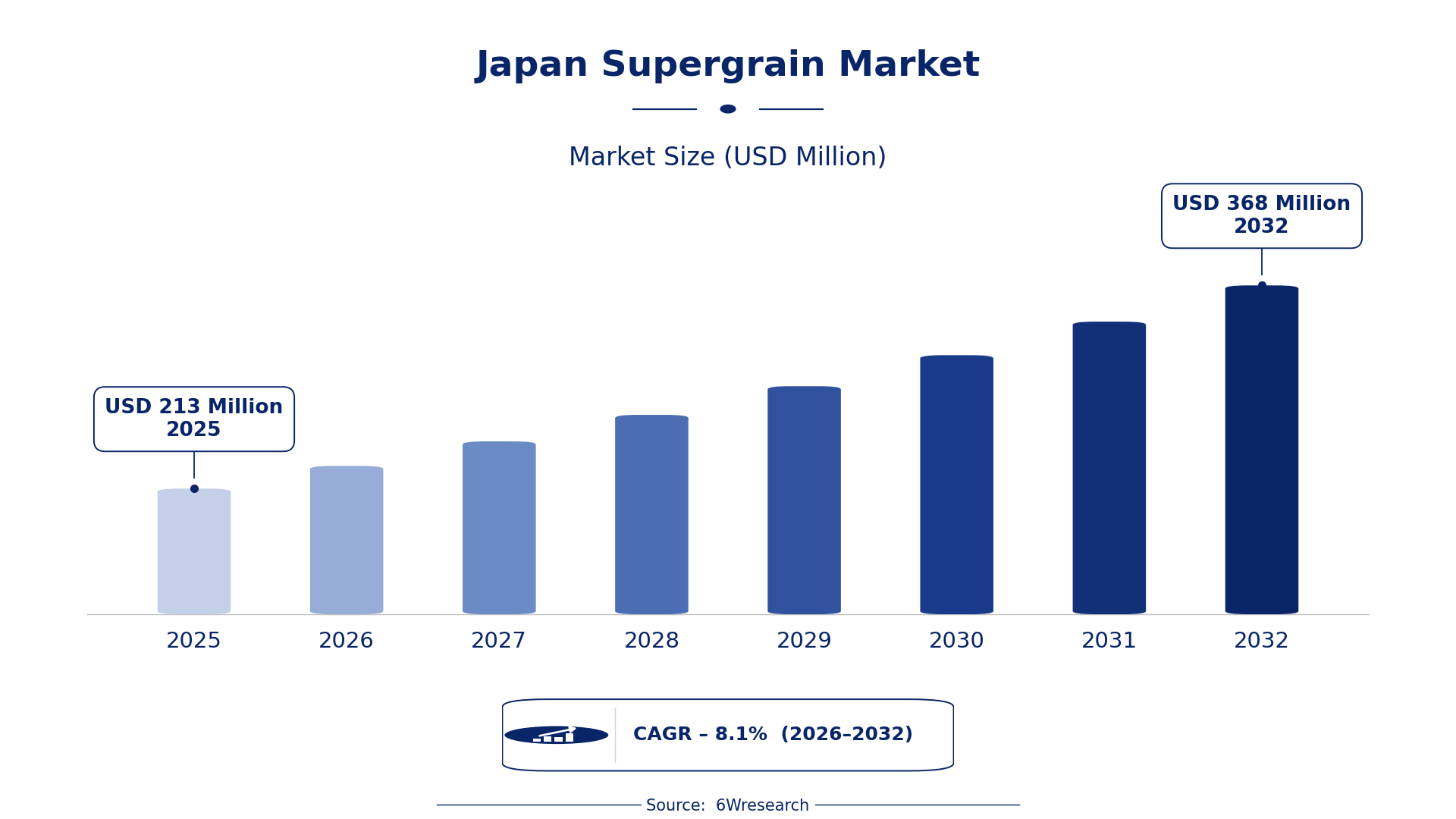
According to 6Wresearch internal database and industry insights, the Japan Supergrain Market was valued at USD 213 Million in 2025 and is projected to reach USD 368 Million by 2032, growing at a CAGR of approximately 8.1% during 2026–2032.
Japan Supergrain Market Highlights
| Report Metric | Details |
| Report Name | Japan Supergrain Market (2026-2032) |
| Market Size 2025 | USD 213 Million |
| Market Size 2032 | USD 368 Million |
| Absolute Growth 2025–2032 | USD 155 Million |
| CAGR 2026–2032 | 8.1% |
| Peak Annual Growth | 9.4% in 2028 |
| Forecast Period | 2026–2032 |
| Historical Data | 2022–2025 |
| Base Year | 2025 |
| Leading Product Type, 2025 | Quinoa-Based (49% share) |
| Leading Grain Type, 2025 | High Protein (43% share) |
| Leading Application Area, 2025 | Functional Foods (57% share) |
| Leading Distribution Channel, 2025 | Health Food Stores (47% share) |
| Leading End User, 2025 | Consumers (44% share) |
| Fastest-Growing Product Type | Ancient Grain Blends (11.5% CAGR) |
| Fastest-Growing Grain Type | Multi-Grain (11.7% CAGR) |
| Fastest-Growing Application Area | Ready-to-Eat Foods (9.3% CAGR) |
| Fastest-Growing Distribution Channel | Retail Chains (10.4% CAGR) |
| Fastest-Growing End User | Food Brands (10.1% CAGR) |
| Growing Sector | Ready-to-Eat Foods |
| Key End Users | Functional Foods, Ready-to-Eat Foods, Nutritional Supplements |
Japan Supergrain Market Year-wise Growth Rate and Key Drivers (2022–2032)
This graph illustrates the annual growth rates of the market from 2022 to 2032, highlighting a steady upward trajectory and projected market expansion over the forecast period.
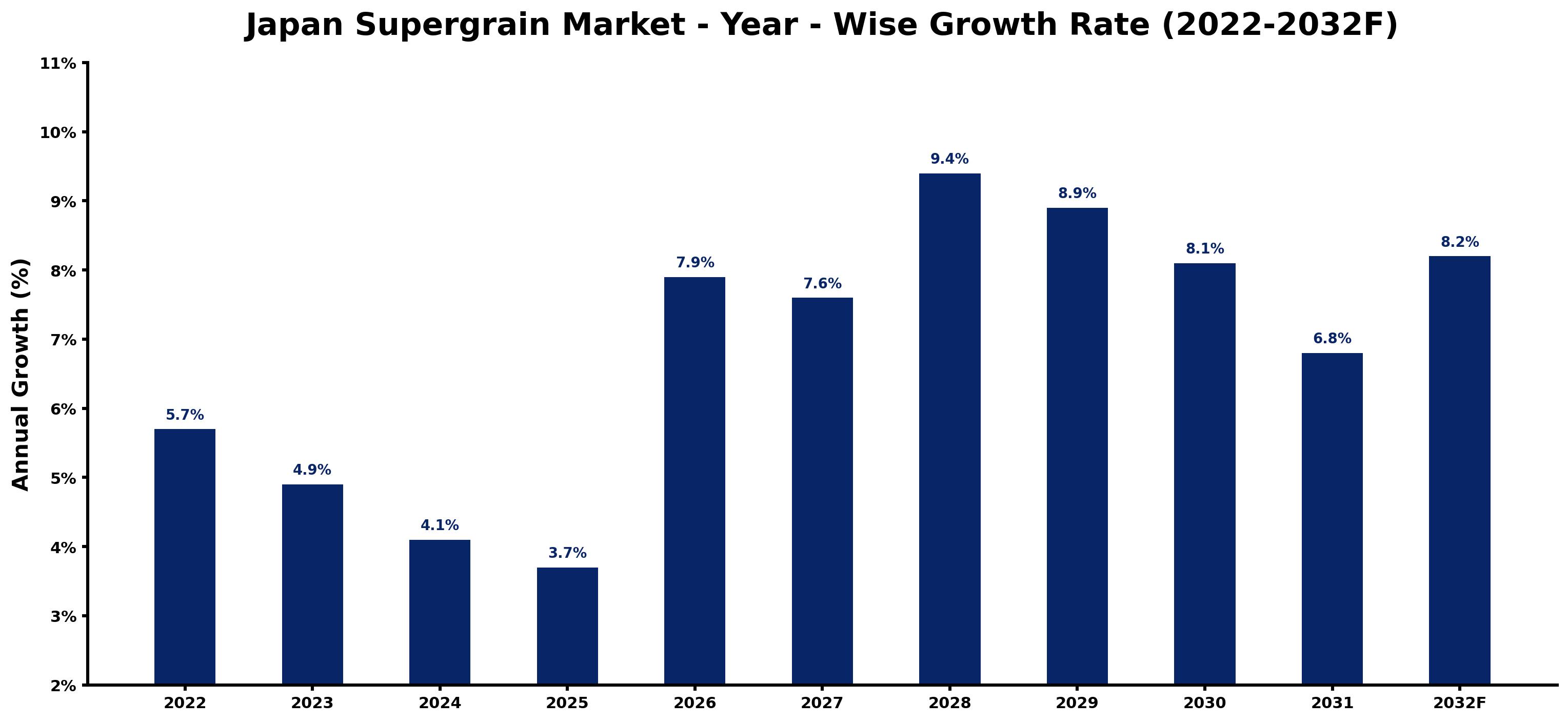
The following figures match every annual growth estimate with the main market development of that year, giving the reasoning behind each rise or slowdown.
| Year | Estimated Annual Growth (%) | Market Rationale |
| 2022 | 5.7 | Market demand was strong due to heightened health awareness among consumers. |
| 2023 | 4.9 | Growth slowed as health food trends faced increased competition from conventional products. |
| 2024 | 4.1 | Demand continued to moderate as consumers explored diverse dietary options. |
| 2025 | 3.7 | The market saw further slowdown as health food prices rose amid inflation. |
| 2026 | 7.9 | Demand rises as consumers increasingly seek high-protein food options. |
| 2027 | 7.6 | Growth slows slightly as market stabilises with established health trends. |
| 2028 | 9.4 | Demand spikes due to a surge in health-focused product launches. |
| 2029 | 8.9 | Growth decelerates as market saturation begins to affect new entrants. |
| 2030 | 8.1 | Demand slows as consumer preferences shift towards convenience foods. |
| 2031 | 6.8 | Growth moderates as competition intensifies among health food brands. |
| 2032 | 8.2 | Demand increases as organic and functional food trends gain traction. |
Note: Market size estimations and growth projections presented in this report are based on 6Wresearch's proprietary forecasting methodology, utilizing the latest available industry data, government publications, and primary research inputs.
Japan Supergrain Market Synopsis
Supergrain refers to nutrient-dense grains such as quinoa, cultivated sustainably and primarily used in health-focused food products. The Japan Supergrain Market is growing due to a health-conscious consumer base and increasing interest in organic and functional foods. The organic food market in Japan was valued at around 1.5 trillion JPY in 2022, driving demand for supergrains. Government initiatives to promote sustainable agriculture are creating new opportunities for growth in this sector, with rising imports of quinoa supporting the market's expansion.
Market Dynamics Impact Analysis (2026–2032)
| Factor | Type | Impact | Primary Segment Affected |
| Growing health consciousness among consumers | Driver | High | Quinoa-Based |
| Rising demand for organic food products | Driver | High | Organic Supergrains |
| Increasing interest in functional foods | Opportunity | High | Functional Foods |
| Expansion of health food retail channels | Opportunity | High | Health Food Stores |
| Competition from conventional grains | Restraint | Medium | High Protein |
| Price volatility in supergrain imports | Restraint | Medium | Ancient Grain Blends |
| High production costs for organic grains | Challenge | High | Organic Supergrains |
| Regulatory compliance for food safety standards | Challenge | High | Functional Foods |
Evaluation of Drivers in Japan Supergrain Market (2026–2032)
Below are the drivers that matter most for revenue growth, with supporting evidence.
| Drivers | Primary Segment Affected | Why It Matters (Evidence) |
| Health-conscious consumers increasingly prefer high-protein options | High Protein | The demand for nutritious food is rising, with 43% of consumers actively seeking high-protein products. |
| Growing popularity of quinoa as a superfood | Quinoa-Based | Quinoa's health benefits are driving imports from Peru and Bolivia, with rising sales in health food stores. |
| Increased focus on organic farming practices | Organic Supergrains | The organic food market's value of 1.5 trillion JPY in 2022 supports demand for organic supergrains. |
| Expansion of e-commerce platforms for health foods | Online Channels | Online sales are growing as consumers seek convenient access to health-focused products, increasing market reach. |
| Rising demand for ready-to-eat meals incorporating supergrains | Ready-to-Eat Foods | The trend towards convenience is increasing the incorporation of supergrains in ready-to-eat products. |
What keeps demand rising is the increasing focus on health and nutrition among consumers, particularly in urban areas like Tokyo. In 2022, the organic food market was valued at approximately 1.5 trillion JPY, which supports the demand for organic supergrains. Health food stores are expanding their product lines to include high-protein options, with 43% of consumers actively seeking such products. The rise of e-commerce platforms facilitates convenient access to health foods, further boosting sales. The trend towards ready-to-eat meals is incorporating supergrains, appealing to busy individuals prioritising health without sacrificing convenience.
Evaluation of Restraints in Japan Supergrain Market
The main factors holding the market back are set out below.
| Market Restraint | Primary Segment Affected | Why It Matters (Evidence) |
| High production costs for organic supergrains | Organic Supergrains | Producers face increased costs due to sustainable farming practices, affecting pricing strategies. |
| Competition from cheaper conventional grains | High Protein | Health food brands struggle to compete with lower-priced conventional alternatives, limiting market share. |
| Regulatory compliance costs for food safety | Functional Foods | Compliance with stringent food safety standards increases operational costs for producers, impacting profitability. |
| Supply chain disruptions affecting imports | Quinoa-Based | Quinoa imports from Peru and Bolivia are vulnerable to supply chain issues, impacting availability and prices. |
| Consumer price sensitivity in health food purchases | Ancient Grain Blends | Rising prices may deter health-conscious consumers from purchasing premium supergrains. |
Japan Supergrain Market Challenges
Health food retailers encounter fierce competition from imported supergrains, which can cause price fluctuations of up to 15% during supply shortages. This situation arises because Japan increasingly sources quinoa from Peru and Bolivia, making local producers vulnerable to external market conditions. Skills shortages in sustainable farming practices impede producers' capacity to meet the growing demand for organic supergrains, delaying production timelines by several weeks for retailers. Technology adoption lags, limiting producers' potential yield improvements of 20%, which restricts their operational efficiency and output. Compliance with ISO 22000 standards adds operational costs of 10%, straining smaller producers' budgets.
Trends in the Japan Supergrain Market
Buyers and suppliers in the Japan Supergrain Market are adjusting to the following trends.
- Shift Towards Organic Supergrains: The trend towards organic supergrains is gaining traction, with the organic food market valued at approximately 1.5 trillion JPY in 2022. This shift reflects a growing consumer preference for healthier food options, particularly in urban centres like Tokyo.
- Increase in E-commerce for Health Foods: E-commerce platforms are becoming increasingly popular for purchasing health foods, with online sales projected to grow by 10% annually. This trend allows consumers to access a wider variety of supergrain products conveniently.
- Rising Demand for Ready-to-Eat Products: The demand for ready-to-eat foods is increasing, with supergrains being incorporated into various convenient meal options. This trend aligns with the busy lifestyles of consumers seeking nutritious meals on the go.
- Focus on Functional Foods: There is a growing emphasis on functional foods that offer health benefits, with supergrains playing a key role. This trend is supported by rising consumer awareness of nutrition and health, with functional foods projected to grow significantly.
Investment Opportunities in the Japan Supergrain Market
The following opportunities in the Japan Supergrain Market pair current demand with a clear way in.
- Ideal Timing for Investment in Organic Supergrains: With the organic food market valued at 1.5 trillion JPY in 2022, now is an ideal time to invest in organic supergrains. Health food brands are increasingly looking for suppliers of organic products to meet consumer demand.
- Entry into E-commerce Channels: Expanding into e-commerce platforms presents a valuable opportunity for suppliers of supergrains. Collaborating with established online retailers can enhance market reach and accessibility, tapping into a growing consumer base.
- Investment in Ready-to-Eat Meal Solutions: The rising demand for ready-to-eat meals incorporating supergrains indicates a lucrative opportunity for producers. Focusing on innovative product formulations can attract health-conscious consumers seeking convenience.
- Strategic Partnerships with Health Food Stores: Forming partnerships with health food stores, particularly in urban areas, can facilitate market entry for new supergrain products. This approach allows suppliers to tap into a growing consumer base that prioritises health.
Government Initiatives in the Japan Supergrain Market
The Food Sanitation Act amendment (2018) introduced a positive list system for synthetic resins used in food packaging, impacting supergrain producers by ensuring compliance with safety standards. This regulation helps maintain consumer trust and safety in health food products, benefiting both producers and consumers.
The Digital Agency, established in September 2021, oversees government digital transformation and common system standards. This agency funds initiatives that enhance digital infrastructure for food safety management, supporting the growth of the supergrain market.
Future Insight of the Japan Supergrain Market
By 2032, a significant policy shift will reshape the supergrain market, driven by government initiatives that promote sustainable agriculture. This will lead to increased local production and encourage producers to adopt advanced farming technologies, improving yield and quality. Health food retailers will expand their offerings to cater to the rising interest in nutrient-dense foods. The government program aimed at supergrain cultivation is expected to boost local production by 30%, enhancing food security and reducing reliance on imports.
Market Segmentation Analysis
Japan Supergrain Market report covers a detailed analysis of the following market segments:
By Product Type – Quinoa-Based Leads, Ancient Grain Blends Expected to Grow Fastest
According to Vasu Joshi, Associate Consultant at 6Wresearch, the largest product type category in 2025 was Quinoa-Based, at 49% of revenue. Quinoa-based products hold a substantial market position due to their exceptional nutritional profile and widespread acceptance among health-conscious consumers. The integration of quinoa into health foods and nutritional supplements illustrates its strong demand in Japan. Ancient Grain Blends are projected to grow fastest, at a CAGR of 11.5% during 2026–2032. The ancient grain blends segment is rapidly expanding as consumers increasingly seek a variety of health benefits from different grains. This trend is highlighted by the growing popularity of functional food products that feature these blends. Suppliers should prioritise the development of quinoa-based and ancient grain blend products to satisfy the rising consumer interest.
By Grain Type – High Protein Leads, Multi-Grain Expected to Grow Fastest
High Protein held 43% of the Japan Supergrain Market by grain type in 2025. High protein grains hold the largest share as they are essential for health-conscious consumers seeking nutritious food options. The growing number of products highlighting high protein content reflects this demand for healthier alternatives. Over 2026–2032, Multi-Grain is expected to post the fastest growth, at a CAGR of 11.7%. The multi-grain segment is rapidly expanding due to its versatility in various food applications, appealing to a broad consumer demographic. This trend is particularly evident in the rising popularity of multi-grain products across diverse culinary categories. Suppliers should diversify their offerings to include both high protein and multi-grain products to cater to evolving consumer preferences.
By Application Area – Functional Foods Lead, Ready-to-Eat Foods Expected to Grow Fastest
Functional Foods took 57% of application area revenue in 2025, more than any other category. Functional foods dominate the application area, driven by robust consumer interest in products that deliver health benefits. This trend is particularly prominent as consumers increasingly seek foods that enhance wellness and nutritional value. Ready-to-Eat Foods are set to record the highest CAGR in this split, 9.3% over 2026–2032. Ready-to-eat foods are experiencing rapid growth as consumers prioritise convenience alongside health. The integration of supergrains into ready-to-eat products highlights the shift towards convenient yet health-oriented eating habits. Manufacturers must prioritise the development of functional and ready-to-eat food products to align with consumer preferences for health and convenience.
By Distribution Channel – Health Food Stores Lead, Retail Chains Expected to Grow Fastest
In 2025, Health Food Stores led the distribution channel split with a 47% share. Health food stores are the leading distribution channel for supergrains, directly serving health-focused consumers in urban areas. Their concentration in cities like Tokyo and Osaka underscores the strong market presence of this channel. The quickest growth will come from Retail Chains, forecast to expand at a CAGR of 10.4% between 2026 and 2032. Retail chains are seeing the fastest growth as they expand their range of supergrain products in supermarkets. This development is fuelled by increasing consumer demand for accessible health-focused food options. Suppliers should enhance collaborations with retail chains to boost product visibility and reach a wider consumer base.
By End User – Consumers Lead, Food Brands Expected to Grow Fastest
With 44% of end user revenue in 2025, Consumers was the largest category. Consumers represent the largest end-user group for supergrains, as they are the primary purchasers of health-oriented food products. This trend is reinforced by the growing awareness of nutrition and health benefits among the population. Food Brands are projected to grow fastest, at a CAGR of 10.1% during 2026–2032. Food brands are swiftly incorporating supergrains into their product formulations, responding to the increasing consumer demand for healthier options. This shift presents substantial opportunities for suppliers to partner with brands in creating appealing products. Suppliers should focus on building partnerships with food brands to leverage the rising trend of integrating supergrains into various product offerings.
Key Attractiveness of the Report
- 10 Years of Market Numbers
- Historical Data Starting from 2022 to 2025
- Base Year 2025
- Forecast Data until 2032
- Key Performance Indicators Impacting the Market
- Major Upcoming Developments and Projects
Key Highlights of the Report:
- Japan Supergrain Market Outlook
- Market Size of Japan Supergrain Market, 2025
- Forecast of Japan Supergrain Market, 2032
- Historical Data and Forecast of Japan Supergrain Market Revenues & Volume for the Period 2022-2032F
- Japan Supergrain Market Trend Evolution
- Japan Supergrain Market Drivers and Challenges
- Japan Supergrain Market Price Trends
- Japan Supergrain Market Porter's Five Forces
- Japan Supergrain Market Industry Life Cycle
- Historical Data and Forecast of Japan Supergrain Market Revenues & Volume By Product Type for the Period 2022-2032F
- Historical Data and Forecast of Japan Supergrain Market Revenues & Volume By Quinoa-Based for the Period 2022-2032F
- Historical Data and Forecast of Japan Supergrain Market Revenues & Volume By Ancient Grain Blends for the Period 2022-2032F
- Historical Data and Forecast of Japan Supergrain Market Revenues & Volume By Organic Supergrains for the Period 2022-2032F
- Historical Data and Forecast of Japan Supergrain Market Revenues & Volume By Grain Type for the Period 2022-2032F
- Historical Data and Forecast of Japan Supergrain Market Revenues & Volume By High Protein for the Period 2022-2032F
- Historical Data and Forecast of Japan Supergrain Market Revenues & Volume By Multi-Grain for the Period 2022-2032F
- Historical Data and Forecast of Japan Supergrain Market Revenues & Volume By Certified Organic for the Period 2022-2032F
- Historical Data and Forecast of Japan Supergrain Market Revenues & Volume By Application Area for the Period 2022-2032F
- Historical Data and Forecast of Japan Supergrain Market Revenues & Volume By Functional Foods for the Period 2022-2032F
- Historical Data and Forecast of Japan Supergrain Market Revenues & Volume By Ready-to-Eat Foods for the Period 2022-2032F
- Historical Data and Forecast of Japan Supergrain Market Revenues & Volume By Nutritional Supplements for the Period 2022-2032F
- Historical Data and Forecast of Japan Supergrain Market Revenues & Volume By Distribution Channel for the Period 2022-2032F
- Historical Data and Forecast of Japan Supergrain Market Revenues & Volume By Health Food Stores for the Period 2022-2032F
- Historical Data and Forecast of Japan Supergrain Market Revenues & Volume By Retail Chains for the Period 2022-2032F
- Historical Data and Forecast of Japan Supergrain Market Revenues & Volume By Online Channels for the Period 2022-2032F
- Historical Data and Forecast of Japan Supergrain Market Revenues & Volume By End User for the Period 2022-2032F
- Historical Data and Forecast of Japan Supergrain Market Revenues & Volume By Consumers for the Period 2022-2032F
- Historical Data and Forecast of Japan Supergrain Market Revenues & Volume By Food Brands for the Period 2022-2032F
- Historical Data and Forecast of Japan Supergrain Market Revenues & Volume By Nutrition Companies for the Period 2022-2032F
- Japan Supergrain Market Import Export Trade Statistics
- Market Opportunity Assessment By Product Type
- Market Opportunity Assessment By Grain Type
- Market Opportunity Assessment By Application Area
- Market Opportunity Assessment By Distribution Channel
- Market Opportunity Assessment By End User
- Japan Supergrain Market Top Companies Market Share
- Japan Supergrain Market Competitive Benchmarking By Technical and Operational Parameters
- Japan Supergrain Market Company Profiles
- Japan Supergrain Market Key Strategic Recommendations
Market Covered
The study includes the following segmentation.
By Product Type
- Quinoa-Based
- Ancient Grain Blends
- Organic Supergrains
By Grain Type
- High Protein
- Multi-Grain
- Certified Organic
By Application Area
- Functional Foods
- Ready-to-Eat Foods
- Nutritional Supplements
By Distribution Channel
- Health Food Stores
- Retail Chains
- Online Channels
By End User
- Consumers
- Food Brands
- Nutrition Companies






































