Japan Supersonic and Hypersonic Weapons Market Size & Growth Rate
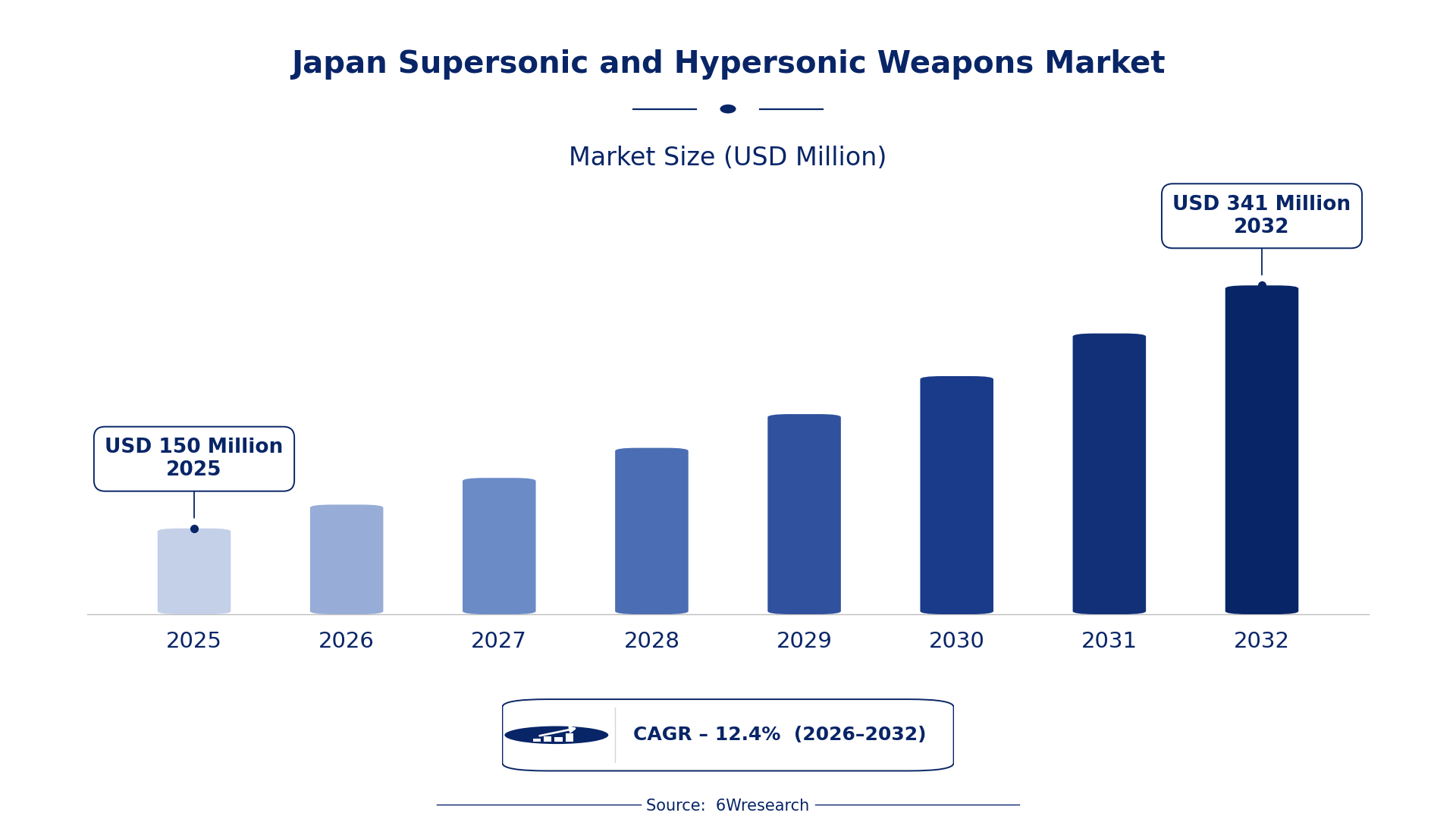
According to 6Wresearch internal database and industry insights, the Japan Supersonic and Hypersonic Weapons Market was valued at USD 150 Million in 2025 and is projected to reach USD 341 Million by 2032, growing at a CAGR of approximately 12.4% during 2026–2032.
Japan Supersonic and Hypersonic Weapons Market Highlights
| Report Metric | Details |
| Report Name | Japan Supersonic and Hypersonic Weapons Market (2026-2032) |
| Market Size 2025 | USD 150 Million |
| Market Size 2032 | USD 341 Million |
| Absolute Growth 2025–2032 | USD 191 Million |
| CAGR 2026–2032 | 12.4% |
| Peak Annual Growth | 16.2% in 2032 |
| Forecast Period | 2026–2032 |
| Historical Data | 2022–2025 |
| Base Year | 2025 |
| Leading Type, 2025 | Land Attack Cruise Missile (25% share) |
| Leading Application, 2025 | Attack (52% share) |
| Fastest-Growing Type | Air Launched Cruise Missile (18.2% CAGR) |
| Fastest-Growing Application | Defence (16.1% CAGR) |
| Growing Sector | military technology |
| Key End Users | government defense agencies, military contractors, defense technology firms |
Japan Supersonic and Hypersonic Weapons Market Year-wise Growth Rate and Key Drivers (2022–2032)
This graph illustrates the annual growth rates of the market from 2022 to 2032, highlighting a steady upward trajectory and projected market expansion over the forecast period.
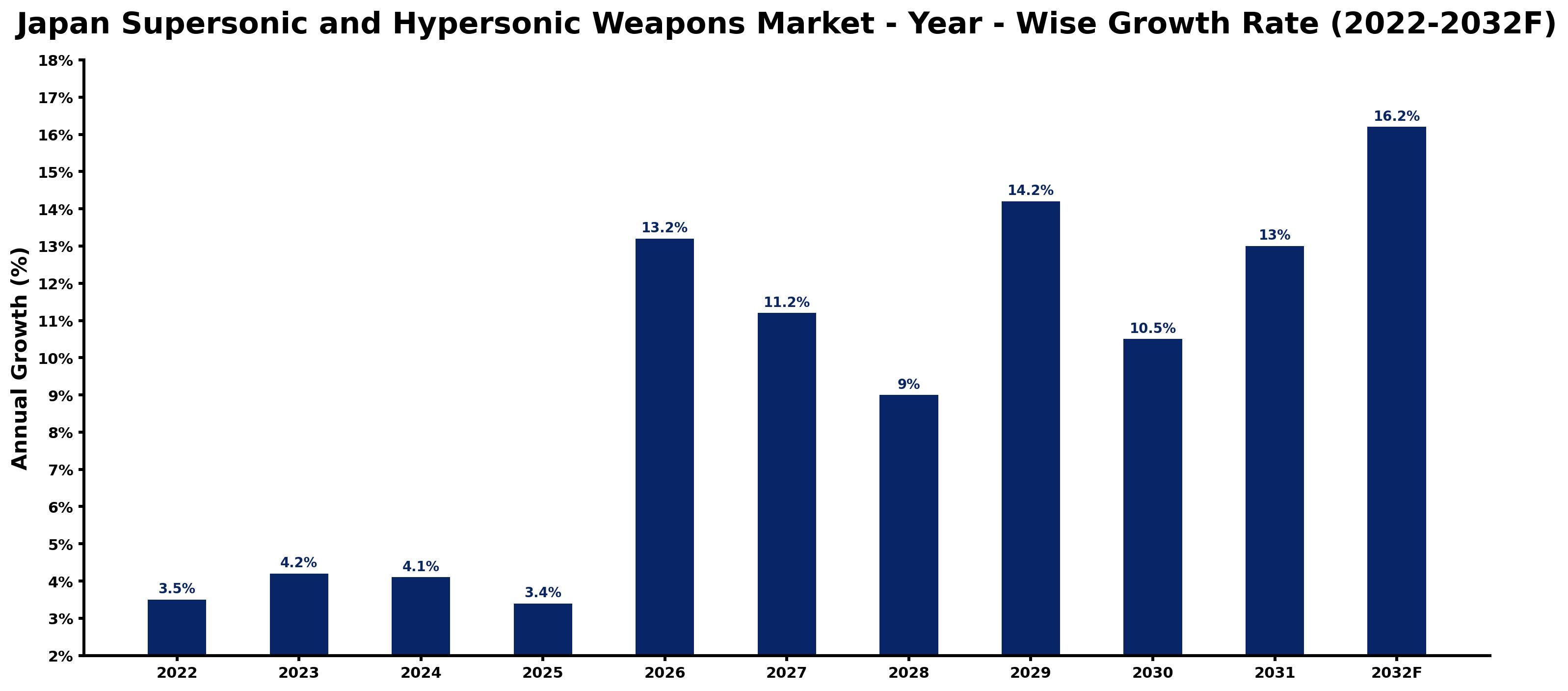
Year by year, the estimates below pair each growth rate with the development that shaped it.
| Year | Estimated Annual Growth (%) | Market Rationale |
| 2022 | 3.5 | The market showed steady growth, reflecting ongoing investments in defense technologies. |
| 2023 | 4.2 | Demand increased as the government focused on military capabilities and regional security. |
| 2024 | 4.1 | Growth slowed slightly due to a reassessment of defense priorities. |
| 2025 | 3.4 | Market expansion continued but at a reduced pace as budget allocations adjusted. |
| 2026 | 13.2 | Demand surged as the Ministry of Defense is expected to accelerate hypersonic development initiatives. |
| 2027 | 11.2 | Growth is projected to moderate as the market adjusts to technological advancements. |
| 2028 | 9.0 | The market is expected to experience a further slowdown as strategic planning takes precedence. |
| 2029 | 14.2 | Demand is anticipated to rebound sharply as new defense initiatives are announced. |
| 2030 | 10.5 | Growth will decelerate again as the focus shifts towards operational readiness. |
| 2031 | 13.0 | Demand is expected to increase as military modernization efforts advance. |
| 2032 | 16.2 | The market is projected to peak with advancements in hypersonic capabilities. |
Note: Market size estimations and growth projections presented in this report are based on 6Wresearch's proprietary forecasting methodology, utilizing the latest available industry data, government publications, and primary research inputs.
Japan Supersonic and Hypersonic Weapons Market Synopsis
Supersonic and hypersonic weapons are advanced military technologies designed for high-speed strike capabilities, essential for precision attacks on strategic targets. The Japan Supersonic and Hypersonic Weapons Market is driven by government defense initiatives and international collaborations. The defense budget for 2023 is approximately 6.8 trillion yen, with the Ministry of Defense planning to develop hypersonic capabilities by 2025. This focus on modernization and regional stability is propelling market growth, with a projected size of USD 341 million by 2032.
Market Dynamics Impact Analysis (2026–2032)
| Factor | Type | Impact | Primary Segment Affected |
| Increasing defense budget allocations | Driver | High | Hypersonic Glide Vehicle |
| Growing international collaborations in defense technology | Driver | High | Air Launched Cruise Missile |
| Investment in missile defense systems | Opportunity | High | Surface to Air Missile |
| Expansion of research facilities in Tokyo | Opportunity | Medium | Land Attack Cruise Missile |
| Regulatory compliance costs for defense manufacturers | Restraint | High | Anti-Ship Cruise Missile |
| Limited domestic production capacity for advanced technologies | Restraint | Medium | Tactical Ballistic Missile |
| Challenges in integrating new technologies into existing systems | Challenge | High | Hypersonic Glide Vehicle |
| Competition from international defense contractors | Challenge | Medium | Air Launched Cruise Missile |
Evaluation of Drivers in Japan Supersonic and Hypersonic Weapons Market (2026–2032)
Demand rests on the following drivers, each shown with the segment it touches most.
| Drivers | Primary Segment Affected | Why It Matters (Evidence) |
| Increased defense spending | Hypersonic Glide Vehicle | Japan's defense budget for 2023 is approximately 6.8 trillion yen, driving demand for advanced military technologies. |
| International collaborations | Air Launched Cruise Missile | Collaborations on missile technology drive demand for advanced solutions in the defense sector. |
| Missile defense enhancements | Surface to Air Missile | In 2023, Japan allocated 200 billion yen for missile defense enhancements, boosting procurement of advanced systems. |
| Research facility expansion | Land Attack Cruise Missile | The Tokyo region is a hub for defense technology research, increasing the development of advanced weaponry. |
| Strategic military initiatives | Anti-Ship Cruise Missile | The Anti-Ship Cruise Missile program is part of Japan's maritime strategy, increasing demand for effective naval weaponry. |
Volumes increase due to heightened defense spending, with Japan's defense budget reaching around 6.8 trillion yen in 2023. The allocation of 200 billion yen for missile defense fuels the procurement of advanced technologies. The Tokyo region's position as a research hub accelerates the development of sophisticated weapon systems. These elements stimulate growth in the supersonic and hypersonic weapons market.
Evaluation of Restraints in Japan Supersonic and Hypersonic Weapons Market
The following restraints limit how fast demand can grow.
| Market Restraint | Primary Segment Affected | Why It Matters (Evidence) |
| High regulatory compliance costs | Anti-Ship Cruise Missile | Manufacturers must adhere to ISO 9001 standards, increasing operational costs and affecting pricing. |
| Limited domestic production capacity | Tactical Ballistic Missile | Current production capabilities cannot meet the rising demand for advanced tactical systems. |
| Integration challenges with existing systems | Hypersonic Glide Vehicle | Incorporating new technologies into current military frameworks is complex and time-consuming. |
| Competition from international contractors | Air Launched Cruise Missile | Foreign defense contractors often offer advanced technologies at competitive prices. |
| Supply chain disruptions | Land Attack Cruise Missile | Global supply chain issues can delay the procurement of essential components. |
Japan Supersonic and Hypersonic Weapons Market Challenges
Japan's defense budget allocation for missile defense enhancements costs the Ministry of Defense approximately 200 billion yen, restricting funds for other initiatives. Lengthy regulatory approval processes can delay hypersonic weapon development by up to two years for producers, impacting their project timelines. Supply chain disruptions in sourcing advanced materials may postpone production schedules for manufacturers by six months, affecting their ability to meet defence demands. Rising technology development costs strain budgets, with the Defense Technology Agency facing funding challenges that hinder innovation, ultimately affecting suppliers' production capabilities.
Trends in the Japan Supersonic and Hypersonic Weapons Market
Below are the shifts with the largest effect on the Japan Supersonic and Hypersonic Weapons Market.
- Shift towards Advanced Hypersonic Capabilities: In 2025, Japan's Ministry of Defense plans to develop hypersonic capabilities, reflecting a strategic shift in defense priorities. This initiative is expected to drive investments in advanced military technologies.
- Transition from Conventional to Precision Strike Systems: Since 2023, Japan has focused on developing precision strike capabilities, exemplified by the Land Attack Cruise Missile program, which is vital for modern military operations.
- Emergence of Collaborative Defense Research: The Tokyo region has become a hub for defense technology research, with significant investments leading to advanced weapon systems and improved military readiness.
- Prioritisation of Missile Defense Enhancements: Japan's Self-Defense Forces are increasing their missile defense systems, targeting a 10% capability increase by 2025, reflecting a commitment to national security.
Investment Opportunities in the Japan Supersonic and Hypersonic Weapons Market
The opportunities below stand out in the Japan Supersonic and Hypersonic Weapons Market for new entrants and existing suppliers.
- Joint Ventures with Local Manufacturers: Establishing joint ventures with local manufacturers can ease entry into the Japanese market, particularly in the Tokyo region, where defense technology is flourishing.
- Investment in Research and Development Facilities: The ongoing expansion of research facilities in Tokyo offers opportunities for investment in advanced weapon systems, supported by the defense budget.
- Focus on Missile Defense Systems: With Japan allocating 200 billion yen for missile defense enhancements, suppliers can target this sector to address the demand for advanced technologies.
- Approval Pathways for Advanced Technologies: Navigating approval pathways for defense technologies can create opportunities in Japan's military sector, especially for advanced missile systems.
Government Initiatives in the Japan Supersonic and Hypersonic Weapons Market
The Battery Industry Strategy, initiated by METI in August 2022, aims to strengthen domestic production capabilities, indirectly benefiting the defense sector by ensuring a steady supply of advanced materials for weapon systems. Additionally, the GX Promotion Act of 2023 establishes a framework for sustainable practices, influencing defense manufacturers to adopt environmentally friendly technologies.
In 2023, Japan allocated 200 billion yen for missile defense enhancements, overseen by the Defense Technology Agency. This funding supports the development of advanced missile systems, ensuring alignment with national security objectives.
Future Insight of the Japan Supersonic and Hypersonic Weapons Market
By 2032, a focus on military advancements will lead to increased investment in hypersonic technologies, driven by government policy changes. Suppliers will adapt by developing cutting-edge materials and propulsion systems to meet new standards. Buyers will benefit from enhanced missile systems, as the Self-Defense Forces target a 10% increase in missile capabilities by 2025. The Tokyo region's prominence in defence technology research will accelerate advancements, reinforcing Japan's position in military innovation.
Market Segmentation Analysis
Japan Supersonic and Hypersonic Weapons Market report covers a detailed analysis of the following market segments:
By Type – Land Attack Cruise Missile Leads, Air Launched Cruise Missile Expected to Grow Fastest
According to Summon Dutta, Assistant Manager at 6Wresearch, Land Attack Cruise Missile took 25% of type revenue in 2025, more than any other category. Land Attack Cruise Missiles hold the largest market share due to their essential role in precision strikes against ground targets, which aligns with Japan's military strategy. The ongoing development in the Kanto region ensures advanced technology and a robust supply chain for these systems. Air Launched Cruise Missile is projected to grow fastest, at a CAGR of 18.2% during 2026–2032. Air Launched Cruise Missiles are experiencing rapid growth as they are deployed from aircraft for strategic attacks, enhancing operational flexibility. The Self-Defense Forces' target of a 10% increase in missile capabilities by 2025 will further accelerate this segment's expansion. Suppliers should focus on developing versatile missile systems to meet the rising demand for advanced military capabilities.
By Application – Attack Leads, Defence Expected to Grow Fastest
Attack accounted for 52% of the market by application in 2025. The Attack application leads the market as it is critical for effectively engaging strategic targets, which is a primary function of these weapons. This focus aligns with Japan's defence strategies that prioritise offensive capabilities to maintain national security. Over 2026–2032, Defence is expected to post the fastest growth, at a CAGR of 16.1%. The Defence application is growing swiftly due to the urgent need for national security and deterrence amid evolving geopolitical challenges. The allocation of 200 billion yen for missile defense enhancements in 2023 highlights the increasing emphasis on this area. Buyers must prioritise investments in defence capabilities to adequately address emerging security threats.
Key Attractiveness of the Report
- 10 Years of Market Numbers
- Historical Data Starting from 2022 to 2025
- Base Year 2025
- Forecast Data until 2032
- Key Performance Indicators Impacting the Market
- Major Upcoming Developments and Projects
Key Highlights of the Report:
- Japan Supersonic and Hypersonic Weapons Market Outlook
- Market Size of Japan Supersonic and Hypersonic Weapons Market, 2025
- Forecast of Japan Supersonic and Hypersonic Weapons Market, 2032
- Historical Data and Forecast of Japan Supersonic and Hypersonic Weapons Revenues & Volume for the Period 2022-2032
- Japan Supersonic and Hypersonic Weapons Market Trend Evolution
- Japan Supersonic and Hypersonic Weapons Market Drivers and Challenges
- Japan Supersonic and Hypersonic Weapons Price Trends
- Japan Supersonic and Hypersonic Weapons Porter's Five Forces
- Japan Supersonic and Hypersonic Weapons Industry Life Cycle
- Historical Data and Forecast of Japan Supersonic and Hypersonic Weapons Market Revenues & Volume By Type for the Period 2022-2032
- Historical Data and Forecast of Japan Supersonic and Hypersonic Weapons Market Revenues & Volume By Land Attack Cruise Missile for the Period 2022-2032
- Historical Data and Forecast of Japan Supersonic and Hypersonic Weapons Market Revenues & Volume By Air Launched Cruise Missile for the Period 2022-2032
- Historical Data and Forecast of Japan Supersonic and Hypersonic Weapons Market Revenues & Volume By Anti-Ship Cruise Missile for the Period 2022-2032
- Historical Data and Forecast of Japan Supersonic and Hypersonic Weapons Market Revenues & Volume By Hypersonic Glide Vehicle for the Period 2022-2032
- Historical Data and Forecast of Japan Supersonic and Hypersonic Weapons Market Revenues & Volume By Surface to Air Missile for the Period 2022-2032
- Historical Data and Forecast of Japan Supersonic and Hypersonic Weapons Market Revenues & Volume By Tactical Ballistic Missile for the Period 2022-2032
- Historical Data and Forecast of Japan Supersonic and Hypersonic Weapons Market Revenues & Volume By Non-Missile Kinetic Penetrators for the Period 2022-2032
- Historical Data and Forecast of Japan Supersonic and Hypersonic Weapons Market Revenues & Volume By Application for the Period 2022-2032
- Historical Data and Forecast of Japan Supersonic and Hypersonic Weapons Market Revenues & Volume By Attack for the Period 2022-2032
- Historical Data and Forecast of Japan Supersonic and Hypersonic Weapons Market Revenues & Volume By Defence for the Period 2022-2032
- Historical Data and Forecast of Japan Supersonic and Hypersonic Weapons Market Revenues & Volume By Others for the Period 2022-2032
- Japan Supersonic and Hypersonic Weapons Import Export Trade Statistics
- Market Opportunity Assessment By Type
- Market Opportunity Assessment By Application
- Japan Supersonic and Hypersonic Weapons Top Companies Market Share
- Japan Supersonic and Hypersonic Weapons Competitive Benchmarking By Technical and Operational Parameters
- Japan Supersonic and Hypersonic Weapons Company Profiles
- Japan Supersonic and Hypersonic Weapons Key Strategic Recommendations
Market Covered
The following segment groups are covered in the report.
By Type
- Land Attack Cruise Missile
- Air Launched Cruise Missile
- Anti-Ship Cruise Missile
- Hypersonic Glide Vehicle
- Surface to Air Missile
- Tactical Ballistic Missile
- Non-Missile Kinetic Penetrators
By Application
- Attack
- Defence
- Others






































