Japan supervisory control systems Market Size & Growth Rate
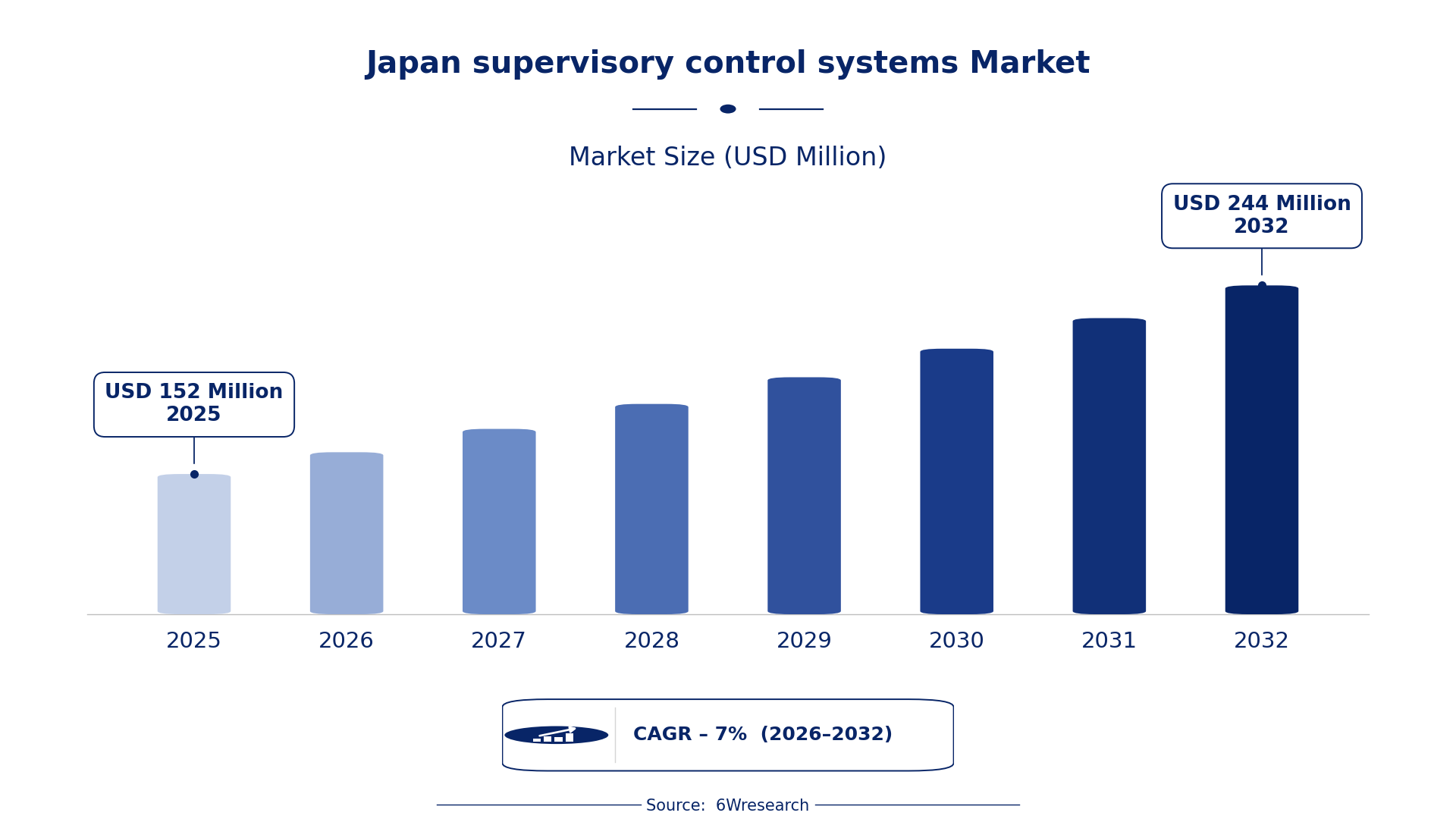
According to 6Wresearch internal database and industry insights, the Japan supervisory control systems Market was valued at USD 152 Million in 2025 and is projected to reach USD 244 Million by 2032, growing at a CAGR of approximately 7% during 2026–2032.
Japan supervisory control systems Market Highlights
| Report Metric | Details |
| Report Name | Japan supervisory control systems Market (2026-2032) |
| Market Size 2025 | USD 152 Million |
| Market Size 2032 | USD 244 Million |
| Absolute Growth 2025–2032 | USD 92 Million |
| CAGR 2026–2032 | 7% |
| Peak Annual Growth | 7.9% in 2026 |
| Forecast Period | 2026–2032 |
| Historical Data | 2022–2025 |
| Base Year | 2025 |
| Leading System Type, 2025 | SCADA Systems (42% share) |
| Leading Architecture Type, 2025 | Centralized (56% share) |
| Leading Control Level, 2025 | Plant-Level Monitoring (52% share) |
| Leading End User, 2025 | Power Generation Units (48% share) |
| Fastest-Growing System Type | HMI-Based Systems (9.6% CAGR) |
| Fastest-Growing Architecture Type | Modular (9.7% CAGR) |
| Fastest-Growing Control Level | Process Control (8.9% CAGR) |
| Fastest-Growing End User | Industrial Automation Firms (9.2% CAGR) |
| Growing Sector | Industrial Automation Firms |
| Key End Users | Power Generation Units, Oil Refining Plants, Utility Operators, Industrial Automation Firms |
Japan supervisory control systems Market Year-wise Growth Rate and Key Drivers (2022–2032)
This graph illustrates the annual growth rates of the market from 2022 to 2032, highlighting a steady upward trajectory and projected market expansion over the forecast period.
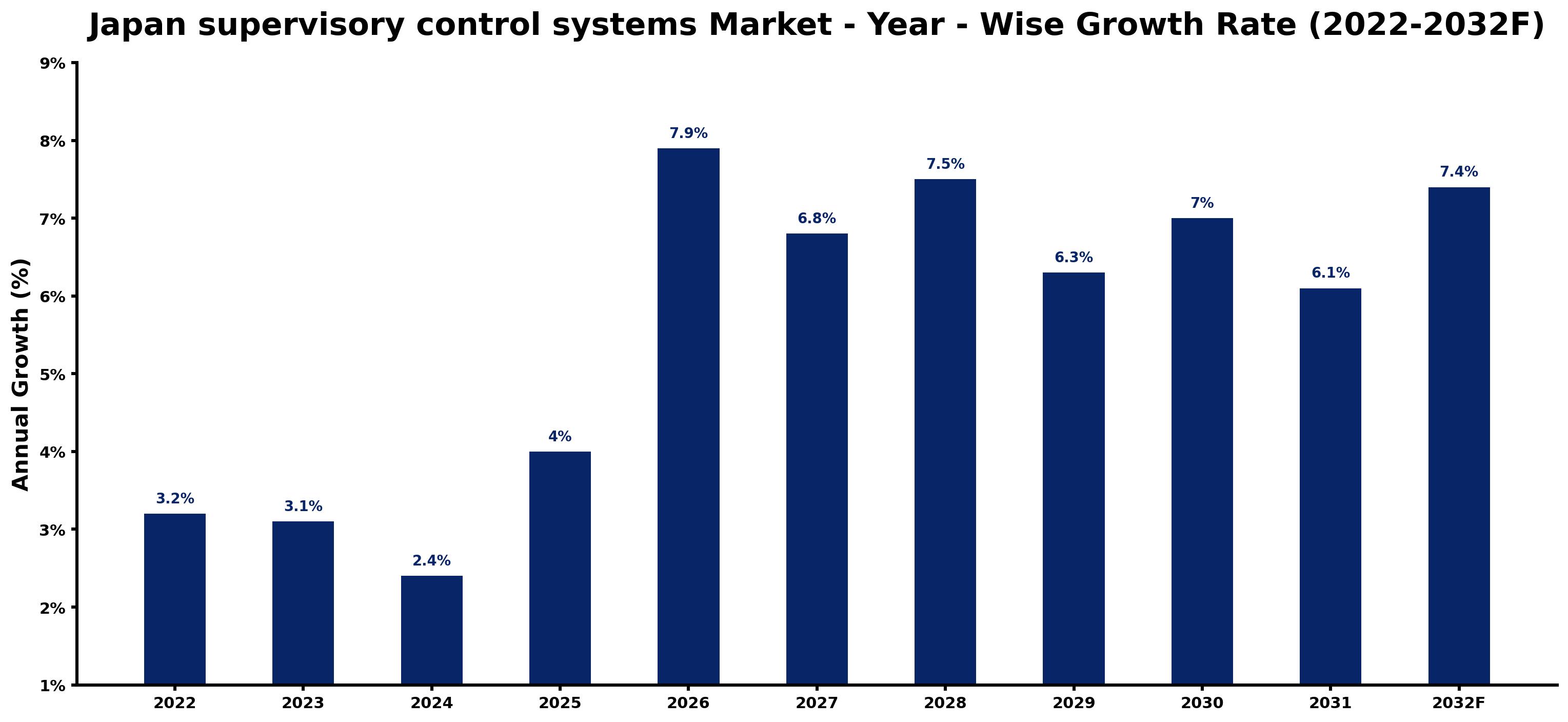
Annual growth estimates for each year appear below with the principal reason behind them, explaining the shifts that set the pace of the market.
| Year | Estimated Annual Growth (%) | Market Rationale |
| 2022 | 3.2 | Demand for supervisory control systems remained steady due to ongoing industrial operations. |
| 2023 | 3.1 | Growth slowed as firms focused on integrating existing technologies into operations. |
| 2024 | 2.4 | Market expansion continued to slow as companies faced challenges in upgrading systems. |
| 2025 | 4.0 | Increased investments in power generation drove faster growth in control systems. |
| 2026 | 7.9 | Demand surged with the implementation of new energy efficiency initiatives. |
| 2027 | 6.8 | Growth slowed as the market adjusted to higher demand levels from previous years. |
| 2028 | 7.5 | Investment in advanced control systems accelerated, driving renewed market growth. |
| 2029 | 6.3 | Growth moderated as firms consolidated their investments in automation technologies. |
| 2030 | 7.0 | Demand increased as companies upgraded aging facilities to improve efficiency. |
| 2031 | 6.1 | Market growth slowed as many firms completed major upgrades and investments. |
| 2032 | 7.4 | Demand will rise with ongoing investments in smart manufacturing technologies. |
Note: Market size estimations and growth projections presented in this report are based on 6Wresearch's proprietary forecasting methodology, utilizing the latest available industry data, government publications, and primary research inputs.
Japan supervisory control systems Market Synopsis
Supervisory control systems are advanced solutions for monitoring and controlling industrial processes, integrating hardware and software for real-time data collection. The Japan supervisory control systems Market is expanding due to investments in power generation and oil refining, which require improved operational efficiency. With Japan's power generation capacity at approximately 1,000 GW, the need for these systems is critical. The Tokyo metropolitan area serves as a hub for industrial automation, further driving demand for these technologies.
Market Dynamics Impact Analysis (2026–2032)
| Factor | Type | Impact | Primary Segment Affected |
| Growing investments in power generation facilities | Driver | High | Power Generation Units |
| Increasing focus on energy efficiency in industrial processes | Driver | High | Oil Refining Plants |
| Rising demand for automation in industrial sectors | Opportunity | High | Industrial Automation Firms |
| Expansion of smart manufacturing initiatives | Opportunity | Medium | Utility Operators |
| Challenges in integrating legacy systems with new technologies | Restraint | High | SCADA Systems |
| High costs associated with upgrading control systems | Restraint | Medium | Distributed Control Systems |
| Limited availability of skilled personnel for system implementation | Challenge | High | HMI-Based Systems |
| Supply chain disruptions affecting component availability | Challenge | Medium | PLC-Integrated Systems |
Evaluation of Drivers in Japan supervisory control systems Market (2026–2032)
Below are the drivers that matter most for revenue growth, with supporting evidence.
| Drivers | Primary Segment Affected | Why It Matters (Evidence) |
| Investment in new power generation projects | Power Generation Units | Japan's power generation capacity is approximately 1,000 GW, necessitating advanced supervisory control systems for efficiency. |
| Focus on energy efficiency initiatives | Oil Refining Plants | In 2023, Japan launched a program to improve energy efficiency in industrial sectors, driving demand for control technologies. |
| Increase in industrial automation spending | Industrial Automation Firms | The annual investment in industrial automation in Japan is projected to exceed 1 trillion JPY by 2025, prompting higher purchases of control systems. |
| Adoption of industry standards like ISO 9001 | Utility Operators | ISO 9001 is widely adopted by firms in Japan to ensure quality management in control systems, prompting upgrades. |
| Aging power generation facilities requiring upgrades | SCADA Systems | The average age of power generation facilities in Japan is over 30 years, driving the need for modern supervisory control systems. |
Behind the steady rise in orders sits Japan's extensive power generation capacity, which is approximately 1,000 GW, requiring advanced supervisory control systems for operational efficiency. The annual investment in industrial automation is expected to exceed 1 trillion JPY by 2025, prompting increased purchases from various sectors. The average age of power generation facilities, over 30 years, necessitates upgrades to existing control systems. The adoption of ISO 9001 standards ensures quality management, prompting further investments in supervisory control systems.
Evaluation of Restraints in Japan supervisory control systems Market
The key brakes on demand, and where they bite hardest, are shown below.
| Market Restraint | Primary Segment Affected | Why It Matters (Evidence) |
| High costs of advanced supervisory control systems | Power Generation Units | Rising operational expenses due to Japan's minimum wage increase to JPY 1,055 per hour in October 2024 limit buyer investments. |
| Aging facilities requiring upgrades | Oil Refining Plants | The average age of power generation plants exceeds 30 years, leading to costly upgrades and inefficiencies. |
| Pressure on lead times and availability | SCADA Systems | High demand for control systems in oil refining, with capacity around 4.5 million barrels per day, complicates supply. |
| Intense competition from international suppliers | Industrial Automation Firms | Local suppliers face pricing pressures, jeopardising margins and affecting overall market competitiveness. |
| Complex integration of new technologies | Utility Operators | The need for seamless integration with existing systems creates challenges for buyers in adopting new solutions. |
Japan supervisory control systems Market Challenges
Japan's minimum wage increase to JPY 1,055 per hour raises operational costs, affecting budgets for power generation companies. Many producers face inefficiencies due to the average age of power generation facilities surpassing 30 years, complicating timely upgrades and resulting in higher expenses. Suppliers encounter delays as the oil refining sector, with a capacity of approximately 4.5 million barrels per day, experiences strong demand for supervisory control systems. Local manufacturers contend with international competitors, necessitating price reductions that jeopardise their profit margins.
Trends in the Japan supervisory control systems Market
The shifts below are changing how Japan supervisory control systems Market products are bought and supplied.
- Shift from Traditional to Smart Control Systems: In 2023, Japan's industrial sectors began adopting smart control systems, with 30% of firms integrating IoT technologies for real-time monitoring. This shift facilitates data analysis, improving operational efficiency.
- Transition to Modular Architecture: The trend towards modular architecture in supervisory control systems gained momentum in 2023, with a 25% increase in installations. This approach allows for flexible scaling and simpler upgrades, appealing to various industries.
- Emergence of Energy Efficiency Standards: The introduction of new energy efficiency standards in 2023 led to a marked increase in demand for advanced control systems. Industries are now prioritising technologies that comply with these standards to maintain competitiveness.
- Growing Demand for Visual Interfaces: Since 2023, there has been a marked rise in the adoption of visual interfaces in control systems, with over 40% of new installations featuring user-friendly designs. This trend improves operator interaction and process management.
Investment Opportunities in the Japan supervisory control systems Market
Several openings in the Japan supervisory control systems Market merit attention from investors.
- Investment in Upgrading Aging Facilities: With Japan's average power generation facility age exceeding 30 years, there is an increasing need for upgrades. This presents a JPY 500 billion opportunity for suppliers focused on modernisation efforts.
- Expansion of Smart Manufacturing Technologies: The ongoing drive for smart manufacturing creates a JPY 200 billion market for advanced supervisory control systems. Collaborating with local industrial automation firms will ease entry into this sector.
- Focus on Energy Efficiency Improvements: The launch of new energy efficiency initiatives in 2023 opens a JPY 300 billion opportunity for suppliers of control technologies. Engaging with utility operators can strengthen market presence.
- Development of Modular Control Systems: The shift towards modular control systems presents a JPY 150 billion opportunity for suppliers. Targeting industrial automation firms in the Tokyo metropolitan area will help capture this demand.
Government Initiatives in the Japan supervisory control systems Market
The Electrical Appliance and Material Safety Act (1961) governs the safety of electrical appliances and materials sold in Japan, ensuring that producers adhere to safety standards. This law requires thorough testing and certification processes for supervisory control systems, affecting both manufacturers and importers. The Industrial Safety and Health Act (1972) establishes employer responsibilities regarding hazardous substances and machinery, compelling firms to invest in safer control technologies.
In 2023, Japan initiated a programme to improve energy efficiency in industrial sectors, providing funding for projects that incorporate advanced control technologies. The Ministry of Economy, Trade and Industry (METI) oversees this initiative, supporting firms that adopt modern supervisory control systems.
Future Insight of the Japan supervisory control systems Market
Investment in industrial automation is projected to exceed 1 trillion JPY annually by 2025, driving demand for advanced supervisory control systems. By 2032, energy efficiency programmes will necessitate substantial upgrades in technology, benefiting both producers and suppliers. The Japan Automation and Control Society's promotion of standards will improve quality management, ensuring reliability in operations. As the installed base of supervisory control systems expands, suppliers will encounter more opportunities to innovate and address specific market needs.
Market Segmentation Analysis
Japan supervisory control systems Market report covers a detailed analysis of the following market segments:
By System Type – SCADA Systems Lead, HMI-Based Systems Expected to Grow Fastest
According to Saurav Kr Singh, Senior Research Analyst at 6Wresearch, SCADA Systems accounted for 42% of the market by system type in 2025. SCADA systems dominate the market as they are extensively utilised for real-time data acquisition and control in sectors like power generation. Their significant installed base of around 10,000 units in Japan highlights their critical role in enhancing operational efficiency. Over 2026–2032, HMI-Based Systems are expected to post the fastest growth, at a CAGR of 9.6%. HMI-based systems are witnessing rapid growth due to their essential function in improving operator interaction and process visualisation, particularly in the Tokyo metropolitan area, a key industrial automation hub. The rising demand for user-friendly interfaces in control technologies is further accelerating this segment's expansion. Suppliers should concentrate on developing advanced HMI solutions to cater to the growing need for enhanced operator engagement.
By Architecture Type – Centralized Leads, Modular Expected to Grow Fastest
In 2025, Centralized led the architecture type split with a 56% share. Centralised architecture is prevalent in Japan, especially in large facilities where streamlined control is essential for operational efficiency. This approach is particularly beneficial for power generation units that require cohesive monitoring across multiple processes. The quickest growth will come from Modular, forecast to expand at a CAGR of 9.7% between 2026 and 2032. Modular architecture is gaining traction as it allows for flexibility in specific applications, catering to the unique needs of various industries. The annual investment in industrial automation exceeding 1 trillion JPY by 2025 supports this trend. Buyers may seek modular solutions to improve adaptability and scalability in their control systems.
By Control Level – Plant-Level Monitoring Leads, Process Control Expected to Grow Fastest
Plant-Level Monitoring took 52% of control level revenue in 2025, more than any other category. Plant-level monitoring is crucial for overseeing entire plant operations, establishing it as the leading control level in Japan's supervisory control systems market. This level of monitoring is particularly important for power generation facilities that demand high efficiency and reliability. Process Control is projected to grow fastest, at a CAGR of 8.9% during 2026–2032. Process control is rapidly expanding as it is vital for maintaining optimal operational parameters, especially in industries with stringent efficiency requirements. The current focus on energy efficiency in industrial sectors is driving this segment's growth. Suppliers should focus on process control solutions to meet the increasing demand for operational optimisation.
By End User – Power Generation Units Lead, Industrial Automation Firms Expected to Grow Fastest
Power Generation Units held 48% of the Japan supervisory control systems Market by end user in 2025. Power generation units are the main users of supervisory control systems, employing them to boost efficiency and reliability in their operations. With Japan's power generation capacity at around 1,000 GW, this segment commands a substantial share of the market. Industrial Automation Firms are set to record the highest CAGR in this split, 9.2% over 2026–2032. Industrial automation firms are accelerating growth by integrating various control technologies to streamline operations, particularly in light of government initiatives for smart manufacturing. Their rising investments in automation technologies are driving this swift expansion. Suppliers must tailor their offerings to meet the specific needs of industrial automation firms to capture this growing market.
Key Attractiveness of the Report
- 10 Years of Market Numbers
- Historical Data Starting from 2022 to 2025
- Base Year 2025
- Forecast Data until 2032
- Key Performance Indicators Impacting the Market
- Major Upcoming Developments and Projects
Key Highlights of the Report:
- Japan supervisory control systems Market Outlook
- Market Size of Japan supervisory control systems Market, 2025
- Forecast of Japan supervisory control systems Market, 2032
- Historical Data and Forecast of Japan supervisory control systems Revenues & Volume for the Period 2022-2032F
- Japan supervisory control systems Market Trend Evolution
- Japan supervisory control systems Market Drivers and Challenges
- Japan supervisory control systems Price Trends
- Japan supervisory control systems Porter's Five Forces
- Japan supervisory control systems Industry Life Cycle
- Historical Data and Forecast of Japan supervisory control systems Market Revenues & Volume By System Type for the Period 2022-2032F
- Historical Data and Forecast of Japan supervisory control systems Market Revenues & Volume By SCADA Systems for the Period 2022-2032F
- Historical Data and Forecast of Japan supervisory control systems Market Revenues & Volume By Distributed Control Systems for the Period 2022-2032F
- Historical Data and Forecast of Japan supervisory control systems Market Revenues & Volume By HMI-Based Systems for the Period 2022-2032F
- Historical Data and Forecast of Japan supervisory control systems Market Revenues & Volume By PLC-Integrated Systems for the Period 2022-2032F
- Historical Data and Forecast of Japan supervisory control systems Market Revenues & Volume By Architecture Type for the Period 2022-2032F
- Historical Data and Forecast of Japan supervisory control systems Market Revenues & Volume By Centralized for the Period 2022-2032F
- Historical Data and Forecast of Japan supervisory control systems Market Revenues & Volume By Hierarchical for the Period 2022-2032F
- Historical Data and Forecast of Japan supervisory control systems Market Revenues & Volume By Visual Interface for the Period 2022-2032F
- Historical Data and Forecast of Japan supervisory control systems Market Revenues & Volume By Modular for the Period 2022-2032F
- Historical Data and Forecast of Japan supervisory control systems Market Revenues & Volume By Control Level for the Period 2022-2032F
- Historical Data and Forecast of Japan supervisory control systems Market Revenues & Volume By Plant-Level Monitoring for the Period 2022-2032F
- Historical Data and Forecast of Japan supervisory control systems Market Revenues & Volume By Process Control for the Period 2022-2032F
- Historical Data and Forecast of Japan supervisory control systems Market Revenues & Volume By Operator Control for the Period 2022-2032F
- Historical Data and Forecast of Japan supervisory control systems Market Revenues & Volume By Equipment-Level Management for the Period 2022-2032F
- Historical Data and Forecast of Japan supervisory control systems Market Revenues & Volume By End User for the Period 2022-2032F
- Historical Data and Forecast of Japan supervisory control systems Market Revenues & Volume By Power Generation Units for the Period 2022-2032F
- Historical Data and Forecast of Japan supervisory control systems Market Revenues & Volume By Oil Refining Plants for the Period 2022-2032F
- Historical Data and Forecast of Japan supervisory control systems Market Revenues & Volume By Industrial Automation Firms for the Period 2022-2032F
- Historical Data and Forecast of Japan supervisory control systems Market Revenues & Volume By Utility Operators for the Period 2022-2032F
- Japan supervisory control systems Import Export Trade Statistics
- Market Opportunity Assessment By System Type
- Market Opportunity Assessment By Architecture Type
- Market Opportunity Assessment By Control Level
- Market Opportunity Assessment By End User
- Japan supervisory control systems Top Companies Market Share
- Japan supervisory control systems Competitive Benchmarking By Technical and Operational Parameters
- Japan supervisory control systems Company Profiles
- Japan supervisory control systems Key Strategic Recommendations
Market Covered
The study includes the following segmentation.
By System Type
- SCADA Systems
- Distributed Control Systems
- HMI-Based Systems
- PLC-Integrated Systems
By Architecture Type
- Centralized
- Hierarchical
- Visual Interface
- Modular
By Control Level
- Plant-Level Monitoring
- Process Control
- Operator Control
- Equipment-Level Management
By End User
- Power Generation Units
- Oil Refining Plants
- Industrial Automation Firms
- Utility Operators































