Japan Supply Chain Authentication Market Size & Growth Rate
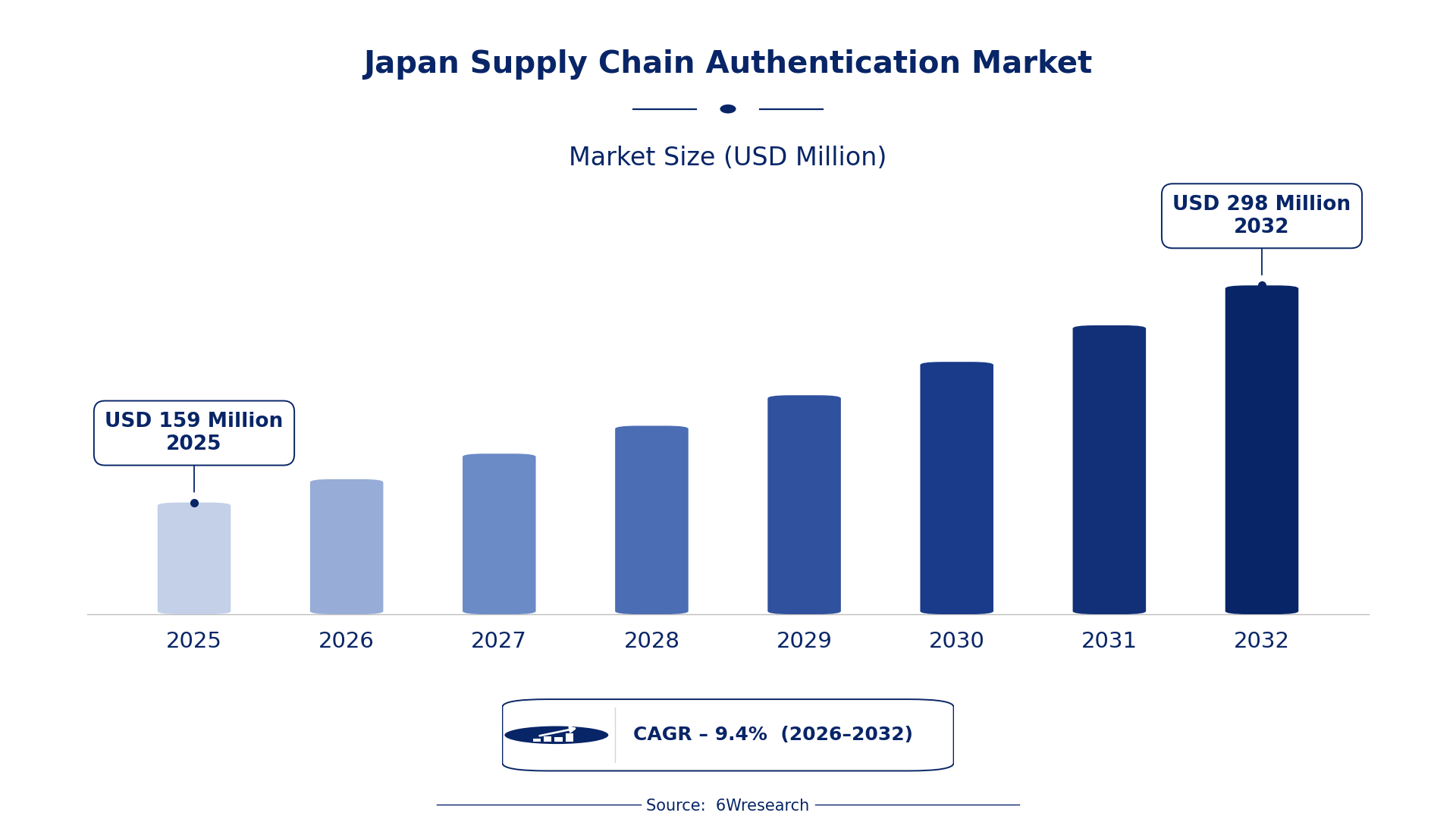
According to 6Wresearch internal database and industry insights, the Japan Supply Chain Authentication Market was valued at USD 159 Million in 2025 and is projected to reach USD 298 Million by 2032, growing at a CAGR of approximately 9.4% during 2026–2032.
Japan Supply Chain Authentication Market Highlights
| Report Metric | Details |
| Report Name | Japan Supply Chain Authentication Market (2026-2032) |
| Market Size 2025 | USD 159 Million |
| Market Size 2032 | USD 298 Million |
| Absolute Growth 2025–2032 | USD 139 Million |
| CAGR 2026–2032 | 9.4% |
| Peak Annual Growth | 11.0% in 2032 |
| Forecast Period | 2026–2032 |
| Historical Data | 2022–2025 |
| Base Year | 2025 |
| Leading Authentication Type, 2025 | Product Serialization (39% share) |
| Leading Technology Used, 2025 | QR Code/RFID (41% share) |
| Leading Industry Application, 2025 | Pharma (48% share) |
| Leading End User, 2025 | Medical Supply Chains (48% share) |
| Fastest-Growing Authentication Type | Blockchain-Based Tracking (13.8% CAGR) |
| Fastest-Growing Technology Used | Distributed Ledger (14.0% CAGR) |
| Fastest-Growing Industry Application | Electronics (12.2% CAGR) |
| Growing Sector | Pharmaceuticals |
| Key End Users | Pharmaceutical manufacturers, luxury goods producers, e-commerce retailers, medical supply chains |
Japan Supply Chain Authentication Market Year-wise Growth Rate and Key Drivers (2022–2032)
This graph illustrates the annual growth rates of the market from 2022 to 2032, highlighting a steady upward trajectory and projected market expansion over the forecast period.
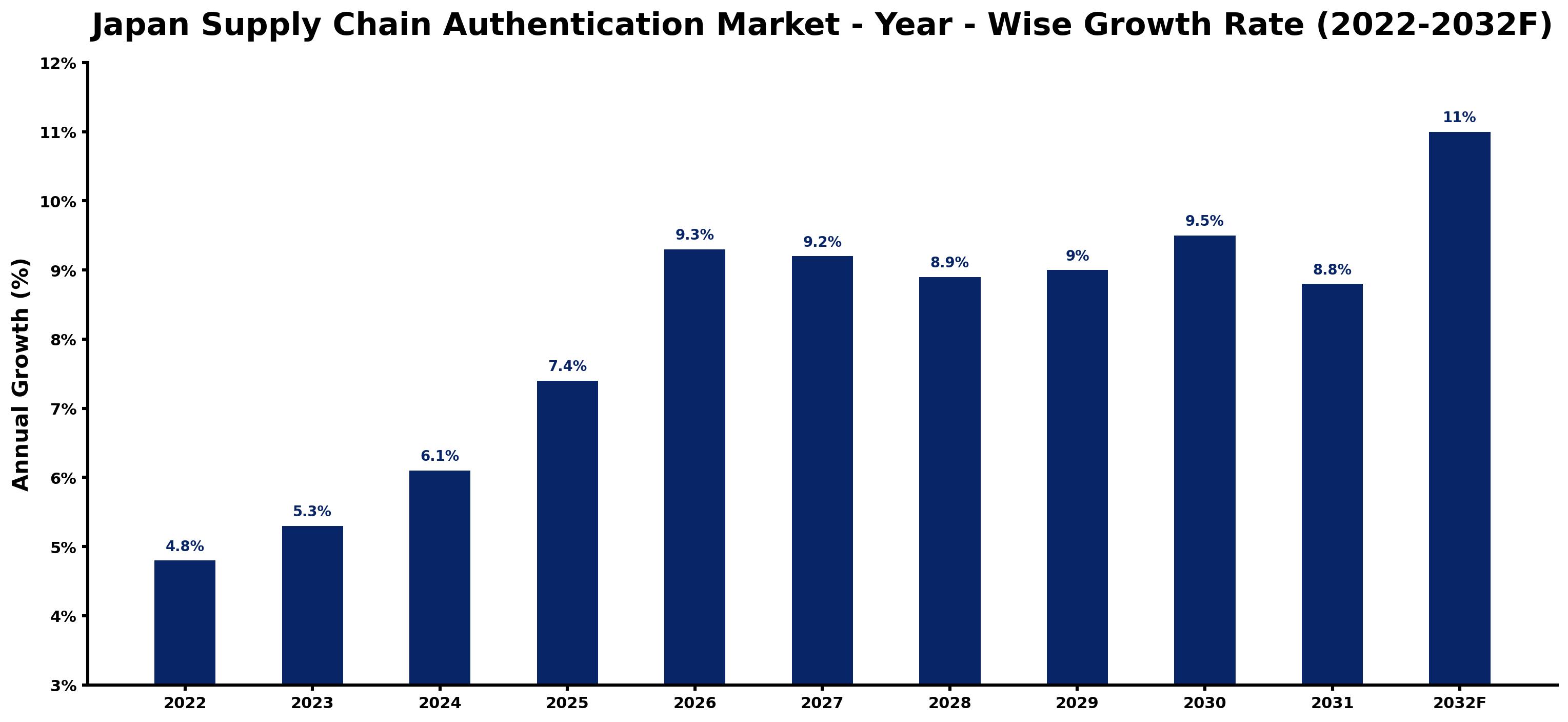
The following figures match every annual growth estimate with the main market development of that year, giving the reasoning behind each rise or slowdown.
| Year | Estimated Annual Growth (%) | Market Rationale |
| 2022 | 4.8 | The market experienced steady growth driven by increased awareness of product authenticity. |
| 2023 | 5.3 | Growth accelerated due to rising concerns over counterfeit products in various industries. |
| 2024 | 6.1 | Demand continued to rise as businesses adopted advanced tracking technologies. |
| 2025 | 7.4 | The pharmaceutical sector's serialization standards boosted market growth. |
| 2026 | 9.3 | Growth strengthened as the adoption of blockchain technology is projected to rise. |
| 2027 | 9.2 | A slight slowdown occurred as market players adjust to new regulations. |
| 2028 | 8.9 | Growth slows further as companies face integration challenges with existing systems. |
| 2029 | 9.0 | Demand picks up again as retailers improve product verification methods. |
| 2030 | 9.5 | The market expands as more sectors recognise the importance of supply chain integrity. |
| 2031 | 8.8 | A slowdown is noted as competition intensifies among authentication solutions. |
| 2032 | 11.0 | The peak growth year is driven by widespread adoption of advanced authentication technologies. |
Note: Market size estimations and growth projections presented in this report are based on 6Wresearch's proprietary forecasting methodology, utilizing the latest available industry data, government publications, and primary research inputs.
Japan Supply Chain Authentication Market Synopsis
Supply Chain Authentication involves technologies and methods to verify product integrity and origin throughout the supply chain. The Japanese market is valued at USD 298 Million by 2032, with demand driven by the pharmaceutical sector's serialization standards and the luxury goods market's reliance on authentication measures. The rise of blockchain technology and QR code usage in retail further fuels this growth, as businesses seek to improve product safety and brand integrity.
Market Dynamics Impact Analysis (2026–2032)
| Factor | Type | Impact | Primary Segment Affected |
| Increasing adoption of serialization standards in the pharmaceutical sector | Driver | High | Product Serialization |
| Growing demand for secure tracking technologies in luxury goods | Driver | High | Blockchain-Based Tracking |
| High value of the luxury goods market necessitating robust authentication | Opportunity | High | Luxury Goods |
| Rising e-commerce activities require secure supply chain solutions | Opportunity | High | Retail |
| Integration challenges with existing systems | Restraint | Medium | Cloud-Based API |
| Limited awareness of advanced authentication technologies | Restraint | Medium | Digital Certificates |
| High costs associated with implementing advanced technologies | Challenge | Medium | Tamper-Proof Labels |
| Competition among various authentication methods leading to market fragmentation | Challenge | Medium | QR Code/RFID |
Evaluation of Drivers in Japan Supply Chain Authentication Market (2026–2032)
The factors lifting demand, and the evidence behind each, are summarised below.
| Drivers | Primary Segment Affected | Why It Matters (Evidence) |
| Increased adoption of serialization standards | Product Serialization | Japan's pharmaceutical sector employs serialization standards to combat counterfeiting, leading to more investments in this technology. |
| Rising demand for secure tracking solutions | Blockchain-Based Tracking | The luxury goods market, valued at over ¥2 trillion, relies heavily on secure tracking to maintain brand integrity. |
| Growing e-commerce activities | QR Code/RFID | The adoption of QR codes in retail has increased by 30% in the last year, improving product verification. |
| Need for compliance in drug distribution | Pharma | Serialization standards in pharmaceuticals ensure compliance and safety, driving demand for authentication solutions. |
| Focus on anti-counterfeit measures | Anti-Counterfeit Solutions | The Japan Anti-Counterfeiting Association promotes awareness and standards, increasing the need for effective solutions. |
The strongest pull on demand comes from the pharmaceutical sector, which employs serialization standards to combat counterfeiting, resulting in increased investments in this technology. The luxury goods market, valued at over ¥2 trillion, relies heavily on secure tracking to maintain brand integrity, which further drives demand. E-commerce activities are also on the rise, with QR code adoption in retail increasing by 30% in the last year, enhancing product verification. Compliance requirements in drug distribution necessitate effective authentication solutions, while awareness campaigns promote standards, further boosting market growth.
Evaluation of Restraints in Japan Supply Chain Authentication Market
The following restraints limit how fast demand can grow.
| Market Restraint | Primary Segment Affected | Why It Matters (Evidence) |
| Integration challenges with existing systems | Cloud-Based API | Many companies struggle to integrate new authentication technologies with their existing supply chain systems, delaying implementation. |
| Limited awareness of advanced authentication technologies | Digital Certificates | Some businesses lack knowledge about the benefits of advanced authentication methods, hindering market growth. |
| High costs associated with implementing advanced technologies | Tamper-Proof Labels | The expenses related to adopting sophisticated authentication solutions can deter smaller companies from investing. |
| Regulatory compliance complexities | Product Serialization | Navigating the regulatory requirements for product serialization can be challenging for manufacturers, affecting their operational efficiency. |
| Market fragmentation due to competition | QR Code/RFID | The presence of various authentication methods can confuse buyers, making it difficult to choose the best solution. |
Japan Supply Chain Authentication Market Challenges
Producers in Japan face rising costs due to outdated technology in supply chain authentication, which can delay product verification by up to 20%. Importers encounter high expenses from stringent regulations, increasing compliance costs by 15%, which directly impacts their profit margins. Buyers struggle with the high costs of anti-counterfeit measures, as the luxury goods market's reliance on authentication drives prices up by 10% annually. Skills shortages in advanced technologies like blockchain limit distributors' ability to implement effective solutions, causing delays in securing supply chains.
Trends in the Japan Supply Chain Authentication Market
These developments are changing demand patterns in the Japan Supply Chain Authentication Market.
- Shift from Traditional to Digital Authentication: Retailers are increasingly moving from traditional authentication methods to digital solutions like QR codes. The adoption of QR codes in retail has increased by 30% in the last year, indicating a shift towards digital methods.
- Transition from Manual to Automated Tracking: In the pharmaceutical sector, companies are adopting automated tracking solutions to improve efficiency and compliance. Serialization standards have led to a 20% increase in automated tracking implementations across major pharmaceutical firms.
- Emergence of Blockchain for Supply Chain Transparency: Blockchain technology is gaining traction in supply chain management, providing secure and transparent tracking of goods. In 2023, the Japanese government launched a programme to support blockchain technology in supply chains, promoting its adoption.
- Increased Focus on Anti-Counterfeit Solutions: There is a growing emphasis on anti-counterfeit solutions across various industries, particularly in luxury goods. The Japan Anti-Counterfeiting Association has reported a 15% increase in awareness campaigns targeting counterfeit prevention.
Investment Opportunities in the Japan Supply Chain Authentication Market
The openings below show where demand in the Japan Supply Chain Authentication Market is visible and how suppliers can enter.
- Gap in Anti-Counterfeit Technologies: With the luxury goods market valued at over ¥2 trillion, a gap exists in anti-counterfeit technologies. Investing in advanced authentication solutions can meet the needs of luxury goods manufacturers seeking to protect their brands.
- Partnerships for Blockchain Integration: The Japanese government allocated ¥500 million in 2023 to support anti-counterfeit technologies, creating avenues for partnerships. Collaborating with local firms can facilitate the integration of blockchain technology in supply chains.
- Expansion in E-Commerce Authentication: Japan's e-commerce sector, supported by a population of 125 million, presents a growing demand for secure supply chain solutions. Emphasising QR code and RFID technologies can address the needs of online retailers.
- Investment in Medical Supply Chains: The medical supply chain sector is rapidly expanding, requiring effective authentication solutions. Engaging with medical supply chain firms can provide opportunities for developing tailored authentication technologies.
Government Initiatives in the Japan Supply Chain Authentication Market
In 2023, the Japanese government launched a programme to support blockchain technology in supply chains, building on previous measures like the Economic Security Promotion Act (2022), which supports supply-chain resilience. This new initiative adds funding and resources to improve the integration of blockchain, ensuring greater security and transparency in supply chains.
In 2023, the Japanese government allocated ¥500 million to support anti-counterfeit technologies, administered by the Ministry of Economy, Trade and Industry. This funding aims to improve the capabilities of firms in implementing effective authentication measures.
Future Insight of the Japan Supply Chain Authentication Market
By 2032, blockchain technology will transform supply chain authentication, improving efficiency and transparency. The Japanese government's programme to advance blockchain technology will boost adoption rates among producers by 40%. Integration of cloud-based APIs will streamline operations, enabling suppliers to respond swiftly to market demands. Enhanced digital certificates from local government initiatives will build trust among buyers, ensuring product integrity and safety in the growing e-commerce sector.
Market Segmentation Analysis
Japan Supply Chain Authentication Market report covers a detailed analysis of the following market segments:
By Authentication Type – Product Serialization Leads, Blockchain-Based Tracking Expected to Grow Fastest
According to Saurav Kr Singh, Senior Research Analyst at 6Wresearch, the largest authentication type category in 2025 was Product Serialization, at 39% of revenue. Product serialization is essential in Japan's pharmaceutical sector, where strict serialization standards are employed to prevent counterfeiting. This method not only ensures regulatory compliance but also enhances safety in drug distribution, making it a preferred choice among manufacturers. Blockchain-Based Tracking is projected to grow fastest, at a CAGR of 13.8% during 2026–2032. Blockchain-based tracking is rapidly growing, particularly due to the Japanese government's 2023 initiative aimed at enhancing blockchain technology in supply chains. This programme is expected to significantly improve the security and transparency of product tracking processes. Suppliers must focus on integrating advanced authentication technologies to meet regulatory requirements and enhance product integrity.
By Technology Used – QR Code/RFID Leads, Distributed Ledger Expected to Grow Fastest
In 2025, QR Code/RFID led the technology used split with a 41% share. QR code and RFID technologies are widely adopted in Japan for their ease of use in providing access to product information. Their popularity in various sectors contributes to their leading position in the market. The quickest growth will come from Distributed Ledger, forecast to expand at a CAGR of 14.0% between 2026 and 2032. The rise of distributed ledger technology is driven by its ability to maintain secure records across the supply chain, which is increasingly necessary for preventing counterfeiting. This trend is expected to accelerate as more industries recognise its benefits. Buyers will benefit from investing in technologies that ensure secure and transparent supply chain processes.
By Industry Application – Pharma Leads, Electronics Expected to Grow Fastest
Pharma took 48% of industry application revenue in 2025, more than any other category. The pharmaceutical industry in Japan relies heavily on supply chain authentication to ensure compliance and safety in drug distribution. This critical need for security makes it the leading application in the market. Over 2026–2032, Electronics is expected to post the fastest growth, at a CAGR of 12.2%. The electronics sector is experiencing rapid growth in authentication measures to prevent counterfeiting and ensure product integrity, particularly in key manufacturing regions like Tokyo and Osaka. This trend is likely to continue as demand for secure products rises. Suppliers must tailor their solutions to meet the specific needs of the electronics industry to capture emerging opportunities.
By End User – Medical Supply Chains Lead and Record the Fastest Growth
With 48% of end user revenue in 2025, Medical Supply Chains was the largest category. Medical supply chains are crucial for tracking and verifying medical products, ensuring safety and compliance in the healthcare sector. The stringent regulations in this area reinforce its leading position in the market. The same category are also set to grow fastest, at a CAGR of 12.3% during 2026–2032. The growth of medical supply chains is driving increased reliance on authentication technologies, maintaining their status as the fastest-growing segment. The ongoing focus on product safety and integrity will further support this growth trajectory. Suppliers should concentrate on developing solutions tailored to the medical sector to address its specific challenges.
Key Attractiveness of the Report
- 10 Years of Market Numbers
- Historical Data Starting from 2022 to 2025
- Base Year 2025
- Forecast Data until 2032
- Key Performance Indicators Impacting the Market
- Major Upcoming Developments and Projects
Key Highlights of the Report:
- Japan Supply Chain Authentication Market Outlook
- Market Size of Japan Supply Chain Authentication Market, 2025
- Forecast of Japan Supply Chain Authentication Market, 2032
- Historical Data and Forecast of Japan Supply Chain Authentication Revenues & Volume for the Period 2022-2032F
- Japan Supply Chain Authentication Market Trend Evolution
- Japan Supply Chain Authentication Market Drivers and Challenges
- Japan Supply Chain Authentication Price Trends
- Japan Supply Chain Authentication Porter's Five Forces
- Japan Supply Chain Authentication Industry Life Cycle
- Historical Data and Forecast of Japan Supply Chain Authentication Market Revenues & Volume By Authentication Type for the Period 2022-2032F
- Historical Data and Forecast of Japan Supply Chain Authentication Market Revenues & Volume By Product Serialization for the Period 2022-2032F
- Historical Data and Forecast of Japan Supply Chain Authentication Market Revenues & Volume By Blockchain-Based Tracking for the Period 2022-2032F
- Historical Data and Forecast of Japan Supply Chain Authentication Market Revenues & Volume By Digital Certificates for the Period 2022-2032F
- Historical Data and Forecast of Japan Supply Chain Authentication Market Revenues & Volume By Tamper-Proof Labels for the Period 2022-2032F
- Historical Data and Forecast of Japan Supply Chain Authentication Market Revenues & Volume By Technology Used for the Period 2022-2032F
- Historical Data and Forecast of Japan Supply Chain Authentication Market Revenues & Volume By QR Code/RFID for the Period 2022-2032F
- Historical Data and Forecast of Japan Supply Chain Authentication Market Revenues & Volume By Distributed Ledger for the Period 2022-2032F
- Historical Data and Forecast of Japan Supply Chain Authentication Market Revenues & Volume By Cloud-Based API for the Period 2022-2032F
- Historical Data and Forecast of Japan Supply Chain Authentication Market Revenues & Volume By NFC for the Period 2022-2032F
- Historical Data and Forecast of Japan Supply Chain Authentication Market Revenues & Volume By Industry Application for the Period 2022-2032F
- Historical Data and Forecast of Japan Supply Chain Authentication Market Revenues & Volume By Pharma for the Period 2022-2032F
- Historical Data and Forecast of Japan Supply Chain Authentication Market Revenues & Volume By Luxury Goods for the Period 2022-2032F
- Historical Data and Forecast of Japan Supply Chain Authentication Market Revenues & Volume By Electronics for the Period 2022-2032F
- Historical Data and Forecast of Japan Supply Chain Authentication Market Revenues & Volume By Retail for the Period 2022-2032F
- Historical Data and Forecast of Japan Supply Chain Authentication Market Revenues & Volume By End User for the Period 2022-2032F
- Historical Data and Forecast of Japan Supply Chain Authentication Market Revenues & Volume By Medical Supply Chains for the Period 2022-2032F
- Historical Data and Forecast of Japan Supply Chain Authentication Market Revenues & Volume By Anti-Counterfeit Solutions for the Period 2022-2032F
- Historical Data and Forecast of Japan Supply Chain Authentication Market Revenues & Volume By Hardware OEMs for the Period 2022-2032F
- Historical Data and Forecast of Japan Supply Chain Authentication Market Revenues & Volume By Supply Chain Security Firms for the Period 2022-2032F
- Japan Supply Chain Authentication Import Export Trade Statistics
- Market Opportunity Assessment By Authentication Type
- Market Opportunity Assessment By Technology Used
- Market Opportunity Assessment By Industry Application
- Market Opportunity Assessment By End User
- Japan Supply Chain Authentication Top Companies Market Share
- Japan Supply Chain Authentication Competitive Benchmarking By Technical and Operational Parameters
- Japan Supply Chain Authentication Company Profiles
- Japan Supply Chain Authentication Key Strategic Recommendations
Market Covered
The report covers the following segments.
By Authentication Type
- Product Serialization
- Blockchain-Based Tracking
- Digital Certificates
- Tamper-Proof Labels
By Technology Used
- QR Code/RFID
- Distributed Ledger
- Cloud-Based API
- NFC
By Industry Application
- Pharma
- Luxury Goods
- Electronics
- Retail
By End User
- Medical Supply Chains
- Anti-Counterfeit Solutions
- Hardware OEMs
- Supply Chain Security Firms































