Japan Supply chain e-solutions Market Size & Growth Rate
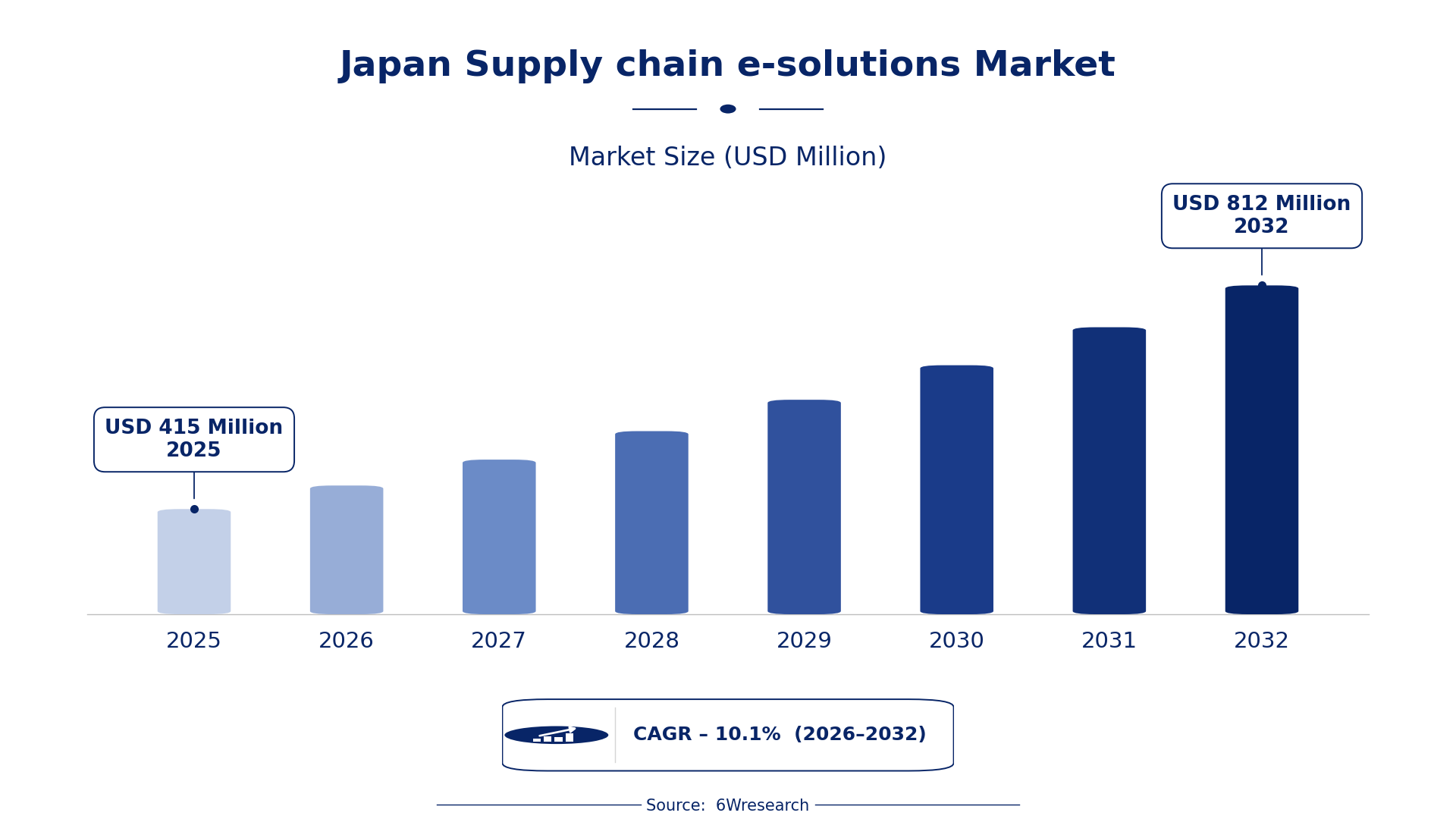
According to 6Wresearch internal database and industry insights, the Japan Supply chain e-solutions Market was valued at USD 415 Million in 2025 and is projected to reach USD 812 Million by 2032, growing at a CAGR of approximately 10.1% during 2026–2032.
Japan Supply chain e-solutions Market Highlights
| Report Metric | Details |
| Report Name | Japan Supply chain e-solutions Market (2026-2032) |
| Market Size 2025 | USD 415 Million |
| Market Size 2032 | USD 812 Million |
| Absolute Growth 2025–2032 | USD 397 Million |
| CAGR 2026–2032 | 10.1% |
| Peak Annual Growth | 11.2% in 2030 |
| Forecast Period | 2026–2032 |
| Historical Data | 2022–2025 |
| Base Year | 2025 |
| Leading Solution Type, 2025 | Transportation Software (37% share) |
| Leading Delivery Mode, 2025 | SaaS (46% share) |
| Leading Integration Scope, 2025 | Real-Time Tracking (39% share) |
| Leading End User, 2025 | Retailers (35% share) |
| Fastest-Growing Solution Type | Demand Forecasting (14.2% CAGR) |
| Fastest-Growing Delivery Mode | AI-Driven (13.2% CAGR) |
| Fastest-Growing End User | FMCG Companies (12.5% CAGR) |
| Growing Sector | retail |
| Key End Users | retailers, manufacturing firms, FMCG companies, 3PL providers |
Japan Supply chain e-solutions Market Year-wise Growth Rate and Key Drivers (2022–2032)
This graph illustrates the annual growth rates of the market from 2022 to 2032, highlighting a steady upward trajectory and projected market expansion over the forecast period.
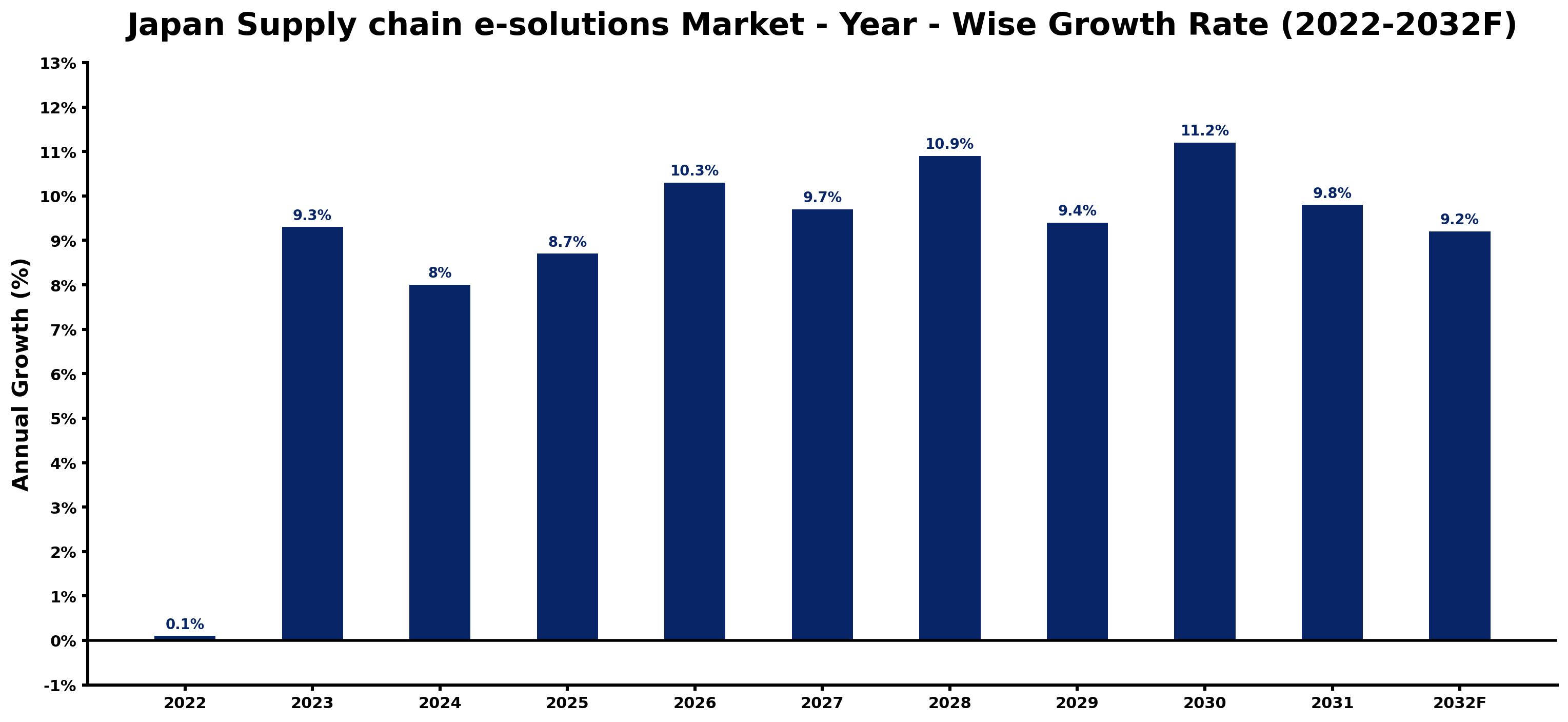
For each year, the table pairs the estimated growth rate with the leading influence on demand, showing how the drivers changed across the period.
| Year | Estimated Annual Growth (%) | Market Rationale |
| 2022 | 0.1 | The market showed minimal growth due to cautious investment in digital solutions. |
| 2023 | 9.3 | Demand surged as retailers increasingly adopted supply chain e-solutions for efficiency. |
| 2024 | 8.0 | Growth slowed as companies began to optimise existing systems rather than invest in new ones. |
| 2025 | 8.7 | Increased investment in technology drove faster growth as firms sought competitive advantages. |
| 2026 | 10.3 | Demand is expected to rise as cloud-based solutions gain traction among manufacturers. |
| 2027 | 9.7 | A slowdown is projected as the market matures and adoption rates stabilise. |
| 2028 | 10.9 | Growth is anticipated to accelerate again as AI-driven solutions become more prevalent in logistics. |
| 2029 | 9.4 | Market growth is expected to slow as saturation in certain sectors begins to appear. |
| 2030 | 11.2 | The peak growth rate will be driven by heightened demand for real-time tracking solutions. |
| 2031 | 9.8 | Growth is projected to slow slightly as companies focus on refining operational efficiencies. |
| 2032 | 9.2 | A further slowdown is expected as the market reaches a more stable phase. |
Note: Market size estimations and growth projections presented in this report are based on 6Wresearch's proprietary forecasting methodology, utilizing the latest available industry data, government publications, and primary research inputs.
Japan Supply chain e-solutions Market Synopsis
Supply chain e-solutions are software-based tools that optimise the flow of goods and information in supply chains. These solutions improve inventory management, demand forecasting, and logistics operations. The Japan Supply Chain e-Solutions Market is expanding due to rising demand from over 1.4 million retail stores and a logistics industry valued at approximately 20 trillion JPY. Key drivers include the adoption of cloud-based solutions, which exceeds 60%, and the growth of the e-commerce market to 20 trillion JPY by 2025.
Market Dynamics Impact Analysis (2026–2032)
| Factor | Type | Impact | Primary Segment Affected |
| Increasing adoption of cloud-based solutions | Driver | High | Cloud-Based |
| Rising demand for real-time tracking solutions | Driver | High | Real-Time Tracking |
| Growing e-commerce market creating new logistics needs | Opportunity | High | Transportation Software |
| Investment in AI-driven solutions for predictive analytics | Opportunity | High | AI-Driven |
| High logistics costs impacting profitability | Restraint | High | Transportation Software |
| Strict regulations on supply chain transparency | Restraint | Medium | Procurement Solutions |
| High competition among 3PL providers | Challenge | High | 3PL Providers |
| Rapid technological changes requiring constant adaptation | Challenge | Medium | Manufacturing Firms |
Evaluation of Drivers in Japan Supply chain e-solutions Market (2026–2032)
These are the developments adding the most demand over the forecast period.
| Drivers | Primary Segment Affected | Why It Matters (Evidence) |
| Increased investment in cloud technology | Cloud-Based | Over 60% of companies are adopting cloud solutions to improve efficiency. |
| Demand for real-time tracking | Real-Time Tracking | The demand for real-time tracking solutions increased by 25% in the last two years. |
| Growth of e-commerce | Transportation Software | The e-commerce market is projected to reach 20 trillion JPY by 2025, driving logistics needs. |
| Adoption of AI for predictive analytics | AI-Driven | AI adoption in supply chain management is expected to increase by 30% by 2025. |
| Focus on inventory management solutions | Inventory Management | Retailers, with over 1.4 million stores, require efficient inventory management to optimise turnover. |
A wider customer base explains much of the growth, as the retail sector increasingly adopts supply chain e-solutions to improve inventory management. The logistics industry drives demand for transportation software, with companies investing in technology to streamline operations. The growth of the e-commerce market fuels this demand, prompting retailers to seek efficient solutions. The anticipated increase in AI adoption by 2025 highlights the shift towards predictive analytics in supply chains, with firms needing advanced tools to improve operational efficiency.
Evaluation of Restraints in Japan Supply chain e-solutions Market
The key brakes on demand, and where they bite hardest, are shown below.
| Market Restraint | Primary Segment Affected | Why It Matters (Evidence) |
| High logistics costs affecting operational budgets | Transportation Software | The average logistics cost in Japan is about 10% of GDP, straining budgets. |
| Strict regulations on supply chain transparency | Procurement Solutions | Regulations enforced by METI demand rigorous compliance, limiting flexibility. |
| Intense competition among 3PL providers | 3PL Providers | With over 3,000 providers, competition drives down prices and margins. |
| Rapid technological changes require constant adaptation | Manufacturing Firms | Firms must continually invest in new technologies to remain competitive. |
| Limited skilled workforce for advanced technologies | AI-Driven | The shortage of skilled professionals hampers the implementation of AI solutions. |
Japan Supply chain e-solutions Market Challenges
Japan's supply chain e-solutions face fierce competition, compelling producers to reduce prices and diminishing profit margins. Distributors encounter high logistics costs, averaging about 10% of GDP, which restricts their capacity to invest in new technologies. Many buyers are hindered by outdated technology, with over 60% of operations still reliant on traditional systems, delaying efficiency improvements. A skills gap persists, as the workforce struggles to adopt new technologies, with a 30% rise in AI integration by 2025 leaving suppliers unable to fully utilise advancements.
Trends in the Japan Supply chain e-solutions Market
Four trends stand out in the Japan Supply chain e-solutions Market.
- Retailers Increasingly Implementing Real-Time Tracking: Retailers are adopting real-time tracking solutions to improve logistics efficiency. The demand for such solutions has surged by 25% recently, reflecting a shift towards greater visibility in supply chains.
- Growing Popularity of Cloud Solutions: A marked shift towards cloud-based supply chain solutions is occurring, with over 60% adoption in Japan. This trend is driven by the need for scalability and collaboration across teams.
- E-commerce Growth Driving Innovations in Logistics: The growth of the e-commerce sector, projected to reach 20 trillion JPY by 2025, is prompting innovations in logistics. This demand is pushing companies to improve their supply chain capabilities.
- Accelerating Adoption of AI-Driven Solutions: The adoption of AI-driven solutions is growing, particularly in predictive analytics. By 2025, AI adoption in supply chain management is expected to rise by 30%, improving decision-making processes.
Investment Opportunities in the Japan Supply chain e-solutions Market
The openings below show where demand in the Japan Supply chain e-solutions Market is visible and how suppliers can enter.
- Advanced Supply Chain Software Solutions: With the e-commerce market projected to reach 20 trillion JPY by 2025, there is an opportunity to supply logistics software. Retailers are seeking solutions to improve their operations.
- Investment in Real-Time Tracking Solutions: The growing demand for real-time tracking solutions presents an opportunity for investment in this technology. Logistics providers are increasingly looking for partners to improve their service offerings.
- AI-Driven Analytics Tools for Manufacturing: Investing in AI-driven analytics tools can meet the increasing demand for predictive capabilities. Manufacturing firms require these tools to improve production planning and inventory management.
- Cloud-Based Supply Chain Platforms: The shift towards cloud-based platforms offers a lucrative opportunity for suppliers. Companies in the Tokyo metropolitan area are looking for local partners to implement these solutions.
Government Initiatives in the Japan Supply chain e-solutions Market
The Economic Security Promotion Act, enacted in 2022, supports supply chain resilience for critical products, ensuring that producers can maintain operational stability. The AI Promotion Act, introduced in 2025, establishes a national framework for AI research and development, which is vital for improving supply chain efficiency through technology.
The Digital Agency oversees the government's digital transformation efforts, funding initiatives aimed at improving supply chain transparency and efficiency. It focuses on integrating advanced technologies into logistics operations, with significant investments in projects that enhance operational capabilities.
Future Insight of the Japan Supply chain e-solutions Market
Investment in supply chain technology will reach 1 trillion JPY annually, creating demand for advanced solutions. By 2032, the e-commerce market will grow to 20 trillion JPY, necessitating more efficient logistics systems. The 'Digital Supply Chain Strategy' will drive innovation, enhancing competitiveness for suppliers. Initiatives such as 'Smart Logistics' will integrate cutting-edge technologies, improving overall operational efficiency and responsiveness in the market.
Market Segmentation Analysis
Japan Supply chain e-solutions Market report covers a detailed analysis of the following market segments:
By Solution Type – Transportation Software Leads, Demand Forecasting Expected to Grow Fastest
According to Saurav Kr Singh, Senior Research Analyst at 6Wresearch, the largest solution type category in 2025 was Transportation Software, at 37% of revenue. Transportation Software holds the largest share because it is essential for planning and executing logistics operations efficiently, particularly in Japan's retail sector with over 1.4 million stores. This segment's significance is highlighted by its direct impact on optimising logistics management in a highly competitive environment. Demand Forecasting is set to record the highest CAGR in this split, 14.2% over 2026–2032. Demand Forecasting is experiencing rapid growth as it plays a critical role in accurately predicting customer demand, especially with the e-commerce market projected to reach 20 trillion JPY by 2025. The sustained demand for Transportation Software will further solidify its leading position in the market. Suppliers should focus on enhancing transportation solutions to meet the increasing demand for efficient logistics management.
By Delivery Mode – SaaS Lead, AI-Driven Expected to Grow Fastest
SaaS held 46% of the Japan Supply chain e-solutions Market by delivery mode in 2025. SaaS captures the largest market share due to its widespread adoption for scalability and cost-effectiveness in software delivery, making it a preferred choice across various sectors in Japan. The adoption rate exceeding 60% underscores its vital role in the supply chain market. The quickest growth will come from AI-Driven, forecast to expand at a CAGR of 13.2% between 2026 and 2032. AI-Driven solutions are rapidly gaining traction owing to their effectiveness in predictive analytics and automation, which are crucial for optimising supply chain processes. The anticipated 30% increase in AI adoption by 2025 indicates a strong future for this delivery mode. Buyers should invest in AI-Driven solutions to improve operational efficiency through enhanced predictive capabilities.
By Integration Scope – Real-Time Tracking Leads and Records the Fastest Growth
In 2025, Real-Time Tracking led the integration scope split with a 39% share. Real-Time Tracking leads the market as it is crucial for monitoring shipments and improving visibility in logistics, particularly in Japan's urban areas. The average delivery time of approximately 24 hours highlights the necessity for effective tracking solutions to meet consumer expectations. Its lead should widen, with a projected CAGR of 12.6% during 2026–2032, the highest in this split. Real-Time Tracking is also the fastest-growing segment, driven by a 25% increase in demand for real-time tracking solutions over the past two years. This growth reinforces its critical importance and strengthens its dominant position in the logistics sector. Suppliers must prioritise the development of real-time tracking technologies to capitalise on this growing demand.
By End User – Retailers Lead, FMCG Companies Expected to Grow Fastest
Retailers took 35% of end user revenue in 2025, more than any other category. Retailers dominate the market as they heavily rely on supply chain solutions to effectively manage inventory and sales in a competitive landscape. Their extensive use of these solutions underscores their vital role in ensuring operational success. Over 2026–2032, FMCG Companies are expected to post the fastest growth, at a CAGR of 12.5%. FMCG Companies represent the fastest-growing end user segment due to their dependence on efficient supply chain management driven by high turnover rates. The increasing need for rapid inventory turnover will further necessitate tailored solutions for this sector. Suppliers should customise their offerings to address the specific requirements of FMCG Companies to capture this expanding market segment.
Key Attractiveness of the Report
- 10 Years of Market Numbers
- Historical Data Starting from 2022 to 2025
- Base Year 2025
- Forecast Data until 2032
- Key Performance Indicators Impacting the Market
- Major Upcoming Developments and Projects
Key Highlights of the Report:
- Japan Supply chain e-solutions Market Outlook
- Market Size of Japan Supply chain e-solutions Market, 2025
- Forecast of Japan Supply chain e-solutions Market, 2032
- Historical Data and Forecast of Japan Supply chain e-solutions Revenues & Volume for the Period 2022-2032F
- Japan Supply chain e-solutions Market Trend Evolution
- Japan Supply chain e-solutions Market Drivers and Challenges
- Japan Supply chain e-solutions Price Trends
- Japan Supply chain e-solutions Porter's Five Forces
- Japan Supply chain e-solutions Industry Life Cycle
- Historical Data and Forecast of Japan Supply chain e-solutions Market Revenues & Volume By Solution Type for the Period 2022-2032F
- Historical Data and Forecast of Japan Supply chain e-solutions Market Revenues & Volume By Inventory Management for the Period 2022-2032F
- Historical Data and Forecast of Japan Supply chain e-solutions Market Revenues & Volume By Demand Forecasting for the Period 2022-2032F
- Historical Data and Forecast of Japan Supply chain e-solutions Market Revenues & Volume By Transportation Software for the Period 2022-2032F
- Historical Data and Forecast of Japan Supply chain e-solutions Market Revenues & Volume By Procurement Solutions for the Period 2022-2032F
- Historical Data and Forecast of Japan Supply chain e-solutions Market Revenues & Volume By Delivery Mode for the Period 2022-2032F
- Historical Data and Forecast of Japan Supply chain e-solutions Market Revenues & Volume By SaaS for the Period 2022-2032F
- Historical Data and Forecast of Japan Supply chain e-solutions Market Revenues & Volume By AI-Driven for the Period 2022-2032F
- Historical Data and Forecast of Japan Supply chain e-solutions Market Revenues & Volume By Cloud-Based for the Period 2022-2032F
- Historical Data and Forecast of Japan Supply chain e-solutions Market Revenues & Volume By Web Platform for the Period 2022-2032F
- Historical Data and Forecast of Japan Supply chain e-solutions Market Revenues & Volume By Integration Scope for the Period 2022-2032F
- Historical Data and Forecast of Japan Supply chain e-solutions Market Revenues & Volume By Real-Time Tracking for the Period 2022-2032F
- Historical Data and Forecast of Japan Supply chain e-solutions Market Revenues & Volume By End-to-End Planning for the Period 2022-2032F
- Historical Data and Forecast of Japan Supply chain e-solutions Market Revenues & Volume By Logistics Integration for the Period 2022-2032F
- Historical Data and Forecast of Japan Supply chain e-solutions Market Revenues & Volume By Supplier Coordination for the Period 2022-2032F
- Historical Data and Forecast of Japan Supply chain e-solutions Market Revenues & Volume By End User for the Period 2022-2032F
- Historical Data and Forecast of Japan Supply chain e-solutions Market Revenues & Volume By Retailers for the Period 2022-2032F
- Historical Data and Forecast of Japan Supply chain e-solutions Market Revenues & Volume By FMCG Companies for the Period 2022-2032F
- Historical Data and Forecast of Japan Supply chain e-solutions Market Revenues & Volume By 3PL Providers for the Period 2022-2032F
- Historical Data and Forecast of Japan Supply chain e-solutions Market Revenues & Volume By Manufacturing Firms for the Period 2022-2032F
- Japan Supply chain e-solutions Import Export Trade Statistics
- Market Opportunity Assessment By Solution Type
- Market Opportunity Assessment By Delivery Mode
- Market Opportunity Assessment By Integration Scope
- Market Opportunity Assessment By End User
- Japan Supply chain e-solutions Top Companies Market Share
- Japan Supply chain e-solutions Competitive Benchmarking By Technical and Operational Parameters
- Japan Supply chain e-solutions Company Profiles
- Japan Supply chain e-solutions Key Strategic Recommendations
Market Covered
Coverage by segment is as follows.
By Solution Type
- Inventory Management
- Demand Forecasting
- Transportation Software
- Procurement Solutions
By Delivery Mode
- SaaS
- AI-Driven
- Cloud-Based
- Web Platform
By Integration Scope
- Real-Time Tracking
- End-to-End Planning
- Logistics Integration
- Supplier Coordination
By End User
- Retailers
- FMCG Companies
- 3PL Providers
- Manufacturing Firms































