Japan Supply Chain Forwarding Market Size & Growth Rate
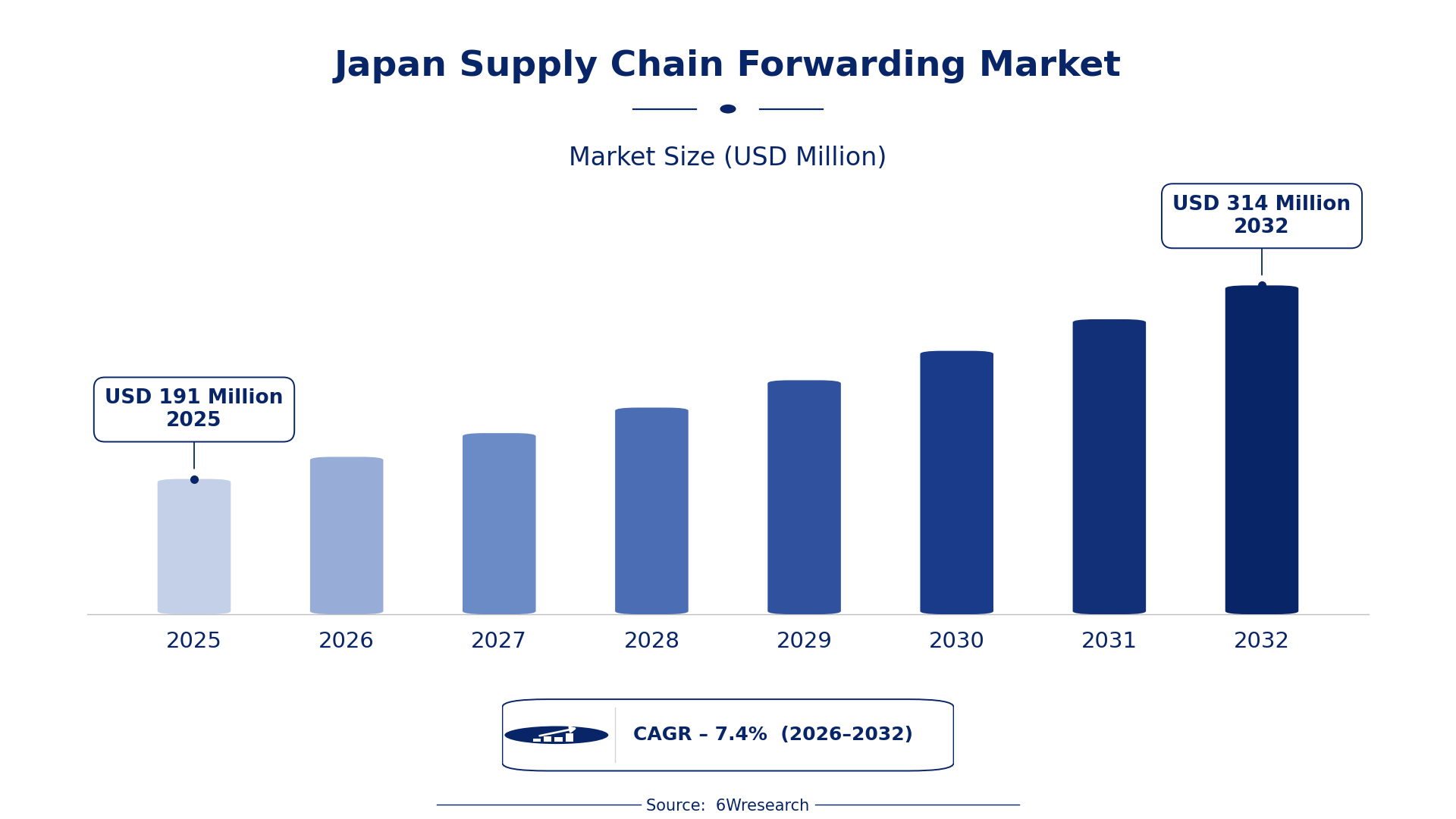
According to 6Wresearch internal database and industry insights, the Japan Supply Chain Forwarding Market was valued at USD 191 Million in 2025 and is projected to reach USD 314 Million by 2032, growing at a CAGR of approximately 7.4% during 2026–2032.
Japan Supply Chain Forwarding Market Highlights
| Report Metric | Details |
| Report Name | Japan Supply Chain Forwarding Market (2026-2032) |
| Market Size 2025 | USD 191 Million |
| Market Size 2032 | USD 314 Million |
| Absolute Growth 2025–2032 | USD 123 Million |
| CAGR 2026–2032 | 7.4% |
| Peak Annual Growth | 8.8% in 2026 |
| Forecast Period | 2026–2032 |
| Historical Data | 2022–2025 |
| Base Year | 2025 |
| Leading Forwarding Type, 2025 | Sea Freight Forwarding (44% share) |
| Leading Transport Mode, 2025 | Ocean (36% share) |
| Leading Service Model, 2025 | Full Container Load (FCL) (46% share) |
| Leading End User, 2025 | E-commerce Firms (40% share) |
| Fastest-Growing Forwarding Type | Air Freight Forwarding (10.1% CAGR) |
| Fastest-Growing Transport Mode | Air (10.0% CAGR) |
| Fastest-Growing Service Model | Express Logistics (9.8% CAGR) |
| Growing Sector | E-commerce |
| Key End Users | E-commerce Firms, Global Exporters, Retail Supply Chains |
Japan Supply Chain Forwarding Market Year-wise Growth Rate and Key Drivers (2022–2032)
This graph illustrates the annual growth rates of the market from 2022 to 2032, highlighting a steady upward trajectory and projected market expansion over the forecast period.
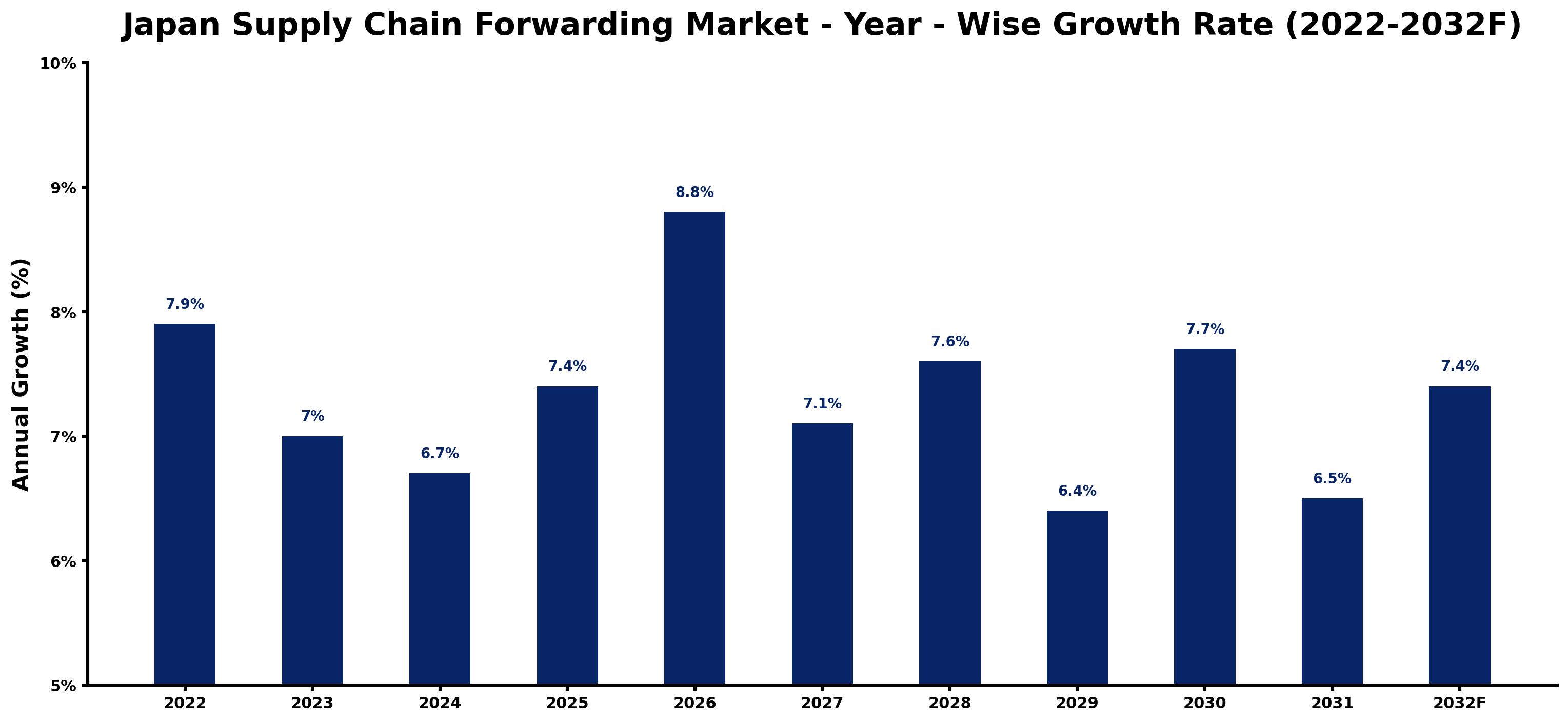
The table below sets out the estimated growth rate for each year and the main factor behind it.
| Year | Estimated Annual Growth (%) | Market Rationale |
| 2022 | 7.9 | The market experienced strong demand from domestic users and global exporters. |
| 2023 | 7.0 | Growth slowed due to challenges in logistics capacity and rising operational costs. |
| 2024 | 6.7 | A continued slowdown occurred as the market adjusted to previous growth rates. |
| 2025 | 7.4 | Growth accelerated as investment in logistics technology began to yield results. |
| 2026 | 8.8 | The market is expected to peak due to increased demand from e-commerce and international trade. |
| 2027 | 7.1 | Growth is projected to slow as the market stabilises after the peak in demand. |
| 2028 | 7.6 | An increase in demand for express logistics services will boost growth. |
| 2029 | 6.4 | Growth is expected to slow again as the market faces capacity constraints in logistics. |
| 2030 | 7.7 | Demand will rise as logistics networks improve efficiency and service quality. |
| 2031 | 6.5 | The market will experience a slowdown as growth rates normalise. |
| 2032 | 7.4 | Growth is expected to pick up again as investments in technology continue to drive efficiency. |
Note: Market size estimations and growth projections presented in this report are based on 6Wresearch's proprietary forecasting methodology, utilizing the latest available industry data, government publications, and primary research inputs.
Japan Supply Chain Forwarding Market Synopsis
Supply Chain Forwarding involves managing logistics and transportation of goods across various channels, supporting international trade, e-commerce, and domestic distribution. The Japan Supply Chain Forwarding Market is expanding due to rising demand from e-commerce firms, investments in logistics technology, and the government’s focus on improving supply chain efficiency.
Market Dynamics Impact Analysis (2026–2032)
| Factor | Type | Impact | Primary Segment Affected |
| Rising demand from e-commerce firms drives logistics services. | Driver | High | E-commerce Firms |
| Investment in logistics technology enhances operational efficiency. | Driver | High | Full Container Load (FCL) |
| Expansion of logistics hubs increases service capacity. | Opportunity | Medium | Sea Freight Forwarding |
| Growing international trade boosts demand for forwarding services. | Opportunity | High | Global Exporters |
| High operational costs constrain profit margins for logistics providers. | Restraint | High | Land Freight Forwarding |
| Capacity constraints in logistics networks limit service availability. | Restraint | Medium | Air Freight Forwarding |
| Competition among logistics providers pressures pricing strategies. | Challenge | High | Express Logistics |
| Technological adaptation challenges may delay service improvements. | Challenge | Medium | Multimodal Forwarding |
Evaluation of Drivers in Japan Supply Chain Forwarding Market (2026–2032)
Below are the drivers that matter most for revenue growth, with supporting evidence.
| Drivers | Primary Segment Affected | Why It Matters (Evidence) |
| Increased e-commerce activity boosts demand for logistics services. | E-commerce Firms | E-commerce sales reached ¥20 trillion in 2022, leading to higher logistics needs. |
| Investment in automation improves efficiency in logistics operations. | Full Container Load (FCL) | With 30% of warehouses automated, operational costs are reduced, driving demand. |
| Expansion of logistics hubs enhances service delivery capabilities. | Sea Freight Forwarding | These hubs support over 1.5 million logistics jobs, increasing service availability. |
| Growth in international trade raises demand for forwarding services. | Global Exporters | Japan's trade volume hit ¥150 trillion in 2022, boosting logistics requirements. |
| Government initiatives support logistics efficiency improvements. | Sea Freight Forwarding | Launched in 2022, it aims to improve supply chain operations across sectors. |
Orders keep climbing as e-commerce activity surged, with sales reaching ¥20 trillion in 2022, increasing logistics demand. Investment in automation is rising, with 30% of warehouses now automated, reducing operational costs and improving service delivery. The expansion of logistics hubs in Tokyo and Osaka supports over 1.5 million workers, further increasing service capacity. Japan's trade volume reached ¥150 trillion in 2022, driving demand for forwarding services.
Evaluation of Restraints in Japan Supply Chain Forwarding Market
Several factors work against faster growth; the main ones are summarised below.
| Market Restraint | Primary Segment Affected | Why It Matters (Evidence) |
| High operational costs limit profitability for logistics providers. | Land Freight Forwarding | Rising fuel prices have increased operational expenses, affecting margins. |
| Capacity constraints in logistics networks restrict service availability. | Air Freight Forwarding | Limited air cargo capacity has delayed shipments, impacting service reliability. |
| Regulatory compliance costs burden logistics operators. | Multimodal Forwarding | Adhering to various regulations increases operational costs for providers. |
| Intense competition leads to price wars among logistics firms. | Express Logistics | Price reductions have squeezed margins, impacting service quality. |
| Technological adaptation challenges slow service improvements. | Full Container Load (FCL) | Many firms struggle to integrate new technologies effectively. |
Japan Supply Chain Forwarding Market Challenges
Buyers in Japan face escalating costs due to strict logistics regulations enforced by the Ministry of Land, Infrastructure, Transport and Tourism, which can delay shipments by up to 48 hours. Competition among logistics providers intensifies, leading to price wars that can shrink profit margins for suppliers by 15%. Unpredictable demand patterns driven by Japan's population of 126 million result in stockouts or excess inventory for buyers, complicating inventory management. The slow adoption of advanced technology in some logistics areas costs suppliers approximately ¥300 billion annually in lost productivity.
Trends in the Japan Supply Chain Forwarding Market
Below are the shifts with the largest effect on the Japan Supply Chain Forwarding Market.
- Automation in Logistics: Japan's logistics sector is increasingly adopting automation, with 30% of warehouses automated as of 2023. This trend improves efficiency and reduces operational costs, benefiting logistics providers and improving service delivery.
- E-commerce Firms Driving Logistics Demand: E-commerce firms are influencing the logistics market, accounting for 40% of end-user demand in 2025. This shift necessitates faster and more efficient logistics solutions to meet consumer expectations.
- Integration of Multimodal Transport Solutions: The logistics industry is moving towards integrated multimodal solutions, enhancing flexibility and efficiency. The Logistics Standardization Council's efforts in 2022 aim to improve service quality across various transport modes.
- Government Support for Logistics Innovation: The Tokyo Metropolitan Government has introduced subsidies to encourage logistics innovation, with ¥5 billion allocated for 2023. This initiative aims to improve operational efficiency and support industry growth.
Investment Opportunities in the Japan Supply Chain Forwarding Market
The following areas offer the clearest openings for investors and suppliers in the Japan Supply Chain Forwarding Market.
- Investment in Logistics Technology: With the logistics sector expected to invest ¥1 trillion in technology by 2025, there is an opportunity for suppliers of automation and software solutions to enter the market.
- Expansion of Logistics Hubs: Tokyo and Osaka are expanding their logistics hubs, providing opportunities for investment in infrastructure and services to support the growing demand from e-commerce firms.
- Growth in International Trade: As Japan's trade volume reached ¥150 trillion in 2022, there is a pressing need for logistics services to support global exporters, creating opportunities for service providers.
- Focus on Sustainability in Logistics: With the Plastic Resource Circulation Act promoting recycling, there is an opportunity for companies to develop sustainable logistics solutions that comply with new regulations.
Government Initiatives in the Japan Supply Chain Forwarding Market
The Food Sanitation Act amendment of 2018 established a positive list system for synthetic resins used in food packaging, improving safety standards for logistics providers handling food products. This law, effective from June 2020, ensures compliance and boosts consumer confidence in food safety.
The Economic Security Promotion Act of 2022 supports supply-chain resilience for critical products, overseen by the Ministry of Land, Infrastructure, Transport and Tourism. This act encourages logistics operators to enhance their capabilities, ensuring a reliable supply of essential goods.
Future Insight of the Japan Supply Chain Forwarding Market
By 2032, buyers will benefit from improved logistics efficiency as the government aims for a 10% reduction in logistics costs. Automation will increase, with a projected investment of ¥1 trillion in technology by 2025, streamlining operations. The Logistics Efficiency Improvement Program will further optimise supply chains, ensuring faster delivery times. Enhanced service quality will emerge from the widespread adoption of ISO 9001 standards, positively impacting both buyers and suppliers.
Market Segmentation Analysis
Japan Supply Chain Forwarding Market report covers a detailed analysis of the following market segments:
By Forwarding Type – Sea Freight Forwarding Leads, Air Freight Forwarding Expected to Grow Fastest
According to Saurav Kr Singh, Senior Research Analyst at 6Wresearch, with 44% of forwarding type revenue in 2025, Sea Freight Forwarding was the largest category. Sea Freight Forwarding holds the largest market share as it offers a cost-effective solution for transporting bulk shipments, essential for Japan's trade activities. This method is particularly significant in international trade, where it accounts for 60% of sea freight. Over 2026–2032, Air Freight Forwarding is expected to post the fastest growth, at a CAGR of 10.1%. Air Freight Forwarding is experiencing rapid growth due to its critical role in transporting time-sensitive goods, with express logistics achieving delivery times of under 24 hours. The surge in e-commerce is driving demand for quicker logistics solutions, further enhancing this segment's growth. Suppliers need to focus on improving air freight capabilities to meet the increasing demand for faster logistics services.
By Transport Mode – Ocean Leads, Air Expected to Grow Fastest
The largest transport mode category in 2025 was Ocean, at 36% of revenue. Ocean transport is the dominant mode for international shipping, making up a substantial portion of logistics operations in Japan. Its efficiency is underscored by Japan's logistics network, which is ranked 1st globally for efficiency in 2023. Air is set to record the highest CAGR in this split, 10.0% over 2026–2032. Air transport is the fastest-growing mode, driven by the critical need for timely delivery of goods, especially in sectors like e-commerce. The high adoption of express logistics services further fuels this segment's growth. Buyers will benefit from investing in air transport solutions to ensure timely deliveries and remain competitive.
By Service Model – Full Container Load (FCL) Leads, Express Logistics Expected to Grow Fastest
Full Container Load (FCL) held 46% of the Japan Supply Chain Forwarding Market by service model in 2025. Full Container Load (FCL) is the most common service model for large shipments, making it a preferred choice among businesses engaged in international trade. Its widespread adoption is reflected in the logistics practices of major shipping firms operating in Japan. Express Logistics is projected to grow fastest, at a CAGR of 9.8% during 2026–2032. Express Logistics is rapidly gaining traction due to the growing demand for fast services, particularly from e-commerce firms that require quick turnaround times. This trend indicates a shift in consumer expectations towards faster delivery options. Suppliers should consider expanding express logistics offerings to cater to the increasing demand for rapid delivery services.
By End User – E-commerce Firms Lead and Record the Fastest Growth
E-commerce Firms accounted for 40% of the market by end user in 2025. E-commerce Firms dominate the end-user segment as they increasingly rely on logistics to handle growing order volumes effectively. The expansion of online shopping necessitates efficient logistics support to ensure timely deliveries and maintain customer satisfaction. Its lead should widen, with a projected CAGR of 9.4% during 2026–2032, the highest in this split. E-commerce Firms are also the fastest-growing segment, as their logistics requirements continue to expand with the rise in online retail activities. This dual role as both leader and fastest suggests a sustained demand for logistics services tailored to this sector. Suppliers should prioritise developing logistics solutions that cater specifically to the needs of e-commerce to capitalise on this ongoing growth.
Key Attractiveness of the Report
- 10 Years of Market Numbers
- Historical Data Starting from 2022 to 2025
- Base Year 2025
- Forecast Data until 2032
- Key Performance Indicators Impacting the Market
- Major Upcoming Developments and Projects
Key Highlights of the Report:
- Japan Supply Chain Forwarding Market Outlook
- Market Size of Japan Supply Chain Forwarding Market, 2025
- Forecast of Japan Supply Chain Forwarding Market, 2032
- Historical Data and Forecast of Japan Supply Chain Forwarding Revenues & Volume for the Period 2022-2032F
- Japan Supply Chain Forwarding Market Trend Evolution
- Japan Supply Chain Forwarding Market Drivers and Challenges
- Japan Supply Chain Forwarding Price Trends
- Japan Supply Chain Forwarding Porter's Five Forces
- Japan Supply Chain Forwarding Industry Life Cycle
- Historical Data and Forecast of Japan Supply Chain Forwarding Market Revenues & Volume By Forwarding Type for the Period 2022-2032F
- Historical Data and Forecast of Japan Supply Chain Forwarding Market Revenues & Volume By Air Freight Forwarding for the Period 2022-2032F
- Historical Data and Forecast of Japan Supply Chain Forwarding Market Revenues & Volume By Sea Freight Forwarding for the Period 2022-2032F
- Historical Data and Forecast of Japan Supply Chain Forwarding Market Revenues & Volume By Land Freight Forwarding for the Period 2022-2032F
- Historical Data and Forecast of Japan Supply Chain Forwarding Market Revenues & Volume By Multimodal Forwarding for the Period 2022-2032F
- Historical Data and Forecast of Japan Supply Chain Forwarding Market Revenues & Volume By Transport Mode for the Period 2022-2032F
- Historical Data and Forecast of Japan Supply Chain Forwarding Market Revenues & Volume By Air for the Period 2022-2032F
- Historical Data and Forecast of Japan Supply Chain Forwarding Market Revenues & Volume By Ocean for the Period 2022-2032F
- Historical Data and Forecast of Japan Supply Chain Forwarding Market Revenues & Volume By Road/Rail for the Period 2022-2032F
- Historical Data and Forecast of Japan Supply Chain Forwarding Market Revenues & Volume By Hybrid for the Period 2022-2032F
- Historical Data and Forecast of Japan Supply Chain Forwarding Market Revenues & Volume By Service Model for the Period 2022-2032F
- Historical Data and Forecast of Japan Supply Chain Forwarding Market Revenues & Volume By Express Logistics for the Period 2022-2032F
- Historical Data and Forecast of Japan Supply Chain Forwarding Market Revenues & Volume By Full Container Load (FCL) for the Period 2022-2032F
- Historical Data and Forecast of Japan Supply Chain Forwarding Market Revenues & Volume By Hub-and-Spoke for the Period 2022-2032F
- Historical Data and Forecast of Japan Supply Chain Forwarding Market Revenues & Volume By End-to-End for the Period 2022-2032F
- Historical Data and Forecast of Japan Supply Chain Forwarding Market Revenues & Volume By End User for the Period 2022-2032F
- Historical Data and Forecast of Japan Supply Chain Forwarding Market Revenues & Volume By E-commerce Firms for the Period 2022-2032F
- Historical Data and Forecast of Japan Supply Chain Forwarding Market Revenues & Volume By Global Exporters for the Period 2022-2032F
- Historical Data and Forecast of Japan Supply Chain Forwarding Market Revenues & Volume By Retail Supply Chains for the Period 2022-2032F
- Historical Data and Forecast of Japan Supply Chain Forwarding Market Revenues & Volume By Logistics Aggregators for the Period 2022-2032F
- Japan Supply Chain Forwarding Import Export Trade Statistics
- Market Opportunity Assessment By Forwarding Type
- Market Opportunity Assessment By Transport Mode
- Market Opportunity Assessment By Service Model
- Market Opportunity Assessment By End User
- Japan Supply Chain Forwarding Top Companies Market Share
- Japan Supply Chain Forwarding Competitive Benchmarking By Technical and Operational Parameters
- Japan Supply Chain Forwarding Company Profiles
- Japan Supply Chain Forwarding Key Strategic Recommendations
Market Covered
Segments analysed in this report are listed below.
By Forwarding Type
- Air Freight Forwarding
- Sea Freight Forwarding
- Land Freight Forwarding
- Multimodal Forwarding
By Transport Mode
- Air
- Ocean
- Road/Rail
- Hybrid
By Service Model
- Express Logistics
- Full Container Load (FCL)
- Hub-and-Spoke
- End-to-End
By End User
- E-commerce Firms
- Global Exporters
- Retail Supply Chains
- Logistics Aggregators































