Japan Supply Chain Optimization AI Market Size & Growth Rate
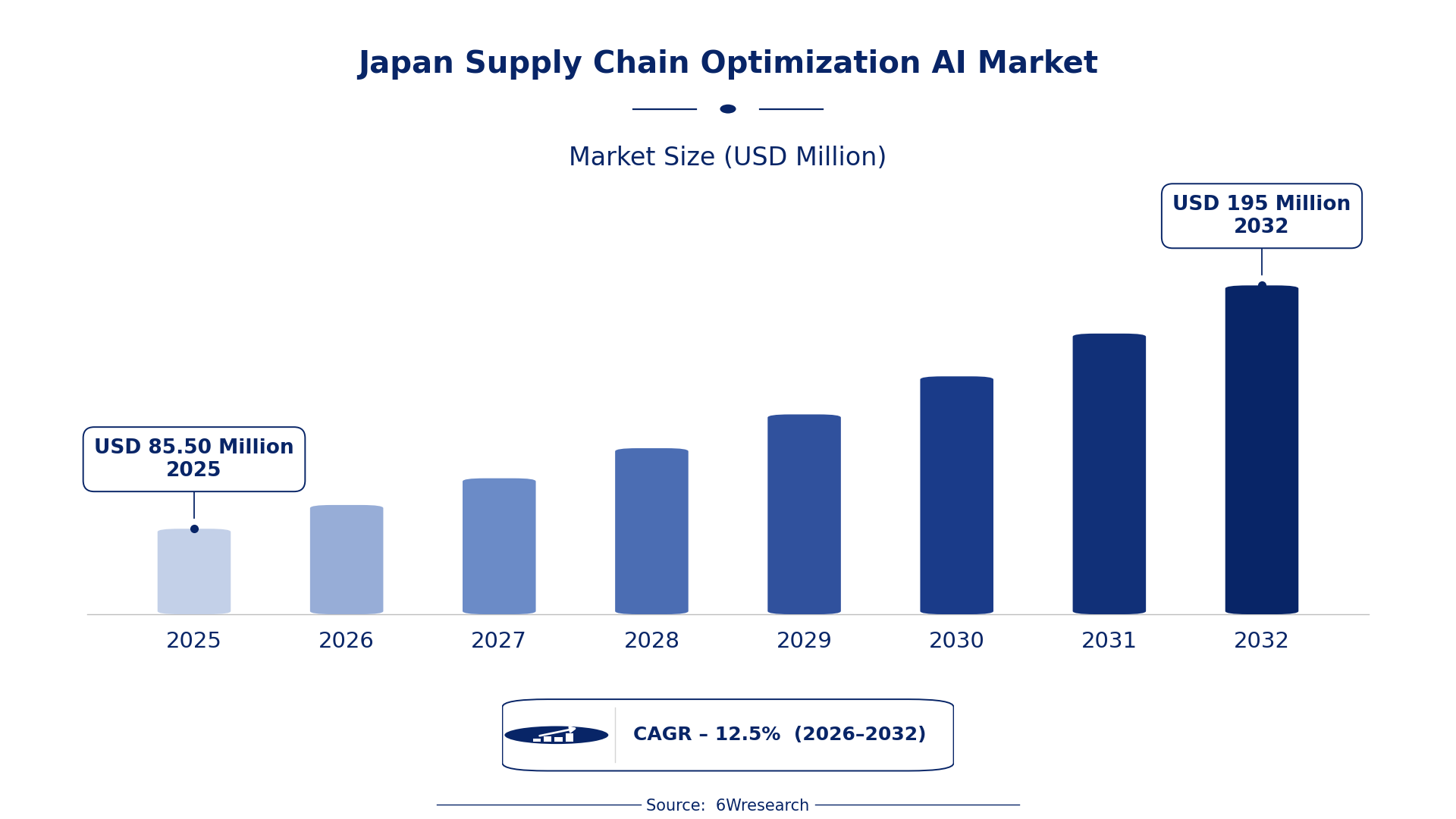
According to 6Wresearch internal database and industry insights, the Japan Supply Chain Optimization AI Market was valued at USD 85.50 Million in 2025 and is projected to reach USD 195 Million by 2032, growing at a CAGR of approximately 12.5% during 2026–2032.
Japan Supply Chain Optimization AI Market Highlights
| Report Metric | Details |
| Report Name | Japan Supply Chain Optimization AI Market (2026-2032) |
| Market Size 2025 | USD 85.50 Million |
| Market Size 2032 | USD 195 Million |
| Absolute Growth 2025–2032 | USD 109.50 Million |
| CAGR 2026–2032 | 12.5% |
| Peak Annual Growth | 13.7% in 2029 |
| Forecast Period | 2026–2032 |
| Historical Data | 2022–2025 |
| Base Year | 2025 |
| Leading Optimization Type, 2025 | Demand Forecasting AI (43% share) |
| Leading AI Capability, 2025 | Predictive Analytics (34% share) |
| Leading Business Function, 2025 | Inventory Planning (37% share) |
| Leading End User, 2025 | Retailers (47% share) |
| Fastest-Growing Optimization Type | Route Optimization AI (17.6% CAGR) |
| Fastest-Growing AI Capability | Machine Learning (16.7% CAGR) |
| Fastest-Growing Business Function | Transportation (16.0% CAGR) |
| Fastest-Growing End User | Logistics Operators (16.4% CAGR) |
| Growing Sector | Logistics |
| Key End Users | Retailers, Logistics Operators, E-commerce Fulfillment Hubs |
Japan Supply Chain Optimization AI Market Year-wise Growth Rate and Key Drivers (2022–2032)
This graph illustrates the annual growth rates of the market from 2022 to 2032, highlighting a steady upward trajectory and projected market expansion over the forecast period.
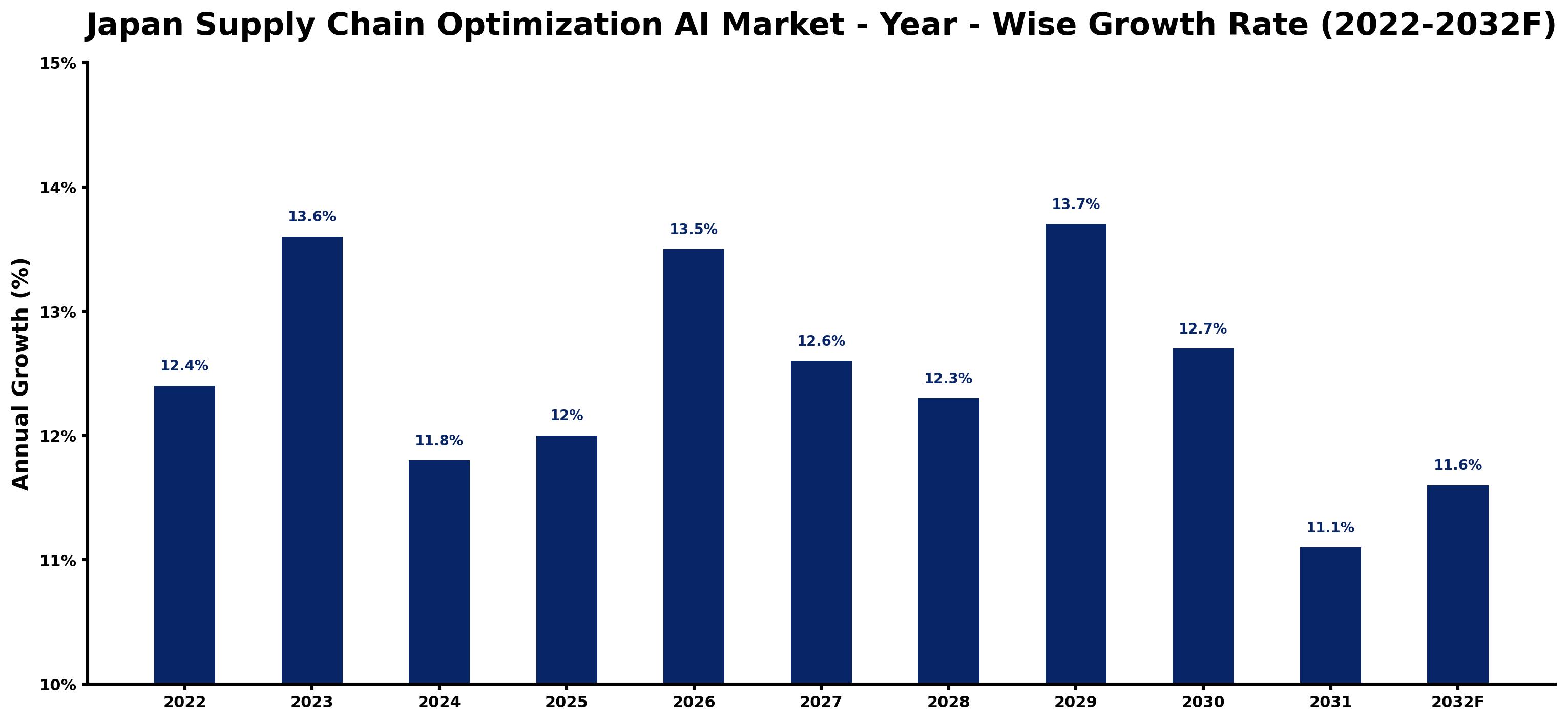
The following figures match every annual growth estimate with the main market development of that year, giving the reasoning behind each rise or slowdown.
| Year | Estimated Annual Growth (%) | Market Rationale |
| 2022 | 12.4 | The market showed strong growth due to increased interest in AI technologies. |
| 2023 | 13.6 | Growth accelerated as businesses sought to improve supply chain efficiency through technology. |
| 2024 | 11.8 | The growth rate slowed as companies adjusted to new technologies and market conditions. |
| 2025 | 12.0 | Demand increased again as firms focused on optimizing logistics and reducing costs. |
| 2026 | 13.5 | The market is expected to experience a resurgence as AI adoption continues to rise among businesses. |
| 2027 | 12.6 | Growth will slow slightly as the market matures and competition intensifies in the sector. |
| 2028 | 12.3 | A further slowdown is projected as companies consolidate their positions and strategies. |
| 2029 | 13.7 | Demand is expected to surge again as new AI capabilities are introduced in the market. |
| 2030 | 12.7 | Growth will slow as the market stabilizes after rapid expansion and technological integration. |
| 2031 | 11.1 | A continued slowdown will reflect the market's maturation phase and evolving buyer needs. |
| 2032 | 11.6 | Demand is expected to rise again as new technologies emerge and enhance operational capabilities. |
Note: Market size estimations and growth projections presented in this report are based on 6Wresearch's proprietary forecasting methodology, utilizing the latest available industry data, government publications, and primary research inputs.
Japan Supply Chain Optimization AI Market Synopsis
Supply Chain Optimization AI is a technology that improves supply chain efficiency through advanced algorithms and machine learning, focusing on demand forecasting, route optimization, and procurement processes. The Japan Supply Chain Optimization AI Market is expanding, driven by e-commerce transactions reaching 2 trillion yen in 2022 and the growing adoption of AI technologies in logistics and retail sectors. Key factors include government initiatives, such as a 5 billion yen allocation for AI research in 2023, which support this growth and improve operational capabilities.
Market Dynamics Impact Analysis (2026–2032)
| Factor | Type | Impact | Primary Segment Affected |
| Increased e-commerce transactions drive demand for efficient logistics solutions. | Driver | High | Demand Forecasting AI |
| Growing reliance on technology for operational efficiency creates opportunities for AI integration. | Driver | High | Route Optimization AI |
| The logistics sector's investment in technology upgrades presents a significant opportunity. | Opportunity | High | Procurement AI |
| The demand for real-time data analytics is rising, creating openings for new solutions. | Opportunity | High | Real-Time Optimization |
| High implementation costs can deter smaller firms from adopting AI solutions. | Restraint | High | Predictive Analytics |
| Limited awareness of AI benefits restricts market growth in certain sectors. | Restraint | Medium | Machine Learning |
| Compliance with evolving regulations can complicate AI integration for businesses. | Challenge | High | Inventory Planning |
| Capacity constraints in logistics may hinder the adoption of AI technologies. | Challenge | Medium | Transportation |
Evaluation of Drivers in Japan Supply Chain Optimization AI Market (2026–2032)
These are the developments adding the most demand over the forecast period.
| Drivers | Primary Segment Affected | Why It Matters (Evidence) |
| Rising e-commerce transactions increase demand for efficient logistics solutions. | Demand Forecasting AI | The number of e-commerce transactions in Japan reached 2 trillion yen in 2022, prompting retailers to improve forecasting accuracy. |
| Growing reliance on technology for operational efficiency boosts AI adoption. | Route Optimization AI | The logistics sector is expected to invest approximately 20 trillion yen in technology upgrades, improving route optimization capabilities. |
| Increased focus on data analytics drives demand for predictive tools. | Predictive Analytics | The adoption of predictive analytics tools in retail is increasing, enhancing inventory management and operational effectiveness. |
| Demand for real-time data processing improves operational capabilities. | Real-Time Optimization | Machine learning technologies are increasingly used in inventory management, allowing for dynamic adjustments based on real-time data. |
| Government initiatives support AI integration in supply chains. | Procurement AI | The government launched a program in 2023 to support AI integration in supply chains, facilitating procurement improvements. |
What keeps demand rising is the surge in e-commerce transactions, which reached 2 trillion yen in 2022, pushing retailers to adopt more accurate forecasting methods. The logistics sector is set to invest heavily in technology upgrades, with an expected investment of approximately 20 trillion yen, enhancing operational efficiency. The growing focus on data analytics drives the adoption of predictive tools, which are essential for managing inventory effectively. Real-time optimization is gaining traction as machine learning technologies are increasingly applied in inventory management, enabling dynamic adjustments to improve responsiveness.
Evaluation of Restraints in Japan Supply Chain Optimization AI Market
These are the pressures that could keep growth below its potential.
| Market Restraint | Primary Segment Affected | Why It Matters (Evidence) |
| High implementation costs deter smaller firms from adopting AI solutions. | Predictive Analytics | Many smaller logistics operators struggle to afford the initial investment required for AI technologies, limiting their competitiveness. |
| Limited awareness of AI benefits restricts market growth in certain sectors. | Machine Learning | Some companies remain unaware of how machine learning can improve their operational efficiency, hindering adoption. |
| Compliance with evolving regulations complicates AI integration for businesses. | Inventory Planning | Companies must navigate complex regulations, which can slow down the adoption of AI solutions and increase costs. |
| Capacity constraints in logistics hinder the adoption of AI technologies. | Transportation | The logistics workforce in Japan is approximately 1.5 million, creating pressure on capacity and limiting scalability. |
| Integration challenges with existing systems can delay AI implementation. | Procurement AI | Many companies face difficulties integrating new AI systems with their legacy infrastructure, causing project delays. |
Japan Supply Chain Optimization AI Market Challenges
Buyers in the logistics sector encounter a skills shortage, as an ageing workforce and insufficient training hinder AI adoption. This gap delays projects, costing firms about 2 trillion yen in lost productivity each year. Heightened competition forces logistics companies to implement AI rapidly, often leading to failures that waste time and resources. Buyers struggle with supply chain optimisation, as the average delivery time of 1-2 days pressures them for quick adjustments, yet outdated systems hinder responsiveness. Rising costs for technology upgrades strain budgets, compelling firms to allocate more resources just to remain competitive.
Trends in the Japan Supply Chain Optimization AI Market
The trends below show where the Japan Supply Chain Optimization AI Market is heading.
- Retailers Increasing Use of Predictive Analytics: Retailers are increasingly adopting Predictive Analytics to improve inventory management, with adoption rates rising to 15% in 2022. This trend is driven by the need for accurate demand forecasting, which boosts efficiency in supply chains.
- Tokyo Region Leading in Logistics Innovation: The Tokyo region is emerging as a leader in logistics innovation, with many companies investing in AI technologies. This shift is evidenced by the region's logistics market valued at approximately 20 trillion yen, indicating strong growth potential.
- Government Support for AI Integration: The government launched a program in 2023 to support AI integration in supply chains, allocating 5 billion yen for research. This initiative aims to improve supply chain resilience and promote technological advancements in logistics.
- Shift Towards Real-Time Optimization: The logistics sector is shifting towards Real-Time Optimization, driven by the need for dynamic adjustments in operations. This trend began gaining traction in 2022 as companies sought to improve efficiency and responsiveness.
Investment Opportunities in the Japan Supply Chain Optimization AI Market
The openings below show where demand in the Japan Supply Chain Optimization AI Market is visible and how suppliers can enter.
- Supply Chain Optimization AI: The growing demand for Supply Chain Optimization AI presents an opportunity, with the logistics sector expected to invest heavily in technology upgrades, estimated at 20 trillion yen. Companies can enter this market by forming partnerships with local logistics firms.
- AI-Driven Route Optimization: With the logistics sector's investment in technology upgrades reaching new heights, there is a gap for AI-driven Route Optimization solutions. Collaborating with logistics operators in Tokyo can facilitate market entry and improve service offerings.
- Demand for Real-Time Data Solutions: The increasing need for real-time data solutions in logistics creates an opportunity for practical AI applications. Logistics operators in Osaka are actively seeking such solutions to improve efficiency and customer satisfaction.
- Investment in Predictive Analytics Tools: The rise in e-commerce transactions highlights the need for predictive analytics tools. Retailers in Japan are looking for advanced solutions to improve inventory management and forecasting accuracy, creating a promising market opportunity.
Government Initiatives in the Japan Supply Chain Optimization AI Market
The Building Energy Efficiency Act, amended in 2022, mandates that all new buildings meet energy standards from April 2025, impacting supply chain operations by ensuring energy-efficient logistics facilities. This law is part of a broader strategy to improve sustainability in the logistics sector and enhance operational efficiency for businesses.
In 2023, the government allocated 5 billion yen for AI research in supply chains, overseen by the Ministry of Economy, Trade and Industry. This funding supports initiatives aimed at integrating AI technologies into logistics, improving operational efficiency and competitiveness for supply chain operators.
Future Insight of the Japan Supply Chain Optimization AI Market
By 2032, buyers will see improved supply chain efficiency through deeper AI integration in logistics operations. Government initiatives will support advancements in inventory management and procurement processes. A projected investment of 5 billion yen in AI research will drive innovation, allowing firms to streamline operations effectively. New international logistics standards will emerge, ensuring timely deliveries and improved service quality, ultimately benefiting buyers and suppliers alike.
Market Segmentation Analysis
Japan Supply Chain Optimization AI Market report covers a detailed analysis of the following market segments:
By Optimization Type – Demand Forecasting AI Leads, Route Optimization AI Expected to Grow Fastest
According to Saurav Kr Singh, Senior Research Analyst at 6Wresearch, Demand Forecasting AI accounted for 43% of the market by optimization type in 2025. Demand Forecasting holds the largest share because it is essential for predicting future demand based on historical data, which logistics companies in Japan rely on for operational effectiveness. Accurate forecasting is particularly important for logistics operations in the Tokyo region to ensure efficiency and meet customer expectations. Route Optimization AI is projected to grow fastest, at a CAGR of 17.6% during 2026–2032. Route Optimization is growing rapidly due to the urgent need to reduce transportation costs and improve delivery times, especially since the average delivery time for e-commerce in Japan is just 1-2 days. This urgency drives logistics operators to swiftly adopt route optimization solutions to maintain competitiveness. Suppliers should focus on enhancing route optimization solutions to capture the increasing demand from logistics operators.
By AI Capability – Predictive Analytics Leads, Machine Learning Expected to Grow Fastest
In 2025, Predictive Analytics led the ai capability split with a 34% share. Predictive Analytics leads the market as it is crucial for forecasting trends and behaviours based on data analysis, which is vital for effective supply chain management. Many logistics companies in Japan implement this capability to stay competitive amid market challenges. The quickest growth will come from Machine Learning, forecast to expand at a CAGR of 16.7% between 2026 and 2032. Machine Learning is experiencing rapid growth as it enhances decision-making through data-driven learning, which is becoming increasingly important in inventory management. The rise in e-commerce transactions, reaching 2 trillion yen in 2022, significantly boosts the demand for machine learning applications. Buyers will gain from investing in machine learning technologies to improve their supply chain efficiency and responsiveness.
By Business Function – Inventory Planning Leads, Transportation Expected to Grow Fastest
The largest business function category in 2025 was Inventory Planning, at 37% of revenue. Inventory Planning is the leading function because it efficiently manages stock levels to meet demand, which is crucial for retailers in Japan's competitive landscape. This function is particularly important given the high volume of e-commerce transactions occurring in the country. Transportation is set to record the highest CAGR in this split, 16.0% over 2026–2032. Transportation is the fastest-growing function due to its critical role in optimising logistics and delivery processes, especially as the logistics sector anticipates significant investments in technology upgrades. This aligns with government initiatives supporting AI integration in transportation. Suppliers should prioritise solutions that enhance transportation efficiency to address the rising demands of logistics operators.
By End User – Retailers Lead, Logistics Operators Expected to Grow Fastest
Retailers held 47% of the Japan Supply Chain Optimization AI Market by end user in 2025. Retailers dominate the market as they heavily depend on optimization technologies for inventory and sales management, which are essential for maintaining competitiveness in Japan's retail sector. The expanding e-commerce landscape further reinforces their position as primary users of these solutions. Over 2026–2032, Logistics Operators are expected to post the fastest growth, at a CAGR of 16.4%. Logistics Operators are experiencing the fastest growth as they increasingly adopt optimization technologies to improve operational efficiency, particularly in response to government initiatives supporting AI integration. This trend is driven by the need for enhanced logistics performance. Suppliers must tailor their offerings to meet the specific needs of logistics operators to capitalise on this growth opportunity.
Key Attractiveness of the Report
- 10 Years of Market Numbers
- Historical Data Starting from 2022 to 2025
- Base Year 2025
- Forecast Data until 2032
- Key Performance Indicators Impacting the Market
- Major Upcoming Developments and Projects
Key Highlights of the Report:
- Japan Supply Chain Optimization AI Market Outlook
- Market Size of Japan Supply Chain Optimization AI Market, 2025
- Forecast of Japan Supply Chain Optimization AI Market, 2032
- Historical Data and Forecast of Japan Supply Chain Optimization AI Revenues & Volume for the Period 2022-2032F
- Japan Supply Chain Optimization AI Market Trend Evolution
- Japan Supply Chain Optimization AI Market Drivers and Challenges
- Japan Supply Chain Optimization AI Price Trends
- Japan Supply Chain Optimization AI Porter's Five Forces
- Japan Supply Chain Optimization AI Industry Life Cycle
- Historical Data and Forecast of Japan Supply Chain Optimization AI Market Revenues & Volume By Optimization Type for the Period 2022-2032F
- Historical Data and Forecast of Japan Supply Chain Optimization AI Market Revenues & Volume By Demand Forecasting AI for the Period 2022-2032F
- Historical Data and Forecast of Japan Supply Chain Optimization AI Market Revenues & Volume By Route Optimization AI for the Period 2022-2032F
- Historical Data and Forecast of Japan Supply Chain Optimization AI Market Revenues & Volume By Procurement AI for the Period 2022-2032F
- Historical Data and Forecast of Japan Supply Chain Optimization AI Market Revenues & Volume By Real-Time Optimization for the Period 2022-2032F
- Historical Data and Forecast of Japan Supply Chain Optimization AI Market Revenues & Volume By AI Capability for the Period 2022-2032F
- Historical Data and Forecast of Japan Supply Chain Optimization AI Market Revenues & Volume By Predictive Analytics for the Period 2022-2032F
- Historical Data and Forecast of Japan Supply Chain Optimization AI Market Revenues & Volume By Machine Learning for the Period 2022-2032F
- Historical Data and Forecast of Japan Supply Chain Optimization AI Market Revenues & Volume By NLP/Automation for the Period 2022-2032F
- Historical Data and Forecast of Japan Supply Chain Optimization AI Market Revenues & Volume By Reinforcement Learning for the Period 2022-2032F
- Historical Data and Forecast of Japan Supply Chain Optimization AI Market Revenues & Volume By Business Function for the Period 2022-2032F
- Historical Data and Forecast of Japan Supply Chain Optimization AI Market Revenues & Volume By Inventory Planning for the Period 2022-2032F
- Historical Data and Forecast of Japan Supply Chain Optimization AI Market Revenues & Volume By Transportation for the Period 2022-2032F
- Historical Data and Forecast of Japan Supply Chain Optimization AI Market Revenues & Volume By Sourcing & Bidding for the Period 2022-2032F
- Historical Data and Forecast of Japan Supply Chain Optimization AI Market Revenues & Volume By Fulfillment for the Period 2022-2032F
- Historical Data and Forecast of Japan Supply Chain Optimization AI Market Revenues & Volume By End User for the Period 2022-2032F
- Historical Data and Forecast of Japan Supply Chain Optimization AI Market Revenues & Volume By Retailers for the Period 2022-2032F
- Historical Data and Forecast of Japan Supply Chain Optimization AI Market Revenues & Volume By Logistics Operators for the Period 2022-2032F
- Historical Data and Forecast of Japan Supply Chain Optimization AI Market Revenues & Volume By Enterprises for the Period 2022-2032F
- Historical Data and Forecast of Japan Supply Chain Optimization AI Market Revenues & Volume By E-commerce Fulfillment Hubs for the Period 2022-2032F
- Japan Supply Chain Optimization AI Import Export Trade Statistics
- Market Opportunity Assessment By Optimization Type
- Market Opportunity Assessment By AI Capability
- Market Opportunity Assessment By Business Function
- Market Opportunity Assessment By End User
- Japan Supply Chain Optimization AI Top Companies Market Share
- Japan Supply Chain Optimization AI Competitive Benchmarking By Technical and Operational Parameters
- Japan Supply Chain Optimization AI Company Profiles
- Japan Supply Chain Optimization AI Key Strategic Recommendations
Market Covered
Segments analysed in this report are listed below.
By Optimization Type
- Demand Forecasting AI
- Route Optimization AI
- Procurement AI
- Real-Time Optimization
By AI Capability
- Predictive Analytics
- Machine Learning
- NLP/Automation
- Reinforcement Learning
By Business Function
- Inventory Planning
- Transportation
- Sourcing & Bidding
- Fulfillment
By End User
- Retailers
- Logistics Operators
- Enterprises
- E-commerce Fulfillment Hubs































