Japan Supply Chain Optimization Market Size & Growth Rate
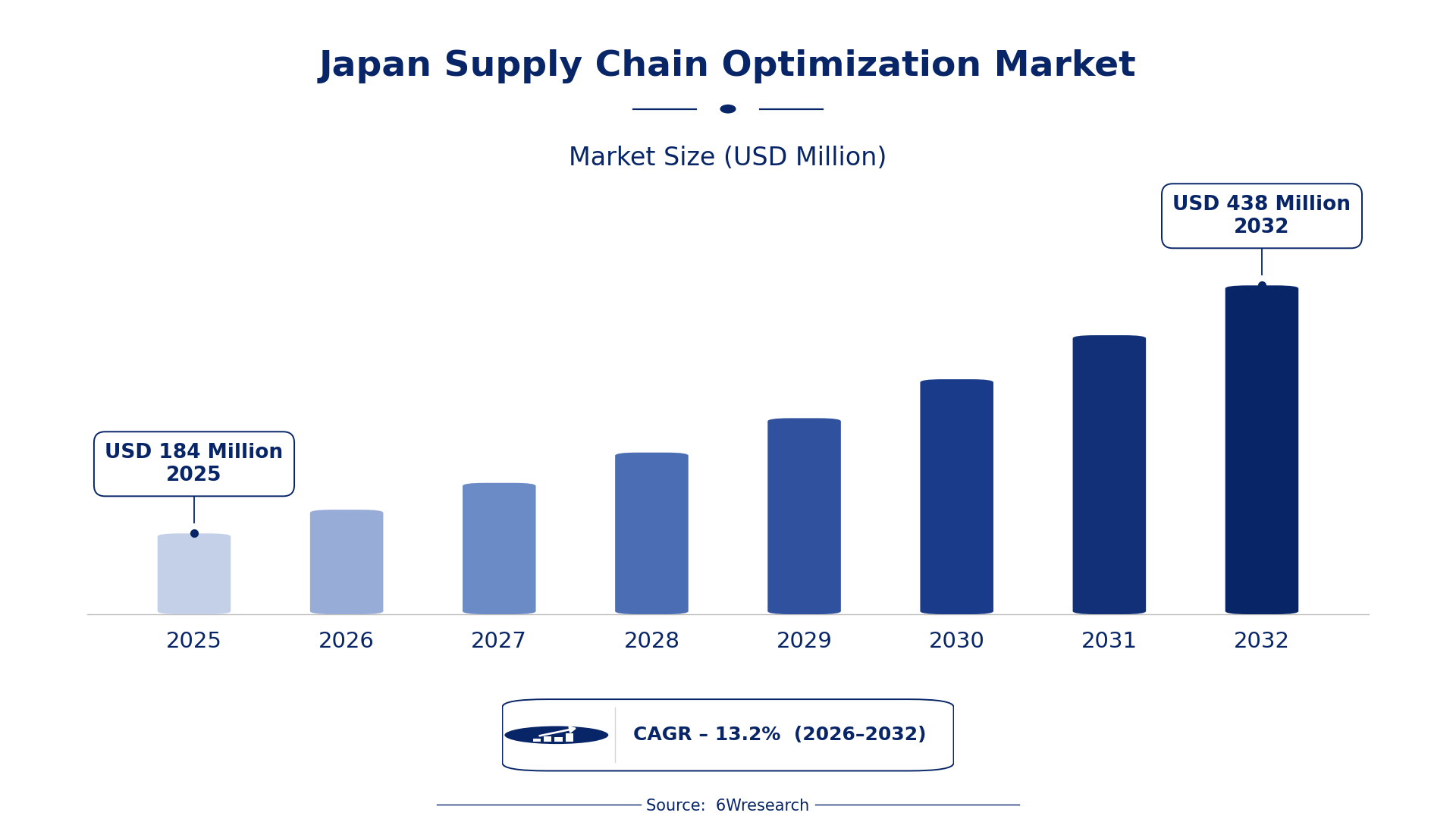
According to 6Wresearch internal database and industry insights, the Japan Supply Chain Optimization Market was valued at USD 184 Million in 2025 and is projected to reach USD 438 Million by 2032, growing at a CAGR of approximately 13.2% during 2026–2032.
Japan Supply Chain Optimization Market Highlights
| Report Metric | Details |
| Report Name | Japan Supply Chain Optimization Market (2026-2032) |
| Market Size 2025 | USD 184 Million |
| Market Size 2032 | USD 438 Million |
| Absolute Growth 2025–2032 | USD 254 Million |
| CAGR 2026–2032 | 13.2% |
| Peak Annual Growth | 15.6% in 2026 |
| Forecast Period | 2026–2032 |
| Historical Data | 2022–2025 |
| Base Year | 2025 |
| Leading Solution Type, 2025 | Planning & Scheduling (36% share) |
| Leading Approach Type, 2025 | Mathematical Optimization (50% share) |
| Leading Use Case, 2025 | Retail Distribution (41% share) |
| Leading End User, 2025 | Manufacturing Corporations (39% share) |
| Fastest-Growing Solution Type | Network Optimization (18.1% CAGR) |
| Fastest-Growing Approach Type | Predictive Insights (17.8% CAGR) |
| Fastest-Growing Use Case | Supplier Disruption (17.0% CAGR) |
| Fastest-Growing End User | Logistics Consultants (16.4% CAGR) |
| Growing Sector | Logistics Consultants |
| Key End Users | Manufacturing Corporations, Multinational Enterprises, Supermarket Chains, Logistics Consultants |
Japan Supply Chain Optimization Market Year-wise Growth Rate and Key Drivers (2022–2032)
This graph illustrates the annual growth rates of the market from 2022 to 2032, highlighting a steady upward trajectory and projected market expansion over the forecast period.
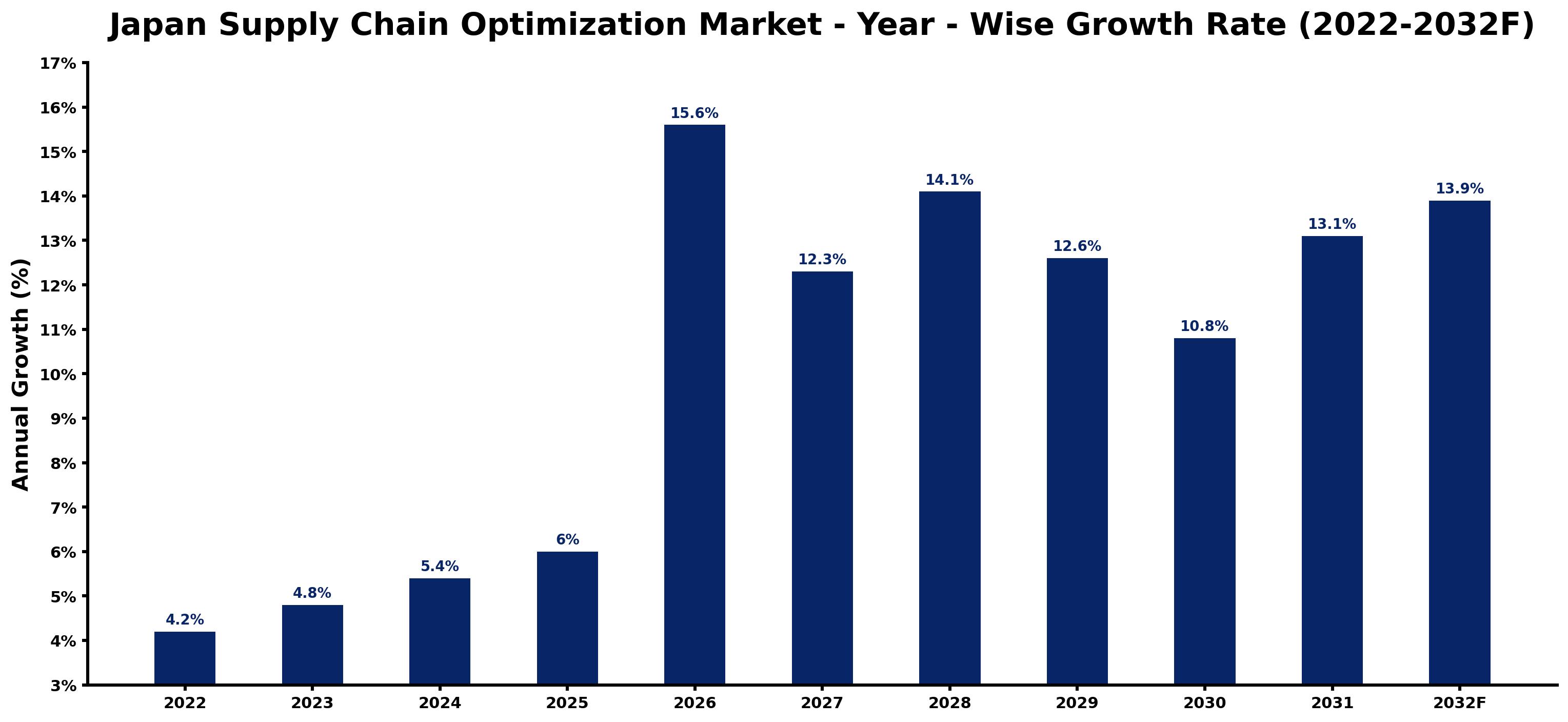
Below, each year's estimated growth is shown next to the factor that most influenced it.
| Year | Estimated Annual Growth (%) | Market Rationale |
| 2022 | 4.2 | The market showed steady growth, reflecting ongoing investments in supply chain technologies. |
| 2023 | 4.8 | Growth accelerated as more businesses adopted optimization solutions to improve efficiency. |
| 2024 | 5.4 | The increase in demand was driven by the need for improved inventory management practices. |
| 2025 | 6.0 | A peak in growth occurred due to heightened focus on logistics efficiency across sectors. |
| 2026 | 15.6 | Demand surged as companies increasingly prioritized technological advancements in supply chains. |
| 2027 | 12.3 | Growth slowed slightly as market saturation began to affect new investments. |
| 2028 | 14.1 | The market rebounded with renewed interest in digital transformation initiatives. |
| 2029 | 12.6 | A modest slowdown occurred as companies adjusted to new operational standards. |
| 2030 | 10.8 | Growth continued to moderate as the market stabilised after rapid expansions. |
| 2031 | 13.1 | A resurgence in demand was noted as businesses sought to refine their supply chain strategies. |
| 2032 | 13.9 | Continued investment in advanced technologies is expected to drive further growth. |
Note: Market size estimations and growth projections presented in this report are based on 6Wresearch's proprietary forecasting methodology, utilizing the latest available industry data, government publications, and primary research inputs.
Japan Supply Chain Optimization Market Synopsis
Supply Chain Optimization encompasses advanced technologies and methodologies designed to improve efficiency in logistics and operations. The Japan Supply Chain Optimization Market is growing, propelled by the manufacturing sector's contribution to GDP and the surge in e-commerce. Government initiatives aim to cut logistics costs by 10% by 2025, further boosting demand for optimization solutions across various sectors.
Market Dynamics Impact Analysis (2026–2032)
| Factor | Type | Impact | Primary Segment Affected |
| Increased adoption of AI technologies | Driver | High | Mathematical Optimization |
| Growing e-commerce market | Driver | High | Retail Distribution |
| Rising demand for efficient logistics solutions | Opportunity | High | Network Optimization |
| Need for enhanced inventory management | Opportunity | High | Cost Optimization |
| Challenges in integrating new technologies | Restraint | Medium | Predictive Insights |
| Limited awareness of optimization benefits | Restraint | Medium | Heuristic Modeling |
| Supply chain disruptions due to global events | Challenge | High | Risk Management |
| Increased competition among optimization providers | Challenge | Medium | Scenario Simulation |
Evaluation of Drivers in Japan Supply Chain Optimization Market (2026–2032)
The factors lifting demand, and the evidence behind each, are summarised below.
| Drivers | Primary Segment Affected | Why It Matters (Evidence) |
| Adoption of AI in logistics | Mathematical Optimization | This technology improves decision-making, leading to more efficient resource allocation and logistics management. |
| Growth of e-commerce | Retail Distribution | The e-commerce market is projected to reach 20 trillion yen by 2025, increasing demand for effective supply chain solutions. |
| Demand for reduced operational costs | Cost Optimization | The manufacturing sector, accounting for 20% of GDP, drives the need for cost-effective supply chain strategies. |
| Focus on supply chain resilience | Risk Management | Government initiatives aim to strengthen supply chain resilience, prompting businesses to invest in optimization solutions. |
| Need for faster delivery times | Network Optimization | With average delivery times of 2-3 days, companies are compelled to optimize their logistics operations. |
Several shifts outside the market lift sales. The e-commerce sector is projected to reach 20 trillion yen by 2025, driving demand for supply chain optimization solutions. As the manufacturing sector contributes approximately 20% to Japan's GDP, companies are increasingly investing in cost-effective strategies. The average delivery time for goods in Japan is around 2-3 days, prompting businesses to improve logistics efficiency. The adoption of AI technologies is transforming decision-making processes within supply chains, driving further investments in optimization solutions.
Evaluation of Restraints in Japan Supply Chain Optimization Market
Several factors work against faster growth; the main ones are summarised below.
| Market Restraint | Primary Segment Affected | Why It Matters (Evidence) |
| Integration challenges with existing systems | Predictive Insights | Many companies face difficulties in integrating new optimization technologies with their legacy systems, hindering adoption. |
| Limited understanding of optimization benefits | Heuristic Modeling | A lack of awareness among businesses about the advantages of optimization solutions restricts market growth. |
| Supply chain disruptions from global events | Risk Management | Ongoing global disruptions create uncertainty, making companies hesitant to invest in new technologies. |
| High initial investment costs | Scenario Simulation | The upfront costs associated with implementing advanced optimization solutions can deter smaller businesses. |
| Regulatory compliance complexities | Mathematical Optimization | Navigating compliance with various regulations can complicate the implementation of optimization strategies. |
Japan Supply Chain Optimization Market Challenges
A major challenge in the supply chain optimization market is the strict ISO 9001 regulations, which can delay project timelines by up to six months for producers and raise their operational costs. Increasing logistics expenses pose difficulties for distributors, as the government targets a 10% reduction by 2025, potentially squeezing their profit margins. Importers encounter a skills gap in advanced technologies, which can hinder efficiency and delay deliveries by 1-2 days. Inconsistent technology adoption results in buyers facing increased operational costs of 15% due to limited access to essential tools.
Trends in the Japan Supply Chain Optimization Market
The following changes are redrawing the Japan Supply Chain Optimization Market.
- Shift towards AI-Driven Logistics Solutions: The adoption of AI technologies in logistics is on the rise, with many companies implementing these solutions to streamline operations. In 2023, the use of AI in supply chain optimization is expanding rapidly, enhancing efficiency across sectors.
- Transition from Traditional to Digital Supply Chains: Japan is experiencing a shift from traditional supply chain practices to digital solutions, driven by the demand for efficiency. The 2023 government program for digital supply chain technologies supports this change.
- Emergence of Predictive Analytics in Supply Chains: Predictive analytics is becoming crucial for forecasting demand and optimising inventory management. The growth of e-commerce is pushing businesses to adopt these technologies to maintain competitiveness.
- Focus on Sustainability in Supply Chain Practices: Sustainability is increasingly important in supply chain management, with companies aiming to reduce their environmental impact. The GX Promotion Act encourages practices that support sustainability.
Investment Opportunities in the Japan Supply Chain Optimization Market
Several openings in the Japan Supply Chain Optimization Market merit attention from investors.
- Gap in Advanced Optimization Solutions: With the e-commerce market projected to reach 20 trillion yen by 2025, there is an opportunity for advanced optimization solutions. Retail distribution networks require these technologies to effectively manage increased demand.
- Investment in AI-Driven Technologies: As AI adoption increases, companies are seeking solutions that incorporate these technologies into their supply chains. Logistics consultants can offer expertise to assist businesses in implementing AI-driven strategies.
- Need for Enhanced Risk Management Solutions: Ongoing global disruptions underscore the necessity for improved risk management in supply chains. Manufacturing corporations are looking for solutions that can effectively mitigate these risks.
- Demand for Faster Delivery Solutions: With average delivery times of 2-3 days, there is a strong need for solutions that improve logistics efficiency. Companies in the Tokyo Bay area are particularly focused on optimising their operations.
Government Initiatives in the Japan Supply Chain Optimization Market
The Economic Security Promotion Act, enacted in 2022, has a substantial impact on supply chain optimization by mandating resilience for critical products and materials. This legislation encourages businesses to invest in advanced technologies, ensuring compliance with national standards. Additionally, the Logistics Efficiency Improvement Law, introduced in 2021, aims to enhance supply chain practices, compelling companies to adopt best practices in logistics management and reporting, which ultimately improves operational efficiency.
The Ministry of Economy, Trade and Industry (METI) plays a key role in approving initiatives that support supply chain resilience. METI funds projects aimed at advancing digital supply chain technologies, focusing on reducing logistics costs by 10% by 2025. The agency also collaborates with industry stakeholders to promote best practices, ensuring that businesses can effectively implement optimization strategies and improve their overall supply chain performance.
Future Insight of the Japan Supply Chain Optimization Market
The launch of new digital supply chain initiatives will transform logistics operations by 2032, creating opportunities for buyers and suppliers. Enhanced AI capabilities will shorten average delivery times, improving overall efficiency. With Japan's e-commerce market projected to reach 20 trillion yen by 2025, the demand for effective supply chain solutions will rise. The logistics infrastructure in the Tokyo Bay area will expand, facilitating better resource management and distribution efficiency.
Market Segmentation Analysis
Japan Supply Chain Optimization Market report covers a detailed analysis of the following market segments:
By Solution Type – Planning & Scheduling Leads, Network Optimization Expected to Grow Fastest
According to Saurav Kr Singh, Senior Research Analyst at 6Wresearch, Planning & Scheduling accounted for 36% of the market by solution type in 2025. Planning & Scheduling holds the largest share due to its essential role in coordinating supply chain activities across various sectors. For instance, the automotive sector utilises these solutions to streamline production and distribution processes effectively. Network Optimization is projected to grow fastest, at a CAGR of 18.1% during 2026–2032. Network Optimization is experiencing rapid growth as companies seek to maximise distribution efficiency amidst rising demands from the e-commerce sector. The recent government initiatives to enhance digital supply chain technologies will further accelerate this trend. Suppliers must focus on developing advanced planning and scheduling solutions to meet the growing needs of the market.
By Approach Type – Mathematical Optimization Leads, Predictive Insights Expected to Grow Fastest
In 2025, Mathematical Optimization led the approach type split with a 50% share. Mathematical Optimization is the leading approach as it is fundamental for effective resource allocation and logistics management. Its widespread adoption in various sectors underscores its importance in enhancing operational efficiency. Over 2026–2032, Predictive Insights are expected to post the fastest growth, at a CAGR of 17.8%. Predictive Insights is the fastest-growing approach, driven by the increasing need for accurate demand forecasting in a competitive market. The rise of e-commerce has intensified the demand for these insights to optimise inventory management. Buyers should prioritise solutions that incorporate predictive insights to stay ahead in a rapidly changing market.
By Use Case – Retail Distribution Leads, Supplier Disruption Expected to Grow Fastest
The largest use case category in 2025 was Retail Distribution, at 41% of revenue. Retail Distribution leads the market as it is essential for managing supply to retail outlets, particularly in urban areas like Tokyo. The significant growth of Japan's e-commerce market further amplifies the need for effective retail distribution strategies. Supplier Disruption is set to record the highest CAGR in this split, 17.0% over 2026–2032. Supplier Disruption is the fastest-growing use case, largely due to the need for maintaining supply chain continuity amid global uncertainties. Recent government initiatives to enhance supply chain resilience have heightened focus on this area. Suppliers should develop robust solutions to address potential supplier disruptions, ensuring continuity in operations.
By End User – Manufacturing Corporations Lead, Logistics Consultants Expected to Grow Fastest
With 39% of end user revenue in 2025, Manufacturing Corporations was the largest category. Manufacturing Corporations dominate the market as they heavily rely on supply chain optimisation for improving production efficiency. This sector, accounting for about 20% of Japan's GDP, drives substantial demand for optimisation technologies. The quickest growth will come from Logistics Consultants, forecast to expand at a CAGR of 16.4% between 2026 and 2032. Logistics Consultants are the fastest-growing end user group, as they provide essential expertise in supply chain strategies to various industries. The increasing complexity of supply chains has led to a higher demand for consultancy services. Suppliers should consider partnerships with logistics consultants to better address the needs of manufacturing clients.
Key Attractiveness of the Report
- 10 Years of Market Numbers
- Historical Data Starting from 2022 to 2025
- Base Year 2025
- Forecast Data until 2032
- Key Performance Indicators Impacting the Market
- Major Upcoming Developments and Projects
Key Highlights of the Report:
- Japan Supply Chain Optimization Market Outlook
- Market Size of Japan Supply Chain Optimization Market, 2025
- Forecast of Japan Supply Chain Optimization Market, 2032
- Historical Data and Forecast of Japan Supply Chain Optimization Revenues & Volume for the Period 2022-2032F
- Japan Supply Chain Optimization Market Trend Evolution
- Japan Supply Chain Optimization Market Drivers and Challenges
- Japan Supply Chain Optimization Price Trends
- Japan Supply Chain Optimization Porter's Five Forces
- Japan Supply Chain Optimization Industry Life Cycle
- Historical Data and Forecast of Japan Supply Chain Optimization Market Revenues & Volume By Solution Type for the Period 2022-2032F
- Historical Data and Forecast of Japan Supply Chain Optimization Market Revenues & Volume By Planning & Scheduling for the Period 2022-2032F
- Historical Data and Forecast of Japan Supply Chain Optimization Market Revenues & Volume By Network Optimization for the Period 2022-2032F
- Historical Data and Forecast of Japan Supply Chain Optimization Market Revenues & Volume By Cost Optimization for the Period 2022-2032F
- Historical Data and Forecast of Japan Supply Chain Optimization Market Revenues & Volume By Risk Management for the Period 2022-2032F
- Historical Data and Forecast of Japan Supply Chain Optimization Market Revenues & Volume By Approach Type for the Period 2022-2032F
- Historical Data and Forecast of Japan Supply Chain Optimization Market Revenues & Volume By Heuristic Modeling for the Period 2022-2032F
- Historical Data and Forecast of Japan Supply Chain Optimization Market Revenues & Volume By Mathematical Optimization for the Period 2022-2032F
- Historical Data and Forecast of Japan Supply Chain Optimization Market Revenues & Volume By Scenario Simulation for the Period 2022-2032F
- Historical Data and Forecast of Japan Supply Chain Optimization Market Revenues & Volume By Predictive Insights for the Period 2022-2032F
- Historical Data and Forecast of Japan Supply Chain Optimization Market Revenues & Volume By Use Case for the Period 2022-2032F
- Historical Data and Forecast of Japan Supply Chain Optimization Market Revenues & Volume By Retail Distribution for the Period 2022-2032F
- Historical Data and Forecast of Japan Supply Chain Optimization Market Revenues & Volume By Warehouse Siting for the Period 2022-2032F
- Historical Data and Forecast of Japan Supply Chain Optimization Market Revenues & Volume By Raw Material Supply for the Period 2022-2032F
- Historical Data and Forecast of Japan Supply Chain Optimization Market Revenues & Volume By Supplier Disruption for the Period 2022-2032F
- Historical Data and Forecast of Japan Supply Chain Optimization Market Revenues & Volume By End User for the Period 2022-2032F
- Historical Data and Forecast of Japan Supply Chain Optimization Market Revenues & Volume By Supermarket Chains for the Period 2022-2032F
- Historical Data and Forecast of Japan Supply Chain Optimization Market Revenues & Volume By Logistics Consultants for the Period 2022-2032F
- Historical Data and Forecast of Japan Supply Chain Optimization Market Revenues & Volume By Manufacturing Corporations for the Period 2022-2032F
- Historical Data and Forecast of Japan Supply Chain Optimization Market Revenues & Volume By Multinational Enterprises for the Period 2022-2032F
- Japan Supply Chain Optimization Import Export Trade Statistics
- Market Opportunity Assessment By Solution Type
- Market Opportunity Assessment By Approach Type
- Market Opportunity Assessment By Use Case
- Market Opportunity Assessment By End User
- Japan Supply Chain Optimization Top Companies Market Share
- Japan Supply Chain Optimization Competitive Benchmarking By Technical and Operational Parameters
- Japan Supply Chain Optimization Company Profiles
- Japan Supply Chain Optimization Key Strategic Recommendations
Market Covered
The following segment groups are covered in the report.
By Solution Type
- Planning & Scheduling
- Network Optimization
- Cost Optimization
- Risk Management
By Approach Type
- Heuristic Modeling
- Mathematical Optimization
- Scenario Simulation
- Predictive Insights
By Use Case
- Retail Distribution
- Warehouse Siting
- Raw Material Supply
- Supplier Disruption
By End User
- Supermarket Chains
- Logistics Consultants
- Manufacturing Corporations
- Multinational Enterprises































