Japan Supply Chain Visibility Market Size & Growth Rate
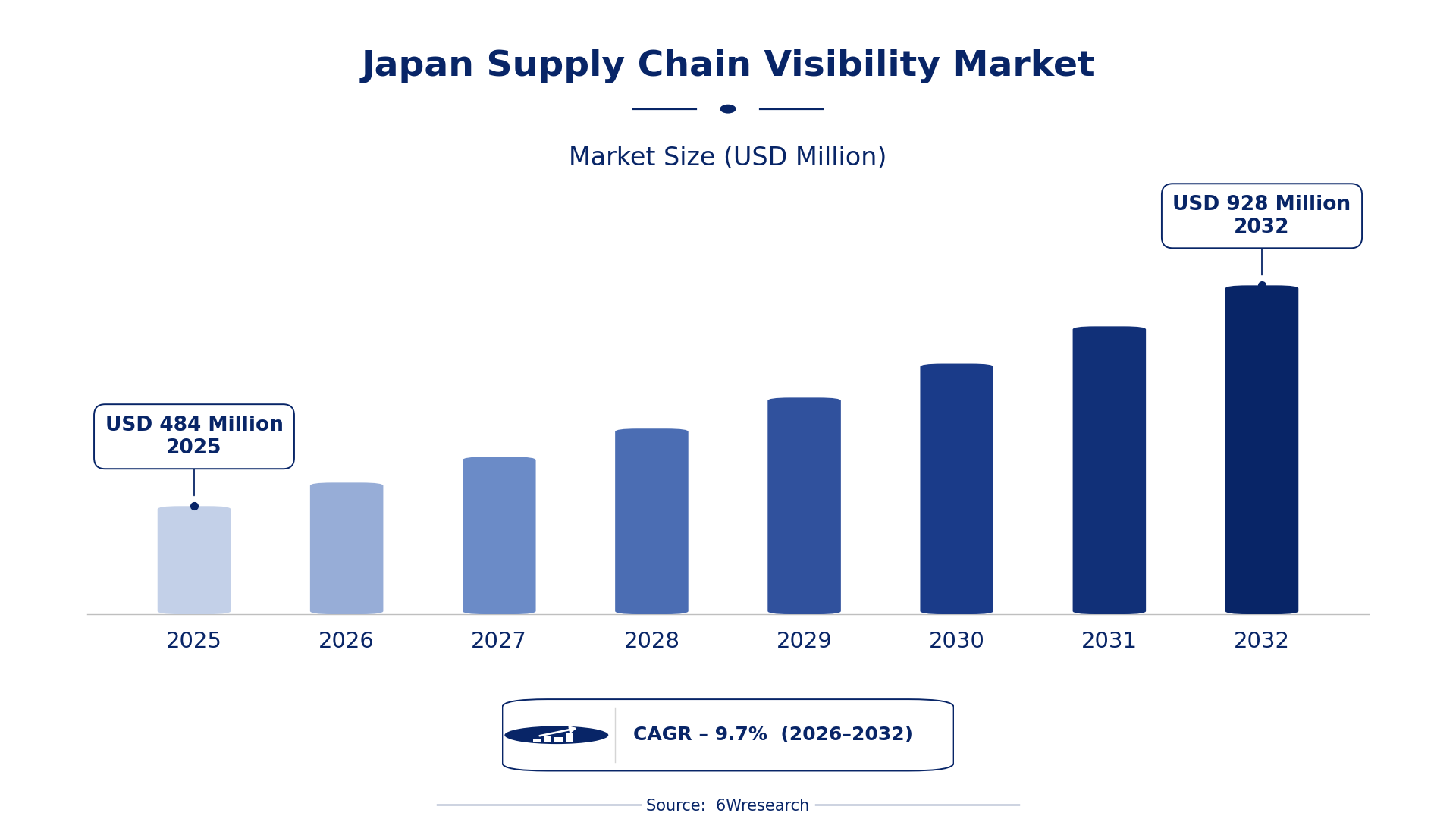
According to 6Wresearch internal database and industry insights, the Japan Supply Chain Visibility Market was valued at USD 484 Million in 2025 and is projected to reach USD 928 Million by 2032, growing at a CAGR of approximately 9.7% during 2026–2032.
Japan Supply Chain Visibility Market Highlights
| Report Metric | Details |
| Report Name | Japan Supply Chain Visibility Market (2026-2032) |
| Market Size 2025 | USD 484 Million |
| Market Size 2032 | USD 928 Million |
| Absolute Growth 2025–2032 | USD 444 Million |
| CAGR 2026–2032 | 9.7% |
| Peak Annual Growth | 11.1% in 2032 |
| Forecast Period | 2026–2032 |
| Historical Data | 2022–2025 |
| Base Year | 2025 |
| Leading Visibility Scope, 2025 | Outbound Logistics (46% share) |
| Leading Platform Type, 2025 | SaaS (38% share) |
| Leading Application Area, 2025 | Supplier Networks (45% share) |
| Leading End User, 2025 | 3PL Providers (38% share) |
| Fastest-Growing Visibility Scope | Multi-tier Supplier View (12.7% CAGR) |
| Fastest-Growing Platform Type | AI-Driven Analytics (14.6% CAGR) |
| Fastest-Growing Application Area | Risk Monitoring (11.7% CAGR) |
| Growing Sector | logistics |
| Key End Users | 3PL Providers, OEMs, FMCG Companies |
Japan Supply Chain Visibility Market Year-wise Growth Rate and Key Drivers (2022–2032)
This graph illustrates the annual growth rates of the market from 2022 to 2032, highlighting a steady upward trajectory and projected market expansion over the forecast period.
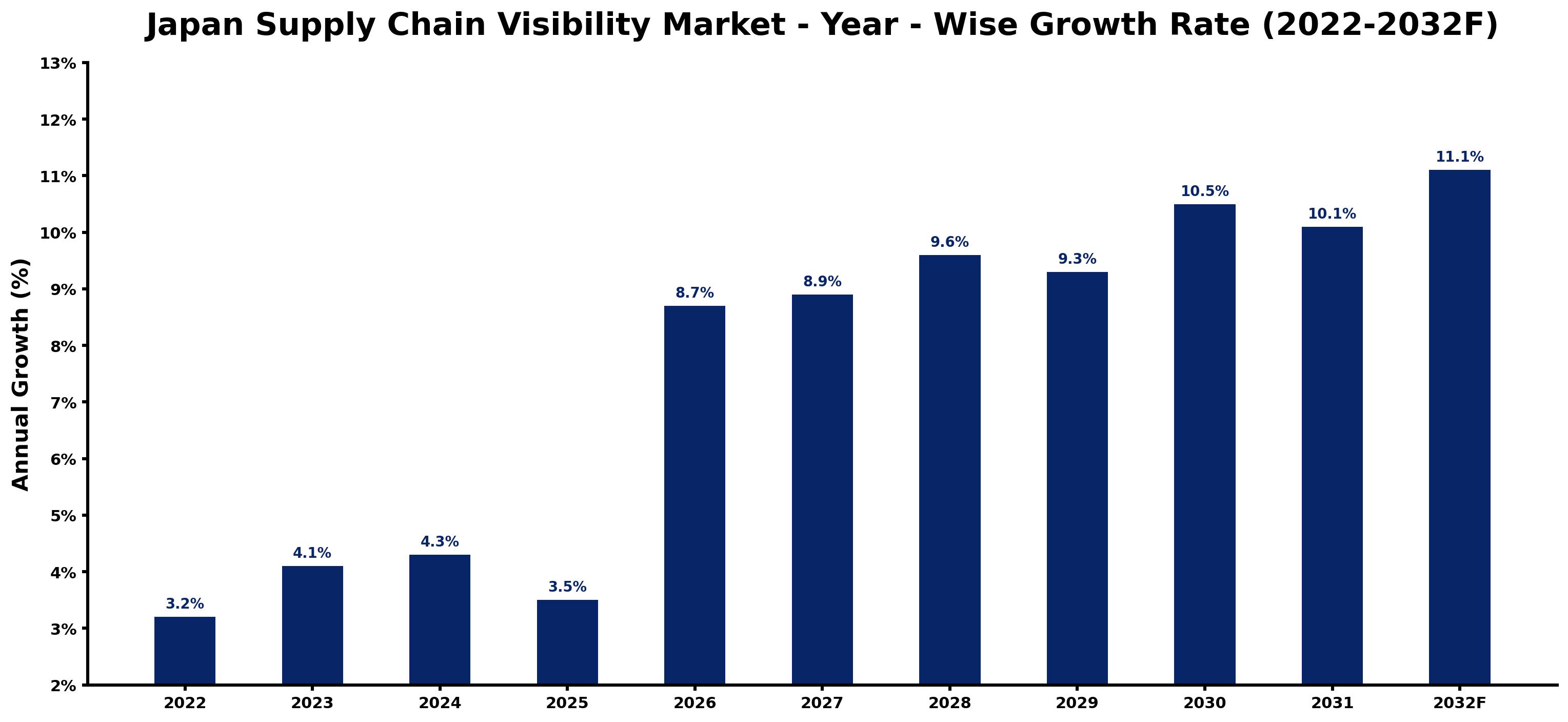
Year by year, the estimates below pair each growth rate with the development that shaped it.
| Year | Estimated Annual Growth (%) | Market Rationale |
| 2022 | 3.2 | The market showed steady growth, driven by increased demand for logistics efficiency. |
| 2023 | 4.1 | Growth accelerated as businesses adopted advanced tracking technologies to improve operations. |
| 2024 | 4.3 | The market continued to expand, supported by rising investments in supply chain management. |
| 2025 | 3.5 | Growth slowed due to market saturation in some logistics sectors, yet demand remained strong. |
| 2026 | 8.7 | Demand is expected to surge as companies increasingly seek to improve visibility across supply chains. |
| 2027 | 8.9 | Growth will continue to rise, driven by the integration of AI in supply chain processes. |
| 2028 | 9.6 | The market is projected to experience strong growth as cloud solutions become more prevalent in logistics. |
| 2029 | 9.3 | Growth is expected to decelerate slightly as the market begins to stabilise after rapid expansion. |
| 2030 | 10.5 | Demand will increase again as companies focus on improving operational efficiencies. |
| 2031 | 10.1 | Growth is projected to moderate as businesses adjust to evolving supply chain requirements. |
| 2032 | 11.1 | The market is expected to peak with substantial investments in visibility technologies and systems. |
Note: Market size estimations and growth projections presented in this report are based on 6Wresearch's proprietary forecasting methodology, utilizing the latest available industry data, government publications, and primary research inputs.
Japan Supply Chain Visibility Market Synopsis
Supply Chain Visibility encompasses technologies and software solutions that improve tracking and management of goods throughout the supply chain. The logistics and manufacturing industries in Japan are key buyer groups, with demand driven by the need for operational efficiency and customer satisfaction. The Japan Supply Chain Visibility Market is growing due to increased adoption of cloud-based solutions, AI-driven analytics, and a national initiative aimed at improving logistics efficiency by 20% in 2023.
Market Dynamics Impact Analysis (2026–2032)
| Factor | Type | Impact | Primary Segment Affected |
| Increased investments in logistics technology | Driver | High | SaaS |
| Growing demand for real-time data access | Driver | High | Cloud |
| Expansion of AI-driven analytics in operations | Opportunity | High | AI-Driven Analytics |
| Rising need for comprehensive supplier oversight | Opportunity | Medium | Multi-tier Supplier View |
| Challenges in integrating new technologies | Restraint | High | Inventory Visibility |
| Limited awareness of supply chain visibility benefits | Restraint | Medium | Outbound Logistics |
| High costs associated with technology upgrades | Challenge | High | 3PL Providers |
| Capacity constraints in logistics infrastructure | Challenge | Medium | Distribution Centers |
Evaluation of Drivers in Japan Supply Chain Visibility Market (2026–2032)
These are the developments adding the most demand over the forecast period.
| Drivers | Primary Segment Affected | Why It Matters (Evidence) |
| Increased logistics technology investments | SaaS | The logistics industry, valued at approximately 10 trillion JPY, drives demand for scalable solutions. |
| Demand for real-time data access | Cloud | Cloud solutions are growing at a rate of 15% annually, improving operational efficiency. |
| Integration of AI-driven analytics | AI-Driven Analytics | AI is being integrated into 30% of supply chain operations, improving predictive capabilities. |
| Need for supplier oversight | Multi-tier Supplier View | This visibility supports better management of supplier relationships and reduces risks. |
| Focus on improving logistics efficiency | Outbound Logistics | The 2023 initiative aims to boost logistics efficiency by 20%, increasing demand for visibility tools. |
Spending rises because demand for logistics technology has increased markedly since five years ago. The logistics industry, valued at approximately 10 trillion JPY, drives investments in scalable solutions. Companies are increasingly seeking real-time data access as cloud-based solutions grow at a rate of 15% annually. The integration of AI-driven analytics into 30% of supply chain operations is improving predictive capabilities.
Evaluation of Restraints in Japan Supply Chain Visibility Market
The table below lists the restraints and the evidence behind each.
| Market Restraint | Primary Segment Affected | Why It Matters (Evidence) |
| Integration challenges with new technologies | Inventory Visibility | Many companies face difficulties in adopting new systems, hindering visibility improvements. |
| Limited awareness of visibility benefits | Outbound Logistics | Some businesses underestimate the advantages of visibility tools, affecting adoption rates. |
| High costs for technology upgrades | 3PL Providers | Upgrading to advanced visibility systems can be prohibitively expensive for many providers. |
| Capacity constraints in logistics infrastructure | Distribution Centers | Bottlenecks in logistics infrastructure limit the effectiveness of visibility solutions. |
| Regulatory compliance issues | Supplier Networks | Navigating compliance can complicate the implementation of visibility technologies. |
Japan Supply Chain Visibility Market Challenges
Buyers in Japan's logistics sector face fierce competition that compresses prices, compelling producers to reduce costs and affecting service quality. Regulatory changes from the Ministry of Land, Infrastructure, Transport and Tourism introduce compliance challenges, causing delays for producers adapting their operations. Technology adoption remains slow, with only 30% of supply chain operations utilising AI-driven analytics, resulting in inefficiencies that waste time and resources for buyers. Skills shortages in advanced software engineering limit producers' ability to implement visibility solutions, leading to extended delays in achieving operational efficiency.
Trends in the Japan Supply Chain Visibility Market
Four trends stand out in the Japan Supply Chain Visibility Market.
- Shift from Traditional to Cloud-Based Solutions: Since 2023, numerous logistics companies have moved to cloud-based solutions for improved data access. This transition is particularly noticeable in Tokyo, where cloud adoption has risen by 15%, facilitating enhanced operational efficiency.
- Emergence of AI-Driven Analytics: In 2023, AI-driven analytics began to take precedence in supply chain operations, especially in Osaka. With 30% of operations integrating AI, companies are refining their processes and enhancing decision-making capabilities.
- Growing Importance of Multi-Tier Supplier Visibility: Beginning in 2023, the demand for oversight of suppliers has escalated, particularly among 3PL providers. This trend is reflected in the fact that these providers make up 25% of the logistics market in Japan.
- Rising Adoption of Real-Time Tracking Technologies: In 2023, logistics firms have increasingly embraced real-time tracking technologies to boost customer satisfaction. This trend is particularly pronounced in Osaka, where operational efficiency has improved markedly.
Investment Opportunities in the Japan Supply Chain Visibility Market
The openings below show where demand in the Japan Supply Chain Visibility Market is visible and how suppliers can enter.
- 3PL Providers Seeking Advanced Solutions: 3PL providers present a notable opportunity, as they constitute 25% of the logistics market. Investing in advanced visibility tools can enhance their service offerings and operational efficiency.
- Gap in AI-Driven Analytics Adoption: With AI-driven analytics integrated into only 30% of operations, a clear gap exists for suppliers to address. Targeting logistics firms in Tokyo could lead to fruitful partnerships.
- Distribution Centers Needing Efficiency Improvements: Distribution centers in Japan are increasingly in search of solutions to boost logistics efficiency. Providing advanced visibility tools can help meet their growing demands for operational enhancements.
- Supplier Networks Requiring Enhanced Communication Tools: Supplier networks are seeking solutions to improve communication and coordination. Investing in technologies that enhance visibility can capture this emerging demand.
Government Initiatives in the Japan Supply Chain Visibility Market
The Economic Security Promotion Act, enacted in 2022, strengthens supply chain resilience for critical products and materials. This legislation builds on existing regulations by imposing stricter oversight and reporting requirements for producers, ensuring greater transparency and reliability in supply chains. Consequently, businesses must invest in compliance measures to meet these heightened standards, ultimately improving operational integrity and consumer trust.
The Digital Agency, established in September 2021, supervises the approval of digital transformation initiatives within the logistics sector. This agency funds projects aimed at enhancing system interoperability and data sharing among stakeholders. In 2023, it allocated substantial resources to assist logistics firms in adopting advanced technologies, which will facilitate smoother operations and improve supply chain visibility across the industry.
Future Insight of the Japan Supply Chain Visibility Market
A logistics efficiency programme is projected to be fully operational by 2032, with the goal of streamlining workflows and significantly boosting productivity. The logistics sector will increasingly integrate advanced tracking technologies, improving inventory management and providing real-time data access. The incorporation of data analytics will become standard, enabling more informed decision-making throughout the supply chain. As these advancements unfold, the average delivery time is expected to decrease, enhancing customer satisfaction and operational effectiveness.
Market Segmentation Analysis
Japan Supply Chain Visibility Market report covers a detailed analysis of the following market segments:
By Visibility Scope – Outbound Logistics Leads, Multi-tier Supplier View Expected to Grow Fastest
According to Saurav Kr Singh, Senior Research Analyst at 6Wresearch, with 46% of visibility scope revenue in 2025, Outbound Logistics was the largest category. Outbound logistics holds the largest share due to its critical role in tracking outgoing shipments, which directly affects customer satisfaction. The logistics industry in Japan, valued at approximately 10 trillion JPY, relies heavily on effective outbound processes to fulfil market demands. The quickest growth will come from Multi-tier Supplier View, forecast to expand at a CAGR of 12.7% between 2026 and 2032. The multi-tier supplier view is growing rapidly as it provides essential oversight of suppliers, crucial in today's intricate supply chains. The employment of over 1.3 million people in Japan's logistics sector highlights the increasing need for enhanced supplier visibility. Suppliers should focus on solutions that enhance visibility across multiple tiers to meet rising market demands.
By Platform Type – SaaS Lead, AI-Driven Analytics Expected to Grow Fastest
The largest platform type category in 2025 was SaaS, at 38% of revenue. SaaS dominates the market as it offers scalable solutions for supply chain management, appealing to various logistics operations. This model is particularly beneficial for companies needing to adapt quickly to Japan's evolving logistics environment. AI-Driven Analytics is projected to grow fastest, at a CAGR of 14.6% during 2026–2032. AI-driven analytics is growing swiftly as it assists in predicting trends and optimising operations, which are vital for maintaining competitiveness. The integration of AI into 30% of supply chain operations in Japan underscores this trend. Buyers should consider AI-driven analytics to improve operational efficiency and enhance decision-making.
By Application Area – Supplier Networks Lead, Risk Monitoring Expected to Grow Fastest
Supplier Networks held 45% of the Japan Supply Chain Visibility Market by application area in 2025. Supplier networks lead the application area as they facilitate effective communication and coordination among suppliers, essential for a smooth supply chain. This is particularly relevant in Japan, where logistics activities are concentrated in key regions like Tokyo and Osaka. Risk Monitoring is set to record the highest CAGR in this split, 11.7% over 2026–2032. Risk monitoring is experiencing the fastest growth due to its vital role in identifying and mitigating supply chain risks, especially in a complex logistics landscape. The recent programme launched in 2023 to enhance logistics efficiency by 20% reflects the growing emphasis on risk management. Investing in risk monitoring capabilities will be crucial for businesses to safeguard their supply chains from potential disruptions.
By End User – 3PL Providers Lead and Record the Fastest Growth
3PL Providers took 38% of end user revenue in 2025, more than any other category. 3PL providers account for the largest share as they utilise visibility tools to manage logistics for clients, making them integral to the supply chain. Their significant presence in Japan's logistics sector emphasises the importance of these providers in ensuring operational efficiency. 3PL Providers are also forecast to expand faster than any other category, at a CAGR of 12.6% over 2026–2032. 3PL providers are also the fastest-growing end user segment, as their reliance on visibility tools continues to rise. The ongoing demand for logistics management solutions among these providers ensures a robust growth trajectory. Suppliers must tailor their offerings to meet the specific needs of 3PL providers to capitalise on this growth opportunity.
Key Attractiveness of the Report
- 10 Years of Market Numbers
- Historical Data Starting from 2022 to 2025
- Base Year 2025
- Forecast Data until 2032
- Key Performance Indicators Impacting the Market
- Major Upcoming Developments and Projects
Key Highlights of the Report:
- Japan Supply Chain Visibility Market Outlook
- Market Size of Japan Supply Chain Visibility Market, 2025
- Forecast of Japan Supply Chain Visibility Market, 2032
- Historical Data and Forecast of Japan Supply Chain Visibility Revenues & Volume for the Period 2022-2032F
- Japan Supply Chain Visibility Market Trend Evolution
- Japan Supply Chain Visibility Market Drivers and Challenges
- Japan Supply Chain Visibility Price Trends
- Japan Supply Chain Visibility Porter's Five Forces
- Japan Supply Chain Visibility Industry Life Cycle
- Historical Data and Forecast of Japan Supply Chain Visibility Market Revenues & Volume By Visibility Scope for the Period 2022-2032F
- Historical Data and Forecast of Japan Supply Chain Visibility Market Revenues & Volume By Inbound Logistics for the Period 2022-2032F
- Historical Data and Forecast of Japan Supply Chain Visibility Market Revenues & Volume By Outbound Logistics for the Period 2022-2032F
- Historical Data and Forecast of Japan Supply Chain Visibility Market Revenues & Volume By Inventory Visibility for the Period 2022-2032F
- Historical Data and Forecast of Japan Supply Chain Visibility Market Revenues & Volume By Multi-tier Supplier View for the Period 2022-2032F
- Historical Data and Forecast of Japan Supply Chain Visibility Market Revenues & Volume By Platform Type for the Period 2022-2032F
- Historical Data and Forecast of Japan Supply Chain Visibility Market Revenues & Volume By SaaS for the Period 2022-2032F
- Historical Data and Forecast of Japan Supply Chain Visibility Market Revenues & Volume By Cloud for the Period 2022-2032F
- Historical Data and Forecast of Japan Supply Chain Visibility Market Revenues & Volume By Mobile/Web Dashboard for the Period 2022-2032F
- Historical Data and Forecast of Japan Supply Chain Visibility Market Revenues & Volume By AI-Driven Analytics for the Period 2022-2032F
- Historical Data and Forecast of Japan Supply Chain Visibility Market Revenues & Volume By Application Area for the Period 2022-2032F
- Historical Data and Forecast of Japan Supply Chain Visibility Market Revenues & Volume By Supplier Networks for the Period 2022-2032F
- Historical Data and Forecast of Japan Supply Chain Visibility Market Revenues & Volume By Distribution Centers for the Period 2022-2032F
- Historical Data and Forecast of Japan Supply Chain Visibility Market Revenues & Volume By Retail Stores for the Period 2022-2032F
- Historical Data and Forecast of Japan Supply Chain Visibility Market Revenues & Volume By Risk Monitoring for the Period 2022-2032F
- Historical Data and Forecast of Japan Supply Chain Visibility Market Revenues & Volume By End User for the Period 2022-2032F
- Historical Data and Forecast of Japan Supply Chain Visibility Market Revenues & Volume By OEMs for the Period 2022-2032F
- Historical Data and Forecast of Japan Supply Chain Visibility Market Revenues & Volume By 3PL Providers for the Period 2022-2032F
- Historical Data and Forecast of Japan Supply Chain Visibility Market Revenues & Volume By FMCG Companies for the Period 2022-2032F
- Historical Data and Forecast of Japan Supply Chain Visibility Market Revenues & Volume By Enterprise Buyers for the Period 2022-2032F
- Japan Supply Chain Visibility Import Export Trade Statistics
- Market Opportunity Assessment By Visibility Scope
- Market Opportunity Assessment By Platform Type
- Market Opportunity Assessment By Application Area
- Market Opportunity Assessment By End User
- Japan Supply Chain Visibility Top Companies Market Share
- Japan Supply Chain Visibility Competitive Benchmarking By Technical and Operational Parameters
- Japan Supply Chain Visibility Company Profiles
- Japan Supply Chain Visibility Key Strategic Recommendations
Market Covered
The study includes the following segmentation.
By Visibility Scope
- Inbound Logistics
- Outbound Logistics
- Inventory Visibility
- Multi-tier Supplier View
By Platform Type
- SaaS
- Cloud
- Mobile/Web Dashboard
- AI-Driven Analytics
By Application Area
- Supplier Networks
- Distribution Centers
- Retail Stores
- Risk Monitoring
By End User
- OEMs
- 3PL Providers
- FMCG Companies
- Enterprise Buyers































