Japan Surface Disinfectants Market Size & Growth Rate
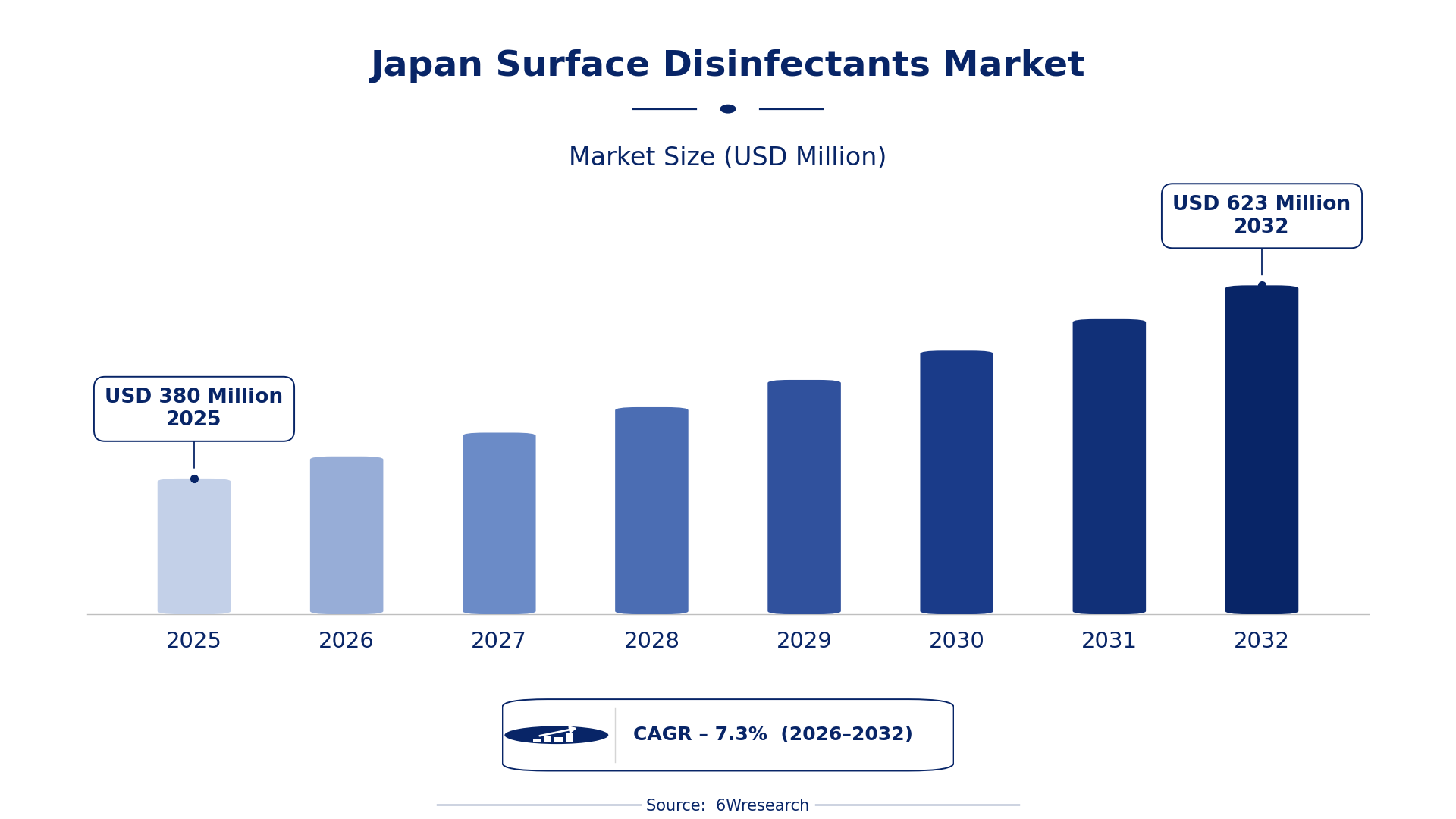
According to 6Wresearch internal database and industry insights, the Japan Surface Disinfectants Market was valued at USD 380 Million in 2025 and is projected to reach USD 623 Million by 2032, growing at a CAGR of approximately 7.3% during 2026–2032.
Japan Surface Disinfectants Market Highlights
| Report Metric | Details |
| Report Name | Japan Surface Disinfectants Market (2026-2032) |
| Market Size 2025 | USD 380 Million |
| Market Size 2032 | USD 623 Million |
| Absolute Growth 2025–2032 | USD 243 Million |
| CAGR 2026–2032 | 7.3% |
| Peak Annual Growth | 8.3% in 2026 |
| Forecast Period | 2026–2032 |
| Historical Data | 2022–2025 |
| Base Year | 2025 |
| Leading Disinfectant Type, 2025 | Alcohol-Based Sprays (37% share) |
| Leading Composition, 2025 | Ethanol/Isopropanol (43% share) |
| Leading Application Environment, 2025 | Hospitals (49% share) |
| Leading End User, 2025 | Healthcare Providers (40% share) |
| Fastest-Growing Disinfectant Type | Quaternary Ammonium Compounds (10.0% CAGR) |
| Fastest-Growing Composition | Quats (10.2% CAGR) |
| Fastest-Growing Application Environment | Clinics (9.8% CAGR) |
| Fastest-Growing End User | Facility Managers (9.2% CAGR) |
| Growing Sector | Healthcare |
| Key End Users | Healthcare Providers, Facility Managers, Infection Control Teams |
Japan Surface Disinfectants Market Year-wise Growth Rate and Key Drivers (2022–2032)
This graph illustrates the annual growth rates of the market from 2022 to 2032, highlighting a steady upward trajectory and projected market expansion over the forecast period.
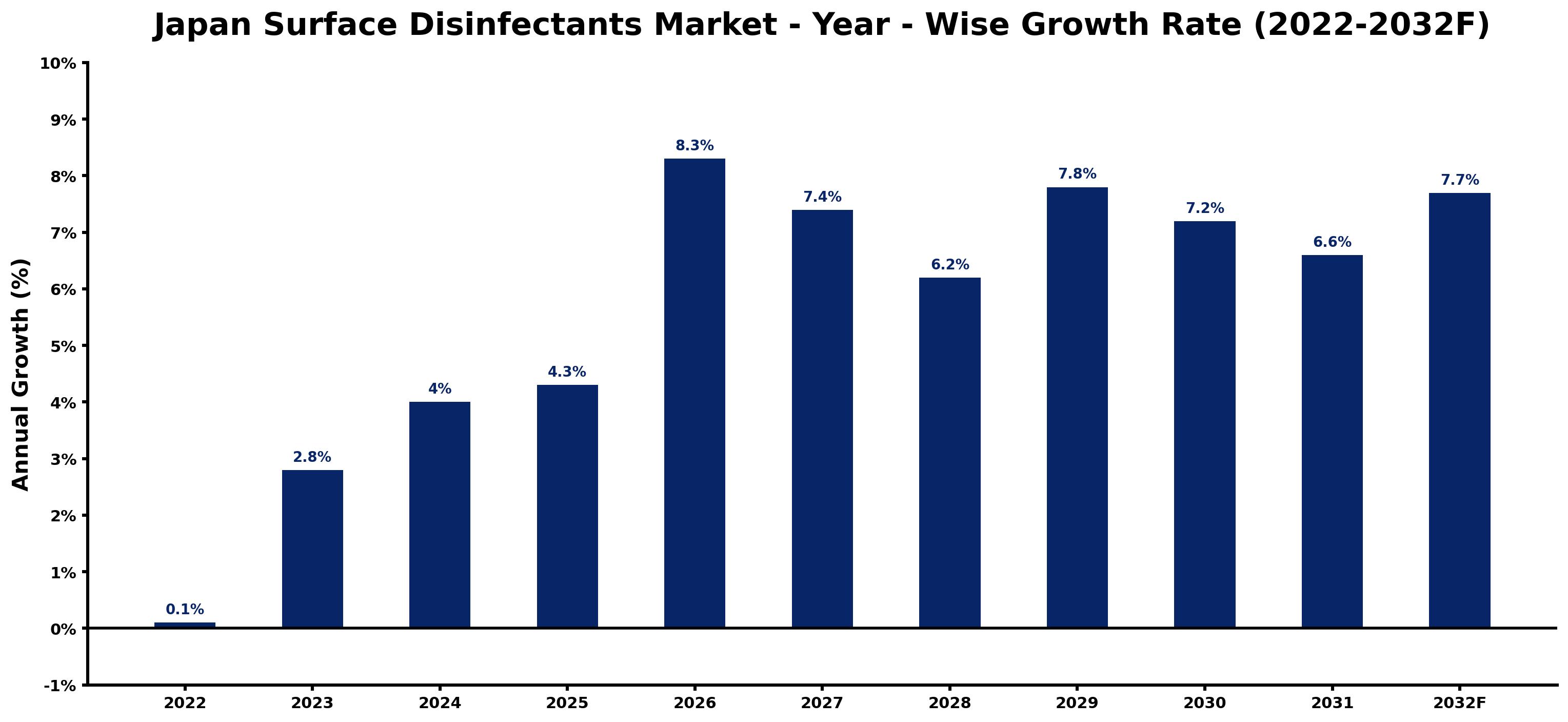
The following figures match every annual growth estimate with the main market development of that year, giving the reasoning behind each rise or slowdown.
| Year | Estimated Annual Growth (%) | Market Rationale |
| 2022 | 0.1 | The market experienced minimal growth due to stabilised demand levels. |
| 2023 | 2.8 | Growth accelerated as healthcare facilities increased disinfection protocols following heightened awareness of hygiene. |
| 2024 | 4.0 | Demand rose further with increased focus on infection control measures in healthcare settings. |
| 2025 | 4.3 | The market continued to expand as hospitals adopted stricter sanitation standards and protocols. |
| 2026 | 8.3 | Growth peaked as hospitals and clinics invested heavily in disinfectant supplies and infrastructure. |
| 2027 | 7.4 | A slight slowdown occurred as the market adjusted to previous high levels of demand and competition. |
| 2028 | 6.2 | Demand growth slowed further as market saturation began to take effect in urban areas. |
| 2029 | 7.8 | The market rebounded with renewed focus on hygiene in public facilities and educational institutions. |
| 2030 | 7.2 | Growth moderated as competition intensified among disinfectant suppliers and product offerings. |
| 2031 | 6.6 | The market continued to grow, driven by ongoing health and safety initiatives in healthcare. |
| 2032 | 7.7 | Demand surged again as healthcare providers prepared for new health challenges and standards. |
Note: Market size estimations and growth projections presented in this report are based on 6Wresearch's proprietary forecasting methodology, utilizing the latest available industry data, government publications, and primary research inputs.
Japan Surface Disinfectants Market Synopsis
Surface disinfectants are chemical agents designed to eliminate pathogens on surfaces, primarily used in healthcare environments, public facilities, and laboratories. The Japan Surface Disinfectants Market is growing, driven by the healthcare sector, which includes over 8,000 hospitals and 100,000 clinics. Increased awareness of infection control, along with investments in sanitation initiatives, such as the ¥10 billion allocated in 2023, is propelling demand for these products across various applications. The focus on hygiene in densely populated areas like Tokyo and Osaka further supports this trend, ensuring steady market expansion.
Market Dynamics Impact Analysis (2026–2032)
| Factor | Type | Impact | Primary Segment Affected |
| Increased healthcare spending | Driver | High | Alcohol-Based Sprays |
| Rising awareness of hygiene practices | Driver | High | Quaternary Ammonium Compounds |
| Growing demand for specialized disinfectants | Opportunity | Medium | Hypochlorite Solutions |
| Expansion of public health initiatives | Opportunity | Medium | Peroxide-Based Cleaners |
| Market saturation in urban areas | Restraint | High | Ethanol/Isopropanol |
| Intense competition among suppliers | Restraint | Medium | Quats |
| Supply chain disruptions affecting availability | Challenge | High | Sodium Hypochlorite |
| Regulatory compliance costs for manufacturers | Challenge | Medium | Hydrogen Peroxide |
Evaluation of Drivers in Japan Surface Disinfectants Market (2026–2032)
These are the developments adding the most demand over the forecast period.
| Drivers | Primary Segment Affected | Why It Matters (Evidence) |
| Increased healthcare spending on sanitation | Alcohol-Based Sprays | Japan's healthcare system includes over 8,000 hospitals, driving demand for effective disinfectants and sanitation products. |
| Heightened awareness of hygiene practices | Quaternary Ammonium Compounds | The adoption level of surface disinfectants in hospitals is above 90%, reflecting strong demand for effective solutions. |
| Rising incidence of healthcare-associated infections | Hypochlorite Solutions | Infection control teams conduct regular audits, increasing the need for effective disinfectants to combat infections. |
| Expansion of public health initiatives | Peroxide-Based Cleaners | Japan allocated ¥10 billion for healthcare sanitation initiatives, boosting disinfectant purchases across various sectors. |
| Focus on infection prevention in laboratories | Ethanol/Isopropanol | Research labs require disinfectants to maintain sterile environments, driving demand for effective cleaning solutions. |
Purchasing is picking up as Japan's healthcare spending on sanitation reached ¥10 billion in 2023, prompting hospitals to invest in effective disinfectants. With over 100,000 clinics across the country, the demand for products like Alcohol-Based Sprays is rising sharply. Infection control teams are conducting regular audits, which increases the need for effective solutions such as Quaternary Ammonium Compounds. The emphasis on infection prevention in research labs is driving the demand for Ethanol/Isopropanol, ensuring sterile environments.
Evaluation of Restraints in Japan Surface Disinfectants Market
These are the pressures that could keep growth below its potential.
| Market Restraint | Primary Segment Affected | Why It Matters (Evidence) |
| Market saturation in urban areas limiting growth | Ethanol/Isopropanol | High population density in urban regions leads to intense competition among suppliers, limiting price increases. |
| Intense competition among suppliers affecting pricing | Quats | Numerous suppliers in the market are driving prices down, impacting profitability and market stability. |
| Supply chain disruptions affecting availability | Sodium Hypochlorite | Global supply chain issues have delayed shipments, limiting product availability in healthcare settings and increasing lead times. |
| Regulatory compliance costs for manufacturers | Hydrogen Peroxide | Manufacturers must invest in compliance with sanitation standards, raising operational costs and affecting pricing strategies. |
| Limited product differentiation among suppliers | Hypochlorite Solutions | Many products offer similar efficacy, making it challenging for suppliers to stand out in a crowded market. |
Japan Surface Disinfectants Market Challenges
Trained personnel shortages hinder effective disinfection, stemming from insufficient training programmes in Japan. This gap can lead to inconsistent sanitation practices, risking patient safety and potentially increasing hospital-acquired infection rates by 10%. Buyers face inflated costs when sourcing disinfectants, as reliance on imported formulations can raise prices by up to 15%. Suppliers struggle with intense competition, where many cannot differentiate their products, leading to price wars that diminish profit margins for producers. Regulatory compliance with JIS Z 2801 complicates product launches, increasing costs for manufacturers by 5% and delaying market entry.
Trends in the Japan Surface Disinfectants Market
These developments are changing demand patterns in the Japan Surface Disinfectants Market.
- Healthcare Providers Increasing Focus on Infection Control: Healthcare providers are prioritising infection control measures, leading to a surge in disinfectant usage. In 2023, over 90% of hospitals adopted advanced disinfectant protocols, significantly impacting purchasing decisions.
- Public Facilities Implementing Stricter Hygiene Standards: Public facilities are adopting stricter hygiene standards, with over 1,000 schools and universities regularly using disinfectants. This shift is driving demand for effective products, particularly in high-density areas like Tokyo.
- Laboratories Emphasising Enhanced Sterilisation Protocols: Research labs are shifting towards enhanced sterilisation protocols, necessitating the use of advanced disinfectants. With a growing emphasis on combating resistant pathogens, the demand for new formulations is rising.
- Transition from Traditional to Advanced Disinfectants: The market is transitioning from traditional disinfectants to advanced formulations, as seen with the rise of Quaternary Ammonium Compounds. Their broad-spectrum antimicrobial properties are driving their adoption in various sectors.
Investment Opportunities in the Japan Surface Disinfectants Market
Where to invest in the Japan Surface Disinfectants Market: the main openings are set out below.
- Healthcare Providers Seeking Advanced Solutions: Healthcare providers are looking for advanced disinfectant solutions to improve sanitation. With ¥10 billion allocated for healthcare sanitation initiatives, suppliers can enter this space by partnering with local distributors to meet demand.
- Public Facilities Needing Regular Disinfection: Public facilities require regular disinfection services, creating opportunities for suppliers of surface disinfectants. With over 1,000 schools and universities, local partnerships can facilitate market entry and growth.
- Laboratories Investing in Sterilisation Products: Laboratories are investing in advanced sterilisation products, driven by the need for sterile environments. Suppliers should consider joint ventures with research institutions to meet this growing demand effectively.
- Increasing Demand for Eco-Friendly Disinfectants: The market is seeing a rising demand for eco-friendly disinfectants, with a significant gap in supply. Suppliers can enter by obtaining certifications for green products to attract environmentally conscious buyers.
Government Initiatives in the Japan Surface Disinfectants Market
The Medical Care Act, enacted in 1948, sets standards for hospitals and clinics, including facilities and staffing, ensuring that healthcare providers maintain high hygiene standards. This act directly impacts the demand for surface disinfectants, as compliance with sanitation regulations is essential for operational effectiveness in healthcare settings.
The Ministry of Health, Labour and Welfare oversees sanitation standards in healthcare settings, ensuring compliance with regulations such as the Long-Term Care Insurance Act of 1997. This oversight helps healthcare providers implement effective disinfection protocols, thereby increasing the demand for disinfectants across various healthcare environments.
Future Insight of the Japan Surface Disinfectants Market
Hospitals will adopt advanced disinfection technologies by 2032, driven by urban areas implementing automated systems to improve sanitation efficiency. Increased investment in healthcare sanitation initiatives will result in a 20% rise in the number of disinfectant dispensers installed across facilities. The national strategy for infection prevention will prioritise improved training programmes, cultivating a more skilled workforce dedicated to maintaining high sanitation standards. Research labs will develop next-generation formulations targeting resistant pathogens, improving the overall effectiveness of surface disinfectants.
Market Segmentation Analysis
Japan Surface Disinfectants Market report covers a detailed analysis of the following market segments:
By Disinfectant Type – Alcohol-Based Sprays Lead, Quaternary Ammonium Compounds Expected to Grow Fastest
According to Saurav Kr Singh, Senior Research Analyst at 6Wresearch, Alcohol-Based Sprays held 37% of the Japan Surface Disinfectants Market by disinfectant type in 2025. Alcohol-based sprays dominate the market due to their effectiveness in rapidly disinfecting surfaces, particularly in healthcare settings. Their widespread use in over 8,000 hospitals in Japan illustrates the strong demand for these products. Over 2026–2032, Quaternary Ammonium Compounds are expected to post the fastest growth, at a CAGR of 10.0%. Quaternary ammonium compounds are experiencing rapid growth as they offer broad-spectrum antimicrobial properties, essential for combating resistant pathogens. The increasing focus on infection control in hospitals drives this demand further. Suppliers should prioritise the production of quaternary ammonium compounds to meet the rising demand in healthcare.
By Composition – Ethanol/Isopropanol Leads, Quats Expected to Grow Fastest
In 2025, Ethanol/Isopropanol led the composition split with a 43% share. Ethanol and isopropanol are essential components in numerous surface disinfectants, prized for their quick action against pathogens. Their widespread use in Japan's healthcare facilities, with over 8,000 hospitals and 100,000 clinics, highlights their critical role in sanitisation efforts. The quickest growth will come from Quats, forecast to expand at a CAGR of 10.2% between 2026 and 2032. Quats are experiencing rapid growth due to their ability to offer prolonged antimicrobial protection on surfaces. This is particularly beneficial as hospitals implement stringent infection control measures, ensuring effective sanitation practices. Suppliers should focus on developing and promoting formulations that include quats to meet the increasing demand for effective long-term disinfectants.
By Application Environment – Hospitals Lead, Clinics Expected to Grow Fastest
The largest application environment category in 2025 was Hospitals, at 49% of revenue. Hospitals are the largest consumers of disinfectants, utilising them extensively for infection control measures. The presence of infection control teams conducting regular audits highlights the critical role of disinfection in these environments. Clinics are projected to grow fastest, at a CAGR of 9.8% during 2026–2032. Clinics are rapidly increasing their use of disinfectants to uphold hygiene standards, driven by the need for patient safety and compliance with sanitation regulations. This trend is seen as clinics adopt more rigorous cleaning protocols. Suppliers should target clinics to capitalise on the growing demand for disinfectants in these settings.
By End User – Healthcare Providers Lead, Facility Managers Expected to Grow Fastest
Healthcare Providers took 40% of end user revenue in 2025, more than any other category. Healthcare providers are the primary users of disinfectants, essential for ensuring patient safety in hospitals and clinics. The high adoption rate of disinfectants in healthcare facilities reflects their critical role in infection prevention. Facility Managers are set to record the highest CAGR in this split, 9.2% over 2026–2032. Facility managers are increasingly prioritising hygiene in various facilities, leading to a surge in disinfectant usage. This shift is influenced by stricter sanitation standards and the need for safe environments. Suppliers must engage facility managers to expand their market reach in non-healthcare sectors.
Key Attractiveness of the Report
- 10 Years of Market Numbers
- Historical Data Starting from 2022 to 2025
- Base Year 2025
- Forecast Data until 2032
- Key Performance Indicators Impacting the Market
- Major Upcoming Developments and Projects
Key Highlights of the Report:
- Japan Surface Disinfectants Market Outlook
- Market Size of Japan Surface Disinfectants Market, 2025
- Forecast of Japan Surface Disinfectants Market, 2032
- Historical Data and Forecast of Japan Surface Disinfectants Revenues & Volume for the Period 2022-2032F
- Japan Surface Disinfectants Market Trend Evolution
- Japan Surface Disinfectants Market Drivers and Challenges
- Japan Surface Disinfectants Price Trends
- Japan Surface Disinfectants Porter's Five Forces
- Japan Surface Disinfectants Industry Life Cycle
- Historical Data and Forecast of Japan Surface Disinfectants Market Revenues & Volume By Disinfectant Type for the Period 2022-2032F
- Historical Data and Forecast of Japan Surface Disinfectants Market Revenues & Volume By Alcohol-Based Sprays for the Period 2022-2032F
- Historical Data and Forecast of Japan Surface Disinfectants Market Revenues & Volume By Quaternary Ammonium Compounds for the Period 2022-2032F
- Historical Data and Forecast of Japan Surface Disinfectants Market Revenues & Volume By Hypochlorite Solutions for the Period 2022-2032F
- Historical Data and Forecast of Japan Surface Disinfectants Market Revenues & Volume By Peroxide-Based Cleaners for the Period 2022-2032F
- Historical Data and Forecast of Japan Surface Disinfectants Market Revenues & Volume By Composition for the Period 2022-2032F
- Historical Data and Forecast of Japan Surface Disinfectants Market Revenues & Volume By Ethanol/Isopropanol for the Period 2022-2032F
- Historical Data and Forecast of Japan Surface Disinfectants Market Revenues & Volume By Quats for the Period 2022-2032F
- Historical Data and Forecast of Japan Surface Disinfectants Market Revenues & Volume By Sodium Hypochlorite for the Period 2022-2032F
- Historical Data and Forecast of Japan Surface Disinfectants Market Revenues & Volume By Hydrogen Peroxide for the Period 2022-2032F
- Historical Data and Forecast of Japan Surface Disinfectants Market Revenues & Volume By Application Environment for the Period 2022-2032F
- Historical Data and Forecast of Japan Surface Disinfectants Market Revenues & Volume By Hospitals, Clinics for the Period 2022-2032F
- Historical Data and Forecast of Japan Surface Disinfectants Market Revenues & Volume By Public Facilities for the Period 2022-2032F
- Historical Data and Forecast of Japan Surface Disinfectants Market Revenues & Volume By Laboratory Surfaces for the Period 2022-2032F
- Historical Data and Forecast of Japan Surface Disinfectants Market Revenues & Volume By Critical Care Units for the Period 2022-2032F
- Historical Data and Forecast of Japan Surface Disinfectants Market Revenues & Volume By End User for the Period 2022-2032F
- Historical Data and Forecast of Japan Surface Disinfectants Market Revenues & Volume By Healthcare Providers for the Period 2022-2032F
- Historical Data and Forecast of Japan Surface Disinfectants Market Revenues & Volume By Facility Managers for the Period 2022-2032F
- Historical Data and Forecast of Japan Surface Disinfectants Market Revenues & Volume By Research Labs for the Period 2022-2032F
- Historical Data and Forecast of Japan Surface Disinfectants Market Revenues & Volume By Infection Control Teams for the Period 2022-2032F
- Japan Surface Disinfectants Import Export Trade Statistics
- Market Opportunity Assessment By Disinfectant Type
- Market Opportunity Assessment By Composition
- Market Opportunity Assessment By Application Environment
- Market Opportunity Assessment By End User
- Japan Surface Disinfectants Top Companies Market Share
- Japan Surface Disinfectants Competitive Benchmarking By Technical and Operational Parameters
- Japan Surface Disinfectants Company Profiles
- Japan Surface Disinfectants Key Strategic Recommendations
Market Covered
This report examines the market across the segments below.
By Disinfectant Type
- Alcohol-Based Sprays
- Quaternary Ammonium Compounds
- Hypochlorite Solutions
- Peroxide-Based Cleaners
By Composition
- Ethanol/Isopropanol
- Quats
- Sodium Hypochlorite
- Hydrogen Peroxide
By Application Environment
- Hospitals
- Clinics
- Public Facilities
- Laboratory Surfaces
- Critical Care Units
By End User
- Healthcare Providers
- Facility Managers
- Research Labs
- Infection Control Teams































