Japan Surface Engineering Market Size & Growth Rate
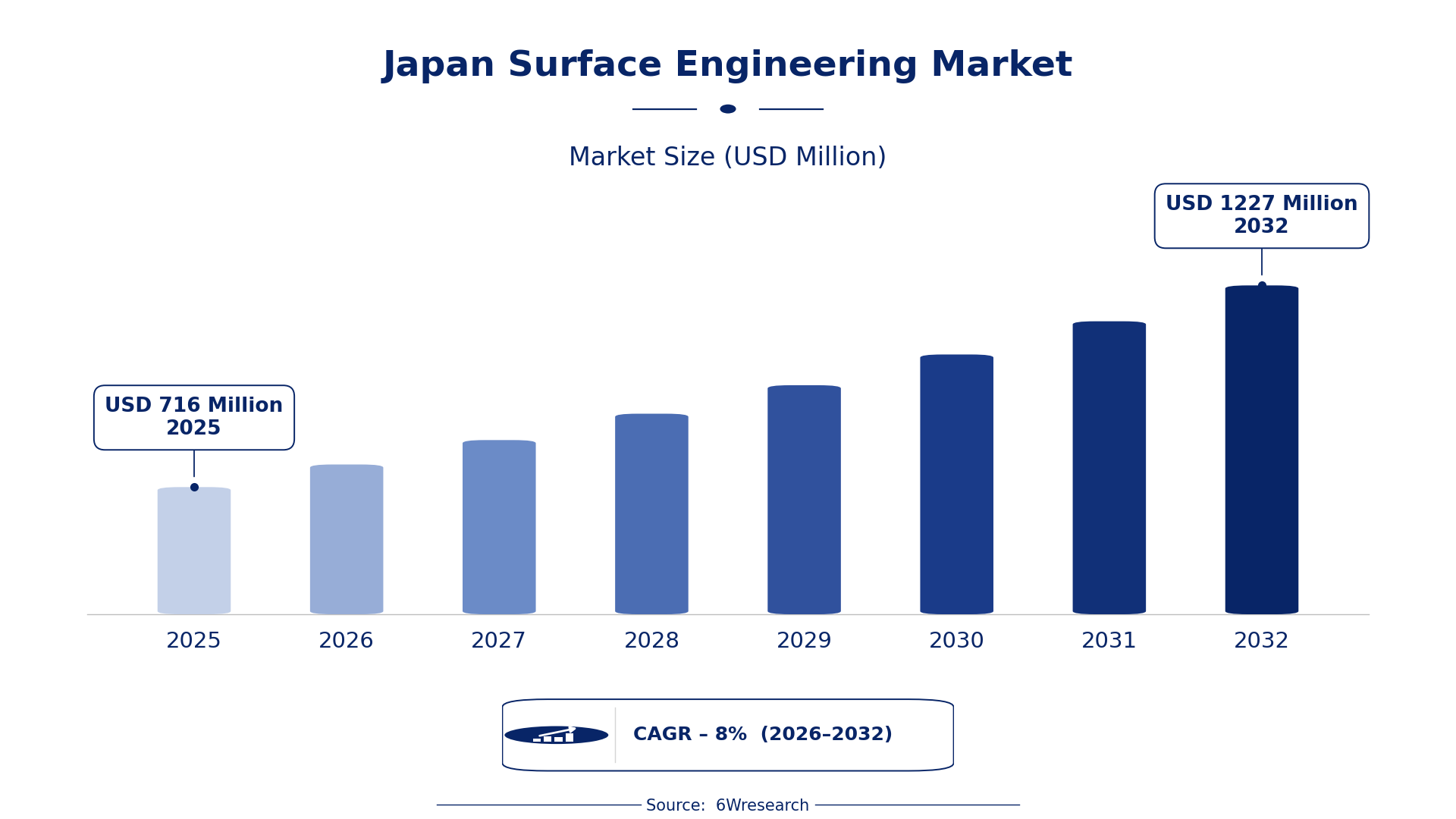
According to 6Wresearch internal database and industry insights, the Japan Surface Engineering Market was valued at USD 716 Million in 2025 and is projected to reach USD 1,227 Million by 2032, growing at a CAGR of approximately 8% during 2026–2032.
Japan Surface Engineering Market Highlights
| Report Metric | Details |
| Report Name | Japan Surface Engineering Market (2026-2032) |
| Market Size 2025 | USD 716 Million |
| Market Size 2032 | USD 1,227 Million |
| Absolute Growth 2025–2032 | USD 511 Million |
| CAGR 2026–2032 | 8% |
| Peak Annual Growth | 11.5% in 2032 |
| Forecast Period | 2026–2032 |
| Historical Data | 2022–2025 |
| Base Year | 2025 |
| Leading Process Type, 2025 | Electroplating (50% share) |
| Leading Engineering Approach, 2025 | Physical Coating (39% share) |
| Leading Treated Material, 2025 | Steel/Alloys (42% share) |
| Leading End User, 2025 | Auto Component Manufacturers (40% share) |
| Fastest-Growing Process Type | Laser Cladding (11.3% CAGR) |
| Fastest-Growing Engineering Approach | Subsurface Modification (10.5% CAGR) |
| Fastest-Growing Treated Material | Semiconductors (11.8% CAGR) |
| Fastest-Growing End User | Microelectronics Producers (10.4% CAGR) |
| Growing Sector | automotive components |
| Key End Users | automotive manufacturers, aerospace OEMs, microelectronics producers, tooling companies |
Japan Surface Engineering Market Year-wise Growth Rate and Key Drivers (2022–2032)
This graph illustrates the annual growth rates of the market from 2022 to 2032, highlighting a steady upward trajectory and projected market expansion over the forecast period.
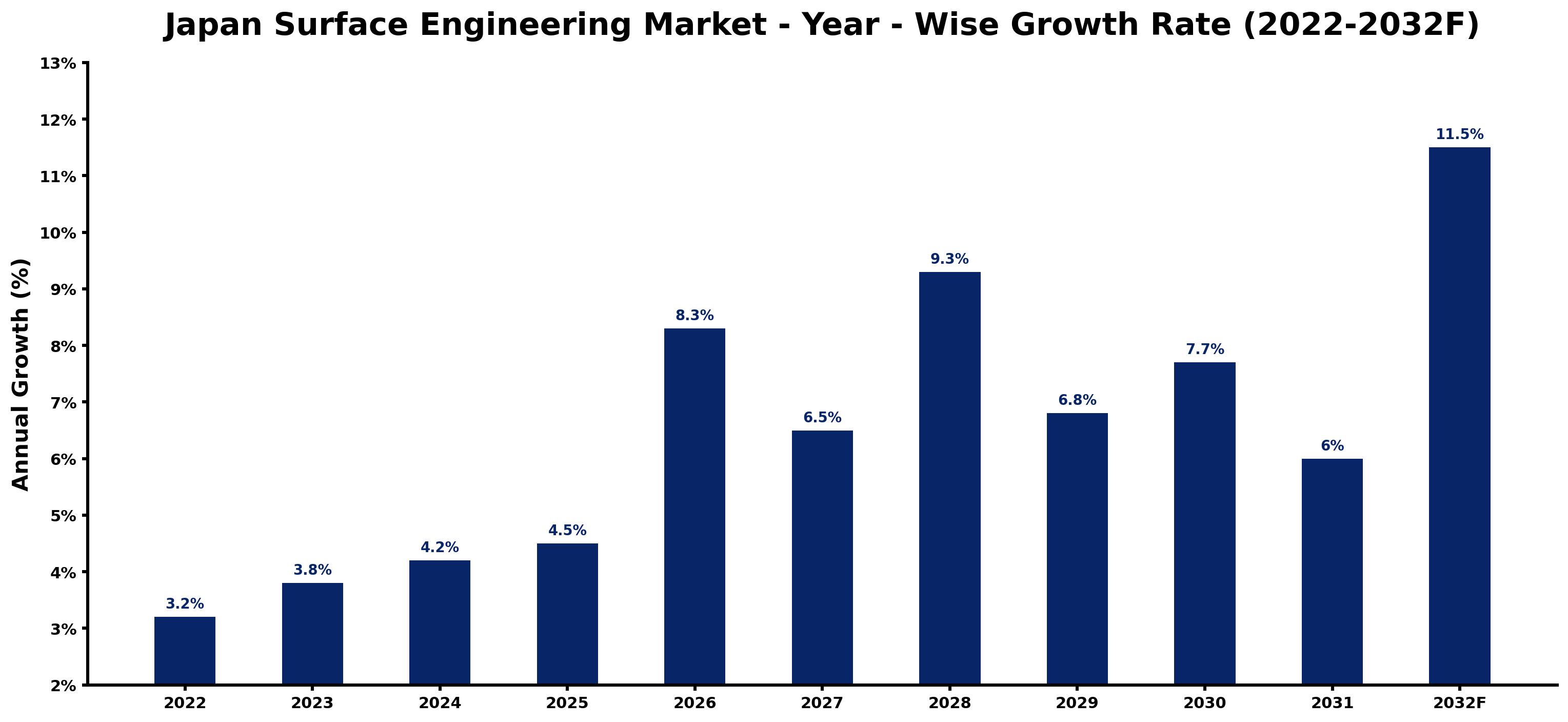
Annual growth estimates for each year appear below with the principal reason behind them, explaining the shifts that set the pace of the market.
| Year | Estimated Annual Growth (%) | Market Rationale |
| 2022 | 3.2 | The market experienced steady growth, reflecting ongoing investments in advanced manufacturing. |
| 2023 | 3.8 | Demand increased as automotive production rose, supporting surface engineering applications. |
| 2024 | 4.2 | Growth continued with the aerospace sector expanding, driving surface treatment needs. |
| 2025 | 4.5 | The market peaked in growth as automotive output reached high levels. |
| 2026 | 8.3 | Investment in advanced technologies surged, unlocking greater demand for surface engineering. |
| 2027 | 6.5 | Growth slowed as the market adjusted to previous high levels of activity. |
| 2028 | 9.3 | Demand rose again due to increased adoption of laser cladding in aerospace. |
| 2029 | 6.8 | A slight slowdown occurred as the market stabilised after rapid growth. |
| 2030 | 7.7 | Growth resumed with rising automotive production and technological advancements. |
| 2031 | 6.0 | The market continued to grow, albeit at a slower pace, reflecting maturing demand. |
| 2032 | 11.5 | A surge in demand is expected as new aerospace projects come online. |
Note: Market size estimations and growth projections presented in this report are based on 6Wresearch's proprietary forecasting methodology, utilizing the latest available industry data, government publications, and primary research inputs.
Japan Surface Engineering Market Synopsis
Surface engineering in Japan involves various processes that improve the surface properties of materials, particularly metals and alloys, through techniques such as thermal spraying and electroplating. The Japan Surface Engineering Market is expanding, primarily driven by the automotive and aerospace industries, which are investing in advanced manufacturing technologies. In 2023, automotive production reached approximately 8 million units, boosting demand for surface engineering solutions. The microelectronics sector, valued at over 40 billion USD, also relies heavily on these techniques, indicating diverse applications and growth potential.
Market Dynamics Impact Analysis (2026–2032)
| Factor | Type | Impact | Primary Segment Affected |
| Rising automotive production drives demand for surface engineering technologies. | Driver | High | Electroplating |
| Increased adoption of laser cladding enhances repair capabilities in aerospace. | Driver | High | Laser Cladding |
| Growing microelectronics sector presents opportunities for surface engineering. | Opportunity | High | Semiconductors |
| Investment in advanced manufacturing technologies is expanding market potential. | Opportunity | Medium | Physical Coating |
| Regulatory compliance costs can hinder investment in surface engineering. | Restraint | High | Electroplating |
| Limited availability of skilled labour impacts production capacity. | Restraint | Medium | Laser Cladding |
| High initial investment costs deter some potential buyers from adopting new technologies. | Challenge | High | Physical Coating |
| Rapid technological advancements require continuous adaptation by suppliers. | Challenge | Medium | Semiconductors |
Evaluation of Drivers in Japan Surface Engineering Market (2026–2032)
The main growth drivers and the segments they affect most are set out below.
| Drivers | Primary Segment Affected | Why It Matters (Evidence) |
| Increased automotive production leads to higher demand for surface treatments. | Electroplating | In 2023, Japan's automotive production reached approximately 8 million units, driving purchases of protective coatings. |
| Adoption of advanced laser cladding techniques improves repair processes. | Laser Cladding | The aerospace sector increasingly utilizes laser cladding for component repair, which is projected to improve efficiency by 15%. |
| Growth in the microelectronics sector boosts demand for surface engineering. | Semiconductors | The microelectronics sector in Japan is valued at over 40 billion USD, necessitating precise surface treatments to meet high standards. |
| Investment in advanced manufacturing technologies expands market opportunities. | Physical Coating | Government programs support investment in technologies, improving surface engineering capabilities by 20%. |
| Rising demand for high-performance tools drives surface engineering adoption. | Industrial Tools | The industrial tools market is projected to grow by 10%, with surface engineering improving tool longevity. |
Buyers are expanding capacity as investment in surface engineering technologies rises. The automotive industry, producing around 8 million units in 2023, fuels demand for protective coatings, especially electroplating. In the aerospace sector, the adoption of laser cladding for component repair improves durability and efficiency, with operational enhancements of up to 15%. The microelectronics sector, valued at over 40 billion USD, depends on surface engineering for precise applications, further driving demand.
Evaluation of Restraints in Japan Surface Engineering Market
The table below lists the restraints and the evidence behind each.
| Market Restraint | Primary Segment Affected | Why It Matters (Evidence) |
| Regulatory compliance costs can be burdensome for surface engineering companies. | Electroplating | Compliance with JIS standards increases operational costs by approximately 15%, impacting pricing strategies. |
| Limited availability of skilled labour affects production capabilities. | Laser Cladding | The aerospace sector's reliance on advanced techniques requires skilled workers, which are in short supply, leading to a potential 20% reduction in output. |
| High initial investment costs deter some buyers from adopting new technologies. | Physical Coating | The need for advanced equipment can limit market entry for smaller manufacturers, potentially reducing their market share by 10%. |
| Technological advancements require continuous investment in training and equipment. | Semiconductors | Staying competitive in the microelectronics sector necessitates ongoing financial commitment, with firms spending up to 25% of their budgets on training. |
| Market fluctuations can lead to uncertainty in long-term contracts. | Industrial Tools | Variability in demand affects production planning and investment decisions, causing delays in over 30% of contracts. |
Japan Surface Engineering Market Challenges
Japan's surface engineering market encounters a critical technology gap, as many facilities lack access to advanced techniques like laser cladding, delaying aerospace component production by three months. Rising raw material costs, particularly for electroplating, compel automotive manufacturers to increase budgets by approximately 15%, affecting their profit margins. Supply chain disruptions have resulted in longer lead times for essential surface treatment equipment, causing production delays for over 20% of suppliers. A shortage of skilled technicians in surface engineering is diminishing operational efficiency, with firms reporting a 25% rise in training costs to uphold quality standards.
Trends in the Japan Surface Engineering Market
Below are the shifts with the largest effect on the Japan Surface Engineering Market.
- Shift towards Laser Cladding in Aerospace: In 2023, the aerospace sector increasingly adopted laser cladding for component repair, improving durability. This shift aligns with the industry's focus on operational efficiency, with laser cladding applications rising significantly.
- Rising Demand for Electroplating in Consumer Electronics: Electroplating has seen heightened demand in consumer electronics since 2022, driven by aesthetic and protective needs. This trend reflects the growing importance of surface treatments in product appeal.
- Increased Focus on Surface Engineering Standards: The introduction of stricter JIS standards in 2021 has led to improved quality assurance in surface engineering. Compliance with these standards is essential for manufacturers aiming to meet market expectations.
- Expansion of Surface Engineering in Automotive Components: The automotive sector has increasingly integrated advanced surface engineering techniques since 2023, improving component performance. This trend is evident in the rising production of treated automotive parts.
Investment Opportunities in the Japan Surface Engineering Market
Where to invest in the Japan Surface Engineering Market: the main openings are set out below.
- Auto Component Manufacturers seek advanced surface treatments: Auto component manufacturers in the Nagoya region are investing in surface engineering technologies, with the market projected to grow substantially. Collaborating with local partners can facilitate market entry.
- Joint ventures in semiconductor production: Microelectronics producers are pursuing partnerships to enhance surface engineering capabilities, with a projected growth of 11.8% for the semiconductor segment. Establishing joint ventures can provide access to advanced technologies.
- Investment in advanced manufacturing facilities: The Tokyo region is prioritising investments in advanced manufacturing facilities, with government backing for surface engineering technologies. Suppliers can enter by obtaining necessary certifications and approvals.
- Expansion of surface engineering services in aerospace: Aerospace OEMs are increasingly adopting surface engineering services, particularly laser cladding, to enhance component performance. Investing in service capabilities can capture this growing demand.
Government Initiatives in the Japan Surface Engineering Market
The Economic Security Promotion Act of 2022 supports supply-chain resilience for critical materials, strengthening the surface engineering sector's stability. This law encourages investments in advanced manufacturing technologies, ensuring producers can meet quality standards and market demands. Additionally, the PRTR Law requires businesses to report chemical substances, promoting environmental safety in surface treatment processes.
The automotive sector benefits from funding provided by the Ministry of Economy, Trade and Industry for research in advanced materials and surface engineering technologies. This funding aids the development of new surface treatment solutions, enabling manufacturers to improve product quality and meet industry standards. The Japan Surface Engineering Association also promotes collaboration and knowledge sharing among industry players.
Future Insight of the Japan Surface Engineering Market
The launch of new research initiatives in advanced materials will begin by 2032, supported by government funding to enhance production capabilities. The adoption of automated surface treatment technologies will streamline processes, reducing production times significantly. Investment in training initiatives will prepare over 10,000 technicians with essential skills, addressing workforce gaps. By 2032, the microelectronics sector will grow, with surface engineering playing a vital role in maintaining high-performance standards.
Market Segmentation Analysis
Japan Surface Engineering Market report covers a detailed analysis of the following market segments:
By Process Type – Electroplating Leads, Laser Cladding Expected to Grow Fastest
According to Saurav Kr Singh, Senior Research Analyst at 6Wresearch, with 50% of process type revenue in 2025, Electroplating was the largest category. Electroplating holds the largest share due to its widespread use in various industries, especially for decorative and protective coatings. The automotive sector exemplifies this reliance, as it utilises electroplating to enhance the durability and aesthetic appeal of vehicle components. Laser Cladding is set to record the highest CAGR in this split, 11.3% over 2026–2032. Laser cladding is rapidly gaining traction, particularly in the aerospace sector, where it is increasingly used for repairing and enhancing high-value components. This growth is fuelled by the aerospace industry's need for efficient maintenance solutions that ensure optimal performance and reliability. Suppliers should prioritise advancements in laser cladding technologies to effectively address the rising demand in the aerospace sector.
By Engineering Approach – Physical Coating Leads, Subsurface Modification Expected to Grow Fastest
Physical Coating held 39% of the Japan Surface Engineering Market by engineering approach in 2025. Physical coating dominates the engineering approach segment, as it significantly improves the surface characteristics of various materials, essential for automotive and industrial applications. This method is vital for achieving the performance standards required in these sectors, particularly in high-stress environments. Over 2026–2032, Subsurface Modification is expected to post the fastest growth, at a CAGR of 10.5%. Subsurface modification is experiencing rapid growth due to its effectiveness in enhancing fatigue resistance in critical components. The increasing emphasis on durability and performance in manufacturing processes is propelling this segment's expansion. Buyers should consider investing in subsurface modification techniques to enhance the longevity and reliability of their components.
By Treated Material – Steel/Alloys Lead, Semiconductors Expected to Grow Fastest
Steel/Alloys took 42% of treated material revenue in 2025, more than any other category. Steel and alloys dominate the market as they are the primary materials treated for automotive and industrial applications, accounting for a substantial portion of surface engineering activities. Their extensive use in vehicle manufacturing underscores their importance in the market. The quickest growth will come from Semiconductors, forecast to expand at a CAGR of 11.8% between 2026 and 2032. Semiconductors are the fastest-growing treated material, driven by the increasing demand for electronic devices that require precise surface properties. The rapid advancement in microelectronics is a key factor in this segment's growth. Suppliers should prioritise semiconductor surface engineering to capitalise on the booming electronics market.
By End User – Auto Component Manufacturers Lead, Microelectronics Producers Expected to Grow Fastest
The largest end user category in 2025 was Auto Component Manufacturers, at 40% of revenue. Auto component manufacturers lead the end user segment, driven by substantial demand for treated components in vehicles, which are crucial for performance and safety. The robust production levels within this sector ensure a continuous need for surface engineering services to meet quality standards. Microelectronics Producers are projected to grow fastest, at a CAGR of 10.4% during 2026–2032. Microelectronics producers are the fastest-growing end user group, as they require high-tech applications that demand precision in surface engineering. The surge in electronic device production is a key factor driving this segment's rapid expansion. Suppliers must adapt their offerings to meet the specific needs of microelectronics producers to remain competitive in the evolving market.
Key Attractiveness of the Report
- 10 Years of Market Numbers
- Historical Data Starting from 2022 to 2025
- Base Year 2025
- Forecast Data until 2032
- Key Performance Indicators Impacting the Market
- Major Upcoming Developments and Projects
Key Highlights of the Report:
- Japan Surface Engineering Market Outlook
- Market Size of Japan Surface Engineering Market, 2025
- Forecast of Japan Surface Engineering Market, 2032
- Historical Data and Forecast of Japan Surface Engineering Revenues & Volume for the Period 2022-2032F
- Japan Surface Engineering Market Trend Evolution
- Japan Surface Engineering Market Drivers and Challenges
- Japan Surface Engineering Price Trends
- Japan Surface Engineering Porter's Five Forces
- Japan Surface Engineering Industry Life Cycle
- Historical Data and Forecast of Japan Surface Engineering Market Revenues & Volume By Process Type for the Period 2022-2032F
- Historical Data and Forecast of Japan Surface Engineering Market Revenues & Volume By Thermal Spraying for the Period 2022-2032F
- Historical Data and Forecast of Japan Surface Engineering Market Revenues & Volume By Ion Implantation for the Period 2022-2032F
- Historical Data and Forecast of Japan Surface Engineering Market Revenues & Volume By Electroplating for the Period 2022-2032F
- Historical Data and Forecast of Japan Surface Engineering Market Revenues & Volume By Laser Cladding for the Period 2022-2032F
- Historical Data and Forecast of Japan Surface Engineering Market Revenues & Volume By Engineering Approach for the Period 2022-2032F
- Historical Data and Forecast of Japan Surface Engineering Market Revenues & Volume By Physical Coating for the Period 2022-2032F
- Historical Data and Forecast of Japan Surface Engineering Market Revenues & Volume By Subsurface Modification for the Period 2022-2032F
- Historical Data and Forecast of Japan Surface Engineering Market Revenues & Volume By Metal Deposition for the Period 2022-2032F
- Historical Data and Forecast of Japan Surface Engineering Market Revenues & Volume By Fusion Surface Treatment for the Period 2022-2032F
- Historical Data and Forecast of Japan Surface Engineering Market Revenues & Volume By Treated Material for the Period 2022-2032F
- Historical Data and Forecast of Japan Surface Engineering Market Revenues & Volume By Steel/Alloys for the Period 2022-2032F
- Historical Data and Forecast of Japan Surface Engineering Market Revenues & Volume By Semiconductors for the Period 2022-2032F
- Historical Data and Forecast of Japan Surface Engineering Market Revenues & Volume By Automotive Parts for the Period 2022-2032F
- Historical Data and Forecast of Japan Surface Engineering Market Revenues & Volume By Industrial Tools for the Period 2022-2032F
- Historical Data and Forecast of Japan Surface Engineering Market Revenues & Volume By End User for the Period 2022-2032F
- Historical Data and Forecast of Japan Surface Engineering Market Revenues & Volume By Aerospace OEMs for the Period 2022-2032F
- Historical Data and Forecast of Japan Surface Engineering Market Revenues & Volume By Microelectronics Producers for the Period 2022-2032F
- Historical Data and Forecast of Japan Surface Engineering Market Revenues & Volume By Auto Component Manufacturers for the Period 2022-2032F
- Historical Data and Forecast of Japan Surface Engineering Market Revenues & Volume By Tooling Companies for the Period 2022-2032F
- Japan Surface Engineering Import Export Trade Statistics
- Market Opportunity Assessment By Process Type
- Market Opportunity Assessment By Engineering Approach
- Market Opportunity Assessment By Treated Material
- Market Opportunity Assessment By End User
- Japan Surface Engineering Top Companies Market Share
- Japan Surface Engineering Competitive Benchmarking By Technical and Operational Parameters
- Japan Surface Engineering Company Profiles
- Japan Surface Engineering Key Strategic Recommendations
Market Covered
Segments analysed in this report are listed below.
By Process Type
- Thermal Spraying
- Ion Implantation
- Electroplating
- Laser Cladding
By Engineering Approach
- Physical Coating
- Subsurface Modification
- Metal Deposition
- Fusion Surface Treatment
By Treated Material
- Steel/Alloys
- Semiconductors
- Automotive Parts
- Industrial Tools
By End User
- Aerospace OEMs
- Microelectronics Producers
- Auto Component Manufacturers
- Tooling Companies































