Japan Surface Finishing Market Size & Growth Rate
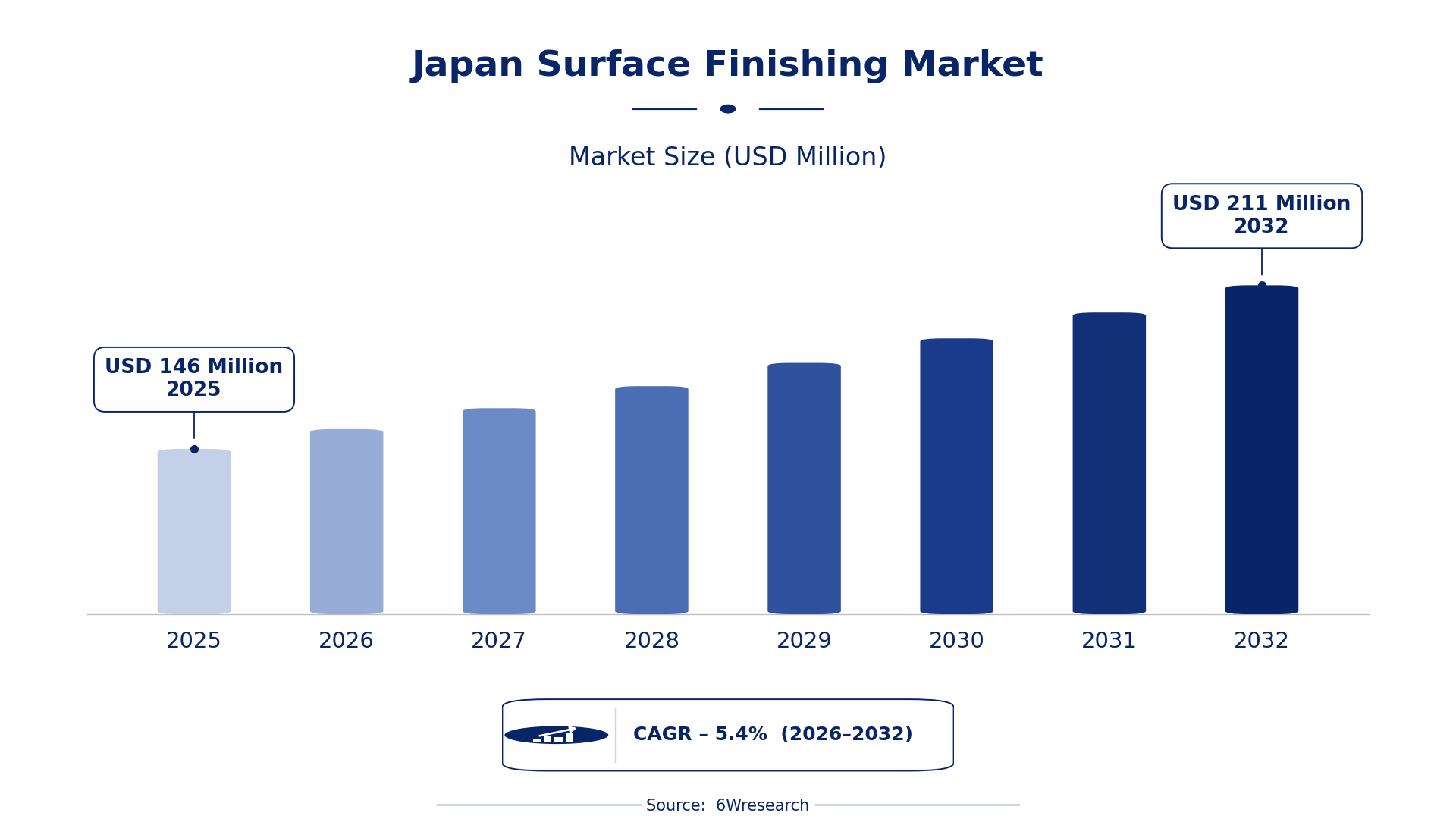
According to 6Wresearch internal database and industry insights, the Japan Surface Finishing Market was valued at USD 146 Million in 2025 and is projected to reach USD 211 Million by 2032, growing at a CAGR of approximately 5.4% during 2026–2032.
Japan Surface Finishing Market Highlights
| Report Metric | Details |
| Report Name | Japan Surface Finishing Market (2026-2032) |
| Market Size 2025 | USD 146 Million |
| Market Size 2032 | USD 211 Million |
| Absolute Growth 2025–2032 | USD 65 Million |
| CAGR 2026–2032 | 5.4% |
| Peak Annual Growth | 6.2% in 2028 |
| Forecast Period | 2026–2032 |
| Historical Data | 2022–2025 |
| Base Year | 2025 |
| Leading Finishing Type, 2025 | Polishing (37% share) |
| Leading Technique Used, 2025 | Mechanical (44% share) |
| Leading Surface Material, 2025 | Metal (35% share) |
| Leading End User, 2025 | Automotive Parts Manufacturers (50% share) |
| Fastest-Growing Finishing Type | Anodizing (7.4% CAGR) |
| Fastest-Growing Technique Used | Electrochemical (6.9% CAGR) |
| Fastest-Growing Surface Material | Aluminum (7.9% CAGR) |
| Fastest-Growing End User | Aerospace Component Suppliers (6.8% CAGR) |
| Growing Sector | Aerospace Component Suppliers |
| Key End Users | Automotive Parts Manufacturers, Aerospace Component Suppliers, Machinery OEMs, Decorative Metal Fabricators |
Japan Surface Finishing Market Year-wise Growth Rate and Key Drivers (2022–2032)
This graph illustrates the annual growth rates of the market from 2022 to 2032, highlighting a steady upward trajectory and projected market expansion over the forecast period.
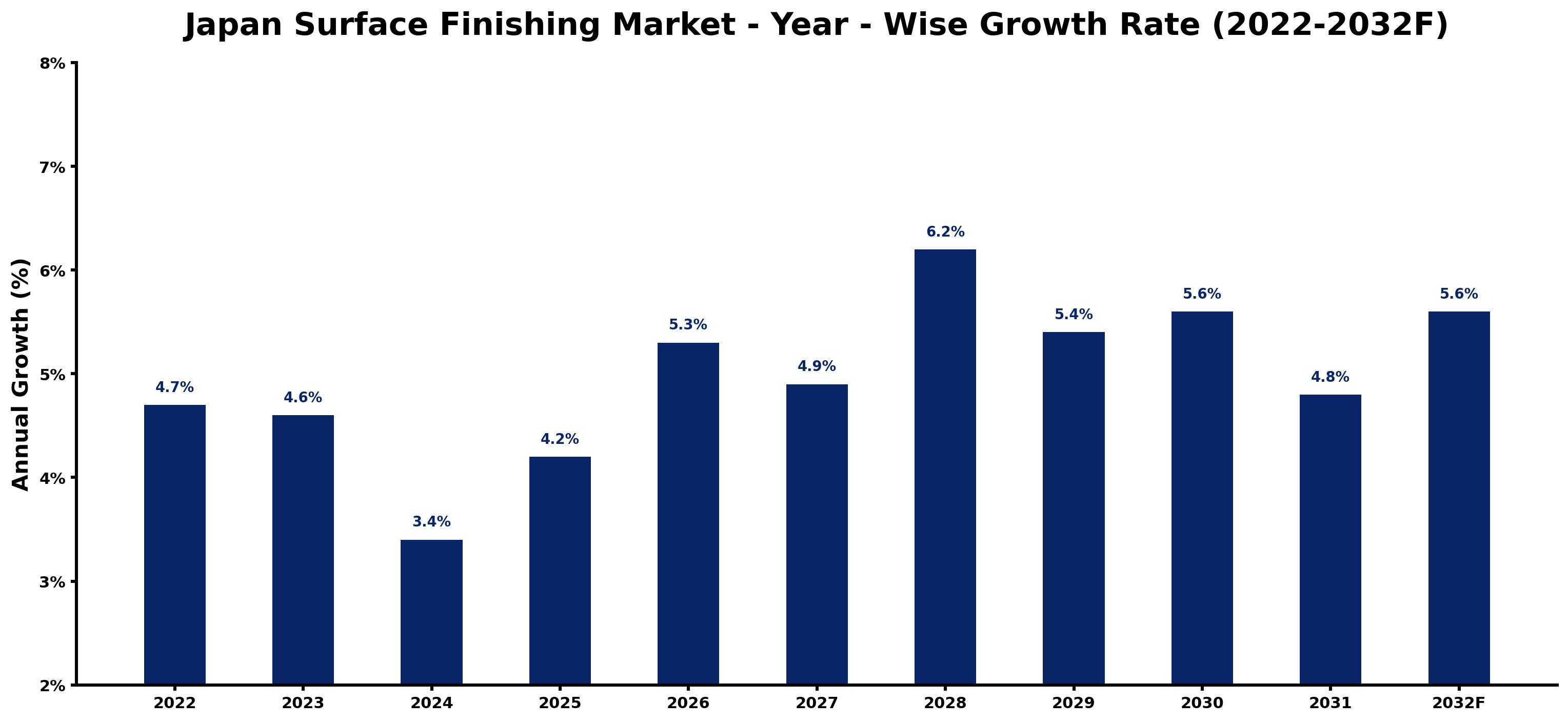
The table below sets out the estimated growth rate for each year and the main factor behind it.
| Year | Estimated Annual Growth (%) | Market Rationale |
| 2022 | 4.7 | The market showed strong activity, driven by automotive production and demand for surface treatments. |
| 2023 | 4.6 | Growth slowed slightly due to market saturation and increased competition in surface finishing. |
| 2024 | 3.4 | The market continued to slow as manufacturers focused on efficiency rather than expansion. |
| 2025 | 4.2 | Growth accelerated as automotive production rebounded, increasing demand for surface finishing services. |
| 2026 | 5.3 | Demand is expected to rise due to investments in advanced surface finishing technologies. |
| 2027 | 4.9 | Growth is projected to moderate as the market adjusts to new technology implementations and competition. |
| 2028 | 6.2 | A surge in aerospace demand for high-quality surface treatments will mark the peak growth year. |
| 2029 | 5.4 | Growth is anticipated to slow as the market stabilises after the peak, adjusting to new demand levels. |
| 2030 | 5.6 | Demand will increase again as automotive and aerospace sectors expand their production capabilities. |
| 2031 | 4.8 | Growth is expected to slow as the market matures and competition intensifies among surface finishing providers. |
| 2032 | 5.6 | The market is projected to see renewed growth driven by emerging technologies and increased industrial activity. |
Note: Market size estimations and growth projections presented in this report are based on 6Wresearch's proprietary forecasting methodology, utilizing the latest available industry data, government publications, and primary research inputs.
Japan Surface Finishing Market Synopsis
Surface finishing in Japan encompasses various techniques that improve the properties of materials, particularly metals, through methods such as polishing, anodizing, and plating. In 2022, Japan's automotive industry produced over 8 million vehicles, creating robust demand for surface finishing services. Growth is propelled by the automotive and aerospace sectors, which require high-quality treatments, alongside advancements in technology like the Economic Security Promotion Act, which supports supply-chain resilience for critical materials.
Market Dynamics Impact Analysis (2026–2032)
| Factor | Type | Impact | Primary Segment Affected |
| Increased automotive production drives demand for surface finishing services. | Driver | High | Polishing |
| The aerospace sector's growth necessitates high-quality surface treatments. | Driver | High | Anodizing |
| Investment in advanced surface finishing technologies presents new market opportunities. | Opportunity | High | Electrochemical |
| The decorative metal fabrication industry is expanding, creating demand for surface finishing. | Opportunity | Medium | Buffing |
| Competition among surface finishing providers can lead to price pressures. | Restraint | High | Plating |
| Regulatory compliance costs can burden surface finishing companies. | Restraint | Medium | Mechanical |
| High operational costs hinder smaller surface finishing firms from competing effectively. | Challenge | High | Electroplating |
| Technological adaptation requires significant investment, affecting cash flow for companies. | Challenge | Medium | Abrasive Wheel |
Evaluation of Drivers in Japan Surface Finishing Market (2026–2032)
The factors lifting demand, and the evidence behind each, are summarised below.
| Drivers | Primary Segment Affected | Why It Matters (Evidence) |
| Increased vehicle production in Japan drives demand for polishing services. | Polishing | Japan's automotive industry produced over 8 million vehicles in 2022, increasing the need for surface finishing. |
| The aerospace sector's expansion boosts the need for anodizing services. | Anodizing | The aerospace sector in Japan is expected to grow, increasing the need for high-quality surface treatments. |
| Rising investments in advanced technologies improve electrochemical finishing capabilities. | Electrochemical | In 2023, the Japanese government launched a program to promote advanced surface finishing technologies. |
| Growing demand for corrosion-resistant finishes fuels electroplating applications. | Electroplating | Electroplating is a key technique used in over 60% of surface finishing applications. |
| Increased production of steel necessitates effective surface treatments. | Mechanical | Japan's steel production reached 78 million tons in 2022, requiring surface finishing for durability. |
Volumes grow on the back of increased vehicle production, with over 8 million vehicles manufactured in 2022 driving demand for polishing services. The aerospace sector is projected to expand, leading to heightened demand for anodizing treatments. Japan's steel production reached 78 million tons in 2022, necessitating effective surface treatments to ensure durability. The importance of electroplating is underscored by its use in over 60% of applications, highlighting its role in meeting industry standards.
Evaluation of Restraints in Japan Surface Finishing Market
Several factors work against faster growth; the main ones are summarised below.
| Market Restraint | Primary Segment Affected | Why It Matters (Evidence) |
| Intense competition among surface finishing providers leads to price pressures. | Plating | The competitive environment forces companies to lower prices, impacting profitability. |
| Regulatory compliance costs burden surface finishing companies. | Mechanical | Compliance with the PRTR Law increases operational costs for surface finishing firms. |
| High operational costs hinder smaller firms from competing effectively. | Electroplating | Smaller companies struggle to meet the financial demands of advanced surface finishing technologies. |
| Technological adaptation requires substantial investment, affecting cash flow. | Abrasive Wheel | Investment in new technologies can strain the financial resources of surface finishing companies. |
| Market saturation limits growth opportunities for existing firms. | Anodizing | As the market matures, finding new clients becomes increasingly challenging for established players. |
Japan Surface Finishing Market Challenges
High production costs burden surface finishing services, as energy prices in Japan have surged by 15% over the past year, raising operational expenses for producers and extending project timelines for automotive manufacturers. Local firms engage in fierce competition, resulting in price reductions that can cut profit margins by up to 20%, compelling suppliers to compromise on quality and reliability for aerospace components. Rapid advancements in finishing technologies leave some companies behind, risking a 30% loss in market share for those unable to adapt. Buyers face challenges in sourcing consistent high-quality services, which can lead to product failures in critical applications, jeopardising safety.
Trends in the Japan Surface Finishing Market
The trends below show where the Japan Surface Finishing Market is heading.
- Shift from Traditional to Advanced Surface Finishing Techniques: Since 2023, the industry has experienced a shift towards advanced surface finishing techniques, driven by the demand for higher quality and efficiency. The introduction of new technologies has resulted in increased demand, with over 70% of applications now utilising anodizing.
- Transition from Manual to Automated Processes: In 2023, numerous surface finishing companies in the Tokyo region began adopting automated processes to enhance efficiency. This transition has led to a 20% increase in production capacity, enabling firms to meet rising demand more effectively.
- Emergence of Eco-Friendly Surface Finishing Solutions: The trend towards eco-friendly surface finishing solutions commenced in 2022, with companies prioritising sustainable practices. This shift has been propelled by the GX Promotion Act, which encourages environmentally friendly technologies in manufacturing.
- Growing Demand for Customised Finishing Solutions: In 2023, automotive parts manufacturers increasingly sought customised surface finishing solutions to fulfil specific requirements. This trend has resulted in a 15% rise in bespoke finishing services across the industry.
Investment Opportunities in the Japan Surface Finishing Market
The following areas offer the clearest openings for investors and suppliers in the Japan Surface Finishing Market.
- Collaborative Ventures for Advanced Technology Implementation: Now is the time for companies to invest in advanced surface finishing technologies through joint ventures. The aerospace component suppliers are seeking innovative solutions, which presents a significant opportunity for collaboration.
- Supply of Eco-Friendly Finishing Products: With the growing emphasis on sustainability, there is a demand for eco-friendly surface finishing products. The decorative metal fabrication industry, valued at approximately 300 billion yen, is a key target for suppliers.
- Investment in Automation Technologies: The market gap for automation in surface finishing is significant, with a projected 20% increase in efficiency. Companies should consider partnerships with technology providers to capture this opportunity.
- Expansion into Aerospace Sector: The aerospace sector is expanding rapidly, creating a demand for high-quality surface treatments. Suppliers can enter this market by obtaining certifications and establishing local partnerships.
Government Initiatives in the Japan Surface Finishing Market
The Economic Security Promotion Act, enacted in 2022, supports supply-chain resilience for critical products and materials, impacting surface finishing producers. This law encourages investment in technologies and processes that improve quality and safety, ensuring that manufacturers can meet the stringent demands of the automotive and aerospace industries. Compliance with standards like JIS H 8601 for anodizing aluminum is essential for maintaining quality assurance in surface finishing operations.
Surface finishing companies benefit from the PRTR Law, which mandates reporting of chemical substances. The Ministry of the Environment and the Ministry of Economy, Trade and Industry oversee compliance, ensuring that businesses adhere to environmental standards. This law helps buyers verify the safety and environmental impact of the surface finishing processes, building trust in the industry.
Future Insight of the Japan Surface Finishing Market
Advanced automated surface finishing technologies will reshape demand by 2032, streamlining production processes and reducing costs for suppliers. The government's initiative to promote these technologies will drive innovation within the sector. By 2025, the aerospace industry will require high-quality surface treatments for over 70% of its components, presenting substantial growth opportunities for suppliers. Enhanced quality standards will ensure uniform results, boosting buyer confidence and satisfaction across the market.
Market Segmentation Analysis
Japan Surface Finishing Market report covers a detailed analysis of the following market segments:
By Finishing Type – Polishing Leads, Anodizing Expected to Grow Fastest
According to Saurav Kr Singh, Senior Research Analyst at 6Wresearch, the largest finishing type category in 2025 was Polishing, at 37% of revenue. Polishing holds the largest share due to its essential role in achieving a smooth surface finish for various applications. This technique is widely used in the automotive sector, which produced over 8 million vehicles in 2022, underscoring its significance. Over 2026–2032, Anodizing is expected to post the fastest growth, at a CAGR of 7.4%. Anodizing is experiencing rapid growth as the aerospace sector expands, increasing the demand for high-quality surface treatments. The need for aluminium protection and aesthetic enhancement in aerospace components is a key factor driving this growth. Suppliers must focus on enhancing anodizing capabilities to meet the rising demand from the aerospace industry.
By Technique Used – Mechanical Leads, Electrochemical Expected to Grow Fastest
Mechanical took 44% of technique used revenue in 2025, more than any other category. Mechanical techniques dominate the market as they are the primary method for surface preparation across various industries. Their widespread application ensures a strong installed base, particularly in automotive and machinery sectors. Electrochemical is set to record the highest CAGR in this split, 6.9% over 2026–2032. Electrochemical techniques are growing quickly due to their importance in specific metal treatments, which are increasingly required in advanced manufacturing processes. This growth is driven by the rising complexity of surface finishing needs. Buyers may seek suppliers that offer advanced electrochemical techniques to meet their specific treatment requirements.
By Surface Material – Metal Leads, Aluminum Expected to Grow Fastest
Metal accounted for 35% of the market by surface material in 2025. Metal is the predominant material utilised in surface finishing processes, establishing it as the largest segment. Its extensive use in automotive and machinery components reinforces its market dominance and relevance. The quickest growth will come from Aluminum, forecast to expand at a CAGR of 7.9% between 2026 and 2032. Aluminium is experiencing the fastest growth as it is essential for various industries, especially in aerospace and automotive applications. The rising adoption of aluminium in lightweight designs propels this upward trend. Suppliers must adjust their offerings to meet the surging demand for aluminium surface finishing services.
By End User – Automotive Parts Manufacturers Lead, Aerospace Component Suppliers Expected to Grow Fastest
Automotive Parts Manufacturers held 50% of the Japan Surface Finishing Market by end user in 2025. Automotive parts manufacturers represent the largest consumer group for surface finishing services, supported by Japan's robust automotive production. Their significant demand reinforces the market presence of this segment, highlighting its importance within the industry. Aerospace Component Suppliers are projected to grow fastest, at a CAGR of 6.8% during 2026–2032. Aerospace component suppliers are the fastest-growing end user segment, driven by the escalating need for safety and performance in aerospace applications. This growth is further propelled by the ongoing expansion of the aerospace industry in Japan. Suppliers should prioritise partnerships with aerospace component suppliers to capitalise on emerging opportunities in this expanding market.
Key Attractiveness of the Report
- 10 Years of Market Numbers
- Historical Data Starting from 2022 to 2025
- Base Year 2025
- Forecast Data until 2032
- Key Performance Indicators Impacting the Market
- Major Upcoming Developments and Projects
Key Highlights of the Report:
- Japan Surface Finishing Market Outlook
- Market Size of Japan Surface Finishing Market, 2025
- Forecast of Japan Surface Finishing Market, 2032
- Historical Data and Forecast of Japan Surface Finishing Revenues & Volume for the Period 2022-2032F
- Japan Surface Finishing Market Trend Evolution
- Japan Surface Finishing Market Drivers and Challenges
- Japan Surface Finishing Price Trends
- Japan Surface Finishing Porter's Five Forces
- Japan Surface Finishing Industry Life Cycle
- Historical Data and Forecast of Japan Surface Finishing Market Revenues & Volume By Finishing Type for the Period 2022-2032F
- Historical Data and Forecast of Japan Surface Finishing Market Revenues & Volume By Polishing for the Period 2022-2032F
- Historical Data and Forecast of Japan Surface Finishing Market Revenues & Volume By Anodizing for the Period 2022-2032F
- Historical Data and Forecast of Japan Surface Finishing Market Revenues & Volume By Plating for the Period 2022-2032F
- Historical Data and Forecast of Japan Surface Finishing Market Revenues & Volume By Buffing for the Period 2022-2032F
- Historical Data and Forecast of Japan Surface Finishing Market Revenues & Volume By Technique Used for the Period 2022-2032F
- Historical Data and Forecast of Japan Surface Finishing Market Revenues & Volume By Mechanical for the Period 2022-2032F
- Historical Data and Forecast of Japan Surface Finishing Market Revenues & Volume By Electrochemical for the Period 2022-2032F
- Historical Data and Forecast of Japan Surface Finishing Market Revenues & Volume By Electroplating for the Period 2022-2032F
- Historical Data and Forecast of Japan Surface Finishing Market Revenues & Volume By Abrasive Wheel for the Period 2022-2032F
- Historical Data and Forecast of Japan Surface Finishing Market Revenues & Volume By Surface Material for the Period 2022-2032F
- Historical Data and Forecast of Japan Surface Finishing Market Revenues & Volume By Metal for the Period 2022-2032F
- Historical Data and Forecast of Japan Surface Finishing Market Revenues & Volume By Aluminum for the Period 2022-2032F
- Historical Data and Forecast of Japan Surface Finishing Market Revenues & Volume By Steel for the Period 2022-2032F
- Historical Data and Forecast of Japan Surface Finishing Market Revenues & Volume By Stainless Steel for the Period 2022-2032F
- Historical Data and Forecast of Japan Surface Finishing Market Revenues & Volume By End User for the Period 2022-2032F
- Historical Data and Forecast of Japan Surface Finishing Market Revenues & Volume By Automotive Parts Manufacturers for the Period 2022-2032F
- Historical Data and Forecast of Japan Surface Finishing Market Revenues & Volume By Aerospace Component Suppliers for the Period 2022-2032F
- Historical Data and Forecast of Japan Surface Finishing Market Revenues & Volume By Machinery OEMs for the Period 2022-2032F
- Historical Data and Forecast of Japan Surface Finishing Market Revenues & Volume By Decorative Metal Fabricators for the Period 2022-2032F
- Japan Surface Finishing Import Export Trade Statistics
- Market Opportunity Assessment By Finishing Type
- Market Opportunity Assessment By Technique Used
- Market Opportunity Assessment By Surface Material
- Market Opportunity Assessment By End User
- Japan Surface Finishing Top Companies Market Share
- Japan Surface Finishing Competitive Benchmarking By Technical and Operational Parameters
- Japan Surface Finishing Company Profiles
- Japan Surface Finishing Key Strategic Recommendations
Market Covered
Coverage by segment is as follows.
By Finishing Type
- Polishing
- Anodizing
- Plating
- Buffing
By Technique Used
- Mechanical
- Electrochemical
- Electroplating
- Abrasive Wheel
By Surface Material
- Metal
- Aluminum
- Steel
- Stainless Steel
By End User
- Automotive Parts Manufacturers
- Aerospace Component Suppliers
- Machinery OEMs
- Decorative Metal Fabricators































