Japan Surface Protection Additives Market Size & Growth Rate
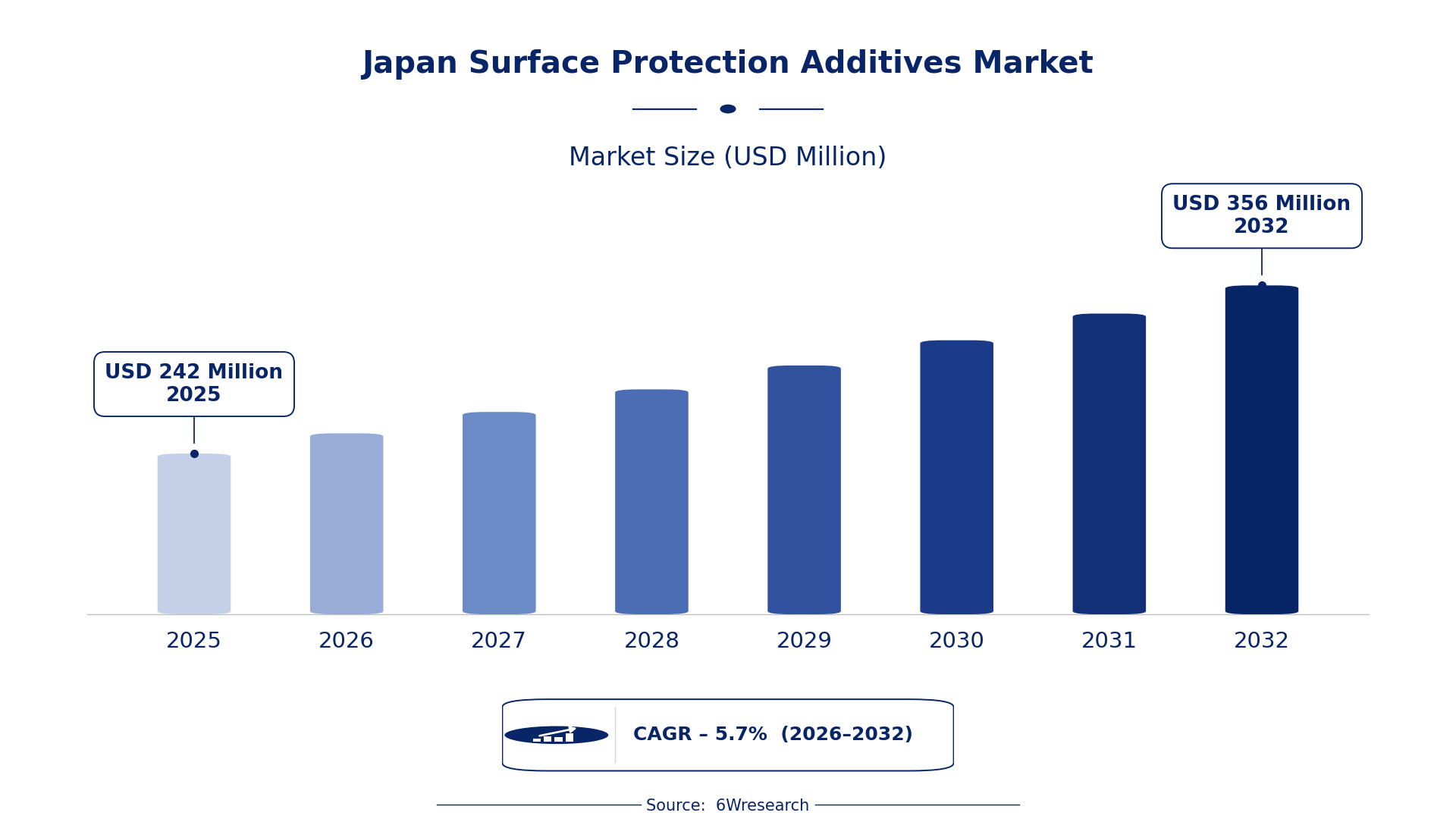
According to 6Wresearch internal database and industry insights, the Japan Surface Protection Additives Market was valued at USD 242 Million in 2025 and is projected to reach USD 356 Million by 2032, growing at a CAGR of approximately 5.7% during 2026–2032.
Japan Surface Protection Additives Market Highlights
| Report Metric | Details |
| Report Name | Japan Surface Protection Additives Market (2026-2032) |
| Market Size 2025 | USD 242 Million |
| Market Size 2032 | USD 356 Million |
| Absolute Growth 2025–2032 | USD 114 Million |
| CAGR 2026–2032 | 5.7% |
| Peak Annual Growth | 6.5% in 2031 |
| Forecast Period | 2026–2032 |
| Historical Data | 2022–2025 |
| Base Year | 2025 |
| Leading Additive Type, 2025 | UV Stabilizers (51% share) |
| Leading Protection Feature, 2025 | Sunlight Resistance (46% share) |
| Leading Application Segment, 2025 | Plastics (44% share) |
| Leading End User, 2025 | Polymer Compounders (39% share) |
| Fastest-Growing Additive Type | Anti-Graffiti Agents (7.9% CAGR) |
| Fastest-Growing Protection Feature | Easy-Clean Property (7.4% CAGR) |
| Fastest-Growing Application Segment | Public Infrastructure (7.6% CAGR) |
| Fastest-Growing End User | Municipality Contractors (7.3% CAGR) |
| Growing Sector | Public Infrastructure |
| Key End Users | Automotive manufacturers, Municipality contractors, Polymer compounders, Shipbuilders |
Japan Surface Protection Additives Market Year-wise Growth Rate and Key Drivers (2022–2032)
This graph illustrates the annual growth rates of the market from 2022 to 2032, highlighting a steady upward trajectory and projected market expansion over the forecast period.
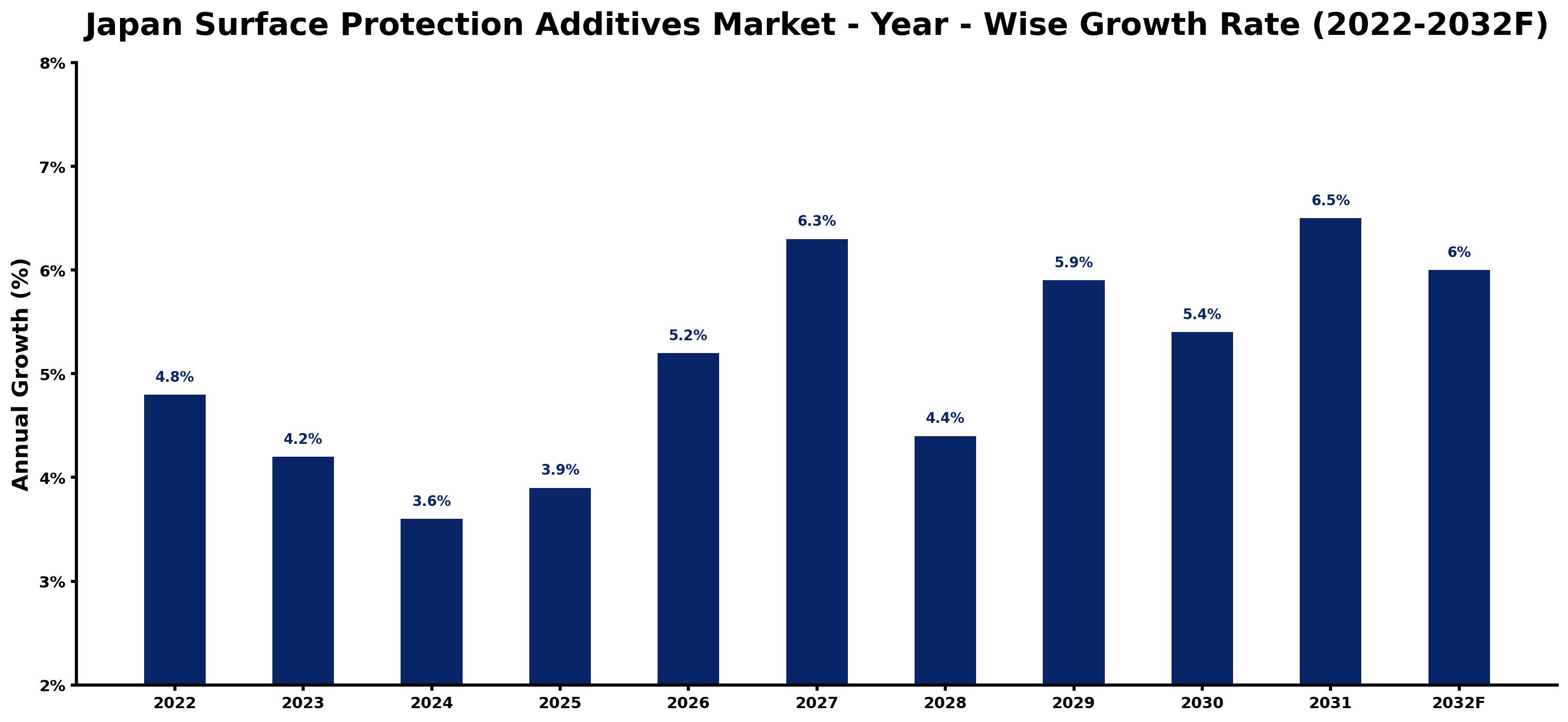
For each year, the table pairs the estimated growth rate with the leading influence on demand, showing how the drivers changed across the period.
| Year | Estimated Annual Growth (%) | Market Rationale |
| 2022 | 4.8 | The automotive sector's production of 8.3 million vehicles drove demand for additives. |
| 2023 | 4.2 | Demand growth slowed due to a slight decrease in automotive production and infrastructure projects. |
| 2024 | 3.6 | The market continued to experience slower growth as public infrastructure projects were delayed. |
| 2025 | 3.9 | Growth accelerated as demand for plastics and protective coatings in construction increased. |
| 2026 | 5.2 | The automotive sector's recovery and new infrastructure projects will boost demand for additives. |
| 2027 | 6.3 | Demand will surge as the shipbuilding industry expands and requires more corrosion inhibitors. |
| 2028 | 4.4 | Growth is expected to slow as the market stabilises after rapid increases in previous years. |
| 2029 | 5.9 | Rising consumer goods production will increase the need for durable plastics. |
| 2030 | 5.4 | Growth will slow slightly as the market adjusts to previous high demand levels. |
| 2031 | 6.5 | The market is projected to peak as the demand for protective coatings reaches new heights. |
| 2032 | 6.0 | Growth is expected to slow as the market stabilises after reaching its peak in the previous year. |
Note: Market size estimations and growth projections presented in this report are based on 6Wresearch's proprietary forecasting methodology, utilizing the latest available industry data, government publications, and primary research inputs.
Japan Surface Protection Additives Market Synopsis
Surface protection additives are chemical compounds that improve the durability of surfaces against environmental factors such as UV radiation and corrosion. Demand primarily arises from industries such as automotive, construction, and marine coatings, which seek long-lasting solutions for their products. Growth in these sectors indicates strong market potential for surface protection additives in Japan.
Market Dynamics Impact Analysis (2026–2032)
| Factor | Type | Impact | Primary Segment Affected |
| Growing automotive production | Driver | High | UV Stabilizers |
| Increasing public infrastructure projects | Driver | High | Corrosion Inhibitors |
| Rising demand for anti-graffiti solutions in urban areas | Opportunity | High | Anti-Graffiti Agents |
| Expansion of the marine coatings segment due to shipping industry growth | Opportunity | Medium | Marine Coatings |
| Strict environmental regulations affecting formulation | Restraint | High | Scratch-Resistant Additives |
| Market saturation in certain application segments | Restraint | Medium | Plastics |
| Supply chain disruptions affecting raw material availability | Challenge | High | Corrosion Inhibitors |
| Competition from alternative surface protection technologies | Challenge | Medium | UV Stabilizers |
Evaluation of Drivers in Japan Surface Protection Additives Market (2026–2032)
The following drivers explain most of the expected growth.
| Drivers | Primary Segment Affected | Why It Matters (Evidence) |
| Increased automotive production | UV Stabilizers | Japan's automotive sector produced 8.3 million vehicles in 2022, increasing demand for UV-stabilised plastics. |
| Expansion of public infrastructure projects | Corrosion Inhibitors | The Tokyo metropolitan area is a hub for projects requiring protective coatings, driving demand for corrosion inhibitors. |
| Growth in consumer goods production | Scratch-Resistant Additives | The electronics sector's rising demand for scratch-resistant surfaces leads to increased purchases of these additives. |
| Rising urbanisation and maintenance needs | Anti-Graffiti Agents | Urban areas increasingly utilise anti-graffiti agents to maintain public spaces, boosting demand for these solutions. |
| Development of marine industries | Marine Coatings | Japan's shipbuilding industry, valued at approximately $20 billion, drives demand for protective marine coatings. |
Volumes increase as Japan's automotive sector produced 8.3 million vehicles in 2022, which raises the need for UV stabilisers in plastics. The expansion of public infrastructure projects in the Tokyo metropolitan area results in a higher demand for corrosion inhibitors. In the electronics sector, rising production of consumer goods drives the need for scratch-resistant additives. Urban areas are increasingly applying anti-graffiti agents to maintain public spaces, while the shipbuilding industry, valued at around $20 billion, stimulates demand for marine coatings.
Evaluation of Restraints in Japan Surface Protection Additives Market
These are the pressures that could keep growth below its potential.
| Market Restraint | Primary Segment Affected | Why It Matters (Evidence) |
| Strict environmental regulations | Scratch-Resistant Additives | Japan's regulations influence the formulation of additives, limiting options for manufacturers. |
| Market saturation in certain segments | Plastics | The plastics segment faces saturation, which slows growth as competition intensifies. |
| Supply chain disruptions | Corrosion Inhibitors | Supply chain disruptions can delay production and increase costs for manufacturers. |
| High competition from alternative technologies | UV Stabilizers | Emerging technologies in surface protection create competition, affecting market share for traditional additives. |
| Economic fluctuations impacting construction | Anti-Graffiti Agents | Economic downturns can reduce funding for public projects, limiting the demand for anti-graffiti solutions. |
Japan Surface Protection Additives Market Challenges
Producers encounter higher production costs due to strict environmental regulations, which can raise expenses by 15% and compress profit margins. Importers face competition from cheaper foreign additives, risking a 20% decline in market share for local distributors. Technology adoption is sluggish, as many manufacturers lack advanced formulation techniques, causing product development delays that can extend timelines by six months. Skills shortages in the chemical engineering sector impede innovation, leading to a 10% reduction in new product introductions for buyers in the automotive and construction industries.
Trends in the Japan Surface Protection Additives Market
Four trends stand out in the Japan Surface Protection Additives Market.
- Shift towards Sustainable Construction Materials: Municipality contractors are increasingly adopting sustainable construction materials, with the Japanese government promoting this initiative. In 2023, a program was launched to encourage the use of surface protection additives, aligning with environmental goals.
- Transition from Traditional to Advanced Coatings: The marine coatings segment is evolving as shipbuilders adopt advanced protective solutions. With Japan's extensive coastline, the demand for new coatings is rising, reflecting a shift in industry standards.
- Emergence of Easy-Clean Properties: Interior trim manufacturers are prioritising easy-clean properties in their products. The growing demand for easy-to-maintain surfaces is reflected in a projected 7.4% CAGR for this feature segment.
- Increasing Implementation of Anti-Graffiti Solutions: Urban areas are increasingly implementing anti-graffiti agents to maintain public spaces. This trend is supported by rising urbanisation, leading to a notable increase in demand.
Investment Opportunities in the Japan Surface Protection Additives Market
The openings below show where demand in the Japan Surface Protection Additives Market is visible and how suppliers can enter.
- Municipality Contractors Seeking Durable Solutions: With a growing focus on public infrastructure, municipality contractors are looking for durable surface protection additives. The market for these solutions is expanding, driven by a projected 7.3% CAGR in this segment.
- Growing Need for Marine Coatings: The shipbuilding industry is expanding, creating a need for advanced marine coatings. This presents an opportunity for suppliers to offer new solutions, given the industry's $20 billion valuation.
- Investing in Scratch-Resistant Additives: The electronics sector's increasing demand for durable surfaces creates an opportunity for suppliers of scratch-resistant additives. Collaborating with manufacturers in this sector can facilitate market entry.
- Focus on Sustainable Products: The timing is ideal for suppliers to invest in sustainable surface protection additives. The Japanese government's promotion of sustainable materials aligns with market trends, creating opportunities for growth.
Government Initiatives in the Japan Surface Protection Additives Market
The Chemical Substances Control Law, enacted in 1973, requires manufacturers to evaluate and control chemical substances. This law ensures that all new and existing chemical substances used in surface protection additives are thoroughly assessed for safety and compliance, impacting producers significantly. The Building Energy Efficiency Act, amended in 2022, mandates that all new buildings meet energy standards from April 2025, influencing the formulation of additives used in construction materials.
The Ministry of the Environment (MoE) and the Ministry of Economy, Trade and Industry (METI) approve and fund initiatives related to sustainable construction materials. Their collaboration under the Plastic Resource Circulation Act promotes the reduction and recycling of plastics, impacting how surface protection additives are formulated and used in various applications.
Future Insight of the Japan Surface Protection Additives Market
The development of urban infrastructure projects will drive demand for surface protection additives in Japan. By 2032, the integration of advanced formulation technologies will enhance production efficiency, enabling suppliers to meet market demands more effectively. The government's initiative to promote sustainable materials will create opportunities for buyers seeking environmentally friendly solutions. As the shipping industry continues to expand, suppliers will need to adjust their offerings to meet the growing requirements in marine coatings.
Market Segmentation Analysis
Japan Surface Protection Additives Market report covers a detailed analysis of the following market segments:
By Additive Type – UV Stabilizers Lead, Anti-Graffiti Agents Expected to Grow Fastest
According to Saurav Kr Singh, Senior Research Analyst at 6Wresearch, UV Stabilizers accounted for 51% of the market by additive type in 2025. UV stabilisers hold the largest share as they are crucial for preventing degradation from UV exposure, particularly in outdoor plastics. Their extensive application in consumer goods that require durability under sunlight underscores their market significance. Anti-Graffiti Agents are projected to grow fastest, at a CAGR of 7.9% during 2026–2032. The growth of anti-graffiti agents is fuelled by rising urbanisation and the need for maintaining public spaces, especially in densely populated areas. This trend is likely to continue as cities enhance their aesthetic appeal and cleanliness. Suppliers should prioritise the development of anti-graffiti agents to meet the increasing urban demand.
By Protection Feature – Sunlight Resistance Leads, Easy-Clean Property Expected to Grow Fastest
With 46% of protection feature revenue in 2025, Sunlight Resistance was the largest category. Sunlight resistance is paramount for outdoor applications, making it the leading protection feature in surface protection additives. Its importance is underscored by the need to prevent damage in products exposed to the elements. Over 2026–2032, Easy-Clean Property is expected to post the fastest growth, at a CAGR of 7.4%. The easy-clean property is gaining traction as consumers seek low-maintenance solutions for surfaces, particularly in public infrastructure. This feature's appeal is likely to drive its rapid adoption in various applications. Buyers will benefit from products that offer easy-clean properties, leading to lower maintenance costs.
By Application Segment – Plastics Lead, Public Infrastructure Expected to Grow Fastest
Plastics took 44% of application segment revenue in 2025, more than any other category. Plastics dominate the application segment due to their widespread use in products requiring enhanced properties, particularly within consumer goods. The high production levels of plastic items in Japan emphasise the importance of this segment in the market. Public Infrastructure is set to record the highest CAGR in this split, 7.6% over 2026–2032. Public infrastructure is experiencing rapid growth as local governments allocate resources for projects aimed at extending service life and improving durability. This investment trend in infrastructure is expected to persist, presenting opportunities for suppliers. Suppliers should focus on the public infrastructure sector to capitalise on the increasing investments in projects.
By End User – Polymer Compounders Lead, Municipality Contractors Expected to Grow Fastest
In 2025, Polymer Compounders led the end user split with a 39% share. Polymer compounders lead the end user segment as they are directly involved in producing polymer blends that utilise surface protection additives. Their integral role in the supply chain ensures a steady demand for these additives. The quickest growth will come from Municipality Contractors, forecast to expand at a CAGR of 7.3% between 2026 and 2032. Municipality contractors are rapidly increasing their use of surface protection additives for municipal projects, driven by the need for durability in public works. This trend reflects a broader commitment to maintaining infrastructure quality. Suppliers should engage with municipality contractors to align their offerings with public project requirements.
Key Attractiveness of the Report
- 10 Years of Market Numbers
- Historical Data Starting from 2022 to 2025
- Base Year 2025
- Forecast Data until 2032
- Key Performance Indicators Impacting the Market
- Major Upcoming Developments and Projects
Key Highlights of the Report:
- Japan Surface Protection Additives Market Outlook
- Market Size of Japan Surface Protection Additives Market, 2025
- Forecast of Japan Surface Protection Additives Market, 2032
- Historical Data and Forecast of Japan Surface Protection Additives Revenues & Volume for the Period 2022-2032F
- Japan Surface Protection Additives Market Trend Evolution
- Japan Surface Protection Additives Market Drivers and Challenges
- Japan Surface Protection Additives Price Trends
- Japan Surface Protection Additives Porter's Five Forces
- Japan Surface Protection Additives Industry Life Cycle
- Historical Data and Forecast of Japan Surface Protection Additives Market Revenues & Volume By Additive Type for the Period 2022-2032F
- Historical Data and Forecast of Japan Surface Protection Additives Market Revenues & Volume By UV Stabilizers for the Period 2022-2032F
- Historical Data and Forecast of Japan Surface Protection Additives Market Revenues & Volume By Anti-Graffiti Agents for the Period 2022-2032F
- Historical Data and Forecast of Japan Surface Protection Additives Market Revenues & Volume By Scratch-Resistant Additives for the Period 2022-2032F
- Historical Data and Forecast of Japan Surface Protection Additives Market Revenues & Volume By Corrosion Inhibitors for the Period 2022-2032F
- Historical Data and Forecast of Japan Surface Protection Additives Market Revenues & Volume By Protection Feature for the Period 2022-2032F
- Historical Data and Forecast of Japan Surface Protection Additives Market Revenues & Volume By Sunlight Resistance for the Period 2022-2032F
- Historical Data and Forecast of Japan Surface Protection Additives Market Revenues & Volume By Easy-Clean Property for the Period 2022-2032F
- Historical Data and Forecast of Japan Surface Protection Additives Market Revenues & Volume By Surface Hardening for the Period 2022-2032F
- Historical Data and Forecast of Japan Surface Protection Additives Market Revenues & Volume By Rust Prevention for the Period 2022-2032F
- Historical Data and Forecast of Japan Surface Protection Additives Market Revenues & Volume By Application Segment for the Period 2022-2032F
- Historical Data and Forecast of Japan Surface Protection Additives Market Revenues & Volume By Plastics for the Period 2022-2032F
- Historical Data and Forecast of Japan Surface Protection Additives Market Revenues & Volume By Public Infrastructure for the Period 2022-2032F
- Historical Data and Forecast of Japan Surface Protection Additives Market Revenues & Volume By Automotive Interiors for the Period 2022-2032F
- Historical Data and Forecast of Japan Surface Protection Additives Market Revenues & Volume By Marine Coatings for the Period 2022-2032F
- Historical Data and Forecast of Japan Surface Protection Additives Market Revenues & Volume By End User for the Period 2022-2032F
- Historical Data and Forecast of Japan Surface Protection Additives Market Revenues & Volume By Polymer Compounders for the Period 2022-2032F
- Historical Data and Forecast of Japan Surface Protection Additives Market Revenues & Volume By Municipality Contractors for the Period 2022-2032F
- Historical Data and Forecast of Japan Surface Protection Additives Market Revenues & Volume By Interior Trim Manufacturers for the Period 2022-2032F
- Historical Data and Forecast of Japan Surface Protection Additives Market Revenues & Volume By Shipbuilding Industry for the Period 2022-2032F
- Japan Surface Protection Additives Import Export Trade Statistics
- Market Opportunity Assessment By Additive Type
- Market Opportunity Assessment By Protection Feature
- Market Opportunity Assessment By Application Segment
- Market Opportunity Assessment By End User
- Japan Surface Protection Additives Top Companies Market Share
- Japan Surface Protection Additives Competitive Benchmarking By Technical and Operational Parameters
- Japan Surface Protection Additives Company Profiles
- Japan Surface Protection Additives Key Strategic Recommendations
Market Covered
Coverage by segment is as follows.
By Additive Type
- UV Stabilizers
- Anti-Graffiti Agents
- Scratch-Resistant Additives
- Corrosion Inhibitors
By Protection Feature
- Sunlight Resistance
- Easy-Clean Property
- Surface Hardening
- Rust Prevention
By Application Segment
- Plastics
- Public Infrastructure
- Automotive Interiors
- Marine Coatings
By End User
- Polymer Compounders
- Municipality Contractors
- Interior Trim Manufacturers
- Shipbuilding Industry































