Japan Surface Treatment Market Size & Growth Rate
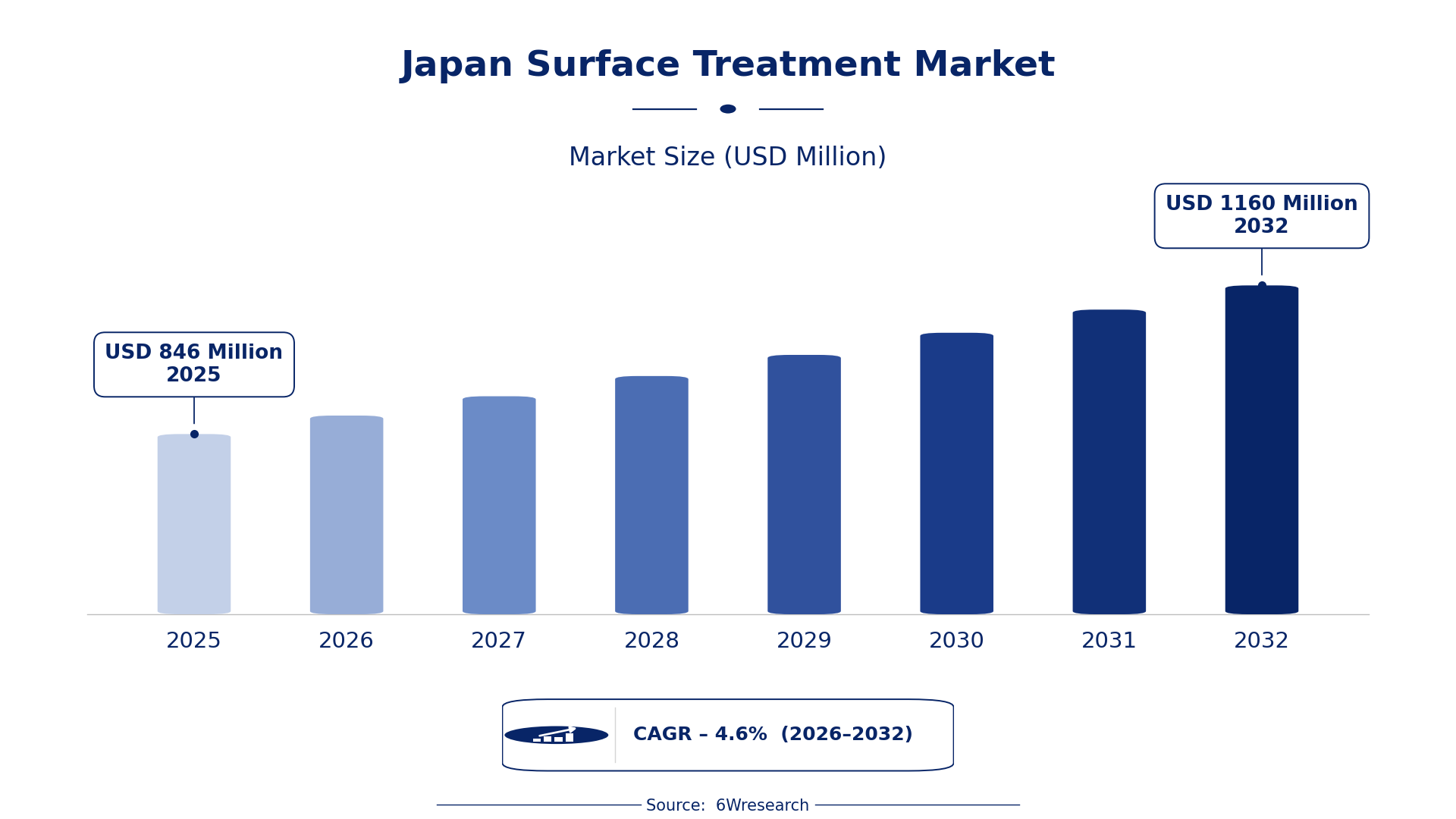
According to 6Wresearch internal database and industry insights, the Japan Surface Treatment Market was valued at USD 846 Million in 2025 and is projected to reach USD 1,160 Million by 2032, growing at a CAGR of approximately 4.6% during 2026–2032.
Japan Surface Treatment Market Highlights
| Report Metric | Details |
| Report Name | Japan Surface Treatment Market (2026-2032) |
| Market Size 2025 | USD 846 Million |
| Market Size 2032 | USD 1,160 Million |
| Absolute Growth 2025–2032 | USD 314 Million |
| CAGR 2026–2032 | 4.6% |
| Peak Annual Growth | 6.5% in 2026 |
| Forecast Period | 2026–2032 |
| Historical Data | 2022–2025 |
| Base Year | 2025 |
| Leading Treatment Type, 2025 | Coating (48% share) |
| Leading Process Technology, 2025 | Electroplating (54% share) |
| Leading Target Material, 2025 | Steel (40% share) |
| Leading End User, 2025 | Auto Component Manufacturers (41% share) |
| Fastest-Growing Treatment Type | Anodizing (6.2% CAGR) |
| Fastest-Growing Process Technology | Powder/Liquid (6.3% CAGR) |
| Fastest-Growing Target Material | Aluminum (6.8% CAGR) |
| Fastest-Growing End User | Electronics Manufacturers (5.7% CAGR) |
| Growing Sector | Electronics Manufacturers |
| Key End Users | Auto Component Manufacturers, Electronics Manufacturers, Aerospace OEMs, Industrial Equipment Makers |
Japan Surface Treatment Market Year-wise Growth Rate and Key Drivers (2022–2032)
This graph illustrates the annual growth rates of the market from 2022 to 2032, highlighting a steady upward trajectory and projected market expansion over the forecast period.
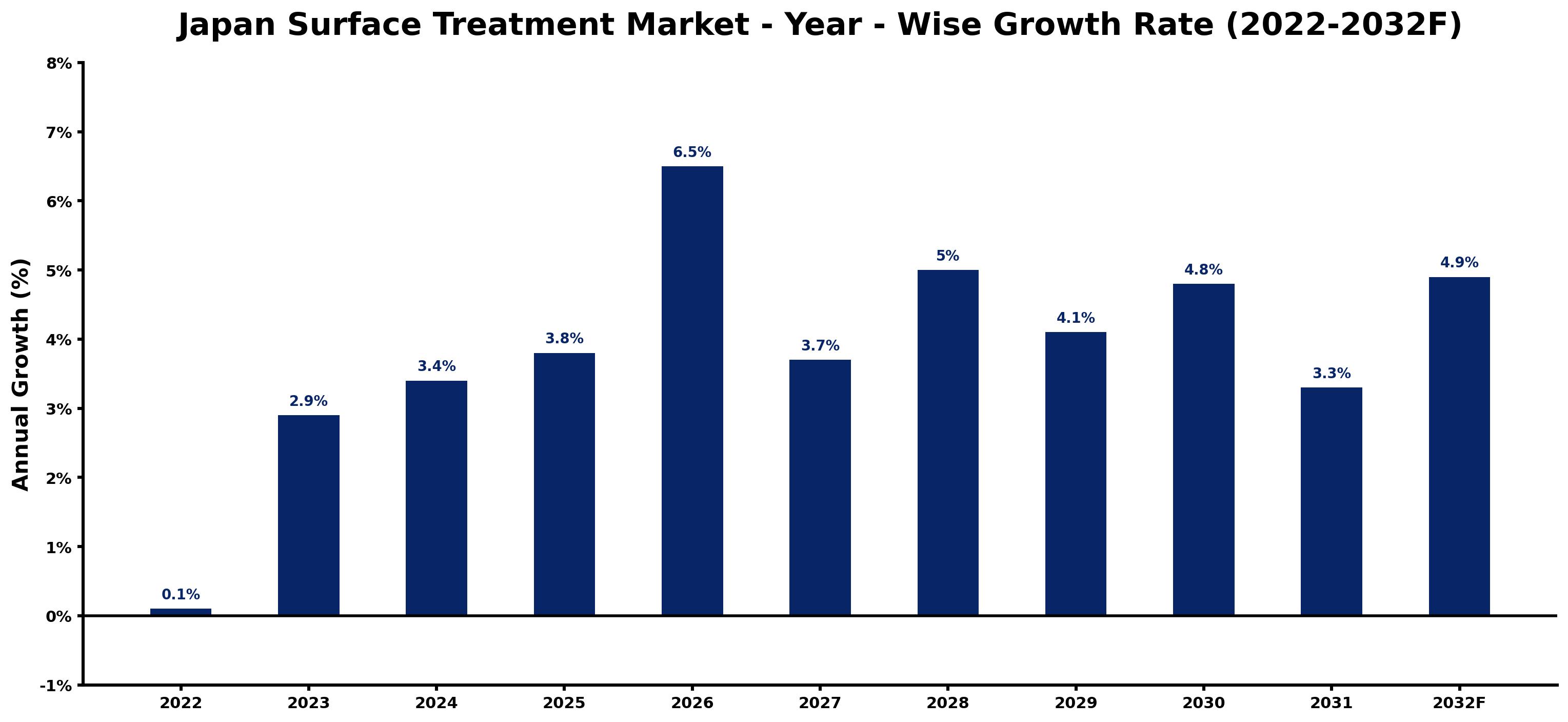
The following figures match every annual growth estimate with the main market development of that year, giving the reasoning behind each rise or slowdown.
| Year | Estimated Annual Growth (%) | Market Rationale |
| 2022 | 0.1 | The market experienced minimal growth due to steady demand from established industries. |
| 2023 | 2.9 | Demand accelerated as automotive production rebounded, leading to increased surface treatment needs. |
| 2024 | 3.4 | Growth continued as the aerospace sector expanded, boosting demand for surface treatment services. |
| 2025 | 3.8 | The market reached a peak growth rate driven by strong automotive and aerospace performances. |
| 2026 | 6.5 | Growth is expected to surge as new technologies and processes are adopted, improving treatment capabilities. |
| 2027 | 3.7 | Growth will slow slightly as the market adjusts to the previous year's rapid expansion. |
| 2028 | 5.0 | Demand is projected to increase again with rising investments in advanced surface treatment technologies. |
| 2029 | 4.1 | Growth will moderate as the market stabilises after previous fluctuations in demand. |
| 2030 | 4.8 | A renewed focus on sustainability in manufacturing will spur further demand for surface treatment. |
| 2031 | 3.3 | Growth is expected to slow as the market faces saturation in certain segments, yet remain positive. |
| 2032 | 4.9 | Demand is projected to rise as new applications for treated materials emerge. |
Note: Market size estimations and growth projections presented in this report are based on 6Wresearch's proprietary forecasting methodology, utilizing the latest available industry data, government publications, and primary research inputs.
Japan Surface Treatment Market Synopsis
Surface treatment involves processes that improve the properties of metals through techniques like anodizing, plating, and coating. These treatments are essential for corrosion resistance, aesthetic enhancement, and durability, particularly in the aerospace and automotive sectors. The Japan Surface Treatment Market is expanding due to increased production in the automotive industry, which manufactured over 8 million vehicles in 2022, along with advancements in treatment technologies that drive new applications. The aerospace sector's reliance on surface treatment for over 70% of its components further fuels market growth, as producers seek innovative solutions to meet evolving demands.
Market Dynamics Impact Analysis (2026–2032)
| Factor | Type | Impact | Primary Segment Affected |
| Increased automotive production | Driver | High | Coating |
| Technological advancements in surface treatment processes | Driver | High | Electroplating |
| Growing demand for aerospace components | Opportunity | High | Anodizing |
| Rising environmental regulations promoting sustainable practices | Opportunity | Medium | Plating |
| High competition leading to price pressures | Restraint | Medium | Coating |
| Limited skilled workforce in advanced treatment technologies | Restraint | High | Electrochemical |
| Fluctuations in raw material prices affecting production costs | Challenge | High | Steel |
| Technological integration challenges within existing facilities | Challenge | Medium | Aluminum |
Evaluation of Drivers in Japan Surface Treatment Market (2026–2032)
The table below links each growth driver to the segment it affects and the evidence for it.
| Drivers | Primary Segment Affected | Why It Matters (Evidence) |
| Increased vehicle production | Coating | In 2022, the automotive industry produced over 8 million vehicles, driving demand for protective coatings. |
| Technological advancements | Electroplating | New electroplating techniques improve efficiency, leading manufacturers to invest more in surface treatment processes, with investments rising by 20% in recent years. |
| Aerospace sector growth | Anodizing | Over 70% of aerospace components require surface treatment, boosting demand in this sector significantly. |
| Rising electronics manufacturing | Electrochemical | The electronics sector is projected to use 30% of treated metals in 2023, increasing demand for surface treatment services. |
| Focus on sustainability | Plating | Environmental regulations are pushing manufacturers to adopt eco-friendly surface treatment processes, with compliance costs increasing by 15%. |
Spending rises because the automotive sector produced over 8 million vehicles in 2022, driving demand for coatings that improve durability and aesthetics. New electroplating techniques are prompting manufacturers to invest in modern surface treatment processes, with investment levels increasing by 20% recently. The aerospace sector relies on surface treatment for over 70% of its components, creating consistent demand for these services. Electronics manufacturing is expected to use 30% of treated metals in 2023, further boosting the market. A focus on sustainability compels manufacturers to adopt eco-friendly practices, increasing overall spending in the sector.
Evaluation of Restraints in Japan Surface Treatment Market
These are the pressures that could keep growth below its potential.
| Market Restraint | Primary Segment Affected | Why It Matters (Evidence) |
| High competition leading to price pressures | Coating | Intense competition among providers is driving down prices, affecting profit margins for manufacturers. |
| Limited skilled workforce | Electrochemical | A shortage of skilled technicians in advanced surface treatment technologies hampers operational efficiency, with a 15% increase in operational costs for manufacturers. |
| Fluctuations in raw material prices | Steel | Volatility in the prices of raw materials increases production costs, impacting overall market growth by up to 10%. |
| Technological integration challenges | Aluminum | Existing facilities struggle to integrate new technologies, delaying upgrades and limiting efficiency, which can extend project timelines by several weeks. |
| Regulatory compliance costs | Plating | Meeting environmental regulations incurs additional costs for surface treatment providers, impacting their profitability. |
Japan Surface Treatment Market Challenges
In Tokyo, surface treatment providers face rising energy costs, inflating operational expenses by up to 15% for manufacturers. Many facilities still utilise outdated equipment, causing inefficiencies that delay project timelines for automotive producers by an average of three weeks. A shortage of trained technicians limits production capacity for suppliers, compelling them to decline contracts worth millions. Foreign firms increasingly enter the market, pressuring local providers to reduce prices, potentially eroding profit margins by approximately 10%.
Trends in the Japan Surface Treatment Market
The trends below show where the Japan Surface Treatment Market is heading.
- Shift from Traditional to Advanced Coating Techniques: Auto Component Manufacturers are increasingly adopting advanced coating techniques to improve durability and reduce environmental impact. In 2023, over 60% of new vehicles incorporated these technologies, reflecting a shift in production practices.
- Transition to Eco-Friendly Surface Treatments: The Green Growth Strategy is driving manufacturers to adopt eco-friendly surface treatment processes. By 2025, it is anticipated that 50% of surface treatment operations will comply with new environmental standards.
- Emergence of Smart Coatings: Electronics Manufacturers are exploring smart coatings that respond to environmental changes. In 2023, the market for these coatings is projected to grow by 25%, indicating a shift towards innovative solutions.
- Increased Automation in Surface Treatment: Tokyo is experiencing a rise in automated surface treatment facilities. In 2023, around 40% of new installations are expected to feature automated processes, enhancing efficiency and consistency.
Investment Opportunities in the Japan Surface Treatment Market
Where to invest in the Japan Surface Treatment Market: the main openings are set out below.
- Timing is Right for Investment: With the automotive sector producing over 8 million vehicles in 2022, there is a growing need for advanced surface treatment technologies. Investing in automation and eco-friendly processes can meet this demand effectively.
- Aerospace Sector Demand: Aerospace OEMs are increasingly seeking advanced surface treatments for component durability. The expected growth in this sector presents opportunities for suppliers to develop specialised solutions.
- Electronics Manufacturing Growth: The electronics sector's projected use of 30% of treated metals in 2023 indicates a strong demand for surface treatment services. Suppliers can focus on developing tailored solutions for this market.
- Environmental Compliance Needs: With regulatory pressures increasing, manufacturers must adopt eco-friendly surface treatment processes. This presents opportunities for providers of sustainable treatment technologies to enter the market.
Government Initiatives in the Japan Surface Treatment Market
The Water Supply Act (1957) sets standards for drinking-water quality and supply, while the Sewerage Act (1958) governs sewerage systems and wastewater treatment, impacting surface treatment operations. Compliance with these laws is essential for producers to ensure safe practices and maintain operational standards.
The Ministry of Economy, Trade and Industry oversees the implementation of the PRTR Law (1999), which requires businesses to report releases of designated chemical substances. This law encourages surface treatment providers to adopt safer practices, ensuring compliance and reducing environmental impact.
Future Insight of the Japan Surface Treatment Market
By 2032, regulatory changes will drive suppliers to adopt advanced technologies, enhancing operational efficiency. The implementation of stricter environmental regulations will require manufacturers to adopt greener practices, reducing waste significantly. Training programmes will emerge to fill the skills gap, ensuring a steady workforce for the sector. In 2023, the electronics manufacturing sector is projected to use 30% of treated metals, indicating a growing demand for innovative surface treatment solutions.
Market Segmentation Analysis
Japan Surface Treatment Market report covers a detailed analysis of the following market segments:
By Treatment Type – Coating Leads, Anodizing Expected to Grow Fastest
According to Saurav Kr Singh, Senior Research Analyst at 6Wresearch, Coating accounted for 48% of the market by treatment type in 2025. Coating holds the largest share because it is essential for protecting surfaces from wear and corrosion, particularly in the automotive industry. With over 8 million vehicles produced in 2022, the demand for coating processes has surged in Japan. Over 2026–2032, Anodizing is expected to post the fastest growth, at a CAGR of 6.2%. Anodizing is experiencing rapid growth due to its vital role in enhancing corrosion resistance for aluminium components, especially in aerospace applications. The fact that over 70% of aerospace components require surface treatment underlines this increasing demand. Suppliers must focus on improving anodizing capabilities to capitalise on the growing aerospace market.
By Process Technology – Electroplating Leads, Powder/Liquid Expected to Grow Fastest
Electroplating took 54% of process technology revenue in 2025, more than any other category. Electroplating leads the market as it is widely used to improve the surface properties of metals across various industries. Its common application in the automotive and electronics sectors reinforces its dominant position in Japan. The quickest growth will come from Powder/Liquid, forecast to expand at a CAGR of 6.3% between 2026 and 2032. Powder/Liquid processes are experiencing rapid growth because of their effectiveness in providing protective coatings, particularly in the automotive and electronics industries. This growth is linked to the increasing need for durable surface treatments in high-demand sectors. Buyers should seek suppliers that offer advanced Powder/Liquid technologies to maintain competitive advantages in their products.
By Target Material – Steel Leads, Aluminum Expected to Grow Fastest
In 2025, Steel led the target material split with a 40% share. Steel is the top material treated in Japan, primarily valued for its strength and corrosion resistance in construction applications. Its extensive use in infrastructure projects solidifies its leading share in the market. Aluminum is set to record the highest CAGR in this split, 6.8% over 2026–2032. Aluminium is growing the fastest as it is extensively treated for aerospace and automotive applications, driven by the demand for lightweight and corrosion-resistant materials. The increasing production of vehicles and aircraft further fuels this trend. Suppliers should invest in aluminium treatment technologies to capitalise on the growing demand in aerospace and automotive sectors.
By End User – Auto Component Manufacturers Lead, Electronics Manufacturers Expected to Grow Fastest
With 41% of end user revenue in 2025, Auto Component Manufacturers was the largest category. Auto Component Manufacturers represent the largest share as they depend on high-performance parts that require reliable surface treatments. The strong vehicle production in Japan necessitates advanced surface treatment solutions for durability and performance. Electronics Manufacturers are projected to grow fastest, at a CAGR of 5.7% during 2026–2032. Electronics Manufacturers are witnessing the fastest growth driven by the essential use of treated metals in circuit board and component production. The anticipated rise in electronics manufacturing in 2023 fuels this rapid expansion. Suppliers should tailor their surface treatment offerings to meet the evolving requirements of electronics manufacturers.
Key Attractiveness of the Report
- 10 Years of Market Numbers
- Historical Data Starting from 2022 to 2025
- Base Year 2025
- Forecast Data until 2032
- Key Performance Indicators Impacting the Market
- Major Upcoming Developments and Projects
Key Highlights of the Report:
- Japan Surface Treatment Market Outlook
- Market Size of Japan Surface Treatment Market, 2025
- Forecast of Japan Surface Treatment Market, 2032
- Historical Data and Forecast of Japan Surface Treatment Revenues & Volume for the Period 2022-2032F
- Japan Surface Treatment Market Trend Evolution
- Japan Surface Treatment Market Drivers and Challenges
- Japan Surface Treatment Price Trends
- Japan Surface Treatment Porter's Five Forces
- Japan Surface Treatment Industry Life Cycle
- Historical Data and Forecast of Japan Surface Treatment Market Revenues & Volume By Treatment Type for the Period 2022-2032F
- Historical Data and Forecast of Japan Surface Treatment Market Revenues & Volume By Anodizing for the Period 2022-2032F
- Historical Data and Forecast of Japan Surface Treatment Market Revenues & Volume By Plating for the Period 2022-2032F
- Historical Data and Forecast of Japan Surface Treatment Market Revenues & Volume By Coating for the Period 2022-2032F
- Historical Data and Forecast of Japan Surface Treatment Market Revenues & Volume By Etching for the Period 2022-2032F
- Historical Data and Forecast of Japan Surface Treatment Market Revenues & Volume By Process Technology for the Period 2022-2032F
- Historical Data and Forecast of Japan Surface Treatment Market Revenues & Volume By Electrochemical for the Period 2022-2032F
- Historical Data and Forecast of Japan Surface Treatment Market Revenues & Volume By Electroplating for the Period 2022-2032F
- Historical Data and Forecast of Japan Surface Treatment Market Revenues & Volume By Powder/Liquid for the Period 2022-2032F
- Historical Data and Forecast of Japan Surface Treatment Market Revenues & Volume By Chemical for the Period 2022-2032F
- Historical Data and Forecast of Japan Surface Treatment Market Revenues & Volume By Target Material for the Period 2022-2032F
- Historical Data and Forecast of Japan Surface Treatment Market Revenues & Volume By Aluminum for the Period 2022-2032F
- Historical Data and Forecast of Japan Surface Treatment Market Revenues & Volume By Steel, Copper for the Period 2022-2032F
- Historical Data and Forecast of Japan Surface Treatment Market Revenues & Volume By Plastics/Metal for the Period 2022-2032F
- Historical Data and Forecast of Japan Surface Treatment Market Revenues & Volume By Glass/Semiconductors for the Period 2022-2032F
- Historical Data and Forecast of Japan Surface Treatment Market Revenues & Volume By End User for the Period 2022-2032F
- Historical Data and Forecast of Japan Surface Treatment Market Revenues & Volume By Aerospace OEMs for the Period 2022-2032F
- Historical Data and Forecast of Japan Surface Treatment Market Revenues & Volume By Auto Component Manufacturers for the Period 2022-2032F
- Historical Data and Forecast of Japan Surface Treatment Market Revenues & Volume By Industrial Equipment Makers for the Period 2022-2032F
- Historical Data and Forecast of Japan Surface Treatment Market Revenues & Volume By Electronics Manufacturers for the Period 2022-2032F
- Japan Surface Treatment Import Export Trade Statistics
- Market Opportunity Assessment By Treatment Type
- Market Opportunity Assessment By Process Technology
- Market Opportunity Assessment By Target Material
- Market Opportunity Assessment By End User
- Japan Surface Treatment Top Companies Market Share
- Japan Surface Treatment Competitive Benchmarking By Technical and Operational Parameters
- Japan Surface Treatment Company Profiles
- Japan Surface Treatment Key Strategic Recommendations
Market Covered
This report examines the market across the segments below.
By Treatment Type
- Anodizing
- Plating
- Coating
- Etching
By Process Technology
- Electrochemical
- Electroplating
- Powder/Liquid
- Chemical
By Target Material
- Aluminum
- Steel
- Copper
- Plastics/Metal
- Glass/Semiconductors
By End User
- Aerospace OEMs
- Auto Component Manufacturers
- Industrial Equipment Makers
- Electronics Manufacturers































