Japan Surgical Assist Devices Market Size & Growth Rate
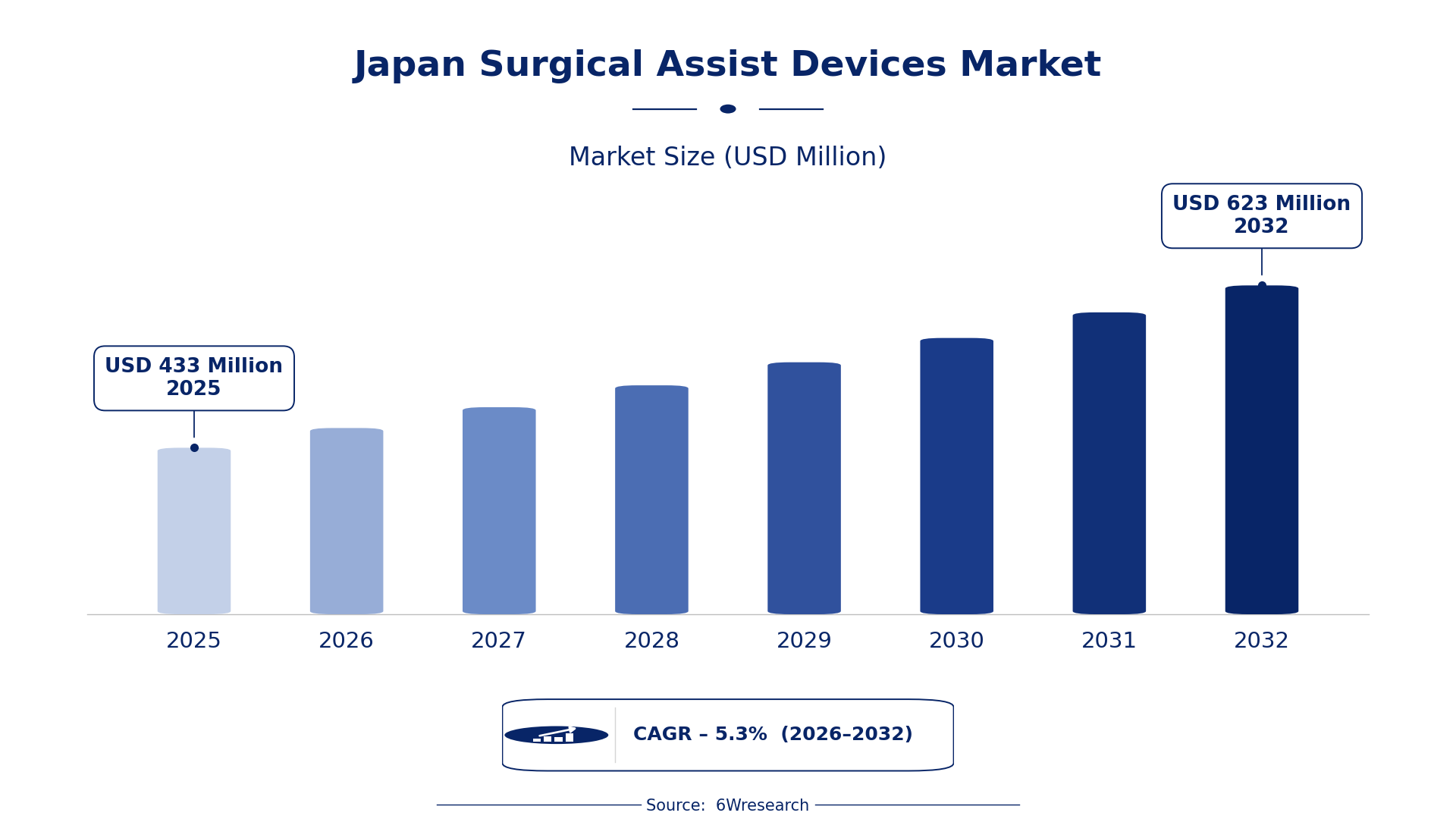
According to 6Wresearch internal database and industry insights, the Japan Surgical Assist Devices Market was valued at USD 433 Million in 2025 and is projected to reach USD 623 Million by 2032, growing at a CAGR of approximately 5.3% during 2026–2032.
Japan Surgical Assist Devices Market Highlights
| Report Metric | Details |
| Report Name | Japan Surgical Assist Devices Market (2026-2032) |
| Market Size 2025 | USD 433 Million |
| Market Size 2032 | USD 623 Million |
| Absolute Growth 2025–2032 | USD 190 Million |
| CAGR 2026–2032 | 5.3% |
| Peak Annual Growth | 6.8% in 2032 |
| Forecast Period | 2026–2032 |
| Historical Data | 2022–2025 |
| Base Year | 2025 |
| Leading Device Type, 2025 | Robotic Arms (50% share) |
| Leading Assistance Method, 2025 | Motorized Precision (46% share) |
| Leading Use Case, 2025 | Minimally Invasive Surgery (39% share) |
| Leading End User, 2025 | Surgical Robotics Firms (49% share) |
| Fastest-Growing Device Type | Surgical Navigation Tools (7.6% CAGR) |
| Fastest-Growing Assistance Method | Imaging-Guided (8.0% CAGR) |
| Fastest-Growing Use Case | Neurosurgery/Ortho (7.3% CAGR) |
| Growing Sector | Surgical Robotics Firms |
| Key End Users | Surgical Robotics Firms, Specialty Hospitals, Operating Rooms, Teaching Hospitals |
Japan Surgical Assist Devices Market Year-wise Growth Rate and Key Drivers (2022–2032)
This graph illustrates the annual growth rates of the market from 2022 to 2032, highlighting a steady upward trajectory and projected market expansion over the forecast period.
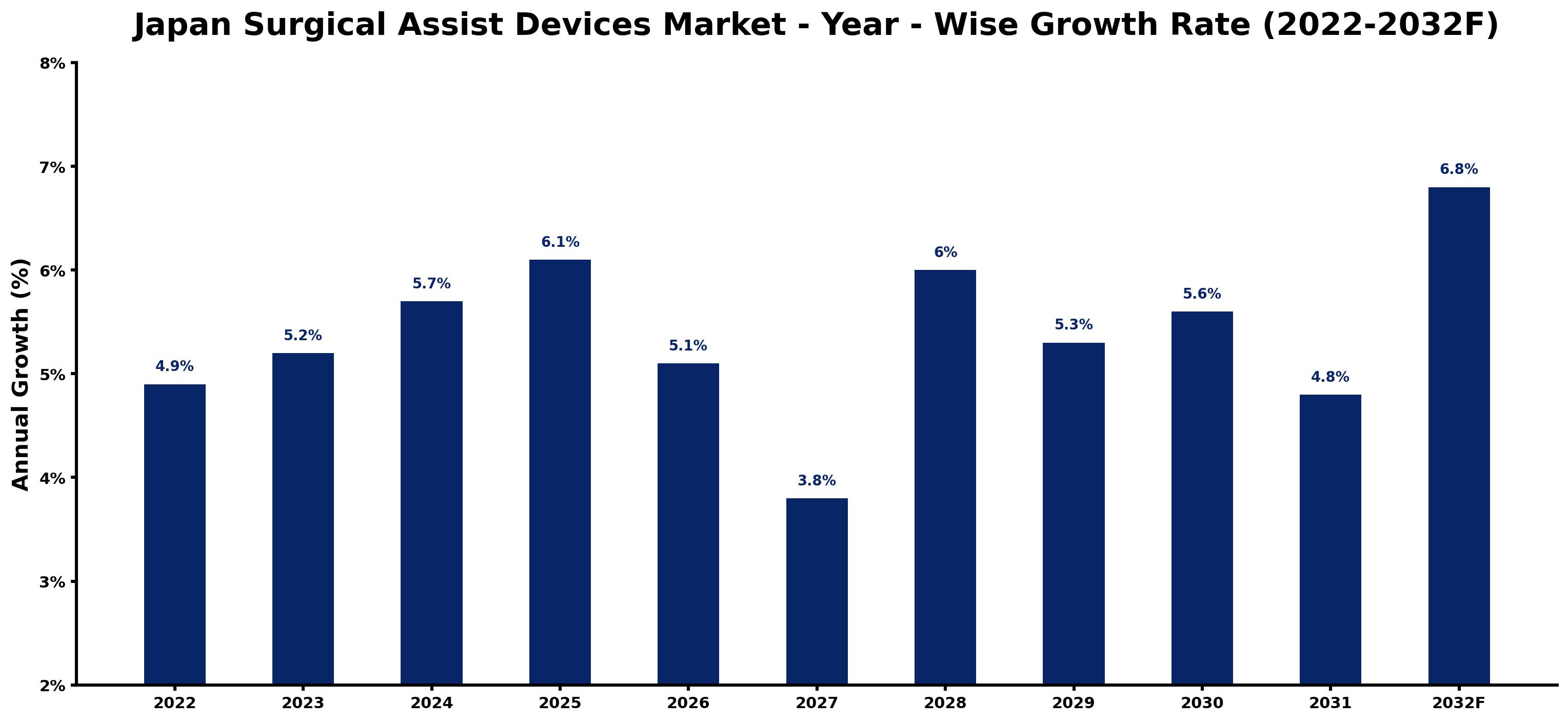
The following figures match every annual growth estimate with the main market development of that year, giving the reasoning behind each rise or slowdown.
| Year | Estimated Annual Growth (%) | Market Rationale |
| 2022 | 4.9 | The market showed steady growth as surgical procedures increased across Japan. |
| 2023 | 5.2 | Growth continued as hospitals invested in advanced surgical technologies to improve outcomes. |
| 2024 | 5.7 | Demand rose with the aging population requiring more surgical interventions. |
| 2025 | 6.1 | The market peaked as minimally invasive surgeries became more prevalent. |
| 2026 | 5.1 | Growth is expected to slow as market saturation begins to affect new investments. |
| 2027 | 3.8 | A further slowdown is projected as competition intensifies among suppliers. |
| 2028 | 6.0 | Demand is expected to accelerate again due to technological advancements in surgical devices. |
| 2029 | 5.3 | Growth is projected to slow slightly as hospitals reassess their surgical technology needs. |
| 2030 | 5.6 | Demand will rise as training programs for advanced surgical techniques expand. |
| 2031 | 4.8 | The market is expected to experience a slowdown as the focus shifts to cost management. |
| 2032 | 6.8 | Growth will peak again with substantial investments in surgical robotics. |
Note: Market size estimations and growth projections presented in this report are based on 6Wresearch's proprietary forecasting methodology, utilizing the latest available industry data, government publications, and primary research inputs.
Japan Surgical Assist Devices Market Synopsis
Surgical Assist Devices are advanced technologies that improve precision and efficiency in surgical procedures, particularly in minimally invasive surgeries and complex tasks. The Japan Surgical Assist Devices Market is expanding due to a growing elderly population, which accounted for 29.3% of the population in 2024, and increased funding for surgical innovation. The Tokyo region is a hub for surgical technology, driving demand from specialty hospitals and surgical robotics firms, which account for over 30% of surgical procedures performed annually.
Market Dynamics Impact Analysis (2026–2032)
| Factor | Type | Impact | Primary Segment Affected |
| Growing elderly population increases surgical needs | Driver | High | Minimally Invasive Surgery |
| Technological advancements in surgical robotics | Driver | High | Surgical Robotics Firms |
| Investment in surgical training programs | Opportunity | Medium | Teaching Hospitals |
| Emerging demand for imaging-guided surgical devices | Opportunity | Medium | Imaging-Guided |
| High costs of advanced surgical technologies | Restraint | High | Surgical Navigation Tools |
| Limited access to funding for smaller facilities | Restraint | Medium | Positioning Systems |
| Increasing competition among suppliers | Challenge | High | Robotic Arms |
| Rising average age of surgeons necessitates training | Challenge | Medium | Surgical Robotics Firms |
Evaluation of Drivers in Japan Surgical Assist Devices Market (2026–2032)
Key forces behind demand, with the segment each one moves most, are listed below.
| Drivers | Primary Segment Affected | Why It Matters (Evidence) |
| Aging population | Minimally Invasive Surgery | 29.3% of Japan's population was aged 65 or older in September 2024, increasing demand for surgical procedures. |
| Technological advancements | Surgical Robotics Firms | The surgical robotics market is valued at approximately 100 billion yen, driving hospitals to invest in advanced devices. |
| Funding for surgical innovation | Specialty Hospitals | Japan's national medical care expenditure was about JPY 46.7 trillion in fiscal 2022, supporting new surgical technologies. |
| Increased number of surgeries | Operating Rooms | The annual number of surgeries performed in Japan exceeds 10 million, leading to higher demand for surgical assist devices. |
| Training programs for surgeons | Teaching Hospitals | In 2023, Japan launched a program to enhance surgical training using AR technologies, improving surgical outcomes. |
Several shifts outside the market lift sales. The aging population drives demand for surgical procedures, as a notable portion of the population requires surgical interventions. Technological advancements are clear as the surgical robotics market reaches approximately 100 billion yen, prompting hospitals to invest in these devices. National medical care expenditure of about JPY 46.7 trillion in fiscal 2022 supports new surgical technologies. The annual number of surgeries performed in Japan exceeds 10 million, increasing the need for surgical assist devices.
Evaluation of Restraints in Japan Surgical Assist Devices Market
The main factors holding the market back are set out below.
| Market Restraint | Primary Segment Affected | Why It Matters (Evidence) |
| High costs of advanced surgical technologies | Surgical Navigation Tools | The average cost of advanced surgical devices limits accessibility for smaller hospitals, affecting their purchasing decisions. |
| Limited access to funding for smaller facilities | Positioning Systems | Smaller hospitals struggle to secure funding, impacting their ability to invest in essential surgical assist devices. |
| Regulatory hurdles for device approval | Robotic Arms | The PMD Act regulates the approval process, delaying market entry for new technologies and affecting supply. |
| Competition among suppliers | Surgical Robotics Firms | Increasing competition leads to price wars, impacting profit margins for suppliers and their ability to invest in innovation. |
| Rising average age of surgeons | Teaching Hospitals | As the average age of surgeons increases, the need for training programs grows, straining resources and delaying device adoption. |
Japan Surgical Assist Devices Market Challenges
Japan's medical device regulations can delay product approvals by up to 18 months for suppliers, hindering timely market access. The increasing average age of surgeons creates a skills gap, costing clinics substantial resources in training and recruitment. Buyers encounter high costs due to advanced technology, with Japan's national medical care expenditure reaching about JPY 46.7 trillion in fiscal 2022, making it difficult for hospitals to invest in essential equipment. Supply chain disruptions can occur as over 1,000 operating rooms equipped with advanced surgical assist devices may face delays in receiving critical components, affecting surgical schedules for clinics.
Trends in the Japan Surgical Assist Devices Market
Several trends are reshaping the Japan Surgical Assist Devices Market; the most important are set out below.
- Surgeons Adopting Advanced Training Techniques: Teaching hospitals are increasingly adopting advanced training techniques, such as AR technologies, to improve surgical skills. In 2023, a new program was launched to support this shift, improving surgical outcomes.
- Shift Towards Minimally Invasive Procedures: There is a growing preference for minimally invasive surgeries among surgeons and patients, driven by better recovery times. Robotic arms are now used in over 50% of these surgeries, reflecting this trend.
- Increased Focus on Surgical Innovation: The Tokyo region is becoming a hub for surgical technology innovation, attracting investments and research. With over 1,000 operating rooms equipped with advanced devices, the region is leading in surgical advancements.
- Emergence of Imaging-Guided Technologies: Imaging-guided surgical devices are gaining traction as hospitals seek real-time imaging capabilities. This shift is supported by the growing number of surgeries performed annually, exceeding 10 million.
Investment Opportunities in the Japan Surgical Assist Devices Market
Investors looking at the Japan Surgical Assist Devices Market should consider the following areas.
- Investment in Advanced Surgical Technologies: With the surgical robotics market valued at approximately 100 billion yen, there is an opportunity for suppliers to invest in advanced surgical technologies. Specialty hospitals are key buyers, and partnerships with local firms can facilitate market entry.
- Expansion of Surgical Training Programs: The launch of AR-based surgical training programs presents an opportunity for investment in educational technologies. Teaching hospitals are increasingly adopting these programs to enhance surgical skills, creating demand for supporting technologies.
- Development of Imaging-Guided Devices: As hospitals seek real-time imaging capabilities, there is a growing demand for imaging-guided surgical devices. Investing in this technology can meet the needs of operating rooms, which perform over 10 million surgeries annually.
- Focus on Minimally Invasive Surgery Solutions: The trend towards minimally invasive surgeries offers opportunities for suppliers to develop specialized devices. Surgical robotics firms are actively seeking innovative solutions to enhance their offerings in this area.
Government Initiatives in the Japan Surgical Assist Devices Market
The PMD Act establishes a regulatory framework for medical devices, ensuring safety and efficacy standards are met. This law, along with the Long-Term Care Insurance Act, promotes funding for surgical innovations, expanding the market for surgical assist devices.
The Pharmaceuticals and Medical Devices Agency (PMDA) oversees the review and monitoring of medical devices, ensuring compliance with regulations. This agency plays a critical role in facilitating access to advanced surgical technologies for hospitals and surgical firms.
Future Insight of the Japan Surgical Assist Devices Market
A programme to improve surgical training using AR technologies will launch by 2032, equipping surgeons with modern skills and improving patient outcomes. Enhanced funding from the Ministry of Health, Labour and Welfare will support the development of advanced devices, giving buyers access to a broader range of options. The Tokyo region's focus on surgical technology innovation will lead to the creation of specialised facilities for complex operations. As the elderly population increases, suppliers will have more opportunities to deliver tailored solutions that meet the growing surgical demands.
Market Segmentation Analysis
Japan Surgical Assist Devices Market report covers a detailed analysis of the following market segments:
By Device Type – Robotic Arms Lead, Surgical Navigation Tools Expected to Grow Fastest
According to Prakhar Dixit, Senior Research Analyst at 6Wresearch, Robotic Arms held 50% of the Japan Surgical Assist Devices Market by device type in 2025. Robotic arms are crucial for achieving high precision in surgical procedures, making them indispensable in advanced surgical facilities. Their extensive use is illustrated by the over 1,000 operating rooms in Japan that have integrated these devices, confirming their essential role in modern surgery. Surgical Navigation Tools are projected to grow fastest, at a CAGR of 7.6% during 2026–2032. Surgical navigation tools are witnessing rapid growth due to the increasing demand for enhanced accuracy in complex surgical scenarios. This surge is supported by the performance of over 10 million surgeries annually, indicating their rising importance in operating rooms. Suppliers should focus on advancing robotic arm technologies to capture a larger share of the growing market.
By Assistance Method – Motorized Precision Leads, Imaging-Guided Expected to Grow Fastest
With 46% of assistance method revenue in 2025, Motorized Precision was the largest category. Motorized precision is essential for executing fine movements in surgical procedures, making it the preferred method among surgeons in Japan. This preference is reinforced by the high volume of surgeries that necessitate meticulous techniques for optimal patient outcomes. Over 2026–2032, Imaging-Guided is expected to post the fastest growth, at a CAGR of 8.0%. Imaging-guided methods are becoming more popular as they provide real-time imaging during surgeries, significantly improving surgical accuracy. The increasing complexity of surgeries performed is a key factor driving the rapid adoption of this assistance method. Buyers should consider investing in imaging-guided technologies to improve surgical precision and patient outcomes.
By Use Case – Minimally Invasive Surgery Leads, Neurosurgery/Ortho Expected to Grow Fastest
In 2025, Minimally Invasive Surgery led the use case split with a 39% share. Minimally invasive surgery is the primary application for surgical assist devices, reflecting the shift towards less invasive techniques in Japan's healthcare system. This trend aligns with the increasing elderly population, which demands such surgical approaches. Neurosurgery/Ortho is set to record the highest CAGR in this split, 7.3% over 2026–2032. Neurosurgery and orthopaedic procedures are experiencing rapid growth due to advancements in surgical techniques and technologies, catering to specific medical needs. The rising complexity and volume of surgeries in these fields drive this segment's expansion. Suppliers should tailor their offerings to meet the specific needs of neurosurgery and orthopaedic applications.
By End User – Surgical Robotics Firms Lead and Record the Fastest Growth
Surgical Robotics Firms accounted for 49% of the market by end user in 2025. Surgical robotics firms are the primary users of surgical assist devices, integrating these technologies to enhance their surgical capabilities. Their prominent role is highlighted by the robust surgical robotics market in Japan, which supports their operations and growth. Its lead should widen, with a projected CAGR of 7.2% during 2026–2032, the highest in this split. The growth of surgical robotics firms is expected to persist as they adopt advanced surgical technologies to remain competitive. This dual role as both leader and fastest-growing segment indicates a strong alignment with the market's ongoing advancements. Suppliers need to collaborate closely with surgical robotics firms to ensure their products meet the latest technological requirements.
Key Attractiveness of the Report
- 10 Years of Market Numbers
- Historical Data Starting from 2022 to 2025
- Base Year 2025
- Forecast Data until 2032
- Key Performance Indicators Impacting the Market
- Major Upcoming Developments and Projects
Key Highlights of the Report:
- Japan Surgical Assist Devices Market Outlook
- Market Size of Japan Surgical Assist Devices Market, 2025
- Forecast of Japan Surgical Assist Devices Market, 2032
- Historical Data and Forecast of Japan Surgical Assist Devices Revenues & Volume for the Period 2022-2032F
- Japan Surgical Assist Devices Market Trend Evolution
- Japan Surgical Assist Devices Market Drivers and Challenges
- Japan Surgical Assist Devices Price Trends
- Japan Surgical Assist Devices Porter's Five Forces
- Japan Surgical Assist Devices Industry Life Cycle
- Historical Data and Forecast of Japan Surgical Assist Devices Market Revenues & Volume By Device Type for the Period 2022-2032F
- Historical Data and Forecast of Japan Surgical Assist Devices Market Revenues & Volume By Robotic Arms for the Period 2022-2032F
- Historical Data and Forecast of Japan Surgical Assist Devices Market Revenues & Volume By Positioning Systems for the Period 2022-2032F
- Historical Data and Forecast of Japan Surgical Assist Devices Market Revenues & Volume By Surgical Navigation Tools for the Period 2022-2032F
- Historical Data and Forecast of Japan Surgical Assist Devices Market Revenues & Volume By Head-Mounted Displays for the Period 2022-2032F
- Historical Data and Forecast of Japan Surgical Assist Devices Market Revenues & Volume By Assistance Method for the Period 2022-2032F
- Historical Data and Forecast of Japan Surgical Assist Devices Market Revenues & Volume By Motorized Precision for the Period 2022-2032F
- Historical Data and Forecast of Japan Surgical Assist Devices Market Revenues & Volume By Adjustable Mounts for the Period 2022-2032F
- Historical Data and Forecast of Japan Surgical Assist Devices Market Revenues & Volume By Imaging-Guided for the Period 2022-2032F
- Historical Data and Forecast of Japan Surgical Assist Devices Market Revenues & Volume By AR Support for the Period 2022-2032F
- Historical Data and Forecast of Japan Surgical Assist Devices Market Revenues & Volume By Use Case for the Period 2022-2032F
- Historical Data and Forecast of Japan Surgical Assist Devices Market Revenues & Volume By Minimally Invasive Surgery for the Period 2022-2032F
- Historical Data and Forecast of Japan Surgical Assist Devices Market Revenues & Volume By Patient Alignment for the Period 2022-2032F
- Historical Data and Forecast of Japan Surgical Assist Devices Market Revenues & Volume By Neurosurgery/Ortho for the Period 2022-2032F
- Historical Data and Forecast of Japan Surgical Assist Devices Market Revenues & Volume By Complex Procedures for the Period 2022-2032F
- Historical Data and Forecast of Japan Surgical Assist Devices Market Revenues & Volume By End User for the Period 2022-2032F
- Historical Data and Forecast of Japan Surgical Assist Devices Market Revenues & Volume By Surgical Robotics Firms for the Period 2022-2032F
- Historical Data and Forecast of Japan Surgical Assist Devices Market Revenues & Volume By Operating Rooms for the Period 2022-2032F
- Historical Data and Forecast of Japan Surgical Assist Devices Market Revenues & Volume By Specialty Hospitals for the Period 2022-2032F
- Historical Data and Forecast of Japan Surgical Assist Devices Market Revenues & Volume By Teaching Hospitals for the Period 2022-2032F
- Japan Surgical Assist Devices Import Export Trade Statistics
- Market Opportunity Assessment By Device Type
- Market Opportunity Assessment By Assistance Method
- Market Opportunity Assessment By Use Case
- Market Opportunity Assessment By End User
- Japan Surgical Assist Devices Top Companies Market Share
- Japan Surgical Assist Devices Competitive Benchmarking By Technical and Operational Parameters
- Japan Surgical Assist Devices Company Profiles
- Japan Surgical Assist Devices Key Strategic Recommendations
Market Covered
The report covers the following segments.
By Device Type
- Robotic Arms
- Positioning Systems
- Surgical Navigation Tools
- Head-Mounted Displays
By Assistance Method
- Motorized Precision
- Adjustable Mounts
- Imaging-Guided
- AR Support
By Use Case
- Minimally Invasive Surgery
- Patient Alignment
- Neurosurgery/Ortho
- Complex Procedures
By End User
- Surgical Robotics Firms
- Operating Rooms
- Specialty Hospitals
- Teaching Hospitals































