Japan Surgical Automation Market Size & Growth Rate
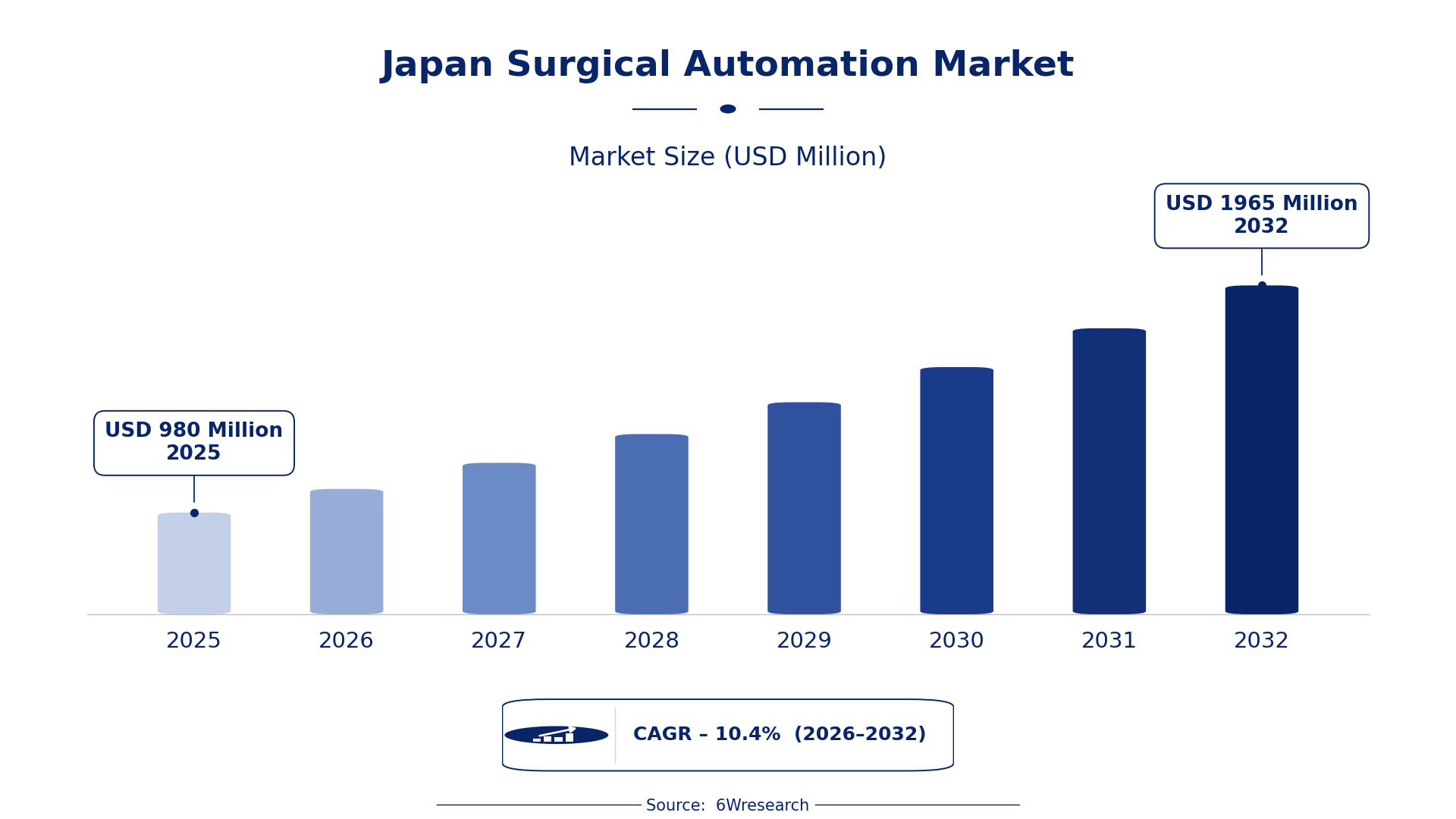
According to 6Wresearch internal database and industry insights, the Japan Surgical Automation Market was valued at USD 980 Million in 2025 and is projected to reach USD 1,965 Million by 2032, growing at a CAGR of approximately 10.4% during 2026–2032.
Japan Surgical Automation Market Highlights
| Report Metric | Details |
| Report Name | Japan Surgical Automation Market (2026-2032) |
| Market Size 2025 | USD 980 Million |
| Market Size 2032 | USD 1,965 Million |
| Absolute Growth 2025–2032 | USD 985 Million |
| CAGR 2026–2032 | 10.4% |
| Peak Annual Growth | 12.0% in 2026 |
| Forecast Period | 2026–2032 |
| Historical Data | 2022–2025 |
| Base Year | 2025 |
| Leading Automation Type, 2025 | Robotic Surgery Systems (45% share) |
| Leading Integration Level, 2025 | Full Automation (37% share) |
| Leading Surgical Specialty, 2025 | Urology (50% share) |
| Leading End User, 2025 | Multi-specialty Hospitals (48% share) |
| Fastest-Growing Automation Type | Semi-Automated Tools (14.6% CAGR) |
| Fastest-Growing Integration Level | Surgeon-Controlled (13.1% CAGR) |
| Fastest-Growing Surgical Specialty | Cardiology (13.6% CAGR) |
| Fastest-Growing End User | Advanced Surgical Centers (13.2% CAGR) |
| Growing Sector | Surgical automation |
| Key End Users | Multi-specialty hospitals, advanced surgical centers, research hospitals |
Japan Surgical Automation Market Year-wise Growth Rate and Key Drivers (2022–2032)
This graph illustrates the annual growth rates of the market from 2022 to 2032, highlighting a steady upward trajectory and projected market expansion over the forecast period.
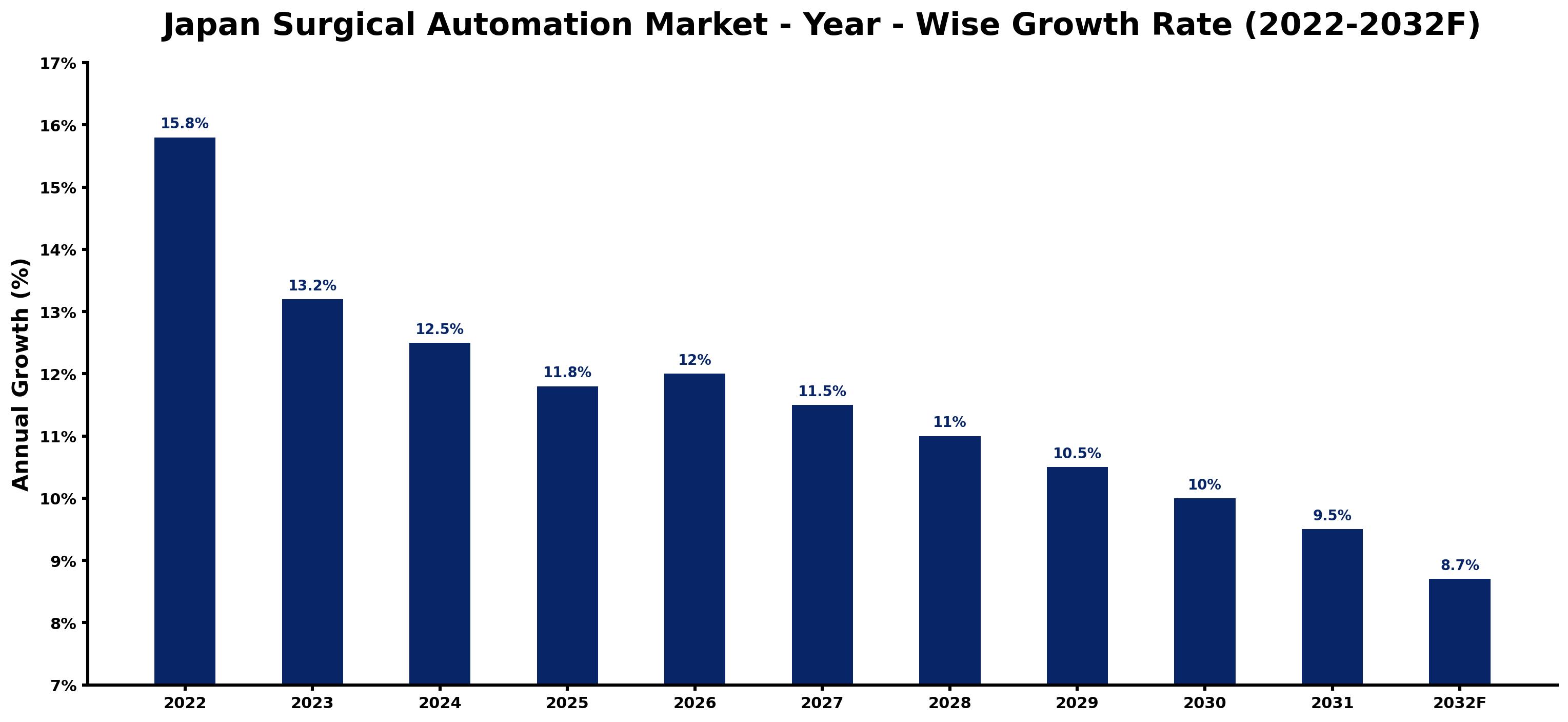
The table below sets out the estimated growth rate for each year and the main factor behind it.
| Year | Estimated Annual Growth (%) | Market Rationale |
| 2022 | 15.8 | The market experienced strong demand due to advancements in surgical technologies. |
| 2023 | 13.2 | Growth slowed as hospitals adjusted to new automation technologies and training. |
| 2024 | 12.5 | The market continued to expand, driven by increasing surgical procedures and automation adoption. |
| 2025 | 11.8 | Demand remained strong as multi-specialty hospitals invested in robotic systems. |
| 2026 | 12.0 | Growth is expected to accelerate with new AI-guided procedures being integrated into surgical practices. |
| 2027 | 11.5 | The market will grow steadily as hospitals focus on improving surgical precision. |
| 2028 | 11.0 | Demand is projected to slow as market saturation begins to affect growth rates. |
| 2029 | 10.5 | Growth is expected to continue to decelerate with fewer new installations of robotic systems. |
| 2030 | 10.0 | The market will maintain growth as hospitals seek to upgrade existing systems. |
| 2031 | 9.5 | Growth is projected to slow as competition among surgical automation providers intensifies. |
| 2032 | 8.7 | The market will continue to grow, supported by an increasing elderly population needing surgeries. |
Note: Market size estimations and growth projections presented in this report are based on 6Wresearch's proprietary forecasting methodology, utilizing the latest available industry data, government publications, and primary research inputs.
Japan Surgical Automation Market Synopsis
Surgical automation encompasses advanced technologies such as robotic surgery systems and AI-guided procedures that enhance surgical precision and efficiency. The Japan Surgical Automation Market is projected to expand, driven by the increasing number of surgeries performed annually, which totals approximately 10 million. Contributing factors include the growing elderly population requiring surgical interventions and the healthcare infrastructure that supports advanced surgical centres and multi-specialty hospitals.
Market Dynamics Impact Analysis (2026–2032)
| Factor | Type | Impact | Primary Segment Affected |
| Increasing number of surgeries performed annually drives demand for automation technologies. | Driver | High | Robotic Surgery Systems |
| The aging population necessitates more surgical interventions, boosting automation adoption. | Driver | High | Urology |
| Growing investment in advanced surgical technologies creates opportunities for suppliers. | Opportunity | High | Advanced Surgical Centers |
| The rising demand for minimally invasive procedures opens new markets for automation. | Opportunity | High | Multi-specialty Hospitals |
| High initial investment costs limit adoption in smaller facilities. | Restraint | Medium | Semi-Automated Tools |
| Training and integration challenges slow the adoption of new systems. | Restraint | Medium | AI-Guided Procedures |
| Competition among providers can lead to pricing pressures affecting margins. | Challenge | High | Robotic Surgery Systems |
| Rapid technological advancements require constant updates and investments. | Challenge | Medium | Workflow Automation |
Evaluation of Drivers in Japan Surgical Automation Market (2026–2032)
The following drivers explain most of the expected growth.
| Drivers | Primary Segment Affected | Why It Matters (Evidence) |
| Rising number of surgeries performed annually drives demand for robotic systems. | Robotic Surgery Systems | Approximately 10 million surgeries are performed annually, increasing the need for automation. |
| The aging population is increasing the demand for surgical interventions. | Urology | With a growing elderly demographic, over 30% of patients require urological surgeries, boosting automation. |
| Investment in advanced surgical technologies is expanding market opportunities. | Advanced Surgical Centers | Japan's healthcare system allocated ¥5 billion for surgical technology advancements in 2023. |
| Minimally invasive procedures are gaining popularity, driving automation adoption. | Multi-specialty Hospitals | The shift towards less invasive surgeries increases the demand for surgical automation technologies. |
| Increased focus on surgical precision is pushing hospitals to adopt robotic systems. | Cardiology | Cardiology departments are investing in automated systems for better patient outcomes. |
Much of the new demand traces back to the increasing number of surgeries performed in Japan, which totals around 10 million annually. This figure highlights the necessity for robotic surgery systems, as hospitals seek to improve surgical outcomes. The aging population, with a rising average age of surgical patients, further drives demand for automation in urology and other specialties. Investment in advanced surgical technologies is also notable, with healthcare facilities focusing on improving their capabilities. For instance, Japan's healthcare system allocated ¥5 billion in 2023 for surgical technology advancements, supporting the growth of advanced surgical centers and multi-specialty hospitals.
Evaluation of Restraints in Japan Surgical Automation Market
The following restraints limit how fast demand can grow.
| Market Restraint | Primary Segment Affected | Why It Matters (Evidence) |
| High initial investment costs limit adoption in smaller facilities. | Semi-Automated Tools | Smaller hospitals may struggle to afford the upfront costs of automation technologies. |
| Training and integration challenges slow the adoption of new systems. | AI-Guided Procedures | Healthcare providers face difficulties in training staff to effectively use new technologies. |
| Regulatory hurdles can delay the introduction of new surgical automation technologies. | Robotic Surgery Systems | Compliance with standards like ISO 13485 can prolong the approval process. |
| Limited awareness of benefits among some healthcare providers hampers growth. | Workflow Automation | Some facilities may not fully understand the advantages of automation, leading to hesitance. |
| Market saturation in urban areas can limit growth opportunities. | Advanced Surgical Centers | Many urban hospitals have already adopted automation, reducing potential new sales. |
Japan Surgical Automation Market Challenges
In advanced surgical centres, buyers face rising costs due to Japan's minimum wage increase to JPY 1,055 per hour in October 2024, which strains operational budgets. Hospitals encounter delays in procurement as surgical automation technology requires substantial upfront investments, compelling them to reallocate funds from other departments. The slow pace of regulatory approvals complicates the integration of new technologies, often extending timelines by several months for hospitals eager to adopt innovations. Suppliers contend with the complexities of ISO 13485 compliance, which raises costs and complicates market entry for their products.
Trends in the Japan Surgical Automation Market
The shifts below are changing how Japan Surgical Automation Market products are bought and supplied.
- Shift towards AI-Guided Procedures: Since 2023, hospitals have increasingly adopted AI-guided procedures, improving surgical decision-making. Approximately 150 advanced surgical centers in Japan are integrating these technologies, resulting in better patient outcomes.
- Transition from Traditional to Robotic Surgery: In 2022, the number of robotic surgery systems installed in Japan surpassed 300 units. This shift is clear in urology, where robotic systems are now standard in many procedures.
- Emergence of Workflow Automation: As of 2023, multi-specialty hospitals are prioritising workflow automation to manage operating room logistics. This trend is driven by the need for efficiency in surgical scheduling.
- Increased Focus on Minimally Invasive Surgeries: The trend towards minimally invasive surgeries has accelerated since 2022, with hospitals reporting a 20% decrease in average surgical procedure time using robotic systems.
Investment Opportunities in the Japan Surgical Automation Market
The opportunities below stand out in the Japan Surgical Automation Market for new entrants and existing suppliers.
- Investment gap in surgical automation technologies: With Japan's healthcare system targeting JPY 150 trillion in decarbonisation investment over ten years, there is a clear opportunity for suppliers of surgical automation technologies to address growing demands.
- Need for advanced surgical training programs: As hospitals improve their robotic surgery capabilities, there is an opportunity to develop training programs. The Tokyo Metropolitan area serves as a hub for advanced surgical technology development.
- Rising demand for minimally invasive surgical solutions: With annual surgeries in Japan reaching approximately 10 million, suppliers can focus on providing advanced robotic systems to multi-specialty hospitals to meet this demand.
- Emerging markets in rural healthcare facilities: As urban hospitals become saturated, rural facilities are increasingly seeking surgical automation. Investing in partnerships with local healthcare providers can facilitate market entry.
Government Initiatives in the Japan Surgical Automation Market
The New Robot Strategy, established in 2015, aims to expand robot use across various sectors, including healthcare. This strategy encourages hospitals to adopt robotic systems, improving surgical precision and efficiency. Additionally, the AI Promotion Act, set to take effect in 2025, will establish a national framework for AI integration in healthcare, further promoting automation adoption in surgical settings.
In 2023, ¥5 billion was allocated for surgical technology advancements, supporting the development and integration of automation systems in hospitals. The Japanese Society of Robotic Surgery oversees standards for robotic surgical systems, ensuring quality and safety in their use. This oversight helps hospitals maintain compliance with regulations, encouraging the adoption of advanced surgical technologies.
Future Insight of the Japan Surgical Automation Market
Japan's JPY 150 trillion investment in decarbonisation will create substantial demand for surgical automation technologies, benefiting suppliers. By 2032, the government aims to increase AI adoption in healthcare by 30%, which will improve surgical precision and efficiency. New training programs for robotic surgery will enhance the skills of medical staff, improving patient outcomes. With over 300 robotic surgery systems installed, the integration of these technologies is expected to further streamline procedures and reduce average surgical times.
Market Segmentation Analysis
Japan Surgical Automation Market report covers a detailed analysis of the following market segments:
By Automation Type – Robotic Surgery Systems Lead, Semi-Automated Tools Expected to Grow Fastest
According to Saurav Kr Singh, Senior Research Analyst at 6Wresearch, with 45% of automation type revenue in 2025, Robotic Surgery Systems was the largest category. Robotic surgery systems dominate the market because they are extensively used for precision in complex surgeries, particularly in advanced surgical centres. With over 300 units installed by 2022, these systems have become essential in enhancing surgical outcomes. Over 2026–2032, Semi-Automated Tools are expected to post the fastest growth, at a CAGR of 14.6%. Semi-automated tools are gaining popularity as they assist surgeons in various procedures, responding to the growing demand for efficiency in surgical practices. The Japanese government's significant investment in surgical technology advancements is expected to further accelerate their adoption. Suppliers should focus on developing semi-automated tools to meet the increasing demand in surgical environments.
By Integration Level – Full Automation Leads, Surgeon-Controlled Expected to Grow Fastest
Full Automation took 37% of integration level revenue in 2025, more than any other category. Full automation leads the market as it represents the highest level of surgical technology, although adoption is not yet universal across all surgical settings. The push from surgical associations to integrate robotic systems into training indicates a strong future direction towards achieving full automation. Surgeon-Controlled is set to record the highest CAGR in this split, 13.1% over 2026–2032. Surgeon-controlled systems are experiencing rapid growth as they allow surgeons to operate directly during procedures, enhancing control and precision. The annual estimate of approximately 10 million surgeries performed highlights the increasing demand for such systems. Buyers should invest in surgeon-controlled systems to improve surgical outcomes and operational efficiency.
By Surgical Specialty – Urology Leads, Cardiology Expected to Grow Fastest
In 2025, Urology led the surgical specialty split with a 50% share. Urology is the leading specialty due to its significant use of robotic systems in urological surgeries, which are increasingly prevalent among Japan's ageing population. The rising average age of surgical patients further drives the demand for advanced techniques in this specialty. The quickest growth will come from Cardiology, forecast to expand at a CAGR of 13.6% between 2026 and 2032. Cardiology is the fastest-growing specialty as hospitals increasingly invest in automated systems for improved outcomes in cardiac procedures. This focus on precision in surgeries accelerates the adoption of robotic systems in cardiology. Suppliers should target cardiology departments to capitalise on the growing trend of automation in surgical practices.
By End User – Multi-specialty Hospitals Lead, Advanced Surgical Centers Expected to Grow Fastest
Multi-specialty Hospitals held 48% of the Japan Surgical Automation Market by end user in 2025. Multi-specialty hospitals are the primary users of surgical automation, employing these technologies across various surgical disciplines to improve patient care. With over 1,000 multi-specialty hospitals in Japan, their demand for advanced surgical solutions is substantial. Advanced Surgical Centers are projected to grow fastest, at a CAGR of 13.2% during 2026–2032. Advanced surgical centers are experiencing the fastest growth as they focus on implementing sophisticated surgical techniques and technologies. Their commitment to cutting-edge advancements significantly accelerates the adoption of surgical automation. Suppliers must prioritise advanced surgical centers to align with the trend towards adopting sophisticated surgical technologies.
Key Attractiveness of the Report
- 10 Years of Market Numbers
- Historical Data Starting from 2022 to 2025
- Base Year 2025
- Forecast Data until 2032
- Key Performance Indicators Impacting the Market
- Major Upcoming Developments and Projects
Key Highlights of the Report:
- Japan Surgical Automation Market Outlook
- Market Size of Japan Surgical Automation Market, 2025
- Forecast of Japan Surgical Automation Market, 2032
- Historical Data and Forecast of Japan Surgical Automation Revenues & Volume for the Period 2022-2032F
- Japan Surgical Automation Market Trend Evolution
- Japan Surgical Automation Market Drivers and Challenges
- Japan Surgical Automation Price Trends
- Japan Surgical Automation Porter's Five Forces
- Japan Surgical Automation Industry Life Cycle
- Historical Data and Forecast of Japan Surgical Automation Market Revenues & Volume By Automation Type for the Period 2022-2032F
- Historical Data and Forecast of Japan Surgical Automation Market Revenues & Volume By Robotic Surgery Systems for the Period 2022-2032F
- Historical Data and Forecast of Japan Surgical Automation Market Revenues & Volume By Semi-Automated Tools for the Period 2022-2032F
- Historical Data and Forecast of Japan Surgical Automation Market Revenues & Volume By AI-Guided Procedures for the Period 2022-2032F
- Historical Data and Forecast of Japan Surgical Automation Market Revenues & Volume By Workflow Automation for the Period 2022-2032F
- Historical Data and Forecast of Japan Surgical Automation Market Revenues & Volume By Integration Level for the Period 2022-2032F
- Historical Data and Forecast of Japan Surgical Automation Market Revenues & Volume By Full Automation for the Period 2022-2032F
- Historical Data and Forecast of Japan Surgical Automation Market Revenues & Volume By Surgeon-Controlled for the Period 2022-2032F
- Historical Data and Forecast of Japan Surgical Automation Market Revenues & Volume By Decision Support for the Period 2022-2032F
- Historical Data and Forecast of Japan Surgical Automation Market Revenues & Volume By OR Scheduling for the Period 2022-2032F
- Historical Data and Forecast of Japan Surgical Automation Market Revenues & Volume By Surgical Specialty for the Period 2022-2032F
- Historical Data and Forecast of Japan Surgical Automation Market Revenues & Volume By Urology, Cardiology for the Period 2022-2032F
- Historical Data and Forecast of Japan Surgical Automation Market Revenues & Volume By Orthopedics for the Period 2022-2032F
- Historical Data and Forecast of Japan Surgical Automation Market Revenues & Volume By Oncology for the Period 2022-2032F
- Historical Data and Forecast of Japan Surgical Automation Market Revenues & Volume By Multi-Disciplinary for the Period 2022-2032F
- Historical Data and Forecast of Japan Surgical Automation Market Revenues & Volume By End User for the Period 2022-2032F
- Historical Data and Forecast of Japan Surgical Automation Market Revenues & Volume By Multi-specialty Hospitals for the Period 2022-2032F
- Historical Data and Forecast of Japan Surgical Automation Market Revenues & Volume By Advanced Surgical Centers for the Period 2022-2032F
- Historical Data and Forecast of Japan Surgical Automation Market Revenues & Volume By Research Hospitals for the Period 2022-2032F
- Historical Data and Forecast of Japan Surgical Automation Market Revenues & Volume By Hospital Administrators for the Period 2022-2032F
- Japan Surgical Automation Import Export Trade Statistics
- Market Opportunity Assessment By Automation Type
- Market Opportunity Assessment By Integration Level
- Market Opportunity Assessment By Surgical Specialty
- Market Opportunity Assessment By End User
- Japan Surgical Automation Top Companies Market Share
- Japan Surgical Automation Competitive Benchmarking By Technical and Operational Parameters
- Japan Surgical Automation Company Profiles
- Japan Surgical Automation Key Strategic Recommendations
Market Covered
This report examines the market across the segments below.
By Automation Type
- Robotic Surgery Systems
- Semi-Automated Tools
- AI-Guided Procedures
- Workflow Automation
By Integration Level
- Full Automation
- Surgeon-Controlled
- Decision Support
- OR Scheduling
By Surgical Specialty
- Urology
- Cardiology
- Orthopedics
- Oncology
- Multi-Disciplinary
By End User
- Multi-specialty Hospitals
- Advanced Surgical Centers
- Research Hospitals
- Hospital Administrators































