Japan Surgical Oncology Market Size & Growth Rate
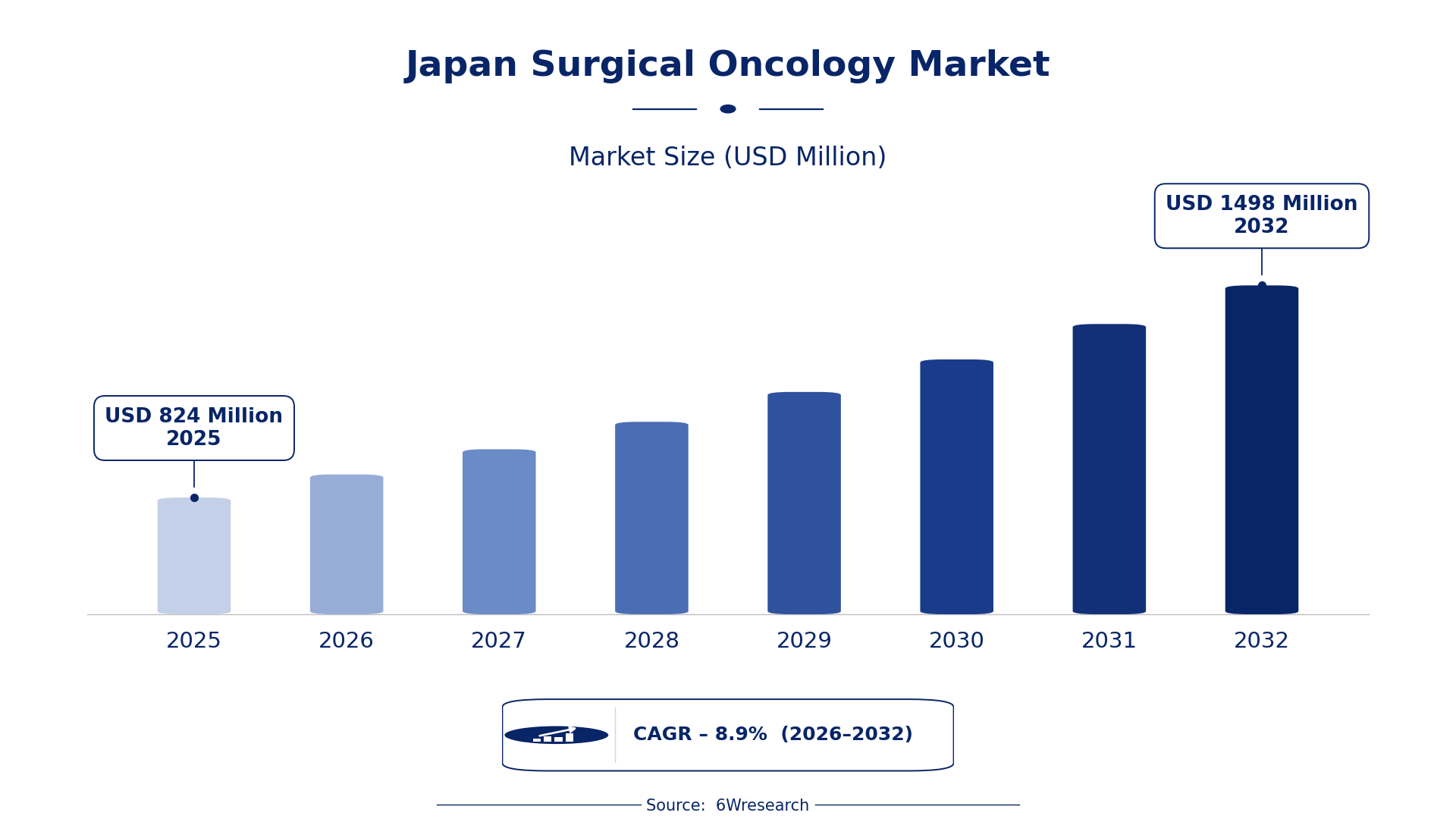
According to 6Wresearch internal database and industry insights, the Japan Surgical Oncology Market was valued at USD 824 Million in 2025 and is projected to reach USD 1,498 Million by 2032, growing at a CAGR of approximately 8.9% during 2026–2032.
Japan Surgical Oncology Market Highlights
| Report Metric | Details |
| Report Name | Japan Surgical Oncology Market (2026-2032) |
| Market Size 2025 | USD 824 Million |
| Market Size 2032 | USD 1,498 Million |
| Absolute Growth 2025–2032 | USD 674 Million |
| CAGR 2026–2032 | 8.9% |
| Peak Annual Growth | 9.5% in 2028 |
| Forecast Period | 2026–2032 |
| Historical Data | 2022–2025 |
| Base Year | 2025 |
| Leading Cancer Type, 2025 | Breast Cancer (39% share) |
| Leading Surgical Procedure, 2025 | Lumpectomy/Mastectomy (45% share) |
| Leading Approach, 2025 | Open/Laparoscopic (47% share) |
| Leading End User, 2025 | Oncology Hospitals (47% share) |
| Fastest-Growing Cancer Type | GI Cancer (12.6% CAGR) |
| Fastest-Growing Surgical Procedure | Colectomy/Gastrectomy (11.9% CAGR) |
| Fastest-Growing Approach | Robotic Assisted (12.3% CAGR) |
| Fastest-Growing End User | Surgical Oncology Centers (11.4% CAGR) |
| Growing Sector | Surgical oncology |
| Key End Users | Oncology hospitals, surgical oncology centers, cancer treatment facilities |
Japan Surgical Oncology Market Year-wise Growth Rate and Key Drivers (2022–2032)
This graph illustrates the annual growth rates of the market from 2022 to 2032, highlighting a steady upward trajectory and projected market expansion over the forecast period.
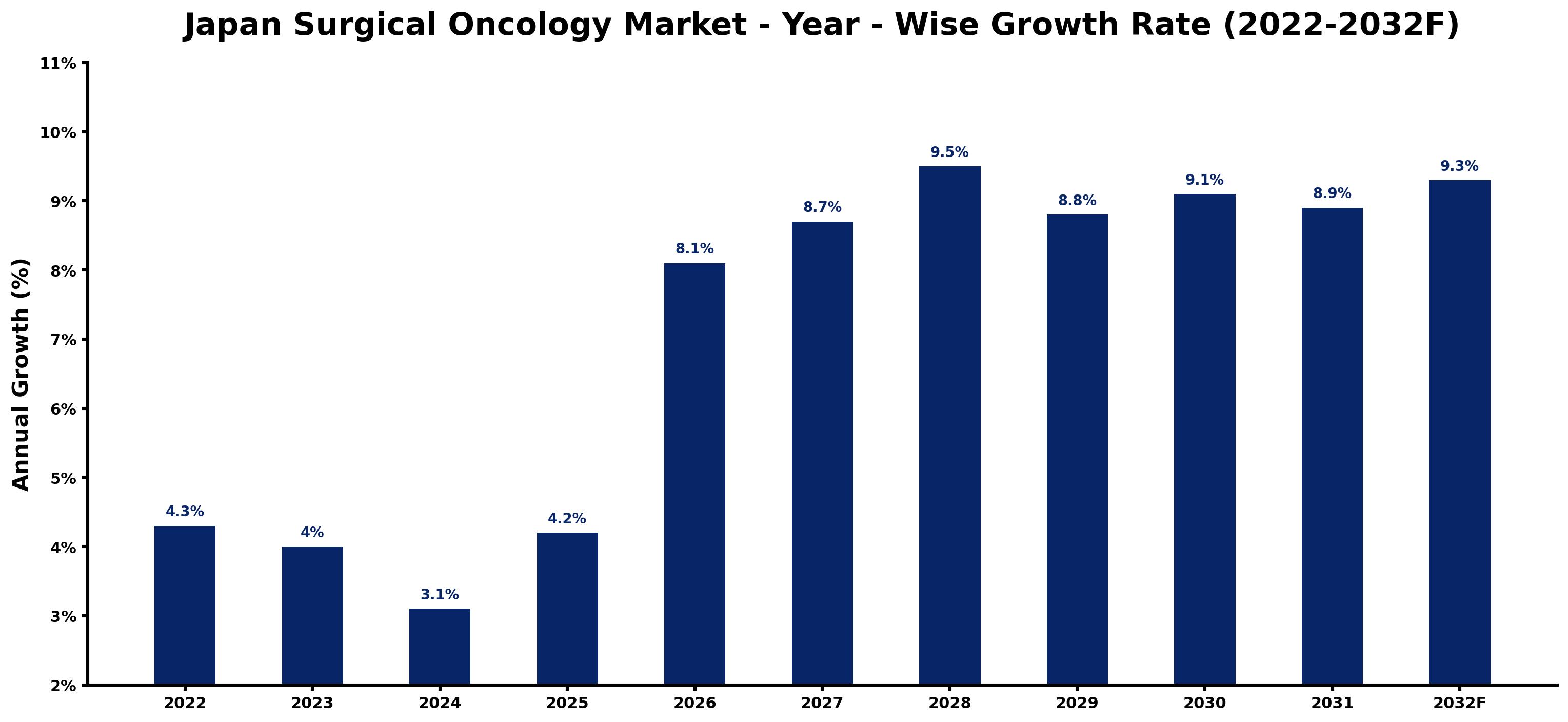
The following figures match every annual growth estimate with the main market development of that year, giving the reasoning behind each rise or slowdown.
| Year | Estimated Annual Growth (%) | Market Rationale |
| 2022 | 4.3 | The market experienced steady growth with a focus on surgical interventions for cancer treatment. |
| 2023 | 4.0 | Demand for surgical oncology procedures continued, but growth slowed due to market saturation. |
| 2024 | 3.1 | A decrease in growth was observed as competition intensified among healthcare providers. |
| 2025 | 4.2 | Increased investments in surgical technologies led to a faster growth rate in this year. |
| 2026 | 8.1 | A surge in cancer cases is expected to prompt higher demand for surgical oncology services and procedures. |
| 2027 | 8.7 | Investment in advanced surgical techniques will contribute to a continued rise in market growth. |
| 2028 | 9.5 | The peak growth rate is projected as new surgical technologies gain widespread adoption. |
| 2029 | 8.8 | Growth is expected to slow slightly as the market begins to stabilise after rapid expansion. |
| 2030 | 9.1 | Continued advancements in surgical methods will support a rebound in growth rates this year. |
| 2031 | 8.9 | The market is projected to experience a slight slowdown as it approaches a more mature phase. |
| 2032 | 9.3 | Growth is expected to accelerate again due to increased focus on early cancer detection and treatment. |
Note: Market size estimations and growth projections presented in this report are based on 6Wresearch's proprietary forecasting methodology, utilizing the latest available industry data, government publications, and primary research inputs.
Japan Surgical Oncology Market Synopsis
Surgical oncology is a specialised field focused on the surgical treatment of cancer, employing various techniques to remove tumours and affected tissues. In 2023, Japan reported over 1 million new cancer cases annually, driving demand for surgical procedures, which account for approximately 30% of cancer treatments. Factors such as the high incidence of breast cancer, with a 20% rate among women, and the concentration of oncology hospitals in the Tokyo region contribute to the growth of the Japan Surgical Oncology Market.
Market Dynamics Impact Analysis (2026–2032)
| Factor | Type | Impact | Primary Segment Affected |
| Rising cancer incidence rates drive the need for surgical interventions. | Driver | High | Breast Cancer |
| Investment in advanced surgical technologies enhances treatment options. | Driver | High | Breast Cancer |
| Growing demand for specialized surgical oncology centers presents opportunities for investment. | Opportunity | High | Surgical Oncology Centers |
| Expansion of robotic-assisted surgical systems opens new avenues for suppliers. | Opportunity | Medium | Breast Cancer |
| High operational costs in oncology hospitals limit profit margins. | Restraint | High | Oncology Hospitals |
| Limited availability of trained surgical oncology specialists constrains service delivery. | Restraint | Medium | Breast Cancer |
| High costs of advanced surgical equipment hinder adoption rates. | Challenge | High | Breast Cancer |
| Regulatory compliance requirements can delay the introduction of new technologies. | Challenge | Medium | Breast Cancer |
Evaluation of Drivers in Japan Surgical Oncology Market (2026–2032)
Below are the drivers that matter most for revenue growth, with supporting evidence.
| Drivers | Primary Segment Affected | Why It Matters (Evidence) |
| Increasing cancer cases necessitate more surgical procedures. | Breast Cancer | In 2023, Japan reported over 1 million new cancer cases, driving demand for surgical interventions. |
| Investment in surgical technologies improves treatment effectiveness. | Breast Cancer | The Japanese government allocated ¥10 billion for cancer research in 2023, promoting advanced surgical methods. |
| Growing healthcare expenditure supports surgical oncology advancements. | Breast Cancer | Healthcare spending in Japan is projected to reach USD 500 billion by 2025, boosting oncology services. |
| Rising awareness of early cancer detection increases surgical demand. | Breast Cancer | Awareness campaigns promote early detection strategies, leading to more patients seeking surgical options. |
| Technological advancements in minimally invasive surgery improve patient outcomes. | Minimally Invasive | Surgical oncology facilities have seen a 15% increase in endoscopic procedures over the last five years. |
Spending rises as the increasing incidence of cancer in Japan necessitates more surgical interventions, with over 1 million new cases reported in 2023. Investment in advanced surgical technologies, supported by a ¥10 billion allocation for cancer research, improves treatment effectiveness. Rising healthcare expenditure, projected to reach USD 500 billion by 2025, further supports oncology services. Awareness campaigns promote early detection strategies, leading to a higher demand for surgical options. Technological advancements in surgical methods have resulted in a 15% increase in endoscopic procedures over the past five years, improving patient recovery experiences.
Evaluation of Restraints in Japan Surgical Oncology Market
These are the pressures that could keep growth below its potential.
| Market Restraint | Primary Segment Affected | Why It Matters (Evidence) |
| High operational costs in oncology hospitals limit profit margins. | Oncology Hospitals | In 2023, oncology hospitals faced rising operational costs, impacting their financial sustainability. |
| Limited availability of trained surgical oncology specialists constrains service delivery. | Prostatectomy | The average patient age for prostatectomy procedures is around 70 years, increasing demand for experienced specialists. |
| High costs of advanced surgical equipment hinder adoption rates. | Breast Cancer | Advanced robotic-assisted surgical systems are expensive, limiting their widespread use in facilities. |
| Regulatory compliance requirements can delay the introduction of new technologies. | Breast Cancer | Stringent regulations from the Japan Ministry of Health, Labour and Welfare slow the approval process. |
| Competition among healthcare providers can reduce profit margins. | Oncology Hospitals | With 500 accredited oncology hospitals in Japan, competition for patients is intense. |
Japan Surgical Oncology Market Challenges
In Japan, surgical oncology training programs produce insufficient skilled surgeons, leading to patient wait times exceeding acceptable limits. Hospitals in the Tokyo region face intense competition, with resource allocation issues inflating operational costs by 20% for providers. Smaller facilities often lack the capital to invest in advanced surgical technologies, delaying critical innovations that could improve patient outcomes. Regulatory compliance from the Japanese Society of Surgical Oncology adds administrative burdens, diverting resources from patient care and extending treatment timelines for hospitals.
Trends in the Japan Surgical Oncology Market
Buyers and suppliers in the Japan Surgical Oncology Market are adjusting to the following trends.
- Shift towards Minimally Invasive Techniques: A notable shift towards minimally invasive surgical techniques is occurring in Japan, evidenced by a 15% increase in endoscopic procedures as facilities adopt these methods for better patient outcomes.
- Emergence of Robotic-Assisted Surgery: Robotic-assisted surgery has gained traction since 2022, with a projected growth rate of 12.3% for this approach. Surgical oncology centres are increasingly investing in robotic systems to improve precision and reduce recovery times.
- Increased Focus on Early Cancer Detection: The launch of the cancer control program in 2023 has heightened awareness of early detection. This initiative is expected to lead to a rise in surgical oncology procedures as more patients seek timely treatment.
- Expansion of Surgical Oncology Centers: The number of specialised surgical oncology centres has grown, responding to the rising demand for cancer treatments. In 2023, over 200,000 surgical oncology procedures were performed, indicating a strong market for these facilities.
Investment Opportunities in the Japan Surgical Oncology Market
Investors looking at the Japan Surgical Oncology Market should consider the following areas.
- Partnerships with Surgical Oncology Centers: Investing in partnerships with surgical oncology centres can yield strong returns, as the market for surgical procedures is expanding. With over 200,000 procedures performed in 2023, there is a clear demand for collaboration.
- Investment in Robotic-Assisted Surgical Systems: The market gap for robotic-assisted systems presents a promising opportunity. With a projected growth rate of 12.3% for robotic-assisted surgeries, suppliers can enter through partnerships with surgical centres.
- Expansion in the Tokyo Region: The Tokyo region, with the highest concentration of oncology hospitals, offers a prime opportunity for investment. The region's healthcare expenditure is expected to rise, creating demand for advanced surgical solutions.
- Development of Training Programs for Specialists: Creating training programs for surgical oncology specialists can address the skills gap in the market. With the average patient age for procedures around 70, there is a growing need for trained professionals.
Government Initiatives in the Japan Surgical Oncology Market
The policy framework for surgical oncology is influenced by laws such as the Cancer Control Act (2007) and the Health Promotion Act (2002), which mandate the establishment of standards for cancer treatment and early detection. These regulations ensure that surgical oncology practices adhere to high standards, promoting patient safety and treatment efficacy.
The Japan Ministry of Health, Labour and Welfare oversees the approval of surgical oncology practices and funds cancer research initiatives. In 2023, the ministry allocated ¥10 billion for cancer research, supporting the development of advanced surgical techniques and ensuring compliance with national health standards.
Future Insight of the Japan Surgical Oncology Market
A policy-driven shift towards early diagnosis and treatment will prompt hospitals to enhance surgical oncology capabilities. By 2032, the allocation of ¥10 billion for cancer research will drive advancements in surgical techniques, benefiting both buyers and suppliers. Increased adoption of robotic-assisted systems will streamline surgical procedures, improving patient recovery experiences. Expansion of training programs will ensure a steady influx of qualified surgeons, addressing workforce needs in the evolving healthcare environment.
Market Segmentation Analysis
Japan Surgical Oncology Market report covers a detailed analysis of the following market segments:
By Cancer Type – Breast Cancer Leads, GI Cancer Expected to Grow Fastest
According to Saurav Kr Singh, Senior Research Analyst at 6Wresearch, the largest cancer type category in 2025 was Breast Cancer, at 39% of revenue. Breast cancer holds the largest share due to its status as the most common cancer among women in Japan, requiring numerous surgical interventions. With a 20% incidence rate, hospitals are consistently engaged in providing surgical oncology services for this prevalent condition. Over 2026–2032, GI Cancer is expected to post the fastest growth, at a CAGR of 12.6%. GI cancer is experiencing rapid growth as the demand for surgical procedures increases, correlating with a rise in gastrointestinal disorders. The significant number of colectomy and gastrectomy surgeries performed highlights the urgent need for enhanced surgical oncology capabilities. Suppliers should focus on developing solutions specifically for GI cancer treatments to effectively cater to the growing market.
By Surgical Procedure – Lumpectomy/Mastectomy Leads, Colectomy/Gastrectomy Expected to Grow Fastest
Lumpectomy/Mastectomy accounted for 45% of the market by surgical procedure in 2025. Lumpectomy and mastectomy are the leading procedures as they are essential surgical practices for breast cancer, ensuring steady demand in oncology hospitals. Their established role in treatment protocols reinforces their prominence in surgical oncology practices across the country. Colectomy/Gastrectomy is set to record the highest CAGR in this split, 11.9% over 2026–2032. Colectomy and gastrectomy are seeing the fastest growth as they are critical for treating GI cancer, driven by the increasing incidence of gastrointestinal conditions. This trend indicates a shift towards prioritising these vital surgeries within clinical settings. Buyers may need to invest in advanced surgical technologies to adequately address the rising demand for GI cancer surgeries.
By Approach – Open/Laparoscopic Leads, Robotic Assisted Expected to Grow Fastest
Open/Laparoscopic held 47% of the Japan Surgical Oncology Market by approach in 2025. Open and laparoscopic approaches dominate the market as they are the most commonly used surgical techniques in oncology procedures. Their established effectiveness in various surgeries contributes to their widespread adoption in Japan's healthcare system. Robotic Assisted is projected to grow fastest, at a CAGR of 12.3% during 2026–2032. Robotic-assisted surgeries are growing rapidly as an emerging technology in surgical oncology, offering precision and improved outcomes. This trend indicates a shift towards more advanced surgical techniques in the treatment of cancer. Suppliers should consider expanding robotic-assisted surgical options to align with the market's technological advancements.
By End User – Oncology Hospitals Lead, Surgical Oncology Centers Expected to Grow Fastest
With 47% of end user revenue in 2025, Oncology Hospitals was the largest category. Oncology hospitals are the primary facilities for surgical oncology, handling a substantial volume of procedures in response to Japan's high cancer incidence. Their established infrastructure and specialised expertise make them the preferred choice for surgical interventions in the country. The quickest growth will come from Surgical Oncology Centers, forecast to expand at a CAGR of 11.4% between 2026 and 2032. Surgical oncology centers are experiencing the fastest growth as they focus on cancer surgeries, meeting the increasing patient demand for targeted surgical care. This trend signifies a shift towards dedicated facilities for effective cancer treatment. Suppliers should concentrate on surgical oncology centers to capitalise on their rapid growth and specialised service offerings.
Key Attractiveness of the Report
- 10 Years of Market Numbers
- Historical Data Starting from 2022 to 2025
- Base Year 2025
- Forecast Data until 2032
- Key Performance Indicators Impacting the Market
- Major Upcoming Developments and Projects
Key Highlights of the Report:
- Japan Surgical Oncology Market Outlook
- Market Size of Japan Surgical Oncology Market, 2025
- Forecast of Japan Surgical Oncology Market, 2032
- Historical Data and Forecast of Japan Surgical Oncology Revenues & Volume for the Period 2022-2032F
- Japan Surgical Oncology Market Trend Evolution
- Japan Surgical Oncology Market Drivers and Challenges
- Japan Surgical Oncology Price Trends
- Japan Surgical Oncology Porter's Five Forces
- Japan Surgical Oncology Industry Life Cycle
- Historical Data and Forecast of Japan Surgical Oncology Market Revenues & Volume By Cancer Type for the Period 2022-2032F
- Historical Data and Forecast of Japan Surgical Oncology Market Revenues & Volume By Breast Cancer for the Period 2022-2032F
- Historical Data and Forecast of Japan Surgical Oncology Market Revenues & Volume By GI Cancer for the Period 2022-2032F
- Historical Data and Forecast of Japan Surgical Oncology Market Revenues & Volume By Head & Neck Cancer for the Period 2022-2032F
- Historical Data and Forecast of Japan Surgical Oncology Market Revenues & Volume By Urological Cancer for the Period 2022-2032F
- Historical Data and Forecast of Japan Surgical Oncology Market Revenues & Volume By Surgical Procedure for the Period 2022-2032F
- Historical Data and Forecast of Japan Surgical Oncology Market Revenues & Volume By Lumpectomy/Mastectomy for the Period 2022-2032F
- Historical Data and Forecast of Japan Surgical Oncology Market Revenues & Volume By Colectomy/Gastrectomy for the Period 2022-2032F
- Historical Data and Forecast of Japan Surgical Oncology Market Revenues & Volume By Tumor Resection for the Period 2022-2032F
- Historical Data and Forecast of Japan Surgical Oncology Market Revenues & Volume By Prostatectomy for the Period 2022-2032F
- Historical Data and Forecast of Japan Surgical Oncology Market Revenues & Volume By Approach for the Period 2022-2032F
- Historical Data and Forecast of Japan Surgical Oncology Market Revenues & Volume By Open/Laparoscopic for the Period 2022-2032F
- Historical Data and Forecast of Japan Surgical Oncology Market Revenues & Volume By Robotic Assisted for the Period 2022-2032F
- Historical Data and Forecast of Japan Surgical Oncology Market Revenues & Volume By Endoscopic for the Period 2022-2032F
- Historical Data and Forecast of Japan Surgical Oncology Market Revenues & Volume By Minimally Invasive for the Period 2022-2032F
- Historical Data and Forecast of Japan Surgical Oncology Market Revenues & Volume By End User for the Period 2022-2032F
- Historical Data and Forecast of Japan Surgical Oncology Market Revenues & Volume By Oncology Hospitals for the Period 2022-2032F
- Historical Data and Forecast of Japan Surgical Oncology Market Revenues & Volume By Surgical Oncology Centers for the Period 2022-2032F
- Historical Data and Forecast of Japan Surgical Oncology Market Revenues & Volume By ENT Surgical Departments for the Period 2022-2032F
- Historical Data and Forecast of Japan Surgical Oncology Market Revenues & Volume By Cancer Treatment Facilities for the Period 2022-2032F
- Japan Surgical Oncology Import Export Trade Statistics
- Market Opportunity Assessment By Cancer Type
- Market Opportunity Assessment By Surgical Procedure
- Market Opportunity Assessment By Approach
- Market Opportunity Assessment By End User
- Japan Surgical Oncology Top Companies Market Share
- Japan Surgical Oncology Competitive Benchmarking By Technical and Operational Parameters
- Japan Surgical Oncology Company Profiles
- Japan Surgical Oncology Key Strategic Recommendations
Market Covered
The study includes the following segmentation.
By Cancer Type
- Breast Cancer
- GI Cancer
- Head & Neck Cancer
- Urological Cancer
By Surgical Procedure
- Lumpectomy/Mastectomy
- Colectomy/Gastrectomy
- Tumor Resection
- Prostatectomy
By Approach
- Open/Laparoscopic
- Robotic Assisted
- Endoscopic
- Minimally Invasive
By End User
- Oncology Hospitals
- Surgical Oncology Centers
- ENT Surgical Departments
- Cancer Treatment Facilities































