Japan Surgical Workflow Software Market Size & Growth Rate
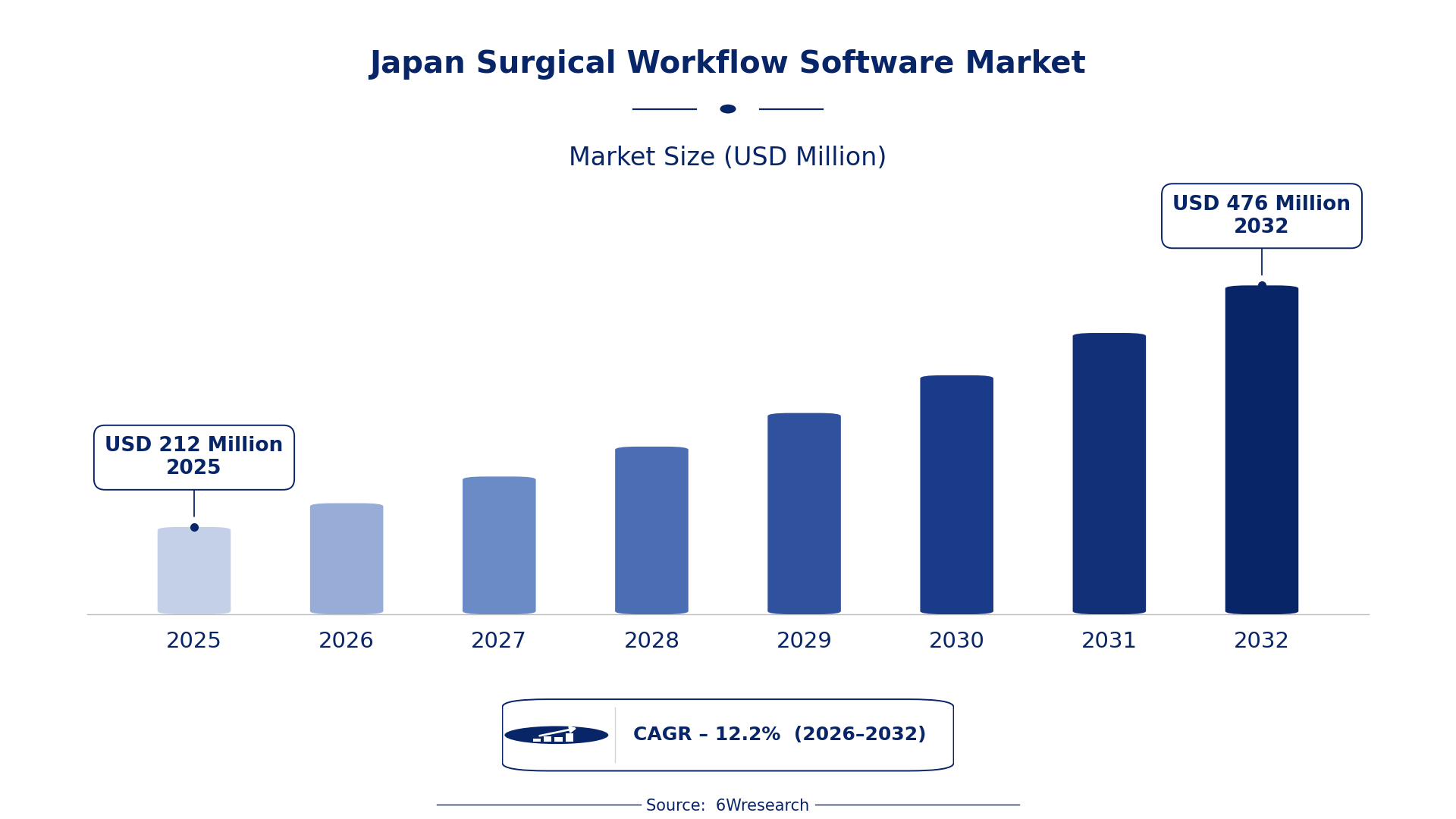
According to 6Wresearch internal database and industry insights, the Japan Surgical Workflow Software Market was valued at USD 212 Million in 2025 and is projected to reach USD 476 Million by 2032, growing at a CAGR of approximately 12.2% during 2026–2032.
Japan Surgical Workflow Software Market Highlights
| Report Metric | Details |
| Report Name | Japan Surgical Workflow Software Market (2026-2032) |
| Market Size 2025 | USD 212 Million |
| Market Size 2032 | USD 476 Million |
| Absolute Growth 2025–2032 | USD 264 Million |
| CAGR 2026–2032 | 12.2% |
| Peak Annual Growth | 13.8% in 2027 |
| Forecast Period | 2026–2032 |
| Historical Data | 2022–2025 |
| Base Year | 2025 |
| Leading Software Type, 2025 | OR Scheduling Software (34% share) |
| Leading Core Function, 2025 | Case Management (45% share) |
| Leading Deployment Model, 2025 | Cloud/On-prem (41% share) |
| Leading End User, 2025 | Hospital Admins (41% share) |
| Fastest-Growing Software Type | Instrument Tracking (17.4% CAGR) |
| Fastest-Growing Core Function | Asset Management (15.3% CAGR) |
| Fastest-Growing Deployment Model | Barcode/RFID (17.9% CAGR) |
| Fastest-Growing End User | Sterile Processing Units (15.2% CAGR) |
| Growing Sector | surgical management |
| Key End Users | hospitals, healthcare facilities, surgical teams, hospital administrators |
Japan Surgical Workflow Software Market Year-wise Growth Rate and Key Drivers (2022–2032)
This graph illustrates the annual growth rates of the market from 2022 to 2032, highlighting a steady upward trajectory and projected market expansion over the forecast period.
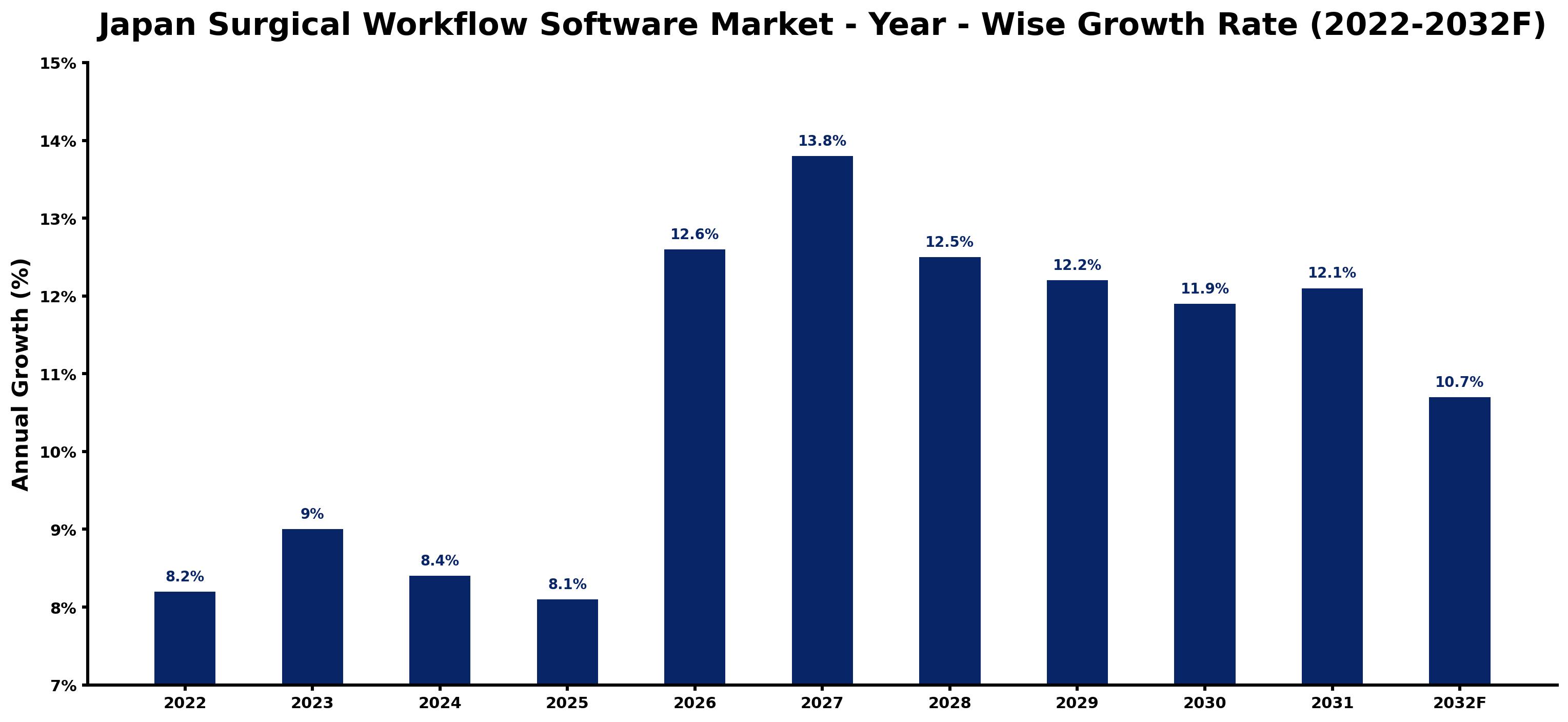
For each year, the table pairs the estimated growth rate with the leading influence on demand, showing how the drivers changed across the period.
| Year | Estimated Annual Growth (%) | Market Rationale |
| 2022 | 8.2 | The market experienced steady growth, driven by increased hospital investments in digital solutions. |
| 2023 | 9.0 | Demand surged as hospitals adopted advanced surgical management tools to improve efficiency. |
| 2024 | 8.4 | Growth slowed slightly as hospitals adjusted to new software implementations and training. |
| 2025 | 8.1 | The market continued to grow, although at a slower pace due to market saturation. |
| 2026 | 12.6 | A rise in demand is expected as hospitals expand their digital health capabilities. |
| 2027 | 13.8 | Growth is projected to peak as the adoption of surgical navigation systems surges in urban hospitals. |
| 2028 | 12.5 | The market is expected to experience a slight slowdown as competition intensifies among software providers. |
| 2029 | 12.2 | Demand will remain strong, though growth rates are projected to moderate as the market matures. |
| 2030 | 11.9 | Growth is anticipated to slow further as hospitals focus on optimising existing software systems. |
| 2031 | 12.1 | A rebound in growth is expected as hospitals renew their focus on surgical efficiency. |
| 2032 | 10.7 | The market is projected to stabilise with consistent demand for advanced surgical workflow solutions. |
Note: Market size estimations and growth projections presented in this report are based on 6Wresearch's proprietary forecasting methodology, utilizing the latest available industry data, government publications, and primary research inputs.
Japan Surgical Workflow Software Market Synopsis
Surgical Workflow Software is a technology that streamlines surgical processes in healthcare facilities, improving operational efficiency and patient safety. The Japan Surgical Workflow Software Market is growing as over 8,000 hospitals adopt advanced management tools. Key growth drivers include the Ministry of Health, Labour and Welfare's push for digital health initiatives and a target for 80% of hospitals to adopt digital solutions by 2025. The increasing focus on surgical data analytics further boosts market demand, reflecting a shift towards digital transformation in the surgical industry.
Market Dynamics Impact Analysis (2026–2032)
| Factor | Type | Impact | Primary Segment Affected |
| Increased hospital investments in digital health solutions | Driver | High | Surgical Navigation |
| Growing demand for data analytics tools to improve surgical outcomes | Driver | High | Data Analytics Tools |
| Rising need for efficient surgical scheduling in urban hospitals | Opportunity | High | OR Scheduling Software |
| Expansion of SaaS models due to their cost-effectiveness | Opportunity | Medium | Cloud/On-prem |
| High costs associated with software implementation and training | Restraint | High | Instrument Tracking |
| Limited integration capabilities with existing hospital systems | Restraint | Medium | Workflow Optimization |
| Compliance with evolving digital health regulations | Challenge | High | Data Analytics Tools |
| Capacity constraints in hospital IT teams for software maintenance | Challenge | Medium | Case Management |
Evaluation of Drivers in Japan Surgical Workflow Software Market (2026–2032)
Demand rests on the following drivers, each shown with the segment it touches most.
| Drivers | Primary Segment Affected | Why It Matters (Evidence) |
| Increased hospital spending on digital solutions | Surgical Navigation | In 2023, a government program allocated ¥1 billion for healthcare IT advancements, prompting hospitals to invest in navigation systems. |
| Growing focus on surgical outcomes analysis | Data Analytics Tools | The Japan Surgical Society emphasises the importance of data analytics, leading hospitals to adopt these tools for improved decision-making. |
| Demand for efficient surgical scheduling | OR Scheduling Software | The average number of surgeries performed annually in Japan is approximately 10 million, increasing the need for effective scheduling solutions. |
| Shift towards scalable SaaS models | Cloud/On-prem | SaaS models are projected to grow as hospitals seek flexible and cost-effective solutions. |
| Need for real-time instrument tracking | Instrument Tracking | The adoption of surgical navigation systems in urban hospitals necessitates effective tracking of instruments. |
Several shifts outside the market lift sales. The average number of surgeries performed annually in Japan is approximately 10 million, prompting hospitals to seek efficient scheduling solutions. The emphasis on data analytics is driving hospitals to adopt these tools for improved outcomes. Urban hospitals are increasingly investing in surgical navigation systems, creating a demand for effective instrument tracking solutions.
Evaluation of Restraints in Japan Surgical Workflow Software Market
Below are the constraints most often cited by buyers and suppliers, with the segment each affects.
| Market Restraint | Primary Segment Affected | Why It Matters (Evidence) |
| High costs of software implementation and training | Instrument Tracking | The average hospital in Japan employs around 300 staff, making training a considerable investment. |
| Limited integration capabilities with existing systems | Workflow Optimization | Many hospitals face challenges integrating new software with legacy systems, reducing effectiveness. |
| Compliance with digital health regulations | Data Analytics Tools | Hospitals must navigate complex regulations, increasing the burden on IT teams and resources. |
| Capacity constraints in hospital IT teams | Case Management | As hospitals expand their digital solutions, IT teams encounter challenges in maintaining systems effectively. |
| Resistance to change among hospital staff | Surgical Navigation | Staff may hesitate to adopt new technologies, impacting implementation timelines and efficiency. |
Japan Surgical Workflow Software Market Challenges
Approximately 10 million surgeries occur annually in Japan, intensifying competition among software providers and squeezing profit margins for suppliers. A shortage of skilled personnel in healthcare facilities hinders the effective deployment of surgical workflow systems, delaying operational efficiency improvements for hospitals. Compliance with ISO 9001 remains a challenge for many suppliers, resulting in increased costs and potential setbacks for healthcare facilities needing certified solutions. Limited integration with existing medical data systems restricts the availability of advanced software, which can slow adoption rates in hospitals.
Trends in the Japan Surgical Workflow Software Market
These developments are changing demand patterns in the Japan Surgical Workflow Software Market.
- Hospital Admins Adopting Advanced Software Solutions: Hospital Admins are increasingly adopting advanced surgical workflow software to improve operational efficiency. In 2023, over 8,000 hospitals in Japan utilised such software, reflecting a growing trend towards digital transformation.
- Shift from On-Premise to SaaS Models: There is a notable shift from traditional on-premise software to SaaS models in hospitals. This change is driven by the need for flexibility and cost-effectiveness, with SaaS projected to grow in the next five years.
- Increased Focus on Data Analytics in Surgery: The surgical industry is placing greater emphasis on data analytics to improve outcomes. The Japan Surgical Society's promotion of analytics tools highlights this trend, with hospitals increasingly investing in these technologies.
- Expansion of Surgical Navigation Systems in Urban Areas: Surgical navigation systems are being increasingly adopted in major urban hospitals. This trend reflects hospitals' efforts to improve surgical precision and patient safety.
Investment Opportunities in the Japan Surgical Workflow Software Market
Where to invest in the Japan Surgical Workflow Software Market: the main openings are set out below.
- Timing for Investment in Surgical Workflow Software: With the Japanese government's target for 80% of hospitals to adopt digital solutions by 2025, there is a clear opportunity to invest in surgical workflow software to meet this demand.
- Urban Hospitals as Key Markets for Software Solutions: The Tokyo metropolitan area is a key region for surgical software adoption, presenting opportunities for suppliers to target urban hospitals with advanced solutions.
- Gap in Instrument Tracking Solutions: The average number of surgeries performed annually in Japan is approximately 10 million, indicating a gap in effective instrument tracking solutions that suppliers can address.
- Supply of Data Analytics Tools: As the Japan Surgical Society emphasises the importance of data analytics, there is a growing opportunity to supply advanced analytics tools to hospitals.
Government Initiatives in the Japan Surgical Workflow Software Market
The Industrial Standardization Act (1949; amended in 2019) establishes standards for medical software, ensuring quality and safety in surgical workflow software production. This law mandates compliance with specific guidelines for software development, impacting producers significantly by requiring adherence to established standards.
The Digital Agency, established in September 2021, leads the government's digital transformation efforts. It promotes the adoption of digital solutions in healthcare, providing funding and support for hospitals to implement surgical workflow software effectively, with initiatives aimed at enhancing digital capabilities in healthcare facilities.
Future Insight of the Japan Surgical Workflow Software Market
Clinics will increasingly adopt digital solutions, with a government target for 80% of hospitals to embrace these technologies by 2025, creating robust demand for surgical workflow software. By 2032, the government program's ¥1 billion allocation for healthcare IT advancements will drive innovation in surgical management tools. Enhanced training programmes supported by medical associations will improve staff proficiency, leading to better patient safety and surgical outcomes. The rise of SaaS models will further streamline operations, making surgical processes more efficient.
Market Segmentation Analysis
Japan Surgical Workflow Software Market report covers a detailed analysis of the following market segments:
By Software Type – OR Scheduling Software Leads, Instrument Tracking Expected to Grow Fastest
According to Saurav Kr Singh, Senior Research Analyst at 6Wresearch, with 34% of software type revenue in 2025, OR Scheduling Software was the largest category. OR Scheduling Software holds the largest share due to its essential role in managing surgical schedules and optimising operating room utilisation. With over 8,000 hospitals in Japan employing this software, it directly addresses critical operational needs. Instrument Tracking is set to record the highest CAGR in this split, 17.4% over 2026–2032. Instrument Tracking is expanding rapidly as hospitals increasingly focus on tracking surgical instruments to ensure their availability. The adoption of advanced tracking technologies in major urban hospitals significantly contributes to its swift growth. Suppliers should enhance features in Instrument Tracking to meet the rising demand in urban healthcare settings.
By Core Function – Case Management Leads, Asset Management Expected to Grow Fastest
In 2025, Case Management led the core function split with a 45% share. Case Management leads the market because it is integral for managing patient cases throughout the surgical workflow. This function is vital for hospital administrators overseeing surgical processes and ensuring optimal patient safety. The quickest growth will come from Asset Management, forecast to expand at a CAGR of 15.3% between 2026 and 2032. Asset Management is experiencing quick growth as it is necessary for effectively tracking and managing surgical assets and equipment. The average of approximately 10 million surgeries performed annually in Japan drives the need for efficient asset management solutions. Buyers will benefit from investing in robust Asset Management tools to optimise their surgical operations.
By Deployment Model – Cloud/On-prem Leads, Barcode/RFID Expected to Grow Fastest
Cloud/On-prem held 41% of the Japan Surgical Workflow Software Market by deployment model in 2025. Cloud/On-prem leads the market as it provides flexibility in deployment options for hospitals, catering to diverse infrastructure preferences. This adaptability is crucial for various hospital environments across Japan, ensuring seamless integration. Over 2026–2032, Barcode/RFID is expected to post the fastest growth, at a CAGR of 17.9%. Barcode/RFID is the fastest-growing segment due to its effectiveness in tracking instruments and ensuring accuracy during surgeries. The increasing focus on operational efficiency in hospitals accelerates the adoption of these technologies. Suppliers should prioritise the development of Barcode/RFID solutions to capitalise on this growing trend.
By End User – Hospital Admins Lead, Sterile Processing Units Expected to Grow Fastest
Hospital Admins accounted for 41% of the market by end user in 2025. Hospital Admins dominate the market as they are the primary users responsible for managing surgical workflows and ensuring operational efficiency. Their critical role in decision-making processes related to the adoption of surgical software underlines their importance. Sterile Processing Units are projected to grow fastest, at a CAGR of 15.2% during 2026–2032. Sterile Processing Units are witnessing rapid growth as they play a vital role in ensuring the sterilisation and availability of instruments for surgeries. The heightened focus on patient safety and infection control drives this segment's expansion. Investments in solutions tailored for Sterile Processing Units will be essential for improving surgical outcomes.
Key Attractiveness of the Report
- 10 Years of Market Numbers
- Historical Data Starting from 2022 to 2025
- Base Year 2025
- Forecast Data until 2032
- Key Performance Indicators Impacting the Market
- Major Upcoming Developments and Projects
Key Highlights of the Report:
- Japan Surgical Workflow Software Market Outlook
- Market Size of Japan Surgical Workflow Software Market, 2025
- Forecast of Japan Surgical Workflow Software Market, 2032
- Historical Data and Forecast of Japan Surgical Workflow Software Revenues & Volume for the Period 2022-2032F
- Japan Surgical Workflow Software Market Trend Evolution
- Japan Surgical Workflow Software Market Drivers and Challenges
- Japan Surgical Workflow Software Price Trends
- Japan Surgical Workflow Software Porter's Five Forces
- Japan Surgical Workflow Software Industry Life Cycle
- Historical Data and Forecast of Japan Surgical Workflow Software Market Revenues & Volume By Software Type for the Period 2022-2032F
- Historical Data and Forecast of Japan Surgical Workflow Software Market Revenues & Volume By OR Scheduling Software for the Period 2022-2032F
- Historical Data and Forecast of Japan Surgical Workflow Software Market Revenues & Volume By Instrument Tracking for the Period 2022-2032F
- Historical Data and Forecast of Japan Surgical Workflow Software Market Revenues & Volume By Surgical Navigation for the Period 2022-2032F
- Historical Data and Forecast of Japan Surgical Workflow Software Market Revenues & Volume By Data Analytics Tools for the Period 2022-2032F
- Historical Data and Forecast of Japan Surgical Workflow Software Market Revenues & Volume By Core Function for the Period 2022-2032F
- Historical Data and Forecast of Japan Surgical Workflow Software Market Revenues & Volume By Case Management for the Period 2022-2032F
- Historical Data and Forecast of Japan Surgical Workflow Software Market Revenues & Volume By Asset Management for the Period 2022-2032F
- Historical Data and Forecast of Japan Surgical Workflow Software Market Revenues & Volume By Image Integration for the Period 2022-2032F
- Historical Data and Forecast of Japan Surgical Workflow Software Market Revenues & Volume By Workflow Optimization for the Period 2022-2032F
- Historical Data and Forecast of Japan Surgical Workflow Software Market Revenues & Volume By Deployment Model for the Period 2022-2032F
- Historical Data and Forecast of Japan Surgical Workflow Software Market Revenues & Volume By Cloud/On-prem for the Period 2022-2032F
- Historical Data and Forecast of Japan Surgical Workflow Software Market Revenues & Volume By Barcode/RFID for the Period 2022-2032F
- Historical Data and Forecast of Japan Surgical Workflow Software Market Revenues & Volume By On-Premise for the Period 2022-2032F
- Historical Data and Forecast of Japan Surgical Workflow Software Market Revenues & Volume By SaaS for the Period 2022-2032F
- Historical Data and Forecast of Japan Surgical Workflow Software Market Revenues & Volume By End User for the Period 2022-2032F
- Historical Data and Forecast of Japan Surgical Workflow Software Market Revenues & Volume By Hospital Admins for the Period 2022-2032F
- Historical Data and Forecast of Japan Surgical Workflow Software Market Revenues & Volume By Sterile Processing Units for the Period 2022-2032F
- Historical Data and Forecast of Japan Surgical Workflow Software Market Revenues & Volume By OR Teams for the Period 2022-2032F
- Historical Data and Forecast of Japan Surgical Workflow Software Market Revenues & Volume By Health IT Teams for the Period 2022-2032F
- Japan Surgical Workflow Software Import Export Trade Statistics
- Market Opportunity Assessment By Software Type
- Market Opportunity Assessment By Core Function
- Market Opportunity Assessment By Deployment Model
- Market Opportunity Assessment By End User
- Japan Surgical Workflow Software Top Companies Market Share
- Japan Surgical Workflow Software Competitive Benchmarking By Technical and Operational Parameters
- Japan Surgical Workflow Software Company Profiles
- Japan Surgical Workflow Software Key Strategic Recommendations
Market Covered
The following segment groups are covered in the report.
By Software Type
- OR Scheduling Software
- Instrument Tracking
- Surgical Navigation
- Data Analytics Tools
By Core Function
- Case Management
- Asset Management
- Image Integration
- Workflow Optimization
By Deployment Model
- Cloud/On-prem
- Barcode/RFID
- On-Premise
- SaaS
By End User
- Hospital Admins
- Sterile Processing Units
- OR Teams
- Health IT Teams































