Japan Surgical Wound Closure Market Size & Growth Rate
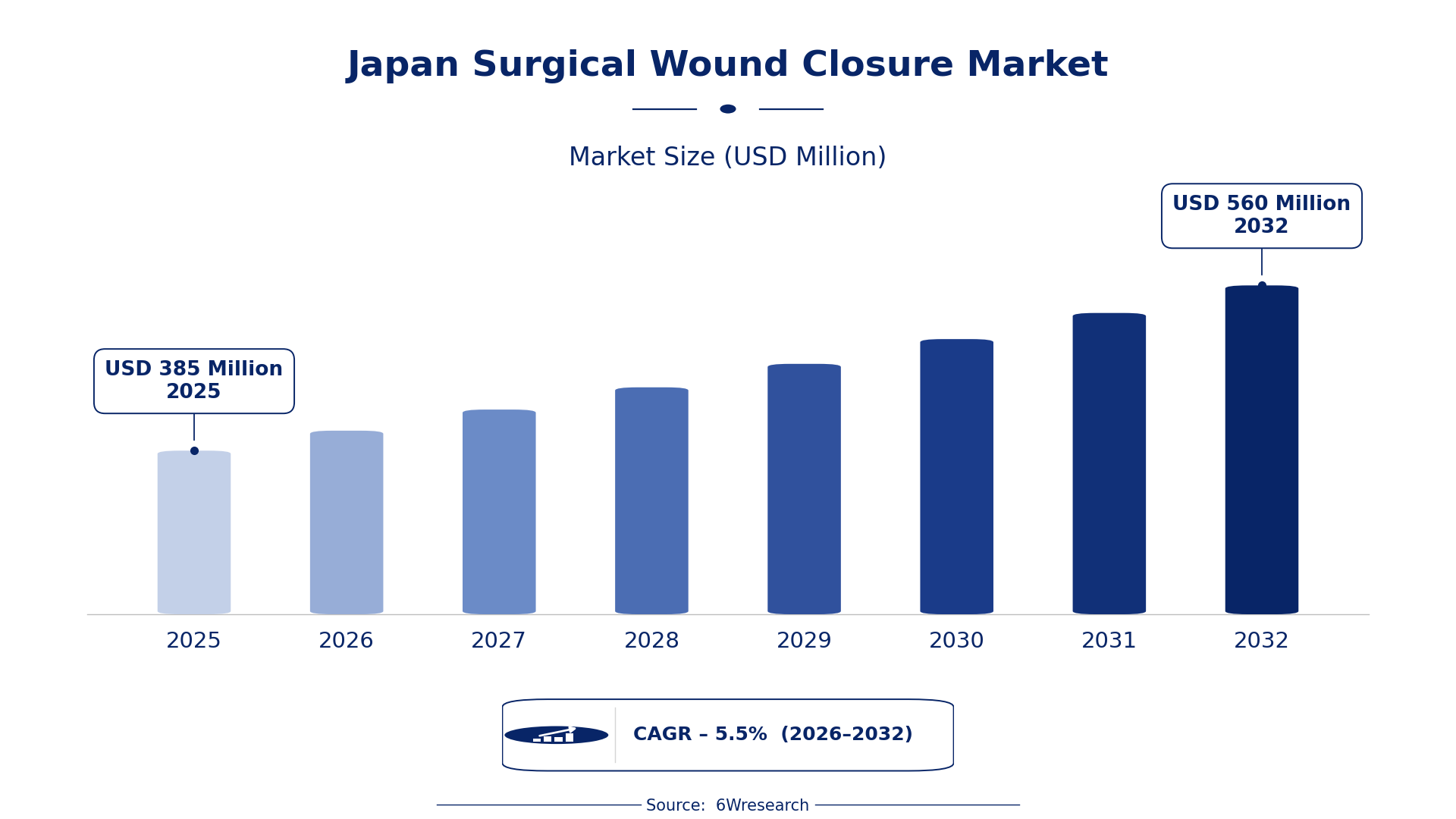
According to 6Wresearch internal database and industry insights, the Japan Surgical Wound Closure Market was valued at USD 385 Million in 2025 and is projected to reach USD 560 Million by 2032, growing at a CAGR of approximately 5.5% during 2026–2032.
Japan Surgical Wound Closure Market Highlights
| Report Metric | Details |
| Report Name | Japan Surgical Wound Closure Market (2026-2032) |
| Market Size 2025 | USD 385 Million |
| Market Size 2032 | USD 560 Million |
| Absolute Growth 2025–2032 | USD 175 Million |
| CAGR 2026–2032 | 5.5% |
| Peak Annual Growth | 7.4% in 2032 |
| Forecast Period | 2026–2032 |
| Historical Data | 2022–2025 |
| Base Year | 2025 |
| Leading Closure Type, 2025 | Sutures (50% share) |
| Leading Method, 2025 | Needle & Thread (39% share) |
| Leading Application Type, 2025 | Skin & Deep Tissue (37% share) |
| Leading End User, 2025 | General Surgery Centers (48% share) |
| Fastest-Growing Closure Type | Staples (7.8% CAGR) |
| Fastest-Growing Method | Mechanical Closure (7.9% CAGR) |
| Fastest-Growing Application Type | Skin/Scalp Closure (8.4% CAGR) |
| Fastest-Growing End User | ER and Trauma Units (7.3% CAGR) |
| Growing Sector | Surgical procedures |
| Key End Users | General Surgery Centers, ER and Trauma Units, Plastic Surgery Clinics |
Japan Surgical Wound Closure Market Year-wise Growth Rate and Key Drivers (2022–2032)
This graph illustrates the annual growth rates of the market from 2022 to 2032, highlighting a steady upward trajectory and projected market expansion over the forecast period.
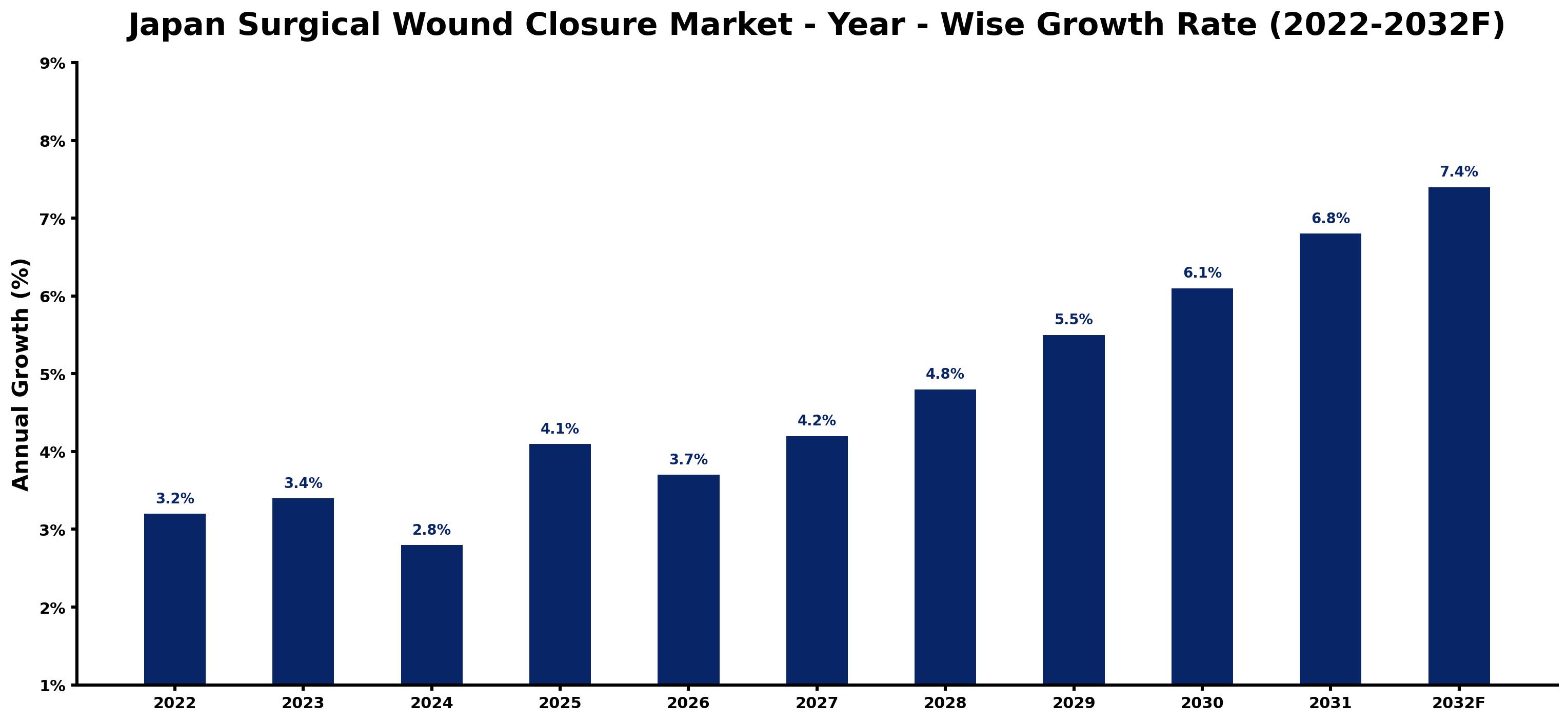
Each row of the following table gives one year's estimated growth and the event or demand shift that explains it.
| Year | Estimated Annual Growth (%) | Market Rationale |
| 2022 | 3.2 | The market showed steady growth due to a high volume of surgical procedures performed. |
| 2023 | 3.4 | Increased surgical activities contributed to a faster growth rate compared to the previous year. |
| 2024 | 2.8 | Growth slowed slightly as hospitals adjusted to new surgical techniques and standards. |
| 2025 | 4.1 | The market experienced a faster growth rate with rising demand for advanced surgical closures. |
| 2026 | 3.7 | A slight slowdown occurred as the market is expected to stabilise after the previous peak in growth. |
| 2027 | 4.2 | Increased adoption of mechanical closure methods is projected to drive faster growth than in 2026. |
| 2028 | 4.8 | Growing interest in minimally invasive surgeries will further accelerate market growth. |
| 2029 | 5.5 | The market is expected to expand as surgical training programs improve skills and techniques. |
| 2030 | 6.1 | Continued advancements in surgical technology will support a higher growth rate. |
| 2031 | 6.8 | The introduction of new closure products is projected to propel demand, leading to faster growth. |
| 2032 | 7.4 | The market is expected to peak with a surge in surgical procedures and new closure techniques. |
Note: Market size estimations and growth projections presented in this report are based on 6Wresearch's proprietary forecasting methodology, utilizing the latest available industry data, government publications, and primary research inputs.
Japan Surgical Wound Closure Market Synopsis
Surgical wound closure products are critical medical devices used to secure tissue edges during surgical procedures. These products are manufactured from various materials, including synthetic polymers and natural fibres. The Japan Surgical Wound Closure Market is expanding due to the increasing number of surgical procedures, which reached approximately 3.5 million in 2022, and the growing need for effective wound management solutions. The aging population in Japan further drives demand, particularly in general surgery centres and trauma units. This growth is supported by rising surgical training programmes and the adoption of advanced closure methods.
Market Dynamics Impact Analysis (2026–2032)
| Factor | Type | Impact | Primary Segment Affected |
| Growing number of surgical procedures | Driver | High | Sutures |
| Increased adoption of mechanical closure methods | Driver | High | Mechanical Closure |
| Rising demand for advanced surgical techniques | Opportunity | High | General Surgery Centers |
| Expansion of plastic surgery clinics | Opportunity | High | Plastic Surgery Clinics |
| Strict regulatory requirements for medical devices | Restraint | High | Sutures |
| Limited awareness of advanced closure products among healthcare providers | Restraint | Medium | Mechanical Closure |
| High costs associated with advanced surgical products | Challenge | High | Tissue Adhesives |
| Competition from alternative wound closure methods | Challenge | Medium | Adhesive Strips |
Evaluation of Drivers in Japan Surgical Wound Closure Market (2026–2032)
The table below links each growth driver to the segment it affects and the evidence for it.
| Drivers | Primary Segment Affected | Why It Matters (Evidence) |
| Increased surgical procedures | Sutures | Japan performed approximately 3.5 million surgical procedures in 2022, driving demand for sutures. |
| Adoption of mechanical closure | Mechanical Closure | The growing preference for mechanical closure methods is reflected in trauma units, improving efficiency and outcomes. |
| Aging population | Tissue Adhesives | The aging demographic in Japan increases the need for effective wound management solutions, particularly in surgical settings. |
| Expansion of surgical training programs | General Surgery Centers | In 2023, funding for surgical training improved skills, leading to more surgeries and product demand. |
| Rising cosmetic procedures | Plastic Surgery Clinics | The high concentration of plastic surgery clinics in urban areas boosts the demand for closure products. |
Spending rises because Japan's aging population, accounting for approximately 28% of the total, increases the need for surgical procedures. In 2022, around 3.5 million surgeries were performed, driving demand for various closure products. The growing number of plastic surgery clinics in urban areas further boosts the market. Consequently, the adoption of mechanical closure methods is becoming more prevalent in trauma units, increasing overall product demand.
Evaluation of Restraints in Japan Surgical Wound Closure Market
The following restraints limit how fast demand can grow.
| Market Restraint | Primary Segment Affected | Why It Matters (Evidence) |
| Strict regulations on medical devices | Sutures | Japan's Pharmaceuticals and Medical Devices Agency enforces stringent regulations, increasing compliance costs. |
| Limited awareness of new closure technologies | Mechanical Closure | Healthcare providers may be unaware of advanced closure products, hindering their adoption. |
| High costs of advanced surgical products | Tissue Adhesives | The premium pricing of advanced closure products may deter healthcare facilities from purchasing. |
| Competition from alternative methods | Adhesive Strips | Alternative wound closure methods, such as adhesive strips, may limit the market for traditional products. |
| Budget constraints in healthcare facilities | General Surgery Centers | Financial limitations in hospitals can restrict the purchase of advanced surgical closure solutions. |
Japan Surgical Wound Closure Market Challenges
Producers face rising costs for surgical sutures, with annual demand estimated at several million units, putting pressure on hospital budgets. Skills shortages in surgical training hinder the development of proficient medical staff, resulting in longer procedure times and increased risks for patients. Technology adoption is slow, particularly regarding advanced surgical techniques, which can prolong recovery periods and strain healthcare resources. Competition from alternative methods, like tissue adhesives, forces producers to innovate, as failure to do so may lead to a loss of market share among buyers in hospitals.
Trends in the Japan Surgical Wound Closure Market
The following changes are redrawing the Japan Surgical Wound Closure Market.
- Shift from Traditional to Mechanical Closure Methods: Since 2023, there has been a noticeable shift towards mechanical closure methods in trauma units, driven by efficiency needs. This transition is seen as hospitals adopt these methods to improve surgical outcomes.
- Emergence of Advanced Tissue Adhesives: The use of tissue adhesives has been increasing since 2022, particularly in minimally invasive surgeries. This trend reflects a growing preference for techniques that reduce recovery time and improve patient comfort.
- Growth of Plastic Surgery Clinics in Tokyo: The Tokyo region has seen a rise in plastic surgery clinics, with approximately 200 facilities reported in 2023. This growth indicates a strong demand for surgical wound closure products tailored for cosmetic procedures.
- Increased Focus on Surgical Training: In 2023, Japan launched a programme to enhance surgical training, impacting general surgery centres. This initiative aims to improve surgical techniques and, consequently, the demand for advanced closure products.
Investment Opportunities in the Japan Surgical Wound Closure Market
Investors looking at the Japan Surgical Wound Closure Market should consider the following areas.
- General Surgery Centers Seeking Advanced Solutions: General surgery centres are increasingly looking for advanced wound closure products to improve patient outcomes. With over 1,200 centres in Japan, this presents a notable opportunity for suppliers.
- Supplying Mechanical Closure Devices: The demand for mechanical closure devices is rising, particularly in trauma units. Suppliers can enter this market by partnering with hospitals to provide effective solutions.
- Investing in Tissue Adhesives for Minimally Invasive Surgeries: Tissue adhesives are gaining traction in minimally invasive surgeries, creating opportunities for suppliers. This trend is particularly strong in urban areas with high surgical activity.
- Focusing on Training Programs for Healthcare Providers: With the government's investment in surgical training programmes, there is an opportunity to supply educational resources and advanced products to enhance surgical practices.
Government Initiatives in the Japan Surgical Wound Closure Market
The Medical Care Act of 1948 establishes standards for hospitals and clinics, ensuring that surgical wound closure products meet quality and safety requirements. Compliance with these regulations is essential for producers and importers to operate effectively in the Japanese market, as they must adhere to strict guidelines. The Ministry of Health, Labour and Welfare oversees these regulations, ensuring that healthcare facilities maintain high standards for surgical procedures and product usage.
The Pharmaceuticals and Medical Devices Agency oversees the implementation of medical regulations, including the approval of surgical wound closure products. This agency ensures that products meet stringent safety standards, benefiting buyers by providing assurance of quality. In 2023, the agency approved several new surgical closure products, enhancing the options available to healthcare providers. This regulatory framework supports the growth of the surgical wound closure market by ensuring that only compliant products are available to end users.
Future Insight of the Japan Surgical Wound Closure Market
Surgical training programmes will expand in hospitals, equipping medical staff with essential skills. By 2032, advanced surgical techniques will become commonplace, improving patient outcomes. ISO 13485 compliance will enhance manufacturing processes, ensuring higher quality products for the market. With approximately 3.5 million surgical procedures performed annually, the demand for effective wound closure solutions will rise, prompting suppliers to adopt new technologies to meet healthcare needs.
Market Segmentation Analysis
Japan Surgical Wound Closure Market report covers a detailed analysis of the following market segments:
By Closure Type – Sutures Lead, Staples Expected to Grow Fastest
According to Saurav Kr Singh, Senior Research Analyst at 6Wresearch, Sutures accounted for 50% of the market by closure type in 2025. Sutures hold the largest share as they are widely utilised in over 1,200 general surgery centres across Japan, essential for effectively closing surgical wounds. Their versatility in handling various incision types ensures they remain the preferred choice among healthcare providers. Over 2026–2032, Staples are expected to post the fastest growth, at a CAGR of 7.8%. The rapid growth of staples is attributed to their efficiency in quickly closing larger incisions, particularly in high-demand environments such as trauma units. This trend is further supported by the approximately 3.5 million surgical procedures performed annually in Japan. Suppliers should expand their offerings of staples to meet the rising demand in surgical settings.
By Method – Needle & Thread Leads, Mechanical Closure Expected to Grow Fastest
The largest method category in 2025 was Needle & Thread, at 39% of revenue. The needle and thread method remains dominant as it is the traditional approach for suturing wounds, widely taught in surgical training programs across Japan. Its established presence in surgical practices ensures a steady demand from healthcare facilities. Mechanical Closure is set to record the highest CAGR in this split, 7.9% over 2026–2032. Mechanical closure is gaining traction due to its efficiency and ease of use in various surgical procedures, aligning with the government's push for advanced surgical techniques. This method's growing acceptance is likely to revolutionise wound closure practices in the near future. Buyers may benefit from exploring mechanical closure options to improve surgical efficiency and outcomes.
By Application Type – Skin & Deep Tissue Leads, Skin/Scalp Closure Expected to Grow Fastest
In 2025, Skin & Deep Tissue led the application type split with a 37% share. Skin and deep tissue applications dominate the market as they represent the primary focus of surgical wound closure, addressing the majority of surgical needs. This segment's importance is underscored by the high volume of surgical procedures performed annually. The quickest growth will come from Skin/Scalp Closure, forecast to expand at a CAGR of 8.4% between 2026 and 2032. The skin/scalp closure segment is experiencing rapid growth due to its specific application in surgeries involving these areas, which are increasingly common in both general and cosmetic surgeries. The rising number of such procedures indicates a strong future demand for this type of closure. Suppliers should consider developing specialised products for skin and scalp closures to capitalise on this growing segment.
By End User – General Surgery Centers Lead, ER and Trauma Units Expected to Grow Fastest
With 48% of end user revenue in 2025, General Surgery Centers was the largest category. General surgery centres are the primary end users for surgical closures, conducting a significant volume of surgical procedures that necessitate effective wound management. Their established infrastructure and expertise make them the leading market segment for these products. ER and Trauma Units are projected to grow fastest, at a CAGR of 7.3% during 2026–2032. ER and trauma units are witnessing the fastest growth due to their critical role in emergency wound management, which demands rapid and reliable closure solutions. The increase in trauma cases across Japan is a key factor propelling this segment's expansion. Suppliers must prioritise partnerships with ER and trauma units to fulfil the urgent need for effective wound closure products.
Key Attractiveness of the Report
- 10 Years of Market Numbers
- Historical Data Starting from 2022 to 2025
- Base Year 2025
- Forecast Data until 2032
- Key Performance Indicators Impacting the Market
- Major Upcoming Developments and Projects
Key Highlights of the Report:
- Japan Surgical Wound Closure Market Outlook
- Market Size of Japan Surgical Wound Closure Market, 2025
- Forecast of Japan Surgical Wound Closure Market, 2032
- Historical Data and Forecast of Japan Surgical Wound Closure Revenues & Volume for the Period 2022-2032F
- Japan Surgical Wound Closure Market Trend Evolution
- Japan Surgical Wound Closure Market Drivers and Challenges
- Japan Surgical Wound Closure Price Trends
- Japan Surgical Wound Closure Porter's Five Forces
- Japan Surgical Wound Closure Industry Life Cycle
- Historical Data and Forecast of Japan Surgical Wound Closure Market Revenues & Volume By Closure Type for the Period 2022-2032F
- Historical Data and Forecast of Japan Surgical Wound Closure Market Revenues & Volume By Sutures for the Period 2022-2032F
- Historical Data and Forecast of Japan Surgical Wound Closure Market Revenues & Volume By Staples for the Period 2022-2032F
- Historical Data and Forecast of Japan Surgical Wound Closure Market Revenues & Volume By Adhesive Strips for the Period 2022-2032F
- Historical Data and Forecast of Japan Surgical Wound Closure Market Revenues & Volume By Tissue Adhesives for the Period 2022-2032F
- Historical Data and Forecast of Japan Surgical Wound Closure Market Revenues & Volume By Method for the Period 2022-2032F
- Historical Data and Forecast of Japan Surgical Wound Closure Market Revenues & Volume By Needle & Thread for the Period 2022-2032F
- Historical Data and Forecast of Japan Surgical Wound Closure Market Revenues & Volume By Mechanical Closure for the Period 2022-2032F
- Historical Data and Forecast of Japan Surgical Wound Closure Market Revenues & Volume By External Bonding for the Period 2022-2032F
- Historical Data and Forecast of Japan Surgical Wound Closure Market Revenues & Volume By Liquid Glue for the Period 2022-2032F
- Historical Data and Forecast of Japan Surgical Wound Closure Market Revenues & Volume By Application Type for the Period 2022-2032F
- Historical Data and Forecast of Japan Surgical Wound Closure Market Revenues & Volume By Skin & Deep Tissue for the Period 2022-2032F
- Historical Data and Forecast of Japan Surgical Wound Closure Market Revenues & Volume By Skin/Scalp Closure for the Period 2022-2032F
- Historical Data and Forecast of Japan Surgical Wound Closure Market Revenues & Volume By Minor Cuts/Incisions for the Period 2022-2032F
- Historical Data and Forecast of Japan Surgical Wound Closure Market Revenues & Volume By Cosmetic and Pediatric Use for the Period 2022-2032F
- Historical Data and Forecast of Japan Surgical Wound Closure Market Revenues & Volume By End User for the Period 2022-2032F
- Historical Data and Forecast of Japan Surgical Wound Closure Market Revenues & Volume By General Surgery Centers for the Period 2022-2032F
- Historical Data and Forecast of Japan Surgical Wound Closure Market Revenues & Volume By ER and Trauma Units for the Period 2022-2032F
- Historical Data and Forecast of Japan Surgical Wound Closure Market Revenues & Volume By Outpatient Clinics for the Period 2022-2032F
- Historical Data and Forecast of Japan Surgical Wound Closure Market Revenues & Volume By Plastic Surgery Clinics for the Period 2022-2032F
- Japan Surgical Wound Closure Import Export Trade Statistics
- Market Opportunity Assessment By Closure Type
- Market Opportunity Assessment By Method
- Market Opportunity Assessment By Application Type
- Market Opportunity Assessment By End User
- Japan Surgical Wound Closure Top Companies Market Share
- Japan Surgical Wound Closure Competitive Benchmarking By Technical and Operational Parameters
- Japan Surgical Wound Closure Company Profiles
- Japan Surgical Wound Closure Key Strategic Recommendations
Market Covered
The study includes the following segmentation.
By Closure Type
- Sutures
- Staples
- Adhesive Strips
- Tissue Adhesives
By Method
- Needle & Thread
- Mechanical Closure
- External Bonding
- Liquid Glue
By Application Type
- Skin & Deep Tissue
- Skin/Scalp Closure
- Minor Cuts/Incisions
- Cosmetic and Pediatric Use
By End User
- General Surgery Centers
- ER and Trauma Units
- Outpatient Clinics
- Plastic Surgery Clinics































