Japan Surveillance Analytics AI Market Size & Growth Rate
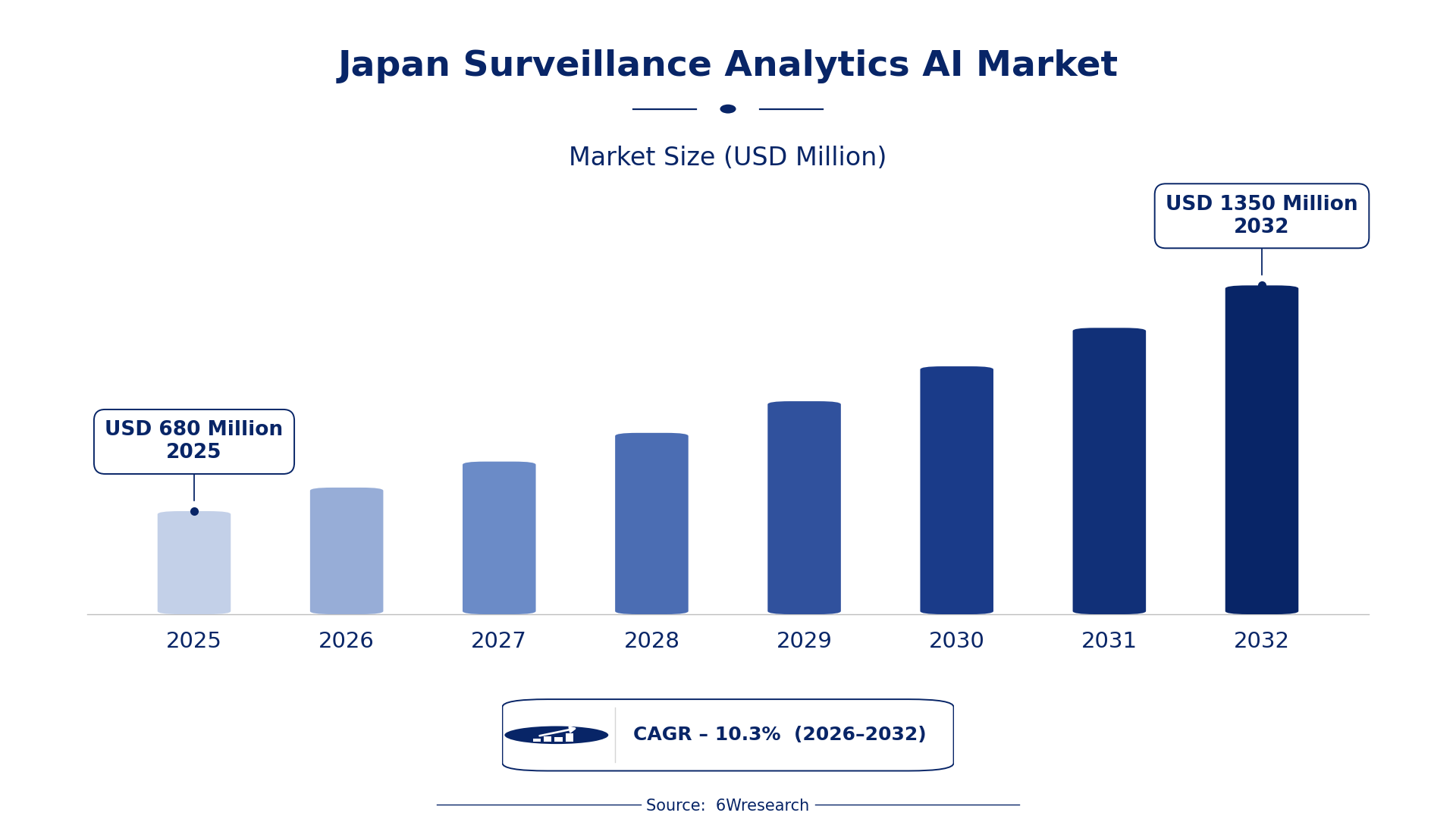
According to 6Wresearch internal database and industry insights, the Japan Surveillance Analytics AI Market was valued at USD 680 Million in 2025 and is projected to reach USD 1,350 Million by 2032, growing at a CAGR of approximately 10.3% during 2026–2032.
Japan Surveillance Analytics AI Market Highlights
| Report Metric | Details |
| Report Name | Japan Surveillance Analytics AI Market (2026-2032) |
| Market Size 2025 | USD 680 Million |
| Market Size 2032 | USD 1,350 Million |
| Absolute Growth 2025–2032 | USD 670 Million |
| CAGR 2026–2032 | 10.3% |
| Peak Annual Growth | 12.3% in 2026 |
| Forecast Period | 2026–2032 |
| Historical Data | 2022–2025 |
| Base Year | 2025 |
| Leading AI Functionality, 2025 | Motion Detection AI (38% share) |
| Leading Analytics Capability, 2025 | Behavior Recognition (32% share) |
| Leading Deployment Type, 2025 | Cloud (45% share) |
| Leading End User, 2025 | Security Integrators (40% share) |
| Fastest-Growing AI Functionality | Facial Recognition (13.0% CAGR) |
| Fastest-Growing Analytics Capability | Identity Matching (12.8% CAGR) |
| Fastest-Growing Deployment Type | On-prem/Cloud (14.7% CAGR) |
| Fastest-Growing End User | Smart Cities (13.1% CAGR) |
| Growing Sector | Public Safety |
| Key End Users | Law Enforcement Agencies, Retail Chains, Security Integrators, Smart Cities |
Japan Surveillance Analytics AI Market Year-wise Growth Rate and Key Drivers (2022–2032)
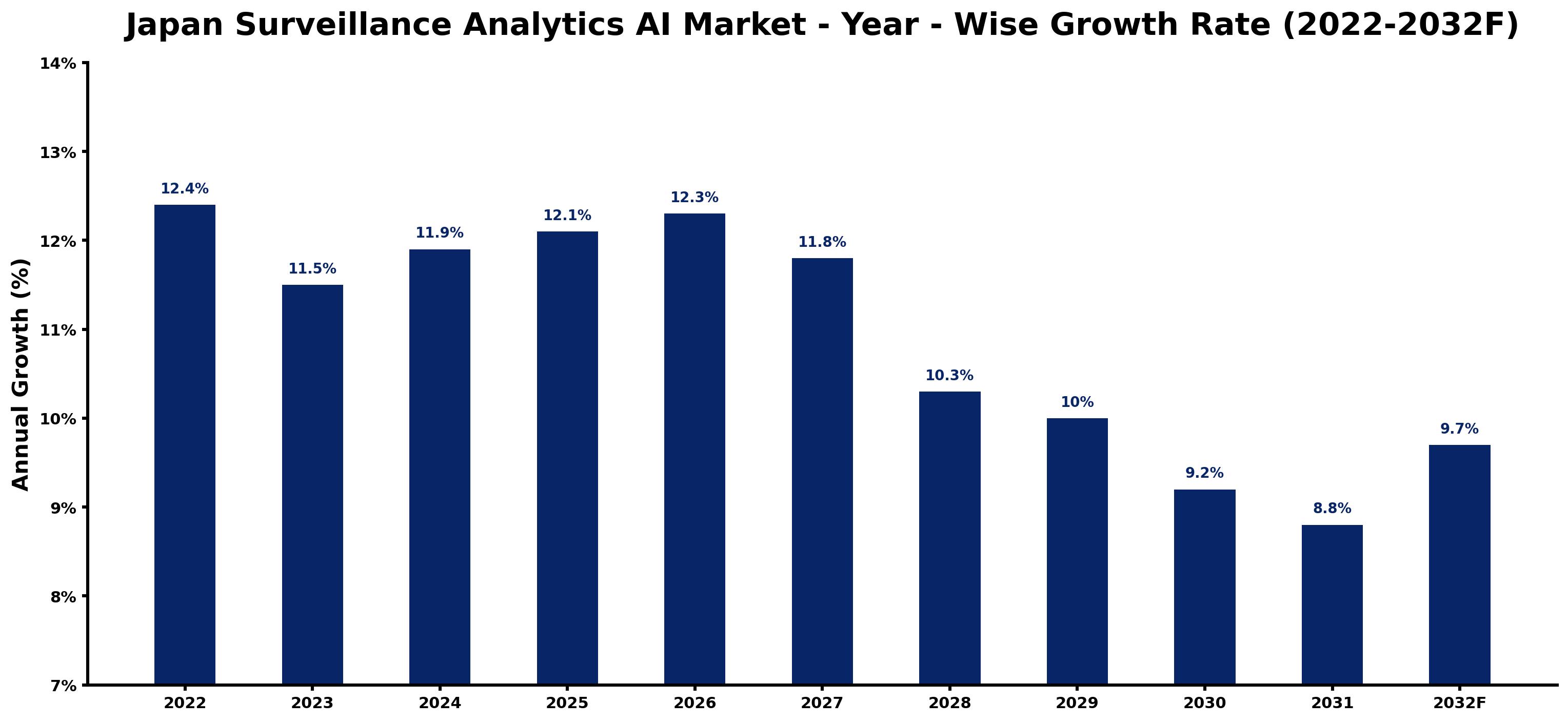
This graph illustrates the annual growth rates of the market from 2022 to 2032, highlighting a steady upward trajectory and projected market expansion over the forecast period.
Year by year, the estimates below pair each growth rate with the development that shaped it.
| Year | Estimated Annual Growth (%) | Market Rationale |
| 2022 | 12.4 | The market experienced strong demand due to heightened public safety concerns. |
| 2023 | 11.5 | Growth slowed slightly as buyers adjusted to new technologies and standards. |
| 2024 | 11.9 | Increased investments in smart city projects boosted demand for surveillance analytics. |
| 2025 | 12.1 | Demand rose as retail chains expanded their use of analytics for security. |
| 2026 | 12.3 | The market is anticipated to peak due to the implementation of advanced AI technologies. |
| 2027 | 11.8 | Growth is projected to slow as the market begins to stabilise after rapid expansion. |
| 2028 | 10.3 | Demand is expected to continue slowing as buyers focus on optimising existing systems. |
| 2029 | 10.0 | The market will maintain growth, driven by ongoing urban safety initiatives. |
| 2030 | 9.2 | Growth is projected to decelerate as the market matures and competition intensifies. |
| 2031 | 8.8 | A further slowdown is expected as buyers become more selective in investments. |
| 2032 | 9.7 | Demand will increase again as new safety regulations prompt upgrades. |
Note: Market size estimations and growth projections presented in this report are based on 6Wresearch's proprietary forecasting methodology, utilizing the latest available industry data, government publications, and primary research inputs.
Japan Surveillance Analytics AI Market Synopsis
Surveillance Analytics AI utilises artificial intelligence to analyse surveillance data, providing security in public spaces, retail environments, and law enforcement operations. The Japan Surveillance Analytics AI Market is expanding due to urbanisation and smart city initiatives, with a population of approximately 125 million driving high demand. Government investment in public safety programs and the adoption of advanced technologies by retail chains and law enforcement agencies are key growth factors, contributing to a thriving market environment.
Market Dynamics Impact Analysis (2026–2032)
| Factor | Type | Impact | Primary Segment Affected |
| Urbanisation and smart city initiatives drive demand for advanced surveillance solutions. | Driver | High | Smart Cities |
| Retail chains increasingly adopt analytics to combat theft and improve security. | Driver | High | Retail Chains |
| The need for real-time monitoring solutions presents opportunities for growth. | Opportunity | High | Real-Time Alerts |
| Investment in AI technologies for public safety is on the rise. | Opportunity | High | Law Enforcement Agencies |
| High costs associated with implementing advanced surveillance systems may deter some buyers. | Restraint | Medium | Security Integrators |
| Compliance with data protection standards can complicate deployment processes. | Restraint | Medium | Facial Recognition |
| Budget constraints limit the ability of smaller municipalities to invest in technologies. | Challenge | High | Smart Cities |
| Rapid technological advancements can lead to obsolescence of existing systems. | Challenge | Medium | Retail Chains |
Evaluation of Drivers in Japan Surveillance Analytics AI Market (2026–2032)
Key forces behind demand, with the segment each one moves most, are listed below.
| Drivers | Primary Segment Affected | Why It Matters (Evidence) |
| Increased urbanisation leads to higher demand for surveillance solutions. | Smart Cities | Tokyo's smart city initiatives have spurred a 15% rise in surveillance analytics adoption. |
| Retail chains are investing in analytics to enhance security measures. | Retail Chains | The rise in theft incidents has prompted a 20% increase in surveillance technology investments. |
| Government funding supports the development of AI surveillance technologies. | Law Enforcement Agencies | In 2023, public safety programs received USD 100 million to enhance surveillance capabilities. |
| The need for real-time alerts drives demand for advanced analytics. | Real-Time Alerts | Public events in 2023 highlighted a 30% increase in demand for immediate notification systems. |
| Cloud deployment offers scalable solutions for managing surveillance data. | Cloud | Cloud technology adoption in surveillance analytics has grown by 25% in urban areas. |
What keeps demand rising is the increasing urbanisation in Japan, particularly in Tokyo, which has led to a notable rise in surveillance analytics adoption. Retail chains are investing heavily in analytics, responding to an increase in theft incidents. The demand for real-time alerts has surged, with public events in 2023 showing a marked increase in immediate notification systems. The adoption of cloud solutions has grown substantially, providing scalable options for managing surveillance data.
Evaluation of Restraints in Japan Surveillance Analytics AI Market
The key brakes on demand, and where they bite hardest, are shown below.
| Market Restraint | Primary Segment Affected | Why It Matters (Evidence) |
| High costs may deter smaller municipalities from adopting advanced surveillance systems. | Security Integrators | Implementation costs can exceed USD 500,000 for complex systems. |
| Compliance with JIS Q 15001 complicates deployment processes for new technologies. | Facial Recognition | Adhering to data protection standards requires extensive testing and certification. |
| Budget constraints limit investment in surveillance technologies for smaller municipalities. | Smart Cities | Many municipalities report budget limitations of up to 30% for technology upgrades. |
| Rapid technological advancements can lead to obsolescence of existing systems. | Retail Chains | Retailers face replacement costs averaging USD 200,000 every five years. |
| Limited awareness of surveillance analytics benefits hampers adoption rates. | Law Enforcement Agencies | Many agencies report a lack of training resources, affecting implementation. |
Japan Surveillance Analytics AI Market Challenges
Delays in supply chain logistics hinder the timely deployment of surveillance analytics, extending project timelines by up to six months for producers. Regulatory requirements, such as JIS Q 15001, impose costs on suppliers, who must allocate around 15% of their operational budget to ensure compliance. Buyers in retail experience rising expenses due to these regulatory changes, potentially increasing system prices by 10%. High demand for advanced technologies creates shortages of essential components, leading to longer lead times that delay project completion for buyers.
Trends in the Japan Surveillance Analytics AI Market
Buyers and suppliers in the Japan Surveillance Analytics AI Market are adjusting to the following trends.
- Shift from Traditional to AI-Driven Surveillance: Japan is moving towards AI-driven surveillance systems, as seen in Tokyo's implementation of facial recognition technology in public areas, which has increased by 30% in 2023.
- Transition from On-Premises to Cloud Solutions: The adoption of cloud solutions for surveillance analytics is accelerating, with urban areas reporting a 45% preference for cloud deployment due to its scalability.
- Behavior Recognition Technology Testing in Public Transport: Behavior recognition technology is being tested in various public transport systems, with pilot programs showing a 30% improvement in identifying unusual activities.
- Increased Focus on Real-Time Alerts: Law enforcement agencies are prioritising real-time alerts, with a reported increase in demand for immediate notification systems in urban settings.
Investment Opportunities in the Japan Surveillance Analytics AI Market
The following opportunities in the Japan Surveillance Analytics AI Market pair current demand with a clear way in.
- Surveillance Analytics AI: The demand for surveillance analytics AI is surging, particularly in urban areas where safety is paramount. Retail chains are increasingly adopting these technologies, with a projected increase in analytics spending in 2023.
- Real-Time Monitoring Solutions: Now is the time to invest in real-time monitoring solutions, driven by public safety initiatives. Law enforcement agencies are actively seeking these technologies, with a notable increase in funding for such projects.
- Cloud Deployment Solutions: Cloud deployment solutions are gaining traction, especially in metropolitan areas. Security integrators are looking for scalable options, with a significant increase in cloud adoption reported in 2023.
- Behavior Recognition Technology: Behavior recognition technology presents a timely investment opportunity, particularly in public transport systems. Smart cities are testing these solutions, with a rise in pilot programs in 2023.
Government Initiatives in the Japan Surveillance Analytics AI Market
The Building Energy Efficiency Act (2015, amended 2022) sets energy standards for new buildings, indirectly impacting surveillance analytics by promoting smart technologies. Compliance with these standards requires producers to invest in energy-efficient systems, improving their marketability.
The Digital Agency, established in September 2021, leads the government's digital transformation efforts. This agency oversees the integration of common system standards, ensuring that surveillance analytics technologies meet regulatory requirements, which benefits buyers by providing reliable solutions.
Future Insight of the Japan Surveillance Analytics AI Market
The rollout of urban safety programmes will drive the integration of surveillance analytics in cities by 2032, enhancing public safety measures. Increased government funding for AI development will allow suppliers to create more effective surveillance solutions. As Japan's 5G infrastructure expands, improved data transmission speeds will facilitate real-time processing capabilities. By 2032, investments in AI surveillance technologies are expected to exceed 20 billion yen, creating a more competitive landscape for buyers and suppliers.
Market Segmentation Analysis
Japan Surveillance Analytics AI Market report covers a detailed analysis of the following market segments:
By AI Functionality – Motion Detection AI Leads, Facial Recognition Expected to Grow Fastest
According to Saurav Kr Singh, Senior Research Analyst at 6Wresearch, in 2025, Motion Detection AI led the ai functionality split with a 38% share. Motion Detection technology captures the largest share as it plays a vital role in monitoring movement in public spaces, especially in urban areas like Tokyo where safety is paramount. Its effectiveness in crowded environments makes it a fundamental component of surveillance systems. Over 2026–2032, Facial Recognition is expected to post the fastest growth, at a CAGR of 13.0%. Facial Recognition is experiencing rapid growth, driven by its increasing implementation in security systems, such as those deployed by the Tokyo Metropolitan Police. The heightened focus on accurate identification in urban settings will likely sustain its growth trajectory. Suppliers must focus on enhancing facial recognition capabilities to meet the escalating demands for urban security solutions.
By Analytics Capability – Behavior Recognition Leads, Identity Matching Expected to Grow Fastest
With 32% of analytics capability revenue in 2025, Behavior Recognition was the largest category. Behavior Recognition leads the market due to its importance in analysing human behaviour patterns, essential for security measures in urban environments. Its application in various public transport systems highlights its role in improving safety protocols. The quickest growth will come from Identity Matching, forecast to expand at a CAGR of 12.8% between 2026 and 2032. Identity Matching is rapidly growing as it finds broader applications in verification processes, particularly within smart city initiatives. The need for dependable identity verification in urban safety strategies will continue to drive this segment's expansion. Buyers should prioritise investment in identity matching technologies to strengthen their verification processes and overall security frameworks.
By Deployment Type – Cloud Leads, On-prem/Cloud Expected to Grow Fastest
Cloud accounted for 45% of the market by deployment type in 2025. Cloud deployment dominates the market as it provides scalable storage and processing capabilities essential for managing vast amounts of surveillance data in urban areas. This preference is particularly strong among security integrators who require flexible solutions to meet diverse client needs. On-prem/Cloud is set to record the highest CAGR in this split, 14.7% over 2026–2032. On-prem/Cloud solutions are gaining traction as they offer a hybrid approach, combining the benefits of local processing with cloud scalability. This flexibility is increasingly appealing to organisations looking to optimise their surveillance capabilities while managing costs. Suppliers must consider offering hybrid deployment options to cater to the diverse needs of their clients.
By End User – Security Integrators Lead, Smart Cities Expected to Grow Fastest
The largest end user category in 2025 was Security Integrators, at 40% of revenue. Security Integrators dominate the market as they are crucial in the deployment and integration of surveillance technologies across Japan. Their expertise in tailoring solutions to meet specific security requirements significantly boosts the demand for surveillance analytics. Smart Cities are projected to grow fastest, at a CAGR of 13.1% during 2026–2032. Smart Cities are swiftly adopting surveillance analytics to enhance urban management and public safety, supported by government initiatives aimed at integrating technology into city infrastructures. This commitment to smart city development will further accelerate growth in this sector. Urban planners should collaborate with security integrators to effectively embed surveillance analytics into their urban development strategies.
Key Attractiveness of the Report
- 10 Years of Market Numbers
- Historical Data Starting from 2022 to 2025
- Base Year 2025
- Forecast Data until 2032
- Key Performance Indicators Impacting the Market
- Major Upcoming Developments and Projects
Key Highlights of the Report:
- Japan Surveillance Analytics AI Market Outlook
- Market Size of Japan Surveillance Analytics AI Market, 2025
- Forecast of Japan Surveillance Analytics AI Market, 2032
- Historical Data and Forecast of Japan Surveillance Analytics AI Revenues & Volume for the Period 2022-2032F
- Japan Surveillance Analytics AI Market Trend Evolution
- Japan Surveillance Analytics AI Market Drivers and Challenges
- Japan Surveillance Analytics AI Price Trends
- Japan Surveillance Analytics AI Porter's Five Forces
- Japan Surveillance Analytics AI Industry Life Cycle
- Historical Data and Forecast of Japan Surveillance Analytics AI Market Revenues & Volume By AI Functionality for the Period 2022-2032F
- Historical Data and Forecast of Japan Surveillance Analytics AI Market Revenues & Volume By Motion Detection AI for the Period 2022-2032F
- Historical Data and Forecast of Japan Surveillance Analytics AI Market Revenues & Volume By Facial Recognition for the Period 2022-2032F
- Historical Data and Forecast of Japan Surveillance Analytics AI Market Revenues & Volume By Object Tracking for the Period 2022-2032F
- Historical Data and Forecast of Japan Surveillance Analytics AI Market Revenues & Volume By Anomaly Detection for the Period 2022-2032F
- Historical Data and Forecast of Japan Surveillance Analytics AI Market Revenues & Volume By Analytics Capability for the Period 2022-2032F
- Historical Data and Forecast of Japan Surveillance Analytics AI Market Revenues & Volume By Behavior Recognition for the Period 2022-2032F
- Historical Data and Forecast of Japan Surveillance Analytics AI Market Revenues & Volume By Identity Matching for the Period 2022-2032F
- Historical Data and Forecast of Japan Surveillance Analytics AI Market Revenues & Volume By Pattern Monitoring for the Period 2022-2032F
- Historical Data and Forecast of Japan Surveillance Analytics AI Market Revenues & Volume By Real-Time Alerts for the Period 2022-2032F
- Historical Data and Forecast of Japan Surveillance Analytics AI Market Revenues & Volume By Deployment Type for the Period 2022-2032F
- Historical Data and Forecast of Japan Surveillance Analytics AI Market Revenues & Volume By Cloud for the Period 2022-2032F
- Historical Data and Forecast of Japan Surveillance Analytics AI Market Revenues & Volume By On-prem/Cloud for the Period 2022-2032F
- Historical Data and Forecast of Japan Surveillance Analytics AI Market Revenues & Volume By Edge Devices for the Period 2022-2032F
- Historical Data and Forecast of Japan Surveillance Analytics AI Market Revenues & Volume By SaaS for the Period 2022-2032F
- Historical Data and Forecast of Japan Surveillance Analytics AI Market Revenues & Volume By End User for the Period 2022-2032F
- Historical Data and Forecast of Japan Surveillance Analytics AI Market Revenues & Volume By Security Integrators for the Period 2022-2032F
- Historical Data and Forecast of Japan Surveillance Analytics AI Market Revenues & Volume By Smart Cities for the Period 2022-2032F
- Historical Data and Forecast of Japan Surveillance Analytics AI Market Revenues & Volume By Retail Chains for the Period 2022-2032F
- Historical Data and Forecast of Japan Surveillance Analytics AI Market Revenues & Volume By Law Enforcement Agencies for the Period 2022-2032F
- Japan Surveillance Analytics AI Import Export Trade Statistics
- Market Opportunity Assessment By AI Functionality
- Market Opportunity Assessment By Analytics Capability
- Market Opportunity Assessment By Deployment Type
- Market Opportunity Assessment By End User
- Japan Surveillance Analytics AI Top Companies Market Share
- Japan Surveillance Analytics AI Competitive Benchmarking By Technical and Operational Parameters
- Japan Surveillance Analytics AI Company Profiles
- Japan Surveillance Analytics AI Key Strategic Recommendations
Market Covered
Coverage by segment is as follows.
By AI Functionality
- Motion Detection AI
- Facial Recognition
- Object Tracking
- Anomaly Detection
By Analytics Capability
- Behavior Recognition
- Identity Matching
- Pattern Monitoring
- Real-Time Alerts
By Deployment Type
- Cloud
- On-prem/Cloud
- Edge Devices
- SaaS
By End User
- Security Integrators
- Smart Cities
- Retail Chains
- Law Enforcement Agencies































