Japan Suspension Components Market Size & Growth Rate
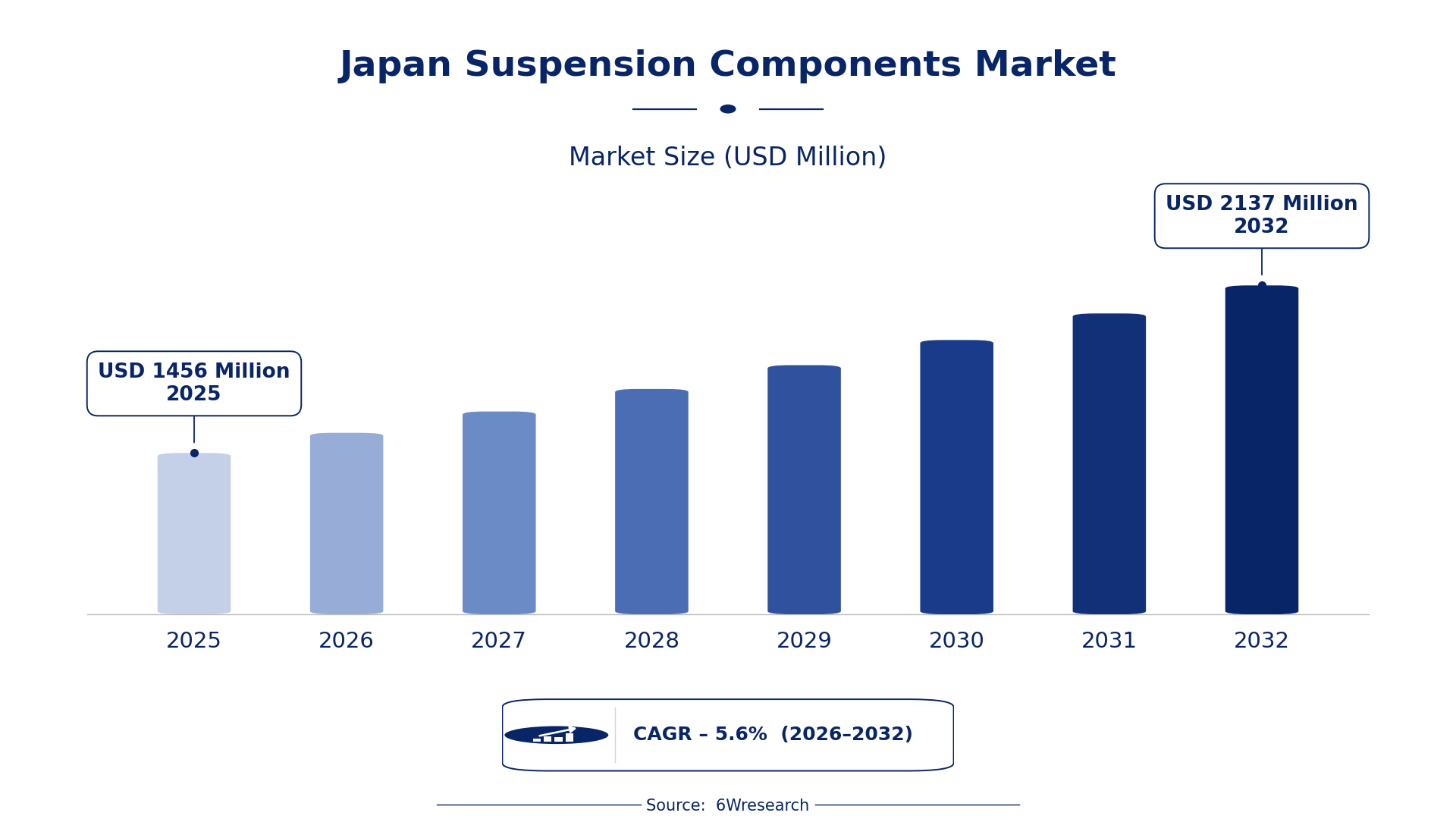
According to 6Wresearch internal database and industry insights, the Japan Suspension Components Market was valued at USD 1,456 Million in 2025 and is projected to reach USD 2,137 Million by 2032, growing at a CAGR of approximately 5.6% during 2026–2032.
Japan Suspension Components Market Highlights
| Report Metric | Details |
| Report Name | Japan Suspension Components Market (2026-2032) |
| Market Size 2025 | USD 1,456 Million |
| Market Size 2032 | USD 2,137 Million |
| Absolute Growth 2025–2032 | USD 681 Million |
| CAGR 2026–2032 | 5.6% |
| Peak Annual Growth | 7.0% in 2032 |
| Forecast Period | 2026–2032 |
| Historical Data | 2022–2025 |
| Base Year | 2025 |
| Leading Component Type, 2025 | Control Arms (42% share) |
| Leading Material Type, 2025 | Steel/Aluminum (45% share) |
| Leading Vehicle Type, 2025 | Passenger Cars (55% share) |
| Leading End User, 2025 | OEMs (37% share) |
| Fastest-Growing Component Type | Link Rods (7.9% CAGR) |
| Fastest-Growing Material Type | Alloy Steel (8.2% CAGR) |
| Fastest-Growing Vehicle Type | SUVs & Trucks (8.0% CAGR) |
| Fastest-Growing End User | Aftermarket Dealers (7.3% CAGR) |
| Growing Sector | automotive aftermarket |
| Key End Users | OEMs, Aftermarket Dealers, Auto Repair Shops |
Japan Suspension Components Market Year-wise Growth Rate and Key Drivers (2022–2032)
This graph illustrates the annual growth rates of the market from 2022 to 2032, highlighting a steady upward trajectory and projected market expansion over the forecast period.
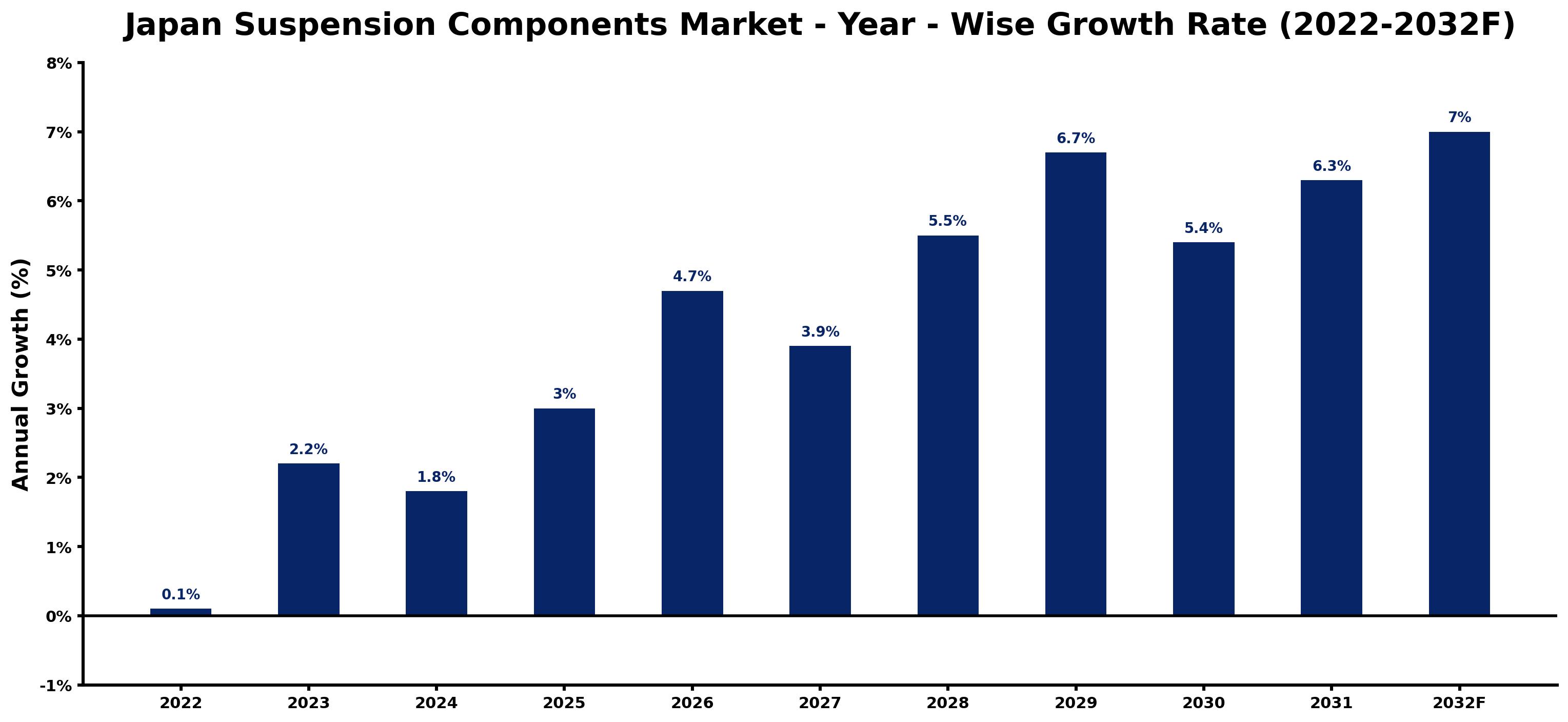
The yearly estimates that follow link every growth rate to its principal driver, so readers can see why the pace changed in each period.
| Year | Estimated Annual Growth (%) | Market Rationale |
| 2022 | 0.1 | The market experienced minimal growth due to ongoing supply chain challenges. |
| 2023 | 2.2 | Growth accelerated as automotive production rebounded in response to rising consumer demand. |
| 2024 | 1.8 | Growth slowed slightly as manufacturers adjusted to new production standards and costs. |
| 2025 | 3.0 | The market saw a peak in growth driven by increased vehicle production and demand. |
| 2026 | 4.7 | Growth is expected to continue as investments in automotive innovation yield results. |
| 2027 | 3.9 | Growth is projected to slow as the market stabilises after a period of rapid expansion. |
| 2028 | 5.5 | Demand is expected to rise again as the shift towards lightweight materials gains momentum. |
| 2029 | 6.7 | The market is projected to expand further, driven by increased sales of SUVs and trucks. |
| 2030 | 5.4 | Growth is expected to moderate as the market adjusts to new consumer preferences and standards. |
| 2031 | 6.3 | Demand is projected to surge again as the automotive sector embraces sustainability initiatives. |
| 2032 | 7.0 | The market is expected to peak with strong demand for advanced suspension components in new vehicles. |
Note: Market size estimations and growth projections presented in this report are based on 6Wresearch's proprietary forecasting methodology, utilizing the latest available industry data, government publications, and primary research inputs.
Japan Suspension Components Market Synopsis
Suspension components are essential for vehicle stability and comfort, primarily made from steel and rubber through forging and machining processes. The Japan Suspension Components Market is projected to grow, driven by the automotive industry's recovery, with production reaching 8.3 million units in 2022. Demand from both OEMs and the aftermarket, alongside the government's focus on sustainable components, are key factors propelling this growth.
Market Dynamics Impact Analysis (2026–2032)
| Factor | Type | Impact | Primary Segment Affected |
| Increased automotive production and innovation investments | Driver | High | Control Arms |
| Growing demand for lightweight materials in vehicles | Driver | High | Steel/Aluminum |
| Expansion of the automotive aftermarket | Opportunity | High | Aftermarket Dealers |
| Rising consumer preference for SUVs and trucks | Opportunity | High | SUVs & Trucks |
| Supply chain disruptions affecting material availability | Restraint | Medium | Link Rods |
| High costs of advanced materials impacting pricing | Restraint | Medium | Ball Joints |
| Competition from alternative suspension technologies | Challenge | High | Bushings |
| Fluctuations in raw material prices affecting production | Challenge | High | Control Arms |
Evaluation of Drivers in Japan Suspension Components Market (2026–2032)
The main growth drivers and the segments they affect most are set out below.
| Drivers | Primary Segment Affected | Why It Matters (Evidence) |
| Recovery of automotive production | Control Arms | Japan's automotive production reached 8.3 million units in 2022, increasing demand for suspension components. |
| Investment in lightweight materials for fuel efficiency | Steel/Aluminum | The use of lightweight materials is increasing to improve fuel efficiency in vehicles. |
| Growing automotive aftermarket value | Aftermarket Dealers | The automotive aftermarket in Japan is valued at around 10 trillion yen, driving demand for replacement parts. |
| Consumer shift towards larger vehicles | SUVs & Trucks | The installed base of passenger vehicles in Japan is approximately 60 million, with growing interest in SUVs. |
| Support from industry standards and practices | Ball Joints | The Japan Automobile Manufacturers Association supports industry standards, ensuring quality in suspension components. |
Orders keep climbing as Japan's automotive production rebounded to 8.3 million units in 2022, driving demand for suspension components. The average age of vehicles on the road exceeds 13 years, prompting increased aftermarket activity. Investment in lightweight materials is rising, focusing on fuel efficiency. The automotive aftermarket, valued at around 10 trillion yen, fuels demand for replacement parts. The shift towards larger vehicles, particularly SUVs, is expanding the market for suspension components.
Evaluation of Restraints in Japan Suspension Components Market
The main factors holding the market back are set out below.
| Market Restraint | Primary Segment Affected | Why It Matters (Evidence) |
| Supply chain disruptions affecting material availability | Link Rods | Supply chain challenges have led to delays in obtaining essential materials, impacting production timelines. |
| High costs of advanced materials impacting pricing | Ball Joints | The rising costs of advanced materials are forcing manufacturers to increase prices, affecting buyer decisions. |
| Competition from alternative suspension technologies | Bushings | Emerging technologies in suspension systems pose a threat to traditional suspension components, affecting market share. |
| Regulatory compliance costs for manufacturers | Control Arms | Compliance with JIS standards increases production costs, impacting overall profitability for manufacturers. |
| Limited availability of skilled labour in manufacturing | Steel/Aluminum | The shortage of skilled workers in the automotive sector is slowing down production capabilities. |
Japan Suspension Components Market Challenges
Rising production costs stem from dependence on steel and rubber, which are affected by global market fluctuations. This situation raises expenses for manufacturers, potentially resulting in price increases for buyers in the automotive sector. Local producers face intense competition from international markets, forcing them to lower prices, which can erode profit margins and impact quality. Compliance with stringent JIS standards can delay product launches for manufacturers, affecting the timely availability of components for the aftermarket. A shortage of skilled workers in advanced manufacturing techniques limits innovation, hindering suppliers from meeting the automotive industry's specific demands.
Trends in the Japan Suspension Components Market
The shifts below are changing how Japan Suspension Components Market products are bought and supplied.
- Green Vehicle Initiative Driving Sustainable Practices: In 2023, Japan launched a green vehicle initiative focusing on sustainable components. This initiative aims to reduce carbon emissions, with a target of achieving carbon neutrality by 2050, influencing suppliers to adopt eco-friendly practices.
- Shift Towards Lightweight Materials: The automotive industry is increasingly adopting lightweight materials to improve fuel efficiency. In 2023, the use of such materials in suspension components rose, aligning with consumer preferences for eco-friendly vehicles.
- Rising Demand for SUVs and Trucks: Consumer preferences are shifting towards larger vehicles, particularly SUVs. In 2023, the market for SUVs and trucks grew by 8%, prompting manufacturers to adapt their suspension offerings accordingly.
- Increased Focus on Aftermarket Services: The automotive aftermarket is expanding, with over 1,000 auto repair shops in Japan servicing suspension components. This growth reflects the rising average age of vehicles, which exceeds 13 years.
Investment Opportunities in the Japan Suspension Components Market
Several openings in the Japan Suspension Components Market merit attention from investors.
- Valuable Market Gap in Aftermarket Parts: The automotive aftermarket is valued at around 10 trillion yen, creating an opportunity to supply replacement suspension components. Aftermarket dealers are actively seeking dependable suppliers to meet rising demand.
- Investment in Advanced Manufacturing Techniques: The shift towards advanced manufacturing techniques offers suppliers a chance to boost production efficiency. OEMs are looking for partners to adopt these technologies, particularly in urban manufacturing hubs.
- Growing Demand for Sustainable Components: The green vehicle initiative launched in 2023 opens new avenues for suppliers of eco-friendly suspension components. This is especially relevant for manufacturers targeting environmentally conscious consumers.
- Expansion of SUV and Truck Segment: The increasing consumer preference for SUVs and trucks, projected to grow at 8% annually, presents opportunities for suppliers to develop specialised suspension components tailored to these vehicles.
Government Initiatives in the Japan Suspension Components Market
The Economic Security Promotion Act, enacted in 2022, supports supply-chain resilience for critical automotive materials. This measure ensures that manufacturers can access necessary components without delays, improving production efficiency and stability in the suspension components market.
The Ministry of Economy, Trade and Industry supervises the implementation of the PRTR Law, which mandates businesses to report chemical substances used in manufacturing. This regulation ensures that suspension component producers maintain compliance and transparency, building trust among buyers.
Future Insight of the Japan Suspension Components Market
Investment in automotive innovation will stimulate demand for advanced suspension components, positively impacting suppliers. By 2032, the installed base of passenger vehicles will likely remain around 60 million, creating consistent aftermarket opportunities. The transition to lightweight materials will require manufacturers to refine their production processes for improved fuel efficiency. Government initiatives aimed at sustainability will drive technological advancements and elevate quality standards, benefiting both buyers and suppliers in the market.
Market Segmentation Analysis
Japan Suspension Components Market report covers a detailed analysis of the following market segments:
By Component Type – Control Arms Lead, Link Rods Expected to Grow Fastest
According to Saurav Kr Singh, Senior Research Analyst at 6Wresearch, Control Arms accounted for 42% of the market by component type in 2025. Control arms are essential for vehicle stability, making them a vital component in the suspension systems of numerous passenger vehicles. Their importance is underscored by the installed base of approximately 60 million passenger vehicles in Japan, which depend on these components for optimal performance. Link Rods are projected to grow fastest, at a CAGR of 7.9% during 2026–2032. The link rod segment is experiencing rapid growth due to its critical role in transferring forces within suspension systems, particularly as manufacturers adopt lightweight materials. This trend aligns with the recent green vehicle initiative launched in 2023, which emphasises sustainable automotive components. Suppliers should enhance production capabilities for control arms while also investing in link rod technology to align with market trends.
By Material Type – Steel/Aluminum Leads, Alloy Steel Expected to Grow Fastest
With 45% of material type revenue in 2025, Steel/Aluminum was the largest category. Steel and aluminium are the primary materials used in suspension components, valued for their strength and weight efficiency, making them the preferred choice among manufacturers. This preference is evident in the production of 8.3 million vehicles in 2022, which heavily utilise these materials for their structural integrity. Over 2026–2032, Alloy Steel is expected to post the fastest growth, at a CAGR of 8.2%. The alloy steel segment is witnessing rapid expansion due to its ability to improve the strength and durability of suspension components, catering to the rising demand for high-performance vehicles. This growth is supported by initiatives from the Ministry of Economy, Trade and Industry that promote automotive innovation. Manufacturers should focus on developing alloy steel products to meet the increasing demand for robust suspension components.
By Vehicle Type – Passenger Cars Lead, SUVs & Trucks Expected to Grow Fastest
Passenger Cars took 55% of vehicle type revenue in 2025, more than any other category. Passenger cars represent the largest market segment in Japan, driven by a substantial installed base and consistent consumer demand for reliable vehicles. This segment's dominance is reflected in the automotive production figures, which reached 8.3 million units in 2022. The quickest growth will come from SUVs & Trucks, forecast to expand at a CAGR of 8.0% between 2026 and 2032. The demand for SUVs and trucks is on the rise, as consumers increasingly prefer larger vehicles for their versatility and space. This trend is supported by the average age of vehicles on the road in Japan being over 13 years, prompting a shift towards newer, larger models. Suppliers should adapt their offerings to cater to the growing preference for SUVs and trucks while maintaining strong support for passenger car components.
By End User – OEMs Lead, Aftermarket Dealers Expected to Grow Fastest
The largest end user category in 2025 was OEMs, at 37% of revenue. OEMs are crucial as the primary manufacturers of vehicles in Japan, holding a substantial share of the suspension components market due to their extensive production capabilities. Their significance is highlighted by the employment of over 5 million people in the automotive sector, which underscores their influence in the market. Aftermarket Dealers are set to record the highest CAGR in this split, 7.3% over 2026–2032. The aftermarket dealer segment is experiencing rapid growth as it supplies replacement parts for an ageing vehicle population, with the automotive aftermarket valued at around 10 trillion yen. This growth is driven by the increasing average age of vehicles on the road, which exceeds 13 years, creating a demand for replacement components. Suppliers must cultivate strong partnerships with aftermarket dealers to ensure a reliable supply of suspension components for the expanding replacement parts market.
Key Attractiveness of the Report
- 10 Years of Market Numbers
- Historical Data Starting from 2022 to 2025
- Base Year 2025
- Forecast Data until 2032
- Key Performance Indicators Impacting the Market
- Major Upcoming Developments and Projects
Key Highlights of the Report:
- Japan Suspension Components Market Outlook
- Market Size of Japan Suspension Components Market, 2025
- Forecast of Japan Suspension Components Market, 2032
- Historical Data and Forecast of Japan Suspension Components Revenues & Volume for the Period 2022-2032F
- Japan Suspension Components Market Trend Evolution
- Japan Suspension Components Market Drivers and Challenges
- Japan Suspension Components Price Trends
- Japan Suspension Components Porter's Five Forces
- Japan Suspension Components Industry Life Cycle
- Historical Data and Forecast of Japan Suspension Components Market Revenues & Volume By Component Type for the Period 2022-2032F
- Historical Data and Forecast of Japan Suspension Components Market Revenues & Volume By Control Arms for the Period 2022-2032F
- Historical Data and Forecast of Japan Suspension Components Market Revenues & Volume By Link Rods for the Period 2022-2032F
- Historical Data and Forecast of Japan Suspension Components Market Revenues & Volume By Ball Joints for the Period 2022-2032F
- Historical Data and Forecast of Japan Suspension Components Market Revenues & Volume By Bushings for the Period 2022-2032F
- Historical Data and Forecast of Japan Suspension Components Market Revenues & Volume By Material Type for the Period 2022-2032F
- Historical Data and Forecast of Japan Suspension Components Market Revenues & Volume By Steel/Aluminum for the Period 2022-2032F
- Historical Data and Forecast of Japan Suspension Components Market Revenues & Volume By Alloy Steel for the Period 2022-2032F
- Historical Data and Forecast of Japan Suspension Components Market Revenues & Volume By Forged Iron for the Period 2022-2032F
- Historical Data and Forecast of Japan Suspension Components Market Revenues & Volume By Rubber/Polyurethane for the Period 2022-2032F
- Historical Data and Forecast of Japan Suspension Components Market Revenues & Volume By Vehicle Type for the Period 2022-2032F
- Historical Data and Forecast of Japan Suspension Components Market Revenues & Volume By Passenger Cars for the Period 2022-2032F
- Historical Data and Forecast of Japan Suspension Components Market Revenues & Volume By SUVs & Trucks for the Period 2022-2032F
- Historical Data and Forecast of Japan Suspension Components Market Revenues & Volume By Light Commercial Vehicles for the Period 2022-2032F
- Historical Data and Forecast of Japan Suspension Components Market Revenues & Volume By Heavy-Duty Vehicles for the Period 2022-2032F
- Historical Data and Forecast of Japan Suspension Components Market Revenues & Volume By End User for the Period 2022-2032F
- Historical Data and Forecast of Japan Suspension Components Market Revenues & Volume By OEMs for the Period 2022-2032F
- Historical Data and Forecast of Japan Suspension Components Market Revenues & Volume By Aftermarket Dealers for the Period 2022-2032F
- Historical Data and Forecast of Japan Suspension Components Market Revenues & Volume By Auto Repair Shops for the Period 2022-2032F
- Historical Data and Forecast of Japan Suspension Components Market Revenues & Volume By Component Assemblers for the Period 2022-2032F
- Japan Suspension Components Import Export Trade Statistics
- Market Opportunity Assessment By Component Type
- Market Opportunity Assessment By Material Type
- Market Opportunity Assessment By Vehicle Type
- Market Opportunity Assessment By End User
- Japan Suspension Components Top Companies Market Share
- Japan Suspension Components Competitive Benchmarking By Technical and Operational Parameters
- Japan Suspension Components Company Profiles
- Japan Suspension Components Key Strategic Recommendations
Market Covered
This report examines the market across the segments below.
By Component Type
- Control Arms
- Link Rods
- Ball Joints
- Bushings
By Material Type
- Steel/Aluminum
- Alloy Steel
- Forged Iron
- Rubber/Polyurethane
By Vehicle Type
- Passenger Cars
- SUVs & Trucks
- Light Commercial Vehicles
- Heavy-Duty Vehicles
By End User
- OEMs
- Aftermarket Dealers
- Auto Repair Shops
- Component Assemblers































