Japan Suspension Force Sensors Market Size & Growth Rate
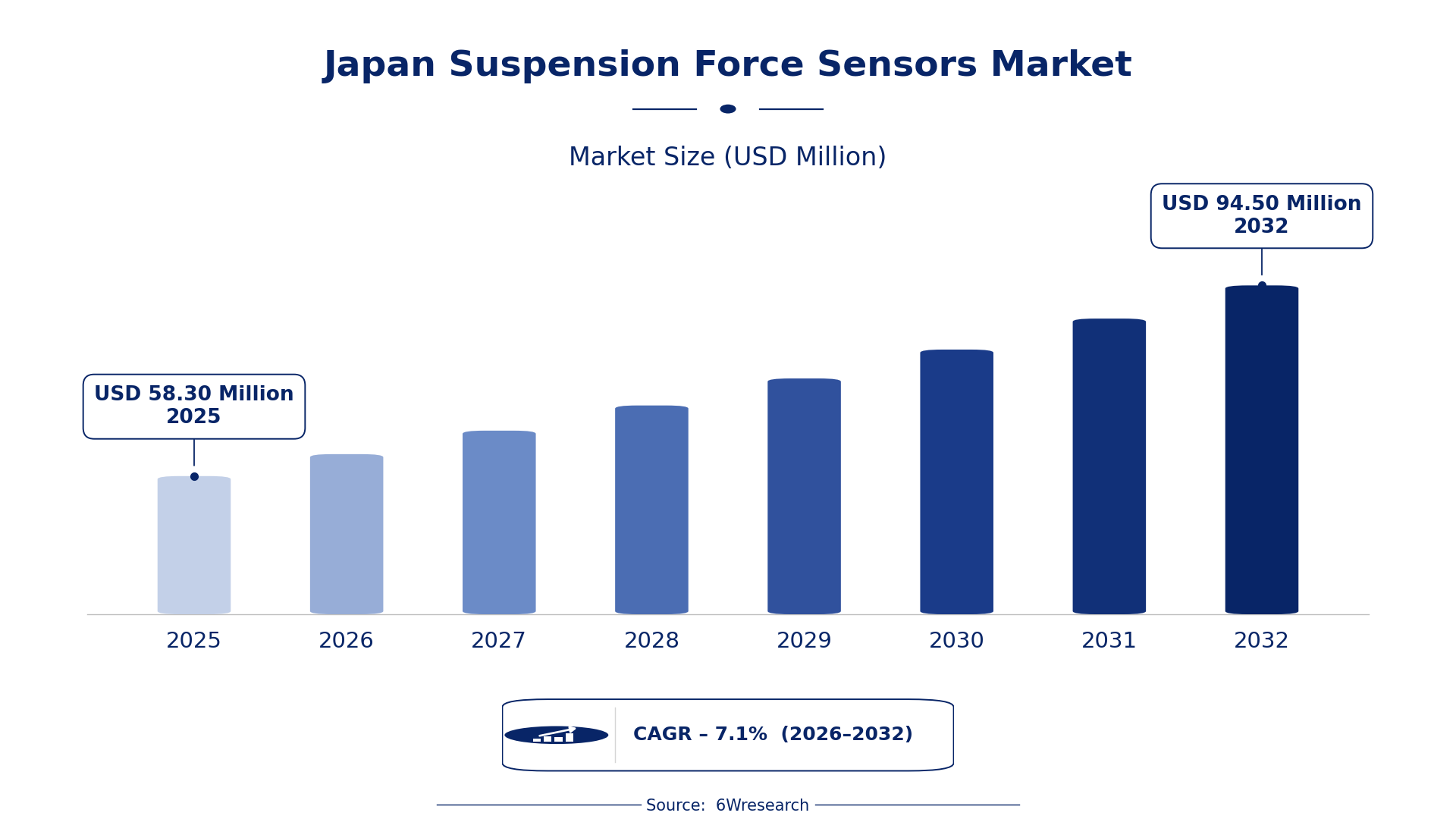
According to 6Wresearch internal database and industry insights, the Japan Suspension Force Sensors Market was valued at USD 58.30 Million in 2025 and is projected to reach USD 94.50 Million by 2032, growing at a CAGR of approximately 7.1% during 2026–2032.
Japan Suspension Force Sensors Market Highlights
| Report Metric | Details |
| Report Name | Japan Suspension Force Sensors Market (2026-2032) |
| Market Size 2025 | USD 58.30 Million |
| Market Size 2032 | USD 94.50 Million |
| Absolute Growth 2025–2032 | USD 36.20 Million |
| CAGR 2026–2032 | 7.1% |
| Peak Annual Growth | 8.1% in 2028 |
| Forecast Period | 2026–2032 |
| Historical Data | 2022–2025 |
| Base Year | 2025 |
| Leading Sensor Type, 2025 | Strain Gauge Sensors (34% share) |
| Leading Output Signal, 2025 | Digital (49% share) |
| Leading Application, 2025 | Load Detection (42% share) |
| Leading End User, 2025 | Auto OEMs (41% share) |
| Fastest-Growing Sensor Type | MEMS Sensors (10.6% CAGR) |
| Fastest-Growing Application | Adaptive Suspension (9.9% CAGR) |
| Fastest-Growing End User | EV Suspension Developers (9.5% CAGR) |
| Growing Sector | automotive |
| Key End Users | Auto OEMs, Motorsports Teams, Luxury Vehicle Manufacturers, EV Suspension Developers |
Japan Suspension Force Sensors Market Year-wise Growth Rate and Key Drivers (2022–2032)
This graph illustrates the annual growth rates of the market from 2022 to 2032, highlighting a steady upward trajectory and projected market expansion over the forecast period.
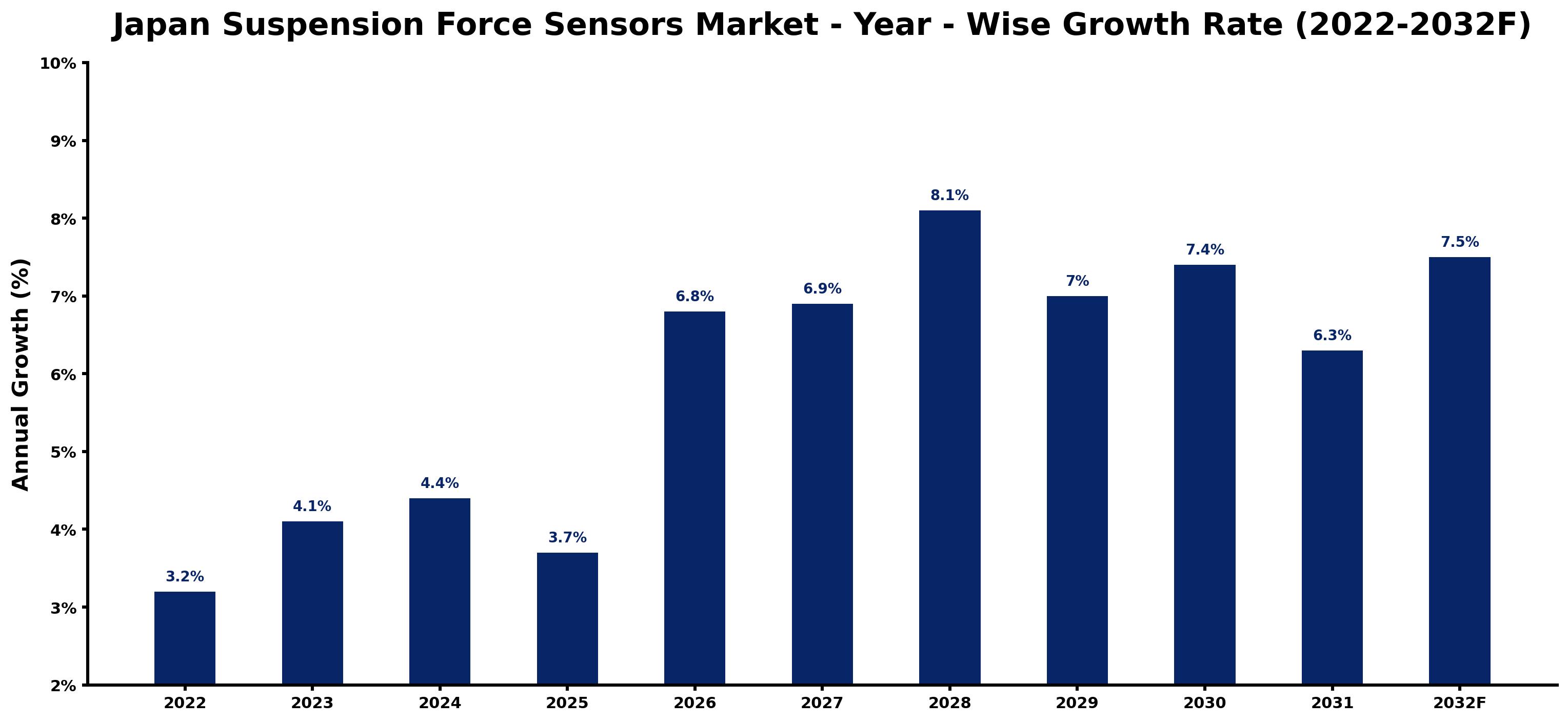
The table below sets out the estimated growth rate for each year and the main factor behind it.
| Year | Estimated Annual Growth (%) | Market Rationale |
| 2022 | 3.2 | The market exhibited steady growth, reflecting ongoing demand from the automotive sector. |
| 2023 | 4.1 | Demand increased as automotive manufacturers focused on improving vehicle performance and safety features. |
| 2024 | 4.4 | The rise in production of new vehicles contributed to a stronger market performance this year. |
| 2025 | 3.7 | Growth slowed slightly due to market saturation and increased competition among manufacturers. |
| 2026 | 6.8 | The introduction of advanced suspension technologies is projected to spur renewed interest in sensor applications. |
| 2027 | 6.9 | Market growth will continue as electric vehicle production gains momentum in the automotive sector. |
| 2028 | 8.1 | The peak growth year will be driven by investments in automotive innovation and technology. |
| 2029 | 7.0 | Growth will moderate as the market adjusts to previous high levels of demand and production. |
| 2030 | 7.4 | The market is projected to rebound with increased focus on adaptive suspension systems in luxury vehicles. |
| 2031 | 6.3 | A slowdown will occur as manufacturers face challenges in supply chain management and production capacity. |
| 2032 | 7.5 | The market is expected to grow as demand for EV suspension solutions continues to rise. |
Note: Market size estimations and growth projections presented in this report are based on 6Wresearch's proprietary forecasting methodology, utilizing the latest available industry data, government publications, and primary research inputs.
Japan Suspension Force Sensors Market Synopsis
Suspension force sensors measure the force on a vehicle's suspension system, utilising technologies such as strain gauge and piezoelectric. The Japan Suspension Force Sensors Market is growing due to rising vehicle production, increased electric vehicle adoption, and advancements in suspension technology. In 2022, the automotive sector produced over 8 million vehicles, driving demand for these sensors. The Tokyo region serves as a hub for automotive innovation, stimulating investment and demand for suspension force sensors.
Market Dynamics Impact Analysis (2026–2032)
| Factor | Type | Impact | Primary Segment Affected |
| Increasing vehicle production in Japan | Driver | High | Strain Gauge Sensors |
| Growing adoption of electric vehicles | Driver | High | Adaptive Suspension |
| Emerging demand for advanced suspension systems | Opportunity | High | MEMS Sensors |
| Rising focus on vehicle safety features | Opportunity | High | Load Detection |
| Market saturation in conventional sensor types | Restraint | Medium | Analog |
| Supply chain disruptions affecting production | Restraint | High | Digital |
| Intense competition among manufacturers | Challenge | High | Auto OEMs |
| Technological advancements requiring continuous investment | Challenge | Medium | Luxury Vehicle Manufacturers |
Evaluation of Drivers in Japan Suspension Force Sensors Market (2026–2032)
The table below links each growth driver to the segment it affects and the evidence for it.
| Drivers | Primary Segment Affected | Why It Matters (Evidence) |
| Rising vehicle production rates | Strain Gauge Sensors | Japan's automotive sector produced over 8 million vehicles in 2022, increasing demand for precise force measurement. |
| Increased adoption of electric vehicles | Load Detection | In 2023, a program was launched to enhance vehicle safety features, increasing the need for advanced sensors. |
| Technological advancements in suspension systems | MEMS Sensors | The use of adaptive suspension systems rose by 30% in 2023, boosting demand for advanced sensors. |
| Focus on improving vehicle safety features | Load Detection | In 2023, a program was launched to enhance vehicle safety features, increasing the need for advanced sensors. |
| Growing motorsports culture in Japan | Piezoelectric Sensors | Japan's strong motorsports culture, with numerous events, increases demand for dynamic load measurements. |
Several shifts outside the market lift sales. The automotive sector's production of over 8 million vehicles in 2022 has led to heightened demand for precise force measurement technologies. The rising adoption of electric vehicles is projected to increase demand for adaptive suspension systems, with a notable 30% rise in usage. Japan's motorsports culture fuels demand for piezoelectric sensors, essential for dynamic load measurements in competitive environments.
Evaluation of Restraints in Japan Suspension Force Sensors Market
The following restraints limit how fast demand can grow.
| Market Restraint | Primary Segment Affected | Why It Matters (Evidence) |
| Market saturation in conventional sensor types | Analog | With over 70% of new vehicles using strain gauge sensors, demand for analog types is declining, affecting market growth. |
| Supply chain disruptions affecting production | Digital | Japan's automotive sector faces supply chain challenges, impacting the timely production and availability of digital sensors. |
| Intense competition among manufacturers | Auto OEMs | Numerous manufacturers in Japan lead to price competition, squeezing margins for suppliers of suspension sensors. |
| Technological advancements requiring continuous investment | Luxury Vehicle Manufacturers | Manufacturers must invest in new technologies to remain competitive, delaying product development and market entry. |
| Limited applications for MEMS sensors | MEMS Sensors | As an emerging technology, MEMS sensors currently have limited applications in suspension systems, restricting market penetration. |
Japan Suspension Force Sensors Market Challenges
Producers of suspension force sensors encounter a skills shortage, as fewer engineers specialise in sensor technology, which can delay product development timelines by up to six months. Regulatory compliance presents another challenge; the ISO 26262 standard for functional safety in automotive electronics necessitates extensive testing, increasing project costs by approximately 20% for manufacturers. Rising production costs, driven by Japan's minimum wage increase to JPY 1,055 per hour, squeeze profit margins for suppliers, compelling them to raise prices for buyers. Buyers in the automotive sector face heightened demand for advanced features, potentially delaying vehicle launches by several weeks.
Trends in the Japan Suspension Force Sensors Market
Several trends are reshaping the Japan Suspension Force Sensors Market; the most important are set out below.
- Shift towards Advanced Suspension Systems: A recent programme promotes advanced vehicle safety features, resulting in a 30% increase in adaptive suspension systems. This trend encourages manufacturers to invest in sensor technology for improved performance.
- Transition from Analog to Digital Sensors: Auto OEMs are increasingly adopting digital sensors, holding a 49% market share in 2025. This shift reflects the growing need for better data processing capabilities in modern vehicles.
- Emergence of MEMS Technology in Suspension: MEMS sensors are gaining traction in the automotive sector, with a projected CAGR of 10.6% from 2026 to 2032. This growth indicates a shift towards more compact and efficient sensor solutions.
- Focus on Load Detection Innovations: Load detection applications are becoming essential in vehicle performance assessment, with a 42% market share in 2025. This trend highlights the importance of precise measurements in automotive engineering.
Investment Opportunities in the Japan Suspension Force Sensors Market
The following opportunities in the Japan Suspension Force Sensors Market pair current demand with a clear way in.
- Tokyo Region as an Automotive Innovation Hub: The Tokyo region is a hub for automotive innovation, with substantial investment in sensor technology. This environment presents opportunities for suppliers to collaborate with local manufacturers to meet growing needs.
- Growing Demand from Auto OEMs: With over 8 million vehicles produced in Japan in 2022, auto OEMs are seeking advanced suspension solutions. Suppliers can enter this market through partnerships or joint ventures with local manufacturers.
- Investment in EV Suspension Development: The automotive market is projected to expand with rising EV adoption, necessitating advanced suspension systems. Suppliers can focus on developing solutions for EV suspension developers to capture this emerging market.
- Rising Interest in Motorsports Applications: Japan's strong motorsports culture creates opportunities for suppliers of precision sensors. By targeting motorsports teams, suppliers can meet the demand for high-performance suspension solutions.
Government Initiatives in the Japan Suspension Force Sensors Market
The Economic Security Promotion Act (2022) supports supply-chain resilience for critical products, ensuring stability in suspension force sensor production. This act complements the Industrial Standardization Act (1949), which governs product standards, ensuring quality and safety in sensor manufacturing.
In 2023, a programme was launched with a budget of JPY 10 billion to improve vehicle safety features. The Consumer Affairs Agency oversees compliance with regulations, ensuring that consumers receive accurate information about suspension sensors.
Future Insight of the Japan Suspension Force Sensors Market
Buyers will experience a transformation in the suspension force sensor market by 2032, as the Ministry of Land, Infrastructure, Transport and Tourism's vehicle safety programme drives the adoption of advanced systems. The Tokyo region will solidify its position as a hub for automotive innovation, fostering new applications in sensor use. As electric vehicles gain traction, the demand for sophisticated suspension systems will rise, influencing the automotive sector's direction. The Japan Automobile Manufacturers Association's promotion of sensor technology standards will streamline development, enhancing efficiency for both buyers and suppliers.
Market Segmentation Analysis
Japan Suspension Force Sensors Market report covers a detailed analysis of the following market segments:
By Sensor Type – Strain Gauge Sensors Lead, MEMS Sensors Expected to Grow Fastest
According to Saurav Kr Singh, Senior Research Analyst at 6Wresearch, in 2025, Strain Gauge Sensors led the sensor type split with a 34% share. Strain gauge sensors hold the largest share due to their widespread application in over 70% of new vehicles in Japan, ensuring precise force measurement for suspension systems. Their established reliability and proven performance make them the preferred choice among automotive manufacturers. The quickest growth will come from MEMS Sensors, forecast to expand at a CAGR of 10.6% between 2026 and 2032. The rapid growth of MEMS sensors is attributed to their increasing recognition for advanced applications, with automotive innovators showing heightened interest in their capabilities. This trend is further propelled by the industry's shift towards more compact and efficient technologies in vehicle designs. Suppliers should focus on advancing MEMS technology to seize emerging opportunities in the automotive sector.
By Output Signal – Digital Leads and Records the Fastest Growth
Digital accounted for 49% of the market by output signal in 2025. Digital output signals are preferred for their ability to provide precise data processing, which is crucial in contemporary automotive systems. This preference stems from the increasing demand for accurate and timely data analysis in vehicle functionalities. Digital is also forecast to expand faster than any other category, at a CAGR of 9.4% over 2026–2032. The digital signal segment is also experiencing rapid growth due to the heightened need for advanced data integration in automotive technologies. As vehicles become more interconnected, the reliance on digital outputs will likely continue to rise. Suppliers should focus on developing digital signal technologies to meet the future demands of the automotive market.
By Application – Load Detection Leads, Adaptive Suspension Expected to Grow Fastest
With 42% of application revenue in 2025, Load Detection was the largest category. Load detection is essential for evaluating vehicle load and performance, making it the leading application for suspension force sensors in Japan's automotive industry. This application is critical for maintaining vehicle safety and efficiency in a market that produced over 8 million vehicles in 2022. Adaptive Suspension is set to record the highest CAGR in this split, 9.9% over 2026–2032. Adaptive suspension systems are increasingly being adopted, particularly in modern vehicles, to improve ride comfort and overall performance. The 30% increase in their use within luxury vehicles in 2023 highlights this trend. Suppliers need to invest in adaptive suspension solutions to keep pace with the market's shift towards enhanced vehicle performance.
By End User – Auto OEMs Lead, EV Suspension Developers Expected to Grow Fastest
Auto OEMs took 41% of end user revenue in 2025, more than any other category. Auto OEMs are the primary users of suspension force sensors, incorporating these technologies into vehicle production to meet safety and performance standards. Their dominant presence in the market ensures a consistent demand for these sensors. Over 2026–2032, EV Suspension Developers are expected to post the fastest growth, at a CAGR of 9.5%. EV suspension developers are the fastest-growing end users, concentrating on optimising suspension systems specifically for electric vehicles. The transition towards electric mobility is propelling this segment's rapid growth, indicating a shift in market focus. Suppliers must tailor their offerings to address the specific requirements of EV suspension developers to capitalise on this growth.
Key Attractiveness of the Report
- 10 Years of Market Numbers
- Historical Data Starting from 2022 to 2025
- Base Year 2025
- Forecast Data until 2032
- Key Performance Indicators Impacting the Market
- Major Upcoming Developments and Projects
Key Highlights of the Report:
- Japan Suspension Force Sensors Market Outlook
- Market Size of Japan Suspension Force Sensors Market, 2025
- Forecast of Japan Suspension Force Sensors Market, 2032
- Historical Data and Forecast of Japan Suspension Force Sensors Revenues & Volume for the Period 2022-2032F
- Japan Suspension Force Sensors Market Trend Evolution
- Japan Suspension Force Sensors Market Drivers and Challenges
- Japan Suspension Force Sensors Price Trends
- Japan Suspension Force Sensors Porter's Five Forces
- Japan Suspension Force Sensors Industry Life Cycle
- Historical Data and Forecast of Japan Suspension Force Sensors Market Revenues & Volume By Sensor Type for the Period 2022-2032F
- Historical Data and Forecast of Japan Suspension Force Sensors Market Revenues & Volume By Strain Gauge Sensors for the Period 2022-2032F
- Historical Data and Forecast of Japan Suspension Force Sensors Market Revenues & Volume By Piezoelectric Sensors for the Period 2022-2032F
- Historical Data and Forecast of Japan Suspension Force Sensors Market Revenues & Volume By Capacitive Sensors for the Period 2022-2032F
- Historical Data and Forecast of Japan Suspension Force Sensors Market Revenues & Volume By MEMS Sensors for the Period 2022-2032F
- Historical Data and Forecast of Japan Suspension Force Sensors Market Revenues & Volume By Output Signal for the Period 2022-2032F
- Historical Data and Forecast of Japan Suspension Force Sensors Market Revenues & Volume By Analog for the Period 2022-2032F
- Historical Data and Forecast of Japan Suspension Force Sensors Market Revenues & Volume By Digital for the Period 2022-2032F
- Historical Data and Forecast of Japan Suspension Force Sensors Market Revenues & Volume By Voltage-Based for the Period 2022-2032F
- Historical Data and Forecast of Japan Suspension Force Sensors Market Revenues & Volume By Compact Format for the Period 2022-2032F
- Historical Data and Forecast of Japan Suspension Force Sensors Market Revenues & Volume By Application for the Period 2022-2032F
- Historical Data and Forecast of Japan Suspension Force Sensors Market Revenues & Volume By Load Detection for the Period 2022-2032F
- Historical Data and Forecast of Japan Suspension Force Sensors Market Revenues & Volume By Suspension Tuning for the Period 2022-2032F
- Historical Data and Forecast of Japan Suspension Force Sensors Market Revenues & Volume By Adaptive Suspension for the Period 2022-2032F
- Historical Data and Forecast of Japan Suspension Force Sensors Market Revenues & Volume By Ride Optimization for the Period 2022-2032F
- Historical Data and Forecast of Japan Suspension Force Sensors Market Revenues & Volume By End User for the Period 2022-2032F
- Historical Data and Forecast of Japan Suspension Force Sensors Market Revenues & Volume By Auto OEMs for the Period 2022-2032F
- Historical Data and Forecast of Japan Suspension Force Sensors Market Revenues & Volume By Motorsports Teams for the Period 2022-2032F
- Historical Data and Forecast of Japan Suspension Force Sensors Market Revenues & Volume By Luxury Vehicle Manufacturers for the Period 2022-2032F
- Historical Data and Forecast of Japan Suspension Force Sensors Market Revenues & Volume By EV Suspension Developers for the Period 2022-2032F
- Japan Suspension Force Sensors Import Export Trade Statistics
- Market Opportunity Assessment By Sensor Type
- Market Opportunity Assessment By Output Signal
- Market Opportunity Assessment By Application
- Market Opportunity Assessment By End User
- Japan Suspension Force Sensors Top Companies Market Share
- Japan Suspension Force Sensors Competitive Benchmarking By Technical and Operational Parameters
- Japan Suspension Force Sensors Company Profiles
- Japan Suspension Force Sensors Key Strategic Recommendations
Market Covered
The report covers the following segments.
By Sensor Type
- Strain Gauge Sensors
- Piezoelectric Sensors
- Capacitive Sensors
- MEMS Sensors
By Output Signal
- Analog
- Digital
- Voltage-Based
- Compact Format
By Application
- Load Detection
- Suspension Tuning
- Adaptive Suspension
- Ride Optimization
By End User
- Auto OEMs
- Motorsports Teams
- Luxury Vehicle Manufacturers
- EV Suspension Developers































